

If you want to speak your mind and finally tell someone what you think then say your peace or say your piece can be a surprisingly tricky choice. Both phrases sound exactly alike when spoken. Only one word changes in writing. Yet that small spelling difference completely changes the meaning.
The correct phrase for expressing your thoughts is say your piece.
Here piece means a portion or part of something. In the expression say your piece it refers to your share of the conversation. You get your chance to speak and express your opinion.
Say your peace is usually a mistaken version of the phrase. The confusion comes from the word peace because peace relates to calmness and harmony. It sounds like it could fit the idea of speaking calmly or settling an argument. English has other expressions involving peace so the mistaken version can feel logical.
This guide explains the difference between say your peace or say your piece in plain English. You’ll learn the correct spelling, meaning, pronunciation, grammar, origin, examples, common mistakes, memory tricks, and the situations where native speakers use the expression naturally.
Need another quick comparison? Read Fact Or Fiction Meaning And How To Use It.
Quick Answer
The correct phrase is say your piece when you mean to express your opinion or speak your mind. Piece refers to your part of the conversation. Peace means calmness or the absence of conflict and doesn’t normally belong in this expression. Since both words sound alike they are easy to confuse in speech.
Say Your Peace Or Say Your Piece Comparison.
| Feature | Say Your Piece | Say Your Peace |
|---|---|---|
| Correct expression | Yes | Usually incorrect |
| Meaning | Express your opinion or thoughts | Not the standard expression |
| Key word | Piece | Peace |
| Part of speech | Noun | Noun |
| Pronunciation | Same as peace | Same as piece |
| Common context | Conversation and disagreement | Mistaken spelling |
| Formal writing | Correct | Avoid |
| Informal writing | Correct | Common error |
| Example | Go ahead and say your piece. | Go ahead and say your peace. |
The central rule is simple.
Use piece when you mean your part of a discussion.
Use peace when you mean calmness or freedom from conflict.

What Does Say Your Piece Mean
Say your piece is an idiomatic expression meaning to express your opinion or make your point. It often appears when someone has something important to say and wants the opportunity to speak without interruption.
The expression can sound neutral or slightly firm depending on the situation.
For example:
Go ahead and say your piece. I’m listening.
The speaker is giving someone permission to explain their thoughts.
Another example:
She said her piece and left the meeting.
This means she expressed her opinion before leaving.
The phrase can also suggest that someone has been waiting for an opportunity to speak.
I’ve listened to everyone else. Now I want to say my piece.
Here the speaker wants their turn to contribute.
What Does Piece Mean In Say Your Piece
The word piece has many meanings in English. It can mean a part of something that has been divided or separated.
For example:
I ate a piece of cake.
A piece is one portion of the cake.
The same basic idea appears in say your piece. Your opinion is treated like your portion of a larger discussion. Other people have their pieces to contribute and you have yours.
This figurative meaning developed naturally from the everyday meaning of piece.
Think of a conversation as something shared among several people. Each person gets a piece of the discussion.
When it’s your turn you say your piece.
What Does Peace Mean
Peace refers to a state of calmness or freedom from fighting and conflict.
For example:
The two countries finally reached a peace agreement.
Here peace means an end to conflict.
You can also use it for personal calm.
I just want some peace and quiet.
In this sentence peace refers to freedom from noise or disturbance.
Other common expressions include:
- Peace and quiet.
- World peace.
- Keep the peace.
- Make peace.
- Rest in peace.
- Peace of mind.
None of these meanings gives say your peace the intended meaning of expressing an opinion.
Which One Is Correct
Say your piece is the standard expression.
Use it when someone expresses an opinion gives their side of an argument or speaks their mind.
Examples:
- You can say your piece after everyone else has finished.
- He said his piece and walked out.
- Let her say her piece before you respond.
- I need to say my piece about what happened.
- She finally got a chance to say her piece.
Say your peace is generally considered a mistake when used with this meaning.
The word peace is not completely unrelated in a logical sense. Someone might talk about peace during a disagreement. But the established idiom is say your piece.
That’s an important distinction.
English contains many expressions whose meanings can’t be guessed simply by combining the meanings of their individual words. Idioms develop through long usage and become fixed expressions. Say your piece is one of them.
Why People Confuse Say Your Peace And Say Your Piece
The confusion has a very obvious cause.
The words peace and piece are homophones. They have the same pronunciation but different spellings and meanings.
When someone says:
You should say your piece.
You hear the sound of peace and piece in exactly the same way.
Nothing in the pronunciation tells you which spelling belongs on the page.
The Words Sound Identical
In standard American English both words are commonly pronounced /piːs/.
That means these sentences sound alike:
I need to say my piece.
I need to say my peace.
Only the written meaning reveals the difference.
The Meanings Feel Close In An Argument
People often connect speaking with resolving conflict.
Someone may say:
Let’s talk about it and make peace.
Another person may say:
I need to say my piece.
Because both ideas can appear during an argument people sometimes blend the expressions together.
The meanings still remain different.
The Spelling Is Easy To Forget
The letters in piece and peace are close enough to cause mistakes.
People who know the phrase perfectly well can still type the wrong word when writing quickly.
Autocorrect can also make the situation worse because both words are legitimate English words. A spelling checker may not flag peace as an error if the sentence is grammatically possible.
Say Your Piece And Say Your Peace Are Homophones
A homophone is a word that sounds like another word but has a different spelling and meaning.
Common examples include:
- Right and write.
- Here and hear.
- Their and there.
- Sea and see.
- Break and brake.
- Peace and piece.
Because peace and piece are homophones you can’t solve this problem through pronunciation alone.
You need to remember the meaning.
That makes this pair a classic vocabulary and spelling trap.
The Difference Between Piece And Peace
The easiest way to understand the phrase is to separate the two nouns.
Piece Means A Part
A piece is a part or portion of something.
Examples:
I want another piece of pizza.
She gave me a piece of advice.
He took a piece of paper from the desk.
The word can also describe a portion of an argument or conversation in a figurative way.
That is the meaning behind say your piece.
Peace Means Calm Or Harmony
Peace refers to a state without fighting conflict or disturbance.
Examples:
The family finally made peace.
Everyone deserves peace and safety.
I need some peace and quiet.
The treaty brought peace to the region.
The word has nothing to do with your portion of a conversation.
A Simple Way To Remember The Correct Phrase
Think of piece as your piece of the conversation.
Imagine several people sitting around a table. Each person has something to contribute. Your opinion is your piece.
So you say your piece.
You can also remember this sentence:
Your opinion is your piece of the conversation.
That single connection is enough for most writers.
Grammar Of Say Your Piece
The phrase follows a straightforward grammatical pattern.
Say is the verb.
Your is the possessive determiner.
Piece is the noun.
The basic structure is:
say + possessive determiner + piece
You can change the possessive word depending on the subject.
Say My Piece
I need to say my piece.
The speaker refers to their own opinion.
Say Your Piece
Go ahead and say your piece.
The speaker refers to the listener’s opinion.
Say His Piece
He said his piece before leaving.
The opinion belongs to a male person.
Say Her Piece
She had a chance to say her piece.
The opinion belongs to a female person.
Say Their Piece
They both said their piece.
The opinions belong to multiple people.
The noun piece stays singular because the expression treats each person’s contribution as one figurative piece.
Is Say Your Piece An Idiom
Yes.
Say your piece functions as an idiomatic expression. Its meaning goes beyond the literal idea of saying a physical object called a piece.
You don’t actually speak a piece of something.
Instead the expression means to give your opinion or state your position.
Similar expressions include:
- Speak your mind.
- Give your opinion.
- Have your say.
- State your case.
- Make your point.
- Give your side of the story.
These expressions overlap in meaning but carry slightly different tones.
Say Your Piece Vs Speak Your Mind
Say your piece and speak your mind are close in meaning.
Both can mean expressing your honest opinion.
Compare these sentences:
She finally said her piece.
She finally spoke her mind.
Both suggest that she expressed what she really thought.
There is a small difference in tone.
Say your piece often focuses on getting your turn to speak or presenting your side.
Speak your mind often emphasizes honesty and directness.
For example:
Go ahead and say your piece.
This sounds like someone is being given an opportunity to speak.
Don’t be afraid to speak your mind.
This encourages someone to express their honest thoughts.
Say Your Piece Vs Have Your Say
These expressions also overlap.
Have your say means to get an opportunity to express your opinion.
Say your piece means to express your opinion or make your point.
For example:
Everyone should have their say before we make a decision.
This emphasizes fairness and participation.
Once I say my piece I’m done discussing it.
This emphasizes the speaker’s own contribution.
Say Your Piece Vs State Your Case
State your case has a stronger connection to an argument or defense.
Someone might state their case when they need to explain why they believe something or defend a position.
The employee was allowed to state her case before the decision was made.
Say your piece sounds more conversational.
Let me say my piece before you make a decision.
Both are correct but the tone differs.
Say Your Piece In Different Situations
The expression works in many everyday contexts.
During An Argument
Just let me say my piece before you walk away.
The speaker wants to explain their side.
During A Family Discussion
Everyone had a chance to say their piece.
The family members each expressed their opinions.
During A Workplace Meeting
I’d like to say my piece before we finalize the plan.
The speaker wants to contribute before the decision is made.
During A Debate
Each candidate was given time to say their piece.
Each person had an opportunity to present their views.
During A Personal Disagreement
I know you’re upset but I’d like to say my piece.
The phrase can soften a request for an opportunity to speak.
Real Life Examples Of Say Your Piece
The expression is most useful when you see it in natural sentences.
Daily Conversation
- Let me say my piece before you decide.
- She said her piece and then left.
- Go ahead and say your piece.
- I just want five minutes to say my piece.
- He finally got to say his piece.
- Everyone deserves a chance to say their piece.
Workplace Writing
- I’d like to say my piece before we move on to the next topic.
- Each team member had an opportunity to say their piece.
- She said her piece during the meeting and offered a practical solution.
- Give him a chance to say his piece before making a final decision.
Emails And Messages
- I know we don’t agree but I’d still like to say my piece.
- Before we close this discussion I want to say my piece.
- You’ve shared your concerns and now I’d like to say my piece.
Academic And Formal Contexts
- The participants were given an opportunity to say their piece before the committee reached its conclusion.
- Each member was encouraged to say their piece during the discussion.
In highly formal academic writing however phrases such as state their position or present their argument may sound more precise.
Journalism
- The article gave residents a chance to say their piece about the proposed changes.
- Several community leaders said their piece before the vote.
Social Media
- I’ve stayed quiet long enough. Time to say my piece.
- Everyone has said their piece and now we can move on.
- She said her piece without attacking anyone.
The expression works especially well in social media because people often use it to introduce an opinion or final comment.
Internal Link Opportunity
A useful internal article after this section would be Peace Vs Piece Difference Explained. It naturally helps readers who want to understand the two homophones beyond this particular idiom.

Why Say Your Piece Sounds Natural To Native Speakers
Native speakers tend to use say your piece when someone wants to express a view after disagreement or discussion.
The phrase can sound calm:
Go ahead and say your piece. I’m listening.
It can sound firm:
I’ve heard your side. Now let me say my piece.
It can also sound slightly dismissive depending on tone:
Fine. Say your piece.
This shows an important point about idioms. Meaning doesn’t come only from the dictionary definition. Tone and context also shape how people understand an expression.
A professional editor looks at all three.
Grammar tells you the phrase is correct.
Meaning tells you what it expresses.
Context tells you how it sounds.
That combination matters when you’re trying to write natural English.
The Spelling Difference Between Peace And Piece.
The difference between peace and piece is only one letter. Their meanings are much farther apart.
Piece usually refers to a part of something. Peace refers to calmness or freedom from conflict.
That small spelling difference matters because English uses both words in many common expressions.
Piece Means A Part.
The noun piece can describe a physical part.
I broke a piece of the cookie.
It can also describe a portion of something abstract.
She gave me a piece of advice.
In say your piece the word has a figurative meaning. Your opinion becomes your part of the discussion.
Peace Means Calmness.
The noun peace describes a state of calm or harmony.
The children finally gave their parents some peace.
It can also describe an absence of war.
The leaders worked together to protect the peace.
Because peace has this meaning it can feel tempting in a disagreement. Someone might think that say your peace means saying something that will bring peace.
The established expression still uses piece.
Say Your Piece In Formal And Informal Writing.
The phrase is correct in both spoken and written English. Its tone depends on the context.
In casual conversation it sounds completely natural.
Let me say my piece.
In a workplace discussion it can also work.
The researcher presented her position.
The committee members stated their views.
This doesn’t make say your piece incorrect. It simply reflects a difference in register.
Good writing isn’t about avoiding everyday expressions. It’s about choosing language that fits the audience and purpose.
Is Say Your Piece Rude
Not necessarily.
The expression itself isn’t rude. The tone surrounding it determines how it feels.
Compare these examples.
Please let me say my piece. I want to explain what happened.
This sounds reasonable and calm.
Fine. Say your piece.
This can sound impatient or dismissive.
I’d like to say my piece before we make a decision.
This sounds firm but professional.
The phrase can therefore express frustration without automatically being aggressive.
Can You Say Say Your Peace
If you mean express your opinion then say your peace is not the standard form of the idiom.
A reader will usually understand what you mean because peace and piece sound identical. Still the spelling is considered incorrect for this expression.
There is an important difference between an understandable mistake and an accepted expression.
English speakers can understand say your peace from context. That doesn’t make it the established phrase.
For polished writing use say your piece.
Say Your Piece In American English
American English uses say your piece as a familiar expression.
It appears in everyday conversations and informal writing. It can also appear in journalism and other forms of general writing when the conversational tone fits.
American speakers don’t normally use a different regional spelling for this phrase.
The same distinction between peace and piece applies in other major varieties of English.
British English And Other Varieties
British English also uses say your piece.
Canadian English and Australian English use the same standard expression as well.
There is no major regional spelling difference here.
That matters because some confused word pairs really do change across regions. For example American and British English sometimes differ in spelling such as color and colour.
Peace and piece don’t work that way.
The correct word in this idiom remains piece across standard varieties of English.
Need another quick comparison? Read Time Flies Or Time Flys Which Is Correct 2026.
The History Of Say Your Piece
The expression connects to the older idea of having a piece or share in a discussion.
The word piece has a long history in English. It came into English through Old French from Latin and developed several related meanings involving a part or portion.
Over time English speakers extended the idea of a physical portion to abstract things.
We still use this pattern today.
A piece of advice.
A piece of information.
A piece of evidence.
A piece of writing.
A piece of news.
In the same way a person’s contribution to a discussion can be treated as their piece.
The expression became established as a way to describe giving someone an opportunity to express their view.
The exact historical path of an idiom can be difficult to pin to one moment. Idioms usually develop through repeated use rather than appearing fully formed on a particular date. What matters for modern writers is that say your piece is the established expression.
Why The Idiom Uses Piece
The figurative meaning becomes easier when you think about a conversation as something shared.
Imagine a group discussing a difficult decision.
One person gives an opinion.
Another person responds.
A third person adds another point.
Each person contributes a portion of the overall discussion.
That contribution is metaphorically a piece.
So when someone says:
I’d like to say my piece.
they’re saying:
I’d like to give my part of the discussion.
This is why piece fits the expression better than peace.
Common Mistakes With Say Your Piece
Understanding the usual mistakes can help you avoid them in your own writing.
Mistake One
I need to say my peace.
Correct:
I need to say my piece.
The speaker wants to express an opinion.
Mistake Two
Let her say her peace before we decide.
Correct:
Let her say her piece before we decide.
She needs an opportunity to express her view.
Mistake Three
Everyone should say their peace.
Correct:
Everyone should say their piece.
Each person is being given an opportunity to contribute to the discussion.
Mistake Four
He finally said his peace.
Correct:
He finally said his piece.
He finally expressed his opinion.
Mistake Five
Assuming that peace is correct because the conversation involves an argument.
The topic of the conversation doesn’t determine the spelling. The meaning of the expression does.
If someone wants to express an opinion then use piece.
If someone wants calm or harmony then use peace.
Say Your Piece Vs Make Your Point
These expressions are similar but not identical.
Say your piece focuses on expressing your thoughts or giving your side.
Make your point focuses on communicating a particular idea clearly.
Compare them.
I want to say my piece before I leave.
The speaker wants to express their overall view.
I want to make my point before we move on.
The speaker wants to emphasize a specific argument.
Both expressions are natural. The best choice depends on the intended meaning.
Say Your Piece Vs Speak Up
Speak up means to speak louder or to express an opinion instead of staying silent.
For example:
If you disagree with the decision you should speak up.
The expression doesn’t necessarily suggest a long explanation.
Say your piece usually implies that someone has a particular opinion or side they want to express.
I’ve been quiet all morning but now I need to say my piece.
The speaker has something specific to communicate.
Say Your Piece Vs Give Your Two Cents
Give your two cents is an informal expression meaning to offer your opinion.
I’ll give you my two cents about the situation.
It often sounds light or slightly humorous.
Say your piece can sound more serious.
I need to say my piece before we move forward.
Both expressions can introduce an opinion but they create different tones.
Say Your Piece Vs Have Your Say
Have your say emphasizes having an opportunity to participate.
Everyone should have their say.
Say your piece emphasizes the actual expression of a person’s opinion.
Everyone had a chance to say their piece.
The difference is subtle but useful.
A person can have their say even if they only make a short comment.
Someone who says their piece usually communicates a more defined position.
Say Your Piece Vs State Your Opinion
State your opinion is direct and neutral.
Please state your opinion on the proposal.
Say your piece is more conversational.
Go ahead and say your piece.
Use state your opinion in formal situations when clarity matters more than personality.
Use say your piece when a natural conversational voice fits the context.
Say Your Piece Vs Give Your Side
Give your side often appears when people disagree about what happened.
Let me give you my side of the story.
Say your piece can work in the same setting.
Let me say my piece before you judge me.
The first expression focuses on explaining your version of events. The second focuses more broadly on expressing your thoughts.
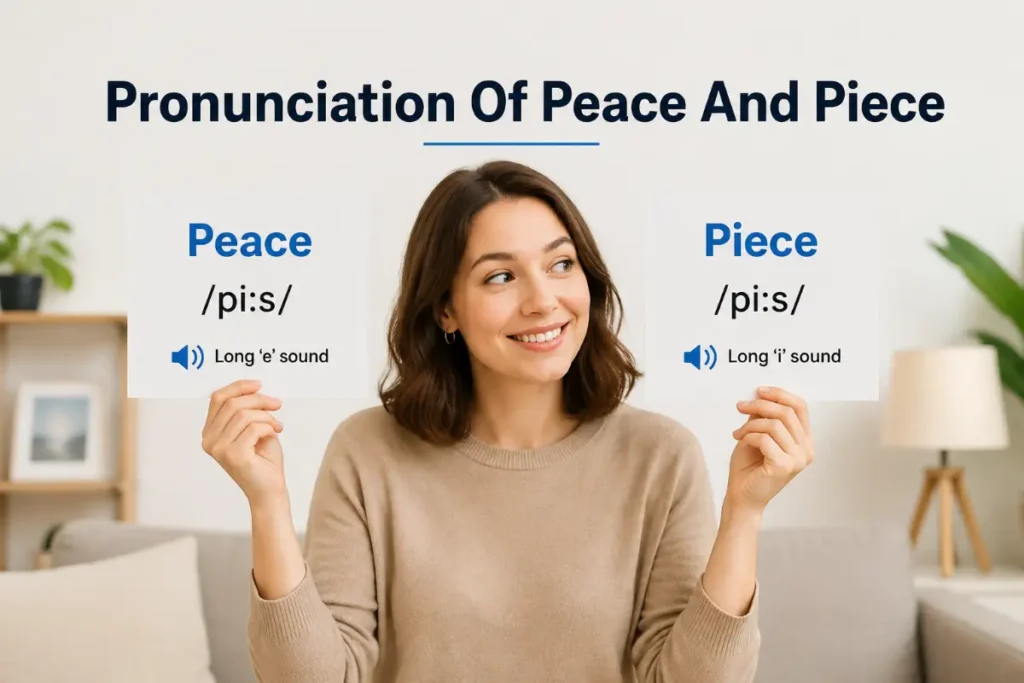
Pronunciation Of Peace And Piece
The two words are homophones.
In standard American English they are both pronounced:
/piːs/
Each word has one syllable.
The vowel sound is the long ee sound found in words such as see and tree.
Because the pronunciation is identical you cannot hear the spelling difference.
This creates an important lesson for English learners.
Listening alone isn’t always enough to identify the correct written word. Context and vocabulary knowledge also matter.
Pronunciation Of Say Your Piece
The complete phrase can be pronounced approximately as:
/seɪ jʊr piːs/
In relaxed American speech the word your may sound reduced depending on the speaker and sentence rhythm.
The key point is that piece and peace remain identical in pronunciation.
That is why learners often discover this mistake only after they begin writing.
A Useful Spelling Memory Trick
There are several ways to remember the difference.
Piece Has Ice In It
Look at the spelling:
p i e c e
The word contains ice when you focus on the final three letters.
Think:
A piece of ice is a piece.
That gives you a visual connection between piece and part.
Peace Has Ea
Think of the ea in peace as part of a calm quiet word.
You can connect it with:
peaceful
peacefully
peacefulness
All of these words relate to calm and harmony.
Your Opinion Is Your Piece
This is the strongest memory trick for the idiom.
Imagine your conversation as a puzzle.
Your opinion is one piece of the whole discussion.
So you say your piece.
When To Use Peace Instead
Knowing the correct phrase becomes easier when you know where peace actually belongs.
Use peace for calmness harmony or freedom from conflict.
Examples:
We all want peace.
The agreement restored peace.
She enjoys the peace of the countryside.
I need some peace and quiet.
They made peace after years of disagreement.
The children finally fell asleep and gave me some peace.
These sentences all use peace correctly.
When To Use Piece Instead
Use piece when you mean a part portion item or contribution.
Examples:
I want a piece of cake.
She gave me a piece of advice.
He found a piece of glass.
I read a fascinating piece of journalism.
Everyone contributed a piece of the project.
I need to say my piece.
The last example uses the figurative sense of piece.
Why Autocorrect Can Miss The Error
Spell checkers are useful but they don’t understand every idiom.
Suppose you type:
I need to say my peace.
Every individual word is spelled correctly.
A basic spelling checker may therefore accept the sentence.
The problem is semantic rather than mechanical.
The software sees a valid noun. It may not know that say your piece is the established expression you intended.
This is why careful proofreading still matters.
A good editor doesn’t only check spelling. An editor checks meaning context grammar usage and idiomatic phrasing.
Internet Myths About Say Your Peace
The internet creates many word usage myths.
One common idea is that say your peace must be correct because someone says it means expressing something that will bring peace.
That interpretation is understandable but it doesn’t reflect the established idiom.
Another common mistake is assuming that an expression becomes correct simply because many people use it online.
Frequent mistakes can spread quickly. Search results and social media posts can repeat the same error thousands of times.
Popularity isn’t the same as standard usage.
When you need the safest form for an article email essay report or professional document use say your piece.
Editorial Advice For Professional Writing
If you’re proofreading a document and see say your peace used to mean expressing an opinion then change it to say your piece.
Don’t rewrite the entire sentence unless the tone requires it.
For example:
She finally said her peace and left.
Edit it to:
She finally said her piece and left.
The correction is small but important.
If the document has a formal tone you might choose a more precise expression:
She finally stated her position and left.
Both versions work. The best choice depends on the voice of the document.
How Native Speakers Understand The Phrase
Native speakers usually recognize say your piece immediately.
They understand it as an invitation or opportunity to express an opinion.
For example:
Go ahead and say your piece.
The listener understands that they have permission to speak.
If someone writes:
Go ahead and say your peace.
Most readers will probably understand the intended meaning. Still the spelling can distract a careful reader because peace creates a different word and meaning.
That small distraction can weaken otherwise polished writing.
Practical Rule For Writers
When you mean express your opinion use:
say your piece
When you mean calmness or freedom from conflict use:
peace
Don’t let the pronunciation make the decision for you.
Use the meaning to choose the spelling.
A Quick Editor Test
When you’re unsure which word to use replace it mentally.
If the sentence still makes sense with part of the discussion then choose piece.
I need to say my part of the discussion.
That points to piece.
If the sentence relates to calmness or harmony then choose peace.
We finally achieved calm and harmony.
That points to peace.
This test works because it focuses on meaning rather than sound.
The Biggest Takeaway So Far
The difference between say your peace and say your piece isn’t a regional spelling issue or a minor preference.
It’s a difference between two completely different words.
Piece means a part or contribution.
Peace means calmness or harmony.
The idiom meaning express your opinion uses piece.
So when you want to tell someone to speak their mind or give their side of an argument the correct phrase is:
Say your piece.
Common Questions About Say Your Piece
Is Say Your Piece The Correct Phrase
Yes. Say your piece is the standard expression when you mean express your opinion or give your side of a discussion. The word piece refers to your part of the conversation. Say your peace is a common spelling mistake caused by the identical pronunciation of peace and piece.
Does Say Your Peace Ever Make Sense
It can make sense as a literal combination of words in a very unusual context. For example a writer could deliberately use say your peace as wordplay about discussing peace. But that isn’t the established idiom. In normal writing use say your piece when you mean express your opinion.
Is Say Your Piece Formal Or Informal
Say your piece is grammatically correct but has a conversational tone. It works well in everyday speech general writing journalism and dialogue. In highly formal academic or professional writing alternatives such as state your position or present your argument may sound more precise.
Why Do Piece And Peace Sound The Same
Piece and peace are homophones. Both are normally pronounced /piːs/ in American English. Their different spellings reflect their different histories and meanings. Because listeners cannot hear the spelling difference people often learn the distinction only after seeing the words in writing.
Can I Say Say My Piece
Yes. The possessive changes with the person speaking. You can say say my piece say your piece say his piece say her piece or say their piece. The noun remains piece because the expression refers to a person’s contribution to the discussion.
What Is Another Way To Say Say Your Piece
Common alternatives include speak your mind have your say state your opinion make your point and give your side. The best choice depends on context. Speak your mind emphasizes honesty. Have your say emphasizes getting an opportunity to participate. State your opinion sounds more neutral and formal.
Is Say Your Piece An Idiom
Yes. The expression has a figurative meaning. It doesn’t mean literally speaking a physical piece. It means expressing your opinion or giving your side of an issue. The expression is established in standard English and is widely understood by native speakers.
How Do I Remember Say Your Piece
Connect piece with the idea of a part. Your opinion is your piece of the conversation. If you are giving your part of a discussion then you say your piece. Save peace for calmness harmony and freedom from conflict.
Related Expressions You Should Know
Learning a few related expressions can make the distinction even easier.
Speak Your Mind
Speak your mind means to express what you honestly think.
She isn’t afraid to speak her mind.
This expression often suggests openness or directness.
Have Your Say
Have your say means to get an opportunity to express your opinion.
Everyone should have their say before we vote.
It focuses more on participation than on the content of the opinion.
Make Your Point
Make your point means to communicate an idea or argument clearly.
I understand your point but I disagree.
It often appears during debates discussions and disagreements.
State Your Position
State your position is a more formal alternative.
The organization stated its position on the proposal.
This works especially well in professional academic and official writing.
Give Your Side
Give your side usually means explain your version of events.
Let me hear your side before I decide.
It works well when people disagree about what happened.
Give Your Two Cents
Give your two cents is informal and often slightly playful.
I’ll give you my two cents if you want them.
It means offer your opinion without making the statement sound overly serious.
Common Mistakes To Avoid
A few simple habits can keep this homophone pair from causing problems.
Don’t Choose The Word By Sound
You can’t hear the difference between peace and piece.
Instead ask what the word means in the sentence.
Don’t Assume Peace Fits Every Argument
An argument may involve peace but that doesn’t make peace the right word.
The expression has its own established form.
Don’t Trust Spell Check Alone
Both words are correctly spelled. A spell checker may accept either one.
Read the sentence for meaning and idiomatic usage.
Don’t Treat Online Frequency As Proof
A mistaken phrase can appear thousands of times online and still remain nonstandard.
Use established dictionaries trusted reference works and professional editorial practice when you’re unsure.
A Practical Proofreading Checklist
Before publishing a sentence containing this expression check these points.
- Do you mean express your opinion.
- If yes use piece.
- Does the sentence refer to calmness harmony or freedom from conflict.
- If yes use peace.
- Are you writing for a formal audience.
- If yes consider state your position or present your view when they fit better.
This quick check takes only a few seconds.
Expert Editor’s Note
A professional editor would treat say your piece as the correct idiomatic form for expressing an opinion.
The key isn’t simply that piece and peace have different dictionary definitions. The stronger point is that English speakers have established say your piece as a fixed expression. Idioms work as familiar combinations and their wording shouldn’t be changed casually.
The spelling say your peace may still be understood because the two words are homophones. But understandable doesn’t automatically mean standard.
For an article email essay report or other polished writing choose say your piece.
If the tone needs to be more formal then consider state your position express your view or present your argument.
A good editor doesn’t correct words in isolation. The editor looks at the meaning of the whole sentence and chooses the expression that sounds natural for the intended audience.
Still confused? Compare Me Either Vs Me Neither Which One Is Correct 2026.
Final Thoughts On Say Your Peace Or Say Your Piece.
The correct phrase is say your piece when you mean to express your opinion speak your mind or give your side of an issue.
The word piece means a part or portion. In this idiom your opinion is treated as your part of the larger conversation.
Peace has a completely different meaning. It refers to calmness harmony or freedom from conflict.
The confusion is easy to understand because peace and piece are homophones. They sound exactly alike but their meanings and spellings differ.
The simplest memory trick is also the most useful.
Your opinion is your piece of the conversation.
So when it’s your turn to speak don’t say your peace.
Say your piece and make your voice count.

Vocabulary & Language Research Writer
Ethan Parker researches English vocabulary, word meanings, slang, idioms, and commonly confused words. His goal is to help readers understand how English is actually used in everyday conversations and writing.