
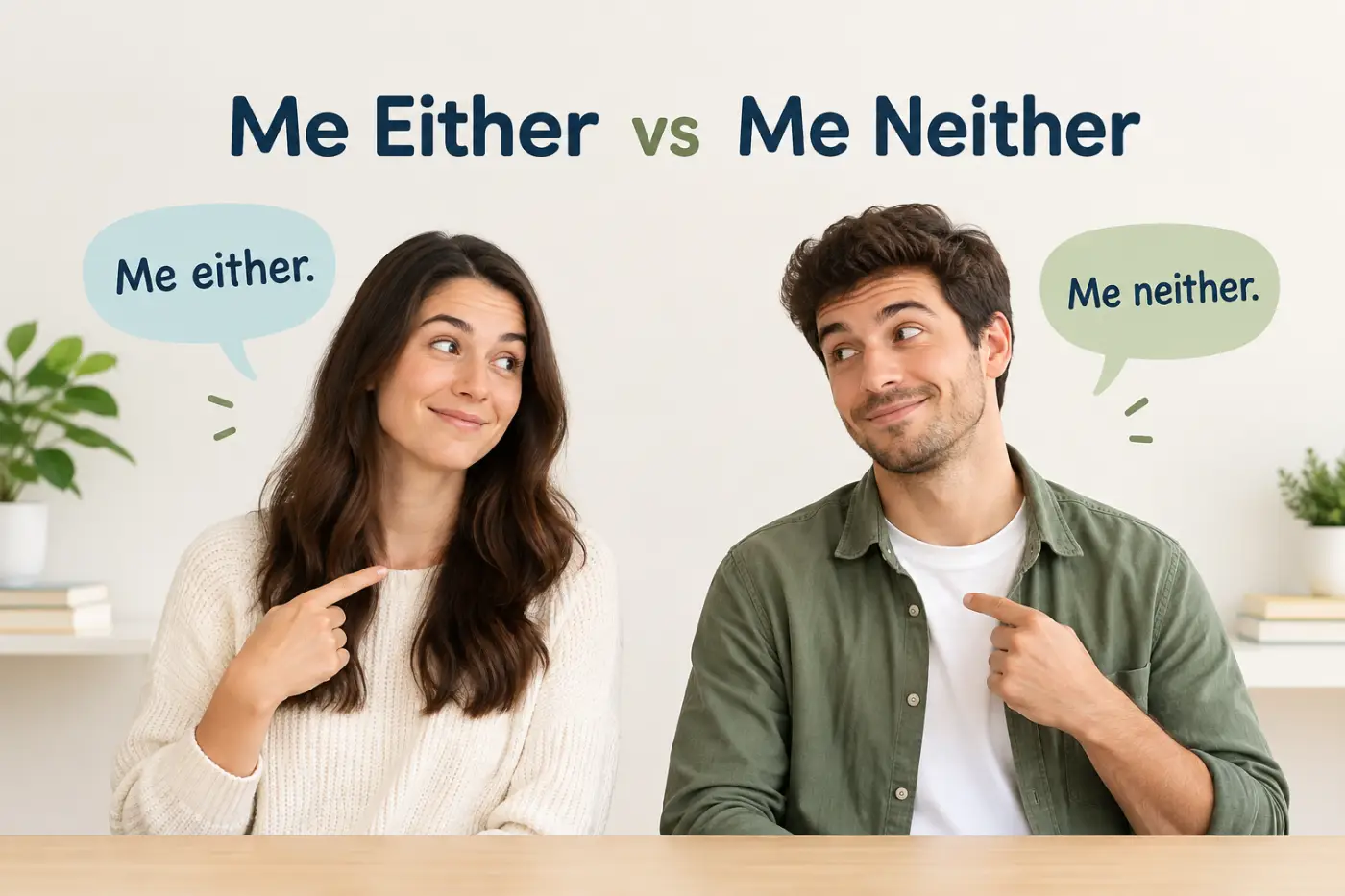
If you’ve ever hesitated between me either vs me neither in a conversation then you’re not alone. Both expressions appear after negative statements and both can sound natural in casual American English. The problem is that they don’t have the same grammatical status or the same level of acceptance.
The safest standard expression is me neither when you agree with a negative statement. For example: I don’t like coffee. Me neither. The phrase means I don’t like coffee either.
Me either is also widely heard in American English. It often appears in casual conversation as a response to a negative statement. However many teachers editors and grammar guides prefer me neither in careful standard English.
The confusion comes from the word either itself. English uses either with negative statements in several different sentence patterns. That makes it tempting to say me either when responding to someone. In real conversations Americans do use it. Still there is an important difference between what people commonly say and what formal grammar traditionally recommends.
This guide explains the difference clearly. You’ll learn how me either and me neither work in conversation and writing. You’ll also see natural examples pronunciation guidance common mistakes regional usage and practical rules that make the choice much easier.
A related grammar guide is Time Flies Or Time Flys Which Is Correct 2026.
Quick Answer
Me neither is the traditional standard response when you agree with a negative statement. Me either is common in informal American speech and means essentially the same thing in that setting. For formal writing and careful English use me neither or a complete sentence such as I don’t either.
Me Either Vs Me Neither Comparison
| Feature | Me either | Me neither |
|---|---|---|
| Basic meaning | I also do not | I also do not |
| Common use | Informal conversation | Standard conversation and writing |
| Response to a negative statement | Common in American speech | Standard and widely accepted |
| Part of speech | Informal conversational phrase | Conversational phrase |
| Formal writing | Usually avoid | Acceptable in dialogue but a complete sentence is often better |
| Example | I don’t want dessert. Me either. | I don’t want dessert. Me neither. |
| More formal alternative | I don’t want dessert either. | I don’t want dessert either. |
| Main concern | Nontraditional grammar pattern | Traditional standard pattern |
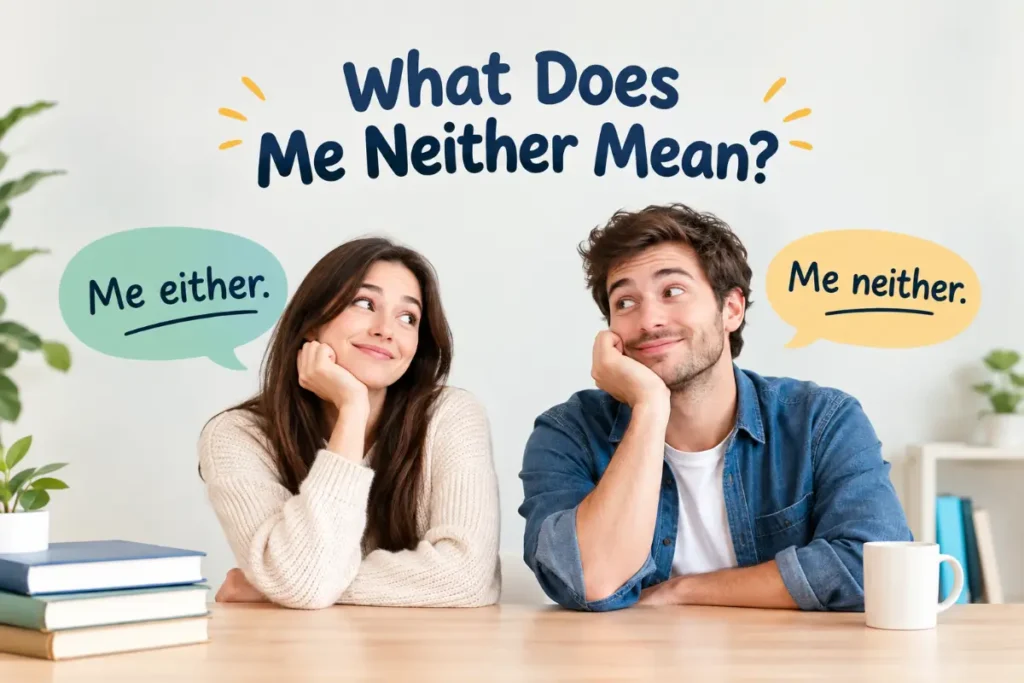
What Does Me Neither Mean
Me neither is used to agree with a negative statement.
If someone says they don’t like something and you feel the same way then you can respond with me neither.
For example:
I don’t like horror movies.
Me neither.
The complete meaning is:
I don’t like horror movies either.
The short response leaves out the repeated subject and verb because the meaning is already clear.
Why Neither Works
The word neither carries a negative meaning. It can mean not one or not either of two things depending on its grammatical role.
In the expression me neither the speaker is essentially saying:
I don’t either.
That makes the negative meaning clear without adding another negative word.
Consider this exchange:
I haven’t seen that movie.
Me neither.
The second speaker means:
I haven’t seen that movie either.
This pattern is common and easy to understand.
What Does Me Either Mean
Me either is an informal conversational expression used mainly in American English to agree with a negative statement.
For example:
I don’t eat seafood.
Me either.
The intended meaning is clear:
I don’t eat seafood either.
You will hear this construction in everyday American conversations. It can also appear in text messages social media posts and informal dialogue.
However me either has a different status from me neither in traditional standard grammar. Many editors and English teachers consider me neither the better choice when you want a conventional grammatical response.
That doesn’t mean people who say me either are impossible to understand. Quite the opposite. The expression is familiar to many native speakers.
The key point is register.
Me either belongs strongly to casual spoken English.
Me neither works more comfortably across casual and careful contexts.
Which One Is Correct
If you’re asking which expression you should use as an English learner the best answer is me neither.
Use me neither when agreeing with a negative statement.
Example:
I don’t like spicy food.
Me neither.
You can also use a complete sentence with either.
I don’t like spicy food either.
This second version is especially useful in formal or professional writing.
Is Me Either Wrong
Calling me either simply wrong doesn’t give the full picture.
Native American speakers do use it. It has a clear meaning and appears regularly in informal speech. Language changes through actual use and conversational patterns don’t always follow the rules found in traditional grammar books.
Still there is a difference between a form that people commonly use and a form that editors usually recommend.
If you’re writing an essay an academic paper a formal email or a professional document then me either isn’t the best choice.
Use:
Me neither.
Or better yet:
I don’t either.
The complete sentence removes any doubt about the grammar.
Why People Confuse Me Either And Me Neither
The confusion comes from several parts of English working together.
Either Often Appears With Negative Sentences
English commonly uses either in negative sentences.
I don’t like tea either.
She isn’t coming either.
They haven’t finished either.
Because learners see either after negative sentences they may naturally form:
Me either.
The meaning is easy to understand. The issue comes from the structure of the shortened response.
Neither Already Has A Negative Meaning
Neither can express agreement with a negative idea without using not again.
For example:
I don’t like mushrooms.
Me neither.
The first speaker supplies the negative idea. The second speaker agrees with it.
Spoken English Is More Flexible
Conversation works differently from formal writing.
When people talk they shorten sentences constantly. We say:
Sounds good.
Me too.
Me neither.
Same here.
No idea.
All of these expressions leave out information that listeners can easily recover from context.
That flexibility helps explain why me either can sound perfectly natural to many American speakers even though traditional grammar recommends me neither.
The Main Difference Between Either And Neither
Understanding either and neither makes this entire topic easier.
Either
In negative sentences either often means also.
I don’t like it either.
She isn’t ready either.
They can’t come either.
The word appears at the end of the sentence in these examples.
Neither
Neither can express agreement with a negative statement.
I don’t like it.
Me neither.
You can also use neither in a complete grammatical structure.
Neither do I.
Neither does she.
Neither can they.
These forms are especially useful in careful English.
Me Neither And Neither Do I
These expressions have the same basic purpose but different structures.
Consider:
I don’t watch television.
Me neither.
You could also say:
Neither do I.
Or:
I don’t either.
All three communicate the same basic idea.
Me Neither
This is short and conversational.
I haven’t finished the book.
Me neither.
Neither Do I
This is a more complete grammatical construction.
I don’t understand the question.
Neither do I.
Notice the word order.
Neither + auxiliary verb + subject
Examples:
Neither do I.
Neither does he.
Neither can we.
Neither have they.
Neither will she.
I Don’t Either
This is another completely standard structure.
I don’t watch sports.
I don’t either.
It uses a negative verb followed by either.
This pattern is extremely useful because it works naturally in both conversation and writing.
A Simple Rule For English Learners
Use this rule when you’re speaking or writing.
Positive statement → Me too.
I love pizza.
Me too.
Negative statement → Me neither.
I don’t like olives.
Me neither.
You can also use a complete sentence.
I don’t like olives either.
This simple pattern will keep your English natural and safe in most situations.
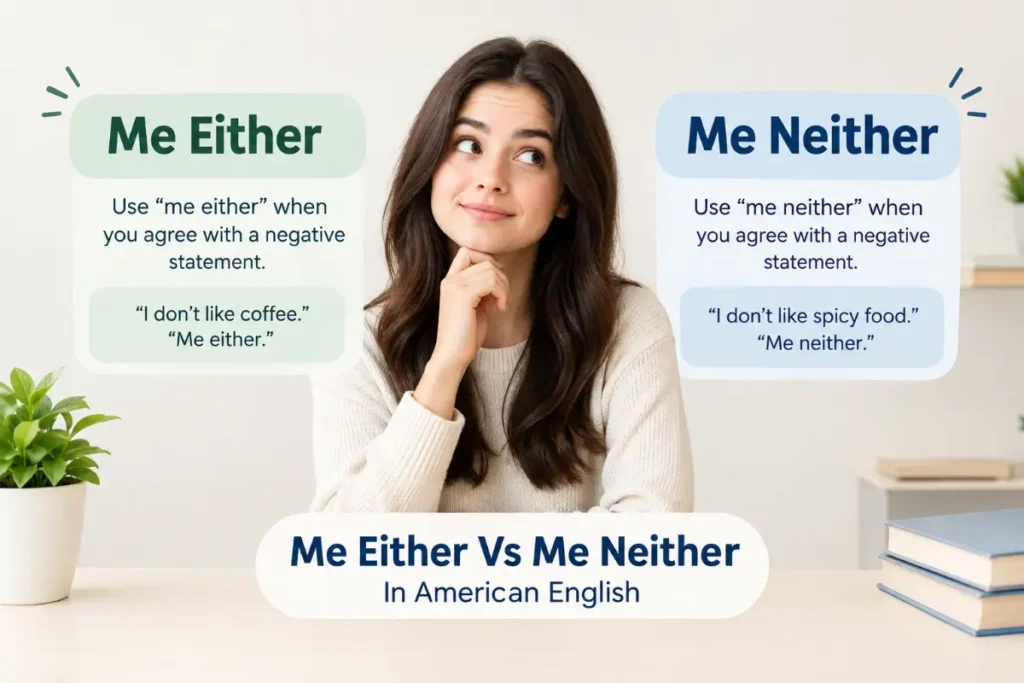
Me Either Vs Me Neither In American English
American English deserves special attention because me either is much more familiar there than many traditional grammar explanations suggest.
You may hear:
I don’t want to go.
Me either.
A speaker may say this without thinking that anything is unusual about it.
Another speaker might say:
I don’t want to go.
Me neither.
Both listeners understand the intended meaning immediately.
The difference is mainly grammatical tradition and register rather than communication.
For an English learner this creates a common trap. You may hear native speakers say me either and assume it must be the preferred form in every context.
It isn’t.
Spoken language often accepts patterns that formal writing avoids. That’s one reason English learners should learn both the grammar rule and the way people actually speak.
Formal Writing And Informal Speech
Your choice should depend on the setting.
Casual Conversation
Both expressions can occur in American English.
I don’t want dessert.
Me neither.
I don’t want dessert.
Me either.
The second sounds more informal and may sound less natural to speakers who prefer the traditional pattern.
Text Messages
Informal texting gives speakers even more freedom.
I can’t stay up late tonight.
Me either.
This is easy to understand and common in casual digital communication.
Workplace Conversation
For spoken workplace English me neither is generally the safer choice.
I don’t think we need another meeting.
Me neither.
You can also say:
I don’t think so either.
That sounds natural and professional.
Formal Emails
Avoid using me either in formal emails.
Instead write:
I don’t think we need another meeting either.
Or:
Neither do I.
The complete structures look more polished and leave less room for criticism.
Academic Writing
Academic writing normally avoids conversational fragments such as me either and me neither.
Instead use a complete sentence.
The study does not support the original conclusion. The second analysis does not support it either.
That style is clearer and more appropriate for formal prose.
Real Life Examples With Me Neither
The fastest way to build confidence is to see the pattern in natural conversations.
Daily Conversation
- I don’t like waking up early.
Me neither.
- I haven’t seen that show.
Me neither.
- I can’t swim very well.
Me neither.
- I don’t eat breakfast every day.
Me neither.
- I wasn’t expecting that result.
Me neither.
Workplace Conversation
- I don’t think the report is finished.
Me neither.
- I haven’t received the email yet.
Me neither.
- I don’t understand this part of the presentation.
Me neither.
- I wouldn’t make that decision yet.
Me neither.
- I can’t attend the meeting tomorrow.
Me neither.
Everyday Relationships
- I don’t feel like going out tonight.
Me neither.
- I haven’t told anyone about it.
Me neither.
- I don’t want to argue about this.
Me neither.
- I didn’t enjoy the movie.
Me neither.
- I don’t remember his name.
Me neither.
Real Life Examples With Me Either
These examples show how me either appears in informal American conversation.
- I don’t want to leave yet.
Me either.
- I don’t know what happened.
Me either.
- I can’t believe she said that.
Me either.
- I haven’t finished my homework.
Me either.
- I don’t feel hungry.
Me either.
The meaning is clear in every example. Still me neither or a complete sentence with either is a better choice for careful English.
The Most Natural Alternatives
If you’re unsure about the expression you can avoid the problem entirely.
I Don’t Either
This is one of the safest alternatives.
I don’t like coffee.
I don’t either.
Neither Do I
This is concise and grammatically standard.
I don’t like coffee.
Neither do I.
Same Here
This is very casual and works when the meaning is obvious.
I don’t want to go.
Same here.
Me Too
Be careful with this one.
For a positive statement:
I love this song.
Me too.
For a negative statement traditional standard English uses me neither rather than me too.
Some speakers may use me too after a negative statement in casual conversation but it can create ambiguity. English learners should avoid that pattern.
Internal Linking Opportunity
A useful internal article to place after this section would be Neither Nor Vs Either Or Explained. It would help readers who understand the basic difference between either and neither but still struggle with paired conjunctions.
Common Mistakes To Avoid
Mistake 1
I don’t like coffee. Me too.
For clear standard English use:
I don’t like coffee. Me neither.
Or:
I don’t like coffee either.
Mistake 2
I don’t like coffee. Neither I.
This structure is incorrect.
Use:
Me neither.
Or:
Neither do I.
Mistake 3
I don’t like coffee. Neither I do.
The word order is wrong.
Use:
Neither do I.
Mistake 4
I don’t like coffee. Me don’t either.
This doesn’t work because me cannot function as the subject of the full sentence.
Use:
I don’t either.
Mistake 5
I don’t like coffee. I don’t neither.
This creates a double negative in standard English.
Use:
I don’t either.
Or:
Me neither.
Memory Trick
Think of too and either as partners for positive and negative ideas.
Positive:
I like it too.
Negative:
I don’t like it either.
Then remember neither can stand alone as a short negative agreement.
I don’t like it.
Me neither.
The easiest mental shortcut is:
Positive means me too.
Negative means me neither.
When you need formal writing use the complete sentence I don’t either or the inversion Neither do I.
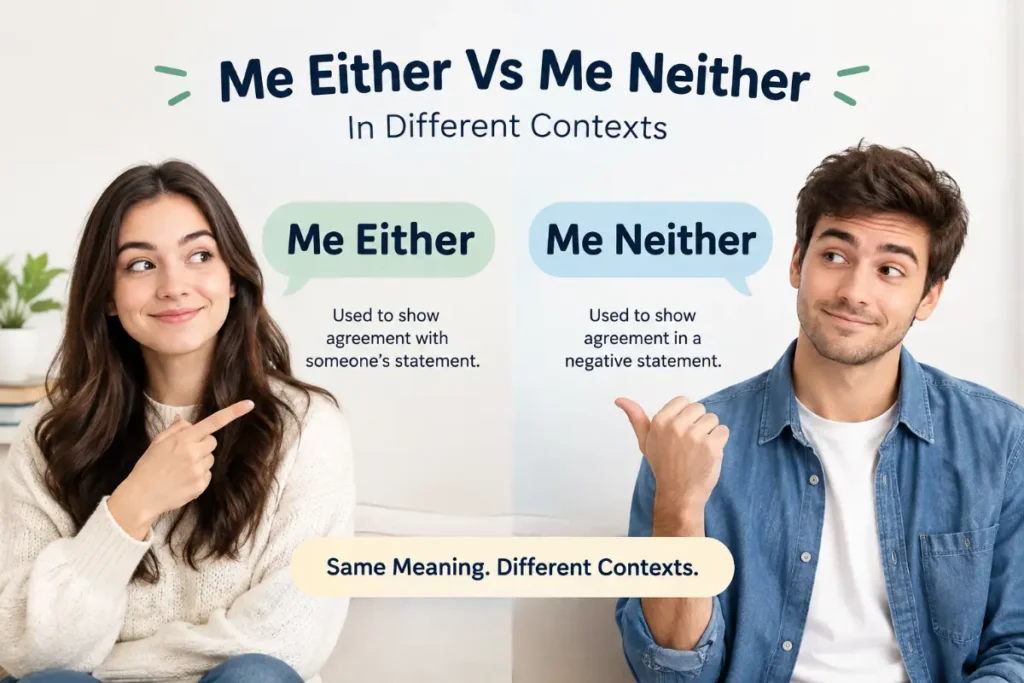
Me Either Vs Me Neither In Different Contexts
The meaning stays similar but the best expression can change with the setting. Casual speech gives you more freedom while formal writing calls for a clearer grammatical structure.
Knowing the difference helps you sound natural without copying every pattern you hear.
In Casual Conversation
American speakers often use short responses because the meaning is obvious from context.
I don’t watch much television.
Me neither.
You may also hear:
I don’t watch much television.
Me either.
The first response is the safer standard form. The second is an informal American usage that many native speakers accept in everyday conversation.
In Text Messages
Texting is even more relaxed.
I haven’t tried that restaurant.
Me neither.
A friend might reply:
Me either.
The second version isn’t likely to cause confusion in a casual text. Still use me neither if you’re learning English and want a reliable standard form.
In Professional Conversation
At work clarity matters more than sounding extremely casual.
I don’t think we need to change the schedule.
Neither do I.
This response sounds natural and professional. You could also say:
I don’t think so either.
Both options avoid the informal controversy around me either.
In Formal Writing
Formal writing usually favors a complete sentence.
I don’t agree with the proposed change either.
That sentence is clearer than a conversational fragment.
Academic writing in particular should avoid relying on short responses because the reader doesn’t have the same immediate context as a person in a conversation.
Me Neither Vs I Don’t Either
These two forms are both standard and express the same basic idea.
Consider this exchange:
I don’t drink coffee.
Me neither.
The longer version would be:
I don’t drink coffee either.
The short response works because the listener already knows the missing information.
When I Don’t Either Works Better
Use I don’t either when you want a complete sentence.
I don’t like crowded places.
I don’t either.
This form can fit both conversation and writing.
It also makes the grammar easy to see.
I + negative verb + either.
Examples:
I don’t know either.
I don’t agree either.
I don’t remember either.
I don’t understand either.
Me Neither Vs Neither Do I
These expressions are close in meaning but have different structures.
Me Neither
Me neither.
This is a short conversational response.
Neither Do I
Neither do I.
This uses subject auxiliary inversion. The structure is:
Neither + auxiliary verb + subject.
Examples:
I don’t like jazz.
Neither do I.
I haven’t finished.
Neither have I.
I can’t drive.
Neither can I.
I won’t be there.
Neither will I.
I wasn’t invited.
Neither was I.
The auxiliary verb changes according to the original sentence.
This is an important point that English learners sometimes miss.
You can’t use neither do I after every negative sentence.
For example:
I haven’t seen it.
Correct:
Neither have I.
Not:
Neither do I.
The helping verb must match the tense and structure of the first statement.
How The Grammar Changes With Different Tenses
The response pattern becomes easier once you focus on the auxiliary verb.
Present Simple
I don’t like spinach.
Neither do I.
Present Simple With Be
I’m not ready.
Neither am I.
Present Perfect
I haven’t finished.
Neither have I.
Past Simple
I didn’t enjoy the movie.
Neither did I.
Past Simple With Be
I wasn’t there.
Neither was I.
Modal Verb
I can’t swim.
Neither can I.
Future
I won’t attend.
Neither will I.
This pattern is more formal than me neither but it gives you a useful grammatical tool for precise English.
Why Either Appears In Negative Sentences
One reason learners struggle with this topic is that either has several jobs in English.
In a negative sentence it can mean also.
For example:
I don’t want dessert either.
She doesn’t want dessert either.
They aren’t coming either.
The word usually appears near the end of the sentence.
Either In Positive Statements
In positive sentences either can have a different meaning.
You can choose either option.
This means one of the two options.
That is different from:
I don’t want either option.
Here either works inside a negative construction.
Understanding these patterns prevents you from treating either as a word that always has one fixed meaning.
Why Neither Is Negative
Neither already carries a negative sense.
For example:
Neither answer is correct.
This means both answers are incorrect.
In a response:
I don’t like the movie.
Me neither.
The negative meaning comes from neither.
That is why standard English doesn’t normally use another negative word with the same structure.
Avoid Double Negatives
A common learner error is:
I don’t like it. Me don’t neither.
That doesn’t work in standard English.
The negative idea is already expressed correctly through neither.
Use:
I don’t like it.
Me neither.
Or:
I don’t like it.
I don’t either.
Or:
I don’t like it.
Neither do I.
Each pattern handles the negative idea cleanly.
Pronunciation Of Me Either And Me Neither
Pronunciation can make these expressions confusing because casual speech often reduces sounds.
Me Either
A common American pronunciation is close to:
/mi ˈiːðər/
The two main words are usually easy to distinguish when spoken carefully.
The th in either is normally voiced. The sound is similar to the th in this rather than the sound in think.
Me Neither
A common American pronunciation is close to:
/mi ˈniːðər/
The first sound of neither is an /n/.
The main stress normally falls on the first syllable of either and neither.
Pronunciation Mistake To Avoid
Don’t pronounce the th in either like the th in think if you’re aiming for the common American pronunciation.
Think of the sound in:
this
that
those
Then use a similar voiced sound in either and neither.
Regional accents can produce different pronunciations. The meaning remains clear from context.
A related grammar guide is Say Your Peace Or Say Your Piece Which One Is Correct (2026).
Is Either Pronounced Two Different Ways
Yes.
English speakers commonly pronounce either in two ways:
/ˈiːðər/
/ˈaɪðər/
You may hear the first vowel as the sound in see or the sound in eye.
Both pronunciations are established in English.
The same variation appears in neither:
/ˈniːðər/
/ˈnaɪðər/
American and British speakers use both patterns. Individual speakers often have a strong personal preference.
This pronunciation difference has nothing to do with the choice between me either and me neither.
British American Canadian And Australian English
The basic grammar works across major varieties of English.
Speakers in the United States Canada the United Kingdom and Australia understand me neither without difficulty.
The interesting difference appears in how people judge me either.
American English
Me either is familiar in informal American speech.
You may hear it regularly in casual conversations.
British English
British speakers also understand the expression but me neither and other standard structures are safer choices in careful English.
Canadian English
Canadian English shares many features with American English. Informal speakers may use patterns that sound similar to casual American speech.
Australian English
Australian English also uses relaxed conversational structures. Me neither remains a clear standard response to negative statements.
There isn’t a simple country rule that makes one expression correct and the other incorrect. Register and individual speech habits matter.
The History Behind Either And Neither
The history of these words helps explain why their grammar can feel unusual to modern learners.
Either and neither developed from older Germanic forms of English. Their meanings have shifted and expanded over centuries.
Neither originally carried the sense of not one and not the other. Either developed meanings connected with one of two and later became common in negative constructions.
English eventually developed the patterns we recognize today.
I don’t like it either.
Neither do I.
Me neither.
These structures reflect a long history of English grammar rather than a simple modern rule invented by teachers.
Why Me Neither Sounds More Grammatically Logical
There is a useful semantic reason me neither feels natural to traditional grammar.
The first speaker gives a negative statement.
I don’t like running.
The second speaker needs to agree with that negative idea.
Me neither.
The word neither directly signals negative agreement.
By contrast either usually appears after a negative verb inside a complete sentence.
I don’t like running either.
So traditional grammar treats I don’t either as the natural complete response rather than me either.
The informal expression developed through conversational shortening.
That distinction explains why you can hear me either frequently while still finding me neither recommended in grammar references.
Twenty More Natural Examples
The following examples show how these expressions work in different situations.
Everyday Life
- I don’t like driving at night.
Me neither.
- I haven’t eaten lunch yet.
Me neither.
- I don’t know the answer.
Me neither.
- I didn’t sleep well last night.
Me neither.
- I can’t remember her name.
Me neither.
Friends And Family
- I don’t want to watch another action movie.
Me neither.
- I haven’t told Mom about the surprise.
Me neither.
- I don’t feel like cooking tonight.
Me neither.
- I wasn’t ready for that question.
Me neither.
- I don’t think we should leave yet.
Me neither.
Workplace
- I haven’t received the latest figures.
Me neither.
- I don’t understand why the deadline changed.
Me neither.
- I didn’t hear the manager mention that.
Me neither.
- I can’t access the shared folder.
Me neither.
- I don’t think the client has replied.
Me neither.
Informal American Speech
- I don’t want to go out tonight.
Me either.
- I can’t believe that happened.
Me either.
- I haven’t seen the new episode.
Me either.
- I don’t know what she’s talking about.
Me either.
- I don’t feel like dealing with this today.
Me either.
These examples demonstrate an important distinction. Me either can occur naturally in informal speech even though me neither remains the safer standard response for English learners.
Common Mistakes With Either
The problem isn’t always me either itself. Learners also make mistakes with either inside complete sentences.
Incorrect Negative Agreement
I don’t like it too.
For standard English use:
I don’t like it either.
Correct Positive Agreement
I like it too.
This is the normal positive pattern.
Correct Negative Agreement
I don’t like it either.
This is the normal negative pattern.
That gives you another useful memory rule:
Too usually follows positive agreement.
Either usually follows negative agreement.
Common Mistakes With Neither
Incorrect Word Order
Neither I do.
Correct:
Neither do I.
Incorrect Auxiliary
I haven’t finished.
Neither do I.
Correct:
Neither have I.
Incorrect Double Negative
I don’t like it neither.
In standard English use:
I don’t like it either.
Or:
Me neither.
The double negative pattern can occur in some dialects and informal varieties of English. English learners should use the standard forms unless they are intentionally reproducing a particular dialect.
Me Either In Social Media And Popular Culture
Social media has made informal grammar highly visible.
People write the way they speak. They shorten sentences use fragments and choose expressions that feel natural in conversation.
That means you may encounter:
Me either.
Me neither.
Same.
Same here.
Neither do I.
All in the same comment section.
Seeing me either online doesn’t automatically make it the best choice for an essay or formal email.
The internet gives us a window into real language use. It doesn’t turn every conversational pattern into a formal writing recommendation.
That distinction is useful for anyone learning English from social media.
Me Either Vs Me Neither In Texting
Texting has its own rhythm.
If a friend writes:
I don’t want to go.
You might reply:
Me neither.
You might also see:
Me either.
Or:
Same.
All three are easy to understand.
For casual texting the choice often depends on personal speaking habits.
For professional messages use a complete sentence instead.
I don’t want to go either.
That sounds clear without drawing attention to the grammar.
When Native Speakers Prefer A Different Expression
Native speakers don’t always choose me neither or me either.
They often use alternatives because those alternatives fit the conversation better.
Same Here
I don’t like crowded restaurants.
Same here.
I Don’t Either
I don’t watch much television.
I don’t either.
Neither Do I
I haven’t seen that movie.
Neither have I.
Not Me Either
This form also appears in informal conversation.
I don’t want to go.
Not me either.
It is understandable but more conversational than the standard alternatives.
If you’re writing for a broad audience I don’t either is a safer choice.
Expert Editor’s Perspective
An experienced editor looks at more than dictionary definitions.
The real question is how the expression functions in the sentence and what kind of writing you’re producing.
For a formal document an editor would usually replace me either with me neither or a complete structure such as I don’t either.
For dialogue an editor may keep me either if it accurately reflects the speaker’s natural voice.
That distinction matters in fiction screenwriting interviews transcripts and conversational content.
Editing isn’t about forcing every sentence into the same style. Good editing preserves natural language while making sure the wording suits the purpose.
A Practical Choice Guide
When you need to answer quickly use this guide.
| Situation | Best choice |
|---|---|
| Casual conversation | Me neither |
| Informal American speech | Me neither or me either |
| Texting a friend | Me neither or me either |
| Workplace conversation | Me neither or I don’t either |
| Professional email | I don’t either |
| Academic writing | I don’t either or a full sentence |
| Formal report | A complete sentence |
| Fictional dialogue | Choose the form that fits the speaker |
| English learning | Me neither |
| Standard grammar practice | Me neither |
The main lesson is simple.
Me neither is the safest short response.
I don’t either is the safest complete response.
Me either belongs mainly to informal conversational American English.
Section 2 Takeaway
The difference between me either vs me neither becomes much clearer once you separate standard grammar from everyday speech.
Me neither directly agrees with a negative statement.
I don’t either expresses the same idea in a complete sentence.
Neither do I provides another standard structure and changes its auxiliary verb to match the original statement.
Me either is widely understood and used informally by some American speakers. It isn’t the best choice for formal writing or for learners who want the safest standard form.
The smartest approach isn’t to pretend informal English doesn’t exist. Learn it recognize it and understand it. Then choose the form that fits the situation.
Common Questions About Me Either And Me Neither
Is Me Either Grammatically Correct
Me either is common in informal American conversation but many traditional grammar references don’t recommend it as the standard form. For careful English use me neither after a negative statement. You can also use I don’t either for a complete sentence. The choice depends on context and register.
Should I Say Me Either Or Me Neither
If you’re learning English and want one reliable rule use me neither after a negative statement. For example: I don’t like coffee. Me neither. In formal writing choose a complete form such as I don’t like coffee either. This avoids the informal usage entirely.
Can I Use Me Neither In Formal Writing
Me neither is understandable and grammatical as a short response but formal writing usually needs complete sentences. Instead of writing Me neither in an academic paper or professional document write I don’t either or another complete sentence that clearly expresses the same idea.
Why Do Americans Say Me Either
Me either developed as an informal conversational pattern in American English. Speakers can understand its meaning from the negative statement that comes before it. Although many native speakers use it naturally the expression doesn’t follow the traditional pattern that places either after a negative verb. That’s why formal grammar advice often favors me neither.
Is Neither Do I More Formal Than Me Neither
Generally yes. Neither do I is a complete grammatical construction and often sounds slightly more polished than me neither. However both are common in conversation. The correct auxiliary depends on the original sentence. For example I haven’t finished becomes Neither have I rather than Neither do I.
Can I Say I Don’t Neither
In standard English you shouldn’t say I don’t neither. That structure creates a double negative. Use I don’t either instead. You can also respond with me neither or neither do I depending on the sentence and context.
Is Me Either Wrong In American English
It would be too broad to call me either simply wrong. Many American speakers use it in casual conversation and understand it immediately. The important distinction is that common spoken usage doesn’t always match traditional formal grammar. For professional and academic writing use me neither or a complete sentence with either.
What Is The Difference Between Either And Neither
Either often appears with a negative verb to mean also. For example I don’t like it either. Neither already carries a negative meaning and can express agreement with a negative statement. For example I don’t like it. Me neither. The two words overlap in meaning but work differently in sentence structures.
Related Expressions You Should Know
Learning a few related expressions makes this grammar pattern much easier.
Me Too
Use me too to agree with a positive statement.
I love chocolate.
Me too.
The speaker has the same positive feeling.
Me Neither
Use me neither to agree with a negative statement.
I don’t like chocolate.
Me neither.
The speaker shares the same negative feeling.
I Do Too
This is another way to agree with a positive statement.
I love chocolate.
I do too.
I Don’t Either
This is the negative counterpart.
I don’t like chocolate.
I don’t either.
Neither Do I
This is another standard negative agreement structure.
I don’t like chocolate.
Neither do I.
These patterns form a useful little system.
Positive agreement
I like it.
Me too.
I do too.
Negative agreement
I don’t like it.
Me neither.
I don’t either.
Neither do I.
Once you learn this system the choice becomes much less confusing.
A Closer Look At Neither Do I
Neither do I deserves extra attention because it appears often in careful English.
The structure follows a clear grammatical pattern.
Neither + auxiliary verb + subject.
The auxiliary must match the first statement.
Present Simple
I don’t work on Sundays.
Neither do I.
Present Simple With Be
I’m not tired.
Neither am I.
Past Simple
I didn’t see him.
Neither did I.
Past Simple With Be
I wasn’t invited.
Neither was I.
Present Perfect
I haven’t finished.
Neither have I.
Modal Verb
I can’t drive.
Neither can I.
Future
I won’t go.
Neither will I.
This is called subject auxiliary inversion. It may look formal at first but native speakers use it naturally.
How Either Works In Complete Sentences
Either is especially useful at the end of negative sentences.
Examples:
I don’t know either.
She doesn’t understand either.
We haven’t decided either.
They can’t come either.
He wasn’t invited either.
The pattern stays consistent.
Negative verb + either.
This is why I don’t either is such a useful alternative to me either.
How Neither Works In Complete Sentences
Neither can also appear in several grammatical structures.
Neither As A Determiner
Neither answer is correct.
This means both answers are incorrect.
Neither As A Pronoun
Neither is available.
This means not one of the two is available.
Neither Nor
Neither John nor Sarah attended the meeting.
This construction connects two negative choices.
Neither Do I
I don’t like the plan.
Neither do I.
Each structure has its own grammar. Learning them separately prevents confusion.
Real World Editing Advice
When editing a sentence ask three questions.
- Is this formal or informal.
- Is the sentence positive or negative.
- Am I responding to someone or writing a complete statement.
If the setting is casual conversation then me neither is an easy safe response.
If the setting is formal then use a complete sentence.
For example:
I don’t agree with the proposal either.
If you’re writing dialogue then you have more freedom.
A character who naturally says me either may sound less believable if an editor changes every instance to me neither.
Good editing respects the speaker’s voice while maintaining clarity.
What Dictionaries And Grammar References Tell Us
Dictionary entries and usage references generally recognize either and neither as established English words with several grammatical functions.
The important issue isn’t the existence of the words. It is the conversational construction me either.
Traditional standard grammar treats either as natural after a negative verb.
I don’t like it either.
It treats neither as natural in a short negative agreement response.
Me neither.
At the same time language research and real world usage show that English speakers often create shortened conversational patterns. Me either belongs to that broader area of informal spoken usage.
This is why a good editor shouldn’t confuse two separate questions.
Is the expression understandable and used by native speakers?
Yes.
Is it the safest standard form for formal English?
No.
That distinction gives learners a much more accurate picture of how English actually works.
Common Myths About Me Either
Myth One
Me either is always wrong.
That’s too absolute. It is widely used in informal American speech.
Myth Two
Me neither is old fashioned.
Not at all. It remains a normal and useful response in contemporary English.
Myth Three
Either always means one of two.
Not always. In negative sentences either can mean also.
I don’t want it either.
Myth Four
Neither always requires nor.
No. Neither can stand alone.
I don’t want it.
Neither do I.
Myth Five
Me too always works after a negative sentence.
It can create confusion. For clear standard English use me neither or I don’t either.
Memory Chart
| First speaker says | Natural agreement |
|---|---|
| I like it. | Me too. |
| I love it. | Me too. |
| I can swim. | Me too. |
| I don’t like it. | Me neither. |
| I haven’t seen it. | Me neither. |
| I can’t swim. | Me neither. |
| I don’t like it. | I don’t either. |
| I haven’t seen it. | I haven’t either. |
| I don’t like it. | Neither do I. |
| I haven’t seen it. | Neither have I. |
| I can’t swim. | Neither can I. |
This chart gives you the pattern at a glance.
The Best Choice For English Learners
If your goal is accurate natural English then you don’t need to memorize every possible variation.
Start with three forms.
Me too for positive agreement.
Me neither for negative agreement.
I don’t either for a complete negative sentence.
Then learn neither do I as another standard option.
These four patterns cover a huge amount of everyday conversation.
Once they feel natural you’ll understand expressions such as me either without needing to copy them.
Expert Editor’s Note
From an editorial point of view the best answer depends on the audience.
For learners me neither is the safest short response to a negative statement.
For formal writing a complete sentence such as I don’t either is usually stronger.
For informal American dialogue me either can be retained when it reflects authentic speech.
The most important lesson is not to label every informal construction as bad English. English has spoken varieties dialects and registers. A skilled writer knows the standard form and also understands how real people speak.
Precision means choosing the form that fits the situation.
Need another quick comparison? Read Fact Or Fiction Meaning And How To Use It.
Conclusion
The difference between me either vs me neither is easier than it first appears.
Use me neither to agree with a negative statement.
I don’t like spicy food.
Me neither.
Use I don’t either when you want a complete standard sentence.
I don’t like spicy food.
I don’t either.
Use neither do I when the auxiliary verb matches the original statement.
I don’t like spicy food.
Neither do I.
Me either is common in informal American speech and is easy for native speakers to understand. Still it isn’t the safest choice for formal writing or careful English.
The biggest mistake is assuming that common spoken English and formal standard English always follow the same patterns. They don’t.
Learn the standard form first. Recognize informal forms when you hear them. Then choose your words based on the situation.
When the sentence is negative remember one simple rule: negative agreement calls for neither or a complete sentence with either.

Editorial Reviewer & Proofreader
Grace Mitchell reviews Gramlify’s articles for clarity, consistency, and readability. She is passionate about creating accurate, approachable content that helps English learners build confidence.