
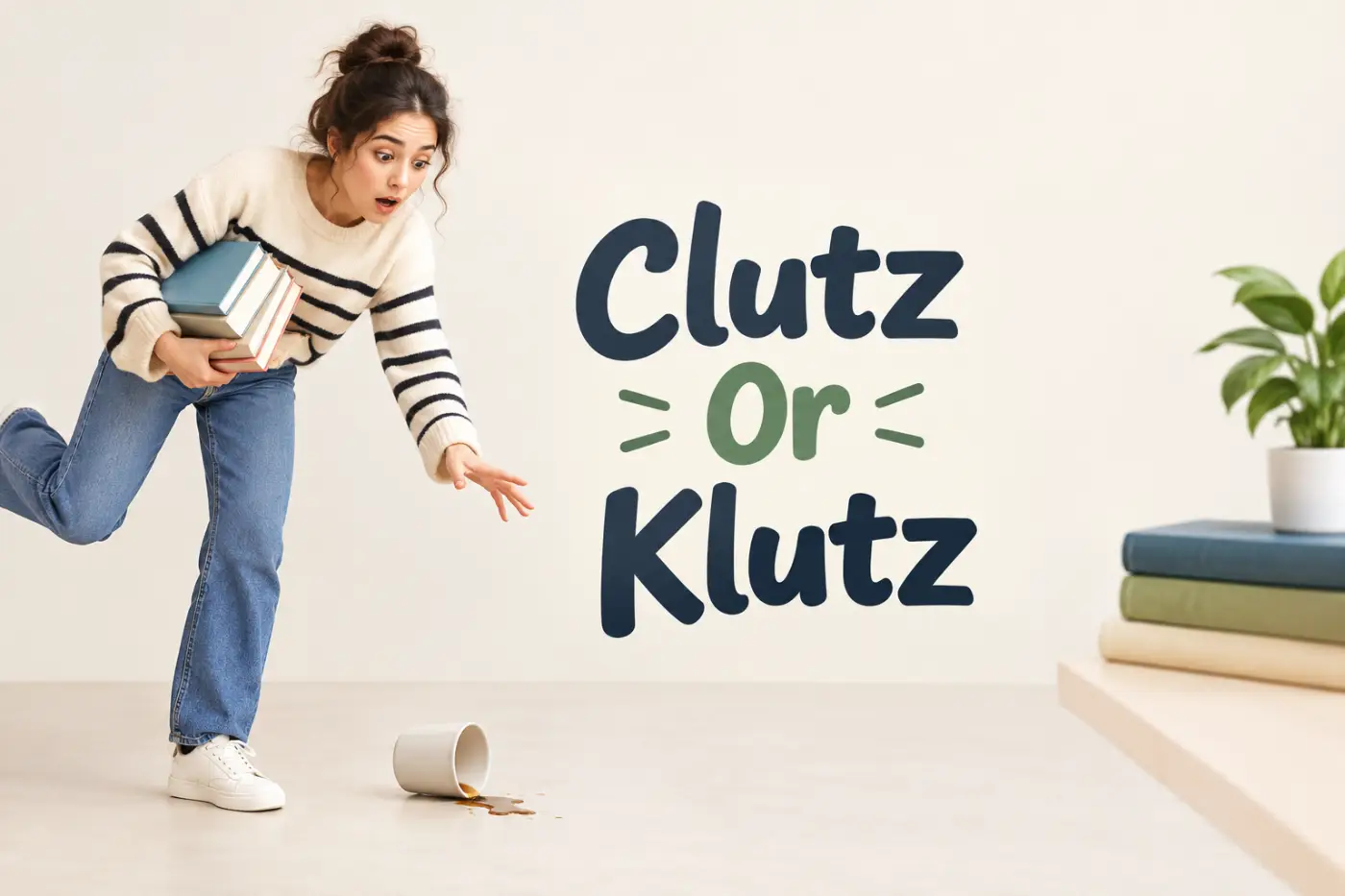
Clutz or klutz? If you’re trying to choose the correct spelling in an email, article, text message, or everyday conversation, the answer is simple: Klutz is the standard and original English spelling. Clutz is a recognized variant. Both forms appear in English usage, but klutz is the traditional spelling you’ll find in dictionaries and established word histories.
The confusion makes sense. The two words sound the same, share the same meaning, and differ by only one letter. If you’ve seen both spellings online, it can be hard to tell which one belongs in your writing.
The word describes a clumsy person. You might use it for someone who keeps dropping things, bumps into furniture, or makes awkward mistakes. It can sound playful or mildly critical, so context matters.
This guide explains the difference between clutz and klutz, their meanings, pronunciation, origins, spelling patterns, and everyday usage. You’ll also find natural examples, common mistakes, memory tips, and practical editorial advice for choosing the right form.
By the end, you’ll know which spelling to use in formal writing and why the alternative appears in modern English.
Learn the difference in Bougie Or Boujee Which Spelling Is Correct(2026 Guide).
Quick Answer
Klutz is the traditional and preferred spelling. It means a clumsy or awkward person and comes from Yiddish. Clutz is an accepted spelling variant used in English. Both words have the same meaning and pronunciation. For general and formal writing, choose klutz because it’s the established dictionary form.
Clutz Or Klutz Comparison Table
| Feature | Klutz | Clutz |
|---|---|---|
| Standard spelling | Yes | Recognized variant |
| Meaning | A clumsy person | A clumsy person |
| Part of speech | Noun | Noun |
| Pronunciation | Same | Same |
| IPA | /klʌts/ | /klʌts/ |
| Syllables | One | One |
| Word origin | Yiddish | Variant spelling |
| Usage | Common and established | Less traditional variant |
| Formal writing | Preferred | Acceptable in some contexts |
| Informal writing | Natural | Natural |
| Plural | Klutzes | Clutzes |
| Adjective form | Klutzy | Clutzy |
The main difference is spelling preference rather than meaning. Both forms refer to a person who behaves clumsily.
Which One Is Correct
Klutz is the preferred spelling for most writing. It is the traditional form derived from Yiddish and is the spelling most closely associated with the word’s English history.
However, clutz isn’t simply a meaningless spelling mistake. English dictionaries recognize it as a variant. You may encounter it in casual writing, published material, and everyday communication.
Use the following practical rule.
- Choose klutz when you want the established spelling for an article, essay, email, or other general writing.
- Recognize clutz as a legitimate variant rather than automatically treating it as an error.
- Keep the spelling consistent within a piece of writing unless you’re discussing the variation itself.
An editor may change clutz to klutz to follow a preferred dictionary or house style. That doesn’t mean every use of clutz is grammatically wrong.

What Does Klutz Mean
A klutz is a person who is clumsy, awkward, or likely to make physical mistakes.
The noun often describes someone who accidentally drops objects, trips, spills drinks, or knocks things over. It can also suggest a person who struggles with coordination or handles situations awkwardly.
Klutz Definition
Klutz means a clumsy person who often makes awkward physical mistakes.
For example:
I’m such a klutz. I just spilled coffee on my shirt.
The speaker is using the word humorously to describe their own mistake.
The term usually has an informal tone. People often use it when talking about themselves, friends, or familiar situations. Calling a stranger a klutz may sound insulting, depending on the context and tone.
Is Klutz A Noun
Yes. Klutz is a noun.
A noun names a person, place, thing, or idea. In this case, klutz names a person who behaves clumsily.
Examples:
- My brother is a klutz in the kitchen.
- She felt like a klutz during her first skating lesson.
- Don’t be a klutz with that glass vase.
The word normally functions as a countable noun. You can talk about one klutz or several klutzes.
Is Klutz An Insult
Klutz can be an insult, but it often appears in playful or self-deprecating language.
The effect depends on the relationship between the speakers and the situation. Someone might laugh when a close friend calls them a klutz. The same word may feel rude when used toward someone who is already embarrassed about a mistake.
For considerate writing, describe the specific action instead of labeling someone. For example, He accidentally knocked over the display is more neutral than He’s a klutz.
What Does Clutz Mean
Clutz has the same meaning as klutz. It is a spelling variant of the noun that describes a clumsy person.
You may see it in informal conversations, online posts, and other English writing. Its pronunciation and grammatical function remain the same as the traditional spelling.
Examples:
- I’m a total clutz when I try to dance.
- He called himself a clutz after dropping the plates.
- She isn’t a clutz. She was just distracted.
The important point is that clutz and klutz don’t describe two different types of people. The spelling changes, but the core meaning stays the same.
Why People Confuse Clutz And Klutz
The confusion comes from a combination of spelling, sound, and English word history. The two forms look almost identical, and most speakers pronounce them the same way.
The Words Sound The Same
Both spellings are pronounced /klʌts/ in standard English pronunciation.
The opening sound resembles the cl in clock. The vowel sounds like the short u in cup. The final sound matches the ts in cats.
Because the pronunciation doesn’t help listeners distinguish the spellings, people often rely on memory or visual familiarity when writing the word.
The First Letter Creates Confusion
The letters c and k can represent the same initial /k/ sound in English.
Compare:
- Cat and kite.
- Cold and kind.
- Class and klutz.
English spelling uses several ways to represent the /k/ sound. As a result, writers may choose the spelling that looks familiar or feels natural.
In klutz, the initial k belongs to the established spelling inherited from the word’s source language.
Informal Writing Spreads Variants
People encounter words through conversation, social media, text messages, and online communities. Informal writing often includes spelling variations that spread through repeated use.
When someone sees clutz several times, the form may begin to look familiar. That familiarity doesn’t necessarily establish it as the preferred dictionary spelling.
Still, repeated use can help explain why variant spellings survive. Language changes through actual usage, and dictionaries document that usage over time.
Autocorrect Doesn’t Settle The Question
Spellcheckers and autocorrect tools can recognize different word forms depending on their dictionaries and language settings. A tool accepting a spelling doesn’t automatically mean it’s the best choice for every context.
Likewise, a tool flagging a word doesn’t prove that the form is universally incorrect. Writers should consider reputable dictionaries, intended audience, and editorial style.
Internal Linking Opportunity
Suggested internal article: [Klutzy Meaning And How To Use It In A Sentence]
This article can help readers who want to understand the related adjective klutzy after learning the noun klutz.
Key Differences Between Clutz And Klutz
The difference between these spellings is mainly historical and editorial. They don’t represent separate meanings or different grammatical categories.
Meaning
Both clutz and klutz describe a person who is clumsy or awkward. Some dictionary definitions also include the idea of a foolish or stupid person.
The word can describe physical clumsiness:
I’m a klutz. I keep dropping my keys.
It can also describe a broader kind of awkwardness:
He felt like a klutz during the dance rehearsal.
The meaning depends on context. Still, the central idea is someone who struggles with coordination or behaves awkwardly.
Grammar
Both spellings function as nouns.
| Singular | Plural |
|---|---|
| One klutz | Several klutzes |
| One clutz | Several clutzes |
The plural usually adds es because the word ends in a sound represented by ts.
Examples:
- That klutz forgot his wallet.
- The two klutzes knocked over the chairs.
- I can be a clutz when I’m tired.
The noun doesn’t change based on the person’s gender. You can use it for anyone.
Pronunciation
Both forms are pronounced the same way in standard English.
IPA: /klʌts/.
The word has one syllable. The vowel sound is similar to the sound in cup or luck. Cambridge and Oxford list /klʌts/ for klutz.
Pronunciation in English
+1
Try saying it in three parts:
- K: The opening sound in key.
- L: The sound in look.
- Uts: The ending sounds similar to cuts.
Put them together: kluts.
The spelling with c doesn’t change the pronunciation.
Klutz Pronunciation Guide
Pronunciation can help you recognize the word when someone says it aloud. It can’t help you choose between the two spellings because both forms have the same standard pronunciation.
How To Say Klutz
The standard pronunciation is /klʌts/.
The word rhymes with cuts, nuts, and guts in accents that use the same vowel sound.
A common mistake is to pronounce the vowel like the oo in food. That isn’t the standard pronunciation of the English word.
Another mistake is adding an extra syllable. Klutz is a one syllable noun. Avoid saying it like kuh-lutz.
Is The Pronunciation Different In British English
The standard pronunciation listed by major learner dictionaries is /klʌts/. The word is especially associated with North American informal English, although it also appears in British English and other varieties.
Oxford Learner’s Dictionaries
+2
You don’t need to change the pronunciation when writing for a US audience. The same basic pronunciation works in everyday American English.
Klutz Word Origin And Etymology
The word klutz comes from Yiddish. Its history explains why the spelling begins with k rather than c.
English adopted the word from Yiddish klots, a term connected with a wooden block or beam. The meaning later developed into the sense of a clumsy or foolish person. The word entered American English in the twentieth century and became established in informal usage.
Etymology, Origin & Meaning
+2
From A Wooden Block To A Clumsy Person
The original image is fairly easy to understand. A block of wood is solid and awkward to move. Over time, related expressions developed figurative meanings connected with a person who seemed awkward or foolish.
The historical connection doesn’t mean modern speakers think about wood when they use klutz. Most people simply understand it as a word for someone who is clumsy.
Etymology helps explain the spelling. It doesn’t mean every English speaker must know the source language to use the word correctly.
Is Klutz A Yiddish Word
Yes. Klutz entered English from Yiddish. English speakers now use it as an established informal noun, especially in North American English.
The word’s history is a useful reminder that English contains vocabulary borrowed from many languages. Borrowed words often retain spelling patterns that don’t match the most common patterns in modern English.

Clutz Or Klutz In American English
For a US audience, klutz is the safest default spelling. It is widely recognized and listed by major English dictionaries.
The variant clutz can still appear in American writing. You may see it in personal messages, online discussions, or other informal contexts.
A professional editor should distinguish between two questions:
- Is the form recognized in English usage?
- Is it the preferred spelling for this publication?
Those questions don’t always have the same answer. A variant can be understandable and documented while a particular publication still prefers the traditional form.
Formal Writing
In academic writing, professional communication, and edited articles, choose klutz unless a specific source or quotation requires another spelling.
The word itself is informal. Even the preferred spelling may not fit a formal sentence that requires a neutral description.
For example:
Informal: He felt like a klutz during the presentation.
More formal: He felt awkward and struggled with the equipment during the presentation.
The second sentence gives readers more precise information. It also avoids labeling the person.
Informal Writing
In texts, casual conversations, and humorous social posts, klutz works naturally.
Examples:
- I’m such a klutz today.
- What a klutz I am.
- I can’t believe I did that. Total klutz moment.
The word often works best when someone uses it about themselves. That approach can make a mistake sound less serious and add a touch of humor.
Clutz Or Klutz In British English
British English speakers recognize klutz, although dictionaries often label the word as North American or informal. It isn’t a spelling difference like color and colour.
The distinction matters because klutz and clutz are spelling variants, not standard US and UK versions of the same word.
British English doesn’t require clutz as an alternative to American klutz. The traditional spelling remains available in British writing.
Canadian and Australian English can also use borrowed vocabulary from American English. Usage varies by speaker, region, and context, so it’s better not to assign a fixed national spelling rule without evidence.
Twenty Natural Examples Of Klutz And Clutz
The following examples show how the noun works in everyday speech and writing. Most use klutz because it’s the preferred spelling for general use.
Daily Conversation
- I’m such a klutz. I dropped my phone again.
- Don’t let me carry the plates. I’m a total klutz.
- He tripped over his own shoelace like a klutz.
- I felt like a klutz during my first skating lesson.
- She’s usually careful, but she can be a klutz when she’s tired.
Workplace Examples
- I felt like a klutz after spilling coffee on the meeting notes.
- He’s a bit of a klutz with small electronic parts.
- I made a silly mistake with the printer. I’m such a klutz today.
- The new employee joked that he was a klutz after dropping the sample box.
- She called herself a klutz after knocking over the office plant.
Emails And Messages
- Sorry about the broken mug. I’m a bit of a klutz.
- I sent the wrong attachment. What a klutz moment.
- I can’t believe I locked myself out again. I’m such a klutz.
- Please ignore my last message. I made a silly mistake.
- I’m feeling like a klutz today. Nothing seems to stay in my hands.
Academic And Formal Contexts
- The student described himself as a klutz during the laboratory exercise.
- The character is portrayed as a lovable klutz who often creates accidental problems.
- The article uses klutz to describe a person who behaves clumsily.
- The writer chose klutz for its informal and humorous tone.
- The editor replaced klutz with clumsy person to suit the formal register.
These examples illustrate different levels of formality. In academic writing, the word can be discussed as vocabulary. In a formal report about someone’s performance, a more specific description is usually clearer.
Common Mistakes Usage And Expert Guidance
Understanding the preferred spelling is only the first step. To use klutz naturally, you also need to recognize its related forms, understand its tone, and avoid common mistakes.
The noun is simple, but small details matter in polished writing. A professional editor looks at spelling, grammar, meaning, and the impression a word creates.
Still confused? Compare Figoro Or Masingo Meaning And Choice Explained.
Common Mistakes With Clutz And Klutz
Writers make several mistakes when using these words. Some involve spelling, while others involve tone or grammar.
Mistake 1 Using The Variant Without Checking Style
Incorrect assumption: Clutz is always wrong.
That claim is too broad. Clutz is a recognized spelling variant. However, klutz is the traditional form and the practical default for most general writing.
Better approach: Use klutz unless your publication or context calls for a different spelling.
Mistake 2 Treating Clutz And Klutz As Different Words
Both forms describe a clumsy person. The spelling doesn’t create a new meaning.
Incorrect interpretation:
A klutz is physically clumsy, but a clutz is mentally awkward.
There is no standard distinction like that. The two spellings refer to the same core word.
Mistake 3 Using Klutz As A Formal Diagnosis
Klutz is an informal descriptive noun. It isn’t a medical diagnosis or a technical term for a person’s coordination.
For example:
She’s a klutz because she struggles with coordination.
This sentence can sound dismissive or overly simplistic. A more precise description would identify the actual difficulty without applying a label.
Mistake 4 Assuming The Word Is Always Friendly
The word can sound playful, but it can also sound insulting.
Compare:
I’m such a klutz.
You’re a klutz.
The first sentence is self-directed and often humorous. The second sentence directly labels another person and may sound critical.
Editorial advice: Pay attention to the target of the word. Self-deprecating humor and criticism don’t always land the same way.
Mistake 5 Confusing Klutz With Klutzy
Klutz is a noun. Klutzy is an adjective.
Compare the following examples.
| Word | Part of speech | Example |
|---|---|---|
| Klutz | Noun | He’s a klutz. |
| Klutzy | Adjective | He’s klutzy today. |
You can call someone a klutz, but you describe an action as klutzy.
For example:
Her klutzy movements knocked over the glass.
The adjective modifies the noun movements. It doesn’t name the person directly.
Klutz And Klutzy Grammar Explanation
The relationship between klutz and klutzy is useful for English learners because it shows how a noun can form a related adjective.
Klutz As A Noun
A noun can appear after an article or possessive determiner.
Examples:
- He’s a klutz.
- She’s such a klutz.
- That klutz dropped the keys.
- My brother can be a klutz.
The indefinite article a works because klutz is a singular countable noun.
You wouldn’t normally write:
He is klutz.
Instead, write:
He is a klutz.
Or use the adjective:
He is clumsy.
Klutzes As The Plural Form
The plural form is generally klutzes.
Examples:
- The two klutzes broke the vase.
- Those klutzes forgot the equipment.
- We were a group of klutzes during the dance class.
The spelling adds es rather than simply adding s. This follows the word’s ending and pronunciation.
Klutzy As An Adjective
Klutzy describes someone or something that is clumsy or awkward.
Examples:
- He made a klutzy attempt to catch the ball.
- Her klutzy movements caused the stack of books to fall.
- I felt klutzy during the first few minutes of the class.
The adjective can appear before a noun or after a linking verb.
Before a noun:
It was a klutzy mistake.
After a linking verb:
I felt klutzy during the performance.
The adjective focuses on the quality of an action or person rather than naming the person as a klutz.
Klutz Spelling Rules And Word Forms
There is no complicated English spelling rule that explains every detail of klutz. The key point is that the word is borrowed vocabulary with an established spelling.
Why The Word Starts With K
The traditional form comes from Yiddish and retains the initial k. English uses both c and k for the /k/ sound, so the spelling alone doesn’t tell you the word’s origin.
Compare:
- Kind.
- Kitchen.
- Keep.
- Klutz.
The letter k appears in each word, but English spelling conventions vary depending on the word’s history.
Is Klutz Spelled With A C
Yes. Clutz is a recognized variant.
Still, klutz is the preferred traditional spelling. Writers who want the established form should choose klutz.
Don’t invent additional spellings such as kluts or cluts in standard English writing. They aren’t the usual dictionary forms of the noun.
Is Klutzy Spelled With A Y
Yes. The common adjective is klutzy.
Examples:
- A klutzy dancer.
- A klutzy movement.
- A klutzy mistake.
The variant clutzy also appears in English usage. If your writing uses the traditional noun klutz, keeping the related adjective as klutzy creates a consistent spelling pattern.

Clutz Or Klutz In Formal And Informal Writing
Choosing a spelling is only part of making a word fit its context. The noun itself carries an informal tone, so your sentence should match the audience and purpose.
In Professional Emails
You can use klutz in a friendly workplace message when the context supports humor.
Sorry about the spilled coffee. I’m such a klutz today.
The sentence works in a casual exchange with a familiar colleague. It might not fit a formal complaint, incident report, or message to someone you don’t know well.
For a more professional tone, describe the action directly.
I accidentally spilled coffee on the printed documents. I’ll send a clean copy shortly.
The second version gives useful information and avoids self-labeling.
In Academic Writing
Academic writing usually favors precise descriptions. You can use klutz when discussing a character, analyzing informal vocabulary, or examining word meaning.
For example:
The author portrays the character as a lovable klutz.
That sentence discusses a literary characterization. It isn’t trying to describe a person’s actual ability in a technical way.
If you’re writing about a real event, use specific language instead:
The participant accidentally dropped the equipment during the exercise.
The sentence provides more useful detail than a general label.
In Social Media
The word is common in humorous and casual self-description.
Examples:
- My klutz era continues.
- Only a klutz like me could do that.
- Today’s achievement: dropping my keys three times.
Social media often favors playful exaggeration. Still, the tone depends on the audience, and a joke about yourself may not translate well when directed at someone else.
Memory Tricks For Remembering Klutz
A useful memory trick connects the spelling to its history or a familiar image. You don’t need to memorize a long dictionary entry.
Memory Trick 1 Remember The K
Think of the phrase:
Klutz keeps the K.
The traditional spelling starts with k. When you need the preferred form, remember the unusual opening letter.
Memory Trick 2 Picture A Clumsy Person
Imagine someone dropping a stack of books while trying to carry too many things.
Say the word aloud:
What a klutz.
Connect the image to the spelling. Visual memory often makes vocabulary easier to recall.
Memory Trick 3 Separate The Noun And Adjective
Remember the pair:
- Klutz: A clumsy person.
- Klutzy: Describes someone or something clumsy.
This distinction helps you choose the correct word in a sentence.
Memory Trick 4 Use A Sentence
Create a sentence you can reuse:
I’m a klutz, but I’m learning.
The sentence reinforces the noun form and its common conversational use.
Related Words And Expressions
Learning related vocabulary helps you express the same idea with more precision. Klutz is informal and sometimes humorous. Other words may sound more neutral, specific, or descriptive.
Klutz And Clumsy
Clumsy is the broader and more neutral adjective. It describes someone who lacks physical coordination or performs an action awkwardly.
Compare:
| Word | Meaning | Example |
|---|---|---|
| Klutz | A clumsy person | He’s a klutz. |
| Clumsy | Lacking coordination or skill | He’s clumsy with tools. |
Use clumsy when you want to describe an action without labeling the person.
For example:
She made a clumsy attempt to catch the ball.
This sentence focuses on the attempt rather than the person’s identity.
Klutz And Awkward
Awkward has a wider meaning than clumsy. It can describe physical movement, social situations, speech, or uncomfortable circumstances.
Examples:
- He made an awkward movement.
- The conversation became awkward.
- She felt awkward at the party.
A klutz is generally associated with clumsy behavior. An awkward person may struggle socially without being physically clumsy.
Klutz And Butterfingers
Butterfingers is an informal expression for someone who frequently drops things or fails to catch them.
Example:
You have butterfingers today. You dropped the ball again.
The expression focuses on handling or catching objects. Klutz has a broader meaning and can describe other kinds of clumsy behavior.
The two expressions may overlap, but they aren’t exact synonyms in every situation.
Klutz And Goof
Goof can describe a foolish mistake or a silly person. It doesn’t necessarily mean someone is physically clumsy.
For example:
I was a goof and forgot the appointment.
The speaker may have made a foolish mistake without dropping anything or behaving awkwardly.
Use klutz for clumsy behavior. Use goof for silliness or foolish mistakes when that meaning fits.
Klutz And Fumble
Fumble is usually a verb. It describes handling something awkwardly or making a mistake while trying to do something.
Examples:
- I fumbled with the keys.
- He fumbled the ball.
- She fumbled for the light switch.
The noun klutz describes the person. The verb fumble describes the action.
This distinction can make your writing more precise:
The klutz fumbled with the keys.
The sentence identifies the person and the action separately.
When To Use Klutz Instead Of Clumsy
The choice depends on the meaning and tone you want.
Choose klutz when:
- You’re using a playful or informal label.
- You’re describing someone who often makes clumsy mistakes.
- You’re writing dialogue or casual conversation.
- You’re discussing a character who is portrayed as physically awkward.
Choose clumsy when:
- You want a neutral description.
- You’re writing a formal report.
- You want to describe a specific action.
- You want to avoid labeling a person.
Compare these sentences:
My friend is a klutz.
My friend accidentally dropped the glass.
The first sentence gives a general impression. The second describes a particular event.
Neither sentence is automatically better. The appropriate choice depends on what the reader needs to understand.
Is Klutz Offensive
The word isn’t automatically offensive, but it can sound unkind in some situations.
Calling yourself a klutz is often a form of self-deprecating humor. Calling another person a klutz can sound teasing, dismissive, or insulting.
The situation matters more than the spelling.
Friendly Use
I’m such a klutz. I walked into the wrong room.
The speaker is making fun of their own mistake.
Potentially Unkind Use
You’re such a klutz. You can’t do anything right.
This sentence goes beyond describing one clumsy action. It makes a broad and negative judgment about another person.
A thoughtful writer should avoid turning a casual label into an unfair personal criticism.
A More Respectful Alternative
Instead of saying:
She’s a klutz.
You could write:
She accidentally knocked over the glass.
Or:
She sometimes struggles with coordination.
The best choice depends on the context. Specific descriptions can be more useful than labels, especially in professional, educational, or sensitive situations.
Expert Editor’s Note On Clutz And Klutz
As an editor, I’d recommend klutz as the default spelling in general English writing.
The word has a clear historical origin and an established spelling. The variant clutz is recognized, so it shouldn’t be treated as an automatic error in every context.
A good editing decision considers three things.
Dictionary Preference
Major English dictionaries document klutz as the traditional form. Some also recognize clutz as a variant. Check the dictionary used by your publication when consistency matters.
A dictionary entry can tell you about spelling, meaning, pronunciation, and usage labels. It doesn’t always determine the exact style choice for every publication.
Audience And Register
The noun is informal. It works naturally in conversation, humor, personal writing, and dialogue.
For formal writing, consider a more precise word when the context calls for it. For example, clumsy, awkward, or a description of the specific action may communicate more clearly.
Consistency
If you choose klutz, use the related form klutzy consistently unless you’re discussing a variant.
Avoid switching between spellings without a reason. Consistent spelling makes your work easier to read and edit.
Professional Recommendation
My practical recommendation is simple:
Use klutz in your own general writing. Recognize clutz as a legitimate variant. Choose a neutral description when the word’s informal or judgmental tone doesn’t fit.
That approach respects established spelling, actual usage, and the needs of your readers.
Additional Real Life Examples
The following examples show how to use the word in different contexts. Each sentence focuses on a specific meaning or writing situation.
Humorous Self Description
- I tried to carry four cups at once, and now I know why people call me a klutz.
- My klutz skills are impressive. I dropped my keys while looking for them.
- I’m not usually a klutz, but today has been a disaster.
- Every time I try to dance, I turn into a complete klutz.
- I managed to spill water on the only clean shirt I had.
Character Description
- The main character is a lovable klutz who keeps getting into trouble.
- The story presents him as a klutz, but he is kind and determined.
- Her klutzy behavior creates several funny moments in the novel.
- The film uses the character’s clumsiness as a source of humor.
- The writer describes the young apprentice as an awkward klutz.
Everyday Situations
- He tripped over the rug and laughed at himself.
- I dropped the spoon while cooking breakfast.
- She bumped into the table while carrying the groceries.
- He fumbled with the zipper and asked for help.
- I knocked over the lamp while reaching for the book.
Writing About The Word
- Klutz is an informal noun for a clumsy person.
- The spelling clutz appears as a variant of klutz.
- Both spellings have the same basic meaning.
- The word has a Yiddish origin.
- Writers often use klutz in humorous self-description.
These examples show that you don’t need to repeat the noun in every sentence. Sometimes a specific description of the action sounds more natural.
Common Questions About Word Choice
Is Klutz A Bad Word
Klutz isn’t a profanity or inherently offensive word. It is an informal label for a clumsy person. However, it can sound insulting when directed at someone in a critical or mocking way. Use it thoughtfully, especially in professional or sensitive contexts.
Can I Use Clutz In An Article
Yes. Clutz is a recognized spelling variant. However, klutz is the traditional spelling and a sensible default for general articles. Follow your publication’s dictionary or house style when a consistent spelling policy matters.
Is Klutzy The Same As Klutz
No. Klutz is a noun that refers to a clumsy person. Klutzy is an adjective that describes someone or something as clumsy or awkward. For example, He’s a klutz uses the noun, while He made a klutzy mistake uses the adjective.
Can Klutz Be Used For Children
Yes. People may use klutz in playful descriptions of children who drop things or move awkwardly. However, adults should consider the child’s feelings and avoid turning a temporary mistake into a negative label. A specific description can be more encouraging.
Is Klutz A Slang Word
Klutz is an informal noun with Yiddish origins. It is established in English dictionaries and has a broader history than a newly created internet slang term. Its casual tone makes it more common in conversation and informal writing than in highly formal prose.
FAQs Metadata And Final Editorial Guide
The central spelling question is now clear. Klutz is the traditional preferred spelling, while clutz is a recognized variant. The remaining details will help you answer related search questions, create useful internal links, and publish the article with accurate metadata.
Frequently Asked Questions About Clutz And Klutz
1. Is Klutz Or Clutz The Correct Spelling
Klutz is the traditional and preferred spelling. Clutz is also recognized as a variant in English usage. Both forms describe a clumsy person and have the same pronunciation. For general writing, choose klutz unless your publication follows a different established style or you are preserving a source’s original spelling.
2. What Is The Meaning Of Klutz
A klutz is a person who is clumsy or awkward. The word often describes someone who drops things, bumps into objects, or makes physical mistakes. It is an informal noun and can sound humorous or mildly critical. For example, I’m such a klutz is a common way to describe your own clumsy mistake.
3. Is Clutz A Misspelling Of Klutz
Not necessarily. Clutz is a recognized spelling variant of klutz. However, klutz is the traditional form and the spelling most writers should choose as a general default. A particular editor or style guide may prefer one form for consistency. The presence of the variant doesn’t make every use of it an error.
4. How Do You Pronounce Klutz
Klutz is pronounced /klʌts/. It has one syllable and rhymes with cuts in accents that use the same vowel sound. The initial consonant cluster sounds like the beginning of clue followed by the final sounds in cuts. The spelling clutz has the same standard pronunciation.
5. Is Klutz A Noun Or An Adjective
Klutz is a noun. It refers to a clumsy person. The related adjective is klutzy, which describes someone or something as clumsy or awkward. For example, He’s a klutz uses the noun, while He made a klutzy mistake uses the adjective. Don’t confuse the two forms when constructing a sentence.
6. What Is The Plural Of Klutz
The standard plural is klutzes. The word follows a plural pattern that adds es to the singular form. For example, The two klutzes dropped the equipment. The same plural spelling applies to clutz, giving clutzes. Use the plural when referring to more than one person.
7. Is Klutz An Offensive Word
Klutz is not a profanity, but it can sound insulting depending on how you use it. Calling yourself a klutz is often playful. Calling another person a klutz can sound critical or dismissive. In formal or sensitive writing, describing the specific action may be more respectful and informative than applying a general label.
8. Is Klutz Used In American English
Yes. Klutz is established in American English and is especially associated with informal usage. It also appears in other English varieties. The spelling isn’t an American versus British distinction like color and colour. Use klutz as the traditional spelling for general US English writing.
9. What Is The Difference Between Klutz And Klutzy
Klutz is a noun that identifies a clumsy person. Klutzy is an adjective that describes a clumsy quality or action. Compare She’s a klutz with She made a klutzy movement. The first sentence labels the person. The second describes the movement. The distinction helps you choose the correct grammatical form.
10. What Is A More Formal Alternative To Klutz
More formal alternatives include clumsy person, awkward individual, or a specific description of the action. The best choice depends on the context. For example, The participant accidentally dropped the equipment is more precise than The participant is a klutz. Specific wording helps readers understand what happened without relying on an informal label.
A related grammar guide is Blankie Or Blanky Which Spelling Is Correct 2026.
Conclusion
Klutz is the traditional preferred spelling, while clutz is a recognized variant. Both words refer to a clumsy person and have the same pronunciation.
The biggest mistake is assuming that the two spellings have different meanings. They don’t. The main distinction is spelling preference and editorial consistency.
For general writing, use klutz. If you encounter clutz in published material or casual conversation, understand that it can be a legitimate variant. When you need a more neutral or professional tone, consider clumsy or describe the specific action instead.
Remember the simplest rule: Klutz keeps the K. Once you connect the spelling with its traditional form, you’ll have an easy way to choose the word confidently.

Vocabulary & Language Research Writer
Ethan Parker researches English vocabulary, word meanings, slang, idioms, and commonly confused words. His goal is to help readers understand how English is actually used in everyday conversations and writing.