
The words ensure vs insure look and sound close enough to trip up even careful writers. They share the same ending and both relate to making something secure or certain. Still, they don’t serve the same purpose in modern English.
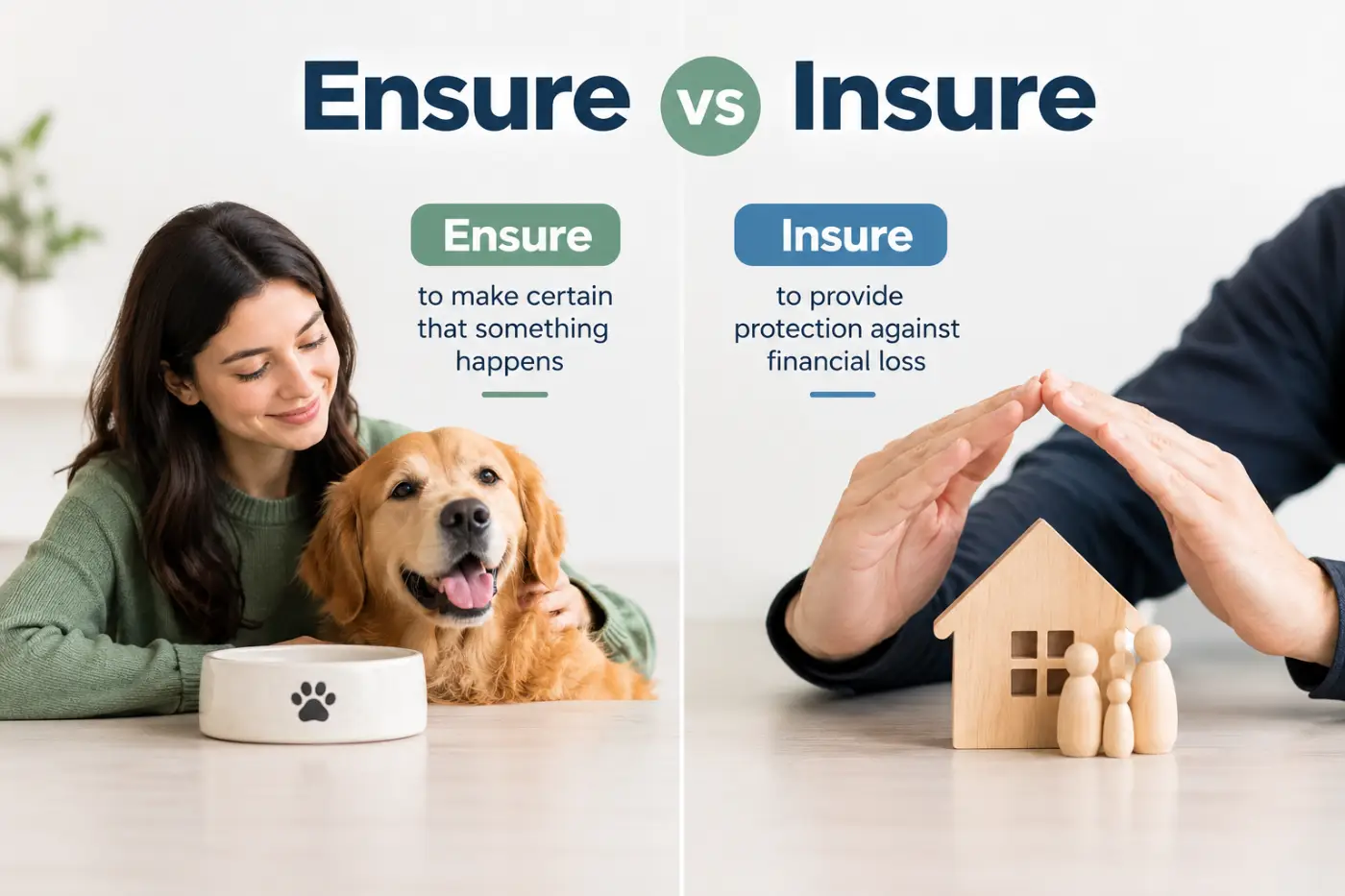
Ensure means to make certain that something happens or is true. You might ensure that a report is accurate or ensure that everyone receives the information. Insure usually relates to financial protection against loss or damage. You can insure your car your home or your business.
The confusion gets stronger because English has a third related word: assure. Assure usually means to tell someone confidently that something is true or will happen. So a manager might assure an employee that the meeting is still scheduled while taking steps to ensure the meeting runs smoothly.
In this guide, you’ll learn the exact difference between ensure and insure. You’ll also see how grammar, meaning, pronunciation, word history, American usage, common phrases, and real examples can help you choose the right word without second guessing yourself.
For another common grammar confusion, see Tear Vs Tare Which Word Is Correct 2026 Guide.
Quick Answer
Ensure means to make certain that something happens or is true. Insure usually means to protect against financial loss through an insurance policy. For example, you can ensure that your documents are safe by backing them up, but you insure your car against accidents or theft.
Ensure Vs Insure At A Glance
| Feature | Ensure | Insure |
|---|---|---|
| Correct spelling | Ensure | Insure |
| Main meaning | Make certain | Protect financially against loss |
| Part of speech | Verb | Verb |
| Pronunciation | /ɪnˈʃʊr/ | /ɪnˈʃʊr/ |
| Common use | Actions and outcomes | Insurance and financial protection |
| Example | Please ensure the door is locked. | We insure our vehicles. |
| Common noun | Assurance | Insurance |
| Typical context | Plans rules results safety | Cars homes health property business |
| Formality | Neutral and formal | Neutral and formal |
| American English | Common | Common |
| British English | Common | Common |
The important point is simple: ensure focuses on making something certain, while insure focuses on financial protection against risk.
What Does Ensure Mean
Ensure is a verb meaning to make certain that something happens or remains true.
It often describes an action taken to produce a desired result. The person using ensure usually has some control over the process.
For example:
Please ensure that all windows are closed before you leave.
The speaker isn’t talking about an insurance policy. The instruction means make certain that all windows are closed.
You can also use ensure with a noun phrase.
Good planning helps ensure success.
Here the meaning is close to help make success certain or more likely.
That distinction matters because ensure often appears in practical instructions and formal writing. You’ll see it in workplace documents academic writing government information technical instructions and everyday conversation.
Common patterns include:
ensure that + clause
Please ensure that everyone has signed the form.
ensure + noun
We need to ensure adequate ventilation.
ensure + adjective or condition
These checks ensure the system remains secure.
The word doesn’t describe buying protection from an insurer. Instead it describes an action that helps establish a particular condition or outcome.
Examples Of Ensure
- Please ensure that your name is spelled correctly.
- Check the lock to ensure the door is secure.
- We arrived early to ensure enough time for registration.
- The teacher reviewed the instructions to ensure everyone understood them.
- Save a copy of the file to ensure you don’t lose your work.
- The company introduced new checks to ensure product quality.
- Please ensure all payments are made on time.
- She called ahead to ensure the restaurant had a table available.
- The engineer tested the equipment to ensure it was working properly.
- Read the label carefully to ensure the product is suitable for your needs.
Notice the common idea. In every sentence someone takes an action to make something certain or secure.
What Does Insure Mean
Insure is a verb associated with insurance.
It generally means to arrange financial protection against a possible loss or risk. An insurance company provides that protection under an insurance policy.
For example:
We insure our house against fire and other covered risks.
The sentence refers to an insurance arrangement. The homeowner pays for coverage and the insurer agrees to provide financial protection under the terms of the policy.
You can insure many different things.
People commonly insure:
- Cars.
- Homes.
- Businesses.
- Property.
- Equipment.
- Vehicles.
- Valuable possessions.
You can also insure against particular risks.
The company insured itself against certain business losses.
In everyday American English insure is strongly associated with insurance policies and financial risk.
That association gives you a useful shortcut. If money compensation or an insurance policy is involved, insure is usually the word you want.
Examples Of Insure
- We insure both cars through the same company.
- She decided to insure her new home.
- The business insures its equipment against damage.
- They insure their warehouse against several risks.
- He forgot to insure the motorcycle before taking it on the road.
- The company insures thousands of commercial vehicles.
- You should check the policy before you insure additional property.
- The museum insured the valuable artwork during transportation.
- The landlord requires tenants to insure their personal belongings.
- The company chose to insure the building against fire damage.
These examples have a clear connection to insurance coverage.
Which One Is Correct
Both ensure and insure are correct English words. Neither is a misspelling of the other.
The correct choice depends on your meaning.
Use ensure when you mean make certain.
Please ensure that the lights are off.
Use insure when you mean provide or obtain financial protection through insurance.
We insure the house against fire.
A quick substitution test can help.
If you can replace the word with make certain without changing the basic meaning, use ensure.
We took extra steps to ensure safety.
You could say:
We took extra steps to make certain that everyone was safe.
If the sentence involves an insurance policy or financial coverage, insure is the natural choice.
We insure the property against theft.
You can’t naturally replace insure with make certain here. The meaning changes completely.
Ensure Vs Insure In Real Sentences
Seeing the two verbs side by side makes the distinction much easier to remember.
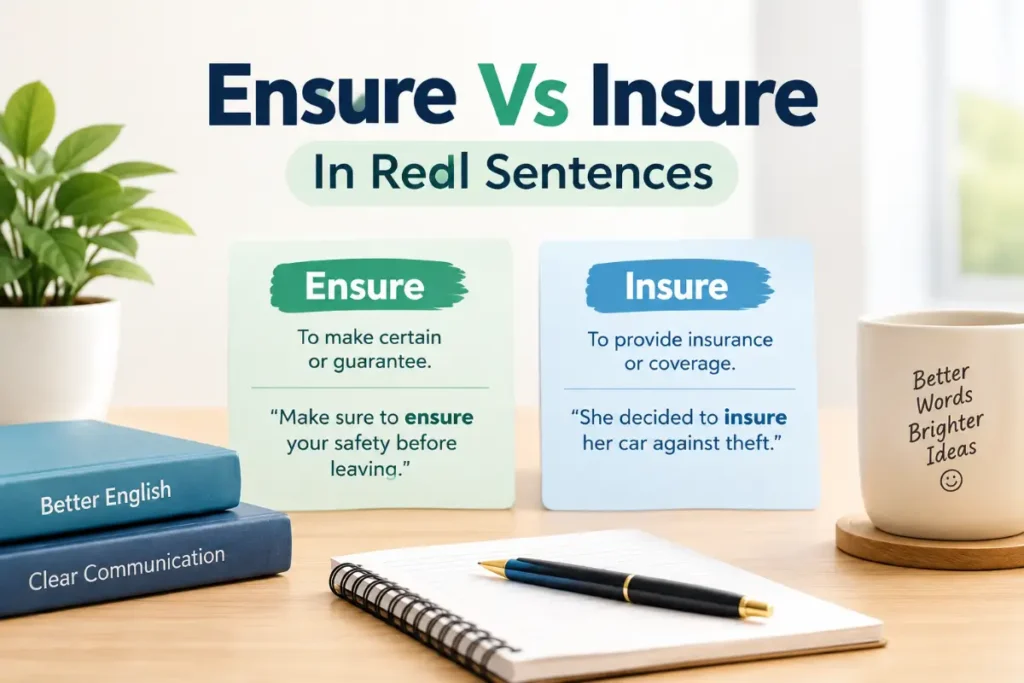
The technician checked the brakes to ensure they were working properly.
The owner decided to insure the car against theft.
The first sentence concerns an action taken to make a condition certain. The second concerns financial protection.
Consider another pair.
Please ensure that the package is delivered by Friday.
The company insured the shipment against damage.
The first sentence focuses on the desired outcome. The second focuses on financial protection if something goes wrong.
One more example shows how both words can appear naturally in the same context.
The company insured the building and introduced new safety checks to ensure that employees could work safely.
Here insured refers to an insurance arrangement. Ensure refers to taking practical steps to produce a safe condition.
That’s the core distinction in action.
Why People Confuse Ensure And Insure
The confusion isn’t surprising. These words are closely related historically and look almost identical on the page.
They Sound Similar
In many varieties of English ensure and insure have the same or nearly the same pronunciation.
Both are commonly pronounced:
/ɪnˈʃʊr/
They usually have two syllables:
en SURE
That means pronunciation won’t always help you choose the correct spelling.
When two words sound alike or nearly alike but have different meanings, writers often rely on context. That’s exactly what happens with ensure and insure.
They Look Almost Identical
The only major spelling difference is the vowel after the initial n.
ensure
insure
That small visual difference can disappear when you’re typing quickly.
A writer who knows the meaning perfectly well may still type the wrong form because the words have such similar shapes.
They Share A Historical Connection
The words aren’t random lookalikes. Their histories are closely connected.
Both developed from older forms related to ideas of making something certain or secure. Over time, modern English developed more specialized meanings for the two forms.
That historical relationship helps explain why their spelling and pronunciation remain so close.
Insurance Gives Insure A Strong Modern Association
Modern English has developed a very clear connection between insure and insurance.
The noun insurance makes the verb easy to recognize.
insure → insurance
That connection gives writers a useful memory aid.
By contrast:
ensure → make certain
The meanings have separated enough that choosing the right word now depends mainly on context.
Key Difference Between Ensure And Insure
The biggest difference is certainty versus financial protection.
Ensure Means Make Certain
When you ensure something you take action to make a result happen or a condition remain true.
The nurse checked the patient’s records to ensure the information was correct.
The nurse isn’t buying financial protection. The action aims to establish accuracy.
Insure Means Provide Financial Protection
When you insure something you arrange coverage against specified risks.
The owner insured the building against fire.
The building has financial protection under an insurance arrangement.
A Simple Comparison
Think of ensure as taking steps before a desired result.
Think of insure as arranging protection in case something goes wrong.
That distinction works in most everyday situations.
Ensure Vs Insure In Workplace Writing
Professional writing often uses ensure because businesses frequently discuss procedures quality safety compliance and results.
For example:
Employees must ensure that all records are complete.
Managers should ensure that safety procedures are followed.
The editor reviewed the figures to ensure accuracy.
These sentences describe actions designed to produce a reliable result.
Insure appears when the workplace discussion turns to actual insurance.
The company insures its delivery vehicles.
Contractors must provide proof that their equipment is insured.
The business insured the property against covered losses.
A useful editing question is this: Is the sentence about making something happen or protecting against financial loss?
If it’s about making something happen, ensure usually fits. If it’s about insurance coverage, insure usually fits.
Ensure Vs Insure In Formal Writing
Both words are completely acceptable in formal writing. The challenge isn’t formality. It’s precision.
Academic writers often use ensure when discussing conditions or outcomes.
Researchers must ensure that participants understand the instructions.
Business writers use ensure for procedures and standards.
The quality control team must ensure consistency across all batches.
Insurance documents use insure for coverage.
The policyholder must insure the property according to the terms of the agreement.
Editors don’t replace one with the other simply because one sounds more formal. The meaning decides the word.
That’s an important writing principle: choose the word that expresses the exact relationship you mean rather than choosing the word that merely looks or sounds more sophisticated.
Grammar Of Ensure
Ensure is a regular transitive verb. It commonly takes an object or a clause describing the result that someone wants to make certain.
The most common structure is:
ensure that + clause
Please ensure that the door is locked.
We need to ensure that the data is accurate.
She checked the schedule to ensure that everyone knew the meeting time.
You can also use ensure + noun phrase.
These procedures ensure quality.
The system ensures data security.
In many cases ensure is followed by that because the writer wants to state the specific result being made certain.
Ensure With Infinitives
You may sometimes see constructions such as:
We took steps to ensure everyone received the message.
You can also encounter:
We took steps to ensure that everyone received the message.
The second version makes the grammatical relationship especially clear. Both patterns can occur in standard English.
Ensure In Different Tenses
Because ensure is a regular verb its basic forms are easy to remember.
Present: ensure.
We ensure that every order is checked.
Past: ensured.
We ensured that every order was checked.
Present participle: ensuring.
We are ensuring that every order is checked.
Past participle: ensured.
The process has ensured consistent results.
The same pattern applies to insure.
Present: insure.
Past: insured.
Present participle: insuring.
Past participle: insured.
Grammar Of Insure
Insure is also a regular transitive verb.
It can take a direct object.
They insured the building.
It can also appear with against when the writer identifies a risk.
They insured the building against fire.
Another common structure uses a passive form.
The vehicle is insured.
The property was insured against theft.
The word insured can therefore function as the past tense or past participle of insure.
Context usually makes the meaning clear.
We insured the car last month.
Here insured is the past tense.
The car is insured.
Here insured is part of a passive or adjectival construction describing the car’s insurance status.
Ensure Vs Insure And Assure
There’s a third word that belongs in this discussion: assure.
This is one of the most useful distinctions for English learners because ensure, insure, and assure are related in form but serve different purposes.
Ensure means make certain.
The checklist helps ensure accuracy.
Insure means protect financially through insurance.
We insure the property.
Assure generally means tell someone confidently that something is true or will happen.
I assure you that everything is ready.
The simplest way to remember the three is:
Ensure an outcome.
Insure against financial loss.
Assure a person.
That isn’t an absolute rule for every historical or specialized use, but it’s an excellent guide for modern standard English.
Compare All Three
The technician checked the equipment to ensure it was safe.
The company insured the equipment against certain losses.
The technician assured the customer that the equipment was safe.
The grammar and meaning change with each verb.
This three word distinction is especially valuable in professional editing because replacing one with another can create a subtle but real change in meaning.
Pronunciation Guide For Ensure And Insure
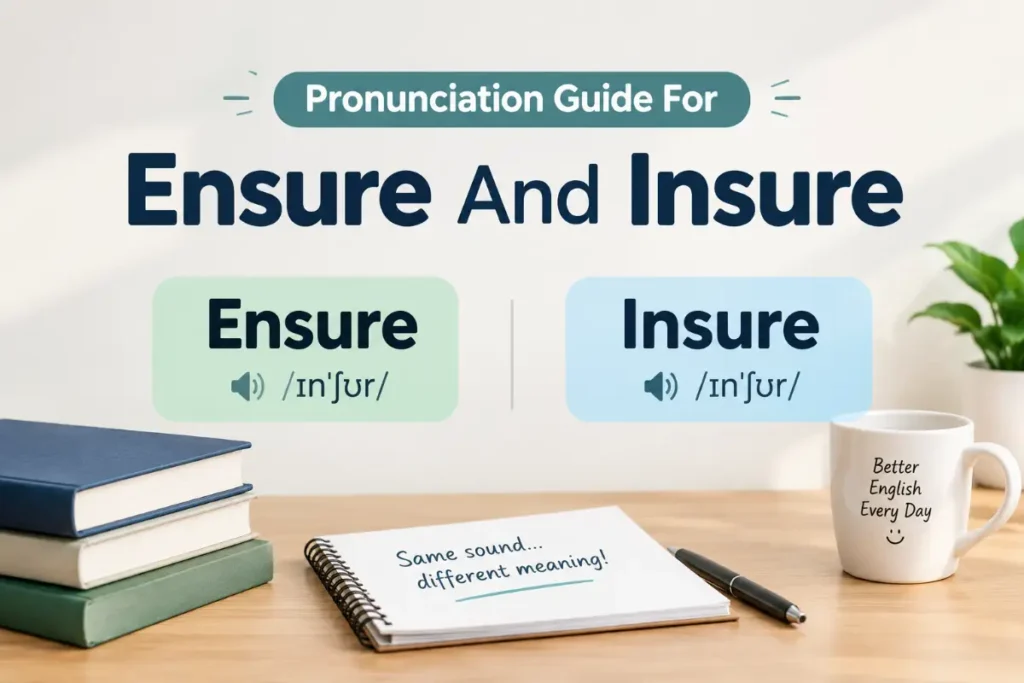
In many forms of English the two words are pronounced the same or very similarly.
Ensure: /ɪnˈʃʊr/
Insure: /ɪnˈʃʊr/
They normally have two syllables.
en SURE
in SURE
The main stress falls on the second syllable.
The final sound comes from the sure part of each word.
Because pronunciation can overlap so closely, spelling and meaning matter more than sound when you’re choosing between them.
Common Pronunciation Mistake
Some learners try to pronounce the words so differently that listeners can clearly hear the spelling distinction.
That isn’t necessary.
In standard American English the pronunciation difference may be minimal or nonexistent. Native speakers generally rely on context to understand which word is intended.
This is another reason memorizing the meaning is more useful than trying to create an artificial pronunciation difference.
Spelling Rules For Ensure And Insure
There isn’t a special spelling rule that lets you generate one form from the other. The safest approach is to connect each spelling with its meaning.
Ensure contains sure.
You can think:
ensure = make sure.
That is an especially useful memory connection because ensure and make sure often express nearly the same idea.
Insure connects directly with insurance.
Think:
insure = insurance.
These two associations are simple but powerful.
When you’re editing quickly you don’t need to remember the entire history of the words. You only need a reliable mental hook.
British And American English
Both ensure and insure are standard words in American and British English.
The basic distinction between them remains useful in both varieties.
American English commonly uses ensure to mean make certain and insure in connection with insurance.
British English follows the same broad distinction. However, British dictionaries and style resources also document insure in some broader uses connected with making something certain or secure.
That broader historical usage can sometimes create confusion for learners who expect a perfectly strict separation.
For modern general writing the clearest approach is still:
Use ensure for make certain.
Use insure for insurance and financial protection.
This advice works well across American English and general international English.
Canadian and Australian English also use both forms with the same central distinction. Regional usage can contain historical variations but doesn’t change the practical rule most writers need.
Real Life Examples Of Ensure And Insure
The best way to make the distinction stick is to see the words doing different jobs in realistic settings.
Daily Conversation
Make sure you call me to ensure I know when you’re arriving.
I need to insure the new car before I drive it regularly.
She checked the address twice to ensure the package went to the right place.
We insured our belongings before moving overseas.
Workplace Communication
Please ensure that the report is ready by Friday.
The company insures all company owned vehicles.
Managers must ensure that employees receive the required training.
The contractor insured the equipment used on the construction site.
Email Writing
Please ensure that you attach the latest version of the document.
Could you confirm that the vehicle is fully insured before delivery?
We added another review step to ensure accuracy.
The client asked us to insure the shipment during transportation.
Academic Writing
Researchers must ensure that their methods are clearly documented.
The study included several controls to ensure reliable results.
Institutions often insure specialized equipment against damage.
The laboratory insured its expensive instruments against specified risks.
Journalism
Officials introduced new measures to ensure public safety.
The company insured the facility against several major risks.
The new procedure aims to ensure faster processing.
The organization confirmed that its properties are insured.
Social Media
Double check your settings to ensure your account stays secure.
I finally insured my car after putting it off for weeks.
A quick backup can help ensure you don’t lose your photos.
Our small business is insured now so we can focus on the next project.
These examples show why the words can’t simply be treated as interchangeable spellings. Their meanings guide their use.
A Practical Test For Choosing Ensure Or Insure
When you’re stuck between the two, don’t stare at the spelling. Look at the sentence’s meaning.
Ask yourself one question:
Am I talking about making something certain or arranging insurance protection?
If you’re talking about making something certain, choose ensure.
We checked everything to ensure the plan was ready.
If you’re talking about insurance coverage, choose insure.
We insured the building before opening the business.
There’s also an even faster test.
Replace the verb mentally with make certain.
If the sentence still makes sense, ensure is probably correct.
Replace the verb mentally with cover financially through insurance.
If that fits, insure is the better choice.
This kind of substitution test is often more reliable than trying to memorize isolated definitions. It connects the word directly to the meaning you want to express.
Ensure Vs Insure In Common Phrases
Some word combinations appear so often that they can help you choose the correct verb almost automatically. Learning these common phrases is more useful than memorizing definitions alone.
Common Phrases With Ensure
You’ll often see ensure with words related to results conditions quality safety and accuracy.
Common combinations include:
- ensure accuracy.
- ensure safety.
- ensure quality.
- ensure consistency.
- ensure compliance.
- ensure success.
- ensure security.
- ensure access.
- ensure fairness.
- ensure availability.
- ensure proper use.
- ensure that something happens.
- take steps to ensure.
- measures to ensure.
- checks to ensure.
For example:
The editor checked every figure to ensure accuracy.
The company added new safeguards to ensure customer security.
Please take steps to ensure that all files are backed up.
These phrases all focus on creating or maintaining a desired result.
Common Phrases With Insure
Insure commonly appears with words connected to property risk coverage and financial protection.
Common combinations include:
- insure a car.
- insure a home.
- insure property.
- insure a business.
- insure equipment.
- insure a vehicle.
- insure valuable items.
- insure against theft.
- insure against fire.
- insure against damage.
- insure against loss.
- be fully insured.
- be adequately insured.
- keep something insured.
- get something insured.
For example:
The homeowner insured the property against fire.
The company keeps all its vehicles insured.
You should check that your equipment is adequately insured.
These combinations point toward insurance coverage rather than simply making something certain.
For another common grammar confusion, see Propose Vs Purpose Which Word Should You Use.
Ensure Vs Insure In Different Contexts
Context can make the distinction almost effortless.
Safety
Use ensure when you mean taking action to make something safe or certain.
Please check the brakes to ensure your car is safe to drive.
Use insure when you’re talking about financial protection for the car.
We insure the car against theft and collision.
The first sentence concerns physical safety. The second concerns financial coverage.
Security
Ensure can describe actions that create security.
Strong passwords help ensure account security.
Insure can describe financial protection against certain losses.
The business insured its computer equipment against theft.
Security and insurance can appear in the same conversation. They still describe different ideas.
Success
Use ensure with success.
Careful preparation can help ensure success.
You generally wouldn’t use insure here in ordinary modern American English.
The sentence isn’t about an insurance policy. It’s about taking steps that improve the chance of a successful outcome.
Protection
This context needs a little more care because ensure and insure can both appear near the word protection.
The lock helps ensure the protection of the equipment.
The company insured the equipment against theft.
The first describes a practical measure. The second describes financial protection through insurance.
Risk
Insure commonly appears when the risk has a financial dimension.
The company insured itself against certain losses.
However, ensure can appear when someone takes action to prevent or manage a risk.
The new procedures help ensure that safety risks are identified early.
So don’t let the word risk automatically push you toward insure. Look at the actual action in the sentence.
Ensure Vs Insure In Business English
Business writing provides some of the clearest examples because companies regularly discuss both procedures and insurance.
Consider this sentence:
The company introduced quality checks to ensure that every product meets its standards.
The company is taking an action to produce a desired result.
Now compare:
The company insured its inventory against certain covered losses.
The company has arranged financial protection.
Both sentences are perfectly natural. They simply answer different questions.
Ensure often appears with:
quality
accuracy
compliance
safety
security
consistency
availability
success
access
reliability
Insure often appears with:
property
vehicles
equipment
buildings
inventory
businesses
assets
shipments
homes
cars
Professional editors pay attention to these word partnerships because they reveal intended meaning very quickly.
Ensure Vs Insure In Academic Writing
Academic writing usually favors ensure when researchers describe methods designed to maintain accuracy or reliability.
For example:
Researchers used multiple checks to ensure the accuracy of the results.
The study design was carefully reviewed to ensure consistency.
Participants received clear instructions to ensure that the procedure was followed correctly.
Insure can appear in academic writing when the subject involves insurance or financial risk.
The institution insured the research equipment against damage.
The study examined how businesses insure commercial property.
If you’re writing an essay or research paper about methods quality or reliability, ensure will often be the appropriate choice.
Ensure Vs Insure In Emails
Email writing often creates small word choice problems because people type quickly.
Suppose you’re sending instructions to a coworker.
Please ensure that the final document includes the updated figures.
That’s correct because you’re asking the person to make something certain.
Now imagine you’re discussing a company vehicle.
Please confirm that the vehicle is insured before it leaves the office.
That’s correct because the topic is insurance coverage.
A useful editing habit is to read the entire sentence rather than checking only the word. Context usually makes the answer obvious.
Ensure Vs Insure In Formal And Informal English
Neither word is especially informal or slangy. Both are standard English verbs.
Ensure works comfortably in everyday speech.
Make sure you lock the door.
In fact, make sure is often more natural in casual American conversation than ensure.
You might hear:
Make sure you bring your ID.
A formal document might say:
Please ensure that you bring valid identification.
Both communicate essentially the same basic idea.
Insure remains natural in conversations about insurance.
Did you insure the new car yet?
Yes. It’s fully insured.
The word doesn’t require a formal setting.
Ensure And Make Sure
One of the easiest ways to understand ensure is to compare it with make sure.
In many contexts:
ensure = make sure
For example:
Please ensure that the door is locked.
Please make sure that the door is locked.
The second sentence sounds more conversational. The first can sound more formal or concise.
This doesn’t mean ensure is always better for professional writing. Good editors choose based on tone and context.
If you’re writing an everyday message to a friend, make sure may sound more natural.
If you’re writing instructions for a manual, report, policy, or formal email, ensure may fit the tone better.
Ensure Vs Insure And Assure In One Sentence
Sometimes all three words can appear in one discussion.
Imagine a company manager speaking to an employee about a business trip.
I assure you that the vehicle is ready. We’ve checked it carefully to ensure it’s safe. The company also insures the vehicle against covered losses.
Each verb has a distinct job.
Assure addresses a person.
Ensure addresses a condition or outcome.
Insure addresses financial protection.
This distinction is worth remembering because these three verbs are often taught together.
The Three Word Memory Rule
Think of the first letters this way:
A = assure a person.
E = ensure an outcome.
I = insure financially.
It isn’t a complete dictionary definition of each word. It’s a practical writing shortcut.
Common Mistakes With Ensure And Insure
The most common mistake is using insure when the sentence means make certain.
Incorrect:
Please insure that the door is locked.
Better:
Please ensure that the door is locked.
The sentence isn’t discussing an insurance policy. It’s asking someone to make certain that the door is locked.
Another common mistake goes in the opposite direction.
Incorrect:
We ensured the car against theft.
Better:
We insured the car against theft.
The sentence describes financial protection. Therefore insure is the natural verb.
Mistake With The Word Insurance
Because insurance comes from insure, writers sometimes use ensure when discussing an insurance policy.
Incorrect:
The property is fully ensured.
Better:
The property is fully insured.
Insured is the normal form when describing something covered by insurance.
Mistake With The Word Assure
Another error occurs when writers use ensure for a person.
For example:
I ensured him that everything was fine.
In standard modern English the usual choice is:
I assured him that everything was fine.
That’s because assure commonly means to tell someone confidently that something is true.
Internet Myths About Ensure And Insure
Online explanations sometimes make the distinction sound more rigid than actual English usage.
One common claim says ensure always means certainty while insure can only refer to insurance.
That works well as a practical rule for modern general writing. However, historical dictionaries record broader uses of insure connected with making something certain or secure.
For most American readers this historical detail shouldn’t change everyday word choice. If you’re writing about insurance use insure. If you mean make certain use ensure.
Another internet myth says that the words must have different pronunciations.
They often don’t.
In many varieties of English the two verbs are pronounced identically or nearly identically. Context carries much of the meaning.
A third myth suggests that using insure for ensure is always simply a spelling mistake.
That’s too simplistic. The words are both legitimate English verbs. The issue is word choice based on meaning.
Etymology And Word Origin
The history of ensure and insure helps explain their close relationship.
Both words developed from Old French forms connected with ideas of making something certain or secure. Their histories also connect with the Latin word securus, meaning safe or free from concern.
Over time English developed different spellings and specialized uses.
Ensure became strongly associated with making something certain.
Insure became strongly associated with protection against financial risk and eventually with modern insurance.
The noun insurance strengthened that connection.
This history explains why the two words still look so similar today. They’re not unrelated words that happen to share several letters. Their forms and meanings have developed along connected paths.
Why Word History Matters
Etymology can explain a word’s shape but shouldn’t override modern usage.
English changes over time. A word may have broader meanings in older texts or dictionaries than it normally has in contemporary American writing.
For a modern writer the practical distinction remains more useful than the historical overlap.
British American Canadian And Australian English
The central distinction between ensure and insure works across major English varieties.
American English commonly uses:
ensure = make certain.
insure = provide insurance.
British English uses the same distinction in everyday modern writing.
Canadian English and Australian English also use both verbs.
There can be differences in style and historical usage across dictionaries and regional writing traditions. Still, writers don’t need a different everyday rule for each country.
For an international audience the safest clear usage is:
Ensure means make certain.
Insure relates to insurance.
That choice will be understood naturally by English speakers across these major varieties.
When Ensure And Insure Can Both Appear
A sentence can contain both words without sounding repetitive because the verbs can describe different actions.
The company insured the building and installed alarms to ensure its security.
The company uses insurance to provide financial protection. The alarms provide a practical security measure.
Another example:
We insured the equipment and created a maintenance schedule to ensure it remained in good condition.
Again the two verbs have separate meanings.
This is a useful reminder that synonyms aren’t always interchangeable. Two words can overlap in a broad idea such as protection while still performing different jobs in a sentence.
Memory Tricks For Ensure And Insure
A good memory trick should be quick enough to use while writing.
Remember Ensure With Sure
The word ensure contains sure.
Think:
ensure = make sure.
Ensure the door is locked.
Make sure the door is locked.
This is probably the most useful memory trick for everyday writing.
Remember Insure With Insurance
The word insure connects directly with insurance.
Think:
insure = insurance.
insure a car.
car insurance.
If money and an insurance policy enter the picture, insure should immediately come to mind.
Remember The Three E I A Words
For the three commonly confused verbs:
Assure a person.
Ensure a result.
Insure against financial loss.
That short pattern can save you from a surprisingly common editing mistake.
Related Words You Should Know
Understanding related words can make the distinction even clearer.
Assurance
Assurance is the noun related to assure.
It can mean confidence or a statement intended to reassure someone.
She gave me assurance that the work would be completed.
Insurance
Insurance is the noun associated with insure.
It refers to financial protection arranged through an insurance contract or policy.
We renewed our home insurance last month.
Ensure
The noun ensurance exists but is uncommon in ordinary modern English.
Native speakers usually express the idea with phrases such as assurance, guarantee, confirmation, or steps to ensure depending on the intended meaning.
This is a useful editorial point. A grammatically possible form isn’t automatically the most natural choice.
Assure
Assure usually involves communicating confidence to another person.
I assure you that the information is accurate.
Make Sure
Make sure is the everyday conversational alternative to ensure.
Make sure you save the file.
Ensure that you save the file.
The first sounds more casual. The second sounds more formal.
Synonyms For Ensure
Depending on context, synonyms for ensure include:
- make certain.
- make sure.
- guarantee.
- secure.
- confirm.
- establish.
- safeguard.
- verify.
These aren’t perfect replacements in every sentence.
For example, verify means check that something is true. It doesn’t always mean take action to make it true.
Similarly, guarantee can suggest a stronger promise than ensure.
Good writers pay attention to these shades of meaning rather than treating synonyms as identical.
Synonyms And Related Terms For Insure
Words related to insure include:
- cover.
- protect.
- underwrite.
- indemnify.
- insure against.
- provide insurance.
- obtain coverage.
- carry insurance.
Again, these words aren’t interchangeable in every grammatical structure.
For example:
The company insured the building.
You could say:
The company obtained insurance coverage for the building.
But underwrite has a more specialized meaning in the insurance industry and shouldn’t replace insure casually.
Internal Link Opportunity
If your site covers commonly confused English words, this is a natural place to link to an article about assure vs ensure vs insure. That page can explain the three way distinction in greater detail and help readers who still confuse all three verbs.
A second useful internal link would be an article about ensure vs assure. The comparison can focus on the difference between making something certain and giving someone confidence.
Expert Editor’s Note
From an editor’s perspective the best rule is also the simplest one.
Use ensure when your sentence means make certain.
Use insure when your sentence involves insurance or financial protection against risk.
Don’t choose based on which spelling looks more familiar. Don’t force a pronunciation difference that native speakers may not make. Instead, identify the action described by the verb.
Professional dictionaries support the core distinction found in modern standard English. They also document historical or less common uses that can make online explanations seem contradictory. For ordinary American writing those broader historical meanings rarely create a practical problem.
One editorial habit is especially useful: check the words around the verb.
If you see accuracy, safety, quality, compliance, success, or access, ensure will often make sense.
If you see insurance, policy, coverage, premium, claim, property, vehicle, or risk of financial loss, insure will usually fit.
This isn’t a rigid grammar formula. It’s a pattern based on real usage.
Most importantly, don’t treat ensure and insure as correct versus incorrect spelling. Both are correct spellings. The real issue is choosing the word that matches your meaning.
FAQs About Ensure Vs Insure
Is ensure the same as insure
No. Ensure usually means to make certain that something happens or remains true. Insure usually refers to arranging financial protection through insurance. For example, you can ensure that your car is locked, but you insure the car against covered risks. The words are related but have different modern meanings.
Should I use ensure or insure
Use ensure when you mean make certain or make sure. Use insure when you’re talking about insurance coverage or financial protection against loss. A quick test is to replace the word with make sure. If that works naturally, ensure is probably the right choice.
Is it correct to say ensure a car
Yes, but the meaning matters. You can say ensure that the car is safe or ensure that the car is locked. If you mean financial protection through an insurance policy, use insure instead: insure the car against theft.
Is it insure or ensure safety
Ensure safety is the normal phrase when you mean take steps to make something safe. For example, The new rules help ensure workplace safety. You’d use insure only if you’re discussing financial protection connected with insurance rather than the practical condition of being safe.
Is it ensure or insure success
The standard choice is ensure success when you mean make success certain or help secure a successful result. For example, Careful planning can help ensure success. Insure success isn’t the normal choice in ordinary modern American English when no insurance meaning is intended.
Is insure a synonym for ensure
Not in ordinary modern usage. The words have related histories and some dictionaries record broader historical uses of insure. However, contemporary American writers generally use ensure for making something certain and insure for insurance. Following that distinction keeps your writing clear and avoids confusion.
What is the difference between ensure and assure
Ensure means make something certain. Assure usually means tell someone confidently that something is true or will happen. For example, The checklist helps ensure accuracy focuses on a result. I assure you the report is accurate focuses on communicating confidence to a person.
What is the difference between insure and assure
Insure usually concerns financial protection through insurance. Assure usually concerns giving a person confidence or removing their doubts. You might insure your home against damage while assuring your customer that the repair will be completed.
Are ensure and insure pronounced the same
In many forms of English they are pronounced the same or almost the same. Both are commonly represented as /ɪnˈʃʊr/ in American English. Because pronunciation doesn’t reliably separate them, writers should focus on meaning and context when choosing the spelling.
Is ensured the past tense of ensure
Yes. Ensured is the regular past tense and past participle of ensure. For example, The editor ensured that every fact was checked. The corresponding forms of insure are insured and insured. For example, The company insured the vehicle last year.
Can ensure and insure appear in the same sentence
Yes. They can appear together when they describe different actions. For example, The company insured the equipment and introduced new checks to ensure it remained secure. Here insured refers to financial protection while ensure refers to creating or maintaining a particular condition.
Which word should I use in formal writing
Use the word that matches your meaning. Ensure is appropriate for formal writing when you mean make certain. Insure is appropriate when you’re discussing insurance. Formal writing doesn’t make the words interchangeable. Precision matters more than choosing the word that sounds more official.
Need another quick comparison? Read Take Affect Vs Take Effect Which One Is Correct 2026.
Conclusion
The difference between ensure vs insure becomes much easier once you focus on meaning instead of spelling.
Ensure means make certain. Use it for results conditions safety accuracy quality and other outcomes.
Insure relates to insurance and financial protection. Use it when someone arranges coverage against loss damage or another specified risk.
The easiest memory trick is simple: ensure means make sure, while insure connects with insurance.
One common mistake is using insure when you simply mean make certain. Another is using ensure when you’re talking about an insurance policy. Keep those two meanings separate and you’ll avoid most errors.
When in doubt, ask yourself what action the verb describes. Are you making something certain or arranging financial protection? Once you answer that question, the right word is usually clear.
Ensure the meaning is right and the spelling will follow.

Editorial Reviewer & Proofreader
Grace Mitchell reviews Gramlify’s articles for clarity, consistency, and readability. She is passionate about creating accurate, approachable content that helps English learners build confidence.