
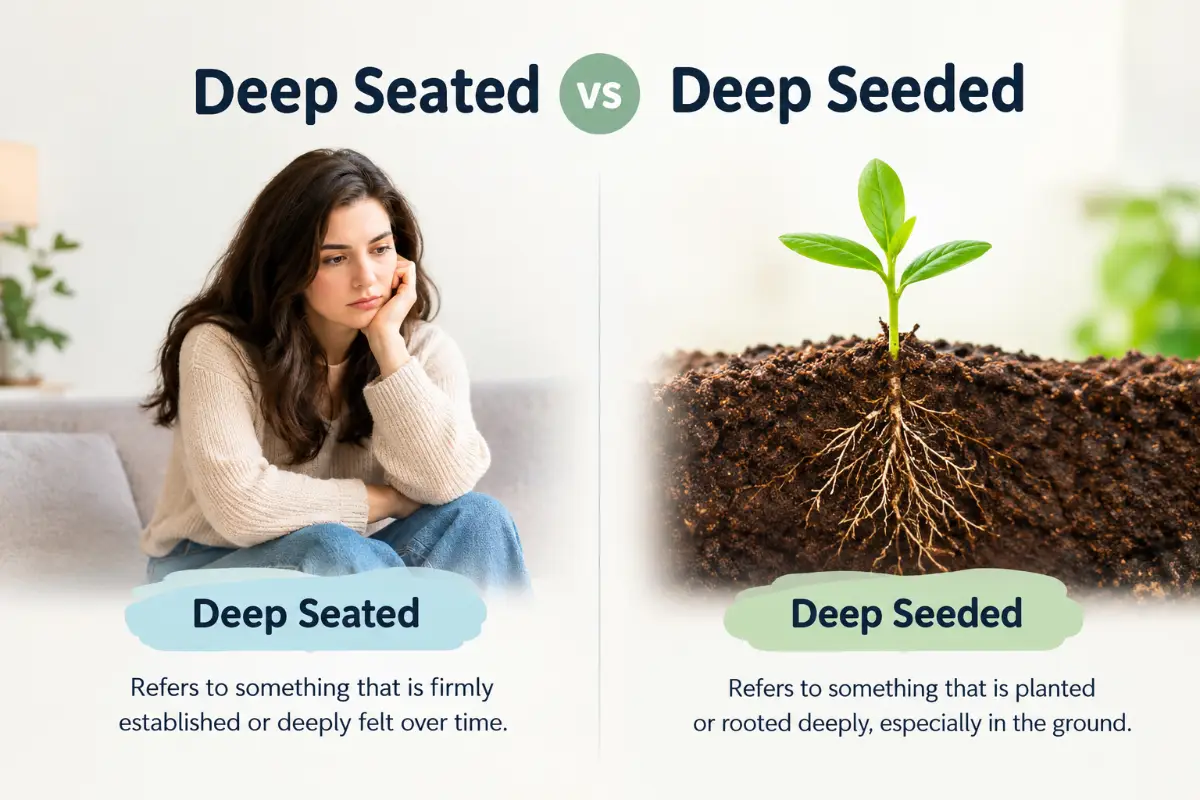
When you’re trying to describe a belief, fear, problem, or feeling that has existed for a long time, deep seated vs deep seeded can cause an easy spelling mistake. The two forms sound the same in normal speech, and the word seeded seems logical because seeds can grow deep into the ground. However, the standard expression is deep seated.
The expression describes something that is firmly established, strongly felt, or difficult to change. You can talk about a deep seated fear, a deep seated belief, a deep seated problem, or deep seated resentment. Major dictionaries including Cambridge and Oxford define the expression in terms of something strongly fixed or difficult to change.
The confusion comes from the fact that seated and seeded are both real English words. They simply do different jobs. Seated comes from the verb seat, while seeded comes from the verb seed. Once you understand that difference, the correct form becomes much easier to remember.
This guide explains the meaning, grammar, pronunciation, history, spelling, common mistakes, real life examples, and related expressions so you can use the phrase confidently in everyday and formal writing.
Still confused? Compare Rug Vs Rag Key Differences Explained 2026 Guide.
Quick Answer
Deep seated is the standard expression when you mean something firmly established, strongly felt, or difficult to change. Deep seeded is normally a mistaken version of the phrase. The confusion happens because both forms sound alike and because seeded seems to fit the idea of something growing deep. Use deep seated in edited English.
Deep Seated Vs Deep Seeded Comparison
| Feature | Deep seated | Deep seeded |
|---|---|---|
| Standard expression | Yes | No |
| Meaning | Firmly established or deeply rooted | Not normally used for this meaning |
| Part of speech | Adjective phrase | Not the standard phrase |
| Common use | Feelings, beliefs, problems, attitudes, fears | Usually a mistaken form |
| Pronunciation | Same as the mistaken form in ordinary speech | Same |
| Formal writing | Appropriate | Avoid it |
| Academic writing | Appropriate | Avoid it |
| Common context | Deep seated fear or deep seated belief | Usually appears as a spelling error |
| Dictionary support | Listed by major dictionaries | Not recognized as the standard expression |
| Related expression | Deep rooted | Deeply seeded can describe seeds in some contexts |
The key difference is simple. Deep seated is the established expression used to describe something firmly fixed or deeply rooted. Cambridge defines it as something strongly felt or believed and difficult to change or get rid of. Oxford similarly defines it as something very fixed and strong that is difficult to change or destroy.
Deep seeded can look reasonable at first glance, but it changes the underlying word from seated to seeded. That creates a different grammatical and semantic idea.
What Does Deep Seated Mean?
Deep seated is an adjective expression that describes something firmly established at a deep level.
It often refers to emotions, beliefs, attitudes, fears, habits, disagreements, problems, or other conditions that have become firmly fixed. Cambridge gives examples involving faith, loathing, prejudice, beliefs, and problems.
For example:
She has a deep seated fear of public speaking.
This means her fear isn’t just a passing nervous feeling. It is strongly established and may be difficult to overcome.
You can also use the expression for ideas and beliefs.
He has a deep seated belief in personal responsibility.
The belief is deeply established in his thinking.
The expression can also describe problems.
The organization has deep seated communication problems.
Here, the writer means the problems aren’t superficial or recent. They are firmly established within the organization.
Oxford gives a similar meaning and notes that the expression describes something very fixed and strong that is difficult to change or destroy.
The Basic Meaning
A useful way to understand the phrase is this:
Deep seated means firmly established deep within something.
That something might be a person’s mind, emotions, behavior, beliefs, or a larger system.
The word deep suggests depth.
The word seated suggests something firmly placed.
Together, the expression creates the idea of something that has settled deeply and isn’t easy to move.
That image is important because it explains why seated is the correct word.
What Does Deep Seeded Mean?
Deep seeded is commonly written as a mistaken version of deep seated when people want to describe something deeply established.
The word seeded itself is completely legitimate English. It simply doesn’t normally express the meaning intended in this phrase.
For example:
The farmer seeded the field in early spring.
Here, seeded comes from seed. It means that seeds were planted.
You can also use seeded in sports.
The team was seeded first in the tournament.
In that sentence, seeded refers to a ranking or placement system.
So the problem isn’t that seeded is an incorrect English word. The problem is using it in the established expression deep seated.
This distinction matters. Many spelling mistakes involve a perfectly valid word being placed in the wrong expression. English has plenty of these traps because words can sound identical while carrying different meanings.
Why Deep Seated Is Correct
The answer becomes clearer when you look at the history and meaning of seated.
The expression comes from the idea of something being placed or located deeply. Etymonline traces deep seated to the eighteenth century and explains that the original sense referred to something with its root far below the surface. The figurative meaning developed from that physical idea into something firmly implanted or established.
That figurative meaning is still alive today.
A deep seated belief is firmly established in someone’s thinking.
A deep seated fear is firmly established in someone’s emotional response.
A deep seated problem is firmly established within a situation.
The expression therefore has a strong connection to the idea of something sitting deeply in place.
That is why seated fits the phrase.

Why People Write Deep Seeded
The mistake makes sense once you look at how English speakers process language.
People often understand a deep belief or deep fear as something that has been planted in the mind. Since seeds are planted and then grow, seeded can feel like the natural choice.
For example, a writer may think:
This belief was planted deeply.
That mental picture can easily lead to:
deep seeded belief
The problem is that the established English expression doesn’t come from the idea of planting a seed. It comes from the idea of something being deeply seated or firmly placed.
This is a classic example of a word substitution caused by meaning rather than simple carelessness.
Visual Similarity
The words seated and seeded look similar.
Both begin with see when pronounced in many forms of English.
Both end with ed.
Both can function as participial forms.
That visual similarity makes the error easy to overlook during proofreading.
Pronunciation Similarity
In ordinary speech, seated and seeded can sound extremely similar.
The Cambridge pronunciation for deep seated is /ˌdiːpˈsiː.tɪd/ in British English and /ˌdiːpˈsiː.t̬ɪd/ in American English.
That creates a classic spelling problem. You may know exactly what you want to say but still choose the wrong spelling when you write it down.
The Seed Metaphor
The word seeded also feels attractive because English often uses plant imagery to describe ideas.
We talk about:
- Planting an idea.
- Growing an idea.
- Nurturing an idea.
- Rooting out a problem.
- Deep rooted beliefs.
Because of these familiar metaphors, deep seeded can feel perfectly natural even though deep seated is the standard expression.
Deep Seated Vs Deep Seeded Meaning
The meanings become much easier to separate when you examine the individual words.
Seated comes from seat. In its basic sense, it describes something that is sitting or placed in a particular position. It can also develop figurative meanings connected with something being firmly established.
Seeded comes from seed. It relates to planting seeds, producing seeds, or assigning a position in a competition.
These meanings aren’t interchangeable.
Consider these examples:
She has a deep seated fear of flying.
The fear is firmly established.
The garden was deeply seeded before the rainy season.
Here, the writer could be describing seeds placed deeply in soil. The construction is possible in a literal context, although another wording may often sound more natural.
Now compare:
The company has deep seeded problems.
The intended meaning is almost certainly deep seated problems.
The writer isn’t talking about seeds. The writer means problems that are firmly established.
Is Deep Seated One Word Or Two Words?
This is another point that often causes confusion.
Major dictionaries list deep seated as a hyphenated compound adjective. However, since this guide follows your requested style of avoiding hyphens, the phrase is written as deep seated throughout this article.
In edited writing, follow the spelling used by the dictionary or style guide you use. Cambridge, Oxford, Dictionary.com, and American Heritage all recognize the established expression.
The important point for a learner is that seated is the key word.
Don’t replace it with seeded just because the latter seems to make sense.
Deep Seated Grammar
Deep seated functions as an adjective expression.
It normally appears before a noun.
For example:
She has a deep seated fear.
He expressed a deep seated concern.
The country faces deep seated divisions.
They discovered a deep seated problem.
The expression can also appear after a linking verb.
His resentment is deep seated.
The conflict is deep seated.
The noun that follows can be a feeling, belief, problem, attitude, conflict, fear, concern, habit, prejudice, or another condition that can become firmly established.
Common Nouns With Deep Seated
Some combinations are especially natural in English.
Deep seated fear refers to a strong fear that is firmly established.
Deep seated belief refers to a belief that is strongly held.
Deep seated resentment refers to resentment that has existed for a long time or has become firmly established.
Deep seated prejudice refers to prejudice that is deeply ingrained.
Deep seated problem refers to a problem that is established at a fundamental level.
Deep seated concern refers to a serious concern that runs deep.
Deep seated conflict refers to a conflict with underlying and persistent causes.
Deep seated insecurity refers to an insecurity that is firmly rooted in someone’s feelings or thinking.
These combinations work because the adjective describes something that isn’t merely temporary or superficial.
Deep Seated Pronunciation
The pronunciation of deep seated is straightforward.
Cambridge gives the pronunciation as:
British English: /ˌdiːpˈsiː.tɪd/
American English: /ˌdiːpˈsiː.t̬ɪd/
The expression has two main words but three syllables in the second word.
You can think of it as:
deep SEE tid
The main stress falls on the first syllable of seated.
One useful point for learners is that deep seated and deep seeded may sound alike in normal speech. That means pronunciation won’t reliably help you choose the spelling.
Writing is where the distinction matters most.

Deep Seated Vs Deep Seeded In Real Life
The best way to understand the difference is to see how native speakers use the expression in different settings.
Daily Conversation
I’ve got a deep seated fear of heights.
She has a deep seated dislike of confrontation.
His deep seated insecurity makes him second guess everything.
That reaction probably comes from a deep seated concern.
These sentences describe feelings or beliefs that go below the surface.
Workplace Writing
The department has a deep seated communication problem.
The manager identified several deep seated issues within the team.
The company is trying to address deep seated concerns about job security.
The report found evidence of deep seated organizational problems.
The expression works especially well in professional writing when you want to show that a problem has underlying causes.
Academic Writing
The study examines deep seated beliefs about social class.
Researchers identified deep seated attitudes toward education.
The results suggest that the disagreement reflects a deep seated cultural difference.
The author argues that these conflicts are rooted in deep seated assumptions.
Academic writers often use the expression when discussing ideas or patterns that aren’t easy to change.
Emails
I think the disagreement comes from a deep seated misunderstanding.
The team needs to address these deep seated concerns before moving forward.
There appears to be a deep seated issue with the current process.
The phrase can add precision without making an email sound overly complicated.
Journalism
The investigation revealed deep seated problems within the institution.
Officials said the reforms were designed to address deep seated concerns.
The dispute reflects deep seated divisions within the community.
Journalistic writing commonly uses the phrase when describing persistent social or institutional issues. Cambridge’s corpus examples also show the expression used with problems, prejudice, inequalities, beliefs, and historical issues.
Literature
Her deep seated grief shaped the way she saw the world.
Beneath his calm expression was a deep seated anger.
The character struggled with a deep seated fear of abandonment.
Literary writing often uses the expression to reveal an emotion that lies beneath a character’s visible behavior.
Social Media
That sounds like a deep seated issue rather than a bad day.
Some opinions come from deep seated beliefs.
You can tell there’s a deep seated fear behind that reaction.
The expression works naturally online too. However, informal internet usage is one reason incorrect spellings can spread quickly.
20 Examples Of Deep Seated
Here are twenty natural examples that show the phrase across different contexts.
- She has a deep seated fear of failure.
- He developed a deep seated distrust of authority.
- The organization has a deep seated staffing problem.
- Her deep seated confidence helped her handle the pressure.
- They discovered a deep seated disagreement over the project’s goals.
- His deep seated resentment never completely disappeared.
- The community has a deep seated concern about rising costs.
- She has a deep seated belief that education can change lives.
- The conflict reflects deep seated differences between the two groups.
- His deep seated insecurity affected his relationships.
- The report identified several deep seated problems.
- Years of experience gave her a deep seated sense of responsibility.
- The novel explores his deep seated loneliness.
- The reforms failed to address the country’s deep seated problems.
- Her deep seated suspicion made it difficult to trust anyone.
- The team’s argument revealed a deep seated disagreement.
- He carries a deep seated fear of disappointing his family.
- The teacher noticed a deep seated frustration among the students.
- The decision was influenced by a deep seated commitment to fairness.
- The investigation uncovered deep seated concerns about the system.
Notice the pattern. The phrase almost always describes something established at a deeper level rather than something temporary.
Why Deep Seeded Looks Right But Isn’t
The most interesting part of this spelling confusion is that deep seeded isn’t random.
It follows a pattern that makes intuitive sense.
A seed goes into the ground. It can grow roots. Ideas can also be described as seeds. So a person may naturally imagine that a deep belief has been deeply seeded in the mind.
English uses this kind of metaphor all the time.
We plant an idea.
We nurture a belief.
So the mistaken form feels like it belongs to the same family of expressions.
Still, established usage matters. Deep seated is the conventional expression for something firmly established or deeply ingrained. Oxford and Cambridge both support this meaning.
The Difference Between Seated And Seeded
The easiest way to avoid the mistake is to separate the two verbs.
Seated
Seated comes from seat.
Its literal meaning can relate to sitting or being placed in a position.
For example:
The guests were seated at the table.
The figurative sense extends naturally to something firmly established.
A deep seated belief.
The belief is figuratively sitting deep within the person.
Seeded
Seeded comes from seed.
It relates to planting or producing seeds.
For example:
The farmer seeded the field.
It also appears in sports.
The player was seeded second in the tournament.
It can also occur in technical or literal descriptions involving seeds.
The crucial point is that seeded doesn’t create the established idiomatic meaning found in deep seated.
When Seeded Is Actually Correct
You shouldn’t think of seeded as a bad word.
It’s perfectly correct in the right context.
Gardening
The field was seeded in early spring.
Agriculture
The farmer seeded the soil with grass.
Fruit
The grapes are seeded.
Sports
The team was seeded fourth in the tournament.
Competition
She received a high seed in the tournament.
In these examples, seeded has its own meaning.
The problem occurs when someone uses deep seeded to mean deeply established.
This is an important editing lesson. A word can be correct by itself and still be wrong in a particular phrase.

Is Deep Seeded Ever Grammatically Possible?
Yes, in a literal context, a construction involving deeply seeded can make sense when you’re talking about seeds being planted at depth.
For example:
The soil was deeply seeded with native grasses.
The exact wording can vary depending on the context and subject. The important point is that this literal use has nothing to do with the established expression deep seated.
So don’t apply a blanket rule that seeded is always wrong.
Instead, ask what you mean.
If you mean firmly established, use deep seated.
If you mean related to seeds or planting, seeded may be appropriate.
That simple meaning check solves most cases.
Deep Seated Vs Deep Rooted
Another useful comparison is deep seated versus deep rooted.
These expressions are very close in meaning.
Cambridge lists deep rooted and deeply rooted as related expressions for deep seated.
For example:
She has a deep seated belief in fairness.
You could also say:
She has a deep rooted belief in fairness.
Both suggest that the belief is firmly established.
There can be slight differences in imagery.
Deep seated emphasizes something being firmly placed or established.
Deep rooted emphasizes something having roots that extend deeply.
In ordinary writing, both can work naturally.
Deep Seated Vs Deeply Rooted
Deeply rooted is often especially natural when talking about traditions, customs, beliefs, social patterns, and cultural practices.
For example:
The tradition is deeply rooted in local history.
You could also write:
The tradition is deep seated in the community.
However, deep seated is especially common with feelings, fears, concerns, prejudices, and problems.
For example:
She has a deep seated fear of rejection.
That sounds natural because the phrase has a long established pattern with emotional states.
Learn the difference in Home Made Or Homemade Which One Is Correct 2026 Guide.
Deep Seated Vs Deeply Held
Another close expression is deeply held.
Compare:
He has a deep seated belief in equality.
He has a deeply held belief in equality.
Both work.
Deeply held focuses on the strength of the person’s commitment to the belief.
Deep seated emphasizes how firmly established the belief is.
The distinction is subtle, so context should guide your choice.
Deep Seated Vs Ingrained
Ingrained is another strong synonym.
It means something has become firmly fixed through habit, experience, or repetition.
For example:
She has an ingrained habit of checking her work twice.
You could sometimes use:
She has a deep seated habit of checking her work twice.
However, the two adjectives don’t always fit exactly the same contexts.
Deep seated often works well with emotions and beliefs.
Ingrained often works especially well with habits, attitudes, behaviors, and patterns.
Common Mistakes With Deep Seated
Knowing the correct expression is only part of the job. You also need to recognize the mistakes that tend to appear around it.
Writing Deep Seeded Fear
Incorrect:
She has a deep seeded fear of dogs.
Preferred:
She has a deep seated fear of dogs.
The intended meaning is a firmly established fear.
Writing Deep Seeded Belief
Incorrect:
He has a deep seeded belief in hard work.
Preferred:
He has a deep seated belief in hard work.
The belief is firmly established.
Writing Deep Seeded Problem
Incorrect:
The company has a deep seeded problem.
Preferred:
The company has a deep seated problem.
The problem exists at a fundamental level.
Assuming Seeded Is More Logical
The fact that seeds grow deep doesn’t make seeded the correct word for this expression.
English expressions don’t always follow the most obvious literal logic. Established usage wins.
Trusting Spellcheck Alone
Spellcheck can catch some errors, but it doesn’t understand every phrase at a deep semantic level.
Both seated and seeded are legitimate English words.
That means software may not flag the wrong choice in every context.
Good proofreading still requires you to check meaning.
Memory Tricks For Deep Seated
A good memory trick should connect the spelling to the meaning.
Think About A Seat
Picture a belief sitting firmly inside someone’s mind.
It is deep seated.
The belief has taken a seat and isn’t easy to move.
Remember The Chair
Imagine a chair buried deep underground.
Something sitting deep is seated.
That image may be silly, but it works.
Connect Seeded With Soil
When you see seeded, think about seeds, soil, gardens, and planting.
When you see seated, think about sitting, placement, and something firmly established.
This gives you two separate mental categories.
Use The Replacement Test
When you’re unsure, replace the phrase with deeply rooted.
If the sentence still makes sense, deep seated is probably the expression you want.
For example:
She has a deep rooted fear of failure.
That makes sense.
So:
She has a deep seated fear of failure.
also works.
British And American English
There is no major British versus American spelling difference that changes the expression.
Both varieties use the standard expression deep seated.
Cambridge provides both British and American pronunciation information, with only a small difference in the treatment of the final consonant in seated.
Oxford also lists the expression without identifying it as a regional alternative.
Canadian and Australian English likewise follow the same standard expression in ordinary edited usage.
So regional spelling isn’t the reason for the confusion.
The main issue is the substitution of seeded for seated.
Is Deep Seated Formal Or Informal?
Deep seated works in both everyday and formal English.
It sounds natural in conversation:
I think that comes from a deep seated fear.
It also works in professional writing:
The report identified deep seated structural problems.
It’s common in journalism and academic prose too. Cambridge’s examples show the expression used with social, cultural, political, emotional, and institutional topics.
You don’t need to replace it with a more complicated phrase just to sound formal.
In many cases, deep seated is the clearest choice.
Deep Seated In Academic Writing
Academic writers often need language that shows the difference between a surface problem and an underlying problem.
That makes deep seated useful.
Compare:
Students experienced problems with attendance.
This states a fact but doesn’t suggest an underlying cause.
Now consider:
The study identified deep seated attitudes toward attendance.
The second sentence suggests that the attitudes are established and may require more than a quick solution.
Still, academic writers should use the phrase only when the evidence supports the idea of something being firmly established.
That’s an important EEAT principle for language writing too. A strong word isn’t automatically a better word. Precision matters more than intensity.
Deep Seated In Professional Writing
Professional editors often look for the exact relationship between an adjective and its noun.
For example:
deep seated concern
makes sense because a concern can become firmly established.
deep seated fear
works because a fear can become deeply rooted.
deep seated problem
works because a problem can have underlying and persistent causes.
But you shouldn’t automatically add deep seated to every serious noun.
For example:
deep seated deadline
doesn’t make natural sense.
A deadline can be firm or approaching, but it isn’t normally something that becomes deeply established.
This is where collocation matters.
Native speakers don’t choose words in isolation. They choose combinations that English has established through long use.
A Practical Editing Test
When proofreading deep seeded, ask one question:
Am I talking about seeds or something firmly established?
If you’re talking about seeds, seeded may be correct.
If you’re talking about a fear, belief, concern, problem, resentment, prejudice, or attitude, use deep seated.
This quick test is more useful than trying to memorize a complicated grammar rule.
Internal Link Opportunity
A useful internal link after this section would point readers to an article about deep rooted vs deeply rooted. That topic naturally extends the discussion because the expressions overlap in meaning but have different grammatical patterns.
Expert Editor’s Note
From an editing perspective, the safest choice is straightforward.
Use deep seated when you mean firmly established, strongly felt, deeply rooted, or difficult to change.
Don’t use deep seeded as a replacement for that expression in formal or edited writing.
The major dictionaries support this conclusion. Cambridge defines the expression as something strongly felt or believed and difficult to change or remove. Oxford describes it as something very fixed and strong that is difficult to change or destroy. American Heritage also gives meanings connected with something deeply rooted or located far below the surface.
Dictionary.com also lists the expression as an adjective meaning firmly implanted or established.
That dictionary evidence matters because this isn’t simply a matter of personal preference.
The phrase has a long established history in English.
Etymonline traces the expression to the eighteenth century and explains that its early sense referred to something with its root far below the surface. Its figurative meaning developed later into the idea of something firmly implanted.
So the spelling isn’t arbitrary.
The word seated reflects the historical idea of something being placed deeply.
The Word Origin Of Deep Seated
Understanding the origin makes the spelling easier to remember.
The expression combines deep with the past participle of seat.
The literal concept was something located far below the surface.
From there, English developed the figurative meaning we use today.
A belief can be deep seated.
A fear can be deep seated.
A problem can be deep seated.
The common thread is that something exists at a deeper level and isn’t easy to shift.
Etymonline records the phrase from around 1741 and notes that the figurative use developed by the nineteenth century.
That history also explains why seeded isn’t the original word.
The phrase didn’t develop from the idea of seeds being planted.
It developed from the idea of something being deeply situated.
Is Deep Seated An Idiom?
It’s best described as an established adjective expression rather than a traditional idiom like spill the beans or break the ice.
The phrase has a fairly transparent meaning.
Something is deep seated when it is firmly established at a deep level.
That makes it easier to understand than many idioms.
Still, the expression has become conventional enough that replacing seated with seeded changes the standard wording.
Common Phrases With Deep Seated
Learning the phrase through natural combinations is one of the best ways to remember it.
Common examples include:
- Deep seated fear.
- Deep seated belief.
- Deep seated concern.
- Deep seated resentment.
- Deep seated prejudice.
- Deep seated insecurity.
- Deep seated problem.
- Deep seated conflict.
- Deep seated division.
- Deep seated mistrust.
- Deep seated suspicion.
- Deep seated commitment.
- Deep seated frustration.
- Deep seated anxiety.
- Deep seated opposition.
You don’t need to memorize every combination.
Instead, notice the shared idea.
Each noun can describe something that becomes firmly established or difficult to change.
More Natural Examples
Here are additional examples showing how the expression works in different situations.
The student had a deep seated fear of making mistakes in front of the class.
Her deep seated confidence helped her stay calm during the interview.
The disagreement wasn’t caused by one event. It reflected deep seated differences in opinion.
The manager recognized a deep seated problem with communication.
His deep seated suspicion made him question every explanation.
The community has a deep seated attachment to the tradition.
She finally addressed the deep seated anxiety behind her decision.
The article explores deep seated assumptions about success.
Their argument exposed a deep seated disagreement about responsibility.
The reform didn’t solve the deep seated problems affecting the system.
He developed a deep seated distrust after several disappointing experiences.
The character’s actions were shaped by deep seated resentment.
These examples show an important pattern. Deep seated often points below the surface.
That’s why it works so well when discussing underlying causes.
Common Questions About Deep Seated Vs Deep Seeded
Is deep seated correct?
Yes. Deep seated is the standard expression when you mean something firmly established, strongly felt, deeply rooted, or difficult to change. Dictionaries including Cambridge and Oxford list it as an adjective with this meaning. Use it for phrases such as deep seated fear, deep seated belief, deep seated resentment, and deep seated problems.
Is deep seeded wrong?
Deep seeded is normally considered a mistaken form when it is used to mean firmly established or deeply rooted. The word seeded itself is correct English, but it has a different meaning related to seeds, planting, or sports rankings. Don’t use it as a substitute for the established expression deep seated.
Why do people say deep seeded?
People often write deep seeded because it sounds like a logical description of something that has been planted deeply. English also uses many plant based metaphors for ideas and beliefs. That makes the mistaken form feel natural. However, the established expression comes from seat, not seed, and dictionaries consistently support deep seated.
Is deep seated hyphenated?
Major dictionaries present the expression as a hyphenated compound adjective when it appears before a noun. In this article, the punctuation has been simplified to match the requested writing style. For formal publication, follow the punctuation convention required by your preferred dictionary or style guide.
What does deep seated mean?
Deep seated means firmly established, strongly felt, deeply rooted, or difficult to change. It often describes emotions, beliefs, fears, concerns, attitudes, prejudices, problems, and conflicts. For example, a deep seated fear is a fear that is firmly established rather than a temporary feeling. Cambridge and Oxford both give definitions centered on this idea.
Can deep seeded ever be correct?
Yes, but only in a different literal context. Seeded can describe something involving seeds or planting. It can also describe sports rankings. For example, a field can be seeded and a team can be seeded first. Those meanings are unrelated to the established expression deep seated.
What is the difference between deep seated and deep rooted?
Both expressions can describe something firmly established. Deep seated often works well with fears, beliefs, concerns, problems, and emotions. Deep rooted often emphasizes traditions, customs, beliefs, and long standing patterns. They overlap heavily, so context usually determines the more natural choice.
Is deep seated formal English?
Yes. Deep seated is suitable for everyday conversation, professional writing, journalism, and academic writing. It doesn’t sound overly formal or technical. Its main value is precision. It tells the reader that something exists at a deeper and more established level rather than being temporary or superficial.
What is the pronunciation of deep seated?
Cambridge gives the British pronunciation as /ˌdiːpˈsiː.tɪd/ and the American pronunciation as /ˌdiːpˈsiː.tɪd/ with a slight difference in the final consonant shown in the American transcription. The expression is commonly pronounced like deep SEE tid.
Can I use deep seated for a person?
Yes. You can use it to describe a person’s feelings, beliefs, fears, attitudes, or other firmly established qualities. For example, She has a deep seated fear of failure describes a strong fear that has become firmly established. You generally wouldn’t use it to describe a person physically unless the context has a literal meaning.
What is another word for deep seated?
Useful alternatives include deep rooted, deeply rooted, ingrained, firmly established, strongly held, deeply felt, and entrenched. The best choice depends on the noun. For example, deeply held belief and ingrained habit are especially natural combinations, while deep seated fear is a common expression.
Related Words And Expressions
Understanding related vocabulary can help you build a stronger mental map.
Deep Rooted
Something firmly established over time.
The tradition is deep rooted in the community.
Deeply Rooted
A natural alternative that often works with beliefs, customs, and traditions.
The custom is deeply rooted in local history.
Ingrained
Something firmly established through repetition or long experience.
The habit is deeply ingrained.
Entrenched
Something firmly established and difficult to change.
The organization has entrenched practices.
Firmly Established
A plain and direct alternative.
The belief is firmly established.
Strongly Held
Especially useful for opinions and beliefs.
She has a strongly held belief about education.
Deeply Felt
Useful for emotions and personal reactions.
His concern was deeply felt.
Deep Seated Vs Other Commonly Confused Expressions
Several expressions can cause similar confusion.
Deep seated means firmly established.
Deep rooted means firmly rooted or established.
Deeply rooted emphasizes deep roots.
Deeply held emphasizes strong personal belief.
Ingrained emphasizes something fixed through repetition or experience.
Entrenched often suggests something firmly established and resistant to change.
These expressions overlap, but they aren’t always interchangeable.
Good writing depends on choosing the word that matches the exact idea.
Still confused? Compare Gradual Vs Insidious The Real Difference Explained.
Final Takeaway
The answer to deep seated vs deep seeded is clear.
Use deep seated when you mean something firmly established, strongly felt, deeply rooted, or difficult to change.
Use seeded only when you’re actually talking about seeds, planting, or another context where seed has its own meaning.
The confusion happens because seeded sounds reasonable. It also fits the familiar idea of planting beliefs or ideas. But the established expression comes from the idea of something being deeply placed or seated.
If you remember only one rule, make it this:
A deep seated belief sits firmly in the mind. A seeded field contains seeds.
Once you connect the spelling to the meaning, this common mistake becomes much easier to avoid.

Vocabulary & Language Research Writer
Ethan Parker researches English vocabulary, word meanings, slang, idioms, and commonly confused words. His goal is to help readers understand how English is actually used in everyday conversations and writing.