

Online advertising gives businesses more opportunities than ever to introduce their products, connect with potential customers, and build brand awareness. From small startups to established companies, marketers are constantly looking for websites and digital platforms that can help them reach relevant audiences without wasting their budgets.
One name attracting attention among online marketers is FeedBuzzard. Businesses searching for new promotional opportunities may come across its advertising guide and wonder whether it is a suitable place to promote their brands.
This guide explains everything in straightforward American English. It covers the available information about FeedBuzzard, potential advertising opportunities, campaign preparation, pricing considerations, performance tracking, and practical ways to protect your marketing investment.

For another common grammar confusion, see TechTrendery.com: A Complete Guide to Its Features, Content.
What Is FeedBuzzard?
FeedBuzzard is a website that publishes digital content across technology, business, lifestyle, gaming, and other topics. Its website includes informational articles, guides, and content intended for readers interested in discovering online trends and useful information.
The website also publishes a dedicated advertising guide titled “How To Advertise With FeedBuzzard: A Step-By-Step Guide To Reach English-Speaking Audiences In 2026.”
That guide describes advertising opportunities intended to help businesses promote products, services, and brands to English-speaking audiences. It discusses native advertisements, banner placements, video promotions, sponsored articles, targeting options, and campaign management.
However, it is important to understand the difference between a publisher’s advertising description and a fully verified advertising service.
In simple terms, FeedBuzzard is a content website with published information about advertising opportunities. Businesses interested in working with it should first confirm the available commercial arrangements directly.
Why Businesses Search for FeedBuzzard Advertising
Businesses are always looking for new ways to increase online visibility. Established advertising networks can provide substantial reach, but smaller publishers may also offer opportunities to introduce a brand to readers interested in specific subjects.
There are several reasons marketers might investigate FeedBuzzard.
1. An Additional Promotional Channel
Businesses do not always need to depend on one advertising source. Exploring different publishers can help marketers discover additional opportunities to communicate with potential customers.
For example, a company selling productivity software might be interested in reaching readers who regularly consume technology-related content.
A fitness business may prefer websites with health and lifestyle audiences, while an online store might look for publishers whose readers are interested in consumer products.
The important factor is audience relevance rather than simply choosing another website.
2. Opportunities for Brand Awareness
Brand awareness is the process of helping potential customers recognize and remember a business.
Sponsored articles, display advertisements, and other promotional placements can introduce a company to people who may not have discovered it through traditional search engines.
Repeated exposure can help establish familiarity, especially when advertisements communicate a clear and consistent message.
3. Content-Based Promotion
Traditional advertisements often focus on short messages and direct calls to action. Content-based promotion provides more room to explain a product, introduce a service, or discuss a business problem.
A sponsored article, for example, can explain how a software product works, identify its main features, and describe situations in which customers might find it useful.
This approach may be suitable for companies that need to educate potential customers before asking them to make a purchase.
4. Exploring Different Audience Groups
FeedBuzzard’s advertising guide describes reaching English-speaking audiences in countries such as the United States, the United Kingdom, Canada, and Australia.
It also mentions technology readers, finance followers, and lifestyle audiences.
For US businesses, geographic relevance is particularly important. A company selling products that ship only within the United States should not spend its advertising budget reaching audiences in countries it cannot serve.
Before launching a campaign, confirm whether US-only placements are available and how geographic delivery is measured.
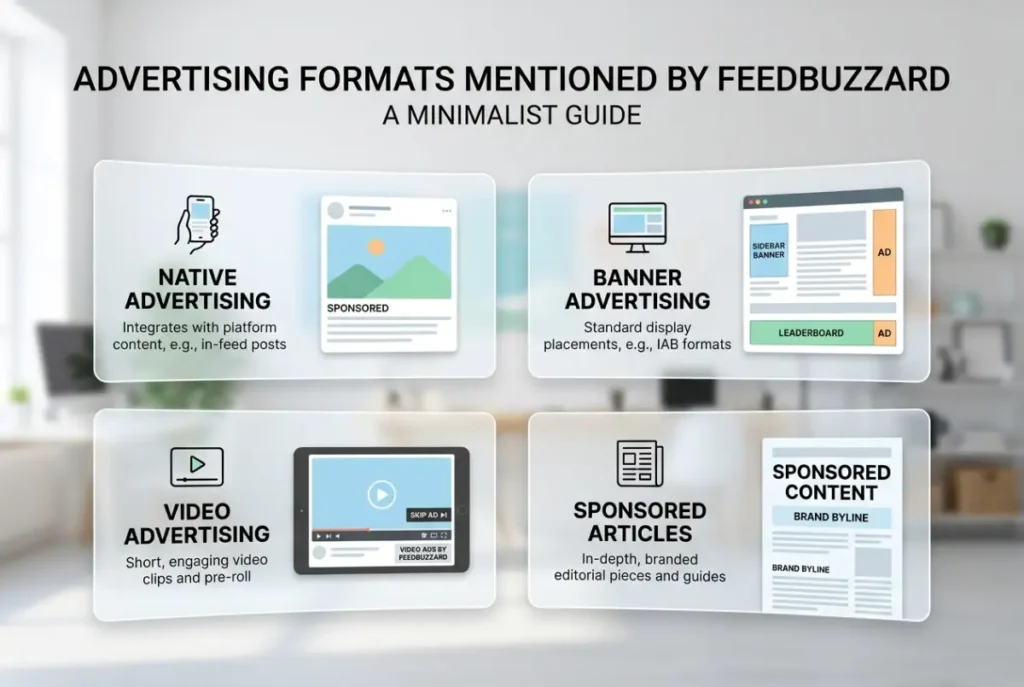
Advertising Formats Mentioned by FeedBuzzard
Choosing an appropriate advertising format is one of the most important parts of campaign planning.
Different formats serve different marketing purposes. Some are designed to attract immediate clicks, while others focus on visibility, storytelling, and long-term brand recognition.
FeedBuzzard’s June 2026 advertising guide describes several possible formats. Their current availability should be confirmed directly with the website.
1. Native Advertising
Native advertising is designed to fit naturally within the surrounding website content while remaining clearly identified as promotional material.
For example, a technology website might display a sponsored card between regular technology articles.
A software company could use this format to introduce a new application, explain a digital service, or highlight a useful product feature.
Native advertising can be helpful because its presentation is connected to the surrounding content.
However, the advertisement should never mislead readers into believing that paid promotional material is independent editorial reporting.
Best suited for:
- Technology companies
- Software businesses
- Digital service providers
- Educational products
- Brands promoting informative content
2. Banner Advertising
Banner advertisements use visual elements such as images, logos, headlines, and calls to action.
They may appear in different areas of a website, depending on the publisher’s available inventory.
For example, an online retailer could use a banner to promote a seasonal discount, while a software company might advertise a new product launch.
A successful banner should communicate its main message quickly.
Useful banner design principles include:
- Use a recognizable brand logo.
- Keep the headline short.
- Select a clear, high-quality image.
- Highlight one main benefit.
- Include an easy-to-understand call to action.
- Make sure the advertisement works on mobile screens.
Before purchasing a placement, ask which pages will display the banner, how frequently it will appear, and whether impressions can be independently measured.
3. Video Advertising
Video advertising allows businesses to communicate through moving images, sound, demonstrations, and storytelling.
A short video can explain a product more clearly than a static advertisement when the product requires visual demonstration.
For instance, a software company could create a brief screen recording showing how its application saves time. A consumer electronics brand might demonstrate important product features.
FeedBuzzard’s advertising guide mentions video placements and identifies MP4 with H.264 encoding as a supported format.
However, businesses should request the current video specifications rather than assuming those technical requirements remain unchanged.
Questions to ask include:
- What is the maximum video length?
- Which aspect ratios are accepted?
- Is sound enabled automatically?
- Are captions required?
- Where will the video appear?
- Are video views measured and reported?
These details help advertisers prepare suitable creative assets before submitting a campaign.
4. Sponsored Articles
Sponsored articles are promotional pieces that allow businesses to communicate more detailed information about their products, services, and company activities.
Unlike a short banner, an article can explain the purpose of a product, discuss its advantages, and provide examples of how customers might use it.
A sponsored article could include:
- A company introduction
- Product information
- Service explanations
- Practical examples
- Original images
- A relevant website link
- A clear next step for readers
For example, a company introducing an AI-powered writing application could publish an informative article explaining its main features and potential business applications.
The content should provide genuine information rather than simply repeating sales messages.
Paid promotional content and links should also be disclosed appropriately. Advertisers should not assume that paying for a sponsored article guarantees improved Google rankings or a valuable backlink.
5. Newsletter Advertising
Newsletter placements are another format sometimes mentioned in third-party descriptions of FeedBuzzard advertising.
A newsletter advertisement can introduce a brand directly to people who have subscribed to receive updates.
However, an active newsletter, subscriber count, audience quality, and delivery statistics must be verified before purchasing this type of placement.
Ask for evidence of:
- Current subscriber numbers
- Average delivery rates
- Open rates
- Click-through rates
- Audience locations
- Advertising frequency
Do not pay for an email placement based only on an estimated subscriber count.
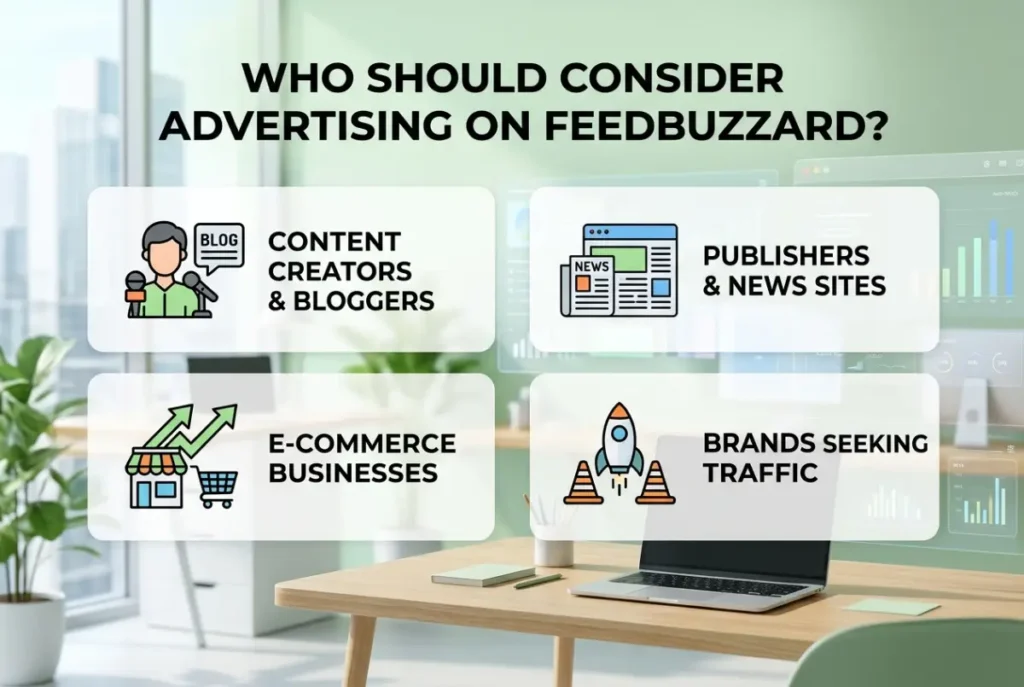
Who Should Consider Advertising on FeedBuzzard?
Not every advertising opportunity is suitable for every business. The best promotional channel depends on the product, customer profile, campaign objective, and available budget.
Here are some business categories that might investigate FeedBuzzard’s advertising opportunities.
Small Businesses and Startups
Small businesses often have limited marketing budgets. They need promotional channels that can help introduce their products without requiring a large initial investment.
A startup might investigate a sponsored article or display advertisement to introduce its brand and explain what makes its service different.
Before spending money, the company should request audience statistics and compare the proposed placement with other available options.
Technology and Software Companies
Technology companies frequently need to explain products that customers may not immediately understand.
For example, an AI software company might use an educational promotional article to explain its application’s features, benefits, and practical uses.
A cybersecurity business could introduce its services through informative content that discusses common online security problems.
The most important consideration is whether the publisher’s actual readership matches the company’s target customers.
E-Commerce Businesses
Online retailers can use digital advertising to introduce products, promote seasonal offers, and attract potential shoppers.
A clothing store might advertise a new collection, while a consumer electronics business could promote a product launch.
However, e-commerce advertisers should measure more than clicks. They should track product views, add-to-cart activity, completed purchases, and customer acquisition costs.
Digital Marketing Agencies
Marketing agencies may investigate publisher placements as part of a broader campaign strategy.
They could evaluate different content publishers, compare audience relevance, and negotiate promotional opportunities for clients.
Agencies should request transparent reporting and written placement agreements before including a publisher in a client’s advertising plan.
Educational and Professional Services
Online learning platforms, consulting firms, and professional service providers may benefit from informative content that explains complicated subjects.
A sponsored article can introduce a service, describe its intended audience, and explain how customers can learn more.
However, promotional claims should be accurate, particularly when advertising financial, legal, health, or other regulated services.
How to Advertise on FeedBuzzard: Step-by-Step Guide
If you are interested in exploring an advertising opportunity, the safest approach is to contact the publisher and confirm the available services before making a commitment.
Here is a practical process.
Step 1: Visit the Official Website
Start with the domain associated with the advertising guide:
Make sure you are visiting the correct website. Similar domain names should not automatically be considered official alternatives.
Look for its advertising information and contact details.
Step 2: Identify Your Advertising Objective
Before contacting the publisher, decide what you want your campaign to achieve.
Common objectives include:
- Increasing brand awareness
- Promoting a new product
- Generating website traffic
- Introducing a business service
- Promoting a special offer
- Publishing sponsored educational content
Having one clear objective makes it easier to evaluate whether a proposed advertising placement is appropriate.
Step 3: Define Your Target Audience
Think about the customers you want to reach.
For a US-based business, consider factors such as:
- Geographic location
- Age range, where appropriate
- Interests
- Purchasing needs
- Device preferences
- Relevant content categories
Do not assume that every targeting option described in an advertising guide is currently available.
Ask the publisher to explain which audience filters can actually be used.
Step 4: Request a Media Kit
A media kit provides information about a publisher’s advertising opportunities.
Ask whether FeedBuzzard can provide a current media kit containing:
- Monthly website visitors
- Monthly page views
- Geographic audience distribution
- Popular content categories
- Available advertisement placements
- Mobile and desktop traffic
- Advertising specifications
- Sponsored content policies
These details help you understand the potential value of a placement.
If the publisher cannot provide reliable audience information, consider whether the advertising opportunity offers enough transparency for your business.
Step 5: Confirm the Available Ad Formats
Ask which promotional options are currently offered.
Do not assume that every format mentioned in the June 2026 guide is available today.
You should confirm whether the publisher accepts banner advertisements, native promotions, video advertisements, sponsored articles, or other placements.
Request examples of previous campaigns if available.
Step 6: Discuss Pricing and Payment Terms
The website’s advertising guide discusses CPM, CPC, and CPI pricing models. However, the public guide does not provide a verified rate card or confirmed minimum advertising budget.
Ask for a written quote that explains:
- Total campaign price
- Advertising duration
- Placement location
- Expected impressions, if applicable
- Payment schedule
- Cancellation policy
- Refund conditions
- Reporting arrangements
Never rely on an informal estimate or an unsupported price published by an unrelated website.
Step 7: Prepare Your Advertising Materials
Once the available format and requirements are confirmed, prepare your advertisement.
For a banner, create a clear image with a short headline and call to action.
For a video advertisement, prepare a demonstration or short promotional presentation that communicates your main message quickly.
Always request the publisher’s current creative specifications before submitting files.
Step 8: Review the Agreement
Before paying, carefully review the commercial agreement.
It should identify the advertising provider, agreed placement, campaign dates, price, payment method, and performance reporting terms.
If you are purchasing sponsored content, also confirm how the article will be labeled and whether any links will carry the appropriate sponsored attribute.
Step 9: Launch a Small Test Campaign
If the publisher provides sufficient evidence and the terms are acceptable, consider beginning with a small, limited campaign.
A controlled test can help determine whether the placement generates genuine visitors and meaningful engagement.
Avoid committing a large amount before you understand the quality of the traffic.
How Much Does FeedBuzzard Advertising Cost?
Advertising costs are an important consideration for businesses, especially small companies that need to manage every marketing dollar carefully.
At present, FeedBuzzard does not publish a verified public advertising rate card on its advertising guide. This means advertisers cannot confidently determine the official cost of a banner, sponsored article, video placement, or other promotional option from the published information alone.
Some third-party articles mention estimated prices and CPM figures. However, those numbers are not confirmed by FeedBuzzard and should not be treated as official rates.
Understanding Common Advertising Pricing Models
Even if the publisher negotiates prices directly, understanding standard advertising models can help you evaluate a proposal.
Cost Per Click (CPC)
CPC means an advertiser pays for each qualifying click on an advertisement.
For example, if a campaign costs $100 and generates 200 qualifying clicks, the average cost per click is $0.50.
This model can be useful when the main objective is attracting visitors to a website.
Cost Per Thousand Impressions (CPM)
CPM refers to the cost of displaying an advertisement 1,000 times.
For example, a $10 CPM means an advertiser pays $10 for every 1,000 billable impressions.
This approach is commonly used for brand awareness campaigns.
Cost Per Install (CPI)
CPI measures advertising costs based on completed application installations.
It can be relevant to businesses promoting mobile applications, provided that installation tracking and attribution are properly supported.
What Determines Advertising Costs?
Several factors can influence the price of an advertising placement:
- Placement location: A prominent homepage position may cost more than a less visible placement.
- Campaign duration: Longer advertising periods may have different pricing arrangements.
- Content format: Video, banner, and sponsored article placements require different resources.
- Audience size: Larger verified audiences may justify higher advertising costs.
- Geographic targeting: US-focused campaigns may have different rates from broader international campaigns.
- Content production: A campaign that includes writing, editing, and design may cost more than a placement using advertiser-provided materials.
The safest approach is to request a written quotation directly from the publisher.
How to Create Effective FeedBuzzard Advertisements
A successful campaign requires more than purchasing advertising space. The creative material must attract attention, communicate value, and encourage readers to take a meaningful action.
Here are several practical recommendations.
1. Write Attention-Grabbing Headlines
Your headline is often the first thing readers notice.
A strong headline should communicate a benefit or answer a question that matters to your target audience.
For example, a software company could use:
“Save Time With Smarter Project Management Tools.”
This headline is more useful than a vague message such as “Discover Our Amazing Company.”
Avoid exaggerated claims and promises that your business cannot support.
2. Use Professional Visuals
Images influence how people perceive a brand.
Choose high-quality graphics that clearly represent your product or service. Avoid overcrowded designs, excessive text, and unrelated stock images.
Your visuals should also match your website’s overall branding.
For US audiences, clear product images and straightforward promotional messages often make advertisements easier to understand.
3. Include One Clear Call to Action
A call to action tells readers what to do next.
Examples include:
- Visit Our Website
- Explore Our Products
- Learn More
- Request a Demo
- Discover Our Services
- Shop the Collection
Use one main action instead of asking readers to perform several different tasks.
4. Make Your Landing Page Relevant
An advertisement should lead to a page that matches its message.
If your banner promotes a particular product, send visitors directly to that product page rather than making them search through your entire website.
A good landing page should include:
- A clear headline
- Relevant product information
- Professional visuals
- Important benefits
- Customer support information
- A visible next step
The closer the connection between the advertisement and landing page, the easier it is for visitors to understand your offer.
5. Optimize for Mobile Devices
Many people browse websites using smartphones.
Make sure your advertisements and landing pages display correctly on smaller screens.
Use readable text, appropriately sized images, fast-loading pages, and simple navigation.
A mobile visitor should be able to understand your offer without zooming in or struggling to find important information.
Need another quick comparison? Read Team Aelftech.com Explained: Website, Team, Services, Features.
How to Measure Advertising Performance
Advertising performance should be evaluated using actual results rather than assumptions.
A campaign may generate thousands of impressions but very few interested visitors. Another campaign might attract fewer people but produce more qualified leads.
For this reason, businesses should define their performance measurements before launching an advertisement.
Click-Through Rate
Click-through rate (CTR) measures the percentage of impressions that result in clicks.
The formula is:
CTR = (Total Clicks ÷ Total Impressions) × 100
For example, if an advertisement receives 10,000 impressions and generates 150 clicks, its CTR is 1.5%.
This measurement helps you understand whether your advertisement encourages people to visit your website.
Conversion Rate
Conversion rate measures the percentage of visitors who complete a desired action.
A conversion might include:
- Purchasing a product
- Submitting a contact form
- Requesting a quotation
- Registering for a service
- Downloading an application
A high click count does not necessarily mean a successful campaign. Conversions provide a better indication of whether visitors are taking valuable actions.
Cost Per Acquisition
Cost per acquisition (CPA) measures how much money a business spends to gain a customer or another defined conversion.
For example, if a campaign costs $500 and generates 10 customers, the CPA is $50.
Businesses should compare this figure with their profit margins and customer lifetime value.
Return on Advertising Spend
Return on advertising spend (ROAS) compares the revenue generated by an advertising campaign with its advertising cost.
The formula is:
ROAS = Advertising Revenue ÷ Advertising Cost
For example, if a business spends $200 and generates $800 in attributable sales, its ROAS is 4x.
However, ROAS is not the same as profit. Businesses must also consider product costs, shipping, operating expenses, and other business expenses.
Use Independent Analytics
If you decide to advertise on FeedBuzzard, consider using Google Analytics 4 (GA4) and campaign tracking parameters.
UTM parameters can help identify visitors who arrive through a particular advertisement.
You can monitor:
- Visitor location
- Traffic sources
- Landing-page engagement
- Conversion activity
- Time spent on important pages
- Completed purchases
Request campaign-level reporting from the publisher and compare it with your own analytics.
This provides a more reliable way to evaluate traffic quality.
Benefits and Limitations of Advertising on FeedBuzzard
Before choosing any advertising publisher, it is useful to consider both potential advantages and possible limitations.
Potential Benefits
1. Additional Brand Exposure
Advertising through another publisher may introduce your business to readers who have not encountered your brand before.
2. Content-Based Promotion
Sponsored articles can provide space for detailed explanations, product introductions, and educational marketing.
3. Different Creative Opportunities
The advertising guide describes multiple formats, including banners, native cards, videos, and sponsored articles.
4. Potential Audience Relevance
If the publisher can demonstrate that its readership matches your target market, a placement may provide an additional promotional opportunity.
5. Campaign Testing
A small advertising test may help businesses evaluate whether a particular publisher can contribute useful traffic.
Potential Limitations
1. Limited Public Pricing Information
There is no verified public rate card, making it difficult to compare official advertising costs before contacting the publisher.
2. Unverified Audience Statistics
Advertisers should request reliable information about website visitors, page views, and geographic distribution.
3. Unclear Availability of Some Features
The advertising guide describes advanced targeting and bidding features, but independent confirmation of a working advertising dashboard and all these tools is limited.
4. Limited Independent Campaign Evidence
Publicly available, independently verified advertiser case studies and performance results are difficult to establish.
5. Uncertain Advertising Return
No publisher can guarantee that an advertisement will generate sales or profitable leads. Results depend on audience relevance, creative quality, pricing, and the product being promoted.
These limitations do not automatically mean that the advertising opportunity is unsuitable. They mean businesses should complete their research before spending money.
FeedBuzzard vs. Google Ads and Meta Ads
Businesses exploring advertising options may also compare smaller publishers with established advertising networks.
Here is a general comparison.
| Factor | FeedBuzzard | Google Ads | Meta Ads |
|---|---|---|---|
| Advertising approach | Publisher advertising opportunities described on its website | Search, display, video, and other campaigns | Social media advertising |
| Public pricing | No verified public rate card | Auction-based pricing | Auction-based pricing |
| Self-service tools | Not independently verified | Established advertising dashboard | Established advertising dashboard |
| Audience targeting | Details require confirmation | Extensive targeting options | Extensive targeting options |
| Campaign reporting | Must be confirmed | Established reporting tools | Established reporting tools |
| Best-known strength | Potential publisher-based promotion | Search intent and broad digital reach | Social discovery and audience engagement |
Google Ads and Meta Ads provide established campaign management systems and extensive advertising tools.
FeedBuzzard should be evaluated differently. It is better treated as a potential publisher placement until its advertising infrastructure and commercial arrangements are independently confirmed.
For businesses with limited budgets, the most sensible approach is to compare verified audience quality, campaign costs, and measurable results instead of assuming that a smaller website automatically offers better value.
Safety Tips Before Spending Money
One of the most important parts of online advertising is protecting your business from unclear agreements and unsupported marketing claims.
Before making a payment, follow these precautions.
Verify the Website
Use the official domain, feedbuzzard.com, and check that any advertising contact information is genuinely associated with the publisher.
Do not assume that an unrelated website offering FeedBuzzard advertising services represents the publisher.
Request Business Information
Ask for the legal business name, the identity of the person handling your campaign, and verifiable contact information.
A clear business identity makes it easier to understand who is responsible for the advertising agreement.
Ask for Traffic Evidence
Request reliable website traffic statistics and geographic audience information.
Where possible, ask for independently measurable evidence rather than relying only on promotional screenshots.
Get Everything in Writing
A written agreement should explain the price, placement, advertising duration, content requirements, and reporting arrangements.
It should also describe cancellation and refund conditions.
Use Traceable Payments
Choose a payment method that provides a transaction record and appropriate buyer protections.
Avoid sending cryptocurrency or irreversible payments to an unverified recipient.
Start With a Small Test
Do not commit a large advertising budget before evaluating the service.
A limited test can help you understand whether the publisher delivers genuine traffic and whether that traffic matches your business goals.
Practical Advertising Strategy for US Businesses
American businesses operate in a competitive digital marketplace. Reaching the right customer often matters more than reaching the largest possible number of people.
A practical strategy should begin with customer research.
For example, imagine a US-based company selling project management software.
Instead of promoting the product to everyone, the company could identify small business owners, remote teams, freelancers, and managers who need better ways to organize their work.
It could then prepare a helpful promotional article explaining how the software works, which problems it solves, and how interested users can request a demonstration.
Before purchasing a placement, the company would verify the publisher’s audience data and request a written advertising proposal.
After launch, it could measure website visits, demo requests, and customer acquisition costs.
The same process can work for e-commerce brands, digital agencies, educational businesses, and other service providers.
The important lesson is to connect every advertising decision with a measurable business objective.
Frequently Asked Questions (FAQs)
1. What does advertise feedbuzzard mean?
The phrase refers to exploring paid promotional opportunities associated with FeedBuzzard.com. These may include advertising placements or sponsored content, depending on the services the publisher currently makes available.
2. How can I advertise on FeedBuzzard?
Visit the official website and review its advertising information. Contact the publisher to ask about available formats, audience statistics, pricing, payment arrangements, and campaign requirements.
3. Is FeedBuzzard an advertising network?
FeedBuzzard publishes an advertising guide describing campaign formats and advertising technology. However, a fully functioning self-service advertising network and its claimed features have not been independently verified. Confirm the actual service directly.
4. What types of advertisements does FeedBuzzard mention?
Its June 2026 advertising guide mentions native advertisements, banner units, video promotions, and sponsored articles. Businesses should confirm which formats are currently available.
5. How much does it cost to advertise on FeedBuzzard?
There is no verified public rate card. Contact the publisher for an official quotation and avoid relying on specific prices published by unrelated third-party websites.
6. Can small businesses use FeedBuzzard advertising?
Small businesses can investigate its advertising opportunities, particularly if they want to explore publisher-based promotion. However, they should first verify audience relevance, pricing, and the publisher’s ability to deliver the agreed placement.
7. Is FeedBuzzard suitable for US businesses?
It may be worth investigating if the publisher can demonstrate a relevant US audience. Ask for geographic traffic data and confirm whether US-focused advertising placements are available.
8. Does FeedBuzzard offer sponsored articles?
Sponsored articles are mentioned in its advertising guide. Confirm the current availability, publication terms, content requirements, and any applicable link disclosure policies before proceeding.
9. Can advertising on FeedBuzzard improve SEO?
A sponsored article may help introduce your business to readers and generate referral traffic. However, paid placements do not guarantee better search rankings. Paid links should be appropriately qualified using Google’s sponsored-link guidelines.
10. How do I measure advertising success?
Track impressions, clicks, click-through rate, conversions, cost per acquisition, and return on advertising spend. Use independent analytics to compare the publisher’s reporting with actual website activity.
11. Is FeedBuzzard better than Google Ads?
The two should not be treated as equivalent services. Google Ads provides established advertising infrastructure, while FeedBuzzard’s published information describes publisher advertising opportunities that require further verification. The better choice depends on your goals and the evidence available.
12. Should I invest a large budget immediately?
No. First request verified traffic information, written pricing, campaign terms, and performance reporting. If everything checks out, begin with a controlled test rather than making a large upfront commitment.
Need another quick comparison? Read Stewart at WaveTechGlobal: (2026 Guide).
Final Verdict: Is FeedBuzzard Worth Exploring?
Digital advertising can help businesses build visibility, introduce new products, and connect with potential customers. However, choosing the right advertising publisher requires more than reading a promotional guide or comparing attractive marketing claims.
FeedBuzzard has published information describing advertising opportunities, including native advertisements, banners, video promotions, and sponsored articles. These options could be relevant to businesses interested in publisher-based marketing.
However, important details remain unclear. Public pricing, independently verified audience statistics, advertiser case studies, and the operation of its claimed advertising technology need further confirmation.
For US marketers, the best approach is to investigate the service carefully, request a current media kit, confirm the publisher’s identity, and obtain a written advertising proposal.
A small, measurable campaign may be worth considering if the publisher provides sufficient evidence and acceptable terms.
Ultimately, successful advertising depends on reaching the right people with the right message at a reasonable cost. Make decisions based on verified information, track every campaign, and prioritize genuine business results over impressive-sounding promises.

Nusrat Basheer is a website review writer who helps readers discover useful websites, understand online services, and make informed decisions through clear, reliable, and easy-to-understand reviews.