

Online fraud has become a serious concern for businesses, website owners, online marketplaces, dating platforms, and everyday internet users. Fake accounts, suspicious logins, automated bots, payment fraud, and misleading online identities can create financial and security problems. As digital services continue to grow, companies need better ways to recognize potentially risky activity before it causes damage.
This is where Scamalytics becomes relevant. It is an IP fraud detection and risk intelligence service designed to help businesses identify suspicious internet connections and assess potential fraud risks. Instead of relying only on an IP address’s geographical location, the platform combines fraud intelligence, proxy detection, reputation information, and other network signals.
For example, an online store may want to identify unusual connections before accepting an order. A dating platform may need to investigate suspicious account registrations. A website administrator may want to understand whether visitors are connecting through VPNs, proxies, or hosting infrastructure.
A risk assessment tool can provide useful information in these situations, but it is important to understand what its results actually mean. A suspicious IP address does not automatically prove that the person using it is a scammer.
This guide explains how the platform works, its major features, pricing considerations, benefits, limitations, and practical uses for US businesses and internet users.
Many readers also check Glossywise.com Review 2026: Is It Legit, Safe, and Worth Visiting?.
What Is Scamalytics?
Scamalytics is an online fraud prevention and IP intelligence platform that helps businesses evaluate the potential risk associated with internet connections and suspicious user activity.
Its services focus on identifying potentially fraudulent connections through IP reputation analysis and helping organizations recognize suspicious users through broader fraud intelligence.
The platform is particularly relevant to businesses that operate websites, dating services, online communities, digital marketplaces, and other services where user trust matters.
Its main purpose is to help organizations answer questions such as:
- Does this IP address have a suspicious reputation?
- Is the visitor connecting through a VPN or proxy?
- Does the IP appear to belong to a hosting or data center network?
- Has the surrounding network been associated with reported fraudulent activity?
- Should the business allow, challenge, or manually review a particular connection?
The platform provides an IP lookup service, fraud risk scoring, API integration, bulk lookup capabilities, and on-premises database options.
It is important to understand that the service is primarily designed for businesses and fraud prevention teams. Individual users can also explore IP information through its public lookup features, but the advanced tools are more relevant to organizations handling large volumes of online activity.
According to its official website, the company provides security products that operate at both the connection-risk level and the broader user-risk level. scamalytics.com+1

How Does Scamalytics Work?
The platform evaluates internet connections using different sources of information and fraud-related signals. Its goal is to identify connections that may deserve additional attention.
Here is a simplified explanation of the process.
1. IP Address Identification
An IP address is a numerical identifier associated with an internet connection. Websites and online services use IP addresses to communicate with visitors and deliver online content.
When a business checks an IP address, the service can provide information about its network reputation, geographical details, and possible proxy or anonymization activity.
2. Fraud Intelligence Analysis
The platform uses its own fraud intelligence, including feedback about confirmed fraudulent activity reported by participating operators.
This information can extend beyond a single IP address. The surrounding subnet, autonomous system number (ASN), and hosting network may also contribute to the assessment.
This approach can help identify potentially risky connections even when a particular address has limited individual history.
3. Proxy and VPN Detection
Some users connect through VPNs, proxies, Tor, or data center infrastructure. These services can change how a visitor’s original internet connection appears to a website.
The platform checks for supported anonymization signals and identifies certain types of network infrastructure.
However, using a VPN is not automatically suspicious. Many legitimate users rely on VPNs for privacy, remote work, travel, and security.
4. Risk Score Generation
After analyzing the available signals, the service generates a numerical IP fraud score.
The score ranges from 0 to 100. A higher score indicates greater estimated fraud risk.
The platform also provides a risk category, helping businesses understand the result without interpreting every technical field individually.
5. Business Security Decisions
Businesses can use the result to decide what should happen next.
For example, a website may allow a low-risk connection normally, request additional verification from a medium-risk visitor, or send a high-risk transaction for manual review.
The final decision should always consider other information, such as account history, payment details, device behavior, and transaction patterns.
Understanding the Scamalytics IP Fraud Score
One of the most important features is its IP fraud score. This score helps businesses understand whether a particular internet connection has characteristics associated with fraudulent activity.
The scoring system ranges from 0 to 100.
Here is the general classification used in the official API documentation:
| Risk score | Risk category | General interpretation |
|---|---|---|
| 0–19 | Low | Limited known fraud risk |
| 20–59 | Medium | Additional verification may be useful |
| 60–89 | High | Requires closer examination |
| 90–100 | Very High | Strong reason for additional investigation |
These categories are useful starting points, not universal rules.
Low-Risk IP Addresses
A low score generally indicates that the IP address has limited known fraud risk according to the available intelligence.
For example, an ordinary residential internet connection with no significant suspicious history may receive a low-risk classification.
However, a low score does not guarantee that the person using the connection is trustworthy.
A fraudster can use a relatively clean IP address, create a new account, or access a service through an internet connection that has not previously been associated with suspicious activity.
Medium-Risk IP Addresses
Medium-risk connections deserve additional attention.
An IP address may receive this classification because of network reputation, unusual infrastructure, or other signals that suggest a higher-than-normal level of risk.
A business could respond by requesting a CAPTCHA, verifying an email address, or applying additional authentication.
This approach can help reduce unnecessary account restrictions while giving the security team more information.
High-Risk IP Addresses
High-risk scores indicate that the connection has stronger associations with potentially fraudulent activity.
Businesses may want to review account registrations, payment attempts, login behavior, or other activities coming from the address.
However, an elevated score should not automatically result in a permanent ban. Shared internet connections, public Wi-Fi, and network infrastructure can affect multiple legitimate users.
Very High-Risk IP Addresses
Very high scores indicate a stronger risk signal.
For example, a business processing an unusually large number of suspicious transactions from a particular network may decide to require additional verification or send the activity for manual investigation.
The final decision should depend on the organization’s risk tolerance and supporting evidence.
Important: A score is a risk estimate, not proof of criminal activity. The official documentation recommends adjusting thresholds using a business’s own fraud data. docs.scamalytics.com+1
Main Features of Scamalytics
The platform provides several tools that can support fraud prevention and online security operations.
1. IP Address Fraud Checker
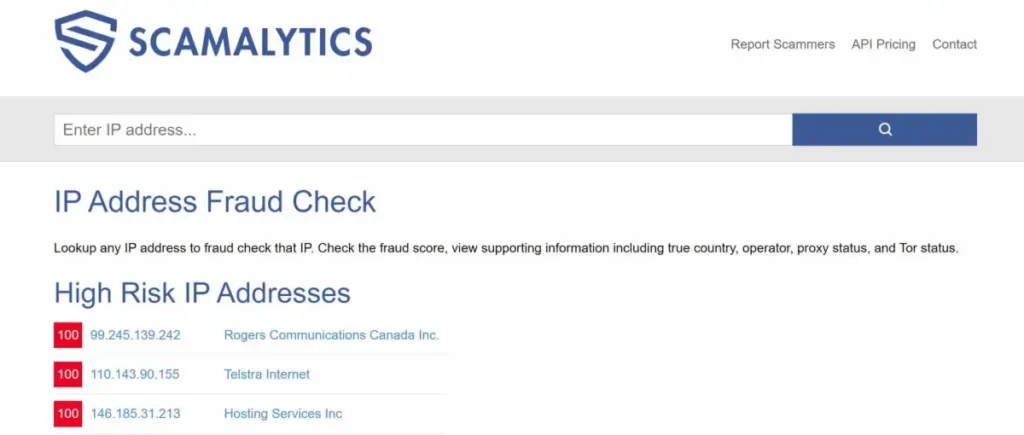
The IP lookup feature allows users to check the reputation of an individual internet address.
It can return information such as:
- IP fraud score
- Risk classification
- Network information
- Proxy and VPN indicators
- Geographical information
- External blacklist signals
This feature is useful when a website administrator wants to investigate an unfamiliar connection or understand why a particular visitor has triggered a security alert.
2. VPN and Proxy Detection
VPNs and proxies are common parts of modern internet usage. They can help users protect their privacy, access company networks, or connect securely while traveling.
Unfortunately, these technologies can also be used to hide the original source of suspicious activity.
The platform provides detection signals for supported VPN, proxy, data center, and anonymization infrastructure.
This can help businesses identify connections that deserve additional verification.
However, VPN detection is not the same as fraud detection. A person working remotely from the United States may legitimately connect through a corporate VPN.
3. Geolocation Intelligence
IP geolocation provides an estimated location associated with an internet connection.
Depending on the available data source, the information may include:
- Country
- State or region
- City
- Postal code
- Coordinates
- Time zone
- Network or ASN information
For US businesses, this information can help identify unusual patterns.
For example, an account normally accessed from California may suddenly receive login attempts from a network associated with another country.
That difference could justify an additional security check.
Still, IP geolocation is not precise enough to prove someone’s physical location. VPNs, mobile networks, corporate gateways, and internet routing can produce inaccurate results.
4. External Blacklist Checks
Another useful feature is the ability to combine fraud intelligence with external reputation sources.
The API documentation identifies several integrated sources, including Spamhaus DROP, FireHOL, IPsum, and other network intelligence providers.
These sources can help identify addresses associated with known suspicious infrastructure or blacklist activity.
Combining multiple sources provides a broader view than relying on a single blacklist.
5. API Integration
The API is particularly useful for developers and businesses that want to automate IP risk checks.
Instead of manually entering every address into a website, an application can send an IP lookup request and receive a structured JSON response.
Businesses can use the response to:
- Review new account registrations.
- Add security checks during login.
- Examine suspicious payment attempts.
- Identify potentially risky connections.
- Send unusual activity to a moderation team.
The API documentation describes US and European endpoints and supports both IPv4 and IPv6 lookups.
It also provides a test mode for development without consuming normal live credits, subject to its fair-use limits. docs.scamalytics.com
6. Bulk IP Lookup
Businesses that investigate many suspicious addresses may benefit from bulk IP lookup capabilities.
Rather than checking addresses individually, users can process larger lists and review the results together.
This can be useful for:
- Fraud investigation teams
- Cybersecurity analysts
- Website administrators
- Online marketplace operators
- Dating platform moderators
- Digital advertising teams
Bulk analysis can make it easier to identify repeated patterns across large sets of network addresses.
7. On-Premises Database
Organizations with high lookup volumes or specific data-handling requirements may consider the on-premises MMDB option.
This allows businesses to run supported IP intelligence lookups within their own infrastructure instead of sending every lookup through an external API.
According to the company, the database is updated daily and supports local lookups without normal API rate limits or network round trips.
This can be useful for organizations that prioritize infrastructure control, performance, and data residency. Scamalytics

Who Should Use Scamalytics?
Not every internet user needs an advanced fraud detection system. Its strongest use cases involve organizations that receive large amounts of online traffic or manage accounts and transactions.
E-Commerce Businesses
Online stores regularly deal with payment fraud, fake accounts, suspicious orders, and automated checkout attempts.
A fraud intelligence service can help an e-commerce company evaluate IP reputation before approving certain transactions.
For example, if a new account makes several unusual payment attempts from a high-risk network, the store could request additional verification.
This does not mean the order must automatically be rejected. It simply provides another signal for the fraud prevention process.
Dating Platforms
Dating services can face problems involving fake profiles, romance scams, automated registrations, and suspicious account behavior.
IP intelligence can help moderation teams identify connections associated with potentially fraudulent activity.
However, an IP address alone cannot establish whether someone is genuine.
Platforms should also consider profile behavior, account history, messaging patterns, reports, and other relevant signals.
Social Networks and Online Communities
Online communities need to protect users from spam, fake accounts, harassment, and automated activity.
IP risk intelligence can help administrators identify suspicious registration patterns and repeated activity across related networks.
Combined with account verification and moderation tools, this can support a safer online environment.
Financial and Payment Services
Financial technology companies must pay close attention to suspicious login attempts, account takeovers, and unusual transactions.
IP reputation can provide another layer of information during risk assessment.
It should not replace identity verification, transaction monitoring, payment security, or regulatory compliance procedures.
Digital Marketing Companies
Advertising and marketing platforms can receive automated traffic, suspicious clicks, and activity that may distort campaign performance.
IP intelligence may help identify unusual network patterns and investigate potentially automated traffic.
It can be especially useful when combined with device signals and campaign analytics.
Scamalytics Pricing: Is It Free?
Pricing is an important consideration for businesses evaluating fraud detection tools.
The official pricing page lists a free allowance of 5,000 monthly requests for its API and bulk lookup services.
Paid plans are available for organizations that need additional lookup capacity.
Here is a snapshot of the published pricing:
| Monthly lookups | Monthly price |
|---|---|
| 5,000 | Free |
| 25,000 | $25 |
| 50,000 | $50 |
| 75,000 | $75 |
| 100,000 | $100 |
| 250,000 | $125 |
| 500,000 | $150 |
| 1 million | $200 |
Annual billing is also listed, with discounts compared with paying monthly.
The company offers additional premium data packages for organizations that need enhanced proxy detection, geolocation, ISP information, and residential proxy intelligence.
These add-ons have separate charges.
Pricing can change, so businesses should review the official Scamalytics API pricing page before making a purchasing decision. scamalytics.com
Is the Free Plan Enough?
For a small website or developer testing a new integration, 5,000 monthly lookups may be a useful starting point.
For example, a website that performs occasional IP checks may not need a large monthly allowance.
However, a busy marketplace or online service processing thousands of registrations every day may quickly require a paid plan.
Businesses should estimate their expected monthly lookup volume before choosing a subscription.
How to Use the IP Lookup Tool
Checking an IP address is relatively straightforward. Users who want to investigate an unfamiliar connection can follow these steps.
Step 1: Visit the Official Website
Open the official website at scamalytics.com.
Make sure you are using the correct domain rather than an unrelated website offering similar services.
Step 2: Find the IP Checker
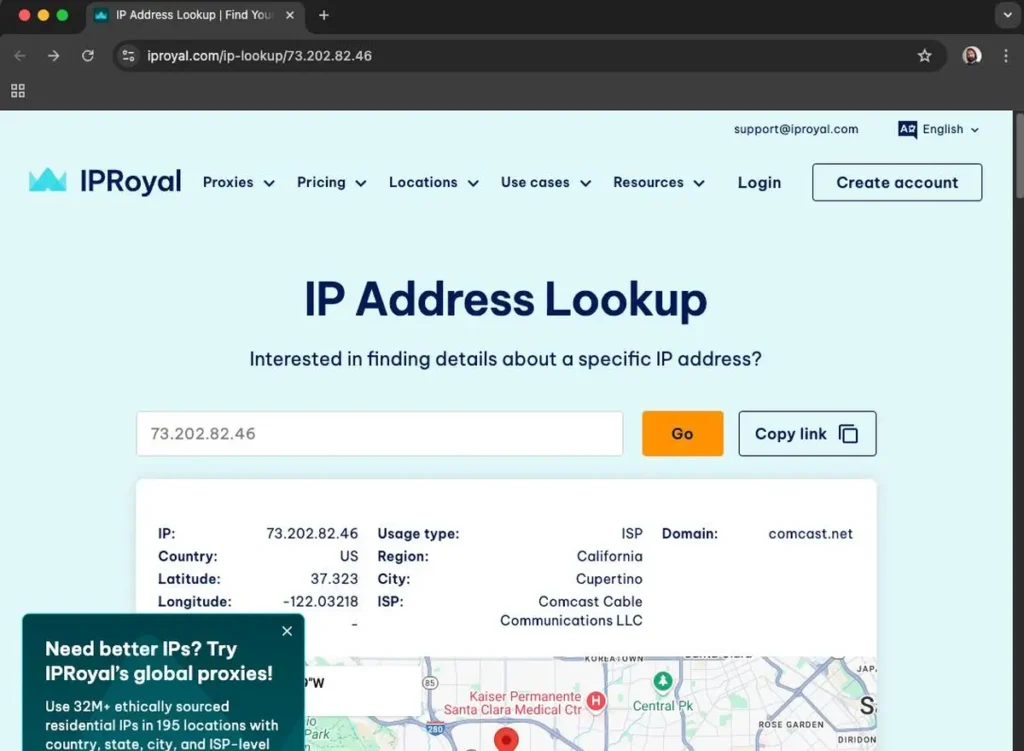
Navigate to the IP address lookup feature. The tool allows users to enter an IP address and examine its available risk information.
Step 3: Enter an IP Address
Enter the IPv4 or IPv6 address you want to investigate.
You can use an IP address from a suspicious login record, website access log, or another legitimate source.
Avoid sharing sensitive personal information unnecessarily.
Step 4: Review the Results
After submitting the address, examine the available information.
Pay attention to:
- Fraud risk score
- Risk category
- Proxy or VPN indicators
- ISP and network information
- Geolocation information
- External blacklist signals
Step 5: Understand the Risk
Do not make decisions based on the numerical score alone.
If an address receives a high score, investigate the surrounding activity. Check whether the account has suspicious login attempts, unusual transactions, or other warning signs.
This approach helps reduce false positives and unnecessary restrictions.
Need another quick comparison? Read PressVibePulse.com: What It Is, Features, Content, Guide.
Benefits of Using Scamalytics
There are several reasons businesses may consider adding IP fraud intelligence to their security systems.
Better Fraud Awareness
One of the biggest advantages is improved visibility into suspicious internet connections.
Instead of relying entirely on basic IP information, businesses can review risk scores and additional network signals.
Automated Risk Assessment
API integration can reduce manual work.
A business can check IP addresses automatically during account registration, login, or selected transactions.
This makes the process more practical for services handling large numbers of users.
Multiple Data Sources
Combining proprietary fraud intelligence with external information can provide a broader assessment of an internet connection.
This is useful when one source does not contain enough information to evaluate a particular address.
Flexible Integration Options
Businesses can choose between API access, bulk lookups, and on-premises database deployment.
Different options can suit different technical requirements and lookup volumes.
Useful for Different Industries
The platform can support organizations in e-commerce, online dating, social networking, cybersecurity, digital advertising, and other industries.
Its applications are not limited to one particular type of website.
Limitations and Things to Consider
Although IP risk intelligence can be valuable, it has limitations that users should understand before relying on it.
1. An IP Score Cannot Prove Fraud
A high-risk score does not automatically mean that the person behind an IP address is a scammer.
An address can have a suspicious reputation because of activity associated with its wider network.
Businesses should use other evidence before blocking accounts or rejecting transactions.
2. Shared IP Addresses Can Create Confusion
Many people use the same public IP address.
For example, employees in an office may connect through one corporate gateway. Residents in an apartment building may share network infrastructure. Public Wi-Fi users may also appear under the same address.
If one connection has a poor reputation, other legitimate users may be affected by that network’s history.
3. VPN Users May Be Legitimate
VPNs are widely used in the United States for privacy, remote work, and secure browsing.
A business that automatically blocks every VPN connection could prevent legitimate customers from accessing its services.
A better approach is to combine VPN detection with other risk signals.
4. Risk Intelligence Can Change
IP reputation is not permanent.
Internet providers can reassign addresses, hosting companies can change infrastructure, and suspicious activity can appear or disappear over time.
Businesses should pay attention to data freshness and avoid treating an old result as a permanent assessment.
5. Advanced Data May Cost Extra
The basic service offers useful information, but some advanced intelligence sources require paid add-ons.
Companies should compare the available data fields and subscription costs before selecting a plan.
6. Integration Requires Technical Knowledge
The API is useful, but developers must understand authentication, HTTP requests, JSON responses, and secure credential management.
The API documentation also warns users not to expose their secret API keys in public-facing JavaScript, mobile applications, or public code repositories.
A secure backend integration is the recommended approach. docs.scamalytics.com+1
Is Scamalytics Safe and Legitimate?
Scamalytics operates as a business-focused fraud prevention service and provides official product documentation, pricing information, API access, and privacy documentation.
Its stated purpose is to help organizations identify potentially fraudulent internet connections and suspicious users.
There are several practical ways to assess whether the service is suitable for your organization:
- Review its official product documentation.
- Understand how its IP risk scores are generated.
- Check which external data sources are included.
- Read the privacy policy.
- Review API authentication requirements.
- Compare subscription costs with your expected usage.
- Test the results against your own fraud investigation data.
Its official website also describes how its services are used by businesses to detect fraud and protect online platforms.
However, being a legitimate service does not mean every result is automatically accurate. No IP reputation system can identify every fraudulent user or guarantee that a low-risk connection is safe.
Businesses should treat the platform as one component of a wider security strategy.
You can review the official privacy policy for information about its stated data handling and processing practices. scamalytics.com+1
Scamalytics vs Traditional IP Lookup Tools
Traditional IP lookup websites generally focus on geographical and network information.
They may show a visitor’s estimated country, city, internet provider, or ASN.
Fraud detection platforms provide additional information that can help businesses evaluate suspicious connections.
| Feature | Basic IP lookup | Fraud intelligence platform |
|---|---|---|
| IP address information | Yes | Yes |
| Estimated location | Usually | Yes |
| ISP information | Usually | Yes |
| Fraud risk score | Not always | Yes |
| VPN and proxy detection | Varies | Supported |
| External blacklist signals | Varies | Supported |
| API integration | Sometimes | Yes |
| Bulk lookup | Varies | Available |
| Business fraud workflows | Limited | More extensive |
The important difference is the purpose.
A basic IP lookup helps answer where an internet connection may be located and which network it belongs to.
A fraud intelligence service attempts to answer a different question: how risky might activity from that connection be?
For businesses that need more than basic geographical information, the second approach can provide additional value.
Practical Tips for Businesses Using IP Fraud Detection
A good fraud prevention strategy should balance security with a positive customer experience.
Here are some practical recommendations.
1. Avoid automatic blocking based on one score. Use the risk rating as an initial signal and review additional information before taking action.
2. Combine multiple security signals. Consider login history, device information, account age, payment behavior, and email verification.
3. Set different verification levels. Low-risk activity may require no additional steps, while suspicious activity can trigger CAPTCHA or stronger authentication.
4. Monitor false positives. Review legitimate customers who are incorrectly flagged. This helps improve security rules over time.
5. Protect API credentials. Store secret keys on your server and never expose them in public code.
6. Review usage regularly. Track monthly lookup consumption so your organization does not unexpectedly exceed its subscription allowance.
7. Respect user privacy. Follow applicable privacy laws and your organization’s data protection policies when collecting and processing IP-related information.
These practices can help businesses use IP intelligence responsibly without creating unnecessary barriers for legitimate customers.
Frequently Asked Questions
1. What is Scamalytics used for?
It is used to evaluate IP address fraud risk, identify suspicious network connections, detect supported VPN and proxy infrastructure, and provide fraud intelligence to businesses.
2. Is Scamalytics free?
Yes. Its published pricing includes a free allowance of 5,000 monthly API and bulk lookup requests. Paid plans are available for higher usage and additional data requirements.
3. How does the IP fraud score work?
The service generates a score between 0 and 100. Lower scores indicate lower estimated fraud risk, while higher scores indicate stronger risk signals.
4. Does Scamalytics detect VPNs?
Yes. Its API provides supported VPN and anonymization detection signals, including indicators for certain proxy and data center connections.
5. Does a high IP risk score mean someone is a scammer?
No. A high score indicates a potentially risky internet connection, not proof that the individual using it is involved in fraud.
6. Can I use it for my website?
Yes. Businesses can integrate its API into websites and applications to assess IP addresses during registration, login, or other selected activities.
7. Does it provide geographical information?
Yes. Depending on the available data sources and subscription tier, IP lookup results can include country, region, city, postal code, coordinates, and timezone information.
8. Can developers integrate its API?
Yes. The API provides structured JSON responses and supports IPv4 and IPv6 address lookups. Developers need an account username and API key.
9. Is it useful for small businesses?
It can be useful for small online businesses that want to investigate suspicious visitors or automate basic IP risk checks. The free monthly allowance may be sufficient for testing or relatively low-volume use.
10. Can it prevent every online scam?
No. IP intelligence is only one part of fraud prevention. Scammers can use legitimate internet connections, new accounts, compromised devices, and other techniques that may not trigger an IP risk warning.
11. Does using a VPN make an IP address fraudulent?
No. VPNs have many legitimate uses. Businesses should consider the reason for the connection and other available security information before restricting access.
12. What is the difference between an IP risk score and an ISP risk score?
An IP risk score evaluates the estimated risk associated with a specific IP address. An ISP risk score evaluates the broader network or internet service provider associated with that connection.
13. Does the platform offer bulk IP checking?
Yes. Its bulk lookup service allows organizations to investigate larger collections of IP addresses without checking every address individually.
14. Who benefits most from IP fraud intelligence?
E-commerce companies, dating platforms, social networks, payment services, cybersecurity teams, and online marketplaces can benefit from additional information about suspicious internet connections.
Final Verdict: Is It Worth Using?
Overall, Scamalytics is a useful option for businesses that want additional visibility into IP reputation, suspicious connections, and potential online fraud.
Its main strengths include IP fraud scoring, proxy and VPN detection, geolocation information, external intelligence sources, API integration, and bulk lookup capabilities.
The free monthly allowance makes it possible for smaller businesses and developers to explore the service before committing to a paid plan. Larger organizations can consider premium data or on-premises deployment based on their requirements.
However, businesses should understand its limitations. An IP address cannot tell the complete story about a person, and even a high fraud score does not prove malicious intent.
My recommendation: Consider it as an additional fraud detection layer rather than a complete cybersecurity solution. When combined with account verification, transaction monitoring, and sensible security policies, IP intelligence can help organizations make better-informed decisions.
For businesses dealing with suspicious registrations, fake accounts, and unusual online traffic, it is worth exploring.
You may also want to read glaadvoice.com: What It Is, and What Readers Should Know.
SEO Publishing Checklist
| SEO element | Recommendation |
|---|---|
| Primary keyword | Scamalytics |
| Search intent | Informational / Commercial investigation |
| Target audience | United States |
| Article category | Cybersecurity / Online Safety |
| Suggested URL | /scamalytics/ |
| Content type | Complete guide and review |
| Featured image alt text | Scamalytics IP fraud detection dashboard |
| Secondary keywords | IP fraud checker, IP risk score, VPN detection, proxy detection, fraud prevention tool |
Related NLPs and LSI Keywords
Use these naturally in headings, image descriptions, internal links, and supporting content:
- IP address fraud detection
- Online fraud prevention
- IP reputation checker
- Fraud risk assessment
- Suspicious IP address
- IP fraud score
- VPN and proxy detection
- IP blacklist checker
- Network reputation
- Geolocation intelligence
- Cybersecurity tools
- Fraud detection API
- Fake account detection
- Online scam prevention
- IP address lookup
Recommended Internal Links
If your website covers technology and online security, consider linking this article to:
- Best IP address lookup tools
- How to identify suspicious IP addresses
- VPN vs proxy: What’s the difference?
- How businesses detect fake accounts
- Best online fraud prevention tools
Featured Image
Generated feature image for the article — suggested placement directly below the H1 title.
Scamalytics cybersecurity and IP fraud detection feature image
Publishing recommendation: Add the official product and pricing links, retain the distinction between risk signals and confirmed fraud, and periodically update pricing and API details to keep the article accurate.
Upgrade to Plus to bring your SEO article with photos closer to the look you want with up to 300 advanced images per day, or try again at 10:40 PM.
Upgrade to Plus

Nusrat Basheer is a website review writer who helps readers discover useful websites, understand online services, and make informed decisions through clear, reliable, and easy-to-understand reviews.