
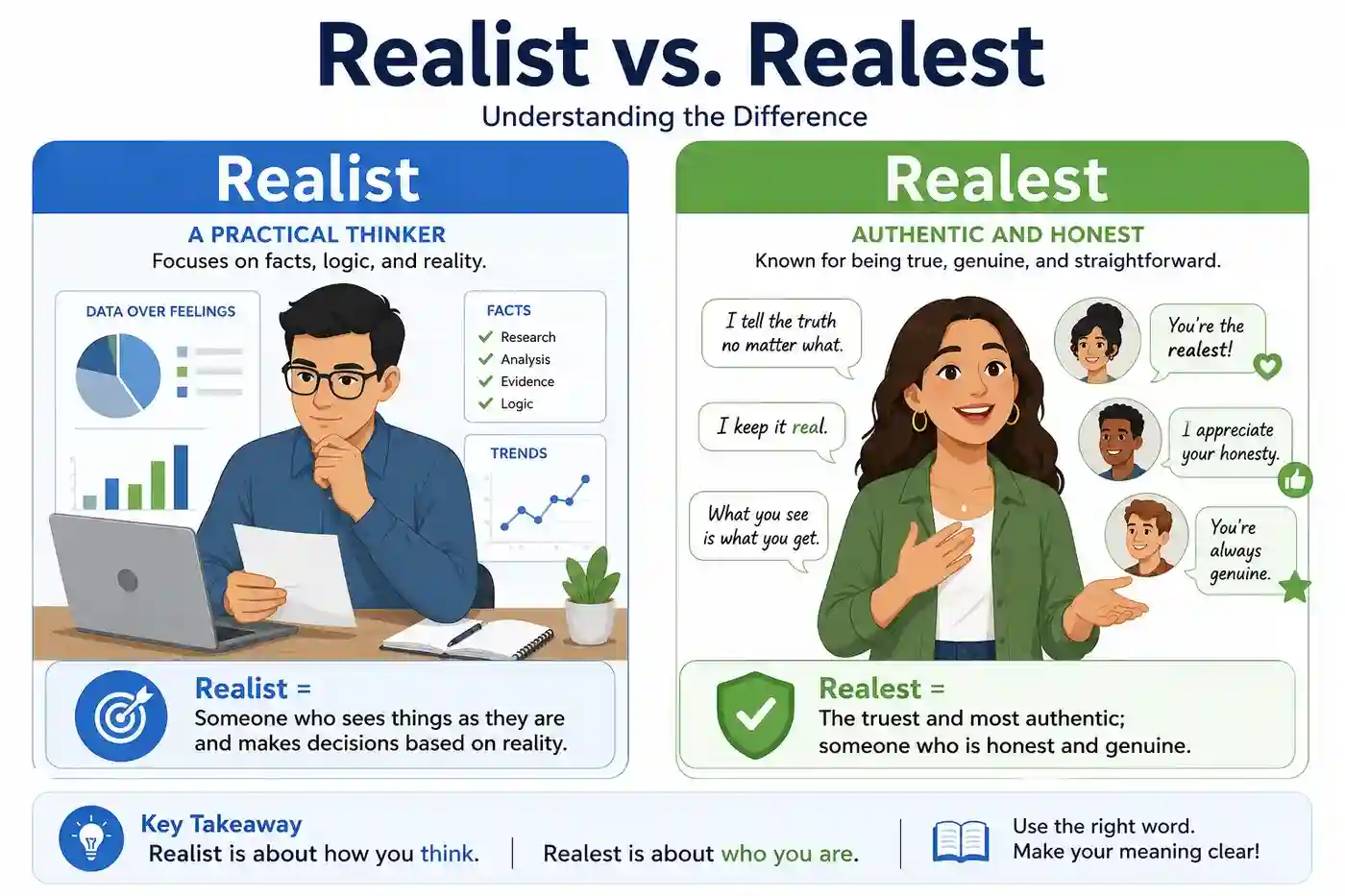
If you’ve searched for realist vs realest you’re probably wondering if both words are correct or if one is simply a common mistake. The confusion makes sense. The words look almost identical and both come from the adjective real. Still they serve very different purposes in English.
Many people see realest in song lyrics social media posts and casual conversations. Others come across realist in books news articles or discussions about politics philosophy and personality types. Since both words are common enough to appear online it’s easy to assume they mean the same thing. They don’t.
The difference comes down to grammar and meaning. One is a noun that describes a person. The other is the superlative form of an adjective that describes a quality. Once you understand that distinction choosing the right word becomes simple.
In this guide you’ll learn what each word means when to use it how native English speakers use both forms and why so many people mix them up. You’ll also see clear examples practical grammar tips and editorial advice that helps you write with confidence.
Still confused? Compare At Least Vs Atleast Which Spelling Is Correct 2026 Guide.
Quick Answer
Realist is a noun that refers to a person who sees situations as they truly are or someone connected with realism in philosophy art or politics.
Realest is the superlative form of real. It means the most genuine the most authentic or the most true. Both words are correct but they have different meanings and cannot replace each other.
Realist Vs Realest Comparison Table
| Feature | Realist | Realest |
|---|---|---|
| Part of speech | Noun | Adjective |
| Meaning | A person who accepts reality or follows realism | The most genuine or authentic |
| Correct English | Yes | Yes |
| Common use | Philosophy personality politics literature | Everyday speech music social media informal writing |
| Formal writing | Very common | Less common but acceptable |
| Describes | A person | A thing person or quality |
| Example | She is a realist who plans ahead. | He’s the realest friend I have. |
| Can replace the other | No | No |
What Does Realist Mean
A realist is someone who looks at life as it truly is instead of focusing on hopes fantasies or impossible outcomes.
The word can also describe a person connected with the idea of realism in philosophy literature politics or art.
Simple Definition
A realist is a person who accepts facts and deals with reality instead of wishful thinking.
How People Use Realist
People often use realist to describe someone who makes practical decisions based on evidence.
Examples include.
- My sister is a realist who always plans for unexpected problems.
- He’s a realist and doesn’t expect success without hard work.
- The coach stayed calm because she was a realist about the team’s chances.
- Investors usually respect a realist who studies the numbers carefully.
- Being a realist doesn’t mean giving up. It means understanding reality before making decisions.
Realist In Different Contexts
Everyday conversation.
He’s a realist so he always keeps a backup plan.
Workplace.
Our manager is a realist who bases decisions on facts instead of guesses.
Academic writing.
Many historians describe the author as a political realist.
Literature.
The novel presents a realist view of ordinary family life.
Philosophy.
Some philosophers identify themselves as realists because they believe reality exists independently of human perception.
What Does Realest Mean
Realest is the superlative form of real. It describes someone or something as the most genuine authentic honest or true compared with others.
Native speakers often use realest in casual speech music and online conversations.
Simple Definition
Realest means the most real the most authentic or the most sincere.
Common Uses
People often use realest to praise honesty loyalty authenticity or genuine behavior.
Examples include.
- She’s the realest person I’ve ever met.
- That was the realest conversation we’ve had in years.
- He’s the realest friend in our group.
- Her advice was the realest thing anyone said all day.
- The documentary gave the realest picture of life in the city.
Although realest appears often in informal English it can also work in standard English when comparing authenticity.
Which One Is Correct
Both realist and realest are correct English words.
The correct choice depends on what you want to say.
Use realist when you’re talking about a person who sees reality clearly.
Use realest when you’re describing someone or something as the most authentic genuine or true.
A quick test makes the choice easy.
If you can replace the word with practical person then realist is probably correct.
If you can replace it with most genuine then realest is the right choice.
For example.
✔ She is a realist who always looks at the facts.
✔ He’s the realest friend I’ve ever had.
✘ She is the realest about economics.
✘ He is a realist friend.
Those last two sentences sound unnatural because the words perform different jobs in the sentence.
Why People Confuse Realist And Realest
The mix up happens because the two words share the same root word real. They look similar at a glance but they belong to different parts of speech and express different ideas.
Several factors make the confusion more common.
Similar Spelling
Only two letters separate the words. Fast reading or typing can make them easy to swap.
Social Media And Music
Many songs captions and posts use realest to describe loyalty honesty or authenticity. People see it often and start thinking it works in places where realist belongs.
Example.
He’s the realest guy I know.
That sentence is correct because it praises authenticity not a practical mindset.
Similar Sound
The endings sound alike in casual speech. If you hear the words instead of reading them you might not notice the difference.
Different Grammar Roles
This is the biggest reason people get confused.
A realist is a person.
Realest describes a person or thing.
Once you remember that one names someone and the other describes someone the choice becomes much easier.
Key Differences Between Realist And Realest
| Feature | Realist | Realest |
|---|---|---|
| Main purpose | Names a person | Describes a quality |
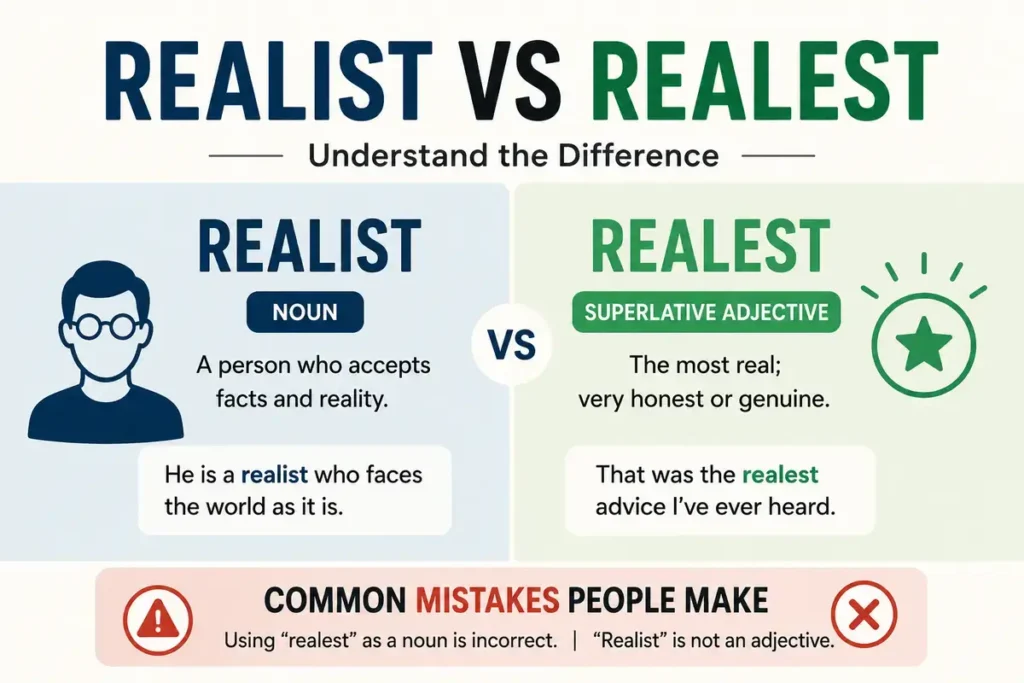
| Part of speech | Noun | Superlative adjective |
| Focus | Practical thinking or realism | Authenticity honesty or genuineness |
| Common setting | Education philosophy politics everyday discussion | Casual conversation music social media |
| Answers which question | Who is this person | How genuine is this person or thing |
The easiest way to remember the difference is this.
A realist thinks realistically.
Someone who is realest feels the most genuine.
Grammar Explanation
Grammar makes the difference clear.
Realist Is A Noun
A noun names a person place thing or idea.
In this case realist names a person.
Examples.
- She’s a realist who prepares for every challenge.
- The writer became a famous realist.
- Every successful team needs at least one realist.
Notice that realist often follows words like a an or the because it names someone.
Realest Is A Superlative Adjective
An adjective describes a noun.
A superlative adjective compares three or more people or things and shows the highest degree of a quality.
Examples.
- She’s the realest friend I have.
- That was the realest story in the entire book.
- This feels like the realest moment of my career.
The word usually appears with the because it identifies the highest level of authenticity.
A Simple Grammar Test
Ask yourself one question.
Are you naming a person or describing someone?
If you are naming a person choose realist.
If you are describing authenticity choose realest.
How Realest Is Formed
Many English adjectives create the superlative form by adding est.
Examples.
- Small becomes smallest.
- Fast becomes fastest.
- Bright becomes brightest.
- Real becomes realest.
That makes realest a perfectly valid English word.
Some people assume it is only slang because they hear it in music and online conversations. In reality it follows a standard English grammar pattern. Its tone simply changes with the context.
In formal writing people sometimes choose phrases like most authentic or most genuine because they sound more polished.
In everyday English realest sounds natural and widely accepted.
Need another quick comparison? Read Totalling Vs Totaling Which Spelling Is Correct 2026.
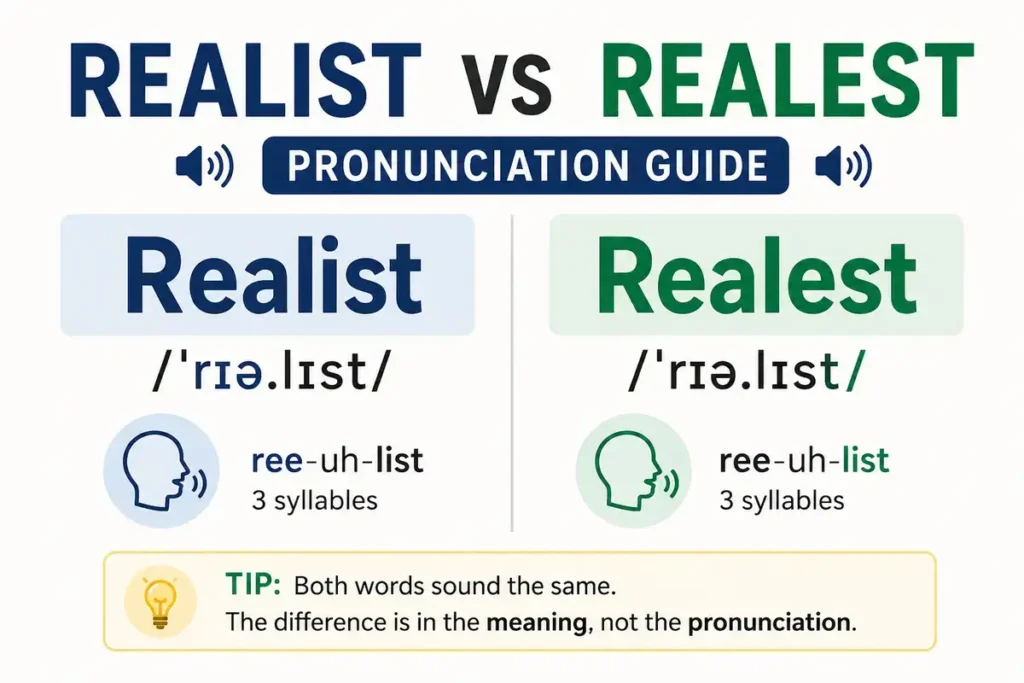
Pronunciation Guide
Understanding pronunciation also helps you tell the words apart.
Realist
IPA
American English
/ˈriː ə lɪst/
Syllables
Re al ist.
Stress
The first syllable receives the strongest stress.
Realest
IPA
American English
/ˈriː ə lɪst/
Syllables
Re al est.
Stress
The first syllable also carries the primary stress.
Why This Causes Confusion
Both words sound almost identical in everyday speech.
Native speakers usually understand the meaning from the sentence instead of the pronunciation.
For example.
She’s a realist.
She’s the realest.
The surrounding words immediately tell listeners which meaning is intended.
Word Origin And History
Learning the history of each word makes the difference easier to remember.
Origin Of Real
The adjective real comes from Latin through Old French. It originally referred to something that actually existed rather than something imagined.
Over time English speakers expanded the meaning to include ideas like authentic true and genuine.
Origin Of Realist
The suffix ist creates nouns that describe people connected with a belief profession movement or characteristic.
Examples include.
- Artist.
- Scientist.
- Pianist.
- Realist.
A realist became someone connected with realism or someone who accepts reality as it is.
Origin Of Realest
The ending est forms the superlative degree of many short adjectives.
Examples include.
- Tallest.
- Smallest.
- Brightest.
- Realest.
This pattern has existed in English for centuries and remains grammatically correct today.
British American Canadian And Australian English
There is no major regional difference between realist and realest.
Speakers in the United States the United Kingdom Canada Australia and New Zealand recognize both words.
The difference appears in style rather than geography.
Formal Writing
Professional writers often prefer expressions like.
- Most authentic.
- Most genuine.
- Most realistic.
Those phrases fit formal reports academic papers and business communication.
Everyday Conversation
People naturally say things like.
- She’s the realest person I know.
- He’s the realest friend anyone could ask for.
These expressions are especially common among younger speakers and in popular culture.
Real Life Examples
The best way to master these words is to see them in everyday situations.
Daily Conversation
- My brother is a realist so he always checks the facts first.
- She’s the realest person in our family.
- I’m a realist but I still believe good things can happen.
- That was the realest compliment I’ve ever received.
Workplace
- Our project manager is a realist who plans for delays.
- Her feedback was the realest advice in the meeting.
- Every successful company needs a realist on the leadership team.
- That customer gave us the realest review we’ve seen all year.
Emails
- I’m trying to stay a realist about the timeline.
- Thanks for sharing the realest feedback on the proposal.
Academic Writing
- Many scholars describe the author as a literary realist.
- The article presents a realist interpretation of international relations.
Journalism
- The columnist called herself a realist instead of an optimist.
- Fans praised the interview as the realest conversation of the season.
Social Media
- You’re the realest friend anyone could ask for.
- That post was the realest thing I’ve read today.
- Stay real and keep supporting people who matter.
- He’s always been a realist even during difficult times.
Literature
- The main character grows into a realist after facing several hardships.
- Critics praised the novel for its realest emotional moments.
Common Mistakes People Make
Even advanced English learners mix up realist and realest. Most mistakes happen because the words look alike or sound almost the same.
Here are the mistakes editors see most often.
Using Realist Instead Of Realest
Incorrect.
He’s my realist friend.
Correct.
He’s my realest friend.
Why?
You are describing the friend as the most genuine. That requires the superlative adjective realest.
Using Realest Instead Of Realist
Incorrect.
She’s a realest who always plans ahead.
Correct.
She’s a realist who always plans ahead.
Why?
You are naming the kind of person she is. That calls for the noun realist.
Assuming Realest Is Not A Real Word
Some people think realest is only slang because they hear it in songs or social media.
It is a legitimate English word. It follows the normal grammar rule for forming superlatives. In formal writing many editors still prefer most authentic or most genuine if those phrases fit the sentence better.
Confusing Realist With Realistic
These words are also different.
A realist is a person.
Realistic describes an idea expectation or plan.
Correct examples.
- She’s a realist.
- That’s a realistic goal.
Easy Memory Tricks
Simple memory tricks can help you choose the correct word every time.
Remember The Ending
The ending ist often refers to a person.
Think about these words.
- Artist.
- Scientist.
- Pianist.
- Realist.
If it ends with ist it probably names someone.
Remember Est Means The Most
Many superlatives end with est.
Examples include.
- Fastest.
- Smallest.
- Brightest.
- Realest.
If you mean the most genuine or authentic choose realest.
Ask One Simple Question
Ask yourself this before writing.
Am I talking about a person or describing a quality?
If you are naming someone use realist.
If you are describing authenticity use realest.
Related Words And Frequently Confused Terms
Learning related words makes your vocabulary stronger.
Synonyms For Realist
- Pragmatist.
- Practical thinker.
- Rational thinker.
- Realistic person.
- Practical planner.
Synonyms For Realest
- Most genuine.
- Most authentic.
- Most sincere.
- Most honest.
- Most true.
Related Words
- Real.
- Reality.
- Realism.
- Realistic.
- Realistically.
- Authentic.
- Genuine.
- Truthful.
Frequently Confused Words
- Realistic and realisticly.
- Real and really.
- Realism and reality.
- Genuine and authentic.
- Practical and pragmatic.
Knowing these differences makes your writing clearer and more natural.
Expert Editor’s Note
Professional editors focus on grammar first and style second.
Every major dictionary recognizes both realist and realest as correct English words. The important point is choosing the one that matches your meaning.
Editors recommend realist when you mean a person who accepts reality or follows realism.
Editors recommend realest when comparing authenticity or sincerity.
In formal documents you may also see most authentic or most genuine because they often sound more polished. In everyday English realest feels natural and native speakers use it often.
The best writing is precise. Pick the word that expresses your idea instead of choosing the one that simply looks familiar.
Frequently Asked Questions
Is Realist Or Realest Correct?
Both are correct. Realist is a noun that refers to a practical person or someone connected with realism. Realest is the superlative form of real and means the most genuine or authentic.
Is Realest A Real English Word?
Yes. Realest is a standard English superlative. It follows the same grammar pattern as words like smallest and fastest. It appears more often in informal conversation than in academic writing.
Can I Say Someone Is The Realest Person I Know?
Yes. Native English speakers use this expression to praise someone for being honest authentic or loyal. It is common in casual conversation social media and popular culture.
What Does A Realist Believe?
A realist accepts facts and makes decisions based on reality instead of wishful thinking. The word can also describe someone who follows the philosophy or artistic movement known as realism.
Is Realest Formal English?
It is grammatically correct but less common in formal writing. Editors sometimes choose most authentic or most genuine because those expressions fit professional writing styles better.
Can Realist Be Used As An Adjective?
No. Realist is primarily a noun. If you need an adjective use realistic or another adjective that matches your meaning.
Why Do These Words Sound So Similar?
They share the same root word real and have similar endings. Context tells listeners which word is being used because their grammar roles are different.
Which Word Should English Learners Remember First?
Learn realist as a person and realest as the highest level of authenticity. That simple rule solves most mistakes.
Is Realest Common In American English?
Yes. American English speakers use realest regularly in everyday conversation music and social media. It is understood across other English speaking countries as well.
What Is The Fastest Way To Remember The Difference?
Think about the endings. Ist usually names a person. Est usually means the most. That pattern works for many English words.
Need another quick comparison? Read Puddy or Putty Which Spelling Is Correct 2026 Guide.
Conclusion
The answer to realist vs realest is simple once you understand the grammar. Realist is a noun. It describes a person who sees the world as it is or follows the ideas of realism. Realest is the superlative form of real. It describes the most genuine honest or authentic person or thing in a comparison.
The biggest mistake is treating the two words as interchangeable. They serve different jobs in a sentence and cannot replace each other.
The next time you write or speak pause for a second and ask yourself one question. Are you naming a person or describing authenticity? That quick check will help you choose the correct word every time.

Vocabulary & Language Research Writer
Ethan Parker researches English vocabulary, word meanings, slang, idioms, and commonly confused words. His goal is to help readers understand how English is actually used in everyday conversations and writing.
1 thought on “Realist Vs Realest Which Word Is Correct (2026 Guide)”