
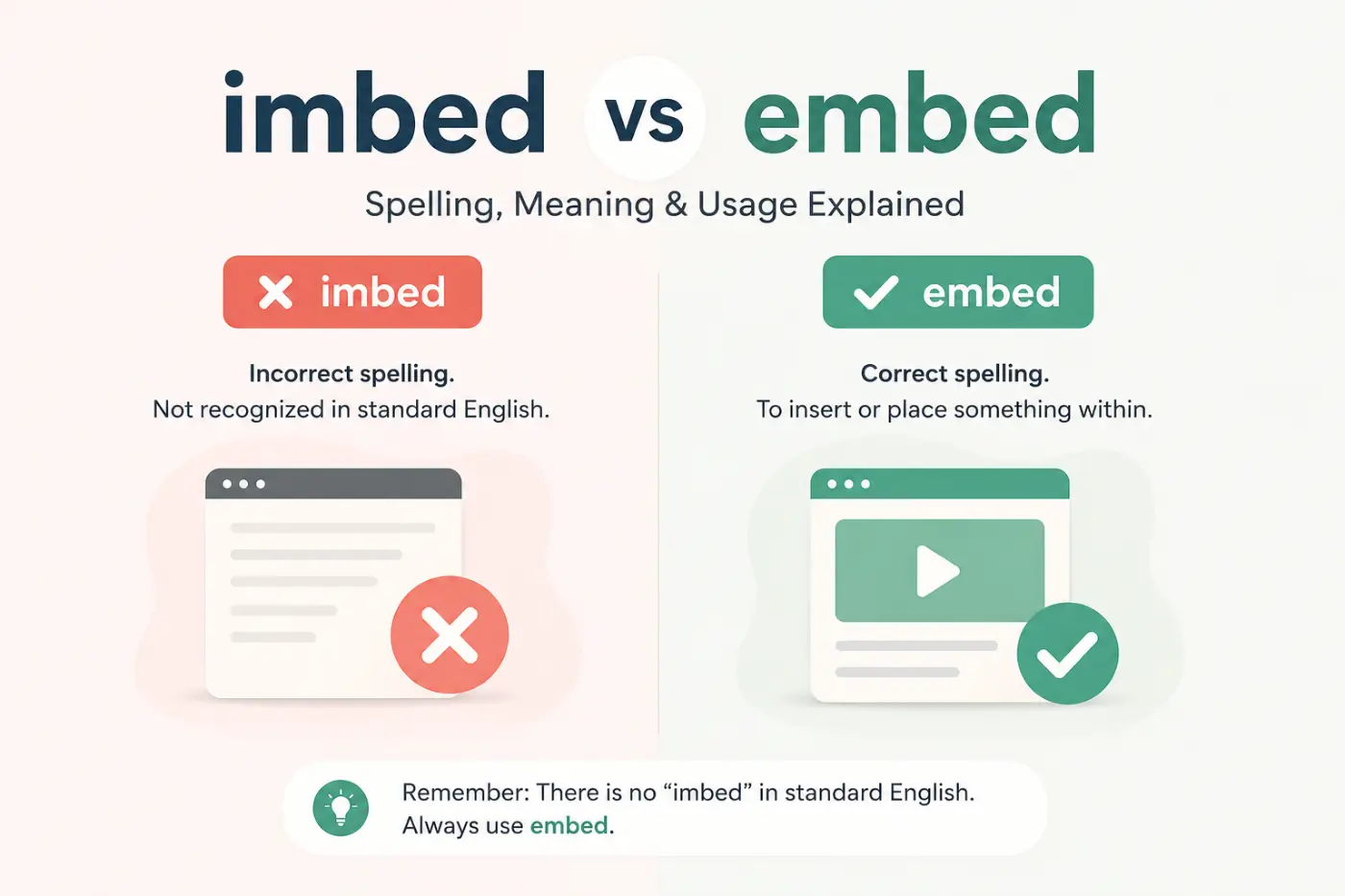
Many English words have older and newer spellings, and imbed vs embed is a perfect example. If you’ve seen both forms in books, websites, software documentation, or everyday writing, you might wonder if one is wrong or if both are acceptable.
The short answer is simple. Embed is the preferred spelling in modern English. It appears in dictionaries, style guides, academic writing, journalism, business communication, and technology. Imbed is an older spelling that is still recognized, but it is far less common today.
The confusion comes from history rather than grammar. Both spellings developed from the same word and share the same meaning. Over time, embed became the standard choice, while imbed gradually faded from everyday use. You may still come across imbed in older books, historical documents, or publications that preserve traditional spelling.
This guide explains the difference between imbed vs embed, why both spellings exist, which one you should use today, and how professional editors, dictionaries, and native English speakers treat these words. You’ll also learn the grammar, pronunciation, spelling patterns, and practical examples that make choosing the correct form easy.
Need another quick comparison? Read Combatting Or Combating Which Spelling Is Correct 2026.
Quick Answer
Embed is the standard and preferred spelling in modern English. Imbed is an older variant that means exactly the same thing but appears much less often. For almost every situation, including school, work, professional writing, and digital content, embed is the better choice.
Imbed Vs Embed Comparison Table
| Feature | Embed | Imbed |
|---|---|---|
| Modern standard spelling | Yes | No. Older variant. |
| Meaning | To fix firmly within something | Same meaning |
| Part of speech | Verb | Verb |
| Accepted in dictionaries | Yes | Yes |
| Common in modern writing | Very common | Rare |
| Formal writing | Preferred | Usually avoided |
| Academic writing | Preferred | Rarely used |
| Journalism | Preferred | Rare |
| Technology | Preferred | Almost always replaced by embed |
| Example | Please embed the video in the article. | The fossil was imbedded in the rock. |
What Does Embed Mean
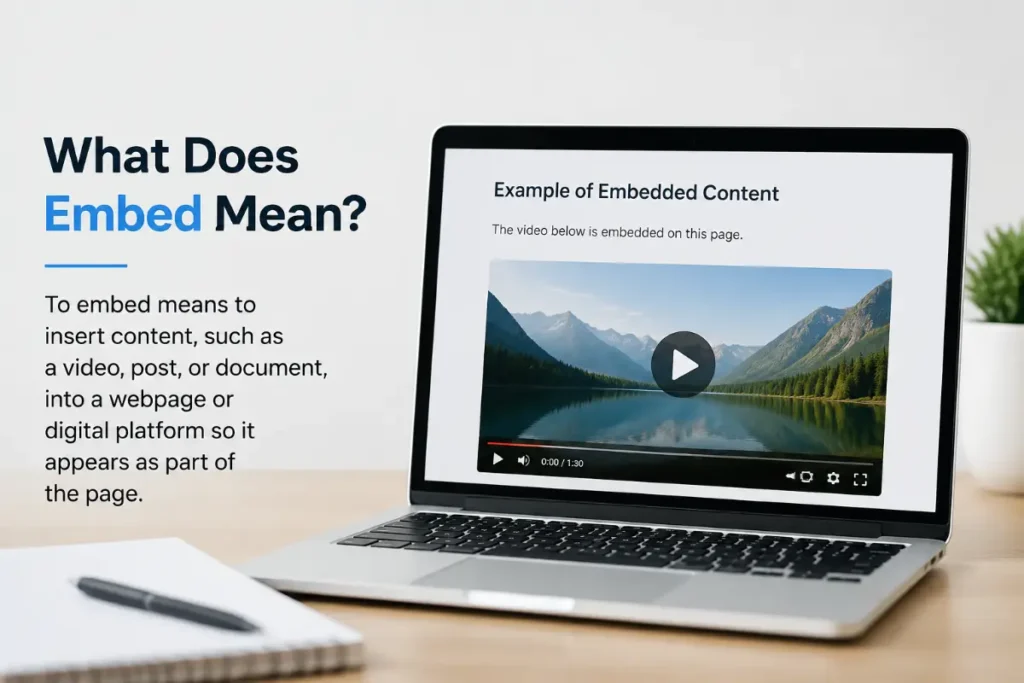
Embed is a verb that means to fix, place, or insert something firmly into another thing so it becomes part of it.
The word has several meanings depending on the context, but the central idea stays the same. Something becomes securely placed inside something else.
Simple Definition
Embed means to place something firmly inside another object, material, document, system, or idea.
Common Uses Of Embed
People use embed in many everyday situations.
- Embedding a video into a web page.
- Embedding an image in a document.
- Embedding a chip inside a device.
- Embedding values into a company culture.
- Embedding a journalist with military troops.
Real Life Examples
- Please embed the chart in the report.
- The engineer embedded the sensor inside the wall.
- We embedded the company logo into the presentation.
- Teachers often embed critical thinking into classroom activities.
- The website lets users embed videos with a single line of code.
What Does Imbed Mean
Imbed has the same meaning as embed.
It is an older spelling that remains listed in many dictionaries because it has been part of English for centuries. Today, however, it appears far less often than embed.
Most native English speakers rarely use imbed, and many style guides recommend avoiding it unless you are quoting an older source or following historical spelling.
Simple Definition
Imbed means to place or fix something firmly inside something else.
Its meaning is identical to embed.
Examples
- The arrow was imbedded in the tree.
- Small stones were imbedded in the concrete.
- The museum preserved the artifact exactly as it appeared in the original text where the older spelling was used.
Although these sentences are correct, most modern editors would replace imbed with embed unless there is a specific reason to keep the older spelling.
Which One Is Correct
Both embed and imbed are correct English spellings.
However, they are not equally common.
Embed is the standard spelling used in modern English around the world. It appears in dictionaries, newspapers, university writing, business communication, software documentation, and professional editing.
Imbed survives as an accepted variant, but its use has become uncommon.
If you are writing today, choose embed in almost every situation.
Here is a simple guide.
| If you are writing | Best choice |
|---|---|
| School assignments | Embed |
| Business emails | Embed |
| Academic papers | Embed |
| News articles | Embed |
| Websites | Embed |
| Books | Embed |
| Technical writing | Embed |
| Historical quotations | Keep the original spelling |
Choosing embed makes your writing look current, polished, and consistent with modern English.
Grammar Explanation
Both embed and imbed are verbs. Since they have the same meaning, they follow the same grammar rules.
Here are the most common verb forms using the preferred modern spelling.
| Verb Form | Embed |
|---|---|
| Base form | embed |
| Third person singular | embeds |
| Present participle | embedding |
| Past tense | embedded |
| Past participle | embedded |
Notice that the final d doubles before adding ed or ing.
Examples.
- She embeds images into every report.
- We are embedding a map on the website.
- The designer embedded a QR code in the brochure.
- Several important lessons were embedded throughout the training program.
The same grammar technically applies to imbed, producing forms such as imbedded and imbedding. Even so, modern publications strongly favor embedded and embedding because they come from the preferred spelling embed.
Why People Confuse Imbed And Embed
The confusion between imbed and embed has nothing to do with meaning. Both words mean exactly the same thing. The confusion comes from their history and the way English spelling has changed over time.
Several factors keep both spellings alive.
Both Spellings Appear In Dictionaries
Many dictionaries list imbed as a variant of embed. When writers see both entries, they naturally wonder if one is more correct than the other.
The answer is simple. Both are correct, but embed is the modern standard.
Older Books Still Use Imbed
If you read books published decades ago, you may find imbed, imbedded, and imbedding.
Modern publishers usually update these forms to embed, embedded, and embedding unless they are preserving the original text.
Search Results Show Both Spellings
Older websites, scanned books, and archived documents still contain imbed. This makes many learners think the spellings are equally common today.
In reality, embed appears far more often in current English.
Technology Reinforces Embed
If you’ve ever worked with websites, videos, PDFs, or software, you’ve probably seen phrases like these.
- Embed a YouTube video.
- Embed an image.
- Embed code.
- Embedded system.
Technology has helped make embed the dominant spelling worldwide.
Key Differences Between Imbed And Embed
| Feature | Embed | Imbed |
|---|---|---|
| Meaning | Place firmly inside something | Same meaning |
| Modern preference | Yes | No |
| Dictionary status | Standard spelling | Accepted variant |
| Formal writing | Recommended | Usually avoided |
| Academic writing | Preferred | Rare |
| Business writing | Preferred | Rare |
| Technical writing | Almost universal | Very uncommon |
| Historical texts | Less common | More common |
The biggest difference is not grammar or meaning.
It is modern usage.
If you want writing that feels current and professional, choose embed.
Spelling Rules
English often keeps older spellings even after one becomes more popular.
The same thing happened with imbed and embed.
Originally, both spellings developed because English borrowed the word from the noun bed, meaning to place something in a bed or fixed position.
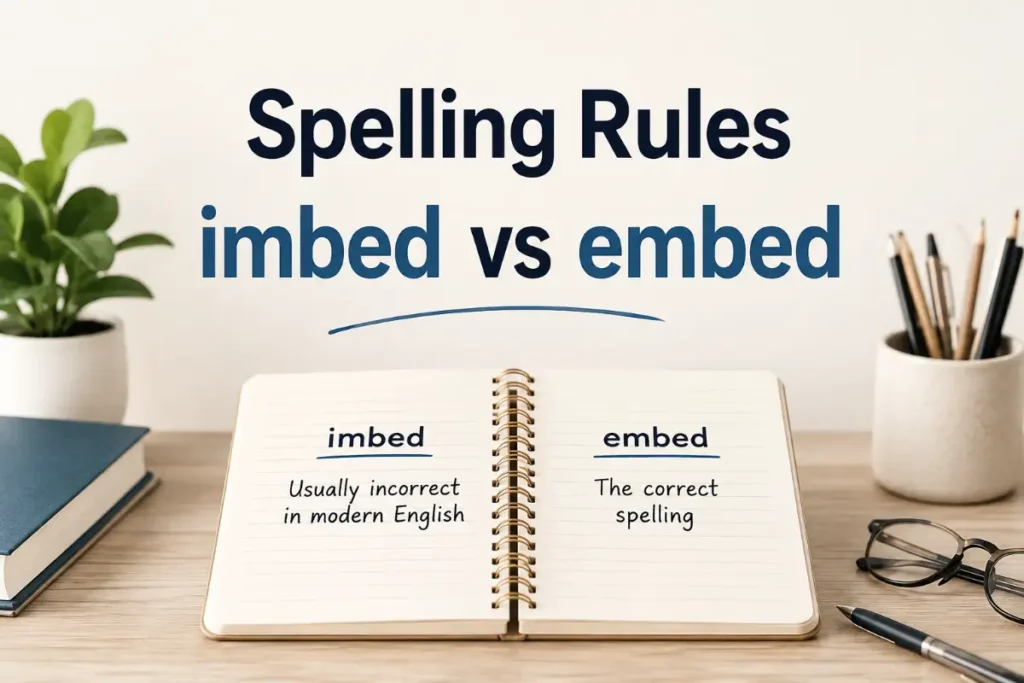
Over time, embed became the preferred spelling because it matched the base word more clearly and appeared more consistently in publishing.
Today, almost every major publisher, university, and style guide recommends embed.
Verb Forms
Always remember these modern forms.
| Base Word | Preferred Form |
|---|---|
| Present | embed |
| Past | embedded |
| Present participle | embedding |
| Past participle | embedded |
Although imbedded and imbedding are still recognized, they now look old fashioned to most readers.
For another common grammar confusion, see Totalling Vs Totaling Which Spelling Is Correct 2026.
Pronunciation Guide
Interestingly, the pronunciation does not change.
Embed
IPA
American English.
/ɪmˈbɛd/
Syllables
Em bed.
Stress
The second syllable receives the primary stress.
Imbed
IPA
American English.
/ɪmˈbɛd/
The pronunciation is exactly the same.
This explains why many people never realize there are two spellings.
Word Origin And History
The history of this word explains why two spellings survived.
The word comes from the prefix em, meaning put into, combined with bed, referring to placing something securely into a surrounding material.
During the eighteenth and nineteenth centuries, writers also began spelling it imbed because the prefix sometimes changed before certain consonants in English.
Both forms appeared in books for many years.
Eventually, publishers, dictionaries, and editors settled on embed as the preferred spelling.
Today, imbed remains an accepted historical variant rather than the standard choice.
British American Canadian And Australian English
Unlike many English spelling differences, this is not a regional issue.
American English
Modern American English strongly prefers embed.
British English
British publishers also use embed almost exclusively.
Canadian English
Canadian dictionaries and newspapers follow the same pattern.
Australian English
Australian English also favors embed.
Across major English speaking countries, the recommendation stays the same.
Use embed unless you are quoting an older source.
Real Life Examples
The easiest way to remember the preferred spelling is to see it in everyday situations.
Daily Conversation
- Please embed the photo in the message.
- The stone was embedded deep in the ground.
- We should embed kindness into our daily habits.
Workplace
- The designer embedded the company logo in the presentation.
- Our training program embeds safety into every lesson.
- The engineer embedded a tracking chip inside the device.
Emails
- Please embed the spreadsheet before sending the report.
- I embedded the meeting link in the email.
Academic Writing
- Researchers embedded sensors throughout the experiment.
- The author embedded historical evidence into every chapter.
Journalism
- The newspaper embedded interactive charts in the online article.
- Several reporters were embedded with rescue teams.
Technology
- Copy this code to embed the video.
- The website lets users embed maps on every page.
- Developers embedded security features into the application.
- Embedded software controls the machine automatically.
Literature
- The writer embedded symbolism throughout the novel.
- Tiny pieces of glass were embedded in the sculpture.
Social Media
- I embedded the reel in my blog post.
- You can embed this post on your website with one click.
Historical Usage
Although modern writing favors embed, you may still encounter sentences like these in older publications.
- The fossil was imbedded in the rock.
- The jewel was imbedded in gold.
These are historically correct but appear much less often today.
Common Mistakes
Even experienced writers occasionally hesitate when choosing between imbed and embed. The good news is that the mistakes are easy to avoid once you know the modern standard.
Using Imbed In Modern Writing
Many people choose imbed because they have seen it in an older book or dictionary.
Less natural.
Please imbed the video in the article.
More natural.
Please embed the video in the article.
For almost every modern document, embed is the better choice.
Mixing Different Verb Forms
Some writers mix spellings within the same document.
Incorrect.
The image was imbedded and later embedded into another file.
Correct.
The image was embedded and later embedded into another file.
Stay consistent throughout your writing.
Assuming Imbed Is Incorrect
Some people believe imbed is a spelling mistake.
It is not.
It is a recognized variant in many dictionaries.
Confusing Embed With Related Words
People sometimes mix embed with words that have similar meanings.
Examples include.
- Imbue.
- Insert.
- Install.
- Include.
Each word has a different meaning, so choose the one that best fits your sentence.
Memory Tricks
A simple memory trick can help you remember the preferred spelling.
Think About Bed
The word embed clearly contains the word bed.
Imagine placing something securely into a bed. Once it is inside, it stays firmly in place.
That picture matches the meaning of embed.
Remember Modern Technology
Every day you see phrases like these.
- Embed code.
- Embedded software.
- Embed a YouTube video.
- Embed a map.
Technology almost always uses embed.
If you think about websites or software, the correct spelling becomes easy to remember.
One Simple Rule
If you are writing something today, choose embed.
Only use imbed when preserving an older quotation or historical spelling.
Related Words
Expanding your vocabulary helps you understand how embed fits into English.
Synonyms
- Insert.
- Fix.
- Place.
- Implant.
- Incorporate.
- Integrate.
- Root.
- Ingrain.
Related Words
- Embedded.
- Embedding.
- Embedded system.
- Embedded journalism.
- Embedded software.
- Embed code.
Opposites
- Remove.
- Extract.
- Detach.
- Separate.
- Dislodge.
Frequently Confused Words
- Imbed and embed.
- Imbue and embed.
- Insert and embed.
- Include and embed.
- Install and embed.
Learning these related words improves both your vocabulary and your writing accuracy.
Expert Editor’s Note
Professional editors almost always choose embed.
Major dictionaries recognize both spellings, but style guides, publishers, newspapers, universities, and technology companies overwhelmingly prefer embed because it reflects current English usage.
If you are writing an essay, article, business email, website, or book, embed is the safest and most natural choice.
Keep imbed only when you are quoting an older source or preserving historical spelling. Modern readers expect to see embed, and using it makes your writing look polished and up to date.
Frequently Asked Questions
Is Imbed Or Embed Correct?
Both spellings are correct. Embed is the modern standard and the preferred choice in professional, academic, technical, and everyday writing. Imbed is an older spelling that appears much less often.
Why Is Embed More Common Than Imbed?
Over time, publishers, dictionaries, and style guides gradually adopted embed as the standard spelling. Today it appears far more often in books, newspapers, websites, and software documentation.
Is Imbed Old Fashioned?
Yes. Most native English speakers consider imbed an older variant. It is still accepted by many dictionaries but rarely appears in modern writing unless an author is quoting historical material.
Which Spelling Should I Use In Business Writing?
Always use embed in business communication. It is the spelling your readers expect to see and matches modern editorial standards.
Are Embedded And Imbedded Both Correct?
Yes. Both forms are recognized. However, embedded is overwhelmingly more common and is the preferred spelling in current English.
Does British English Prefer Imbed?
No. British English, American English, Canadian English, and Australian English all prefer embed in modern writing.
Is Embed Used In Technology?
Yes. Technology almost always uses embed. Common examples include embed code, embedded software, embedded systems, and embed a video.
A related grammar guide is Courtesy Vs Curtesy Which Word Is Correct 2026.
Conclusion
The answer to imbed vs embed is straightforward.
Both spellings are correct, but embed is the standard form used in modern English. It appears in dictionaries, style guides, academic writing, journalism, business communication, and technology.
Imbed survives as an accepted historical variant, but it is rarely the best choice for new writing.
If you are unsure which spelling to use, choose embed. It is clear, current, and widely accepted by editors and native English speakers.
A small spelling choice can make your writing look more polished, and embed is the spelling that readers expect today.

Editorial Reviewer & Proofreader
Grace Mitchell reviews Gramlify’s articles for clarity, consistency, and readability. She is passionate about creating accurate, approachable content that helps English learners build confidence.