
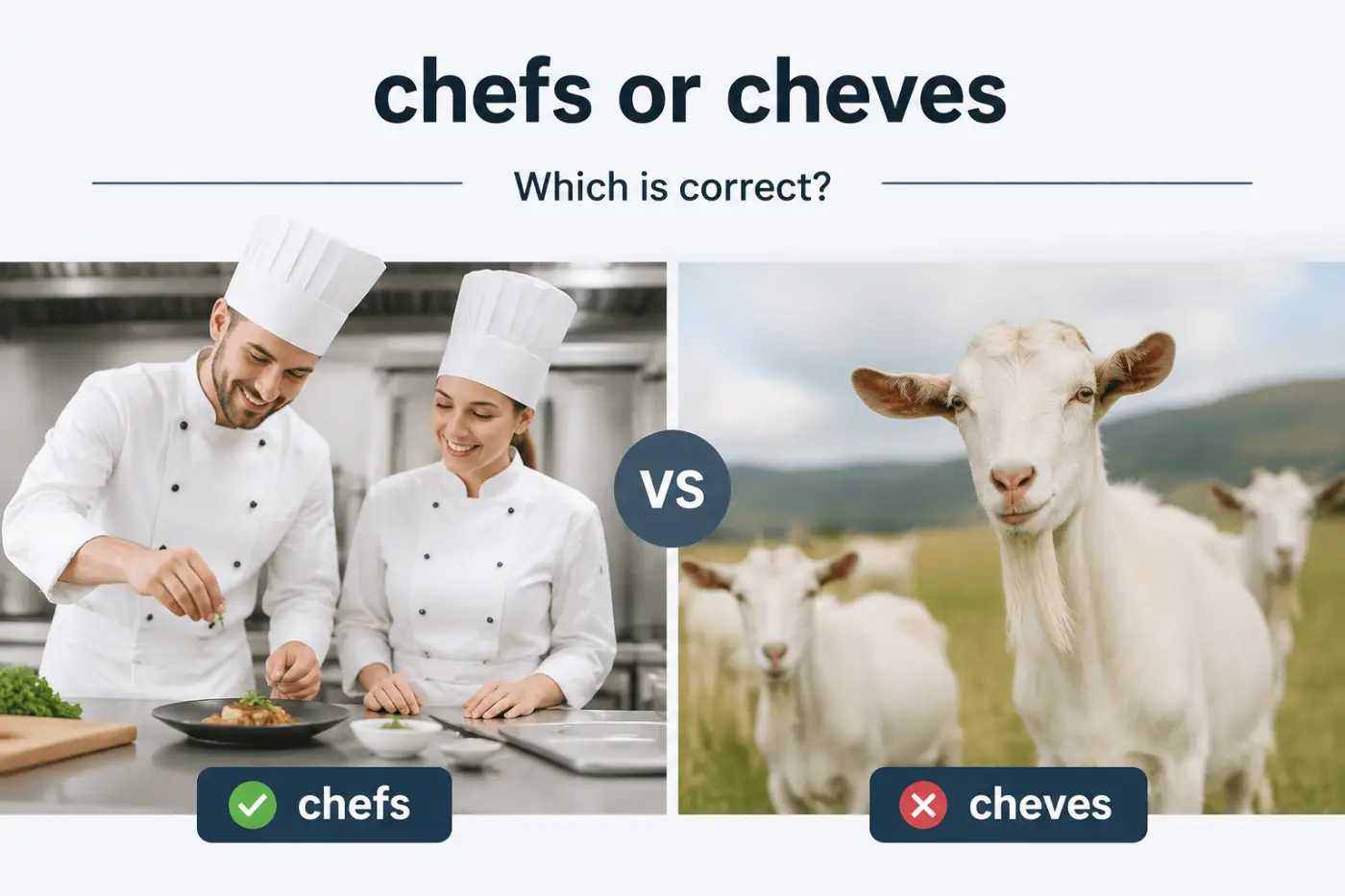
If you’re searching for chefs or cheves because you’re unsure how to spell the plural of chef you’re not alone. The correct spelling is chefs. Cheves is not the standard English plural of chef and shouldn’t be used in formal or everyday writing.
The confusion usually comes from the way English handles words borrowed from other languages. Chef comes from French and ends with the letter f. English has many words where an ending changes when a plural form is created. Some words ending in f or fe change to ves such as knife becoming knives and leaf becoming leaves. That pattern can make cheves look reasonable even though it isn’t correct.
Fortunately the rule for chef is much simpler. You add s to form the plural.
One chef becomes two chefs.
In this guide you’ll learn why chefs is correct how to pronounce it where the word came from why cheves looks tempting and how the plural works in American English and other varieties of English. You’ll also see natural examples that show exactly how native speakers use the word.
Learn the difference in Pentoxide Vs Pentaoxide Which Spelling Is Correct 2026 Guide.
Quick Answer
The correct plural of chef is chefs. The spelling cheves is incorrect in standard English. Although some English nouns ending in f change to ves in the plural such as knife to knives and leaf to leaves that rule doesn’t apply to chef. Simply add s to make chefs.
Chefs Or Cheves Comparison
| Feature | Chefs | Cheves |
|---|---|---|
| Correct spelling | Yes | No |
| Singular form | Chef | Chef |
| Plural form | Chefs | Not standard |
| Part of speech | Noun | Incorrect plural form |
| Meaning | More than one chef | No standard English meaning |
| Pronunciation | Usually pronounced chefs | Not a standard word |
| Formal writing | Correct | Avoid |
| Informal writing | Correct | Avoid |
| American English | Correct | Incorrect |
| British English | Correct | Incorrect |
| Example | The chefs prepared dinner. | The cheves prepared dinner. |
The answer is clear. Chefs is the word to use.

What Does Chef Mean
A chef is a professional cook. The word often refers to someone who works in a professional kitchen and has responsibility for preparing food or managing part of the cooking operation.
The word can describe many types of culinary professionals.
A chef might run a restaurant kitchen. Another might specialize in pastries. Someone else might focus on seafood Italian food French cuisine or large scale catering.
In everyday English people sometimes use chef for any skilled cook. In professional settings the word can carry a more specific meaning depending on the person’s role.
Chef As A Singular Noun
Use chef when you’re talking about one person.
Examples include.
- The chef prepared a fresh seafood dish.
- My brother wants to become a chef.
- The chef created a new dessert for the restaurant.
- A talented chef can turn simple ingredients into an impressive meal.
- The hotel hired an experienced chef.
The important point is simple. Chef means one chef.
Chefs As A Plural Noun
Use chefs when you’re talking about two or more people.
Examples include.
- The chefs prepared dinner together.
- Several chefs competed in the cooking contest.
- The restaurant employs five chefs.
- The chefs created a seasonal menu.
- Professional chefs often work long hours.
The plural ending is simply s.
Chef becomes chefs.
Why Chefs Is Correct
The plural form chefs follows a common English pattern for borrowed nouns.
English doesn’t apply one single plural rule to every word. Some nouns take s. Others take es. Some change their spelling completely.
For chef the standard plural is formed by adding s.
Chef + s = chefs.
There’s no spelling change to the f. The f stays in the word.
This is important because learners sometimes see other words ending in f and assume they all follow the same plural pattern.
They don’t.
English contains many exceptions and competing patterns. The safest approach is to learn the plural form of commonly used words instead of assuming every noun follows the same rule.
Why Cheves Looks Correct
The spelling cheves seems logical because English has a familiar pattern involving words that end in f or fe.
For example.
- Knife becomes knives.
- Wife becomes wives.
- Leaf becomes leaves.
- Life becomes lives.
- Wolf becomes wolves.
Seeing these forms can lead someone to think that chef should work the same way.
Chef looks similar because it ends in f. However English doesn’t automatically change every final f into ves.
That distinction matters.
The correct form is chefs.
The F To Ves Pattern
The spelling change from f to ves appears in several common English plurals. It developed through historical sound and spelling changes rather than a simple modern rule that applies to every word.
Some familiar examples include.
- Half becomes halves.
- Calf becomes calves.
- Shelf becomes shelves.
- Self becomes selves.
- Thief becomes thieves.
But other nouns keep the f and simply take s.
Examples include.
- Roof becomes roofs.
- Belief becomes beliefs.
- Chief becomes chiefs.
- Proof becomes proofs.
- Safe becomes safes.
- Chef becomes chefs.
This is why spelling cheves based only on the final f doesn’t work.
Chefs Or Cheves In American English
American English uses chefs as the standard plural.
You’ll see it in restaurant menus newspaper articles cookbooks professional profiles culinary school materials and everyday conversation.
For example.
The chefs prepared a five course dinner.
The restaurant is known for its talented chefs.
Several chefs shared their favorite recipes.
The cooking school trains aspiring chefs.
You don’t need a special American spelling here. The same plural form works across standard varieties of English.
Chefs Or Cheves In British English
British English also uses chefs.
There is no major British American spelling difference for this word.
The plural remains.
Chef → chefs.
The same applies in Canadian Australian and New Zealand English.
This makes the spelling especially easy to remember. You don’t need to switch between regional forms.
Pronunciation Of Chef And Chefs
Spelling is only part of the problem. Pronunciation can also help reinforce the correct form.
Chef Pronunciation
In American English chef is commonly pronounced:
/ʃef/
It has one syllable.
The first sound is similar to the sound at the beginning of shoe. The ending sounds like the ef in the letter name F.
Chefs Pronunciation
Chefs is commonly pronounced:
/ʃefs/
It also has one syllable.
The plural ending adds an s sound after the final f.
You can think of it as.
Chef → chefs.
The spelling stays clear and the pronunciation adds the plural sound.
A Common Pronunciation Mistake
Some learners may try to pronounce chefs as two syllables. That’s not standard.
Chefs has one syllable.
The plural ending doesn’t create another syllable.
The Word Origin Of Chef
The history of chef explains why the word doesn’t behave like a typical native English word.
English borrowed chef from French. The French word chef means a leader or chief and comes from an older French form connected with the idea of a head or leader.
In French the word developed into a term for someone who leads a kitchen. English later adopted the culinary meaning.
This history also explains why chef has a spelling that may feel different from older English words.
The word entered English as a French borrowing but became fully established in everyday English.
Today chef is a normal English noun. English speakers don’t treat it as a foreign word when forming the plural. They use the regular plural chefs.
How The Plural Rule Works
The easiest way to understand the spelling is to focus on the whole word rather than its final letter.
Some learners use a shortcut like this.
Words ending in f become words ending in ves.
That shortcut is too broad.
A better rule is this.
Some nouns ending in f or fe form plurals with ves. Other nouns simply add s.
The word chef belongs to the second group.
That means.
Chef → chefs.
Not.
Chef → cheves.
The same basic pattern appears with other words.
Chief → chiefs.
Roof → roofs.
Proof → proofs.
Belief → beliefs.
So if you’ve learned that every final f changes to ves you’re dealing with an oversimplified rule. English plural spelling has several patterns and many historical exceptions.
Real Life Examples With Chefs
Seeing the correct form in different settings makes the spelling easier to remember.
Everyday Conversation
- The chefs at that restaurant are amazing.
- We watched two chefs prepare the meal.
- My friends are both professional chefs.
- The chefs came out after dinner to greet the guests.
Restaurant Writing
- Our chefs prepare every dish from fresh ingredients.
- The restaurant’s chefs specialize in modern American cuisine.
- Guests can watch the chefs work in the open kitchen.
Workplace Writing
- The hotel employs several chefs across its restaurants.
- The head chef supervises the other chefs during service.
- The chefs attended a training session this morning.
Academic Writing
- Culinary students often study the techniques used by famous chefs.
- The study examined how professional chefs manage kitchen pressure.
Journalism
- Local chefs gathered for a charity dinner.
- Several chefs appeared at the annual food festival.
Social Media
- These chefs make every dish look effortless.
- Three chefs shared their favorite comfort food recipes.
- The chefs posted behind the scenes photos from the kitchen.
Formal Writing
- The event will feature chefs from several regional restaurants.
- Participating chefs must submit their menus in advance.
- The chefs agreed to follow the competition’s food safety rules.
Notice how naturally chefs works in every setting. You don’t need a different plural form for casual writing formal writing or professional communication.

Common Mistakes With Chefs
The most common error is writing cheves instead of chefs.
However a few other mistakes are worth knowing.
Mistake One
The cheves prepared the meal.
Correct.
The chefs prepared the meal.
Mistake Two
Three chef prepared dinner.
Correct.
Three chefs prepared dinner.
When the noun refers to more than one person the plural form is required.
Mistake Three
The chefs was ready.
Correct.
The chefs were ready.
Because chefs is plural the verb should normally be plural too.
Mistake Four
A chefs prepared the meal.
Correct.
A chef prepared the meal.
The article a refers to one person. Use the singular noun after it.
Mistake Five
Two chef’s prepared dinner.
Correct.
Two chefs prepared dinner.
The apostrophe isn’t needed for a simple plural.
An apostrophe can show possession.
For example.
The chefs’ kitchen was spotless.
Here the apostrophe shows that the kitchen belongs to or is associated with multiple chefs.
The Difference Between Chefs And Chef’s
This distinction causes plenty of trouble in everyday writing.
Chefs means more than one chef.
Chef’s normally shows possession by one chef.
Compare these sentences.
The chefs prepared the meal.
The chef’s knife was on the counter.
The first sentence talks about multiple cooks.
The second sentence talks about something belonging to one chef.
There is also a plural possessive form.
Chefs’
For example.
The chefs’ uniforms were hanging in the kitchen.
Here multiple chefs own or use the uniforms.
Understanding these three forms will prevent many punctuation mistakes.
Chef = one person.
Chefs = more than one person.
Chef’s = belonging to one chef.
Chefs’ = belonging to multiple chefs.
Chefs Or Cheves In Possessive Forms
Plural forms become slightly more interesting when possession enters the sentence. The key is to separate the plural ending from the possessive apostrophe.
Chefs means more than one chef.
Chef’s means something belongs to one chef.
Chefs’ means something belongs to more than one chef.
Look at the difference.
- The chefs prepared the menu.
- The chef’s menu was popular.
- The chefs’ menu was popular.
The first sentence has multiple chefs.
The second sentence refers to one chef and that chef’s menu.
The third sentence refers to a menu associated with multiple chefs.
Why Cheves Is Never The Plural Possessive
You might see a form like cheves’ online and wonder if it could be correct. It isn’t.
The standard plural is chefs. The plural possessive is chefs’.
For example.
The chefs’ recipes were published online.
You don’t change the f to v before adding the apostrophe.
For another common grammar confusion, see Immerse Vs Emerse Which Word Is Correct 2026 Guide.
Chefs Or Cheves In Formal Writing
For formal writing the choice is straightforward.
Use chefs.
Avoid cheves.
This applies to school assignments academic papers business documents restaurant websites menus news articles and professional correspondence.
Consider these examples.
Correct.
The conference invited several chefs to speak.
Incorrect.
The conference invited several cheves to speak.
Correct.
The chefs developed a new menu.
Incorrect.
The cheves developed a new menu.
A spelling mistake can make otherwise strong writing look careless. Since chefs is the established plural form there is no reason to use the incorrect spelling.
Chefs Or Cheves In Informal Writing
Informal writing follows the same spelling rule.
You might write a social media caption like this.
The chefs absolutely nailed dinner tonight.
You could text a friend.
The chefs at that place are incredible.
You might comment on a cooking video.
Those chefs know what they’re doing.
The relaxed setting doesn’t change the spelling. Informal English allows slang and creative expressions but cheves isn’t a standard alternative spelling for chefs.
Is Cheves Ever Correct
In standard English cheves is not the accepted plural of chef.
If you encounter cheves online it may be a spelling error or a name rather than the plural noun you need.
Proper names can follow their own spelling conventions. A surname or place name that happens to look like Cheves doesn’t change the English plural of chef.
For ordinary writing about professional cooks use chefs.
Why Some Words Use Ves And Others Use S
This is one of the most useful spelling questions behind the confusion.
English plural spelling developed over a long period. Modern speakers inherited several patterns rather than one perfectly neat system.
Some nouns ending in f or fe take ves.
Examples include.
- Leaf becomes leaves.
- Knife becomes knives.
- Wife becomes wives.
- Life becomes lives.
- Wolf becomes wolves.
Other nouns ending in f simply take s.
Examples include.
- Chef becomes chefs.
- Chief becomes chiefs.
- Roof becomes roofs.
- Belief becomes beliefs.
- Proof becomes proofs.
- Cliff becomes cliffs.
- Safe becomes safes.
The important lesson is not to create a rule that English doesn’t actually have.
Why The Pattern Isn’t Fully Predictable
Historical sound changes played a major role in these plural forms. Some old English nouns developed a change in the final consonant before the plural ending. Other words entered English later or followed different patterns.
Because chef came into English from French its plural developed as chefs rather than following the f to ves pattern seen in several older English words.
This is a good example of why word history can explain modern spelling better than a simple classroom rule.
A Useful List Of F Words With S Plurals
If you’re learning English you don’t need to memorize every word at once. Start with common examples.
| Singular | Correct plural |
|---|---|
| Chef | Chefs |
| Chief | Chiefs |
| Roof | Roofs |
| Proof | Proofs |
| Belief | Beliefs |
| Cliff | Cliffs |
| Handkerchief | Handkerchiefs |
| Safe | Safes |
| Reef | Reefs |
| Grief | Griefs |
This list helps show that a final f doesn’t automatically become ves.
A Useful List Of F Words With Ves Plurals
Compare those words with common examples that do change.
| Singular | Correct plural |
|---|---|
| Knife | Knives |
| Wife | Wives |
| Life | Lives |
| Leaf | Leaves |
| Wolf | Wolves |
| Shelf | Shelves |
| Thief | Thieves |
| Calf | Calves |
| Half | Halves |
| Loaf | Loaves |
These examples explain why cheves may look convincing at first. The pattern exists but it doesn’t apply to chef.
How To Choose The Correct Plural
When you’re unsure about an English plural don’t rely only on the final letter.
Instead consider three things.
- Check the standard dictionary form.
- Look at reliable examples from edited English.
- Learn common exceptions as individual vocabulary items.
For chef the answer is easy.
Chef → chefs.
If you’re writing for school work business or publication you should use the established form rather than trying to apply a broad spelling shortcut.
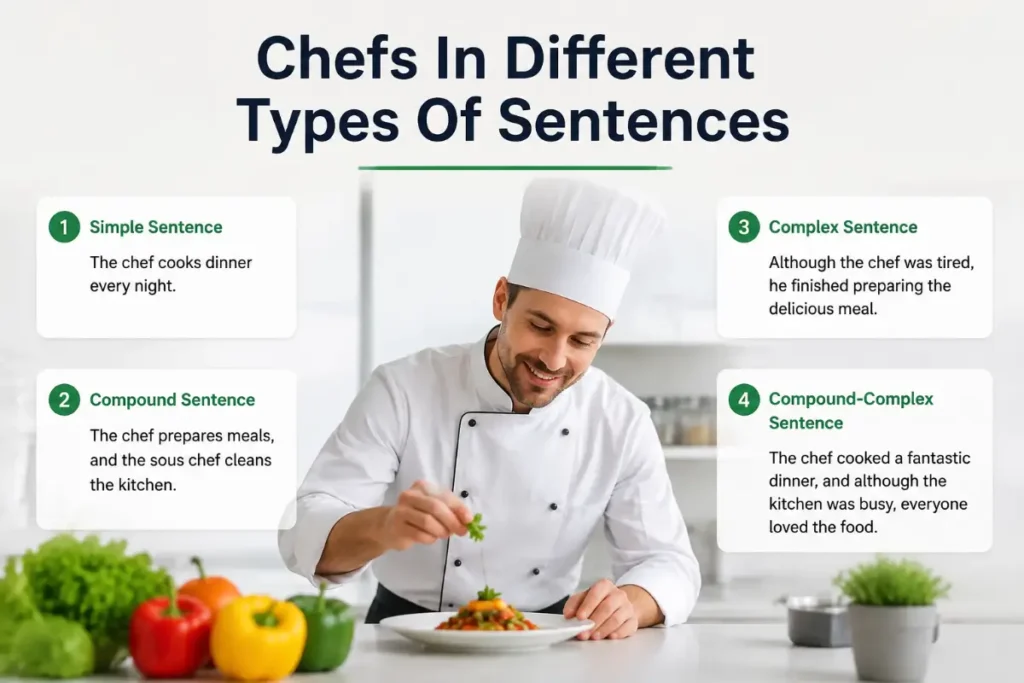
Chefs In Different Types Of Sentences
Understanding sentence structure can help you recognize the plural instantly.
Subject Of A Sentence
The chefs prepared the appetizers.
Here chefs is the plural subject.
Object Of A Sentence
The restaurant hired two chefs.
Here chefs receives the action of the verb hired.
After A Number
Five chefs entered the competition.
A number greater than one normally requires the plural noun.
After Several
Several chefs attended the event.
The word several signals a plural noun.
After Many
Many chefs start their careers in busy kitchens.
Again the plural form is required.
After One
One chef prepared the entire meal.
Use the singular form after one.
This simple agreement pattern makes the distinction practical.
Common Grammar Questions About Chefs
Is Chefs Singular Or Plural
Chefs is plural.
The singular form is chef.
One chef.
Two chefs.
Several chefs.
Many chefs.
What Is The Plural Of Chef
The plural of chef is chefs.
There is no spelling change to the final f.
Is Chefs A Noun
Yes. Chefs is the plural form of the noun chef.
A noun names a person place thing or concept. Here it names multiple professional cooks.
Is Chefs A Verb
No. Chefs is not normally used as a verb in standard English.
The related verb cook is commonly used instead.
For example.
The chefs cook dinner every night.
Is Chef A Countable Noun
Yes. Chef is a countable noun.
You can say.
A chef.
Two chefs.
Several chefs.
Many chefs.
This is why the plural form chefs is so common.
Chefs In Professional Culinary Language
The word chef can refer to different roles in a professional kitchen.
For example a head chef may supervise a kitchen and manage menus staff and food preparation.
An executive chef often has broader responsibility across one or more kitchens.
A sous chef works directly under the head chef in many traditional kitchen structures.
A pastry chef specializes in desserts baked goods and pastries.
These compounds keep the same plural idea.
Head chef becomes head chefs.
Sous chef becomes sous chefs.
Pastry chef becomes pastry chefs.
You don’t turn chef into cheves in any of these expressions.
Real World Culinary Examples
The correct spelling appears naturally across the food industry.
Restaurant Menus
A restaurant might write.
Our chefs prepare seasonal dishes every evening.
Culinary Schools
A school might write.
Students learn techniques from experienced chefs.
Food Festivals
An event announcement might say.
Local chefs will demonstrate their favorite recipes.
Restaurant Reviews
A critic might write.
The chefs clearly understand how to balance flavor and texture.
Cooking Shows
A television description might say.
The chefs compete in a series of timed challenges.
Food Magazines
An article might feature.
Ten chefs share their favorite summer dishes.
The same spelling works across all these contexts.
Memory Tricks For Chefs
The simplest memory trick is also the most reliable.
Chef takes s.
Think.
Chef plus s equals chefs.
You can also connect it with chief.
Chief becomes chiefs.
Chef follows the same basic plural pattern.
Another useful trick is to remember a pair.
Knife becomes knives.
Chef becomes chefs.
The first changes to ves.
The second simply adds s.
If you memorize that pair you’ll be less likely to apply the wrong pattern.
Related Words And Expressions
The word chef belongs to a larger group of culinary vocabulary.
Related People
- Cook.
- Baker.
- Pastry chef.
- Head chef.
- Sous chef.
- Caterer.
- Culinary instructor.
Related Food Terms
- Kitchen.
- Recipe.
- Menu.
- Cuisine.
- Ingredient.
- Dish.
- Seasoning.
- Preparation.
- Cooking.
- Baking.
Related Expressions
Common phrases include.
Professional chef.
A trained cook who works professionally.
Head chef.
The person who leads a kitchen.
Pastry chef.
A chef who specializes in pastries and desserts.
Celebrity chef.
A chef who has gained public recognition through media or entertainment.
Private chef.
A chef hired to prepare food for an individual family or private group.
These expressions all use chef as the base noun and chefs as its standard plural.
Expert Editor’s Note
From an editorial perspective the answer doesn’t need much debate.
Chefs is the correct plural. Cheves is not a standard plural form.
The mistake comes from applying a real English spelling pattern too broadly. Learners often remember that some f words become ves words and then apply the pattern to every noun ending in f. English simply doesn’t work that neatly.
Professional editing relies on established usage rather than invented spelling rules. When a common noun has a fixed plural form the safest choice is to use the form found in reputable dictionaries and edited publications.
For chef that form is chefs.
The same principle applies beyond this word. When a plural seems uncertain don’t guess based on appearance alone. Check the established form and learn the word as a complete unit.
Learn the difference in Combatting Or Combating Which Spelling Is Correct 2026.
Conclusion
The correct answer to chefs or cheves is chefs.
Chef is the singular form.
Chefs is the plural form.
Cheves is not the standard English plural.
The main source of confusion is the familiar spelling pattern where some words ending in f change to ves. Words like knife and leaf follow that pattern. Chef doesn’t.
Remember one simple rule.
Chef takes s to become chefs.
Once you learn that form you can use it confidently in conversation emails school assignments restaurant writing and professional documents.
Good spelling isn’t about guessing the pattern every time. It’s about knowing the form English speakers have established and using it with confidence.

Editorial Reviewer & Proofreader
Grace Mitchell reviews Gramlify’s articles for clarity, consistency, and readability. She is passionate about creating accurate, approachable content that helps English learners build confidence.