
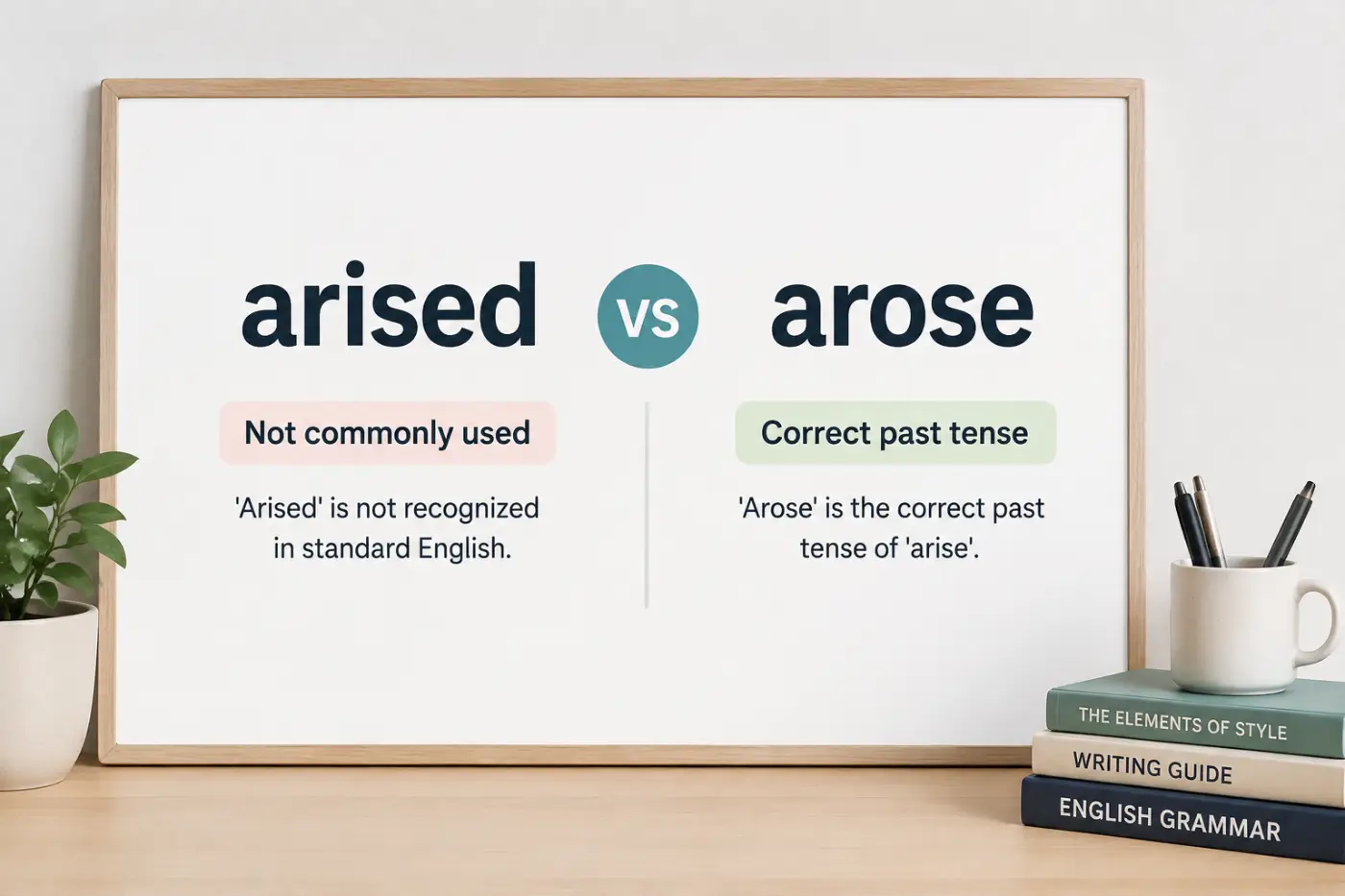
If you’ve ever paused over arised or arose while writing a sentence you’re not alone. Both forms seem connected to the verb arise and both look like they could describe something that happened in the past. But standard English does not treat them as equal choices. Arose is the correct simple past form of arise. Arised is not the standard past tense form.
The confusion comes from a familiar English pattern. Many verbs form their past tense by adding ed. We say walked from walk and opened from open. That rule works for regular verbs. Arise is different because it is an irregular verb.
The correct forms are arise, arose, and arisen. Each one has a specific grammatical job. Arise is the base form. Arose is the simple past form. Arisen is the past participle and normally appears with has, have, or had.
This guide explains the difference in plain English. You’ll learn why arised is incorrect in standard English, how to use arose naturally, how arisen fits into the same verb family, and how to avoid this mistake in formal writing, conversation, academic work, and everyday messages.
For another common grammar confusion, see Meantime Or Mean Time Which One Is Correct 2026.
Quick Answer
Arose is the correct past tense of arise. Use arose when something happened or began in the past. Arised is not a standard English verb form. The main forms are arise in the present, arose in the simple past, and arisen as the past participle.
Arised Or Arose Comparison Table
| Feature | Arised | Arose |
|---|---|---|
| Standard English | No | Yes |
| Base verb | Arise | Arise |
| Verb type | Incorrect form | Irregular verb form |
| Simple past | No | Yes |
| Past participle | No | No |
| Meaning | Intended to mean began or appeared | Began appeared or came up |
| Formal writing | Avoid | Correct |
| Everyday English | Avoid | Correct |
| Example | The problem arised yesterday. | The problem arose yesterday. |
The important point is simple. Arose is the simple past form you need.

What Does Arise Mean
Arise is an irregular verb with several related meanings. Its most common meaning is to happen or appear especially when talking about a problem situation opportunity or question.
For example:
- Problems can arise during a large project.
- Questions may arise after the meeting.
- New opportunities often arise unexpectedly.
- A conflict could arise if nobody explains the rules.
Arise can also mean to get up from a sitting or lying position. This use sounds more formal or literary than everyday American speech.
For example:
He arose from his chair and walked toward the door.
In ordinary conversation most Americans would probably say:
He got up from his chair and walked toward the door.
There is another important use in formal or literary language. Arise can describe something coming into existence or becoming noticeable.
For example:
A new concern arose after the report was released.
The verb often appears with nouns such as problem, question, issue, concern, opportunity, conflict, difficulty, and situation.
What Does Arose Mean
Arose is the simple past form of arise.
It tells the reader that something happened in the past.
For example:
A serious problem arose during the project.
The problem appeared or developed at some point in the past.
Another example is:
Several questions arose after the announcement.
The questions came up after the announcement.
The word arose can sound slightly formal. Still, it remains completely natural in American English, especially in professional writing, journalism, academic writing, and careful speech.
In casual conversation, speakers may sometimes choose simpler expressions such as came up, happened, appeared, or started.
Compare these sentences.
A problem arose during the meeting.
A problem came up during the meeting.
Both are natural. The first sounds more formal. The second sounds more conversational.
Which One Is Correct
Arose is correct. Arised is incorrect in standard English.
The reason is grammatical. Arise belongs to a group of irregular English verbs that do not form the simple past by adding ed.
You should write:
A new issue arose yesterday.
Not:
A new issue arised yesterday.
You should write:
Several concerns arose during the discussion.
Not:
Several concerns arised during the discussion.
You should write:
An unexpected problem arose.
Not:
An unexpected problem arised.
This rule applies in standard American English and standard forms of other major English varieties.

Why People Confuse Arised And Arose
The mistake is understandable because arise looks like an ordinary verb.
Many English verbs use ed for the past tense.
Ask becomes asked.
Need becomes needed.
Change becomes changed.
Start becomes started.
A learner may naturally apply the same pattern to arise and create arised. English has other irregular verbs that require a different pattern, though.
Rise becomes rose.
Drive becomes drove.
Write becomes wrote.
Speak becomes spoke.
Arise follows the same kind of pattern as rise.
That connection is one of the best ways to remember the correct form.
The Arise Verb Forms
The complete basic verb pattern is:
| Verb form | Word | Example |
|---|---|---|
| Base form | Arise | Problems can arise quickly. |
| Third person present | Arises | A problem often arises here. |
| Simple past | Arose | A problem arose yesterday. |
| Past participle | Arisen | Several problems have arisen. |
| Present participle | Arising | New concerns are arising. |
This table reveals an important point. Arose and arisen are both correct but they are not interchangeable.
Arose works as the simple past.
Arisen works as the past participle.
That difference matters in grammar.
Arose And Arisen Are Not The Same
English learners sometimes solve the arised problem by replacing it with arisen everywhere. That creates a different grammar mistake.
Consider these sentences.
A problem arose yesterday.
Correct.
A problem has arisen today.
Correct.
But:
A problem has arose today.
Incorrect.
The reason is that has requires the past participle arisen.
Likewise:
Several questions arose during the meeting.
Correct.
Several questions have arisen during the meeting.
Correct.
The tense determines the form.
Grammar Explanation For Arose
Arose is the simple past tense of arise.
The simple past normally describes an action or event completed in the past.
Examples include:
- A problem arose during the inspection.
- A disagreement arose after the decision.
- Several questions arose at the end of the lecture.
- An opportunity arose unexpectedly.
- A technical issue arose last night.
Notice something important about these sentences. The verb doesn’t need an extra helping verb.
You don’t say:
A problem did arose.
You say:
A problem arose.
If you use did to form a question or negative sentence, return to the base form arise.
Correct:
Did a problem arise during the meeting?
Correct:
No major problem did not arise during the meeting.
More naturally:
No major problem arose during the meeting.
Incorrect:
Did a problem arose during the meeting?
The rule is straightforward. After did, use the base verb.
Arose In Different Sentence Structures
You can use arose in several common sentence patterns.
Arose With A Subject
A problem arose unexpectedly.
The subject is a problem.
Arose With A Time Expression
A problem arose yesterday.
The word yesterday makes the past time clear.
Arose With A Prepositional Phrase
Several concerns arose during the meeting.
The phrase during the meeting explains when the concerns appeared.
Arose After A Trigger
Confusion arose after the instructions changed.
This structure explains the cause or point at which something developed.
Arose In Formal Writing
Several ethical concerns arose during the study.
This kind of sentence works naturally in academic and professional writing.
Real Life Examples Of Arose
Seeing the word in realistic sentences makes the grammar easier to remember.
Daily Conversation
- A strange problem arose while we were cooking dinner.
- A question arose after I read the message.
- Some confusion arose because nobody knew the schedule.
- An unexpected issue arose this morning.
- A disagreement arose between the two friends.
Workplace Writing
- A scheduling problem arose during the planning process.
- Several concerns arose after the proposal was reviewed.
- A technical issue arose before the presentation began.
- A new opportunity arose after we spoke with the client.
- A communication problem arose between the two departments.
Email Writing
- An unexpected issue arose with the order.
- A question arose regarding the payment date.
- A delay arose because the required document was missing.
Academic Writing
- Several questions arose from the research findings.
- A debate arose among scholars after the study was published.
- New concerns arose during the second phase of the experiment.
Journalism
- Questions arose after officials released the statement.
- Tensions arose following the announcement.
- Concerns arose about the safety of the new system.
Everyday Online Writing
- A problem arose right when we thought everything was finished.
- A funny argument arose over who should choose the movie.
- A new idea arose while we were talking.
- Several questions arose after I saw the update.
These examples show why arose remains useful. It works in casual sentences but becomes especially valuable when you need precise and polished writing.
Common Mistakes With Arised
The most common mistake is adding ed to arise.
Incorrect:
A problem arised yesterday.
Correct:
A problem arose yesterday.
Another mistake involves using arose after has, have, or had.
Incorrect:
Several problems have arose.
Correct:
Several problems have arisen.
A third mistake appears in questions.
Incorrect:
Did the issue arose during the meeting?
Correct:
Did the issue arise during the meeting?
A fourth mistake occurs when writers confuse arise with rise.
Both verbs can describe something moving upward or appearing. Their grammar and meanings differ depending on context. Arise often describes a problem or situation appearing. Rise commonly describes physical upward movement or an increase.
For example:
A problem arose during the meeting.
The temperature rose during the afternoon.
Both are correct, but they express different ideas.
Arised Or Arose In Formal Writing
Arose works especially well when you need a precise and polished way to say that a problem question concern or situation appeared in the past.
Consider this sentence.
Several concerns arose during the review.
It tells the reader exactly what happened without adding unnecessary words.
In professional writing you may also see arose from and arose after.
The disagreement arose from a misunderstanding.
Several questions arose after the results were published.
These patterns are common because arise often describes something that develops as a result of another event.
Arise Arose And Arisen Compared
The three forms can look confusing at first. Their grammar becomes much easier once you connect each form with its job.
| Form | Grammar | Example |
|---|---|---|
| Arise | Base form | Problems may arise. |
| Arises | Present tense | A problem often arises here. |
| Arose | Simple past | A problem arose yesterday. |
| Arisen | Past participle | Several problems have arisen. |
| Arising | Present participle | New concerns are arising. |
The key pattern is:
Arise → arose → arisen.
There is no standard form arised in this sequence.
When To Use Arise
Use arise for the present tense or after modal verbs and auxiliary verbs that require the base form.
Examples include:
- Problems can arise at any time.
- Questions may arise during the discussion.
- A conflict could arise if the rules aren’t clear.
- New opportunities might arise later.
- Difficulties often arise when communication breaks down.
Notice how words such as can, may, could, and might are followed by arise.
You don’t write:
Problems can arose.
You don’t write:
Problems can arised.
When To Use Arose
Use arose when the event happened in the past.
Examples include:
- A problem arose last night.
- Several questions arose during the interview.
- A disagreement arose after the announcement.
- An opportunity arose unexpectedly.
- A technical issue arose during the presentation.
If you can add a past time expression such as yesterday, last week, earlier, or during the meeting, arose may be the form you need.
When To Use Arisen
Use arisen as the past participle.
It usually appears with has, have, or had.
Examples include:
- A serious problem has arisen.
- Several concerns have arisen.
- A new question has arisen.
- The issue had arisen before the meeting began.
- Unexpected difficulties have arisen during the project.
This is a useful distinction for English learners.
Arose stands alone as the simple past.
Arisen normally works with a helping verb.
Compare:
A problem arose yesterday.
A problem has arisen today.
Both sentences describe a problem appearing. The grammar and time perspective are different.
Arise Arose And Arisen In Different Tenses
Understanding the tense pattern removes most uncertainty.
Present
Problems arise when instructions aren’t clear.
Present Third Person
A problem arises when the system fails.
Simple Past
A problem arose when the system failed.
Present Perfect
Several problems have arisen since the update.
Past Perfect
Several problems had arisen before the team arrived.
Future
More questions may arise after the announcement.
Continuous
New concerns are arising as the situation develops.
Each form has a specific grammatical purpose. English doesn’t allow you to choose the form simply because it sounds familiar.
Do You Say Arose Or Rose
This is another useful distinction.
Arose comes from arise.
Rose comes from rise.
The verbs are related but they don’t always express the same idea.
Use arise when something develops or appears.
A serious problem arose during the project.
Use rise when something moves upward or increases.
The temperature rose during the afternoon.
You can also use rise for people getting up.
She rose from her chair.
You can use arise in a similar physical sense but it sounds more formal.
She arose from her chair.
In everyday American English got up is usually more natural.
Arise Vs Raise
Another common source of confusion is raise.
These three verbs have different patterns.
Arise is usually intransitive. It doesn’t normally take a direct object.
A problem arose.
Raise is transitive. It normally needs an object.
She raised a question.
This difference matters.
You wouldn’t normally write:
She arose a question.
The correct sentence is:
She raised a question.
You can write:
A question arose during the meeting.
The question appeared or came up on its own.
This distinction is especially useful in professional and academic writing.
Why Arised Sounds Plausible
If arised is incorrect then why does it sound believable?
English learners often rely on productive grammar rules. The rule add ed to form the past tense works extremely well for regular verbs.
For example:
Call becomes called.
Open becomes opened.
Discuss becomes discussed.
Explain becomes explained.
The problem is that English contains many irregular verbs that preserve older patterns.
Arise belongs to this group.
Its past tense does not follow the regular ed pattern.
This isn’t a matter of personal preference. Standard dictionaries list arose as the past tense of arise.
The Connection Between Arise And Rise
One of the best memory aids comes from the relationship between arise and rise.
Look at the forms.
Rise → rose → risen.
Arise → arose → arisen.
The pattern is almost identical.
Once you know rise → rose → risen, you can use the same vowel change to remember arise → arose → arisen.
This gives you a much stronger memory than simply trying to memorize one isolated spelling.
Still confused? Compare Time Slot Vs Timeslot Which Spelling Is Correct 2026.
Spelling Rules For Arose
There isn’t a special suffix rule that creates arose. It’s an irregular past tense that you need to learn as part of the verb family.
The spelling is:
a r o s e
Don’t write:
a r i s e d
Don’t write:
a r o s e d
Don’t write:
a r o u s e
The correct form is simply arose.
The same principle applies to arisen.
It is spelled:
a r i s e n
Learning the complete family together is more effective.
arise → arose → arisen
Pronunciation Of Arose
The standard American English pronunciation of arose is commonly represented as:
/əˈroʊz/
It has two syllables.
a rose
The main stress falls on the second syllable.
The final sound is a z sound rather than an s sound.
You can think of the pronunciation as roughly:
uh ROHZ
Don’t pronounce the final part like ross. The ending sounds like the word rose.
Pronunciation Of Arise
Arise is commonly pronounced:
/əˈraɪz/
It also has two syllables.
a rise
The stress falls on the second syllable.
The vowel sound in the second syllable is the long i sound found in words such as time and right.
Compare the two.
Arise → /əˈraɪz/
Arose → /əˈroʊz/
The middle vowel changes from the sound in rise to the sound in rose.
Pronunciation Of Arisen
Arisen is commonly pronounced:
/əˈrɪzən/
It has three syllables.
a ris en
The stress falls on the second syllable.
Knowing the pronunciation can reinforce the spelling pattern.
Word Origin Of Arise
The history of arise explains why its forms don’t follow the regular ed pattern.
The verb comes from Old English and belongs to a much older Germanic verb family. Its development is closely related to the verb rise.
Old English had strong verbs that changed their internal vowel to mark different grammatical forms. English inherited many of these patterns.
That history survives in familiar verb pairs such as:
sing → sang → sung
drive → drove → driven
write → wrote → written
rise → rose → risen
arise → arose → arisen
Modern English speakers don’t need to know the historical grammar to use these verbs correctly. Still, understanding the pattern explains why arised doesn’t fit the standard system.
British And American English
There is no meaningful difference between British and American English for the basic verb forms.
American English uses:
arise → arose → arisen
British English uses the same forms.
Canadian Australian and New Zealand English also follow the same standard pattern.
The main variation appears in style and frequency.
In formal writing across these varieties arose is completely standard.
In everyday speech American speakers may often replace it with simpler phrases such as came up or happened.
For example:
A problem arose during the meeting.
More casually:
A problem came up during the meeting.
Both can be natural. The choice depends on tone and context.
Arose In Academic And Professional Writing
Arose is particularly useful when writing about events that developed during a process.
Academic examples include:
Several questions arose from the findings.
Ethical concerns arose during the study.
A debate arose among researchers.
Professional examples include:
A scheduling conflict arose during the final stage.
Several concerns arose during the audit.
A technical problem arose after the software update.
These sentences sound clear because arose describes the development of an issue without making the sentence unnecessarily complicated.
Arose In Literature And Journalism
Writers have long used arose to describe events emotions questions conflicts and situations that emerge.
In literary writing the word can have a more elevated tone.
A strange silence arose after the announcement.
In journalism it can help describe the development of a public issue.

Common Mistakes With Arose And Arisen
The most important errors are easy to spot once you know the pattern.
Mistake One
The problem arised yesterday.
Correct:
The problem arose yesterday.
Mistake Two
Several problems have arose.
Correct:
Several problems have arisen.
Mistake Three
Did a problem arose?
Correct:
Did a problem arise?
Mistake Four
Problems can arose unexpectedly.
Correct:
Problems can arise unexpectedly.
Mistake Five
A question was arose during the meeting.
Correct:
A question arose during the meeting.
The last mistake happens because writers sometimes add unnecessary passive grammar to a verb that doesn’t need it.
Common Mistakes To Avoid
The easiest way to master arised or arose is to stop treating arise like a regular verb. The past tense doesn’t take ed. It changes form completely.
Here are the mistakes worth watching for.
Using Arised As The Past Tense
Incorrect.
A serious issue arised during the meeting.
Correct.
A serious issue arose during the meeting.
The mistake comes from applying the regular past tense rule. Arise is irregular so arose is the correct simple past form.
Using Arose After Have Or Has
Incorrect.
Several concerns have arose.
Correct.
Several concerns have arisen.
After have or has you need the past participle arisen.
Using Arose After Did
Incorrect.
Did the problem arose yesterday?
Correct.
Did the problem arise yesterday?
The auxiliary verb did already carries the past tense. The main verb returns to its base form.
Using Arisen As The Simple Past
Incorrect.
A new problem arisen yesterday.
Correct.
A new problem arose yesterday.
Arisen normally needs a helping verb.
A new problem has arisen.
How To Remember Arise Arose And Arisen
The three forms become much easier when you learn them as one unit.
Arise → arose → arisen.
A useful memory trick is to connect the verb with rise.
Rise → rose → risen.
Arise → arose → arisen.
The two patterns match closely.
If you remember rise rose risen you can usually recall arise arose arisen without hesitation.
Another simple trick is to associate each form with a tense.
Arise means now or generally.
Arose means it happened in the past.
Arisen usually appears with has have or had.
Think:
Problems arise.
Problems arose.
Problems have arisen.
That three sentence pattern captures the core grammar.
Related Words And Expressions
Learning related vocabulary helps you understand the meaning of arise rather than simply memorizing its forms.
Synonyms For Arise
Depending on context you can replace arise with words such as:
- Appear.
- Develop.
- Emerge.
- Occur.
- Happen.
- Come up.
- Begin.
- Surface.
The best synonym depends on the sentence.
For example:
A problem arose.
Could become:
A problem appeared.
A problem developed.
A problem came up.
These aren’t always exact substitutes. Arise often suggests that a situation develops or becomes noticeable.
Synonyms For Arose
Because arose is the past form of arise its possible replacements include:
- Appeared.
- Developed.
- Emerged.
- Occurred.
- Happened.
- Came up.
- Surfaced.
For example:
Several concerns arose during the discussion.
You could write:
Several concerns emerged during the discussion.
Or in casual English:
Several concerns came up during the discussion.
Arise And Occur
These verbs sometimes overlap but they aren’t identical.
Occur often means an event happened.
The accident occurred at noon.
Arise often suggests that a problem question or situation developed.
A problem arose during the inspection.
This small difference matters in polished writing.
If you’re describing a clear event you can often use occur.
If you’re describing an issue developing during a process arise may sound more natural.
Arise And Emerge
Emerge means to appear or become known.
New evidence emerged during the investigation.
Arise can describe a similar development.
New questions arose during the investigation.
The words overlap but they aren’t interchangeable in every sentence.
Emerge often focuses on something becoming visible or known.
Arise often focuses on something developing as a problem question possibility or situation.
Arise And Happen
Happen is much more common in casual American English.
What happened?
A problem happened.
The second sentence sounds less natural than:
A problem arose.
Native speakers generally use arise for issues concerns questions and situations rather than every ordinary event.
For example:
A disagreement arose.
Sounds natural.
A disagreement happened.
Sounds awkward.
So don’t treat arise and happen as perfect substitutes.
Formal And Informal Alternatives
The word you choose can change the tone of a sentence.
Formal:
Several concerns arose during the review.
Neutral:
Several concerns came up during the review.
More conversational:
We ran into several problems during the review.
All three can communicate a similar idea. The first feels more polished and works especially well in reports and formal documents.
Twenty More Natural Examples
These examples show how arose works across different contexts.
Everyday English
- A small argument arose while we were deciding where to eat.
- An unexpected problem arose on our way home.
- A question arose after I read your message.
- Some confusion arose because the directions weren’t clear.
- A strange situation arose at the party.
Workplace English
- A scheduling conflict arose before the meeting.
- Several concerns arose during the budget review.
- A technical issue arose after the update.
- A new opportunity arose when the client expanded the project.
- A disagreement arose between the two teams.
Academic English
- Several questions arose from the research.
- A debate arose among scholars about the results.
- New concerns arose during the second stage of the study.
- An important issue arose from the evidence.
Professional Emails
- An unexpected issue arose with the shipment.
- A question arose regarding the revised agreement.
- A delay arose because we were waiting for approval.
Journalism
- Questions arose after the company announced the changes.
- Public concerns arose following the report.
- Tensions arose after officials released the statement.
When Arise Means Get Up
There is another meaning of arise that English learners should know.
The verb can mean to get up from a seated or lying position.
For example:
He arose from his chair.
She arose early and prepared for the journey.
This use is grammatically correct but it sounds formal or literary in modern American English.
In everyday conversation people usually say:
He got up from his chair.
She got up early.
You may still encounter arose in historical writing religious texts literature and formal prose.
For example:
The king arose from his throne.
Here arose means got up rather than developed or appeared.
Context tells you which meaning applies.
Arose Can Describe Something Beginning
Another useful meaning is came into existence or began to develop.
For example:
A new movement arose in the early twentieth century.
A conflict arose between the two groups.
Several questions arose during the debate.
This meaning is common in historical academic and journalistic writing.
It can describe ideas movements conflicts problems opportunities and other developments.
Does Arised Ever Appear Online
You may encounter arised on websites social media forums or informal posts.
Its appearance online doesn’t make it standard English.
People make spelling and grammar mistakes on the internet every day. Search results can also repeat incorrect forms because one page copies another.
If you’re writing an essay email report application or professional document use arose for the simple past.
Don’t assume a form is correct simply because you can find examples of it online.
Expert Editor’s Note
From an editing perspective the decision is straightforward.
Use arose as the simple past form of arise.
Use arisen as the past participle.
Avoid arised in standard English.
Professional editors also pay attention to tone. Arose is completely correct but it can sound more formal than came up or happened. That doesn’t make it old fashioned or incorrect. It simply means you should choose the expression that fits the audience.
In academic writing a sentence such as:
Several ethical concerns arose during the study.
sounds precise and appropriate.
In casual conversation you might naturally say:
A few problems came up during the study.
Both are useful. Good writing isn’t about using the most formal word possible. It’s about choosing the clearest word for the situation.
Frequently Asked Questions
Is Arised A Correct Word
No. Arised is not the standard simple past form of arise. The correct past tense is arose. The complete basic pattern is arise for the base form, arose for the simple past, and arisen for the past participle.
What Is The Past Tense Of Arise
The simple past tense of arise is arose. For example: A serious problem arose during the meeting. Don’t add ed to arise. It is an irregular verb and changes form in the past.
What Is The Past Participle Of Arise
The past participle of arise is arisen. It normally appears with helping verbs such as has, have, or had. For example: Several new problems have arisen since the project began.
Can I Say A Problem Arised
No. In standard English you should say a problem arose. For example: A problem arose during the meeting. If you use has or have, use arisen instead: A problem has arisen during the project.
Is Arose Past Or Present Tense
Arose is the simple past tense of arise. It describes something that happened or developed in the past. For example: Several questions arose after the presentation.
Is Arisen The Same As Arose
No. Arose is the simple past form while arisen is the past participle. You can say a problem arose yesterday but you say a problem has arisen recently. The helping verb determines the correct structure.
Why Does Arised Sound Correct
It sounds reasonable because many English verbs form the past tense with ed. Arise is irregular so it follows the older pattern arise arose arisen instead. The similar verb pattern rise rose risen can help you remember it.
What Is The Difference Between Arise And Rise
Arise often means to develop or appear while rise commonly means to move upward or increase. For example: A problem arose during the meeting and The temperature rose during the afternoon. Their past forms are arose and rose.
Many readers also check Simpler Or More Simple Which Form Is Correct 2026.
Conclusion
The correct answer to arised or arose is clear.
Arose is the correct simple past form of arise.
Arised isn’t the standard English past tense and should be avoided in careful writing.
Remember the complete verb family:
Arise → arose → arisen.
Use arise for the base form.
Use arose for something that happened in the past.
The most useful memory trick is to connect it with rise → rose → risen. Once that pattern sticks you’ll have much less trouble with this verb.
When you’re writing professionally don’t let the familiar ed ending fool you. English has plenty of irregular verbs and arise is one of them.
When a problem appears in the past it didn’t arised. It arose.

Senior Grammar Editor
Olivia Reynolds is a grammar editor and language writer who enjoys making complex English rules easy to understand. She specializes in grammar, punctuation, sentence structure, and everyday writing tips, helping readers write with greater confidence and clarity.