
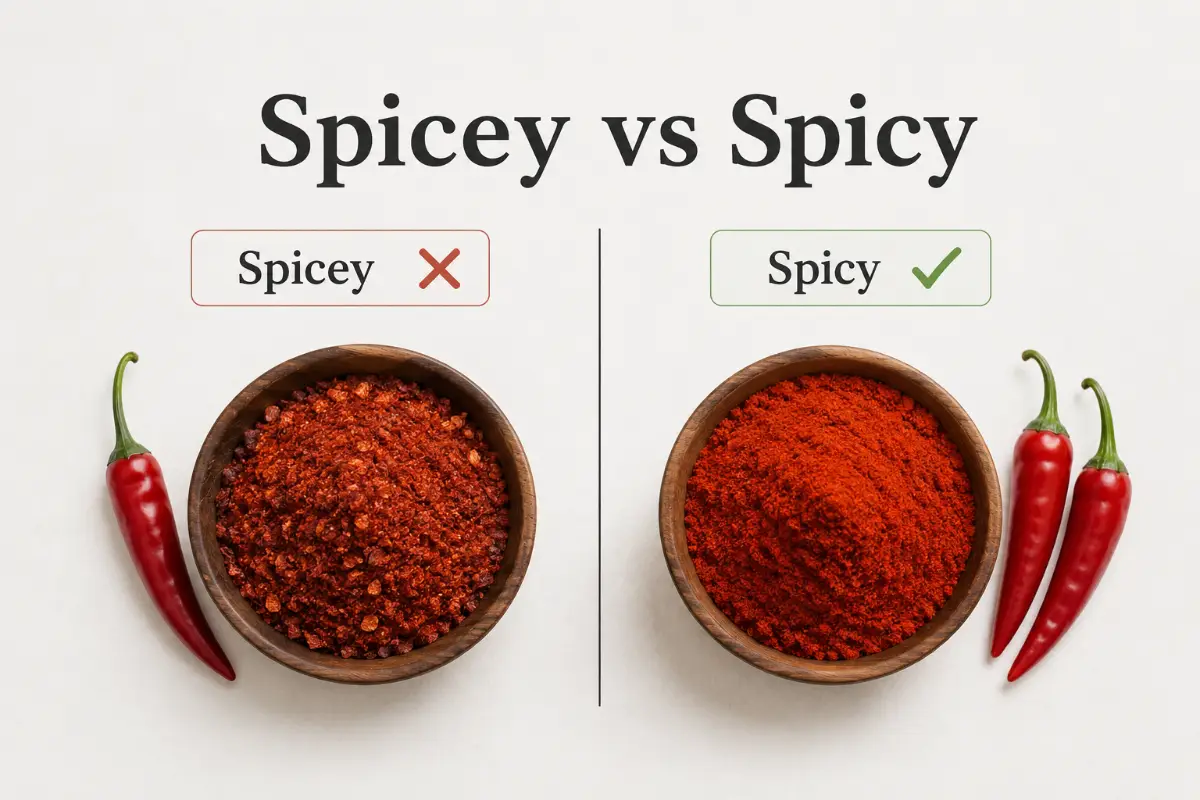
Have you ever typed spicey vs spicy and stopped because both versions look perfectly reasonable? You’re not alone. The confusion comes from a common English spelling pattern. Many adjectives add y to a word ending in a consonant. That makes spicey look as if it should be the natural spelling of spice. But English has a small spelling change here that matters.
The correct spelling is spicy. The spelling spicey is incorrect in standard modern English.
The reason is simple. When spice becomes the adjective spicy the final e is dropped before y is added. The same pattern appears in words such as icy from ice and juicy from juice. You might still see spicey online because of typing mistakes autocorrect issues or informal posts. Seeing it often doesn’t make it standard English.
This guide explains the difference clearly. You’ll learn why spicy is correct how to pronounce it how the spelling developed how it works in American English and how to avoid similar mistakes in your own writing.
For another common grammar confusion, see Potatoes Or Potatos Which Spelling Is Correct 2026.
Quick Answer
Spicy is the correct spelling in standard English. Spicey is a misspelling. Spicy describes food or other things with a strong spice flavor or a hot sensation. The final e in spice is removed before the adjective ending y is added. So write spicy food rather than spicey food.
Spicey Vs Spicy Comparison
| Feature | Spicy | Spicey |
|---|---|---|
| Correct spelling | Yes | No |
| Standard English | Yes | No |
| Meaning | Having a strong spice flavor or heat | Intended to mean spicy |
| Part of speech | Adjective | Misspelling |
| Base word | Spice | Spice |
| Pronunciation | /ˈspaɪsi/ | Not a standard word |
| American English | Correct | Incorrect |
| British English | Correct | Incorrect |
| Formal writing | Correct | Avoid |
| Informal writing | Correct | Avoid |
| Example | This salsa is spicy. | This salsa is spicey. |
The important point is that spicey isn’t an alternative spelling of spicy. It is simply a spelling error.
What Does Spicy Mean
Spicy is an adjective that describes something containing a lot of spice or producing a hot or strong sensation when you eat it.
The word commonly describes food. It can also describe flavors and sometimes ideas or language in a figurative sense.
For example.
- I ordered spicy chicken.
- This curry is too spicy for me.
- She likes spicy salsa.
- The restaurant is famous for its spicy noodles.
- Add less chili if you don’t want the soup to be too spicy.
The meaning can vary slightly depending on context. A spicy dish may taste hot because it contains chili peppers. It may also have a strong mixture of seasonings without being extremely hot.
What Does Spicey Mean
Spicey isn’t the standard English spelling.
If someone writes spicey they almost always mean spicy. The extra e usually comes from treating the word spice as if the regular spelling rule simply requires adding y.
That produces this incorrect form.
spice + y = spicey
Standard English instead uses this spelling change.
spice + y = spicy
The final e disappears before the y is added.
So these are correct.
spicy food
spicy sauce
spicy chicken
spicy peppers
And these are incorrect in standard English.
spicey food
spicey sauce
spicey chicken
spicey peppers
Which One Is Correct
Spicy is correct. Spicey is incorrect.
Use spicy in school assignments emails articles recipes menus professional documents and everyday conversation.
For example.
Correct: This soup is spicy.
Incorrect: This soup is spicey.
Correct: I love spicy food.
Incorrect: I love spicey food.
You don’t need to treat spicey as a British American spelling difference. English speakers across major English speaking regions use spicy as the standard form.
Why Is Spicy Spelled Without The E
The spelling becomes much easier once you understand what happens to the final e.
The noun is spice.
When we form the adjective spicy the final e is removed.
So the spelling develops like this.
spice → spicy
This isn’t an unusual accident. English has several words that follow a similar pattern.
Compare these forms.
ice → icy
juice → juicy
lace → lacy
space → spacious
The exact spelling rule can vary depending on the suffix. English spelling has developed through several historical influences so you shouldn’t assume every word behaves in exactly the same way.
Still the pattern in spice → spicy is reliable.
Why People Write Spicey
The incorrect spelling has an obvious visual explanation.
When people see spice they naturally recognize the word spice. When they want to turn it into an adjective they may simply add y.
That gives them spicey.
The problem is that English doesn’t always form adjectives by adding a letter without changing the original spelling.
A similar mistake can happen with other words.
Someone might reason.
ice + y = icey
But standard English uses icy.
Likewise.
juice + y = juicey
is incorrect.
The standard form is juicy.
This is one reason learning common word patterns works better than trying to spell every new word by sound.
Spicy Is An Adjective
Understanding the grammar behind spicy helps you use it correctly.
An adjective describes a noun.
In spicy food the word spicy describes the food.
In spicy sauce it describes the sauce.
In spicy peppers it describes the peppers.
You can place the adjective before a noun.
We ordered spicy wings.
You can also place it after a linking verb.
The wings are spicy.
Both structures are standard.
Comparative And Superlative Forms
The adjective spicy can also have comparative and superlative forms.
The common forms are.
spicy
spicier
spiciest
For example.
- This salsa is spicy.
- The green salsa is spicier than the mild salsa.
- That red salsa is the spiciest one on the menu.
Notice another spelling change.
spicy → spicier
spicy → spiciest
The final y changes to i before the comparative or superlative ending.
You don’t write spicyer or spicyest in standard English.
The Spelling Pattern Behind Spicy
The word spicy demonstrates a useful English spelling pattern.
Words ending in a consonant followed by y often behave differently when they take certain endings.
For example.
happy → happier
happy → happiest
easy → easier
easy → easiest
With spicy you get.
spicy → spicier
spicy → spiciest
This gives English learners another useful clue.
If you’re writing the adjective itself the correct form is spicy.
If you’re comparing two things use spicier.
If you’re describing the highest degree use spiciest.
Examples.
This taco is spicy.
This taco is spicier than the other one.
This is the spiciest taco I’ve ever eaten.
Is Spicy A Noun Or An Adjective
Spicy is an adjective.
It describes a quality.
The related noun is spice.
The related verb is spice as well.
The related noun spiciness describes the quality of being spicy.
You can see the relationship clearly.
Spice is the ingredient or seasoning.
Spicy describes something with a strong spice quality.
Spiciness refers to the degree or quality of being spicy.
For example.
The sauce contains several spices.
The sauce is spicy.
The spiciness increases after you add the peppers.
This distinction matters in formal writing because each word performs a different grammatical job.
Spicy And Spice Difference
These words are related but they aren’t interchangeable.
Spice can function as a noun or verb.
As a noun it refers to a substance used to add flavor to food.
Cinnamon is a common spice.
As a verb it means to add spices to food or make something more interesting.
Spice the chicken before cooking it.
Spicy is an adjective.
The chicken is spicy.
A simple memory trick is to think of spice as the thing and spicy as the description.
Spicy And Hot Are Not Always The Same
English speakers often use hot and spicy when talking about food but they can express different ideas.
Hot can describe temperature.
The soup is hot.
It can also describe a burning sensation caused by chili peppers.
The sauce is hot.
Spicy focuses more directly on the presence or effect of spices and strong seasoning.
The curry is spicy.
A dish can be hot in temperature without being spicy.
Likewise a dish can be spicy after it has cooled down.
That distinction becomes useful when describing food accurately.
Is Spicy A Formal Word
Yes. Spicy is completely standard English.
You can use it in casual speech.
I don’t like spicy food.
You can use it in a restaurant review.
The restaurant serves spicy dishes inspired by regional cooking.
You can use it in educational writing.
Capsaicin is responsible for the burning sensation associated with chili peppers.
You can also use it in recipes.
Add the spicy sauce after cooking.
The word itself isn’t informal or slang.
Its figurative uses can have a more casual tone. For example someone might call a controversial comment spicy. In that context the word means provocative or bold rather than literally hot.
Why The Spelling Matters In Professional Writing
A single extra letter can make a word look careless.
If you’re writing a recipe blog a restaurant menu food review school paper or professional email the correct form is spicy.
Consider these examples.
The restaurant serves spicy Korean noodles.
The recipe creates a spicy tomato sauce.
The study examined consumer preferences for spicy foods.
The spelling spicey may still be understood. However readers will recognize it as an error.
Professional editing is often about small details like this. A word doesn’t need to be confusing for an incorrect spelling to weaken the credibility of the writing.
A Quick Rule To Remember
Think of the transformation this way.
Spice loses e before becoming spicy.
You can also connect it with ice → icy.
If you remember icy you can remember spicy.
Don’t write the extra e.
Spice → spicy.
That small pattern will save you from one of the most common spelling mistakes involving this word.
Spelling Rules For Spicy
The spelling of spicy follows a useful pattern in English. The base word is spice. When the adjective ending y is added the final e is removed.
So the correct form is.
spice → spicy
Not.
spice → spicey
The same idea appears in several other English words.
ice → icy.
juicy comes from juice.
lacy comes from lace.
This pattern isn’t universal for every English word ending in e. English spelling has many exceptions. Still it gives you a reliable rule for spicy.
Why The E Disappears
The final e in spice doesn’t need to stay when the word becomes an adjective ending in y.
The spelling becomes shorter without changing the pronunciation of the base word in a confusing way.
Compare these forms.
spice
spicy
spicier
spiciest
Each form has its own spelling pattern.
A common mistake is to preserve the entire base word and simply attach y. That’s how spicey appears. Standard English doesn’t use that form.
Spicy Spicier And Spiciest
The word spicy also changes when you compare levels of intensity.
The basic adjective is spicy.
The comparative form is spicier.
The superlative form is spiciest.
Examples.
- This chili is spicy.
- The red chili is spicier than the green one.
- That curry is the spiciest dish on the menu.
Notice the spelling change from y to i.
spicy → spicier
spicy → spiciest
Avoid these forms.
spicyer
spicyest
They aren’t standard English spellings.
Pronunciation Of Spicy
The pronunciation of spicy is straightforward once you separate the word into its sounds.
American English Pronunciation
The common pronunciation is:
IPA: /ˈspaɪsi/
It has two syllables.
SPI cy.
The main stress falls on the first syllable.
The opening sound is the same vowel sound you hear in words such as sky and my.
The final part sounds like see.
So a simple pronunciation guide is.
SPY see.
Don’t pronounce the written c as a hard k sound. In spicy the c has a soft sound.
Common Pronunciation Mistakes
Some learners pronounce the word as if the c were hard.
That would sound closer to spiky.
The standard pronunciation uses the soft s sound.
spicy sounds like SPY see.
The incorrect spelling spicey can also make learners hesitate about pronunciation. Since spicey isn’t the standard written form you shouldn’t use it as a guide to pronunciation.
Is Spicey Ever Correct
In standard modern English spicey isn’t considered the correct spelling of the adjective.
You may encounter it online in comments social media posts recipes personal blogs or user generated content. Those examples don’t establish it as a standard spelling.
People make spelling mistakes for all kinds of reasons.
A writer may type quickly.
A phone keyboard may suggest an unusual form.
Someone may remember the base word spice and add y without changing the spelling.
A person may also have learned the word from speech rather than from reading.
None of these reasons makes spicey the preferred spelling.
For professional writing stick with spicy.
Why Autocorrect Can Make Things Confusing
Modern typing tools can sometimes make spelling mistakes harder to notice.
If a person types spicey and the device doesn’t flag it the writer may assume the spelling is acceptable. Online dictionaries search engines and social platforms can also expose people to misspelled words repeatedly.
Frequency doesn’t always equal correctness.
A misspelled word can appear thousands of times on the internet and still remain a misspelling.
This is an important lesson for English learners. When two spellings compete don’t decide based only on how often you’ve seen them online. Check the standard dictionary form and consider the word’s grammatical role.
Spicy In American English
Spicy is the standard spelling in American English.
Americans use the word constantly when describing food.
Examples include.
spicy chicken.
spicy tacos.
spicy salsa.
spicy noodles.
spicy curry.
spicy wings.
spicy soup.
The spelling doesn’t change across common American contexts.
You won’t normally find a separate American spelling such as spicey. The correct form remains spicy.
Still confused? Compare Sentence Or Sentance Which Spelling Is Correct 2026 Guide.
British English And Other Varieties
British English also uses spicy.
Canadian English uses spicy.
Australian English uses spicy.
New Zealand English uses spicy.
So this isn’t a case like color and colour where American and British spelling differ.
There is no major regional spelling divide here.
If you’re writing for an American audience use spicy.
If you’re writing for a British Canadian or Australian audience use spicy too.
That makes this one easy.
Spicy In Different Contexts
The word has a literal meaning and several figurative uses.
Food
This is the most common meaning.
I ordered a spicy chicken sandwich.
Here spicy describes the flavor and heat of the food.
Flavor
You can also use it to describe a strong or hot flavor.
The sauce has a spicy flavor.
The soup has a spicy kick.
Figurative Language
English speakers sometimes use spicy in a figurative way.
A conversation can be called spicy if it becomes bold dramatic or provocative.
For example.
The interview got spicy after the two guests disagreed.
No food is involved here. The speaker is using the food related idea of heat as a metaphor for tension or excitement.
Social Media
You may see spicy used to describe an opinion that could start an argument.
That’s a spicy take.
In online language a spicy take usually means a bold controversial or unexpected opinion.
This is an informal expression. It works well in casual communication but may not fit an academic essay.
Real Life Examples Of Spicy
Seeing the correct word in different settings helps make the spelling automatic.
Everyday Conversation
- I love spicy food.
- Is this salsa spicy?
- This soup is a little too spicy for me.
- My dad always adds spicy peppers to his meals.
- We ordered the spicy version.
Restaurants
- Is the chicken spicy?
- Can you make the sauce less spicy?
- The menu has several spicy options.
- I thought the curry would be spicy but it was actually mild.
- That restaurant serves some of the spiciest wings in town.
Cooking
- Add a little chili if you want the dish to be spicy.
- The recipe uses several spices to create a rich spicy flavor.
- Taste the sauce before adding more spicy ingredients.
- You can use fresh peppers for a stronger spicy kick.
Workplace Writing
- The restaurant introduced a new spicy chicken sandwich.
- Customer interest in spicy foods has increased.
- The product is available in mild medium and spicy varieties.
- The chef developed a spicy sauce for the new menu.
Academic Writing
- Spicy foods can produce a burning sensation in the mouth.
- The researchers examined consumer preferences for spicy dishes.
- The study compared perceptions of spicy flavors among different groups.
Journalism
- The restaurant has become known for its spicy menu.
- The chef challenged customers with an unusually spicy dish.
- The new product offers a spicy alternative to the original flavor.
Social Media
- This is a spicy opinion.
- That debate got spicy very quickly.
- I wasn’t ready for such a spicy take.
These examples show why context matters. The basic spelling stays the same even when the meaning changes.
Spicy And Spiciness
Spicy and spiciness are related but they don’t perform the same grammatical job.
Spicy is an adjective.
Spiciness is a noun.
Compare.
The sauce is spicy.
The spiciness of the sauce surprised me.
The first sentence describes the sauce.
The second sentence names the quality itself.
This distinction is useful in formal writing.
For example.
The dish has a high level of spiciness.
sounds more technical than.
The dish is very spicy.
Neither is wrong. The best choice depends on the sentence and the tone you need.
Spicy And Spiced
Another pair worth knowing is spicy and spiced.
They aren’t identical.
Spicy describes something with a strong hot or pungent flavor.
Spiced means something has had spices added to it.
A dish can be heavily spiced without being very hot.
For example.
The rice is richly spiced but not spicy.
This sentence makes a useful distinction.
The rice contains several spices. However it doesn’t produce much heat.
That distinction matters in food writing because spicy doesn’t simply mean contains spices.
Spicy And Hot
The words spicy and hot overlap when talking about food but they aren’t perfect synonyms.
Hot can refer to temperature.
The coffee is hot.
It can also refer to chili heat.
The salsa is hot.
Spicy usually refers to the flavor or burning sensation created by spices and ingredients such as chili peppers.
A pizza can be physically hot without being spicy.
A cooled dish can still be spicy.
So context tells you which meaning hot has while spicy gives a more specific description.
Spicy And Mild
The opposite of spicy in food contexts is often mild.
Compare.
This salsa is spicy.
This salsa is mild.
You can also use words such as bland depending on the meaning.
However mild is usually the better opposite when you’re talking about the level of heat.
A mild dish may still have plenty of flavor. It simply doesn’t have a strong burning sensation.
Spicy And Pungent
Pungent is another related adjective but it has a broader meaning.
A pungent smell or flavor can be strong sharp or intense. It doesn’t necessarily mean hot.
For example.
The cheese has a pungent smell.
That doesn’t mean the cheese is spicy.
Likewise.
The mustard has a pungent flavor.
It may have heat but the word pungent focuses on intensity rather than specifically describing chili heat.

Spicy In Formal And Informal Writing
Spicy works perfectly well in formal writing when you are discussing food or flavor.
For example.
The study examined consumer responses to spicy foods.
There’s nothing informal about that sentence.
The figurative use can be more casual.
The article offers a spicy opinion about the election.
That phrasing may work in a magazine or casual commentary but it would sound less appropriate in a formal academic paper.
A good editor looks at meaning and context rather than labeling a word as simply formal or informal.
The word spicy itself is standard. Its figurative meaning often carries a more relaxed tone.
What Dictionaries Tell Us
Standard English dictionaries list spicy as the adjective derived from spice.
The core meanings center on food or drink containing spices and on flavors that produce a strong or hot sensation.
Dictionaries also record figurative uses connected with excitement controversy or provocative ideas.
They don’t treat spicey as the standard alternative spelling.
That gives writers a clear editorial answer.
If you’re deciding between spicey and spicy in an article a school assignment a recipe or professional communication choose spicy.
A Useful Editing Test
When proofreading your writing search for spicey.
If you find it ask yourself what you intended.
If you mean the adjective describing food flavor heat or a figurative quality change it to spicy.
For example.
The restaurant serves spicey noodles.
becomes.
The restaurant serves spicy noodles.
This quick search is especially useful in long documents where a spelling mistake can hide among hundreds of words.
A professional editor doesn’t rely only on memory. Good proofreading includes targeted checks for words that are easy to mistype.
The Most Important Rule To Remember
You don’t need to memorize a complicated grammar rule to spell this word correctly.
Remember one transformation.
spice → spicy.
The e disappears before y.
Then remember the comparison forms.
spicy → spicier → spiciest.
And remember the related noun.
spice → spiciness.
Once those forms become familiar you’ll be much less likely to write spicey by accident.
Common Mistakes With Spicey And Spicy
The most common mistake is simple. People see spice and assume they can add y without changing anything.
That creates spicey.
Standard English uses spicy.
Mistake One Adding Y Without Removing E
Incorrect.
This chicken is spicey.
Correct.
This chicken is spicy.
The final e from spice is removed before the adjective ending is added.
Mistake Two Assuming Spicey Is A Regional Spelling
It isn’t.
American English uses spicy. British English uses spicy. Canadian English and Australian English also use spicy.
You don’t need to switch spellings based on the country you’re writing for.
Mistake Three Thinking Internet Frequency Proves Correctness
You might find spicey on social media websites menus reviews and user comments.
That doesn’t make it a standard spelling.
Online writing contains plenty of typos. A misspelling can spread because people copy what they see. Always check the established dictionary form when you’re unsure.
Mistake Four Confusing Spicy With Spiced
These words aren’t interchangeable.
Spicy describes strong heat or flavor.
Spiced means spices have been added.
A dish can be heavily spiced without being very spicy.
For example.
The rice is warmly spiced but not spicy.
That’s a perfectly reasonable distinction.
Memory Tricks For Spicy
The easiest memory trick is to connect spicy with icy.
Think.
ice → icy.
Then.
spice → spicy.
Both words lose the final e before the adjective ending.
You can also remember this short phrase.
Spice drops E to become spicy.
Another useful trick involves the sound.
Spicy starts with the sound of spy.
Think of it as.
spy + see.
That can help you remember the letters after the first part.
Remember The Comparison Forms
Once you know spicy you can build the other forms naturally.
spicy.
spicier.
spiciest.
Don’t add an extra e.
Don’t write spicey.
Don’t write spicyer.
Don’t write spicyest.
These forms follow their own standard spelling patterns.
Related Words To Spicy
Understanding the word family gives you a stronger command of its meaning and usage.
Spice.
Spice is mainly a noun or verb.
As a noun it refers to an ingredient used to add flavor.
Cinnamon is a popular spice.
As a verb it means to add spice or flavor.
Spice the soup before serving it.
Spiciness
Spiciness is a noun.
It describes the quality or degree of being spicy.
The spiciness of the sauce increases after you add the peppers.
Spicier
Spicier is the comparative form.
Use it when comparing two things.
This salsa is spicier than the other one.
Spiciest
Spiciest is the superlative form.
Use it when comparing three or more things or identifying the highest degree.
This is the spiciest curry on the menu.
Spiced
Spiced describes something prepared with spices.
We ordered spiced rice.
The dish doesn’t have to be hot.
Synonyms For Spicy
The best synonym depends on what you mean.
When describing food with heat you can use.
- Hot.
- Fiery.
- Peppery.
- Piquant.
- Zesty.
- Strong.
When describing a bold or provocative idea you might use.
- Provocative.
- Bold.
- Controversial.
- Edgy.
- Provocative.
Don’t treat these as perfect replacements in every sentence. Hot can describe temperature. Zesty can suggest freshness or a bright flavor. Piquant often sounds more literary or formal.
Good word choice depends on the exact meaning you want.
Opposites Of Spicy
When discussing food the most useful opposite is usually mild.
The curry is spicy.
The curry is mild.
Other possible contrasts include.
- Bland.
- Gentle.
- Subtle.
- Flavorless.
These words don’t mean exactly the same thing.
A mild dish can still be flavorful. Bland suggests that the food lacks strong flavor. That’s why mild is usually the safest opposite for spicy food.
Spicey Vs Spicy In Real Writing
Consider how the spelling looks in different types of writing.
Recipes
Correct: Add one teaspoon of spicy chili sauce.
Incorrect: Add one teaspoon of spicey chili sauce.
Restaurant Menus
Correct: Spicy Garlic Chicken.
Incorrect: Spicey Garlic Chicken.
Food Reviews
Correct: The noodles have a rich and spicy flavor.
Incorrect: The noodles have a rich and spicey flavor.
School Writing
Correct: Some people enjoy spicy foods because they like intense flavors.
Incorrect: Some people enjoy spicey foods because they like intense flavors.
Workplace Writing
Correct: Our new product comes in mild and spicy varieties.
Incorrect: Our new product comes in mild and spicey varieties.
The correct spelling remains spicy in every example.
Expert Editor’s Note
As an editor I’d make one correction immediately when reviewing a document.
Change spicey to spicy.
There is no need to preserve the extra e because spicy is the established adjective in standard English.
I would also check the surrounding sentence because writers sometimes confuse spicy, spiced, hot, and seasoned.
For example a sentence such as The recipe contains spicy cinnamon might need attention depending on the intended meaning. Cinnamon is certainly a spice but calling it spicy can suggest heat. Spiced or seasoned with cinnamon may express the idea more accurately.
This is an important editing principle. Correct spelling matters but precise meaning matters too.
Professional writing doesn’t simply avoid errors. It chooses the word that communicates the intended idea most clearly.
Frequently Asked Questions
Is Spicey Or Spicy Correct
Spicy is correct. Spicey is a misspelling in standard English. The adjective comes from spice but drops the final e before taking the y ending. Write spicy food spicy sauce and spicy chicken in standard American English.
Why Is Spicy Not Spelled Spicey
English spelling removes the final e from spice when forming spicy. The same general pattern appears in words such as ice becoming icy. So the standard form is spicy rather than spicey.
Is Spicey An Acceptable Informal Spelling
You may see spicey in casual online writing but it isn’t the standard spelling. Informal writing can contain intentional variations but there is no need to use spicey in normal communication. For school work professional writing recipes and published content always use spicy.
Is Spicy The Same As Hot
Not exactly. Spicy usually describes food with strong seasoning or heat. Hot can describe temperature or chili heat. A dish can be hot because it has just been cooked without being spicy. A cooled dish can still be spicy.
What Is The Comparative Form Of Spicy
The comparative form is spicier. Use it when comparing two things.
This sauce is spicier than the first one.
The superlative form is spiciest.
This is the spiciest sauce we’ve tried.
What Is The Noun Form Of Spicy
The common noun form is spiciness. It refers to the quality or degree of being spicy.
The spiciness of the curry surprised me.
The related noun spice refers to an ingredient or seasoning.
Does British English Spell It Spicey
No. British English uses spicy as the standard spelling. American English Canadian English and Australian English also use spicy. This isn’t a regional spelling difference.
Can Spicy Have A Figurative Meaning
Yes. English speakers sometimes use spicy to describe a bold controversial or provocative comment or situation. For example That was a spicy opinion means the opinion was likely to attract strong reactions. This use is informal and metaphorical.
Need another quick comparison? Read Conex Or Connex Which Spelling Is Correct 2026 Guide.
Conclusion
The answer to spicey vs spicy is clear.
Spicy is the correct spelling.
Spicey is a misspelling.
The word spicy is an adjective that can describe food with strong seasoning or heat. It can also describe something bold or provocative in informal figurative language.
The spelling becomes easier to remember when you connect it with ice → icy. Just as icy loses the final e, spicy drops the e from spice.
The biggest mistake to avoid is assuming that spice + y automatically becomes spicey. English spelling doesn’t always work by simply attaching a suffix to the untouched base word.
When in doubt remember one simple line.
Spice drops the E and becomes spicy.

Editorial Reviewer & Proofreader
Grace Mitchell reviews Gramlify’s articles for clarity, consistency, and readability. She is passionate about creating accurate, approachable content that helps English learners build confidence.