
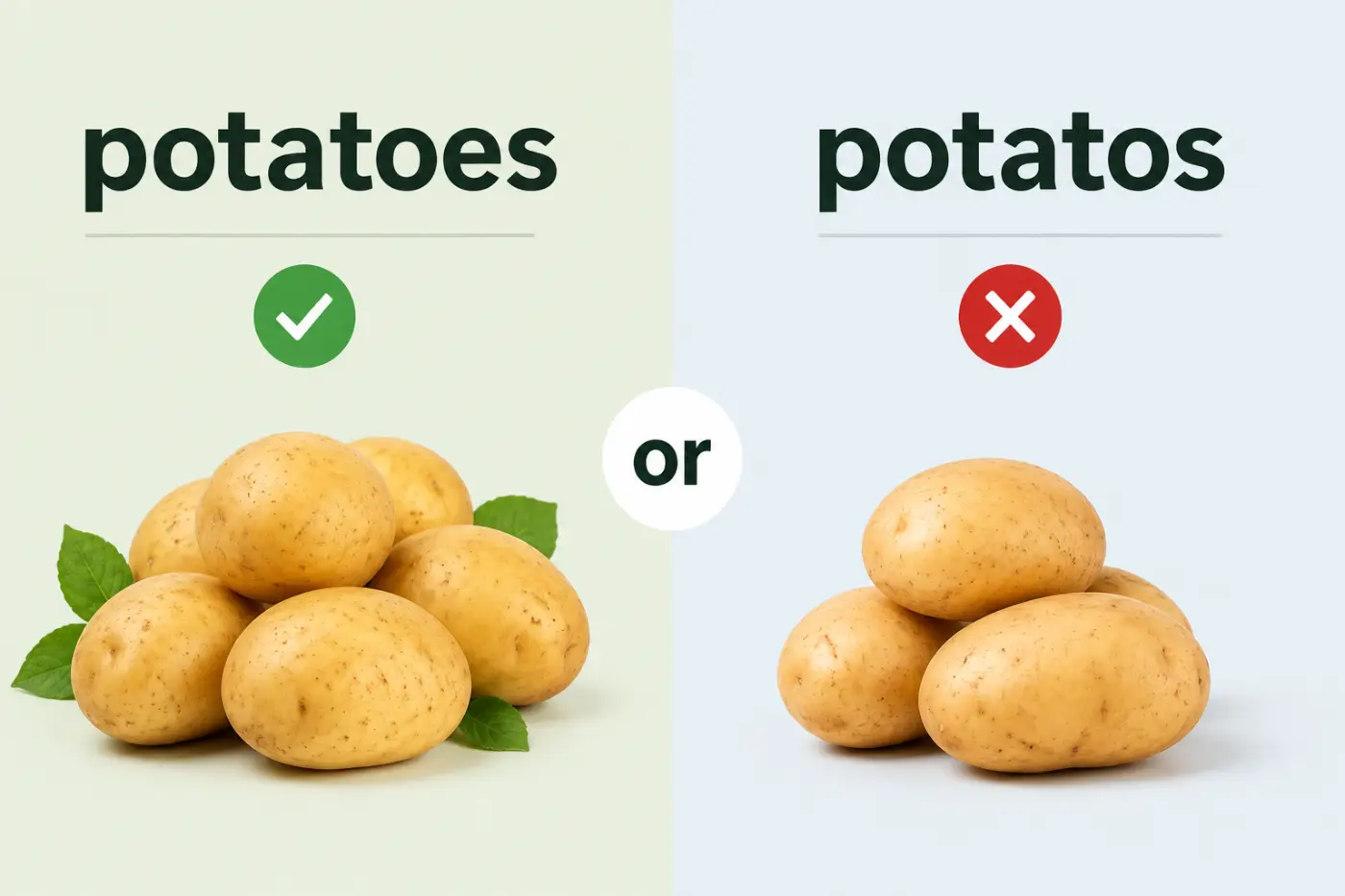
If you’ve ever paused while writing the plural of potato and wondered about potatoes or potatos you’re not alone. The two forms look close enough to make the mistake feel natural. However only one is the standard plural spelling in English.
The correct spelling is potatoes. Potatos is an incorrect spelling of the plural noun. The extra e matters because potato belongs to a group of nouns that traditionally form their plural with es rather than simply adding s.
This small spelling rule can cause surprising trouble. You might see potatos in social media posts casual messages or online comments. That repeated exposure can make the incorrect form look familiar. Familiarity doesn’t make it correct.
The good news is that the rule is easy to learn. In this guide you’ll see why potatoes is correct how to pronounce it how the plural is formed and why people often leave out the e. You’ll also get natural examples memory tricks common mistakes and practical advice for formal and informal writing.
Many readers also check Affend Vs Offend Which Word Is Correct 2026.
Quick Answer
Potatoes is the correct plural spelling of potato. Potatos is incorrect in standard English. The word potato normally forms its plural by adding es rather than only s. Use one potato for the singular and two potatoes for the plural.
Potatoes Or Potatos Comparison
| Feature | Potatoes | Potatos |
|---|---|---|
| Correct spelling | Yes | No |
| Singular form | Potato | Potato |
| Plural form | Potatoes | Incorrect |
| Part of speech | Noun | Not a standard plural form |
| Meaning | More than one potato | Intended to mean more than one potato |
| Pronunciation | puh TAY tohz | Usually intended to sound like potatoes |
| Formal writing | Correct | Avoid |
| Informal writing | Correct | Still incorrect |
| Example | We bought five potatoes. | We bought five potatos. |
The important point is simple. Potatoes is the form you should use in schoolwork professional writing emails recipes articles and everyday communication.
What Does Potato Mean
A potato is an edible underground tuber produced by a plant in the nightshade family. It is one of the most widely eaten crops in the world and appears in countless dishes.
The word can refer to the food itself or the plant that produces it.
For example.
- I baked a potato for lunch.
- This potato is too small for the recipe.
- The farmer grows potatoes on several acres.
- We need three potatoes for the soup.
The singular form is potato.
The plural form is potatoes.
That distinction is the foundation of the entire spelling question.
What Does Potatoes Mean
Potatoes is simply the plural form of potato. It means two or more potatoes.
Examples include.
- I bought six potatoes.
- The potatoes are ready for the oven.
- She peeled three potatoes for dinner.
- These potatoes taste great with garlic.
- We planted potatoes in the garden.
Nothing changes about the basic meaning of the word. The ending changes because English uses a plural spelling pattern for this noun.
What Does Potatos Mean
Potatos is not the standard English plural of potato.
People who write potatos almost always intend to write potatoes. The mistake usually happens because writers remember the common plural rule of adding s to a noun.
For many nouns that rule works perfectly.
- Book becomes books.
- Car becomes cars.
- Apple becomes apples.
- Banana becomes bananas.
Because potato ends in a vowel sound and looks similar to many ordinary nouns that take s, it can feel natural to write potatos.
Standard English uses potatoes instead.
Which One Is Correct
Potatoes is correct. Potatos is incorrect.
If you’re writing the plural of potato, always use potatoes.
Correct.
I need two potatoes for the recipe.
Incorrect.
I need two potatos for the recipe.
The same rule applies in formal and informal English. You shouldn’t use potatos in an email simply because the message is casual.
Why Is Potatoes Spelled With Es
The spelling comes from an older English plural pattern.
Many nouns ending in o can form plurals with es. This pattern developed through the history of English and became established in several common words.
Examples include.
- Potato becomes potatoes.
- Tomato becomes tomatoes.
- Hero becomes heroes.
- Echo becomes echoes.
- Torpedo becomes torpedoes.
Not every noun ending in o follows this pattern. That’s why English learners often find this group confusing.
For example.
- Photo becomes photos.
- Piano becomes pianos.
- Radio becomes radios.
- Video becomes videos.
- Solo becomes solos.
So you shouldn’t create a universal rule saying every word ending in o needs es. English has several spelling patterns and some exceptions must simply be learned.
For potato the established standard form is potatoes.
The Grammar Behind Potatoes
The word potato is a countable noun.
A countable noun can refer to one item or several individual items.
When you have one you use the singular form.
One potato.
When you have more than one you use the plural form.
Two potatoes.
The plural form also affects other parts of the sentence.
Compare these examples.
The potato is on the table.
The potatoes are on the table.
The singular noun takes the singular verb is.
The plural noun takes the plural verb are.
This matters in formal writing because the spelling and grammar need to work together.
Potato And Potatoes In A Sentence
Here are some simple examples that show the difference clearly.
Singular Examples
- I baked a potato.
- The potato is still hot.
- She cut the potato into pieces.
- He planted one potato in the garden.
- This potato is perfect for the recipe.
Plural Examples
- I baked four potatoes.
- The potatoes are still hot.
- She cut the potatoes into pieces.
- He planted several potatoes in the garden.
- These potatoes are perfect for the recipe.
Notice how the noun changes from potato to potatoes. The verb can change too depending on the number of items.
The Plural Rule For Words Ending In O
One reason potatoes causes spelling problems is that English has more than one plural pattern for nouns ending in o.
Some take es.
Some take s.
A few words allow more than one form depending on usage.
This means English learners shouldn’t rely on a simple visual rule such as add s to every word.
Consider this comparison.
| Singular | Plural |
|---|---|
| Potato | Potatoes |
| Tomato | Tomatoes |
| Hero | Heroes |
| Echo | Echoes |
| Photo | Photos |
| Piano | Pianos |
| Radio | Radios |
| Video | Videos |
The safest approach is to learn common words as complete vocabulary items.
For potato, remember the pair as a unit.
Potato → Potatoes.
That simple habit will prevent most spelling errors.
Why People Write Potatos
The incorrect spelling potatos has a few obvious causes.
The Basic Plural Rule
Most English learners first learn that you make a plural by adding s.
Cat becomes cats.
Dog becomes dogs.
House becomes houses.
When that rule becomes automatic it’s easy to apply it to potato and produce potatos.
The Missing E
The extra e in potatoes doesn’t change the basic pronunciation in an obvious way for many speakers. When people spell the word from memory they may leave it out.
Visual Familiarity
Online writing can reinforce mistakes. If someone repeatedly sees potatos in comments or posts they may begin to recognize it as a familiar spelling.
A familiar spelling can feel correct even when dictionaries and standard usage disagree.
Fast Typing
When people type quickly they often omit letters. The e in potatoes is easy to skip because the word remains recognizable without it.
That explains the mistake but doesn’t make potatos correct.
Is Potatos Ever Correct
In standard modern English potatos is not the accepted plural spelling of potato.
You may encounter it online or in informal writing but it should be treated as a spelling error.
For professional communication academic work published writing recipes educational material and edited content use potatoes.
There is no standard American English context where potatos becomes the preferred plural spelling.
Why The Extra E Matters
The e isn’t decorative. It forms part of the established plural ending es.
Compare these forms.
Potato → potatoes.
Tomato → tomatoes.
Hero → heroes.
Removing the e produces a nonstandard spelling.
This is similar to other English spelling patterns where one letter looks small but changes the accepted written form.
For an English learner the best approach is not to think of the word as potato + s. Think of it as a complete plural form.
Potatoes.
Pronunciation Of Potato And Potatoes
Pronunciation can also help you remember the difference.
Potato
In American English potato is commonly pronounced:
puh TAY toh
IPA:
/pəˈteɪtoʊ/
It has three syllables.
puh • TAY • toh
The middle syllable receives the main stress.
Potatoes
In American English potatoes is commonly pronounced:
puh TAY tohz
IPA:
/pəˈteɪtoʊz/
It has three syllables.
puh • TAY • tohz
The final sound changes from oh to ohz because the plural ending adds a voiced z sound.
This pronunciation can help you remember that the plural has a distinct ending even though the extra written e isn’t pronounced as a separate vowel.
Common Pronunciation Mistakes
Most speakers don’t have serious trouble pronouncing potatoes. The more common problem is spelling.
Still some learners may pronounce the plural too literally.
For example they might try to give the e its own strong vowel sound. Standard American pronunciation doesn’t normally do this.
Think of the ending as one smooth sound.
Potatoes.
Not.
Potato ees.
The goal is a natural flow rather than pronouncing every written letter separately.
Potato In Formal Writing
Potato and potatoes are ordinary standard English words. There is no need to replace them with more complicated vocabulary.
In academic writing you might write.
The study examined potato production in several regions.
In a report you might write.
Potatoes accounted for a large share of the farm’s vegetable harvest.
In a recipe you might write.
Peel the potatoes and cut them into small cubes.
In an email you might write.
Please pick up two potatoes on your way home.
The plural form stays the same across these contexts.
Potato In Informal Writing
Casual writing doesn’t change the correct spelling.
You can write.
I’m making mashed potatoes tonight.
We need more potatoes.
Those potatoes look amazing.
Even though these sentences are informal the spelling remains potatoes.
Informal English may shorten words or use slang. It doesn’t automatically change established spellings.
Real Life Examples With Potatoes
Seeing the correct form in different settings makes the spelling easier to remember.
Daily Conversation
- Can you grab some potatoes from the store?
- I think we have three potatoes left.
- The potatoes are almost ready.
- She washed the potatoes before cooking them.
Workplace
- The restaurant needs a fresh shipment of potatoes.
- Our supplier delivers potatoes twice a week.
- The chef checked the potatoes before service.
- Please add five bags of potatoes to the order.
- We received the potatoes this morning.
- The potatoes should be stored in a cool dry place.
Academic Writing
- Researchers examined the effect of temperature on potato storage.
- The study compared several varieties of potatoes.
Journalism
- Farmers reported higher potato yields this season.
- Potato prices increased after a difficult growing season.
Social Media
- These roasted potatoes turned out perfectly.
- I could eat potatoes with every meal.
- Dinner tonight is homemade potatoes and vegetables.
Recipes
- Wash the potatoes thoroughly.
- Cut the potatoes into equal pieces.
- Bake the potatoes until they are tender.
The spelling remains the same in every example.
Potatoes As A Countable Noun
One useful grammar point is that potato is a countable noun.
You can count individual potatoes.
One potato.
Two potatoes.
Ten potatoes.
This means you can use numbers and words such as many and several with the plural form.
Examples.
- We bought ten potatoes.
- How many potatoes do we need?
- Several potatoes were left in the basket.
- There aren’t many potatoes in the pantry.
You can also use quantity expressions.
- A bag of potatoes.
- A sack of potatoes.
- A basket of potatoes.
- A bowl of potatoes.
The noun remains plural when you’re talking about multiple individual potatoes.
Potatoes And Possessives
Possessive forms can sometimes create another spelling question.
The plural potatoes can become possessive by adding an apostrophe.
For example.
The potatoes’ skins were left on.
Here the apostrophe comes after the plural s because the skins belong to multiple potatoes.
For a singular potato you would write.
The potato’s skin was left on.
This distinction follows the standard possessive rule.
Singular.
potato’s
Plural.
potatoes’
The apostrophe does not change the basic plural spelling.
Potato Versus Potatoes
The difference is simple but important.
Potato means one.
Potatoes means more than one.
Compare.
I ate a potato.
I ate two potatoes.
The potato is on the plate.
The potatoes are on the plate.
One small spelling change also affects subject verb agreement.
The potato is ready.
The potatoes are ready.
Learning these pairs together is a useful way to build accurate English grammar.
The Most Common Spelling Mistake
The biggest mistake is writing potatos instead of potatoes.
It may seem like a tiny error but repeated spelling mistakes can affect how polished your writing looks.
This matters most in places where accuracy is expected.
Academic papers.
Business documents.
Menus.
Recipes.
Websites.
Product descriptions.
School assignments.
Professional emails.
The correction is easy.
Whenever you write potatos stop and check the ending.
The correct form has es.
Potatoes.
A Quick Memory Trick
Use this simple memory line.
A potato grows an extra e when it grows in number.
It’s not a grammar rule you can apply to every noun ending in o. It’s simply a useful reminder for this word.
You can also pair it with tomato.
Potato and tomato both take es in the plural.
Potato becomes potatoes.
Tomato becomes tomatoes.
That pairing gives you two common words to remember together.
What Dictionaries Say
Major English dictionaries list potatoes as the standard plural form of potato. The singular noun is potato and its regular established plural is potatoes.
That matters because dictionary evidence provides a reliable reference when an unfamiliar spelling appears online.
If you’re editing an article and see potatos the professional correction is straightforward.
Change it to potatoes.
There is no need to rewrite the sentence or change its meaning. The issue is simply the plural spelling.
Editor’s Rule To Remember
When you’re unsure about potatoes or potatos don’t rely on what looks familiar.
Check the established plural form.
Potato → potatoes.
That is the form used in standard American English and standard English more broadly.
The extra e is part of the spelling. Keep it in formal writing and casual writing alike.
Suggested Internal Link: Tomatoes Or Tomatos Which Spelling Is Correct.
Section One Takeaway
The answer is clear.
Potatoes is the correct plural spelling.
Potatos is a misspelling.
The reason for the confusion is easy to understand. Many English nouns simply add s to form their plural but several nouns ending in o use es. Potato belongs to that group.
Remember the basic pair.
One potato.
Two potatoes.
Once that pattern becomes familiar you’ll have little reason to hesitate again.
Why Potatoes Takes Es
The spelling of potatoes can seem unusual if you learned the basic rule of adding s to make a plural. English has a longer history than that simple rule suggests.
Words ending in o follow different plural patterns. Some take es while others take s. The word potato belongs to the group that traditionally takes es.
Compare these common forms.
- Potato becomes potatoes.
- Tomato becomes tomatoes.
- Hero becomes heroes.
- Echo becomes echoes.
Now compare them with words that take s.
- Photo becomes photos.
- Piano becomes pianos.
- Radio becomes radios.
- Video becomes videos.
So the spelling isn’t based on the final letter alone. English uses established patterns shaped by the history and origin of individual words.
For everyday writing the safest rule is simple. Learn the plural of potato as potatoes rather than trying to create it from scratch each time.
Why Potatos Looks So Natural
The incorrect form potatos looks believable because English uses s for so many plurals.
You already know patterns such as.
Book becomes books.
Car becomes cars.
Table becomes tables.
Apple becomes apples.
That pattern is so common that your brain may automatically apply it to potato. The result looks perfectly reasonable at first glance.
There is another reason the error survives. The missing e doesn’t create a dramatic visual difference.
Compare.
potatoes
potatos
Most readers can understand both immediately. Because the meaning remains obvious the writer may never notice the mistake.
That doesn’t make the spelling interchangeable. In edited English only potatoes is standard.
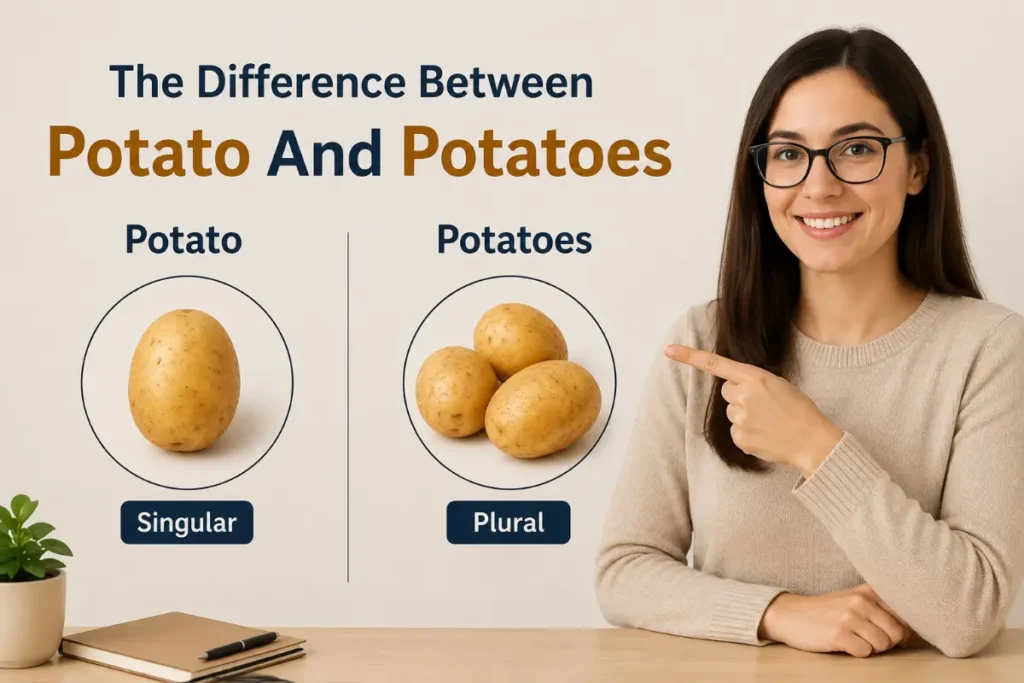
The Difference Between Potato And Potatoes
The singular and plural forms have different grammatical jobs.
Potato refers to one item.
Potatoes refers to two or more.
Consider these examples.
- I bought one potato.
- I bought two potatoes.
- The potato is on the counter.
- The potatoes are on the counter.
- This potato looks fresh.
- These potatoes look fresh.
The change from singular to plural affects more than the noun itself. Demonstratives and verbs can change too.
This potato is fresh.
These potatoes are fresh.
The potato is ready.
The potatoes are ready.
This is why learning vocabulary together with grammar is useful. You aren’t only memorizing a spelling. You’re learning how the word behaves inside a sentence.
Potatoes In American English
American English uses potatoes as the standard plural.
You will see it in newspapers recipes textbooks restaurant menus product descriptions and everyday conversation.
Examples include.
The store has fresh potatoes.
We need more potatoes for dinner.
Potatoes are a common side dish.
The farmer grows potatoes in the northern part of the state.
There isn’t a special American spelling that changes potatoes to potatos.
If you’re writing for a US audience use potatoes.
Potatoes In British English
British English also uses potatoes.
The plural spelling doesn’t change across the major varieties of English.
American English.
Potatoes.
British English.
Potatoes.
Canadian English.
Potatoes.
Australian English.
Potatoes.
This makes the word easier to learn because regional spelling isn’t an issue here.
Some English words do have different spellings across countries. Potatoes isn’t one of them.
Does The Pronunciation Change
Yes but only slightly.
The singular potato commonly ends with an oh sound.
The plural potatoes ends with an ohz sound.
American English pronunciation.
Potato
/pəˈteɪtoʊ/
Potatoes
/pəˈteɪtoʊz/
The plural ending adds the final z sound.
You don’t pronounce the written e as a separate syllable. The word still has three syllables.
Potato.
puh TAY toh.
Potatoes.
puh TAY tohz.
The main stress stays on the middle syllable.
How To Pronounce Potatoes Naturally
English learners sometimes try to pronounce every letter they see. That can make potatoes sound stiff or unnatural.
Instead think of the ending as one smooth sound.
tohz
The final sound should connect naturally with the rest of the word.
For example.
I bought some potatoes.
The potatoes are ready.
We need more potatoes.
In normal speech the word flows as one familiar unit. You don’t need to emphasize the spelling.
Is Potatoes A Countable Noun
Yes. Potato is a countable noun.
You can count individual potatoes.
One potato.
Two potatoes.
Three potatoes.
Twenty potatoes.
Because it is countable you can use numbers and quantity words with it.
Examples.
- We bought several potatoes.
- How many potatoes do we need?
- There are only a few potatoes left.
- The recipe calls for four potatoes.
- She planted dozens of potatoes.
This differs from many uncountable food nouns.
For example you normally don’t count rice as individual grains in ordinary conversation. With potatoes the individual items are easy to count.
How Articles Work With Potato
The singular form can take a or an depending on the word.
Because potato begins with a consonant sound you use a.
Correct.
I bought a potato.
She cooked a potato.
He planted a potato.
You don’t normally use a with the plural.
Correct.
I bought potatoes.
Incorrect.
I bought a potatoes.
The plural can work with words such as some, many, several, these, and those.
Examples.
Some potatoes.
Many potatoes.
Several potatoes.
These potatoes.
Those potatoes.
Understanding articles gives you another useful way to remember the difference between the singular and plural forms.
You may also want to read Dieing Vs Dying Which Spelling Is Correct 2026.
Potato And Potatoes With Verbs
Plural nouns normally take plural verbs.
That gives you another reliable grammar clue.
The potato is ready.
The potatoes are ready.
The potato looks fresh.
The potatoes look fresh.
A common mistake is to keep the singular verb after changing the noun to the plural.
Incorrect.
The potatoes is ready.
Correct.
The potatoes are ready.
Incorrect.
The potatoes looks fresh.
Correct.
The potatoes look fresh.
The spelling and subject verb agreement should match.
Possessive Forms Of Potato
Possessives can make the spelling look more complicated but the rule remains simple.
For one potato use the singular possessive.
The potato’s skin.
For multiple potatoes use the plural possessive.
The potatoes’ skins.
Compare these sentences.
- The potato’s skin is thin.
- The potatoes’ skins are thin.
In the first sentence one potato owns or has the skin being discussed.
In the second sentence multiple potatoes have skins.
Notice the spelling.
potato’s
potatoes’
The apostrophe moves after the s in the plural possessive.
Common Mistakes With Potatoes
Spelling errors often appear in predictable forms.
Potatos
This is the most common mistake.
Correct.
Potatoes.
Incorrect.
Potatos.
Potato’s For The Plural
Some writers add an apostrophe because they think it marks a plural.
Incorrect.
I bought three potato’s.
Correct.
I bought three potatoes.
An apostrophe does not normally create a plural.
Potatoe
Another common error is adding the e before the plural ending and stopping there.
Incorrect.
I bought two potatoe.
Correct.
I bought two potatoes.
The singular remains potato. The plural becomes potatoes.
Potato’s For A Plural Possessive
Incorrect.
The potato’s were in the basket.
Correct.
The potatoes were in the basket.
If you simply mean more than one potato you don’t need an apostrophe.
Why Apostrophes Cause Trouble
Apostrophes have several jobs in English but forming ordinary plurals isn’t one of them.
They can show possession.
The potato’s color.
They can also appear in contractions.
It is becomes it’s.
They should not normally be added just because a noun is plural.
So remember.
One potato.
Two potatoes.
One potato’s skin.
Two potatoes’ skins.
Once you see the four forms together the pattern becomes much easier.
Potatoes In Recipes
Recipes provide some of the most common examples of the plural.
You’ll often see instructions such as.
- Peel the potatoes.
- Wash the potatoes thoroughly.
- Cut the potatoes into small pieces.
- Boil the potatoes for ten minutes.
- Season the potatoes with salt.
- Bake the potatoes until tender.
Recipe writers almost always use potatoes when referring to multiple tubers.
You might also see potato when describing an ingredient in a general sense.
For example.
Add one medium potato.
The recipe uses potato as a base ingredient.
The distinction depends on the number and meaning.
Potatoes In Workplace Writing
Food businesses use the word constantly.
A restaurant might write.
We need to order more potatoes.
A supplier might write.
The potatoes will arrive tomorrow morning.
A grocery store might label a product.
Fresh potatoes.
A manager might write.
Please check the potatoes before opening the store.
In each case potatoes is the correct plural.
There is no benefit to using potatos in informal business communication. A spelling error can make a menu email or product description look careless.
Potatoes In Academic Writing
Academic writing often uses potato and potatoes in agriculture biology nutrition food science and economics.
Examples include.
- The researchers studied potato growth under different conditions.
- Several potato varieties were tested.
- The experiment examined the storage life of potatoes.
- The researchers compared potatoes grown in different soils.
- Potato production increased during the study period.
Academic writing demands accurate spelling because small errors can distract from otherwise strong work.
Potatoes In Journalism
News writing uses both forms naturally.
Examples include.
- Farmers harvested millions of potatoes this season.
- Potato prices rose after heavy rainfall.
- Local growers reported strong demand for potatoes.
- The market received a new supply of potatoes.
Journalists generally choose plain familiar words. Potatoes fits naturally into that style.
Potatoes In Social Media
Social media contains both correct and incorrect spellings because posts are rarely edited as carefully as published writing.
You might see someone write.
These potatoes are amazing.
You might also encounter.
These potatos are amazing.
The second version is still a spelling mistake.
Social media doesn’t create a new accepted spelling simply because many people use an error.
This is an important lesson for English learners. Frequency online doesn’t always equal correctness.
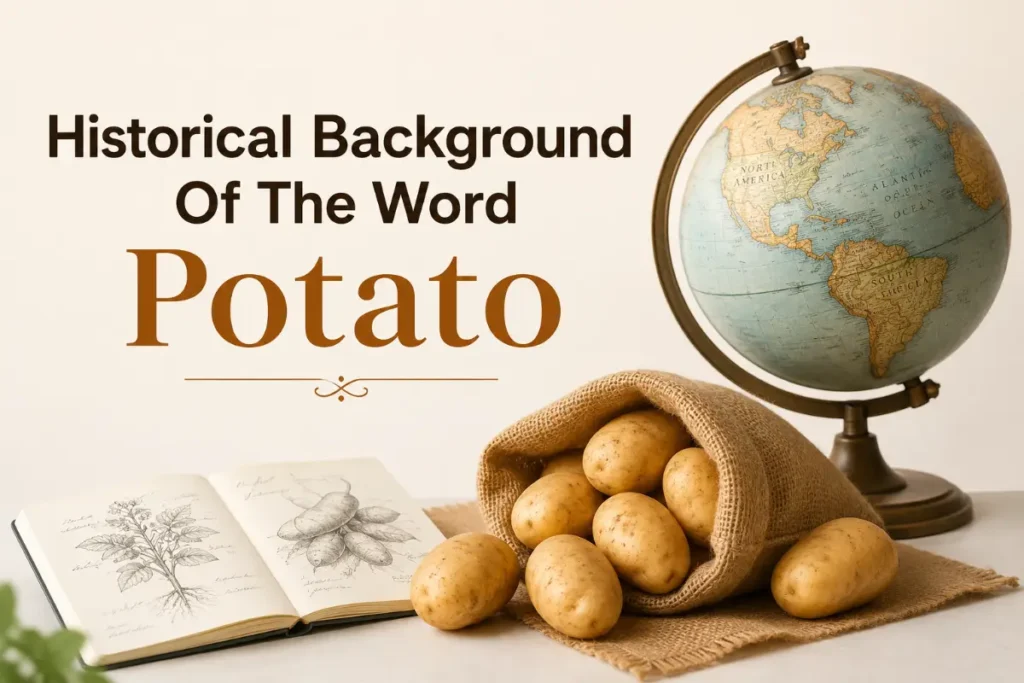
Historical Background Of The Word Potato
The word potato has an interesting history.
English borrowed the word from Spanish patata. The Spanish word came from an Indigenous Caribbean and South American context involving names for related tubers.
The food itself originated in South America and became widely cultivated and eaten in Europe after the Columbian exchange.
As the word entered English it developed into the familiar form potato.
The plural then followed an established English pattern and became potatoes.
This history helps explain why the spelling is not simply based on a modern rule that says every noun ending in o must take es.
English spelling reflects layers of history. Some patterns are productive while others survive because particular words became established in common use.
Why English Has Different Plurals For O Words
This is one of the most useful spelling questions behind potatoes or potatos.
English nouns ending in o don’t all behave alike.
Some take es.
Tomato becomes tomatoes.
Potato becomes potatoes.
Hero becomes heroes.
Others take s.
Photo becomes photos.
Piano becomes pianos.
Radio becomes radios.
Video becomes videos.
There are also words where both plural forms can appear in different contexts or styles.
This means you shouldn’t rely on a single rule for every word ending in o.
Instead learn common words through repeated exposure and reliable references.
For potato there is no real uncertainty.
Potatoes is the standard plural.
A Useful Spelling Pattern
If you’re building your English vocabulary you can memorize a small group of familiar o ending nouns that take es.
Potato.
Potatoes.
Tomato.
Tomatoes.
Hero.
Heroes.
Echo.
Echoes.
These words can form a useful mental group.
You don’t need to memorize every English plural at once. Start with words you actually use.
What Native Speakers Expect
Native English speakers won’t normally pause to think about the spelling of potatoes. The form is so familiar that it feels automatic.
That’s a good goal for English learners too.
Instead of remembering a complicated grammar explanation every time you write the word try to make the correct form familiar through repeated use.
Write.
Potatoes.
Read.
Potatoes.
Use it in sentences.
The potatoes are ready.
We bought some potatoes.
Those potatoes look fresh.
Repeated exposure turns a rule into a habit.
A Practical Editing Test
If you’re proofreading a sentence and see potatos use a quick three step check.
- Find the singular form.
Potato.
- Ask if you’re talking about more than one.
If yes you need the plural.
- Write the established plural.
Potatoes.
This takes only a few seconds and catches the error immediately.
Section Two Takeaway
The spelling potatoes follows an established English plural pattern. The incorrect form potatos usually appears because writers apply the simple rule of adding s.
English has several patterns for nouns ending in o. That’s why memorizing the correct form of common words is often more reliable than searching for one rule that covers everything.
Remember the core forms.
One potato.
Two potatoes.
The potato is ready.
The potatoes are ready.
Once those patterns become familiar the spelling becomes second nature.
How To Remember The Correct Spelling
The easiest way to remember potatoes is to connect it with another familiar word that follows the same pattern.
Think of these two words together.
Potato → potatoes.
Tomato → tomatoes.
Both singular words end in o and both add es in the plural.
You can also remember a simple phrase.
One potato. Two potatoes.
Say the pair aloud when you’re learning the word. Repetition helps turn the spelling into a habit instead of something you need to reconstruct every time.
Another useful trick is to picture the plural ending as a complete unit.
potato + es = potatoes
Avoid thinking of it as potato + s. That mental shortcut is exactly what produces potatos.
Common Mistakes With Potato And Potatoes
The spelling problem doesn’t stop with potatos. Several other errors can appear when writers aren’t sure how the word works.
Using Potatos As The Plural
Incorrect.
I bought three potatos.
Correct.
I bought three potatoes.
The plural needs es.
Adding An Apostrophe
Incorrect.
We bought four potato’s.
Correct.
We bought four potatoes.
An apostrophe doesn’t make an ordinary noun plural.
Using Potatoe As The Singular
Incorrect.
I cooked a potatoe.
Correct.
I cooked a potato.
The singular has no e at the end.
Using Potato When The Meaning Is Plural
Incorrect.
The potato are ready.
Correct.
The potatoes are ready.
The plural noun requires the plural verb are.
Using Potatoes With A Singular Article
Incorrect.
I bought a potatoes.
Correct.
I bought a potato.
Or.
I bought some potatoes.
The article and noun need to agree in number.
Potatoes And Other Food Words
English learners sometimes wonder if the plural changes when potato describes food in general.
Usually the meaning tells you which form you need.
Use potato when referring to one item or the ingredient as a general category.
Use potatoes when referring to multiple individual items.
Examples.
Potato is an important crop.
The farmer harvested potatoes.
I need one potato.
I need five potatoes.
This distinction is similar to many other countable food nouns.
Apple becomes apples.
Carrot becomes carrots.
Onion becomes onions.
Tomato becomes tomatoes.
The key is to identify the number before choosing the form.
Potato As A Modifier
The word potato can also appear before another noun to describe something related to potatoes.
For example.
Potato salad.
Potato soup.
In these combinations potato often stays singular even when the final noun refers to a general category.
For example.
Potato salad means a type of salad made with potatoes.
You don’t normally write potatoes salad.
Similarly.
Potato farming is the general activity of growing potatoes.
This is an important English pattern. A noun can modify another noun and often appears in its singular form.
Potato And Potatoes In Compound Expressions
Here are several common expressions.
- Potato salad.
- Potato soup.
- Potato chips.
- Potato skin.
- Potato farmer.
- Potato field.
- Potato crop.
- Potato production.
The correct form depends on the grammatical role of the word.
Compare these examples.
Potato salad is popular.
The first word describes the type of salad.
The potatoes in the salad are cooked.
Here potatoes is the actual plural noun.
This distinction helps prevent another common mistake.
Are Potatoes Always Plural
Potatoes is grammatically plural because it refers to more than one potato.
However the food itself can sometimes be discussed as a general category.
For example.
Potatoes are a major food crop.
Here potatoes refers broadly to the crop rather than a specific group sitting on a table.
This use is common with food and agricultural terms.
Compare.
The potatoes are in the basket.
This refers to specific potatoes.
Potatoes are grown in many regions.
This refers to the crop in general.
Both sentences use the plural form because the noun represents the potato as a countable type of food or crop.
Potato And Potatoes In Scientific Writing
Scientific and academic writing may use both forms depending on the subject.
For example.
Potato plants require suitable soil conditions.
Here potato works as a noun modifier.
Potatoes contain carbohydrates and several important nutrients.
Here potatoes is the plural noun referring to individual food items.
Another example.
The study examined potato growth.
The researchers measured the size of individual potatoes.
The difference is grammatical rather than stylistic.
Potato And Potatoes In Business Writing
Businesses that sell food use both forms frequently.
A supplier might write.
We deliver fresh potatoes to restaurants.
A product description might say.
Our potatoes are washed and ready for cooking.
An agricultural report might say.
Potato production increased this year.
A restaurant menu might say.
Creamy potato soup.
Notice how potato can function as a modifier while potatoes functions as the plural noun.
This is why simply counting letters isn’t enough. You need to look at the job the word performs in the sentence.
What About Potato’s
Potato’s is correct in some situations but it does not mean plural.
It is the singular possessive form.
Example.
The potato’s skin is thin.
Here the skin belongs to one potato.
For multiple potatoes use the plural possessive.
The potatoes’ skins are thin.
The difference is small but important.
Potato.
Potatoes.
Potato’s.
Potatoes’.
Each form has a different grammatical function.
What About Potatoes’
Potatoes’ is the plural possessive form.
Use it when something belongs to or is associated with multiple potatoes.
For example.
The potatoes’ skins were left on.
The sentence refers to the skins of several potatoes.
You may not need this form often but knowing it can help when proofreading.
The spelling sequence is.
Singular.
potato
Plural.
potatoes
Singular possessive.
potato’s
Plural possessive.
potatoes’
Learning these four forms together makes the pattern much easier to understand.
Potatoes In Everyday Questions
Here are natural questions you might hear or use in conversation.
- How many potatoes do we need?
- Did you buy the potatoes?
- Where are the potatoes?
- Are the potatoes ready?
- Should I peel the potatoes?
- Which potatoes should I use?
- How long should the potatoes cook?
- Do we have enough potatoes?
These examples show why the plural form appears so often in everyday English.
Potatoes In American Recipes
American recipes commonly use potatoes when referring to multiple potatoes.
For example.
- Wash four potatoes.
- Cut the potatoes into quarters.
- Place the potatoes on a baking sheet.
- Season the potatoes with salt and pepper.
- Bake the potatoes until golden.
The spelling doesn’t change because the recipe is informal.
A recipe is still edited text and should use standard English.
Potatoes In School Writing
If you’re writing a school assignment the correct form is especially important.
Incorrect.
Potatos are an important crop.
Correct.
Potatoes are an important crop.
Incorrect.
Farmers grow many potatos each year.
Correct.
Farmers grow many potatoes each year.
A teacher may mark potatos as a spelling error even if the meaning is obvious.
The good news is that this is an easy error to eliminate once you memorize the plural.
Potatoes In Professional Writing
Professional writing follows the same standard.
Use potatoes in.
- Reports.
- Emails.
- Articles.
- Menus.
- Product descriptions.
- Business proposals.
- Research papers.
- Presentations.
There is no need to change the spelling based on the level of formality.
The form stays potatoes.
Why Internet Frequency Doesn’t Make Potatos Correct
One of the most important lessons for English learners is that online frequency isn’t the same as language authority.
You might search the internet and find potatos many times.
That doesn’t establish it as a standard spelling.
People make spelling errors every day. Social platforms also encourage fast typing and short posts. Those conditions produce many nonstandard forms.
When accuracy matters use a reputable dictionary or established editorial reference rather than counting how often a spelling appears online.
Expert Editor’s Note
A professional editor would make the correction immediately.
If the intended meaning is more than one potato then potatoes is the standard form.
There is no editorial reason to retain potatos in polished English.
Editors also look beyond the spelling itself. They check agreement and sentence structure.
For example.
The potatoes are ready.
This sentence has the correct plural noun and plural verb.
The potatoes is ready.
The noun is spelled correctly but the grammar is wrong.
Good proofreading catches both problems.
An editor would also distinguish between potatoes and potato’s because the apostrophe signals possession rather than plurality.
The professional approach is simple.
Check the spelling.
Check the number.
Then read the sentence aloud to make sure it sounds natural.
Related Words You Should Know
Learning related forms can strengthen your vocabulary.
Potato
The singular noun.
Example.
I baked a potato.
Potatoes
The plural noun.
Example.
I baked four potatoes.
Potato’s
The singular possessive.
Example.
The potato’s skin was crisp.
Potatoes’
The plural possessive.
Example.
The potatoes’ skins were crisp.
Potato Based
An adjective phrase describing something made with potatoes.
Example.
The restaurant offers several potato based dishes.
In polished writing some style guides may prefer potato based depending on the sentence and house style. Follow the publication’s established style rules when a specific guide applies.
Frequently Confused Food Plurals
Potatoes aren’t the only food word that can cause spelling trouble.
Consider these common pairs.
- Tomato and tomatoes.
- Loaf and loaves.
- Leaf and leaves.
- Knife and knives.
- Cherry and cherries.
- Berry and berries.
- Potato and potatoes.
Each word follows its own spelling pattern.
This is why memorizing common plural forms is useful. English has many patterns but not every noun fits one universal formula.
A Simple Proofreading Checklist
When you see potato in your writing ask three questions.
- Am I talking about one potato?
Use potato.
- Am I talking about more than one?
Use potatoes.
- Am I showing possession?
Check if you need potato’s or potatoes’.
This quick check prevents most errors.
If you see potatos during proofreading replace it with potatoes.
Frequently Asked Questions
Is Potatoes The Correct Spelling
Yes. Potatoes is the correct standard plural of potato. The form potatos is a spelling error. Use potato when referring to one item and potatoes when referring to two or more. This spelling is standard in American English as well as British Canadian and Australian English.
Why Does Potato Become Potatoes
Potato belongs to a group of nouns that traditionally form their plural with es. The pattern is established through English usage and is similar to tomato becoming tomatoes and hero becoming heroes. Not every noun ending in o follows this pattern.
Is Potatos Ever An Accepted Spelling
No. Potatos is not the standard plural spelling in modern English. You may find it online in informal posts or other unedited writing but those examples don’t make the spelling correct. In school professional academic and published writing always use potatoes.
How Do You Spell More Than One Potato
Spell the plural as potatoes. The singular is potato and the plural is potatoes. The spelling includes es at the end. For example you can write We bought five potatoes for dinner.
Is Potato’s The Plural Of Potato
No. Potato’s is the singular possessive form. It means something belongs to one potato. The normal plural is potatoes. The plural possessive form is potatoes’. For example the potato’s skin refers to one potato while the potatoes’ skins refers to several.
Do British And American English Spell Potatoes Differently
No. American British Canadian and Australian English all use potatoes as the standard plural spelling. This isn’t a regional spelling difference. You can safely use potatoes for an English speaking audience in any of these major varieties.
Is Potatoes A Plural Noun
Yes. Potatoes is the plural form of the countable noun potato. It normally refers to two or more individual potatoes. It can also refer to potatoes as a general crop or food category. For example Potatoes are grown in many parts of the world.
What Is The Easiest Way To Remember Potatoes
Pair the word with tomatoes. Remember potato becomes potatoes just as tomato becomes tomatoes. Another useful trick is to memorize the phrase one potato two potatoes. The repeated pattern makes the correct spelling easier to recall.
You may also want to read Traveled Or Travelled Which Spelling Is Correct 2026.
Conclusion
The choice between potatoes or potatos has one clear answer.
Potatoes is correct.
Potatos is a misspelling.
The word potato forms its plural with es. That gives us potatoes rather than potatos. The same pattern appears in familiar words such as tomatoes and heroes although English doesn’t apply the pattern to every noun ending in o.
Remember the four useful forms.
Potato for one.
Potatoes for more than one.
Potato’s for something belonging to one potato.
Potatoes’ for something belonging to multiple potatoes.
The most common mistake is simple to fix. Don’t add only s to potato. Add es and write potatoes.
When one small letter separates the right spelling from the wrong one the best habit is to learn the whole word rather than guess the ending.
One potato becomes two potatoes. Once you remember that pair the spelling is as easy as pie.

Editorial Reviewer & Proofreader
Grace Mitchell reviews Gramlify’s articles for clarity, consistency, and readability. She is passionate about creating accurate, approachable content that helps English learners build confidence.