
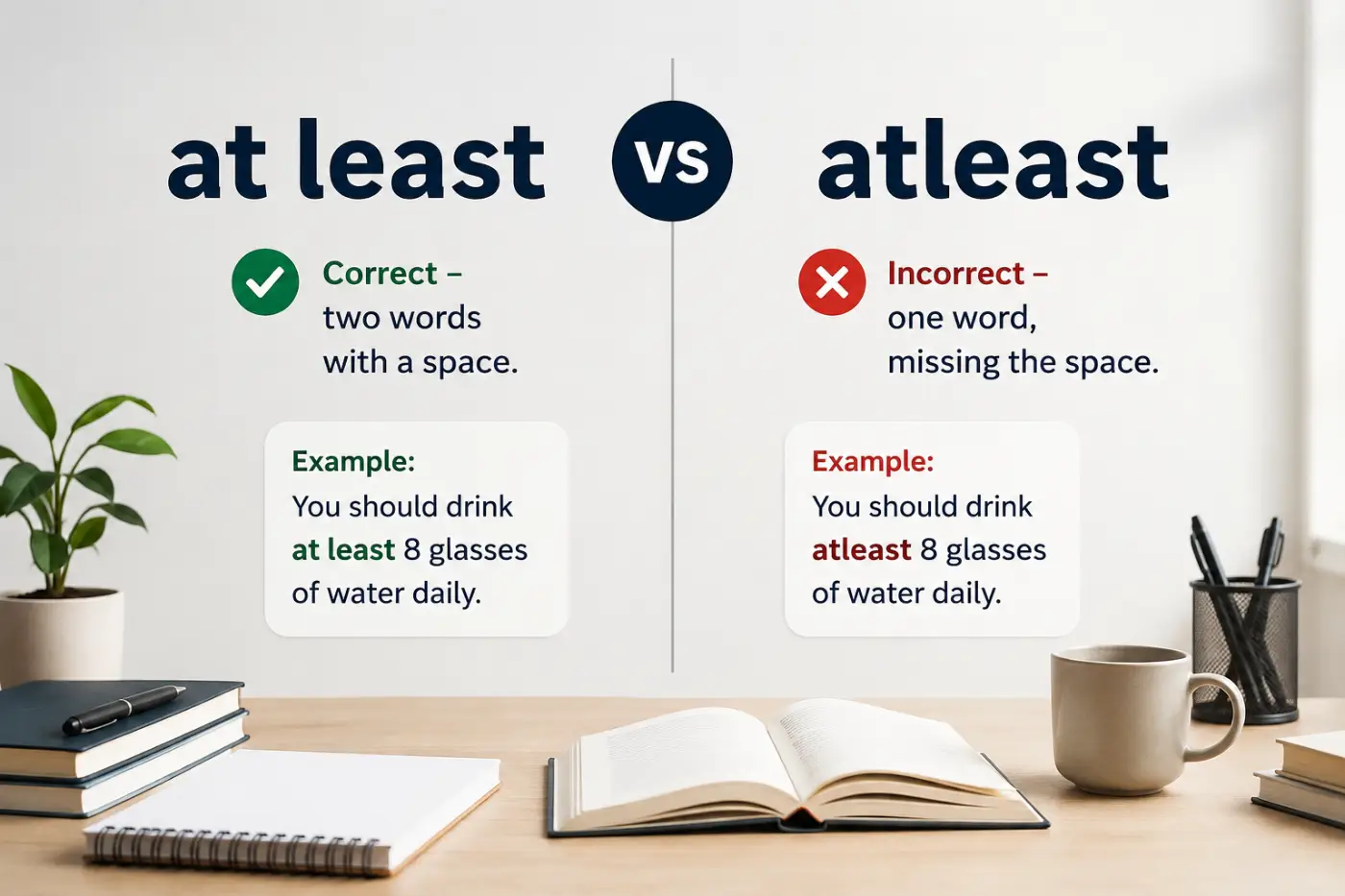
If you’ve ever paused over at least vs atleast while writing an email, school assignment, work message, or social media post, you’re not alone. The two forms look almost identical, but only one is accepted as the standard spelling in English.
The correct form is at least. It is always written as two separate words. Atleast is a common spelling mistake and isn’t recognized as the standard form in edited English.
The confusion usually comes from the way we say the phrase. In fast speech, at least can sound like one smooth unit. That makes it tempting to write it as one word. Search engines and social media also show plenty of incorrect examples, which can make the mistake seem more legitimate than it is.
Once you know the basic rule, the choice is easy. Write at least as two words in formal writing, casual writing, schoolwork, workplace communication, and everyday messages.
This guide explains the meaning, grammar, pronunciation, word history, common mistakes, real life usage, and simple memory tricks behind at least vs atleast. You’ll also see examples that show exactly how native English speakers use the phrase.
Many readers also check Unkept Or Unkempt Which Word Is Correct 2026 Guide.
Quick Answer
At least is the correct spelling. It is always written as two words when it means a minimum amount, a minimum number, or something that is true to a certain degree. Atleast is an incorrect spelling. For example, write I need at least two hours rather than I need atleast two hours.
At Least Vs Atleast Comparison
| Feature | At least | Atleast |
|---|---|---|
| Correct spelling | Yes | No |
| Number of words | Two | One |
| Standard English | Yes | No |
| Meaning | A minimum amount or degree | No standard meaning |
| Part of speech | Adverbial phrase | Not a standard English word |
| Formal writing | Correct | Incorrect |
| Informal writing | Correct | Incorrect |
| Academic writing | Correct | Incorrect |
| Workplace writing | Correct | Incorrect |
| Example | We need at least five people. | We need atleast five people. |
The most important point is simple.
At least is correct.
Atleast is incorrect.
There is no standard English rule that allows atleast as one word.

What Does At Least Mean
At least is a common English phrase with several closely related uses. Its core idea is a minimum.
It can refer to a minimum number, amount, time, level, or degree.
For example.
- I need at least ten dollars.
- The trip will take at least three hours.
- At least twenty people attended the meeting.
- You should drink at least six glasses of water.
- Give me at least five minutes.
In each sentence, at least tells the reader that the stated amount is the lowest expected amount.
If you say at least five people came, five is the minimum. More than five people may have come.
If you say the package costs at least fifty dollars, fifty dollars is the minimum price. The actual price could be higher.
That idea of a lower limit is the heart of the phrase.
The Basic Meaning Of At Least
The phrase at least commonly expresses four ideas.
A Minimum Number
Use at least when you mean no fewer than a certain number.
For example.
There were at least thirty guests at the party.
The sentence tells us that thirty is the minimum. The actual number could be thirty five or forty.
A Minimum Amount
Use the phrase with money, food, distance, weight, or other measurable amounts.
For example.
The repair will cost at least $200.
The speaker doesn’t say the repair will cost exactly $200. The amount could be higher.
A Minimum Period Of Time
You can also use at least with time.
For example.
It will take at least an hour to finish.
The work may take one hour. It may also take two hours. One hour is simply the minimum estimate.
A Minimum Degree
The phrase can describe an idea or quality rather than a physical amount.
For example.
The movie was at least entertaining.
This use has a slightly different feeling. The speaker may not think the movie was excellent, but they believe it had one positive quality.
At Least Is Always Two Words
This is the spelling rule worth remembering.
Write:
at least
Do not write:
atleast
The phrase contains the preposition at and the adjective least. Together they form the established expression at least.
English has many phrases that look as though they could become one word but remain separate.
Examples include:
- At first.
- At last.
- At once.
- At times.
- At home.
- At work.
- At large.
- At least.
The fact that people pronounce these phrases quickly doesn’t change their written form.
Why Is Atleast Wrong
Atleast is wrong because standard English does not treat it as a single word.
You may still encounter it online. People sometimes type it as one word because they hear the phrase as a single sound unit. Others make the mistake because they have seen it written incorrectly many times.
Frequent exposure can make an error look familiar.
That doesn’t make the spelling correct.
Professional editors, teachers, dictionaries, and standard English style practices use at least as two words.
For example.
Correct.
I need at least one more day.
Incorrect.
I need atleast one more day.
Correct.
You should save at least ten percent.
Incorrect.
You should save atleast ten percent.
Which One Is Correct
The correct spelling is at least.
There is no standard spelling rule that turns the phrase into atleast.
If you’re writing a resume, email, essay, report, article, school assignment, text message, or social media post, use at least.
You don’t need to worry about choosing a different spelling for American English or British English. The standard form is the same across major varieties of English.
This makes the rule unusually easy.
At least is always two words.
Why People Confuse At Least And Atleast
The confusion has little to do with meaning. Most people understand what at least means. The problem is spelling.
Several factors make atleast look believable.
Speech Makes The Phrase Sound Connected
In normal conversation, people don’t pronounce every word with a clear pause.
For example.
I need at least five minutes.
When spoken quickly, at least can sound almost like one word. English listeners process the phrase as a single chunk of meaning.
Writing doesn’t always follow the rhythm of speech.
That’s why a phrase can sound connected but still need separate words on the page.
The Phrase Is Extremely Common
People use at least constantly.
You hear it at home, at work, in classrooms, in movies, in news reports, and online.
Because it’s so familiar, writers sometimes type it quickly without thinking about the individual words.
A familiar phrase can slip past your internal spelling check.
Search Results Can Reinforce The Mistake
The internet contains millions of spelling mistakes.
If someone searches for atleast and sees the form repeated on websites, comments, captions, or user generated content, they may assume both spellings are accepted.
They aren’t.
Online frequency isn’t the same as language correctness.
A word can appear thousands of times online and still be a spelling error.
Autocorrect Doesn’t Always Save You
Spell checkers are helpful, but they aren’t perfect.
Some writing tools focus heavily on grammar, punctuation, or context. A typo can occasionally survive if the software doesn’t flag it immediately.
That’s another reason it’s useful to know the rule yourself.
Good writing shouldn’t depend entirely on an automated checker.
English Has Many Closed Compounds
English often combines words into single forms over time.
For example.
- Cannot.
- Bedroom.
- Notebook.
- Football.
- Someone.
Because English contains many compound words, writers may naturally wonder if common phrases such as at least eventually work the same way.
In this case, they don’t.
At least remains an open phrase made of two words.
The Grammar Behind At Least
Understanding the grammar gives you a stronger reason to remember the spelling.
At least functions as an adverbial phrase in many sentences. It modifies an amount, number, time, degree, or statement.
Consider this sentence.
I need at least three days.
The phrase at least modifies three days. It tells us that three days is the minimum.
Now consider:
She is at least six feet tall.
Here the phrase modifies the measurement six feet. It indicates a lower limit.
You can also use it to qualify an opinion.
The meal was at least decent.
Here at least adds a limited positive judgment. The speaker may have stronger criticisms, but they acknowledge one acceptable feature.
At Least In Number Expressions
One of the most common uses involves numbers.
Examples.
- We need at least four volunteers.
- She has read at least ten books this year.
- The store needs at least three employees tonight.
- I waited at least twenty minutes.
- The box weighs at least five pounds.
In each example, the number represents a minimum.
This is why at least often appears alongside words such as minimum, more, fewer, enough, and numerical expressions.
For example.
You need at least three references.
The same basic idea can be expressed as:
You need a minimum of three references.
The wording changes, but the meaning remains similar.
At Least In Everyday Conversation
Native speakers use at least constantly in casual speech.
It can express a minimum.
I need at least an hour.
It can soften a statement.
He’s at least trying.
It can show a positive point during a disappointing situation.
We missed the train, but at least we got some coffee.
It can also introduce a correction.
There were at least fifty people there.
The phrase is flexible because English speakers use it for both exact quantities and broader judgments.
At Least In Formal Writing
At least is completely acceptable in formal English.
You can use it in academic papers, business reports, professional emails, journalism, technical writing, and official documents.
Examples.
- The study included at least 500 participants.
- Applicants must have at least two years of experience.
- The process requires at least three stages.
- The company expects the project to take at least six months.
- The treatment should continue for at least seven days.
In formal writing, the phrase is often useful because it gives a precise minimum without claiming an exact figure.
At Least In Informal Writing
The phrase works just as naturally in texts and casual messages.
Examples.
- I’ll need at least ten minutes.
- Bring at least two snacks.
- We should stay for at least an hour.
- At least you tried.
- At least we know what happened.
Notice how the phrase can work with numbers and with ideas.
That flexibility makes at least one of the most useful everyday expressions in English.
At Least Can Mean No Fewer Than
When used with a number, at least often means no fewer than.
For example.
We need at least six chairs.
This means six chairs are necessary as the minimum. Seven or eight would also satisfy the condition.
Compare the following.
At least six chairs.
Six is acceptable. More than six is also acceptable.
Exactly six chairs.
Only six is intended.
Fewer than six chairs.
The number is below six.
This distinction matters in instructions, contracts, academic writing, workplace communication, and everyday planning.
At Least Can Mean No Less Than
With amounts, at least can mean no less than.
For example.
The item costs at least $50.
The price cannot be lower than the stated minimum under the condition being described.
Another example is:
The container holds at least two liters.
The capacity is two liters or more.
This use is especially useful when giving estimates without pretending to know an exact figure.
At Least Does Not Mean Exactly
This is an important meaning distinction.
If someone says:
You need at least three hours.
They aren’t saying you need exactly three hours.
They are saying three hours is the minimum.
You could need four hours. You could need five hours. The phrase leaves room for a higher amount.
Compare:
At least three hours.
Three hours or more.
Exactly three hours.
Three hours and no more.
About three hours.
Approximately three hours.
These expressions aren’t interchangeable.
At Least Can Show A Positive Side
One of the most interesting uses of at least appears when something isn’t completely good but still has one positive feature.
For example.
The weather was terrible, but at least the hotel was comfortable.
The speaker isn’t praising the whole experience. They are pointing out one thing that went well.
Another example.
I didn’t win, but at least I learned something.
Here at least shifts attention toward the positive part of a disappointing situation.
This use is common in natural conversation because people often use the phrase to find a small bright spot.
At Least Can Limit A Statement
Sometimes at least means something like to the minimum degree mentioned.
For example.
He’s at least honest.
This doesn’t necessarily mean the person is perfect. It means honesty is one quality the speaker is willing to credit him with.
Another example.
The book is at least interesting.
The speaker may not think the book is brilliant. Still, they consider it interesting enough to mention.
This use can carry a subtle tone. Depending on context, it may sound positive, neutral, resigned, or slightly critical.

At Least And At Last Are Different
Writers sometimes confuse at least with other expressions that look similar.
At least refers to a minimum or a positive point.
At last means finally or after a long wait.
Compare these sentences.
I need at least two hours.
I finished the work at last.
The first sentence expresses a minimum.
The second expresses completion after waiting or difficulty.
The phrases look similar because they begin with at, but their meanings have nothing to do with each other.
At Least And At Most Are Opposites
Another useful comparison is at least and at most.
At least sets a minimum.
At most sets a maximum.
For example.
You need at least three days.
This means three days or more.
You have at most three days.
This means three days or fewer.
That difference can completely change the meaning of an instruction.
In practical writing, pay close attention to these phrases because they communicate limits.
At Least And Minimum
At least and minimum often communicate the same basic idea, but they work differently in a sentence.
Compare:
You need at least five people.
You need a minimum of five people.
Both sentences mean five people are required as the lowest acceptable number.
The first version sounds more natural in everyday conversation.
The second can sound more formal or technical.
Neither is inherently better. Choose the structure that fits your sentence and audience.
At Least And Atleast In Digital Writing
The spelling mistake atleast appears frequently in online writing because people type quickly.
You may see it in:
- Social media comments.
- Text messages.
- Online forums.
- User reviews.
- Informal posts.
- Chat messages.
Seeing it in these places doesn’t make it correct.
Digital communication contains many shortcuts, typos, and nonstandard spellings. Professional writing requires a different standard.
If you’re writing something that represents you professionally, use at least.
A Simple Rule To Remember
Think of at least as a phrase that sets a floor.
Imagine a building.
The phrase tells you the lowest level you can accept.
If you need at least five people, five is the floor.
If you need at least $100, $100 is the floor.
If you need at least two hours, two hours is the floor.
And because the phrase has two separate words, the spelling stays at least.
Never turn it into atleast.
At Least Vs Atleast In Real Life Writing
Knowing the spelling rule is only the first step. The bigger skill is knowing how at least behaves inside different kinds of sentences.
Merriam Webster defines at least primarily as at the minimum and also records a second use meaning in any case. That distinction matters because the phrase does more than set a numerical minimum.
At Least In Daily Conversation
People use at least in everyday speech to set a minimum or point out one good thing in an imperfect situation.
- I need at least ten minutes to get ready.
- We should have at least three people there.
- The store is at least open today.
- At least we found the right address.
- You got there at least five minutes early.
- I want to save at least $100 this month.
- Give me at least one good reason.
- We can stay for at least another hour.
The phrase feels natural because it gives the listener a clear lower limit or a small positive point.
At Least In Workplace Writing
At least is especially useful when you need to communicate requirements clearly.
Consider these examples.
- Applicants need at least two years of experience.
- The meeting should last at least thirty minutes.
- Please provide at least three references.
- The report needs at least five supporting sources.
- We expect at least 100 customers to attend.
- The equipment requires at least two trained operators.
These sentences leave no doubt about the minimum requirement.
This precision makes at least useful in policies, instructions, schedules, project plans, reports, and professional emails.
At Least In Academic Writing
Academic writers frequently use at least when discussing quantities or minimum conditions.
Examples include:
- The sample included at least 300 participants.
- Students must complete at least four assignments.
- The experiment was repeated at least three times.
- The study lasted at least six months.
- The survey received responses from at least 1,000 participants.
The phrase is perfectly suitable for formal academic English.
You don’t need to replace it with a more complicated expression simply because the writing is formal. Clear writing often wins over unnecessarily elaborate wording.
At Least In Emails
The phrase also works naturally in professional emails.
For example:
Please give me at least two days to review the document.
We need at least three volunteers for Friday.
I’ll need at least an hour to complete the revisions.
Please send at least one supporting document with your application.
These sentences are direct and easy to understand.
At Least In Journalism
News writing often uses at least when reporting estimates.
Examples include:
- At least 50 people attended the event.
- The storm damaged at least 200 homes.
- The company plans to hire at least 500 workers.
- At least three roads remain closed.
This usage is common because reported figures may represent a confirmed minimum rather than a final total. Merriam Webster’s usage examples also show at least appearing naturally with numbers, time periods, quantities, and other lower limits.
At Least Can Mean In Any Case
There is another important use that doesn’t involve numbers.
Consider this sentence:
I don’t know if she’ll come, but at least we invited her.
Here at least doesn’t mean a minimum number.
It means something closer to in any case or if nothing else.
Merriam Webster lists this as a separate meaning of the phrase.
More examples make the difference clear.
- I didn’t get the job, but at least I gained experience.
- The restaurant was crowded, but at least the food was good.
- We missed the bus, but at least we weren’t late for the meeting.
- The plan isn’t perfect, but at least it gives us a starting point.
- I couldn’t finish everything, but at least I completed the important parts.
In these sentences, the phrase introduces a positive point after something disappointing or uncertain.
At Least And At Most
One of the most useful comparisons is at least versus at most.
They point in opposite directions.
| Expression | Meaning | Example |
|---|---|---|
| At least | Minimum | You need at least four people. |
| At most | Maximum | You need at most four people. |
| Exactly | Precise amount | You need exactly four people. |
| More than | Above a number | You need more than four people. |
| Fewer than | Below a number | You need fewer than four people. |
Look closely at these sentences.
You can bring at least five guests.
Five is the minimum. Six or seven is also fine.
You can bring at most five guests.
Five is the maximum. Four or three is fine.
You can bring exactly five guests.
The intended number is five.
A single phrase can change the entire meaning of an instruction. That’s why editors pay close attention to expressions that establish limits.
At Least And At Last
Another common source of confusion is at least versus at last.
They look similar but have completely different meanings.
At least means a minimum or a positive point.
At last means finally.
Compare:
I need at least two hours.
I finished the project at last.
The first sentence gives a minimum amount of time.
The second says the project was finally completed.
You can also say:
At least we finished the project.
At last we finished the project.
These sentences aren’t identical.
The first focuses on the positive result.
The second focuses on the fact that the result finally happened.
At Least And At First
At first is another phrase that can confuse learners because it has the same opening word.
At first means in the beginning.
For example:
At first, I didn’t like the movie.
At least I enjoyed the ending.
The two expressions can even appear in the same sentence, but they perform different jobs.
At first, the project seemed difficult, but at least we had enough time.
The first phrase establishes a starting point.
The second highlights a positive condition.
At Least And Least
The word least can stand alone.
For example:
This is the least expensive option.
She was the least experienced person on the team.
He worried least about the cost.
But that doesn’t mean atleast is possible.
The word least is an independent word. When it appears in the established phrase at least, it remains separate.
Merriam Webster identifies least as the superlative form of little and traces it to Old English.
That history helps explain why the phrase has such a long presence in English.
At Least And A Minimum Of
The phrase a minimum of can often replace at least when you’re talking about quantities.
Compare:
You need at least five pages.
You need a minimum of five pages.
Both mean five pages or more.
The first sentence sounds more natural in everyday English.
The second can sound more formal or technical.
For example, a workplace policy might say:
Employees must complete a minimum of ten hours of training.
A manager speaking to an employee might simply say:
You need at least ten hours of training.
Both are clear.
At Least And No Less Than
No less than can also express a minimum.
For example:
The building is at least 100 years old.
The building is no less than 100 years old.
The meanings are similar, but the tone can differ.
At least is usually simpler and more natural.
No less than can place stronger emphasis on the size or importance of the figure.
For example:
She donated no less than $10,000.
This sounds more emphatic than:
She donated at least $10,000.
The best choice depends on the point you want to emphasize.
At Least And More Than
These expressions can look similar but don’t mean exactly the same thing.
At least five means five or more.
More than five means above five.
In ordinary counting, more than five means six or higher.
Compare:
At least five people attended.
Five or more people attended.
More than five people attended.
Six or more people attended.
This difference matters in legal writing, statistics, research, business reports, and instructions.
If five is allowed, use at least five.
If five isn’t enough, use more than five.
At Least In Comparisons
The phrase can also appear with comparative structures.
For example:
The new model is at least as reliable as the old one.
This means the new model is equally reliable or more reliable.
Another example:
The second option is at least as affordable as the first.
Again, the meaning allows equality or something greater.
This structure is common in careful comparisons.
It can be especially useful when you don’t want to claim that one thing is definitely better while still stating that it isn’t worse.
At Least And At Least As
The expression at least as often appears before an adjective or adverb.
Examples include:
- She is at least as experienced as her manager.
- This method is at least as effective as the previous one.
- The new laptop is at least as fast as the older model.
- The second route is at least as convenient as the first.
The pattern is:
at least as + adjective or adverb + as
This construction is grammatically different from simply using at least with a number.
Understanding the pattern can help advanced learners use the phrase more naturally.
At Least In Conditional Statements
You can also use at least when explaining conditions.
For example:
You need at least 80 percent to pass.
Students must complete at least three assignments to qualify.
The account must contain at least $500.
These statements establish a threshold.
A threshold is a point that must be reached before something happens.
This is one reason at least appears so often in rules, requirements, eligibility conditions, and instructions.
For another common grammar confusion, see Coachs Or Coaches Which Spelling Is Correct 2026.
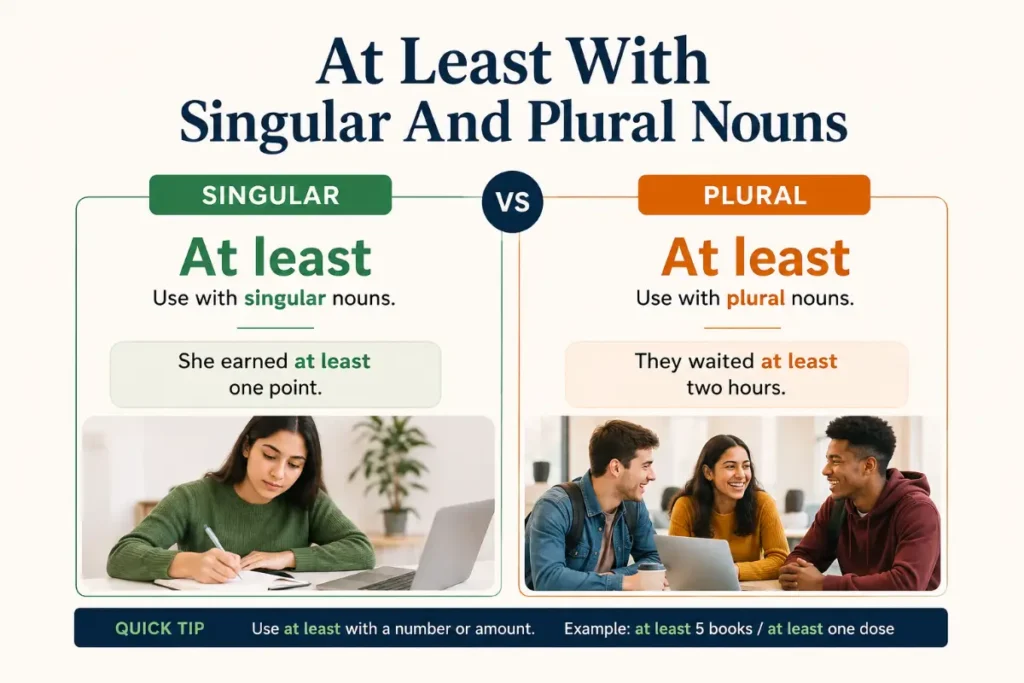
At Least With Singular And Plural Nouns
When at least modifies a number greater than one, the noun usually takes its normal plural form.
Correct:
You need at least three chairs.
We hired at least five employees.
She read at least ten books.
For one, use the singular noun.
You need at least one chair.
We hired at least one employee.
She read at least one book.
The phrase itself doesn’t change.
Only the noun changes according to the number.
At Least With Time
Time expressions are among the most common uses of at least.
Examples include:
- Wait at least ten minutes.
- I need at least an hour.
- The repair could take at least two days.
- We’ve known each other for at least five years.
- Give the paint at least 24 hours to dry.
The phrase establishes the minimum duration.
Be careful not to confuse at least two hours with about two hours.
At least two hours means two hours or more.
About two hours means approximately two hours.
Those expressions communicate different levels of certainty.
At Least With Money
Money provides another common use.
Examples include:
- I need at least $50.
- The repair will cost at least $500.
- She earns at least $20 an hour.
- Save at least $100 each month.
- The ticket costs at least $75.
Again, the amount is a lower limit.
If the ticket costs at least $75, it could cost $80, $100, or more.
It doesn’t mean the ticket costs exactly $75.
At Least With Measurements
You can use the phrase with almost any measurable quantity.
Examples include:
- At least two miles.
- At least five pounds.
- At least three inches.
- At least 20 gallons.
- At least 100 degrees.
- At least 15 percent.
- At least 500 milliliters.
The structure is simple.
At least + number + unit.
This makes the phrase useful in science, cooking, construction, fitness, travel, finance, and everyday planning.
At Least With Abstract Ideas
The phrase isn’t limited to numbers.
Consider:
At least he was honest.
At least the explanation made sense.
At least she tried.
At least we know the truth now.
At least they apologized.
Here the phrase introduces something the speaker considers worthwhile.
This use adds emotional nuance to a sentence. It can suggest relief, acceptance, disappointment, or reassurance depending on the context.
For example:
We lost the game, but at least everyone played well.
The speaker isn’t celebrating the loss. They’re finding one positive aspect.
At Least And Tone
The meaning of at least can remain stable while the tone changes.
Compare these examples.
At least you tried.
This could sound encouraging.
Well, at least you tried.
This could sound slightly disappointed.
At least you tried. That’s more than most people did.
Now it sounds strongly supportive.
The surrounding words and voice affect the emotional meaning.
This is a useful lesson for English learners. Grammar tells you the basic meaning, but context often determines the feeling.
At Least In Social Media And Texting
You’ll often see at least in short posts and messages.
Examples:
At least we had fun.
At least it’s Friday.
At least someone understands me.
At least I tried.
At least the coffee was good.
The expression works well in short informal writing because it communicates a lot with only two words.
However, don’t copy the common online error atleast just because you see it in comments or captions.
Standard spelling still requires the space.
Is Atleast Ever Acceptable
In standard English, atleast should not be used as a single word.
It may appear as a typo, a search query, a username, a website title, or an informal digital error. Those appearances don’t establish it as a standard spelling.
The distinction is important.
A form can exist on the internet without being accepted English.
For schoolwork, professional communication, publishing, journalism, and edited content, use at least.
Common Spelling Mistakes With At Least
The most common mistake is simple.
Incorrect:
I need atleast five minutes.
Correct:
I need at least five minutes.
Another common mistake is inconsistent spacing.
Incorrect:
We waited at leastfive minutes.
Correct:
We waited at least five minutes.
The two words should remain separate.
You should also avoid treating at least as a compound word.
Incorrect:
The atleast requirement is five years.
Better:
The minimum requirement is five years.
Or:
The requirement is at least five years.
This last point matters because at least doesn’t normally function as a standalone adjective before a noun.
Why The Space Matters
Spacing is part of English spelling.
Compare these pairs:
a lot and alot
at least and atleast
in fact and infact
at first and atfirst
In each case, the incorrect closed form comes from combining words that standard English keeps separate.
The eye may become accustomed to a common error, but the grammar doesn’t change just because the error becomes familiar.
For writers, this is a useful editing habit: don’t judge spelling by how familiar a form looks. Check the established form.
A Reliable Editing Test
When you’re unsure about at least, use a quick substitution test.
Replace it with at a minimum.
If the sentence still makes sense, you’re probably using at least in its minimum sense.
For example:
I need at least three days.
I need at a minimum three days.
The second sentence is less natural, but the meaning is clear.
Another test is to replace it with if nothing else.
For example:
I didn’t win, but at least I learned something.
I didn’t win, but if nothing else, I learned something.
Again, the meaning works.
These tests help you understand the phrase rather than memorize it blindly.
Memory Tricks For At Least
The easiest memory trick is to picture the phrase as a small pair.
AT + LEAST
Two words.
Two parts.
One expression.
Another useful trick is to compare it with at most.
You would never normally write atmost as one word.
So remember:
at least
at most
Both stay open.
You can also connect least with most.
Least and most are opposites.
At least gives a lower limit.
At most gives an upper limit.
That relationship makes the spelling easier to remember.
The Fastest Rule To Remember
If you remember only one sentence from this guide, remember this:
Always write at least as two words.
You don’t need a special American spelling.
You don’t need a British spelling.
You don’t need a formal version.
You don’t need a different spelling for academic writing.
The standard form is at least.
Merriam Webster lists the phrase as a dictionary entry and gives its core meaning as at the minimum. It also records its use in the sense of in any case.
That gives you both the spelling and the main meanings in one place.
Expert Editor’s Note
From an editing standpoint, this is one of the easy decisions.
Use at least every time you mean the established phrase. Don’t treat atleast as an alternate spelling.
A professional editor would correct:
Please allow atleast two weeks.
to:
Please allow at least two weeks.
The correction isn’t about style. It’s about standard spelling.
The same rule applies in casual writing. You can change the tone of a sentence, but you don’t need to change the spelling.
The phrase has been established in English for a very long time. Merriam Webster gives its first known use as before the 12th century.
So this isn’t a new internet convention or a recent grammar preference.
It’s an old and stable part of English.
The practical editorial rule is simple: keep at least open and keep the meaning clear.
Internal Link Opportunities
A natural internal link after this section would be A Lot Vs Alot because readers who search for atleast often confuse other commonly merged phrases.
Another useful internal link near the conclusion would be At Least Vs At Most because the two expressions establish opposite limits and help readers understand the grammar more deeply.
What Native Speakers Usually Write
Native English speakers write at least as two words in standard English.
You may still see atleast online because spelling mistakes travel quickly. A person can make the same mistake thousands of times and still be making a mistake.
The safer approach is to follow established dictionary forms and standard editorial practice rather than copying whatever appears most often in casual online content.
That principle is useful far beyond this one phrase.
Familiar doesn’t always mean correct.
Common Mistakes With At Least
Most errors with at least aren’t really grammar problems. They’re spelling and usage problems. Once you know the standard form you can avoid nearly all of them.
Writing Atleast As One Word
This is the biggest mistake.
Incorrect.
I need atleast three days.
Correct.
I need at least three days.
The phrase must stay separated into two words. The same rule applies in formal and informal English.
Treating Atleast As An Alternate Spelling
Some writers assume atleast might be an acceptable American or British variation.
It isn’t.
American English uses at least. British English uses at least. Canadian English and Australian English use at least as well.
There is no regional spelling difference here.
Using At Least When You Mean Exactly
Consider this sentence.
The meeting will last at least one hour.
This doesn’t mean the meeting will last exactly one hour. It means one hour is the minimum expected duration.
If you know the precise duration you should say:
The meeting will last exactly one hour.
That small difference can matter in instructions and professional writing.
Confusing At Least With At Most
These phrases establish opposite limits.
At least five means five or more.
At most five means five or fewer.
For example:
You can invite at least five people.
Five is the minimum.
You can invite at most five people.
Five is the maximum.
Changing one phrase for the other can completely reverse an instruction.
At Least Vs At Last
These phrases look similar but have different meanings.
At least refers to a minimum or highlights a positive point.
At last means finally.
Compare these examples.
I need at least two hours.
I finished the assignment at last.
The first sentence gives a minimum amount of time.
The second tells us something happened after waiting or difficulty.
You can remember the difference by connecting last with time.
At last means finally.
At least means a minimum.
At Least Vs At First
At first refers to the beginning of something.
For example:
At first, I didn’t understand the lesson.
At least doesn’t describe a starting point.
For example:
At least I understand the basic rule now.
These expressions can appear together.
At first, the instructions seemed confusing, but at least the examples helped.
The phrases have different functions even though both begin with at.
At Least Vs A Lot
Another useful spelling comparison is at least and a lot.
Both phrases contain two words.
Correct:
I have a lot of work.
I need at least two hours.
Incorrect:
I have alot of work.
I need atleast two hours.
English learners often merge common phrases because they hear them as one unit during fast speech.
The solution is simple. Learn the written form of common expressions instead of spelling them exactly as they sound.
At Least Vs Alright
At least and alright aren’t related in meaning but they can both appear in casual writing.
At least expresses a minimum or a positive point.
Alright is an informal form meaning acceptable or satisfactory. Many formal style guides still prefer all right.
For example:
At least the plan is ready.
The plan is alright.
The words perform completely different jobs.
At Least In Formal Writing
There’s no need to avoid at least in formal writing.
It works naturally in:
- Academic papers.
- Business reports.
- Professional emails.
- News articles.
- Research writing.
- Instructions.
- Technical documents.
For example:
The sample contained at least 200 observations.
This is clear and professional.
Trying to replace a simple phrase with complicated language can actually make writing weaker. Good formal writing isn’t about making every sentence sound grand. It’s about making every sentence precise.
At Least In Academic Research
Researchers often need to distinguish a known minimum from an exact value.
For example:
The study included at least 250 participants.
This tells readers that 250 is the lowest confirmed or reported number.
If the exact number is known, the writer may say:
The study included exactly 250 participants.
If the number is approximate, the writer might say:
The study included about 250 participants.
These three phrases communicate different levels of precision.
At least means the number cannot be below the stated minimum in the context.
Exactly identifies a precise amount.
About signals an approximation.
At Least In Professional Instructions
Clear instructions often depend on minimum requirements.
Examples include:
- Submit at least two references.
- Complete at least three training sessions.
- Provide at least one form of identification.
- Attend at least 80 percent of the classes.
- Allow at least five business days for processing.
The phrase gives the reader a measurable target.
If the requirement is strict you should state it clearly. At least is one of the simplest ways to do that.
At Least In Technical And Scientific Writing
Technical writing uses at least when a value represents a lower boundary.
Examples include:
The device requires at least 12 volts.
The solution must contain at least 10 percent alcohol.
The system needs at least 8 GB of memory.
The container must remain at least two meters from the heat source.
The phrase helps prevent ambiguity.
For technical readers, a lower limit can be much more important than an approximate estimate.
At Least In Literature And Creative Writing
Writers also use at least to show a character’s thoughts or emotional reaction.
For example:
At least she had tried.
At least the house still felt like home.
At least he had told the truth.
Here the phrase can carry emotion without explicitly explaining it.
It may suggest relief, acceptance, disappointment, or hope.
This is one reason at least is such a useful expression in natural English. It can communicate logic and emotion at the same time.
At Least In Journalism
Journalists often use the phrase when a reported figure represents a minimum.
For example:
At least 40 people attended the event.
At least three buildings were damaged.
At least 15 flights were canceled.
The wording avoids claiming an exact total when the available information supports only a minimum.
That makes at least useful for careful reporting.
At Least In Social Media
Casual online writing often uses the phrase to express relief or find something positive.
Examples include:
At least we tried.
At least it’s finally Friday.
At least the food was good.
At least nobody got hurt.
The style is informal but the spelling remains the same.
Social media doesn’t create a special spelling rule for the phrase.
Pronunciation Of At Leas
The standard pronunciation is straightforward.
IPA
/ət liːst/
In natural American speech the first word is usually weak. The vowel in at can reduce toward the schwa sound.
The phrase may therefore sound closer to:
uh least.
This reduced pronunciation can make atleast feel natural when you’re hearing it.
But spoken rhythm doesn’t determine written spacing.
English contains many phrases that sound tightly connected even though they remain separate in writing.
Common Pronunciation Mistake
Some learners give equal stress to both words.
In natural speech the main emphasis usually falls on least when the phrase expresses a minimum.
For example:
I need at least two hours.
The exact rhythm can change depending on the speaker and the sentence, but the important point is that the phrase is normally pronounced as one connected unit while remaining two written words.
Word Origin Of At Least
The history of at least is tied to the history of the word least.
Least comes from Old English læst and is connected with the idea of being the smallest or lowest amount.
The word developed through earlier forms of English and remained part of the language as the superlative form associated with little.
The preposition at has Germanic roots and has been used in English for centuries to express position, point, time, and other relationships.
Together, at least developed into an established expression meaning a minimum or a lower limit.
The phrase has been part of English for a very long time. It isn’t a modern internet expression.
British Vs American English
There is no spelling difference between American and British English for at least.
American English:
I need at least two hours.
British English:
I need at least two hours.
Canadian English follows the same standard form.
Australian English also uses at least.
You don’t need to memorize a regional variation.
This is different from words such as color and colour or center and centre, where regional spelling differences exist.
At least doesn’t have that problem.
Real Life Examples Of At Least
Seeing the phrase in different settings makes its use easier to recognize.
Everyday Examples.
- I need at least ten minutes.
- We should bring at least two umbrellas.
- She waited at least half an hour.
- Give me at least one reason.
- We have at least enough food for everyone.
Workplace Examples.
- The position requires at least three years of experience.
- Please provide at least two references.
- The meeting will take at least an hour.
- We need at least five people for the project.
- The report should contain at least three sources.
Academic Examples.
- Students must complete at least four assignments.
- The experiment was repeated at least five times.
- The study included at least 500 participants.
- The paper should contain at least 2,000 words.
- Participants needed at least six months of experience.
Formal Examples.
- Applicants must be at least 18 years old.
- The equipment should remain at least one meter from the wall.
- The payment must arrive at least five business days before the event.
Emotional And Conversational Examples
- At least we know the truth.
- At least she apologized.
- I didn’t win, but at least I learned something.
- At least you gave it a try.
- The trip wasn’t perfect, but at least we had fun.
- At least nobody was injured.
These examples show why context matters. The same phrase can express a measurable minimum or add a reassuring point to a sentence.
Common Internet Misconceptions
One of the biggest misconceptions is that atleast has become acceptable because so many people use it online.
It hasn’t.
Another misconception is that atleast is informal while at least is formal.
That’s also incorrect.
The correct form is at least in both casual and formal writing.
You can write:
At least I’ll get some rest.
You can also write:
The applicant must have at least five years of experience.
The tone changes because of the sentence itself. The spelling doesn’t.
What Dictionaries Say.
Major English dictionaries treat at least as a phrase rather than recognizing atleast as the standard spelling.
Merriam Webster gives at least as an established expression and includes meanings connected with a minimum and with in any case.
Cambridge Dictionary also lists at least as a phrase used to describe the smallest possible amount or degree and records additional conversational uses.
The editorial takeaway is clear.
If you’re deciding between at least and atleast, choose at least.
Frequently Asked Questions.
Is Atleast A Correct Word.
No. Atleast is not the standard spelling in English. The correct form is at least with a space between the two words. You should use the two word form in school assignments, professional emails, articles, academic writing, social media posts, and everyday messages.
Why Is At Least Written As Two Words.
At least is an established phrase made from two separate words. English spelling doesn’t combine them into a single word. Although the phrase can sound connected during fast speech, its written form remains at least.
Is At Least One Word Or Two Words.
At least is two words. The space is required in standard English. Writing atleast as one word is a spelling error. This rule applies across American English, British English, Canadian English, and Australian English.
Can I Use At Least In Formal Writing.
Yes. At least is completely appropriate in formal writing. It frequently appears in academic papers, research reports, workplace documents, journalism, technical instructions, and professional emails. You don’t need to replace it with a more complicated expression.
Does At Least Mean Exactly.
No. At least normally means the stated amount is the minimum. If you need at least five minutes, five minutes is the minimum and you may need more. Use exactly when you mean one precise amount.
What Is The Difference Between At Least And At Most
At least establishes a minimum and means the stated amount or more. At most establishes a maximum and means the stated amount or less. For example, at least five means five or more while at most five means five or fewer.
Is Atleast An American Spelling
No. American English uses at least as two words. British, Canadian, and Australian English also use at least. There is no standard regional spelling called atleast. If you see it online, you’re most likely seeing a spelling mistake.
How Can I Remember The Correct Spelling
Think of at least as a two word phrase that sets a floor. Five people at least means five is the lowest acceptable number. You can also remember it alongside at most. Both phrases keep at and the following word separate.
For another common grammar confusion, see Occasion Or Ocassion Which Spelling Is Correct 2026 Guide.
Conclusion
The at least vs atleast question has a clear answer.
At least is correct.
Atleast is incorrect.
Use at least whenever you mean a minimum amount, number, time, degree, or a positive point in an otherwise disappointing situation.
The phrase works in casual conversation and formal writing. It doesn’t change spelling between American and British English. It also doesn’t become one word just because people pronounce it quickly or type it incorrectly online.
The most useful rule is the simplest one.
At least always needs a space.
Once you remember that small space, this common English spelling problem becomes one less thing to second guess.

Editorial Reviewer & Proofreader
Grace Mitchell reviews Gramlify’s articles for clarity, consistency, and readability. She is passionate about creating accurate, approachable content that helps English learners build confidence.