
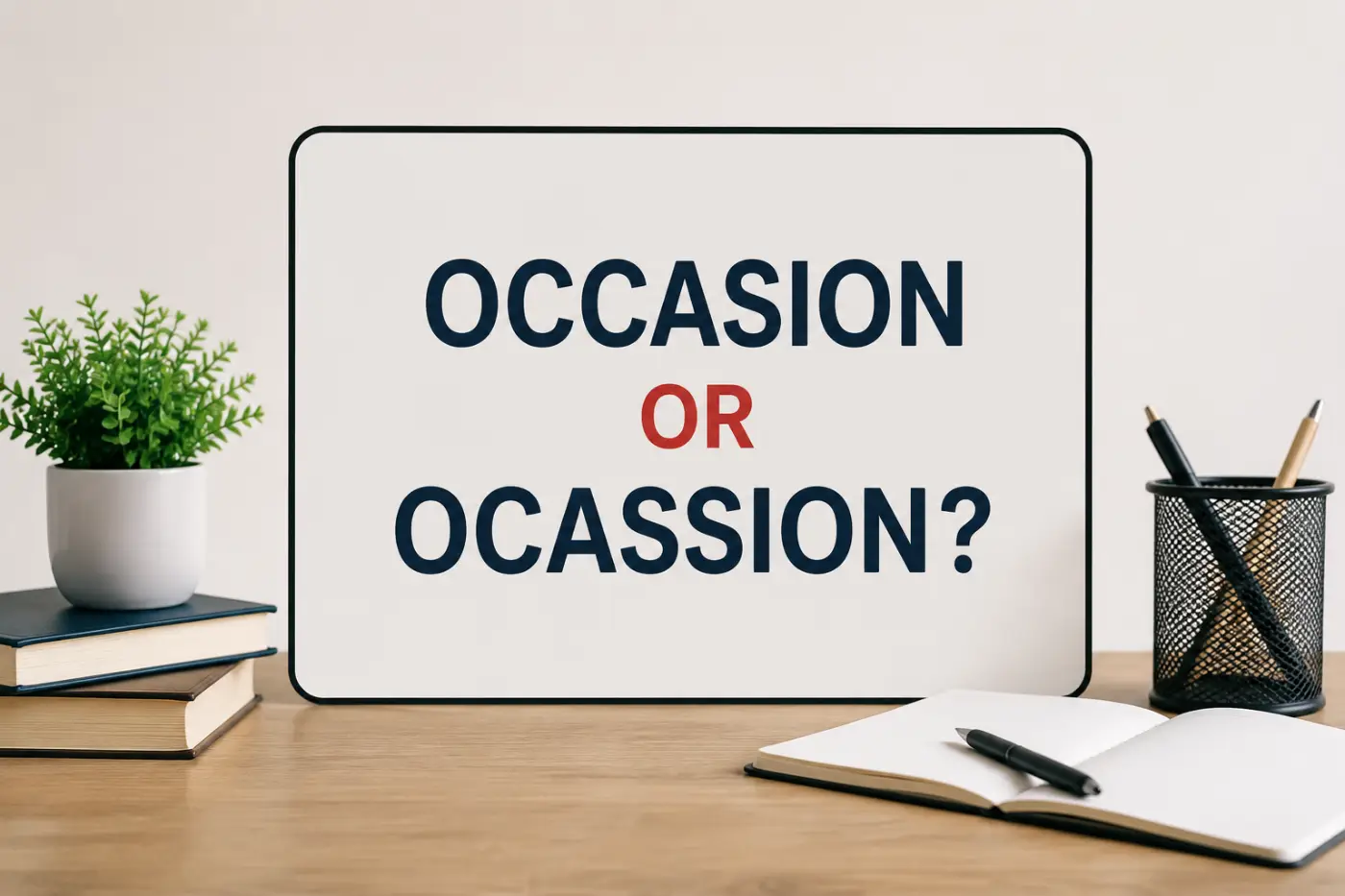
One missing letter can turn a perfectly good English word into a spelling mistake. Occasion or ocassion is a classic example. If you’ve ever paused while typing occasion and wondered if it needs one c or two then you’re not alone. The correct spelling is occasion with two c letters and one s.
The incorrect form ocassion swaps the spelling pattern by using one c and two s letters. It looks convincing because English has many words with doubled consonants. However occasion follows a different pattern.
The word occasion can mean a particular event or time. It can also refer to a special event such as a wedding birthday or celebration. As a verb it can mean to cause something to happen although this use is less common in everyday American English.
This guide explains the difference between occasion and ocassion in plain English. You’ll learn the correct spelling meaning pronunciation grammar word origin common mistakes and practical examples. By the end you’ll have a simple memory trick that makes this spelling easy to remember.
Many readers also check Etc Or Ect Which Spelling Is Correct 2026.
Quick Answer
Occasion is the correct spelling. Ocassion is incorrect. The word occasion is spelled with two c letters followed by one s. It can mean an event a particular time or a special event. For example you can say This is a special occasion. Never write ocassion in standard English.
Occasion Or Ocassion Comparison
| Feature | Occasion | Ocassion |
|---|---|---|
| Correct spelling | Yes | No |
| Meaning | An event or particular time | No standard English meaning |
| Part of speech | Noun and verb | Incorrect form |
| Pronunciation | /əˈkeɪʒən/ | Not a standard word |
| Standard American English | Yes | No |
| Standard British English | Yes | No |
| Formal writing | Correct | Incorrect |
| Informal writing | Correct | Incorrect |
| Example | It was a special occasion. | Incorrect spelling |
The key point is simple. Occasion is the only standard spelling.
What Does Occasion Mean
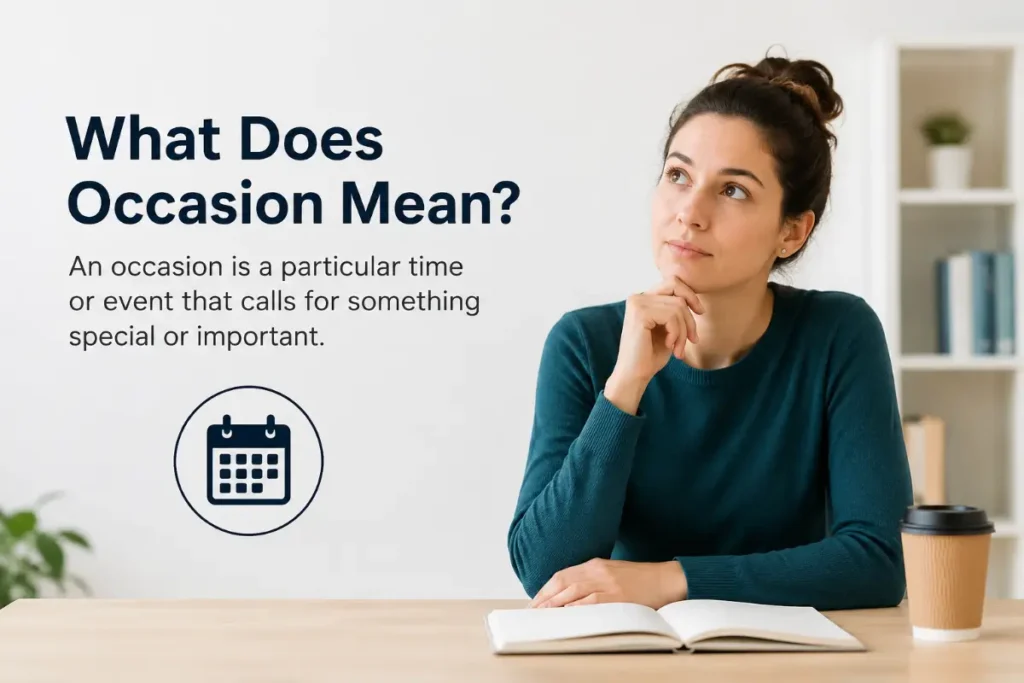
Occasion is a noun with several related meanings. The most common meaning is an event or a particular time when something happens.
It often appears in everyday speech because people use the word to talk about celebrations important moments and specific situations.
Occasion As An Event
An occasion can be an event or gathering that has some importance.
For example.
- The wedding was a beautiful occasion.
- We dressed up for the special occasion.
- Her birthday is always a happy occasion.
- The award ceremony was an important occasion.
In these sentences occasion refers to an event or moment worth noticing.
Occasion As A Particular Time
The word can also refer to a specific time when something happened.
For example.
- I’ve met him on several occasions.
- On one occasion we stayed until midnight.
- She has helped me on many occasions.
Here occasion doesn’t necessarily mean a celebration. It simply means a particular instance or time.
Occasion As A Special Event
You may hear special occasion very often in American English.
A special occasion could include a birthday wedding anniversary graduation holiday party or other meaningful event.
Examples include.
- We bought a cake for the special occasion.
- She wore her favorite dress for the occasion.
- This restaurant is perfect for a special occasion.
- They saved the expensive bottle for a special occasion.
The phrase is so common that many people learn occasion through this expression.
What Does Ocassion Mean
Ocassion is not the correct spelling of the English word.
You may find it on websites social media posts forums messages or other informal sources. Its appearance online doesn’t make it an accepted spelling.
If you’re writing an email school assignment article application report or professional document use occasion.
Incorrect.
It was a special ocassion.
Correct.
It was a special occasion.
The mistake usually happens because writers remember the doubled s sound or spelling pattern but place the repeated letter in the wrong position.
Which One Is Correct
Occasion is correct.
Ocassion is incorrect.
The correct sequence is.
O C C A S I O N
The easiest way to see the spelling is to divide the word into parts.
oc ca sion
The first important detail is the double c.
There is only one s.
So if you see ocassion with one c and two s letters then the spelling is wrong.
Correct Examples
- This is a wonderful occasion.
- We don’t get many occasions like this.
- She bought a dress for the occasion.
- I’ve seen him on several occasions.
- Graduation is a memorable occasion.
Incorrect Examples
- This is a wonderful ocassion.
- We don’t get many ocassions like this.
- She bought a dress for the ocassion.
The plural follows the same spelling pattern.
occasion → occasions
Notice that the plural ending adds s to the correct spelling. It doesn’t create a second s inside the word.
Why People Confuse Occasion And Ocassion
The mistake has a few clear causes.
The Sound Can Mislead You
The pronunciation of occasion doesn’t clearly reveal its spelling.
The word is pronounced approximately as uh KAY zhuhn in American English.
The c letters don’t sound like a hard k sound. Instead the word contains a sound represented by the letter combination around the middle of the word.
When you hear the word you can’t simply spell it from the sound.
English Spelling Isn’t Always Phonetic
English has many words where pronunciation doesn’t give you every spelling detail.
Occasion is one of them.
A learner may hear the word and remember the general sound but not remember the exact placement of the repeated consonant.
The Double S Pattern Looks Familiar
English contains many common words with ss.
Examples include.
- Address.
- Success.
- Necessary.
- Possession.
- Discussion.
Because double s appears so often learners may instinctively write ocassion.
The problem is that occasion belongs to a different spelling pattern.
Typing Makes The Error Easy
When you’re writing quickly you may remember the general shape of the word without checking each letter.
The fingers can also produce ocassion because the spelling feels visually familiar.
This is especially common when writing quickly on a phone.
Search Results Can Reinforce Mistakes
People sometimes assume a spelling must be correct because they have seen it online.
That’s not a safe test.
The internet contains user generated text with typos. A misspelled word can appear thousands of times and still be wrong.
Dictionary entries and established editorial sources are much better evidence for standard spelling.
Key Differences Between Occasion And Ocassion
There is only one real difference because ocassion isn’t an accepted alternative spelling.
Occasion Is A Standard Word
Occasion has established meanings grammar forms pronunciation and historical roots.
You can use it in casual conversation formal writing academic work journalism and professional communication.
Ocassion Is A Spelling Error
Ocassion doesn’t have its own standard definition.
If you encounter it in a sentence it normally represents a misspelling of occasion.
Occasion Works In Formal Writing
You can confidently write.
The ceremony marked an important occasion.
You should not write.
The ceremony marked an important ocassion.
The first version is appropriate for professional and academic contexts. The second contains a spelling error.
Grammar And Usage Of Occasion
Understanding the grammar of occasion can make the spelling easier because you’ll see how the word behaves in real sentences.
Occasion As A Noun
The most common grammatical role is a noun.
A noun can name an event time or instance.
Examples.
- It was a memorable occasion.
- The occasion brought the whole family together.
- We have met on several occasions.
- Every occasion deserves a little celebration.
The noun can appear in singular or plural form.
Singular: occasion.
Plural: occasions.
Articles With Occasion
Because occasion is a countable noun you can use a or an depending on the surrounding grammar.
Examples.
- It was a special occasion.
- We celebrated an important occasion.
- The occasion was unforgettable.
The choice between a and an depends on the sound of the following word.
Because occasion begins with a vowel sound the natural phrase is an occasion.
Correct.
It was an occasion I’ll always remember.
Incorrect.
It was a occasion I’ll always remember.
Plural Form
The plural is occasions.
Add s to the correctly spelled singular form.
occasion → occasions
Examples.
- I’ve visited the city on several occasions.
- There have been many occasions when she helped us.
- On rare occasions the store stays open late.
Be careful not to write ocassions.
That version carries the same spelling mistake as ocassion.
Possessive Form
The possessive form can be singular or plural.
Singular possessive.
occasion’s
Example.
The occasion’s meaning was important to the family.
Plural possessive.
occasions’
Example.
The occasions’ schedules were published together.
These forms are grammatically possible but less common than rewriting the sentence for clarity.
Occasion As A Verb
Occasion can also function as a verb meaning to cause something or provide a reason for something.
This use is less common in everyday American conversation but it appears in formal and literary writing.
Example.
His remarks occasioned a heated debate.
Here occasioned means caused.
Another example.
The discovery occasioned further research.
This means the discovery caused further research.
You’ll most often encounter this use in formal writing.
Verb Forms
The verb follows regular English verb patterns.
Present form.
occasion
Third person singular.
occasions
Past tense.
occasioned
Present participle.
occasioning
Examples.
- The decision occasions concern among residents.
- The announcement occasioned several questions.
- The new policy is occasioning debate.
For most everyday situations the noun occasion is far more common.
Common Phrases With Occasion
Learning common phrases is one of the best ways to remember correct spelling.
Special Occasion
This is one of the most familiar expressions.
Example.
We bought a new outfit for the special occasion.
On Occasion
On occasion means sometimes or from time to time.
Example.
I eat dessert on occasion.
It usually describes something that happens sometimes rather than regularly.
On Several Occasions
This means several times.
Example.
We’ve discussed the issue on several occasions.
On One Occasion
This refers to one particular time.
Example.
On one occasion she arrived before everyone else.
On This Occasion
This means at this particular time or in this particular situation.
Example.
On this occasion we decided to stay home.
On Every Occasion
This means every time.
Example.
He arrived early on every occasion.
For The Occasion
This refers to something prepared or selected for a particular event.
Example.
She bought a new dress for the occasion.
Rise To The Occasion.
Rise to the occasion is an idiomatic expression meaning to respond successfully when a difficult or important situation requires your best effort.
Example.
The team rose to the occasion and won the final game.
This phrase is useful because it connects the word with a memorable expression.
Spelling Rules For Occasion
The spelling becomes much easier once you focus on its internal structure.
Remember The Double C
The word begins with occ.
Write it as.
occ
Not.
oc
The first three letters are o c c.
Remember The Single S
After the a comes only one s.
The middle sequence is.
cas
Not.
cass
So the basic visual pattern is.
occ + asion
That gives you.
occasion
Don’t Copy The Sound
English spelling often requires memory rather than pure sound based spelling.
Instead of trying to spell occasion by pronunciation remember its letter pattern.
O C C A S I O N
Writing the word several times can help build visual memory.
Occasion Pronunciation Guide
Correct pronunciation can reinforce the correct spelling even though pronunciation alone won’t tell you every letter.
American English Pronunciation
The common American English pronunciation is approximately.
/əˈkeɪʒən/
You can think of it as.
uh KAY zhuhn
The main stress falls on the second syllable.
Syllables
The word has three syllables.
oc ca sion
In spoken English the first syllable is weak and the middle syllable receives the strongest stress.
Common Pronunciation Mistakes
Some learners try to pronounce every written letter clearly.
English doesn’t work that way here.
The two c letters don’t produce two separate hard sounds. The word has a smooth pronunciation that can make the spelling seem less obvious.
Listening practice helps but visual spelling practice matters too.
Word Origin Of Occasion
The history of occasion helps explain why its spelling doesn’t always feel intuitive.
The English word came through French from Latin roots associated with the idea of something happening or falling into place.
The Latin occāsio referred to an opportunity or suitable time. English eventually developed the modern noun occasion with meanings connected to a particular event time or circumstance.
The historical spelling also explains why the word contains the double c.
English borrowed many words from French and Latin. Their spellings often preserve patterns that don’t match simple modern pronunciation.
This is one reason English learners should treat spelling as a combination of sound patterns word history and established usage.
Learn the difference in Receiver Vs Reciever Which Spelling Is Correct 2026 Guide.
British And American English
There is no spelling difference between American and British English here.
Both use.
occasion
Neither standard variety uses ocassion.
The same spelling also appears in Canadian and Australian English.
Examples.
American English.
It was a special occasion.
British English.
It was a special occasion.
Canadian English.
The event was an important occasion.
Australian English.
They dressed up for the occasion.
Regional accents may change pronunciation slightly but the written form remains the same.
Real Life Examples Of Occasion
Seeing the word in different settings makes its meaning and spelling easier to recognize.
Daily Conversation
- Is there a special occasion?
- We don’t need an occasion to celebrate.
- I’ve seen that movie on more than one occasion.
- On this occasion I’ll stay home.
Workplace Writing
- The meeting was arranged to mark the occasion.
- This announcement is an important occasion for our company.
- We should prepare a short speech for the occasion.
- The manager has praised her work on several occasions.
Email Writing
- Thank you for inviting me to this special occasion.
- I appreciate your support on this occasion.
- Please let me know if you need anything for the occasion.
Academic Writing
- The event represents an important occasion in the history of the organization.
- The author refers to this occasion several times.
- Such occasions can influence public opinion.
Journalism
- The ceremony was a significant occasion for the local community.
- Officials gathered for the occasion.
- The celebration marked an important occasion in the city’s history.
Social Media
- Getting together with old friends is always a special occasion.
- No special occasion needed for cake.
- We dressed up for the occasion.
- Some memories turn an ordinary day into a special occasion.
Literature And Creative Writing
- The family gathered for the occasion.
- She remembered the occasion clearly.
- The occasion changed the course of his life.
These examples show how flexible the word can be. It works naturally in casual speech and serious writing alike.
Common Mistakes With Occasion
The spelling mistake ocassion is easy to make because the word contains sounds and letter patterns that can feel familiar. The good news is that most errors disappear once you remember the correct letter order.
Writing Ocassion Instead Of Occasion
Incorrect.
We bought flowers for the ocassion.
Correct.
We bought flowers for the occasion.
The mistake removes one c and adds an extra s.
Remember the correct pattern.
occ a sion
Not.
oc a ssion
Writing Occassion
Another common variation is occassion. It keeps the double c but adds two s letters.
Incorrect.
It was a beautiful occassion.
Correct.
It was a beautiful occasion.
The word has two c letters but only one s.
Writing Occassion Instead Of Occasion
You may also see occassion and ocassion mixed up in the same text. Neither spelling is correct.
The standard form remains occasion.
Misspelling The Plural
The plural form creates another opportunity for mistakes.
Correct.
occasion → occasions
Incorrect.
ocassions
Incorrect.
occassions
The correct plural has the same internal spelling as the singular word. You simply add s at the end.
Occasion And Real Related Words
Several words share the same root or connect closely with the idea of an event or opportunity.
Occasion And Occasional
Occasional means happening sometimes rather than regularly.
Example.
We have occasional meetings on Friday afternoons.
Notice the spelling.
occasion → occasional
The double c remains.
Occasion And Occasionally.
Occasionally means sometimes.
Example.
I occasionally eat at that restaurant.
The word still begins with occ.
A useful spelling family is.
occasion
occasional
occasionally
occasioned
Seeing these forms together helps reinforce the correct spelling.
Occasion And Occurrence
These words are related in meaning but aren’t interchangeable.
Occurrence means something that happens or takes place.
Occasion can mean a particular event or time.
Example.
The accident was an unusual occurrence.
The wedding was a joyful occasion.
Occasion And Opportunity
People sometimes confuse occasion with opportunity because both can describe a situation connected with a particular time.
An occasion is an event or instance.
An opportunity is a favorable chance to do something.
Compare these examples.
The graduation was a special occasion.
The internship gave me an opportunity to gain experience.
A graduation is an event. An internship can provide a chance.
The words overlap in some older or formal uses but they aren’t simple substitutes.
Occasion And Event
Event is often the closest everyday synonym for one meaning of occasion.
Still the two words aren’t identical.
An event usually refers to something planned or something that happens.
An occasion often adds a sense of importance or a particular circumstance.
Compare.
The company held an event.
The anniversary was a special occasion.
The second sentence emphasizes the significance of the moment.
Occasion And Instance
Instance means a particular example or occurrence.
Example.
On one instance the machine stopped working.
However on one occasion is more natural when you’re talking about a particular time something happened.
Example.
On one occasion the machine stopped working.
This distinction matters in polished writing because native speakers have strong preferences for common word combinations.
Memory Tricks For Occasion.
A good spelling trick should be quick enough to use while you’re writing.
Remember Two Cs And One S.
The simplest rule is.
Occasion has two Cs and one S.
Say it to yourself as.
Two Cs. One S. Occasion.
This is short and practical.
Connect It With Occasional
Think of the word family.
occasion
occasional
occasionally
They all keep the cc.
If you remember occasional correctly then occasion becomes easier to spell.
Use The Visual Pattern
Look at this sequence.
O C C A S I O N
The important middle section is.
CCA S
Not.
CA SS
That visual contrast catches the most common mistake.
Build A Sentence
Instead of memorizing the word alone use it in a sentence.
This is a special occasion.
Repeat the sentence mentally when you’re unsure of the spelling.
Context gives the word something to attach to in your memory.
When To Use Occasion In Formal Writing
Occasion works very well in professional and academic English.
Examples include.
The conference marked an important occasion in the organization’s history.
The study examines several occasions when policy changes affected the community.
The ceremony provided an opportunity to recognize outstanding achievement.
In formal writing the word sounds natural when the context calls for an event or particular instance.
Avoid replacing it with complicated vocabulary simply to sound academic. A familiar precise word is often stronger than an unnecessarily fancy one.
When To Use Occasion In Informal Writing
The word is equally natural in everyday English.
You might say.
We don’t need a special occasion to have cake.
What are you wearing for the occasion?
I see her on occasion.
These expressions sound normal and conversational.
The word doesn’t belong exclusively to formal English.
Occasion In American English Expressions
American speakers use several fixed phrases with occasion.
On Occasion
This means sometimes.
I still visit that old bookstore on occasion.
Special Occasion
This means an important or memorable event.
We save that restaurant for special occasions.
For The Occasion
This means specifically for a particular event.
She bought a new jacket for the occasion.
On The Occasion Of
This is more formal and means at the time of a particular event.
The award was presented on the occasion of his retirement.
Rise To The Occasion
This idiom means to perform well when circumstances demand it.
The substitute player rose to the occasion and scored the winning goal.
Learning these expressions gives you a stronger feel for how native speakers naturally use the word.
Expert Editor’s Note
From an editing perspective the choice is straightforward.
Occasion is the established standard spelling. Ocassion is a spelling error.
The important editorial issue isn’t deciding between two accepted variants. It is recognizing that only one spelling belongs in standard English.
Professional editors also look beyond spelling. They check the word’s meaning and grammatical role.
For example.
We met on several occasions.
This is correct because occasions means several times.
We met on several opportunities.
This changes the meaning because opportunities suggests chances rather than simply instances.
Good editing isn’t only about catching misspelled words. It also means checking that the chosen word communicates exactly what the writer intends.
For students and English learners the strongest habit is simple. When a spelling feels uncertain don’t rely on how familiar it looks. Check a reliable dictionary and compare related forms.
Frequently Asked Questions About Occasion
Is Occasion Or Ocassion Correct
Occasion is the correct spelling. Ocassion is a misspelling. The standard word contains two c letters and one s. You can use occasion as a noun for an event or particular time and as a less common verb meaning to cause something to happen.
Why Is Occasion Spelled With Two Cs
The spelling comes from the word’s historical development through French from Latin. The double c has remained part of the standard English spelling. The pronunciation doesn’t clearly reveal this pattern so learners often need to remember the written form rather than spell it entirely from sound.
How Do You Spell Occasion Correctly
Spell it O C C A S I O N. A useful memory rule is two Cs and one S. Avoid ocassion and occassion. Both forms contain an incorrect arrangement of the repeated consonants.
What Is The Plural Of Occasion
The plural is occasions. Simply add s to the correctly spelled singular form. For example you can say We have met on several occasions. Don’t write ocassions or occassions.
What Does Occasion Mean In A Sentence
Occasion commonly means an event a particular time or a special situation. For example The wedding was a wonderful occasion refers to an event. In I’ve seen her on several occasions it means several particular times.
Is Occasion A Formal Word
Yes. Occasion works in formal academic professional and informal writing. Common expressions such as special occasion and on occasion are also normal in everyday American English. You don’t need to replace the word with a more complicated term to make your writing sound formal.
How Do You Pronounce Occasion.
In American English occasion is commonly pronounced approximately uh KAY zhuhn and represented in IPA as /əˈkeɪʒən/. The main stress falls on the middle syllable. The pronunciation doesn’t make the double c obvious so spelling needs separate attention.
What Is The Difference Between Occasion And Opportunity.
An occasion is an event time or particular instance. An opportunity is a chance to do something. For example a graduation is an occasion while receiving a scholarship can create an opportunity. The words sometimes overlap in formal contexts but they aren’t interchangeable in every sentence.
For another common grammar confusion, see Partys Vs Parties Which Spelling Is Correct 2026 Guide.
Conclusion
The correct answer to occasion or ocassion is clear.
Occasion is the standard English spelling.
Ocassion is incorrect.
The easiest rule to remember is two Cs and one S. Write the word as occasion and keep that spelling in related forms such as occasional and occasionally.
The word itself is useful far beyond special celebrations. It can describe an event a particular time an instance or a circumstance. You can use it comfortably in conversation emails academic writing journalism and professional documents.
If you aren’t sure about the spelling while writing don’t trust the version that simply looks familiar. Look for the cc at the beginning and the single s in the middle.
One small spelling rule can save you from a surprisingly common mistake.

Editorial Reviewer & Proofreader
Grace Mitchell reviews Gramlify’s articles for clarity, consistency, and readability. She is passionate about creating accurate, approachable content that helps English learners build confidence.