
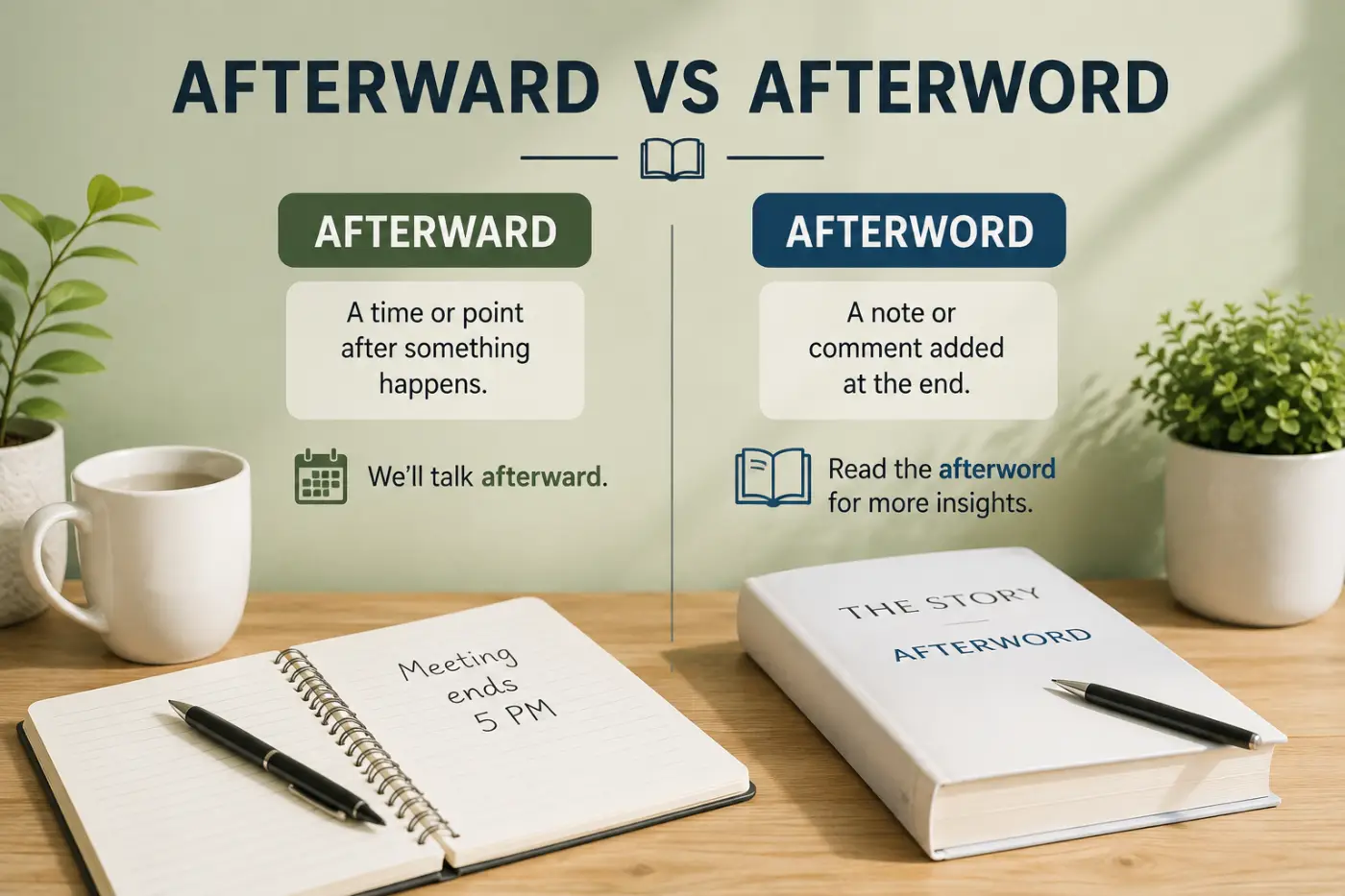
Choosing between afterward vs afterword can feel like a tiny spelling problem. It isn’t. These two words have different meanings and different jobs in a sentence. One refers to time while the other refers to a part of a book or other written work.
The confusion comes from their nearly identical spelling and pronunciation. Both begin with after and differ by only one letter near the end. When you’re typing quickly or editing your work late at night it’s easy to choose the wrong one.
The good news is that the difference is easy to remember once you connect each word with its meaning. Afterward means at a later time or later. Afterword is a section added near the end of a book. It often contains comments from the author or another writer about the work.
This guide explains the difference between afterward vs afterword with clear definitions grammar rules pronunciation guidance word origins and natural examples. You’ll also learn the difference between afterward and afterwards and see why afterword sometimes gets confused with epilogue and foreword.
A related grammar guide is Preform Vs Perform Which Word Is Correct 2026 Guide.
Quick Answer
Afterward means later or after something has happened. Afterword is a section at the end of a book or other written work. Use afterward when you’re talking about time and afterword when you’re talking about a piece of writing. Both are correct words but they aren’t interchangeable.
Afterward Vs Afterword Comparison
| Feature | Afterward | Afterword |
|---|---|---|
| Meaning | At a later time | A section added near the end of a book |
| Part of speech | Adverb | Noun |
| Main function | Shows when something happens | Names a part of a written work |
| Pronunciation | /ˈæf.tɚ.wɚd/ | /ˈæf.tɚ.wɝːd/ |
| Common context | Conversation and general writing | Books publishing and literary discussion |
| Formality | Standard | Standard |
| Plural form | Usually not applicable | Afterwords |
| Example | We went home afterward. | The author included an afterword. |
| Related word | Later | Foreword |
| Common confusion | Confused with afterword | Confused with afterward |
The quickest distinction is simple.
Afterward = later.
Afterword = a section of writing.
If you remember those two ideas you’ll avoid most mistakes.

What Does Afterward Mean
Afterward is an adverb that means later or at a later time.
It tells the reader or listener when something happens. Usually the event happens after another event already mentioned or understood from context.
For example:
We had dinner and went for a walk afterward.
Here afterward means after dinner.
The word doesn’t name a person place object or section of a book. It tells you when something happened.
Afterward In Simple English
You can usually replace afterward with later without changing the basic meaning.
Consider these examples.
- I’ll call you afterward.
- We talked about it afterward.
- She felt tired afterward.
- They went home afterward.
- He apologized afterward.
Each sentence describes something that happened later.
Afterward In Everyday Conversation
American English speakers use afterward naturally in casual speech.
You might hear someone say:
- Let’s grab coffee afterward.
- I’ll tell you the story afterward.
- We can discuss the details afterward.
- I didn’t realize it until afterward.
- She called me afterward to explain.
The word fits easily into both spoken and written English.
What Does Afterword Mean
An afterword is a section that appears near the end of a book or another written work.
It usually comes after the main text. An author may use it to discuss the background of the book explain how it was written provide historical context or reflect on the work.
Another writer may also contribute an afterword.
For example:
The author added an afterword explaining the inspiration behind the novel.
Here afterword is a noun. It refers to an actual piece of writing.
Afterword In Simple English
Think of an afterword as a writer’s words that come after the main work.
A book might contain:
- The main text.
- An epilogue.
- An afterword.
- Acknowledgments.
- Notes.
Not every book includes an afterword. It’s an optional section that can give readers extra information or perspective.
What Can An Afterword Discuss
An afterword can serve several purposes.
It may explain the author’s research.
It may describe the historical background.
It may discuss the writing process.
It may respond to readers or critics.
It may explain why the author chose a particular subject.
It may provide context that wasn’t necessary for the main story.
It may reflect on how the book relates to real events.
The content depends on the book and the writer.
Which One Is Correct
Both afterward and afterword are correct.
The correct choice depends entirely on your meaning.
Use afterward when you mean later.
Use afterword when you mean a section added near the end of a book.
Compare these sentences.
Correct: We talked afterward.
Correct: The author wrote an afterword.
The first sentence describes time. The second names a part of a book.
You cannot swap them.
Incorrect: We talked afterword.
Incorrect: The author wrote an afterward.
The first sentence needs an adverb because it explains when the conversation happened. The second needs a noun because it identifies a written section.
Why People Confuse Afterward And Afterword
The confusion is understandable because the words look almost identical.
Visual Similarity
Both words begin with after and end with ward or word.
That makes the difference easy to miss when you’re reading quickly.
Compare them closely.
afterward
afterword
The key difference is the vowel before the final consonant.
Similar Pronunciation
The words also sound very similar in many varieties of English.
That creates a special problem when people learn vocabulary mainly through conversation.
You may know the meaning of afterword but never have seen it written. When you later need to type it you might naturally write afterward.
The reverse can happen too.
Keyboard Mistakes
Typing quickly can make the distinction even harder.
Since afterward is much more common in general writing people may automatically type it when they mean afterword.
Spell check won’t always help because both words are legitimate English words.
That’s an important point.
A spelling checker can recognize the word afterward as correctly spelled even when it doesn’t fit your sentence.
Internet And Social Media Influence
Online writing often favors short casual language. People also encounter fewer book related terms than they once did.
As a result afterword can be unfamiliar to readers who don’t spend much time discussing books or publishing.
Meanwhile afterward appears constantly in ordinary conversation.
Frequency can make one word feel more familiar even when the less common word is exactly what your sentence needs.
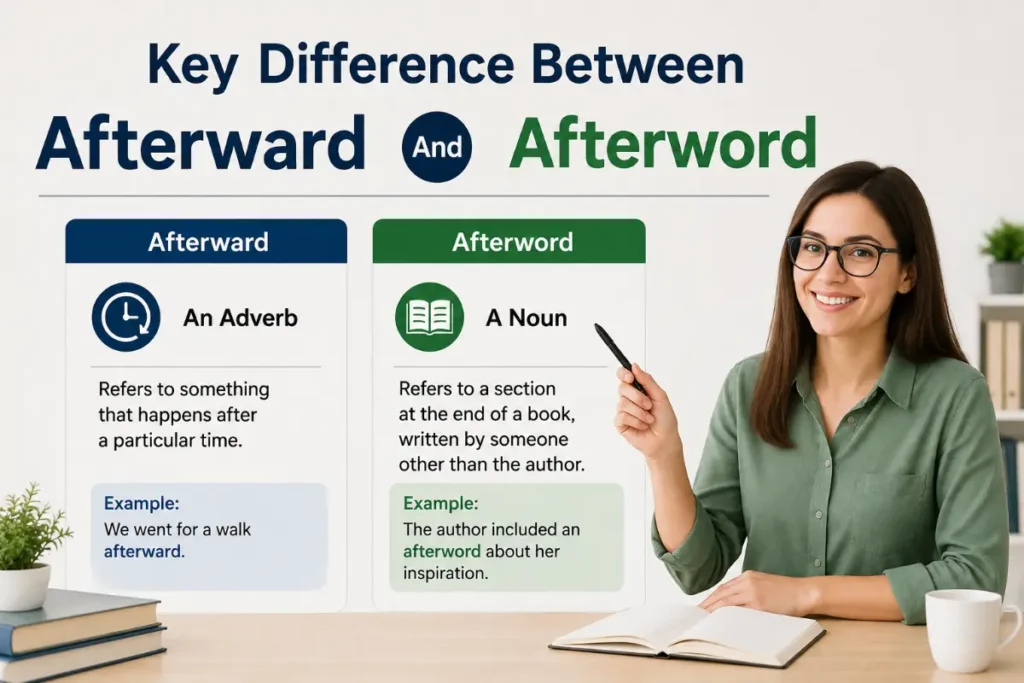
Key Difference Between Afterward And Afterword
The central difference is meaning.
Afterward relates to time.
Afterword relates to writing.
You can think of them as answering different questions.
Afterward answers:
When did it happen?
Afterword answers:
What is this section of the book called?
That distinction works in almost every situation.
Afterward Describes Time
We went home afterward.
The word tells us when they went home.
Afterword Names A Written Section
The translator wrote an afterword for the new edition.
The word identifies a section of the book.
Grammar Explanation
Grammar gives you another reliable way to tell these words apart.
Afterward Is An Adverb
An adverb can modify a verb and tell us when an action happens.
In this sentence:
We discussed the problem afterward.
Discussed is the verb.
Afterward tells us when the discussion happened.
It can appear in several positions.
We went home afterward.
Afterward we went home.
We went home soon afterward.
All three are grammatical.
Afterword Is A Noun
A noun names a person place thing or idea.
Afterword names a written section.
It can therefore take an article or determiner.
an afterword
the afterword
this afterword
the author’s afterword
For example:
I enjoyed the author’s afterword.
The word behaves like other countable nouns.
Plural Form Of Afterword
The plural form is afterwords.
For example:
The collection contains several afterwords by different scholars.
This plural form is uncommon in everyday conversation but completely grammatical when you’re discussing multiple books or multiple contributions.
Can Afterward Be Plural
No.
Afterward is an adverb and doesn’t normally have a plural form.
You wouldn’t write afterwardses or afterwards as a plural noun.
The word afterwards is a variant of the adverb and has a different spelling pattern. It doesn’t represent a plural form of afterward.
Afterward And Afterwards
This is another useful distinction for English learners.
Afterward and afterwards have the same basic meaning.
Both mean later or after something happens.
American English strongly favors afterward.
British English commonly uses afterwards as well as afterward.
For example:
We went out afterward.
We went out afterwards.
Both sentences are grammatical.
If you’re writing for a US audience afterward is usually the safest and most natural choice.
The important point is that afterwards still has nothing to do with an afterword.
Compare:
Afterward means later.
Afterwards means later.
Afterword means a section at the end of a book.
That final s doesn’t turn afterword into a time expression.
Afterword Vs Epilogue
People sometimes confuse afterword with epilogue because both can appear near the end of a book.
They aren’t the same thing.
An epilogue is usually part of a story. It can show what happens to characters after the main events of a novel or play.
An afterword usually provides commentary or context about the work itself.
For example:
The novel ends with an epilogue showing the characters years later.
Then:
The author adds an afterword explaining the historical research behind the story.
The distinction isn’t absolute because books can use these sections in different ways. Still, this is a useful general rule for readers and writers.
Afterword Vs Foreword
Foreword and afterword are closely related terms.
A foreword appears near the beginning of a book.
An afterword appears near the end.
A foreword is often written by someone other than the main author. It may introduce the book and explain its importance.
An afterword comes later and may offer reflection or additional context.
A simple memory trick works here.
Foreword comes before the main text.
Afterword comes after the main text.
Don’t confuse foreword with forward either.
Forward relates to direction or progress.
Foreword is a section at the beginning of a book.
Many readers also check Drier Vs Dryer Which Word Is Correct 2026 Guide.
Spelling Rules That Make The Difference Clear
The spelling difference is small but meaningful.
Afterward Uses Ward
The ending ward appears in words connected with direction position or movement.
Examples include:
- Forward.
- Backward.
- Homeward.
- Eastward.
- Upward.
- Downward.
Afterward follows a related historical pattern and functions as an adverb of time.
Afterword Uses Word
The ending word tells you exactly what the second word represents.
An afterword is literally a set of words placed after the main work.
This isn’t a strict modern word formation rule for every English word. It’s simply a useful memory aid.
If you’re talking about words in a book choose afterword.
If you’re talking about what happens later choose afterward.
Pronunciation Guide
The words are close enough in sound to cause confusion.
Afterward
A common American English pronunciation is:
/ˈæf.tɚ.wɚd/
The stress falls on the first syllable.
You can think of it as:
AF ter ward
Afterword
A common American English pronunciation is approximately:
/ˈæf.tɚ.wɝːd/
Again the first syllable receives the main stress.
Think:
AF ter word
The final part differs slightly in pronunciation for many speakers. Still, the distinction may be subtle in fast speech.
That’s why context matters more than sound alone.
Word Origin And Etymology
The two words share after but developed through different word building patterns.
Origin Of Afterward
Afterward developed from after combined with the directional or relational suffix ward.
The suffix appears in many English words that indicate direction or movement.
Over time afterward became an adverb meaning at a later time.
Origin Of Afterword
Afterword combines after with word.
The term refers literally to words placed after the main body of a work.
It became established as a literary and publishing term for an additional section appearing near the end of a book.
Understanding these roots makes the spelling easier to remember.
After + ward = later.
After + word = words added after the main work.
British And American English
The main distinction between afterward and afterword remains the same in both American and British English.
There is one useful regional difference worth knowing.
American English commonly prefers afterward.
British English frequently uses afterwards.
For example:
American English:
We talked afterward.
British English:
We talked afterwards.
Both forms are standard.
The noun afterword keeps the same meaning across major English varieties.
Canadian and Australian English also recognize afterward, afterwards, and afterword, with usage patterns influenced by both American and British English.
Real Life Examples Of Afterward
Here are natural examples showing how afterward works in different settings.
Daily Conversation
- I’ll call you afterward.
- We can get something to eat afterward.
- She felt much better afterward.
- I didn’t think about it until afterward.
Workplace
- Let’s finish the meeting and discuss the budget afterward.
- The manager spoke with the client afterward.
- I’ll send you the updated file afterward.
Emails
- We can review the remaining questions afterward.
- I spoke with the team afterward and clarified the issue.
Academic Writing
- The participants completed a short survey afterward.
- The researchers interviewed the students afterward.
Journalism
- The mayor spoke to reporters afterward.
- The team issued a statement afterward.
Literature
- The narrator reflects on the decision afterward.
- The character regrets the choice only afterward.
Real Life Examples Of Afterword
Now compare those examples with afterword.
Books
- The new edition includes an afterword by the historian.
- I read the afterword after finishing the novel.
- The author’s afterword explains how the story developed.
Academic Publishing
- The editor contributed an afterword to the collection.
- The revised edition contains an afterword discussing the book’s influence.
Literary Discussion
- The afterword provides useful historical context.
- The writer uses the afterword to address questions raised by readers.
Publishing
- The publisher asked another scholar to write the afterword.
- The afterword appears after the final chapter.
These examples show why the two words can’t substitute for one another.
Common Mistakes
The most common error is choosing the word based on spelling instead of meaning.
Mistake One
We talked afterword.
Correct:
We talked afterward.
The sentence describes a later action.
Mistake Two
The book contains an afterward.
Correct:
The book contains an afterword.
The sentence refers to a section of writing.
Mistake Three
I read the afterwards at the end of the book.
Correct:
I read the afterword at the end of the book.
Afterwards is an adverb. It doesn’t name a book section.
Mistake Four
The author explained the research afterward.
This sentence can be correct if the author explained the research later.
But if you’re referring to a section in the book you need:
The author explained the research in the afterword.
The surrounding context changes the correct word.

Memory Tricks For Afterward And Afterword
You don’t need a complicated mnemonic.
Remember The Meaning
Afterward means later.
Think about time.
Afterword means written words.
Think about a book.
Use The Book Test
If the word appears beside chapter author book edition or publisher then afterword may be what you need.
For example:
The author’s afterword appears after Chapter 12.
If the word describes an action happening later choose afterward.
We went home afterward.
Use The Replacement Test
Replace the word with later.
If the sentence still makes sense use afterward.
We left later.
Therefore:
We left afterward.
Now try replacing it with later in a book context.
The book includes a later.
That doesn’t work.
The correct word is:
The book includes an afterword.
This quick test works surprisingly well.
Related Words You Should Know
These words often appear in the same discussions.
Later
Later means at a time after the present or after another event.
I’ll finish it later.
Afterwards
Afterwards also means later and is especially common in British English.
We talked afterwards.
Afterward
Afterward has the same basic meaning as afterwards and is especially common in American English.
We talked afterward.
Afterword
An afterword is additional writing placed near the end of a book.
The historian wrote the afterword.
Foreword
A foreword is an introductory section at the beginning of a book.
The professor wrote the foreword.
Epilogue
An epilogue is a concluding section of a story that often describes events following the main narrative.
The epilogue reveals what happened to the characters years later.
Preface
A preface is an introductory statement from the author or another contributor that explains the purpose or background of a book.
These terms overlap in location and purpose but they aren’t interchangeable.
Expert Editor’s Note
From an editing perspective the best way to handle afterward vs afterword is to stop looking at spelling and identify the grammatical job first.
If the word modifies an action and means later, use afterward.
If the word names a section of a book, use afterword.
Professional editors also watch for a second issue. Writers sometimes use afterword when they really mean epilogue. The two can appear close together in a book but they serve different editorial functions.
Another useful point concerns afterward and afterwards. Neither form is wrong. For US focused writing, afterward is generally the cleaner default. Writers working for British audiences can comfortably use afterwards.
The dictionary meaning matters more than what a spell checker suggests. Both afterward and afterword are legitimate words, so software alone can’t decide which one fits your sentence.
When editing your own work, ask one question before checking the spelling.
Am I talking about time or a piece of writing?
That question usually settles the issue immediately.
Frequently Asked Questions
Is Afterward Or Afterword Correct?
Both words are correct but they have different meanings. Afterward means later or at a later time. Afterword means a section of writing placed near the end of a book. The right choice depends on your sentence. Use afterward for time and afterword for a book section.
What Is The Difference Between Afterward And Afterwards?
Afterward and afterwards both mean later. American English commonly favors afterward, while afterwards is especially common in British English. Neither word means a section of a book. For that meaning, use afterword.
Is Afterword One Word Or Two Words?
Afterword is normally written as one word. It refers to additional writing placed near the end of a book or similar work. You may see it discussed alongside terms such as foreword, preface, and epilogue.
Is An Afterword The Same As An Epilogue?
No. An epilogue usually continues or concludes a story by showing what happens after the main narrative. An afterword usually comments on the work itself. It may discuss research, inspiration, history, interpretation, or the writing process.
Can Afterward Be Used At The Beginning Of A Sentence?
Yes. Afterward can appear at the beginning, middle, or end of a sentence. For example, you can write, Afterward, we went home. You can also write, We went home afterward. Both structures are natural and grammatically correct.
Does Afterword Have A Plural Form?
Yes. The plural is afterwords. It’s useful when discussing more than one book section. For example, The collection includes afterwords written by several historians. The word afterwards is different because it is an adverb rather than the plural of afterword.
Which Word Is More Common In American English?
Afterward is much more common in everyday American English because people frequently need a word meaning later. Afterword is less common because it belongs mainly to literary, publishing, academic, and book related contexts.
You may also want to read Ballot Or Bullet Which Word Is Correct 2026 Guide.
Conclusion
The difference between afterward vs afterword comes down to one simple idea.
Afterward means later.
Afterword means a section of writing near the end of a book.
Use afterward when you’re talking about what happens next in time.
We went home afterward.
Use afterword when you’re talking about additional material in a book.
The author included an afterword.
Don’t let the similar spelling fool you. The words may look like close relatives but they do completely different jobs.
If you’re writing for an American audience, remember one more useful point. Afterward is the usual choice for later, while afterword belongs to the world of books.
When in doubt, ask yourself: Am I talking about time or words? Once you answer that, the spelling usually takes care of itself.

Vocabulary & Language Research Writer
Ethan Parker researches English vocabulary, word meanings, slang, idioms, and commonly confused words. His goal is to help readers understand how English is actually used in everyday conversations and writing.