
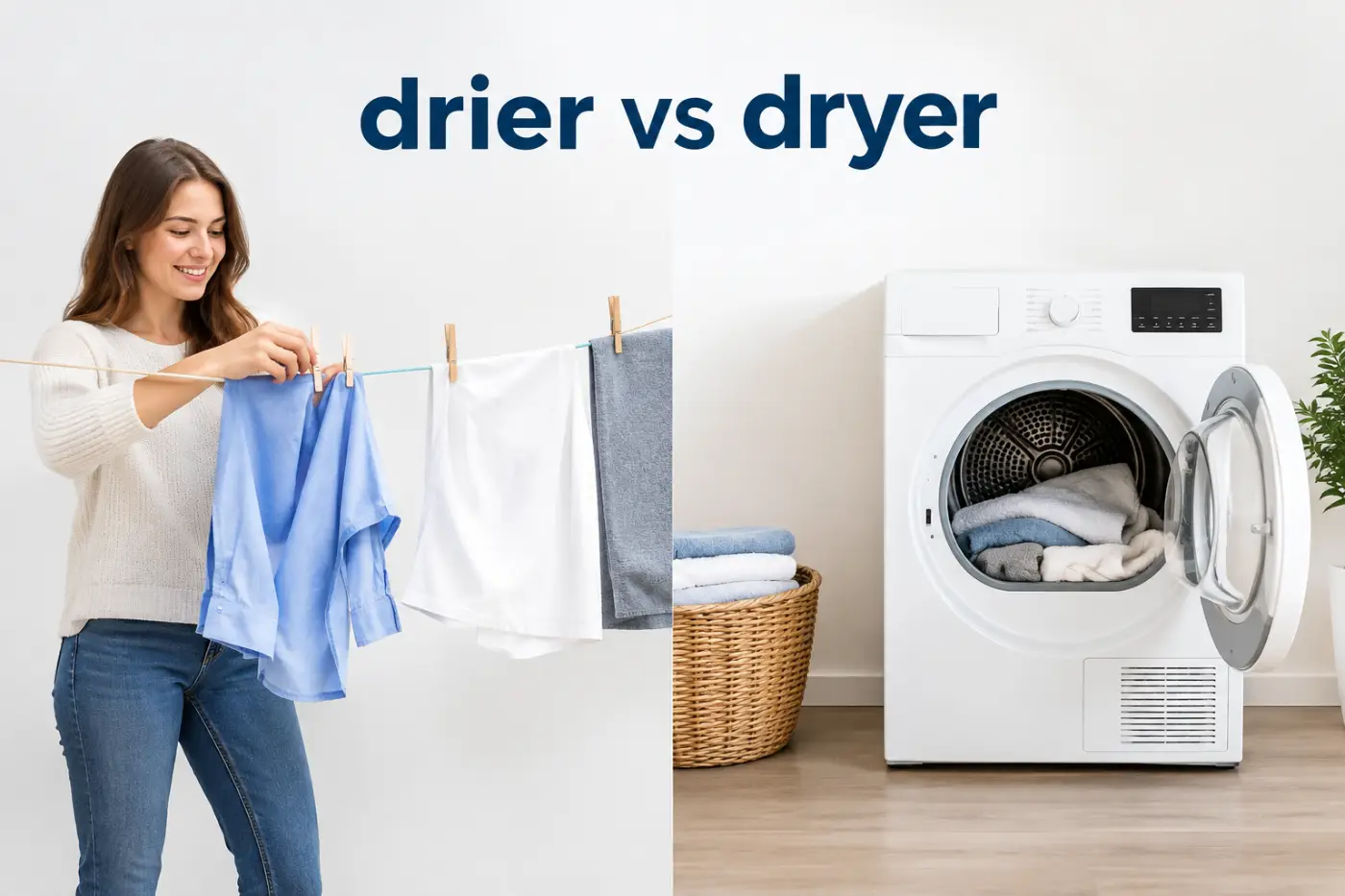
If you’ve ever paused over drier vs dryer while writing about clothes weather or moisture you’re not alone. The two words look almost identical and they share the same basic connection to the word dry. Yet they don’t always mean the same thing and they aren’t always interchangeable.
The good news is that both drier and dryer are correct English words. The choice depends on what you mean.
Drier is usually the comparative form of dry. It means less wet or less moist than something else. For example you can say This towel is drier than that one.
Dryer can also be a comparative form of dry. However it is especially common as the noun for a machine that removes moisture from clothes. You might say Put the towels in the dryer.
This creates the main source of confusion. One spelling can describe something that has become less wet while the other commonly names an appliance.
In this guide you’ll learn exactly how to use each word. You’ll also see the spelling rule behind the difference real life examples common mistakes pronunciation tips regional usage and practical advice from an editor’s point of view.
Many readers also check Implicit Vs Complicit Differences Meanings And Correct 2026.
Quick Answer
Drier and dryer can both mean more dry or less wet. Dryer is also the standard spelling for a machine that dries clothes or other items. Use drier when comparing dryness and dryer when referring to a drying machine. In everyday American English both comparative spellings can appear depending on context.
Drier Vs Dryer Comparison Table
| Feature | Drier | Dryer |
|---|---|---|
| Basic meaning | More dry or less wet | More dry or less wet |
| Other meaning | Usually no separate noun meaning | A machine or device that dries something |
| Part of speech | Usually comparative adjective | Comparative adjective or noun |
| Base word | Dry | Dry |
| Example | The air is drier today. | The air is dryer today. |
| Appliance meaning | No | Yes |
| Clothes machine | Not standard | Standard |
| Formal writing | Correct | Correct |
| American English | Common | Very common |
| British English | Common | Common |
| Main source of confusion | Looks like a misspelling of dryer | Used both as a comparison and as a noun |
| Plural form | Driers when used as a noun in specialized contexts | Dryers |
| Most useful memory clue | Think comparison | Think machine when used as a noun |
What Does Drier Mean
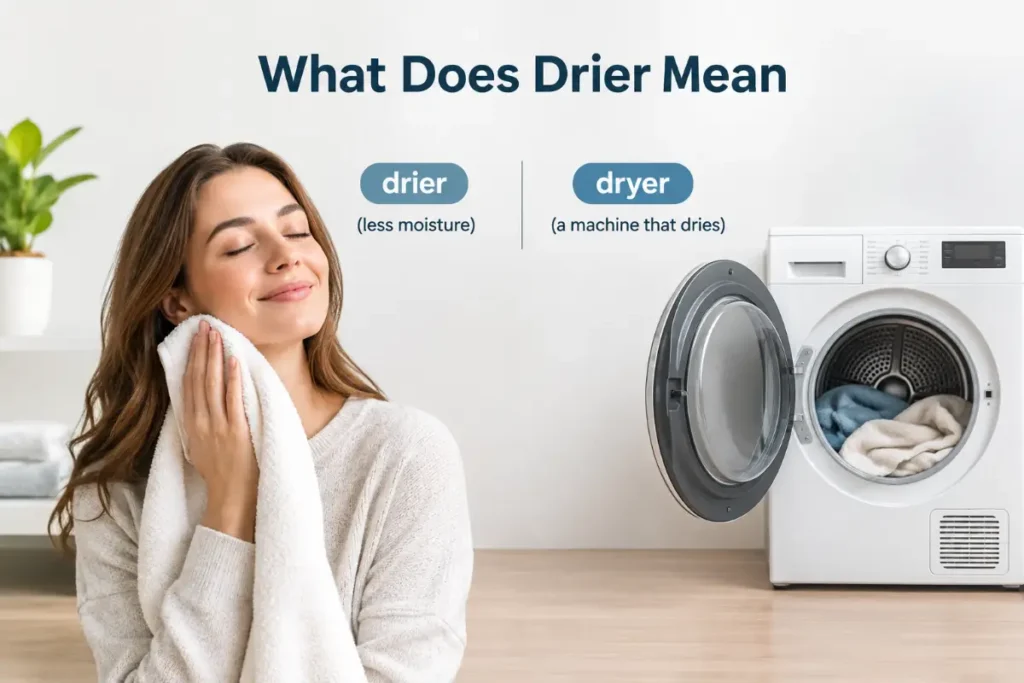
Drier is commonly the comparative form of the adjective dry.
It means that something contains less water or moisture than something else.
For example:
The desert air is drier than the air near the coast.
The sentence compares two types of air. The desert air contains less moisture.
You can use drier for many things.
- Clothes.
- Skin.
- Air.
- Soil.
- Weather.
- Food.
- Paint.
- Towels.
- Wood.
- Surfaces.
Drier In Everyday English
Here are some natural examples.
- This towel is drier than the other one.
- The weather feels drier today.
- My skin gets drier during winter.
- The soil is drier near the wall.
- The second batch of cookies came out drier.
- The paint will be drier by tomorrow morning.
In each example drier describes a greater degree of dryness.
Drier As A Comparative Adjective
The word dry describes a condition.
When you compare two things you can use drier.
Think of the pattern this way.
Dry → drier
For example.
This shirt is dry.
This shirt is drier than the one I washed earlier.
The second sentence makes a comparison.
That is the core grammar behind drier.
What Does Dryer Mean
Dryer has two major uses.
First it can work as a comparative form of dry.
Second and more importantly in everyday American English it can be a noun meaning a machine or device used to dry something.
Dryer As A Machine
The most familiar meaning of dryer is a clothes drying machine.
For example.
- The clothes are in the dryer.
- The dryer stopped working.
- I need to clean the dryer filter.
- The towels are still in the dryer.
- Our new dryer uses less energy.
You can also use dryer for other devices.
A hair dryer blows warm or cool air to dry hair.
A hand dryer dries hands in a public restroom.
An air dryer removes moisture from air.
A food dryer removes moisture from food.
So when dryer acts as a noun it usually refers to something designed to make another thing dry.
Dryer As A Comparative Form
Dryer can also mean more dry.
For example.
The air feels dryer today.
That use is grammatically possible and appears frequently in American English.
Still many writers choose drier when they simply mean more dry.
This is one reason style and context matter.
Which One Is Correct
Both drier and dryer are correct.
The safest choice depends on the job the word performs.
Use drier when you mean more dry or less moist.
Use dryer when you mean a machine that dries something.
For example.
Correct.
The towels are drier now.
Correct.
The towels are in the dryer.
The first sentence describes the condition of the towels.
The second sentence identifies the machine.
There is also a third point worth remembering.
Dryer can function as a comparative adjective too.
For example.
This room is dryer than the basement.
That spelling is accepted and widely used.
However drier is often the clearer choice when the only meaning is more dry.
Why People Confuse Drier And Dryer
The confusion comes from English spelling rather than from a major difference in pronunciation.
Both words begin with dry. The only visible difference is the vowel before the final r.
That tiny difference creates a surprisingly large number of mistakes.
The Same Root Word
Both words come from dry.
That gives us this basic pattern.
dry + comparative ending
The problem is that English has more than one spelling tradition for the comparative form.
Dryer Has A Strong Noun Meaning
Most Americans immediately recognize dryer as a machine.
That association is so strong that some writers automatically type dryer even when they only mean more dry.
For example.
The climate is dryer here.
The sentence is understandable and accepted. Yet drier may be the better choice if the writer wants to make the comparison clear.
Fast Typing Makes The Problem Worse
The words differ by only one letter.
When someone types quickly they may not stop to consider the meaning. Spellcheck may also accept both forms because both are legitimate words.
That makes this a context problem rather than a simple spelling problem.
Online Writing Adds More Confusion
People encounter dryer constantly because clothes dryers hair dryers and other drying devices are common.
At the same time drier appears in weather reports science writing gardening advice and descriptions of physical conditions.
Both spellings therefore remain visible in modern English.
The Key Difference Between Drier And Dryer
The simplest distinction is this.
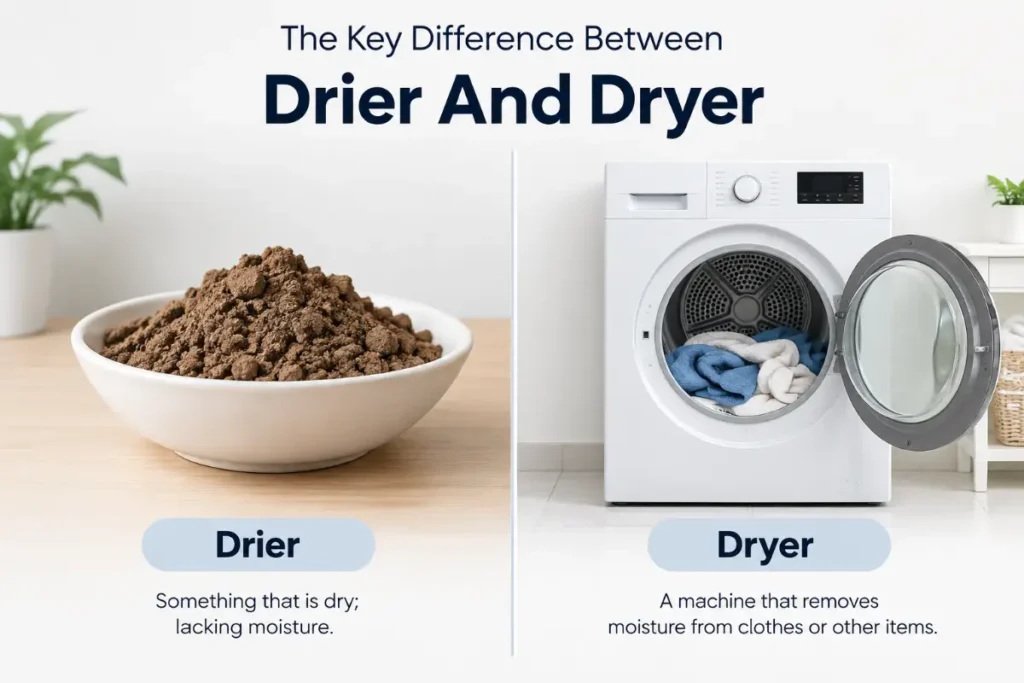
Drier usually describes a condition.
Dryer often names a device.
Compare these sentences.
The clothes are drier now.
The clothes are in the dryer.
The first sentence tells you about the clothes.
The second tells you where the clothes are.
That distinction will solve most everyday spelling questions.
However there’s one important detail.
Dryer can also describe something that is more dry.
That means you should not treat drier as the only correct comparative form.
Drier As More Dry
When you are comparing two things based on moisture or dryness drier is a clear and natural choice.
Weather
Arizona is generally drier than Florida.
Skin
My skin feels drier in cold weather.
Soil
This part of the garden is drier than the area near the fence.
Food
The second loaf was drier than the first.
Paint
The surface is drier now.
The word works naturally in each case because you are talking about a condition.
Dryer As A Machine
When dryer means an appliance or device the spelling is straightforward.
Clothes Dryer
The dryer is running.
Hair Dryer
I left my hair dryer at the hotel.
Hand Dryer
The restroom has an automatic hand dryer.
Industrial Dryer
The factory uses a large industrial dryer.
In these examples dryer is a noun.
It does not mean more dry.
It means something that performs the action of drying.
Grammar Explanation
Understanding the grammar makes the difference much easier.
Dry Is An Adjective
Dry is commonly an adjective.
It describes something that contains little or no moisture.
Examples include.
- Dry clothes.
- Dry soil.
- Dry air.
- Dry skin.
- Dry weather.
Drier Is A Comparative Adjective
Drier compares two things.
For example.
This towel is drier than that towel.
The word than often appears after a comparative adjective.
You can also use drier without than when the comparison is understood.
My skin feels drier today.
The implied comparison could be with yesterday.
Dryer Can Be A Comparative Adjective
Dryer can also act as a comparative adjective.
The air is dryer inside the house.
Here dryer means more dry.
Dryer Can Be A Noun
This is the use that makes the spelling especially important.
The dryer is broken.
Here dryer names an appliance.
You can use articles with it.
a dryer.
the dryer.
You can also make it plural.
two dryers.
That grammatical behavior tells you that dryer is functioning as a noun.
Drier Vs Dryer In American English
American English uses dryer very often as the noun for a clothes drying machine.
That makes the word extremely familiar to US readers.
For the comparative adjective American writers use both drier and dryer.
Many style conscious writers prefer drier when they want to avoid confusion with the appliance.
For example.
The climate is drier in the western part of the state.
This sentence is immediately clear.
If you write.
The climate is dryer in the western part of the state.
Readers can still understand it. The context makes the meaning clear.
Still drier gives the reader less chance of a split second misunderstanding.
For another common grammar confusion, see Baloney Vs Bologna Which Word Is Correct 2026.
British English And Other Varieties
The same basic distinction works across major varieties of English.
British English uses dryer for a machine that dries clothes.
For example.
Put the towels in the dryer.
British English also uses drier as a comparative form.
Canadian English and Australian English follow the same broad pattern.
Regional usage can vary in preference and frequency. The core meanings remain stable.
The important point is that dryer does not belong only to American English.
Drier Vs Dryer Spelling Rules
The spelling becomes easier when you understand how the words developed.
The base adjective is dry.
English commonly forms the comparative of short adjectives with er.
Examples include.
- Fast becomes faster.
- Cold becomes colder.
- Small becomes smaller.
- Dry becomes drier.
The spelling change in drier follows a familiar English pattern.
Why Does Y Become I
When an adjective ends in a consonant followed by y the y often changes to i before certain suffixes.
For example.
Happy → happier.
Easy → easier.
Dry → drier.
That gives drier a strong grammatical basis.
But dryer has its own history and use.
The spelling dryer became established as the noun for a device that dries something.
That noun form is now standard.
Is Drier The Only Correct Comparative
No.
This is one of the most important points in the entire comparison.
Both drier and dryer can be used as comparative forms meaning more dry.
However they aren’t equally useful in every context.
When you mean a drying appliance use dryer.
When you mean more dry and want the comparison to be immediately obvious use drier.
For example.
The desert is drier than the coast.
This is clean and clear.
The desert is dryer than the coast.
This can also be understood as a comparative statement. Yet some readers may briefly think about a machine because dryer is such a familiar noun.
That doesn’t make the sentence wrong.
It simply makes drier a useful editorial choice.
Pronunciation Guide
The two words are extremely close in pronunciation.
Drier
A common American English pronunciation is approximately:
/ˈdraɪər/
It can sound like two syllables.
dry er
Dryer
A common pronunciation is also approximately:
/ˈdraɪər/
In normal speech the two words may sound identical or nearly identical.
That means pronunciation usually won’t help you decide which spelling to use.
Context does the heavy lifting.
If someone says:
Put it in the dryer.
You know they mean the appliance.
If someone says:
The weather is getting drier.
You know they mean less moist.
Real Life Examples Of Drier
Here are natural examples showing how drier works across different situations.
Daily Conversation
- My clothes are drier than they were this morning.
- The weather is getting drier.
- My hands feel drier after using that soap.
- This towel is drier than the other one.
Workplace
- The office air is drier in winter.
- The paint should be drier before we apply another coat.
- The storage room is drier than the warehouse.
- The new material stays drier during shipping.
Emails
- The soil should be drier before we plant the seeds.
- The samples need to be drier before testing.
Academic Writing
- The region has a drier climate than the surrounding areas.
- The upper layer became drier during the experiment.
- Researchers found that the exposed surface was drier.
Journalism
- The western region is expected to experience drier conditions this week.
- Meteorologists warned of drier weather across the state.
Social Media
- My skin gets so much drier when winter arrives.
- This year’s summer feels drier than last year’s.
- The garden looks drier after a week without rain.
Real Life Examples Of Dryer
Now compare those examples with dryer as a noun.
Daily Conversation
- The dryer is finished.
- I need to move the clothes from the washer to the dryer.
- The dryer is making a strange noise.
- Can you check the dryer?
Workplace
- The lab uses a specialized dryer.
- The restaurant has a commercial food dryer.
- The equipment includes a powerful air dryer.
Home
- The hair dryer is in the bathroom.
- I bought a new clothes dryer.
- The dryer filter needs cleaning.
Journalism
- The manufacturer recalled several dryers because of a safety concern.
- Energy efficient dryers are becoming more popular.
Social Media
- My dryer just decided to quit on laundry day.
- Nothing feels better than warm towels straight from the dryer.
Common Mistakes With Drier And Dryer
Mistake One
My skin is dryer in winter.
This isn’t necessarily wrong because dryer can function as a comparative adjective.
Still drier is often the clearer editorial choice.
My skin is drier in winter.
Mistake Two
Put the clothes in the drier.
This is not the standard spelling for the appliance.
Use:
Put the clothes in the dryer.
Mistake Three
The weather is dryer today than yesterday.
Again this can be understood and is used by native speakers.
But many editors would choose:
The weather is drier today than yesterday.
The spelling makes the comparative meaning immediately obvious.
Mistake Four
Assuming drier refers only to weather.
It doesn’t.
You can use drier for anything that can become less moist.
That includes skin soil food paint wood air and fabric.
Mistake Five
Assuming dryer is always wrong when you mean more dry.
That is also incorrect.
Dryer has a legitimate comparative use.
The context determines the meaning.
A Useful Memory Trick
Here is the easiest way to remember the distinction.
Drier describes. Dryer dries.
If you’re talking about something becoming less wet choose drier as the clear comparative form.
If you’re talking about a machine that makes things dry choose dryer.
Think about these two sentences.
The towel is drier.
The towel is in the dryer.
One describes the towel.
The other identifies the machine.
That simple pair is enough to settle most spelling questions.
Related Words
Understanding the word family can help you build stronger vocabulary.
Dry
An adjective meaning free from moisture or containing little moisture.
The clothes are dry.
Dryness
A noun describing the condition of being dry.
The dryness of the soil surprised us.
Dried
The past participle of dry.
The flowers were dried carefully.
Drying
The present participle or gerund form.
The clothes are drying.
Dryer
A noun for a device that dries something.
The dryer needs repair.
Dryest
The superlative form of dry.
This is the dryest month of the year.
You may also encounter driest. That spelling follows the same pattern as dry → drier.
In careful writing driest is the common standard form for the superlative adjective.
Drier And Dryer In Formal Writing
Formal writing benefits from precision.
If you mean more dry then drier is often the safest choice.
For example.
The region has a drier climate than the northern provinces.
That wording is clear and natural.
If you mean the appliance then dryer is the correct noun.
The facility purchased three industrial dryers.
There is no reason to avoid dryer simply because the word can also have a comparative meaning.
Good editing is about context.
It isn’t about declaring one spelling correct and the other wrong.
Expert Editor’s Note
A professional editor would not mark every use of dryer as an error.
That approach misses an important feature of English.
Drier is a well established comparative form of dry.
Dryer is a well established noun for a drying machine.
Dryer can also appear as a comparative adjective meaning more dry.
The most useful editorial rule is therefore based on clarity.
When the word is a noun meaning a machine use dryer.
When you are comparing dryness use drier if you want the meaning to be immediately clear.
For example.
The air is drier near the mountains.
is clean and easy to read.
Meanwhile.
The clothes are in the dryer.
is equally clear.
Professional writing should make the reader’s job easy. If two forms are grammatically possible choose the one that removes confusion.
FAQs About Drier Vs Dryer
Is Drier Or Dryer Correct
Both spellings are correct. Drier is a common comparative form of dry and means more dry or less moist. Dryer is the standard noun for a machine that dries clothes hair or another material. Dryer can also function as a comparative adjective. Context tells you which meaning applies.
Should I Write Drier Or Dryer For Weather
Drier is usually the clearer choice when talking about weather or climate. For example you can write The western region has a drier climate. Dryer can also be used as a comparative adjective but many editors prefer drier in this context because it clearly signals the meaning more dry.
Is A Clothes Drier Or Dryer
The standard spelling is clothes dryer. A clothes dryer is an appliance that removes moisture from clothing. Clothes drier may be understandable but it isn’t the usual modern spelling for the appliance. If you’re writing for a general US audience use clothes dryer.
Why Is Drier Spelled With An I
The spelling drier follows a common English pattern in which a final consonant plus y changes to i before a suffix. The same pattern appears in happy → happier and easy → easier. Therefore dry → drier is a natural comparative form.
Can Dryer Mean More Dry
Yes. Dryer can function as a comparative adjective meaning more dry. For example The air is dryer today. However drier is also a standard comparative form and is often preferred when the meaning is simply more dry.
Is Dryer An American Spelling
Dryer is not limited to American English. English speakers in Britain Canada Australia and other English speaking regions use dryer for a drying machine. Regional preferences can differ but the noun is widely recognized across major varieties of English.
What Is The Difference Between Dried And Drier
Dried describes something that has already been made dry or became dry. Drier is comparative and means more dry than something else. For example The clothes are dried describes their condition after drying. These clothes are drier than those makes a comparison.
How Can I Remember Drier And Dryer
Use this simple reminder: Drier describes while dryer dries. If you are comparing moisture levels use drier as your clear default. If you are naming a machine use dryer. This quick distinction works in most everyday writing situations.
You may also want to read Gradual Vs Insidious The Real Difference Explained.
Conclusion
The difference between drier vs dryer becomes simple once you focus on meaning.
Drier is a standard comparative form of dry. It means more dry or less moist and works well for weather clothes skin soil food paint and many other things.
Dryer is most commonly a noun for a machine that dries something. You see it in phrases such as clothes dryer hair dryer and hand dryer. It can also work as a comparative adjective meaning more dry.
The biggest mistake is treating drier as the only correct spelling or dryer as a simple misspelling. Both words have legitimate uses.
For clear everyday writing remember one rule: drier describes a condition while a dryer does the drying.
Once you connect the spelling to the meaning the choice becomes almost automatic.

Vocabulary & Language Research Writer
Ethan Parker researches English vocabulary, word meanings, slang, idioms, and commonly confused words. His goal is to help readers understand how English is actually used in everyday conversations and writing.