

Few everyday phrases cause as much unnecessary confusion as goodmorning or good morning. You might have typed goodmorning in a text message and wondered if it should be written as one word. You might also have seen Good Morning used as a greeting and wondered if capitalization changes the answer.
The correct standard spelling is good morning as two separate words.
Goodmorning is not the standard spelling of the greeting in English. You should write Good morning when greeting someone at the start of the day. You can use it in a text message an email a conversation or a formal letter. The phrase stays open because good is an adjective describing the noun morning.
The confusion usually comes from the way people speak. When native speakers say good morning quickly the two words can sound almost like one unit. Texting and social media also encourage shortened forms and creative spellings. That can make goodmorning look more acceptable than it actually is.
This guide explains the spelling meaning grammar pronunciation capitalization punctuation and usage of goodmorning or good morning. You’ll also see natural examples and simple ways to remember the correct form.
Learn the difference in Journies or Journeys Which Is Correct 2026 Guide.
Quick Answer
Good morning is the correct standard spelling. Write it as two separate words when using it as a greeting. Goodmorning is not the standard English spelling. The phrase contains the adjective good and the noun morning. You can write Good morning in casual messages and formal writing alike.
Goodmorning Or Good Morning Comparison
| Feature | Goodmorning | Good morning |
|---|---|---|
| Standard spelling | No | Yes |
| Number of words | One | Two |
| Part of speech | Not standard as one word | Adjective plus noun |
| Meaning | Intended as a morning greeting | A greeting used in the morning |
| Pronunciation | Usually intended like good morning | /ɡʊd ˈmɔːrnɪŋ/ |
| Formal writing | Avoid | Correct |
| Informal texting | Sometimes seen | Correct |
| Dictionaries | Not the standard greeting | Standard phrase |
| Email use | Avoid | Correct |
| Social media | May appear as a creative form | Standard choice |
| Example | Avoid this spelling | Good morning. |
The key point is simple. Good morning is the established English form.
What Does Good Morning Mean
Good morning is a common English greeting used when speaking to someone during the morning.
It can be friendly formal polite warm or casual depending on the situation and the speaker’s tone.
The Meaning Of Good Morning
The phrase literally combines two ordinary words.
Good is an adjective. It expresses a positive quality.
Morning is a noun. It refers to the early part of the day between night and afternoon.
Together good morning works as a greeting. It communicates goodwill at the beginning of the day.
For example.
- Good morning. How are you?
- Good morning. Did you sleep well?
- Good morning everyone.
- Good morning Professor.
- Good morning. It’s nice to see you.
The phrase doesn’t need to mean that the morning is objectively good. It functions as a conventional social greeting.
Good Morning As A Greeting
English has several greetings connected with different parts of the day.
Good morning is generally used in the morning.
Good afternoon is used during the afternoon.
Good evening is used later in the day or evening.
The greeting is flexible. You can use good morning with a close friend or with someone you’ve never met.
For example.
A child might say Good morning Mom.
An employee might say Good morning everyone.
A receptionist might say Good morning. How can I help you?
A student might say Good morning Professor.
The relationship changes the tone but not the spelling.
Is Goodmorning Correct
No. Goodmorning is not the standard spelling of the English greeting.
The accepted form is good morning with a space between the two words.
This distinction matters most in formal writing. A spelling checker may flag goodmorning because standard dictionaries and writing conventions treat the greeting as two words.
You might still encounter goodmorning online. Someone may type it as one word because they are writing quickly. A social media username might also contain goodmorning because usernames often remove spaces. Those examples don’t change the standard spelling.
Compare these sentences.
Correct.
Good morning. I hope you’re doing well.
Incorrect in standard English.
Goodmorning. I hope you’re doing well.
The first version is the one you should use in school assignments professional emails articles and everyday communication.
Why Is Good Morning Written As Two Words
The spelling becomes easier to understand when you look at the grammar.
Good modifies morning.
That makes good an adjective and morning a noun.
English commonly keeps an adjective and the noun it describes as separate words.
Consider these examples.
- Good day.
- Good evening.
- Good night.
- Happy birthday.
- Beautiful morning.
- Cold morning.
- Busy morning.
The same basic pattern appears in good morning.
The phrase developed as a combination of ordinary words rather than as a single compound word. There is no standard spelling rule that turns good morning into goodmorning.
Why Spoken English Can Sound Different
Speech can make two words feel like one.
When someone says Good morning naturally they may connect the sounds. The phrase can come out quickly with very little pause between good and morning.
For an English learner that can create the impression that the phrase should be written as one word.
Writing doesn’t always follow the sound of a phrase.
For example.
Ice cream contains two words even though people say it smoothly.
Good night contains two words.
Good afternoon contains two words.
Good morning follows the same pattern.
This is a useful lesson in English spelling. Words that sound connected don’t always become one written word.
Good Morning Grammar Explained
The grammar of good morning is simple but interesting.
Good Is An Adjective
In the phrase good morning the word good functions as an adjective.
An adjective describes or modifies a noun.
For example.
Good book.
Good idea.
Good friend.
Good morning.
In each example the word good adds information about the noun that follows it.
Morning Is A Noun
Morning is a noun because it names a period of the day.
Examples include.
- I love the morning.
- The morning was quiet.
- We met in the morning.
- She exercises every morning.
When you say Good morning as a greeting the noun morning remains part of the phrase even though the expression has a special social function.
The Phrase Works Like A Greeting
A greeting doesn’t always behave like an ordinary sentence.
When someone says Good morning they aren’t necessarily making a detailed statement about the quality of the morning. They’re greeting another person.
That’s why you can simply say.
Good morning.
You don’t need a verb.
The same thing happens with other greetings.
Good evening.
Good night.
Hello.
Hi.
English allows these short expressions to stand alone in conversation.
When Should You Say Good Morning
You can use good morning when greeting someone during the morning.
The exact cutoff isn’t fixed by a strict universal rule. Context matters.
Most speakers use good morning from the time they wake up through the late morning. As the day moves toward midday people generally switch to good afternoon.
For practical everyday use you can think of the morning as the period before noon.
Still you don’t need to worry about getting the exact minute right.
If you greet someone at 11:30 a.m. with Good morning nobody is likely to object. At 12:30 p.m. Good afternoon will usually sound more natural.
Good Morning In Everyday Conversation
You can use the phrase with friends family members coworkers neighbors teachers customers and strangers.
Examples include.
- Good morning. How’s everything going?
- Good morning. Did you have a good night?
- Good morning, Sarah.
- Good morning, everyone.
- Good morning. Ready for the meeting?
The tone can be warm and personal or polite and professional.
Good Morning At Work
Good morning is especially useful in the workplace because it sounds polite without being overly formal.
You might greet a coworker with.
Good morning. How’s your morning going?
You could open a team meeting with.
Good morning everyone. Let’s get started.
A receptionist might say.
Good morning. Welcome to our office.
A manager could write.
Good morning team. I’ve attached the schedule for today’s meeting.
The phrase works across many professional settings because it is familiar and respectful.
Good Morning In Emails
The correct spelling remains good morning in email writing.
You can use it as an opening greeting before the person’s name or as part of a complete sentence.
Examples.
Good morning, James.
Good morning, everyone.
Good morning. I’m writing to confirm our meeting time.
The punctuation depends on the style of the message.
Should You Capitalize Good Morning
If good morning begins a sentence or serves as the opening greeting in an email it is normally written as Good morning.
The first word is capitalized because it begins the sentence or greeting.
For example.
Good morning, Maria.
Good morning everyone.
Inside a sentence where the phrase isn’t functioning as a standalone greeting lowercase letters may be appropriate.
For example.
She wished everyone a good morning before leaving.
Here good morning appears within the sentence rather than at the beginning as a direct greeting.
Do You Need A Comma After Good Morning
The answer depends on how you use the phrase.
When you’re directly addressing someone by name the comma normally separates the greeting from the name.
Good morning, Alex.
Good morning, everyone.
If you simply use the greeting by itself you don’t need a comma.
Good morning.
If the greeting introduces another sentence you can end it with a period.
Good morning. I hope you’re having a great day.
This is one reason punctuation should be considered separately from spelling. The phrase is still written as two words.
Good Morning Or Goodmorning In Texting
Text messages often contain informal spellings. You may see goodmorning in casual posts messages hashtags usernames or captions.
That doesn’t make it the standard spelling.
If you want your writing to look polished use good morning.
For example.
Casual but standard.
Good morning! Hope you slept well.
Nonstandard.
Goodmorning! Hope you slept well.
The first version is just as easy to type and follows normal English spelling.
Why People Type Goodmorning
People sometimes combine the words because they’re typing quickly. Others treat the phrase like a single greeting in the same way they might type hello.
Autocorrect and predictive text can also affect how people write familiar phrases.
Social media adds another layer. Users may combine words in hashtags or usernames because spaces aren’t always allowed.
For example a hashtag might appear as #goodmorning.
That’s different from standard sentence writing.
Hashtags often remove spaces for technical reasons. The hashtag format doesn’t tell you how the phrase should appear in ordinary prose.
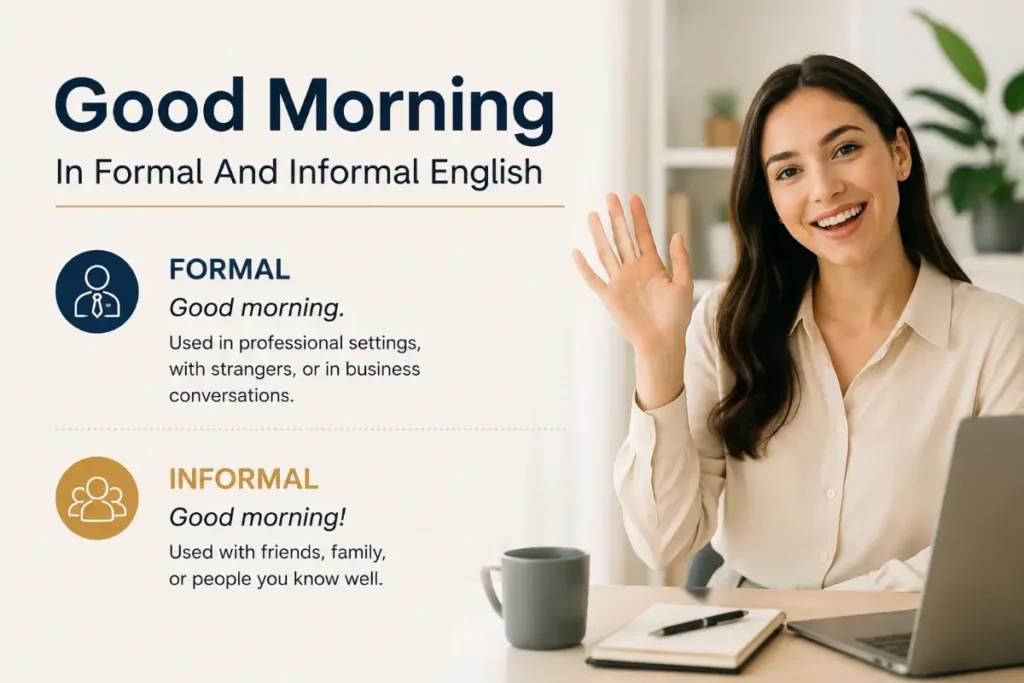
Good Morning In Formal And Informal English
The phrase works in both formal and informal English.
Its versatility is one reason it remains such a useful greeting.
Formal Examples
Good morning, Dr. Wilson.
Good morning. Thank you for joining us.
Good morning, members of the committee.
Good morning, everyone. I’d like to begin today’s presentation.
These examples are appropriate in professional settings.
Informal Examples
Good morning! How’d you sleep?
Morning!
Good morning, buddy.
Good morning! Coffee yet?
Informal speech often shortens greetings to Morning! This is common in American English and sounds friendly and relaxed.
Still the full standard form remains good morning.
Good Morning And Capitalization
Capitalization causes another small point of confusion.
The phrase isn’t normally capitalized as Good Morning in the middle of an ordinary sentence.
Instead use capitalization based on its position and function.
Correct.
Good morning, Lisa.
Correct.
She wished me a good morning.
Usually unnecessary.
She wished me a Good Morning.
The last version gives the phrase unnecessary title style capitalization.
You might see Good Morning in a poster headline a program title a sign or a design element. Headline capitalization follows different style choices from normal sentence writing.
For ordinary prose Good morning is the safer standard when it begins a greeting.
A Simple Rule To Remember
If you’re greeting someone at the start of the day write good morning as two words.
Think of it as two building blocks.
Good + morning = good morning.
Don’t combine them just because they sound connected when spoken.
If you remember only one rule from this article remember this.
A space belongs between good and morning.
That small space is the difference between the standard phrase and the nonstandard spelling.
Good Morning Spelling And Word Formation
The standard spelling is good morning with a space. English treats the phrase as two separate words because good modifies the noun morning.
This matters in formal writing because spelling conventions aren’t based only on how words sound when spoken. A phrase can feel like one unit in conversation while still remaining two words on the page.
Why Goodmorning Looks Right To Some People
The visual confusion comes from familiarity. People see goodmorning in usernames captions hashtags and informal messages. After seeing it repeatedly the combined form can start to look normal.
But frequency online doesn’t automatically make a spelling standard.
Consider the difference between these examples.
Good morning, everyone.
#goodmorning
The first is ordinary sentence writing. The second is a social media hashtag. Hashtags remove spaces because the platform treats the entire tag as one searchable unit.
The same idea applies to usernames.
Someone might choose goodmorning123 as a username. That doesn’t mean goodmorning has become the standard spelling of the greeting.
Good Morning And Compound Words
English contains thousands of compound words. Some are written as one word while others remain open phrases.
For example.
- Bedroom is one word.
- Toothbrush is one word.
- Ice cream is normally two words.
- Post office is two words.
- Good morning is two words.
English spelling doesn’t provide one simple rule that combines every pair of words used together frequently. Historical usage determines many compound forms.
That’s why you shouldn’t assume that good morning becomes goodmorning simply because people use the phrase often.
Good Morning Pronunciation Guide
The pronunciation of good morning can also explain why learners sometimes write it as one word.
In American English the phrase is commonly pronounced approximately as:
/ɡʊd ˈmɔrnɪŋ/
It has two main spoken parts.
good
morning
The strongest stress normally falls on morning.
How Native Speakers Say Good Morning
Native speakers don’t always pronounce every sound with equal force. In quick conversation the phrase may sound smooth and connected.
For example.
Good morning.
A speaker might say it quickly enough that the boundary between the two words becomes less obvious.
That doesn’t change the spelling.
This happens throughout English. Speech naturally connects words while writing keeps their standard forms.
Common Pronunciation Mistakes
English learners sometimes pronounce morning with a strong final g sound. In American English the ending is commonly pronounced with the ng sound /ŋ/.
Another common mistake is giving both words equal stress.
Natural speech usually places more emphasis on morning.
You don’t need to exaggerate the pronunciation. A relaxed Good morning sounds more natural than carefully separating every sound.
Good Morning In American English
American English uses good morning as a standard everyday greeting.
You’ll hear it at home at school at work in stores at appointments and during public events.
It works in both casual and professional situations.
For example.
Good morning, Mom.
Good morning, everyone.
Good morning, Mr. Davis.
Good morning. How can I help you?
American speakers may also shorten the greeting to Morning in casual situations.
For example.
Morning! How’s it going?
This shortened version doesn’t change the spelling of the full expression.
Good Morning In British English
British English also uses good morning as the standard form.
The spelling is the same as American English.
The main differences you may notice involve pronunciation accent and conversational habits rather than spelling.
For example.
Good morning, everyone.
is standard in both varieties.
The phrase is also widely understood throughout the English speaking world.
Good Morning In Canadian And Australian English
Canadian English uses good morning in the same standard form.
Australian English also uses good morning.
There is no major regional spelling difference comparable to words such as color and colour.
This is important because some learners assume that every English spelling question has an American version and a British version.
This one doesn’t.
Good morning is the standard form across major English varieties.
Good Morning In Real Life
Seeing the phrase in different settings makes its function much clearer.
Daily Conversation
- Good morning. Did you sleep well?
- Good morning, Mom.
- Good morning, everyone.
- Good morning. How are you feeling today?
- Good morning, Jake. Long time no see.
At Work
- Good morning, team. We have a busy day ahead.
- Good morning, Sarah. Did you get my email?
- Good morning, everyone. The meeting will start in five minutes.
- Good morning, Mr. Brown. Your appointment is at ten.
- Good morning. How can I help you today?
In School
- Good morning, class.
- Good morning, Professor Smith.
- Good morning, everyone. Please take your seats.
- Good morning, Mrs. Taylor. I brought my assignment.
In Emails
- Good morning, David. I wanted to follow up on our conversation.
- Good morning, team. I’ve attached the updated schedule.
- Good morning. Thank you for getting back to me.
- Good morning, everyone. Here are the notes from yesterday’s meeting.
In Customer Service
- Good morning. Welcome to our store.
- Good morning. How may I assist you?
- Good morning. Do you have an appointment?
- Good morning. Your order is ready for pickup.
In Casual Messages
- Good morning! Hope you have a great day.
- Good morning! Coffee first.
- Good morning. Did you see my message?
- Good morning! Have a wonderful day.
These examples show why good morning is so useful. The phrase can sound warm and personal or polite and professional depending on the context.
Common Good Morning Spelling Mistakes
The most obvious mistake is writing the entire phrase as one word.
Incorrect.
Goodmorning everyone.
Correct.
Good morning everyone.
Another mistake involves unnecessary capitalization.
Usually avoid:
Good Morning everyone.
Prefer:
Good morning everyone.
The first word is capitalized because it begins the greeting. The second word normally stays lowercase.
Mistake With A Person’s Name
When you directly address someone you can use a comma after morning.
Correct.
Good morning, John.
Correct.
Good morning, Sarah.
The comma helps show that you’re speaking directly to the person.
Mistake With The Whole Phrase
You may also see people write:
Good Morning, John.
Some headline styles capitalize both words. That doesn’t make it the best choice for ordinary sentence writing.
For a normal greeting use:
Good morning, John.
Good Morning Or Morning
Both expressions are correct but they don’t have exactly the same tone.
Good morning is the complete traditional greeting.
Morning is a shorter and more casual greeting.
Compare these examples.
Good morning, Professor.
This sounds polite and respectful.
Morning, Professor.
This sounds more relaxed and may be acceptable in an informal relationship.
In professional communication good morning is usually the safer choice.
Good Morning Or Have A Good Morning
These expressions serve different purposes.
Good morning works as a greeting.
Have a good morning is a wish.
For example.
When you arrive:
Good morning.
When you’re leaving:
Have a good morning.
The second expression tells someone you hope their morning goes well.
You could also say:
Have a great morning.
Have a nice morning.
These are not replacements for the standard spelling. They simply serve a different conversational purpose.
Learn the difference in Using or Useing Which Spelling Is Correct.
Good Morning And Good Day
Good morning identifies the time of day.
Good day is broader and can function as a greeting or farewell.
In modern American English good morning is much more natural for a morning greeting.
For example.
Good morning. How are you?
sounds completely ordinary.
Good day. How are you?
is grammatically correct but can sound formal or old fashioned depending on the speaker and context.
Good Morning And Good Afternoon
The two phrases follow the same basic grammar pattern.
Good morning.
Good afternoon.
Both contain an adjective followed by a noun.
Both are written as two words.
Both can function as greetings.
This parallel can help you remember the spelling.
If you wouldn’t normally write goodafternoon then you shouldn’t write goodmorning either.
Is Good Morning A Phrase Or A Sentence
In grammar discussions good morning is often described as a greeting or greeting expression rather than a complete traditional sentence.
It doesn’t contain a subject and finite verb.
Still it can stand alone in conversation.
Good morning.
That’s perfectly normal English.
Everyday communication contains many expressions that don’t form complete grammatical sentences but still communicate a complete social meaning.
Examples include:
Hello.
Thanks.
Good night.
See you.
Good morning.
So you don’t need to add a verb to make the greeting correct.
Can Good Morning Be A Noun Phrase
Yes. In grammatical analysis good morning can function as a noun phrase in some sentence structures.
For example:
I wished her a good morning.
Here good morning acts as the thing being wished.
The adjective good modifies the noun morning.
This is different from the standalone greeting:
Good morning!
The same words can perform different functions depending on the sentence.
That distinction is useful for advanced English learners because English words and phrases often change grammatical roles based on context.
Good Morning In Literature And Journalism
Writers use the phrase naturally in dialogue and reported speech.
For example.
A fictional character might say:
Good morning. I hope you slept well.
A journalist might write:
The host welcomed viewers with a cheerful good morning.
A novel might describe someone saying good morning to a neighbor.
In formal prose the phrase generally remains two words.
This reinforces the central spelling rule. The phrase doesn’t become one word simply because it appears frequently in writing.
Good Morning In Social Media
Social media has made goodmorning much more visible.
You may see:
#goodmorning
#goodmorningworld
#goodmorningeveryone
These forms are perfectly normal as hashtags because spaces aren’t used inside standard hashtags.
But remove the hashtag and return to ordinary writing.
Correct:
Good morning, everyone.
Not standard:
Goodmorning, everyone.
This is an important distinction for digital writing. A platform’s formatting rules can change how a phrase looks without changing standard English spelling.
Good Morning In Text Messages
Texting is informal but standard spelling still matters.
You can write:
Good morning! How are you?
or:
Good morning! Hope you’re doing well.
You don’t need to combine the words to make the message shorter.
If you’re deliberately playing with language for humor or creating a username then goodmorning may appear. In ordinary writing good morning remains the better choice.
When Good Morning Becomes Part Of Another Expression
The phrase can appear inside larger expressions.
Examples include:
a good morning
have a good morning
a very good morning
a surprisingly good morning
a good morning routine
Notice that the words stay separate in each example.
For instance:
I had a good morning.
Here good describes morning.
She wished us a good morning.
Again the phrase remains open.
My good morning routine starts with coffee.
The spelling doesn’t change just because another word appears before or after it.
The Main Spelling Rule
The most reliable rule is simple.
Write good morning as two words in standard English.
Don’t rely on pronunciation.
Don’t copy social media hashtags.
Don’t assume frequent online use makes a spelling standard.
Don’t combine the words just because they form a familiar expression.
When you’re writing an email an article an assignment a message or a professional document the correct form is always:
Good morning.
That small space is part of the spelling.
sec 3
Good Morning Common Mistakes
The biggest mistake is joining the two words together. Goodmorning may appear online but it isn’t the standard spelling in ordinary English.
A few other mistakes involve capitalization punctuation and choosing the wrong greeting for the situation.
Writing Goodmorning As One Word
Incorrect.
Goodmorning everyone.
Correct.
Good morning everyone.
The space matters because good and morning remain separate words.
Capitalizing Both Words
Incorrect for ordinary sentence writing.
Good Morning, Sarah.
Preferred.
Good morning, Sarah.
Only the first word needs a capital letter when the greeting begins a sentence.
Forgetting The Comma With A Name
When you directly address someone by name a comma normally follows the greeting.
Good morning, Emily.
The comma isn’t part of the spelling of good morning. It simply separates the greeting from the person’s name.
Using Good Morning At The Wrong Time
Good morning is normally used during the morning.
If it’s later in the day you can switch to:
Good afternoon.
In the evening use:
Good evening.
The exact time can depend on context. You don’t need to treat noon like a hard linguistic deadline.
Goodmorning In Social Media And Hashtags
You may wonder why goodmorning appears so often online if it’s not standard spelling.
The answer is formatting.
Hashtags don’t normally allow spaces. So people write:
#goodmorning
instead of:
#good morning
This doesn’t mean the phrase has become one word.
The same principle applies to usernames and web addresses. Digital platforms often require words to be joined. Standard English spelling doesn’t change because of a technical restriction.
This distinction is useful for writers because online formatting can create many apparent spelling patterns that don’t belong in ordinary prose.
Good Morning In Formal Writing
Good morning works perfectly well in professional communication.
You can use it in:
- Business emails.
- Workplace conversations.
- School communication.
- Customer service messages.
- Presentations.
- Meetings.
- Letters.
- Professional announcements.
For example:
Good morning, everyone. Thank you for joining the meeting.
The greeting is polite without sounding stiff.
In an academic paper the phrase itself isn’t usually needed unless you’re writing dialogue or discussing a greeting. But in an email to a professor or instructor it can be entirely appropriate.
Good Morning In Informal Writing
The phrase also feels completely natural in casual English.
You might text a friend:
Good morning! How’d you sleep?
You might message a family member:
Good morning! Don’t forget your appointment.
You might post:
Good morning, everyone. Hope you have a great day.
The spelling doesn’t become less correct just because the situation is informal.
That’s an important point. Good morning is standard in both casual and formal communication.
Good Morning And Similar Expressions
Several English expressions look similar to good morning. Understanding them can prevent another round of confusion.
Good Afternoon
Good afternoon is a greeting used during the afternoon.
It follows the same open spelling pattern.
Good afternoon, everyone.
You wouldn’t normally write goodafternoon in standard English.
Good Evening
Good evening is used as an evening greeting.
For example:
Good evening, ladies and gentlemen.
Again the two words remain separate.
Good Night
Good night is different because it commonly works as a farewell rather than a greeting.
For example:
Good night. See you tomorrow.
It can also be said when someone is going to bed.
Good night, Mom.
Have A Good Morning
This expression isn’t a greeting in quite the same way.
It expresses a wish for someone to enjoy the rest of their morning.
Have a good morning.
You might say this when leaving someone.
Good Morning And Morning Routine
The phrase can also appear inside ordinary noun phrases.
For example:
My good morning routine starts with a cup of coffee.
Here good directly modifies morning as part of the larger expression.
You might also write:
I had a good morning.
Here you’re describing the morning as pleasant.
This shows why grammar matters. Good morning can function as a greeting or as part of a larger sentence depending on context.
Good Morning Word Origin
The history of good morning connects with the long history of English greetings.
The word good comes from Old English gōd. It has roots in the Germanic language family and has been part of English vocabulary since the earliest stages of the language.
Morning developed from Old English morgen and related Germanic forms. The word refers to the early part of the day.
English speakers gradually developed greetings based on time of day. Expressions such as good morning became established social formulas.
The modern phrase isn’t simply a shortened sentence describing the quality of the morning. It has become a conventional greeting.
That distinction explains why someone can say Good morning even when the weather is terrible or they’ve had a rough start to the day.
The speaker isn’t necessarily making a factual claim about the weather or their mood. They’re performing a polite social greeting.
Good Morning As A Social Expression
Language does more than transfer information.
Sometimes we use words to build social connection.
Good morning is a good example.
When you say it to a coworker you’re acknowledging them and starting an interaction.
When you say it to a neighbor you’re being friendly.
When a teacher says it to a class the greeting signals the beginning of the lesson.
When a receptionist says it to a visitor it creates a polite opening.
So the phrase has a practical social function beyond its literal meaning.
Good Morning Common Internet Myths
Several misconceptions circulate online.
Myth One
Goodmorning is the newer version of good morning.
No. It’s simply a nonstandard joined form that appears in informal digital writing.
Myth Two
Goodmorning is correct because people use it on social media.
Social media use doesn’t determine standard spelling. Hashtags usernames and search terms often remove spaces for technical reasons.
Myth Three
Good Morning is always wrong because only the first word should be capitalized.
Not exactly. In ordinary sentence writing Good morning is the normal form. A title or graphic may use title style capitalization for design reasons.
Myth Four
Good morning is only appropriate in formal situations.
No. Americans use it with friends family coworkers teachers strangers and customers.
Myth Five
Goodmorning is acceptable because the words sound connected.
Speech and spelling follow different rules. Natural pronunciation doesn’t turn two words into one.
Memory Tricks For Good Morning
A simple memory trick can save you from the mistake.
Think of good morning as the same pattern as good evening.
Both contain:
good + time of day
The words stay separate.
Another trick is to picture good pointing toward morning.
Good → morning
An adjective describes a noun. Since good describes morning the two words don’t need to merge.
You can also remember this sentence:
Good morning needs a little space.
That tiny space is easy to remember and surprisingly useful.
Related Words And Expressions
Learning related vocabulary helps you understand the phrase more naturally.
Words Related To Morning
- Dawn.
- Sunrise.
- Daybreak.
- Daylight.
- Breakfast.
- Early.
- Wake up.
- Sunrise.
- Morning routine.
- Morning time.
Related Greetings
- Hello.
- Hi.
- Good afternoon.
- Good evening.
- Good night.
- Morning.
- Welcome.
- Have a good day.
These expressions don’t all have the same function but they often appear in the same conversational situations.
Expert Editor’s Note
A professional editor would make the correction quickly.
Use good morning as two words.
Don’t change it to goodmorning simply because you’ve seen the combined form online. Standard English relies on established spelling conventions rather than social media frequency.
Editors also pay attention to capitalization.
At the beginning of a sentence:
Good morning.
Before a person’s name:
Good morning, Daniel.
Inside a sentence:
She wished everyone a good morning.
The phrase itself doesn’t need special capitalization just because it’s a greeting.
Native speakers generally find good morning completely natural. They don’t need the words joined to make the expression feel connected.
If you’re proofreading an article an email a school assignment or professional communication and you see goodmorning used as the ordinary greeting the safest editorial correction is straightforward.
Change it to good morning.
Internal Linking Opportunity
A useful related article would be Good Night Or Goodnight Which Is Correct because readers who search for goodmorning or good morning often have the same question about other time based greetings.
Another strong internal article opportunity is Good Afternoon Or Goodafternoon Which Is Correct. It reinforces the spelling pattern while answering a closely related search question.
Frequently Asked Questions
Is Goodmorning One Word Or Two Words
The standard spelling is good morning as two words. Good is an adjective and morning is a noun. You may see goodmorning in usernames hashtags captions or informal online messages but that doesn’t make it the standard spelling for ordinary English writing.
Should I Write Good Morning Or Goodmorning In An Email
Write Good morning in an email. The phrase is appropriate for both professional and casual messages. If you’re greeting someone by name use a comma after morning such as Good morning, Sarah. Joining the words into goodmorning is not recommended in polished writing.
Is Good Morning Grammatically Correct
Yes. Good morning is grammatically correct and functions as a conventional greeting. The phrase contains the adjective good and the noun morning. It can also appear inside a larger sentence such as I wished everyone a good morning.
Should Good Morning Be Capitalized
Capitalize Good when the greeting begins a sentence. Normally keep morning lowercase. For example Good morning, James. In ordinary prose there is no need to capitalize both words. A title or graphic may use different capitalization for design purposes.
Why Do People Write Goodmorning
People may join the words because they’re typing quickly or because they’ve seen the form used online. Hashtags and usernames also commonly remove spaces. Those digital conventions can make goodmorning look normal but they don’t change the standard spelling used in regular English writing.
Can I Say Morning Instead Of Good Morning
Yes. Morning is a common shortened greeting in casual American English. It sounds relaxed and friendly. Good morning is the fuller form and works across both casual and professional settings. If you’re unsure which one to use especially in a formal situation Good morning is the safer choice.
Is Good Morning Used In British And American English
Yes. Good morning is standard in both British and American English. Canadian and Australian English also use the same spelling. There is no major regional spelling difference for this phrase. Differences may appear in accent pronunciation or conversational style rather than in the written form.
Is Good Morning A Greeting Or A Sentence
Good morning is primarily a greeting expression. As a standalone greeting it doesn’t contain a subject and verb but it can still stand alone naturally in conversation. English uses many expressions this way including Hello Good evening and Good night.
You may also want to read Choosing or Chosing Which Spelling Is Correct 2026.
Conclusion
The correct answer is simple: good morning is written as two words.
Use it when greeting someone during the morning. Keep the space between good and morning in emails messages assignments articles and professional writing.
Don’t let hashtags usernames or casual online spelling convince you that goodmorning is the standard form. Digital formatting can remove spaces but standard English spelling doesn’t change with the platform.
Remember the basic pattern. Good describes morning so the two words stay separate.
When in doubt give good morning the space it deserves. A tiny space keeps your English right on the mark.

Editorial Reviewer & Proofreader
Grace Mitchell reviews Gramlify’s articles for clarity, consistency, and readability. She is passionate about creating accurate, approachable content that helps English learners build confidence.