

If you’ve ever typed using or useing and stopped to wonder which spelling looks right, you’re not alone. The two forms look almost identical, but only one is standard English. The correct spelling is using. Useing is a misspelling.
The confusion comes from a common English spelling rule involving verbs that end in silent e. When we add ing to a verb such as use, we normally remove the final e before adding the suffix. That gives us using rather than useing.
This small spelling change matters because using appears constantly in everyday English. You might be using a phone, using a computer, using a new method, or using a word in a sentence. The form also appears in academic writing, workplace communication, instructions, journalism, and casual conversation.
In this guide, you’ll learn why using is correct, why useing is wrong, how the spelling rule works, how using functions grammatically, and how to avoid similar mistakes with other verbs. You’ll also see natural examples that show how native English speakers use the word in real sentences.
Need another quick comparison? Read Scarey Or Scary Which Spelling Is Correct 2026 Guide.
Quick Answer
Using is the correct spelling. Useing is incorrect. The verb use drops its final silent e before the ing ending is added. So use + ing = using. The same pattern appears in words such as making, writing, giving, and taking.
Using or Useing Comparison
| Feature | Using | Useing |
|---|---|---|
| Correct spelling | Yes | No |
| Base verb | Use | Use |
| Form | Using | Useing |
| Part of speech | Verb form | Misspelling |
| Meaning | Applying or operating something | No standard meaning |
| Grammar | Standard English | Not standard |
| Pronunciation | /ˈjuːzɪŋ/ | Not a standard English form |
| Common context | Conversation and writing | Spelling mistakes |
| Formal writing | Correct | Incorrect |
| Informal writing | Correct | Incorrect |
The key point is simple. Using is the standard form in American English and other major varieties of English.
Useing is not an alternative spelling. It is a spelling error created by adding ing to use without removing the final e.
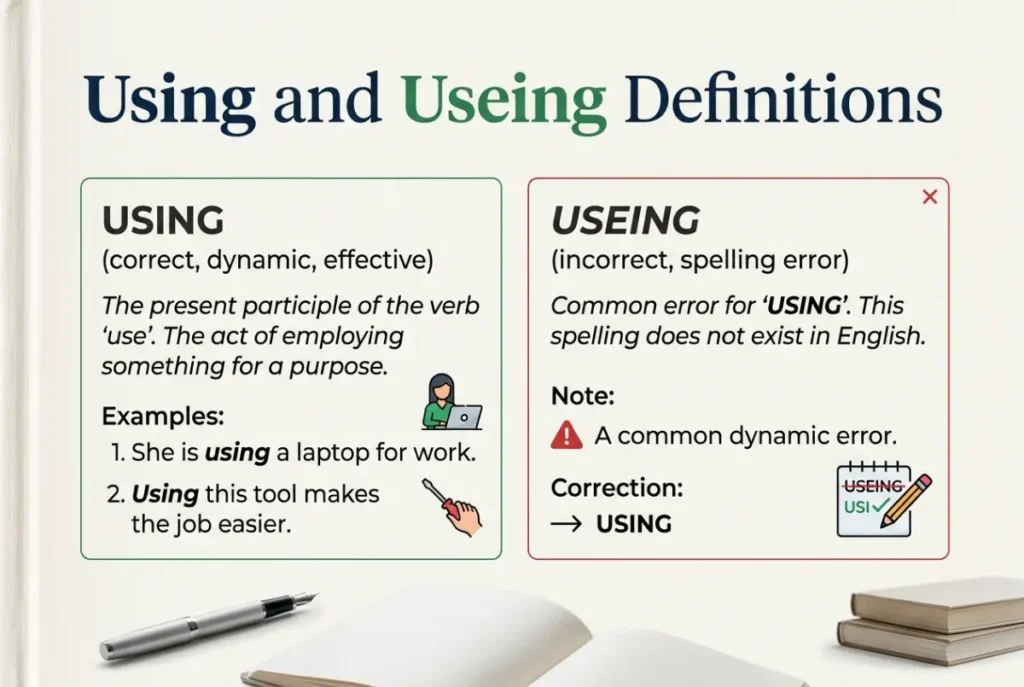
Using and Useing Definitions
What Using Means
Using is the ing form of the verb use. It can describe an action that is happening now or an action connected with another verb or structure.
For example:
I’m using my laptop right now.
Here, using describes an action in progress.
It can also appear after certain verbs and expressions.
She enjoys using fresh ingredients.
In this sentence, using functions as a gerund. It acts as the object of enjoys.
The word can also describe the way someone applies an object, method, skill, system, or idea.
He solved the problem using a calculator.
The meaning stays connected to the basic idea of putting something into action or making use of it.
What Useing Means
Useing has no standard meaning in English. It is simply an incorrect spelling of using.
You may see useing in online comments, social media posts, text messages, student writing, or other informal material. Its appearance online does not make it an accepted spelling.
That distinction is important. The internet contains countless spelling errors. A word appearing in search results or user generated content does not automatically make it a standard English form.
For formal writing, school assignments, workplace communication, published articles, and professional documents, use using.
Which One Is Correct
Using is correct.
Useing is incorrect.
The reason is a standard English spelling rule. When a verb ends in a silent e and we add the ing suffix, we usually remove the final e.
So:
use + ing = using
Not:
use + ing = useing
The same rule explains several familiar forms:
| Base verb | Correct ing form |
|---|---|
| use | using |
| make | making |
| write | writing |
| take | taking |
| give | giving |
| drive | driving |
| move | moving |
| close | closing |
| hope | hoping |
| save | saving |
This pattern is so common that fluent writers usually apply it automatically.
A useful editorial test is to look at the base verb first. If the verb ends in a final silent e, check the spelling rule before adding ing. In many cases, the e disappears.
Cambridge explains that verbs ending in e generally lose that final letter before the ing ending is added. Its examples include love → loving, lose → losing, and write → writing.

Why People Confuse Using or Useing
The mistake is understandable because the spelling process feels logical at first.
A learner sees:
use + ing
It can seem natural to keep every letter from the original verb and simply attach ing. That produces useing.
English spelling does not always work that way.
When suffixes are added, English often changes the spelling of the base word. The final e in use is one example. It helps signal the pronunciation of the vowel in the base word, but it does not normally remain when ing is attached.
There are several reasons learners make this mistake.
The Visual Pattern Feels Natural
Many regular verbs simply take ing without a spelling change.
For example:
walk → walking
play → playing
work → working
help → helping
Because those forms keep the entire base word, learners may assume the same process applies to use.
It doesn’t.
The final e is removed:
use → using
The Base Word Is Easy to Recognize
When people see use, they naturally want to preserve the whole word.
That instinct works for some suffixes. For example:
useful
user
But it does not work with ing.
The correct form is using.
English Spelling Does Not Always Match Simple Addition
English suffix rules depend on the letters and sounds at the end of the base word. Some forms require dropping letters. Others require doubling a consonant. Some keep the spelling unchanged.
Cambridge groups these patterns under rules involving dropping and adding letters as well as consonant doubling.
Compare these forms:
hope → hoping
run → running
play → playing
Each verb follows a different spelling pattern.
That’s why memorizing one universal rule such as simply adding ing can cause mistakes.
Typing Quickly Can Cause the Error
Useing can also appear as a typing mistake. When people type quickly, they may form the word mechanically by adding ing to the visible base word.
Spellcheck often catches this error. However, writers should still understand the underlying rule rather than rely entirely on software.
A spellchecker can identify a wrong form. It doesn’t always explain why the form is wrong.
Using or Useing Spelling Rules
The central rule is straightforward.
When a verb ends in a final silent e, we generally remove the e before adding ing.
The pattern is:
verb + ing
with the final e removed when the rule applies.
For use:
use → using
For make:
make → making
For write:
write → writing
For take:
take → taking
For give:
give → giving
For drive:
drive → driving
This rule is part of a larger system of English verb spelling.
Cambridge gives the general pattern as love → loving, lose → losing, and write → writing.
Why the E Disappears
The final e in use is silent. It helps distinguish the pronunciation and spelling of use from forms that would otherwise look different.
When ing is added, the spelling no longer needs that final e.
The result is:
use
becomes
using
The pronunciation also changes naturally as the word takes its new grammatical form.
Using is pronounced /ˈjuːzɪŋ/.
It has two syllables:
us ing
The first syllable carries the main stress.
Similar Examples
Learning several examples makes the pattern easier to remember.
choose → choosing
excuse → excusing
refuse → refusing
reuse → reusing
confuse → confusing
amuse → amusing
abuse → abusing
These examples show that the pattern applies beyond use itself.
The important point is that the final e is normally removed before ing.
A Useful Contrast
Not every verb ending in a similar sound follows the same visual pattern. English has exceptions and special cases.
For example:
see → seeing
The final spelling does not lose an e because see ends in ee, not a single final silent e.
Likewise:
agree → agreeing
The ee remains.
Cambridge specifically notes that verbs ending in ee, ye, or oe generally keep the final e before ing.
That gives you a useful comparison:
use → using
but
see → seeing
and
agree → agreeing
The rule is therefore not simply “remove every final e.” It is more precise: a final silent e is generally removed before ing, while certain endings keep their spelling.
Grammar and the Word Using
Using is an ing form of the verb use. Depending on the sentence, it can function as a present participle or as a gerund.
The spelling stays the same in both uses.
Using as Part of a Continuous Verb Form
The word using can combine with a form of be to describe an action in progress.
I am using the new software.
She is using my computer.
They are using the wrong file.
We were using a different method.
In these examples, using is part of the verb phrase.
The tense comes from the form of be:
am using for present progressive.
is using for present progressive.
are using for present progressive.
was using for past progressive.
were using for past progressive.
The ing form itself does not mark the tense on its own.
Using as a Gerund
The same form can act as a noun like a verb.
Using a dictionary can improve your vocabulary.
Here, using a dictionary functions as the subject of the sentence.
Another example is:
I enjoy using this app.
In this sentence, using this app is the complement of enjoy.
English has many verbs that commonly take an ing form after them. Cambridge lists verbs such as enjoy, avoid, finish, mind, and consider among verbs that are followed by an ing form.
So the spelling question connects directly with grammar. Once you understand how using works, you can recognize it in several different sentence structures.
Using in a Prepositional Phrase
The word can also appear after a preposition.
You can improve your writing by using shorter sentences.
She opened the package by using a small knife.
He learned the process through using several online resources.
The first two examples are especially natural because by using is a common structure.
The form remains using, never useing.
Using After Certain Verbs
Some verbs naturally take an ing form after them.
I enjoy using this method.
She avoids using unnecessary words.
They finished using the old system.
We considered using a different approach.
This is not just a spelling choice. It is also a matter of grammar and verb patterns. Cambridge notes that some verbs require or strongly favor an ing form rather than a to infinitive.
Understanding the grammar makes the spelling easier to remember because you start seeing using as a complete grammatical form rather than as a base word with letters attached.
Real Examples of Using
The best way to make a spelling rule stick is to see it working in ordinary sentences.
- I’m using my phone to check the address.
- She’s using a new recipe tonight.
- We’re using the latest version of the software.
- He was using the wrong password.
- They’re using recycled materials.
- I prefer using simple language.
- She enjoys using her creativity at work.
- Try using a smaller brush.
- The teacher suggested using a dictionary.
- He solved the problem by using a calculator.
- We’re using a different approach this year.
- The company is using new training materials.
- I stopped using that website last month.
- She is using examples to explain the idea.
- They started using the new system yesterday.
- He apologized for using the wrong name.
- The writer avoided using complicated terms.
- You can save time by using this shortcut.
- I’m using the information in my report.
- The students practiced using the new vocabulary.
Notice that using works naturally in conversation, workplace writing, academic contexts, instructions, and everyday messages.
The spelling never changes to useing.
Using or Useing Pronunciation Guide
The pronunciation of using is straightforward once you separate the word into its sounds.
Using is pronounced:
/ˈjuːzɪŋ/
It has two syllables:
u sing
The main stress falls on the first syllable.
The first part sounds like yooz. The second part sounds like ing.
So the word sounds roughly like:
YOO zing
The final g in the ing ending represents the /ŋ/ sound. It isn’t normally pronounced like a hard /g/ in standard English.
Why the Pronunciation Can Help With the Spelling
The pronunciation doesn’t contain a separate sound for the written e in use.
That can help you remember the spelling.
The base verb is:
use
The e is silent.
After adding ing, the word becomes:
using
You don’t pronounce an extra vowel between use and ing.
A common learner mistake is to think about the spelling as if the word were pronounced in two complete pieces:
use + ing
English doesn’t work that way here. The spelling changes when the suffix is added.
The Pronunciation of Use
The base verb use is normally pronounced /juːz/.
The final sound is /z/ when use functions as a verb.
For example:
I use this computer every day.
The noun use has a different pronunciation in many contexts. As a noun it is commonly pronounced /juːs/.
Compare:
use as a verb: /juːz/
use as a noun: /juːs/
This pronunciation difference can be useful for advanced learners because it shows that English spelling doesn’t always give you every detail about pronunciation.
Does Using Have a Z Sound
Yes.
The first part of using contains the /z/ sound:
/ˈjuːzɪŋ/
That is consistent with the pronunciation of the verb use.
For example:
She is using my laptop.
The first part of using sounds like yooz.
This is another reason the spelling using is easy to recognize once you become familiar with the word.
Using or Useing Word Formation
Understanding how using is built can make the spelling rule easier to remember.
The base verb is:
use
The suffix is:
ing
The final silent e is removed.
The result is:
using
This is a process called suffixation. A suffix is added to a base word to create a new grammatical or lexical form.
The ing ending has several functions in English. It can help create a present participle. It can also create a gerund.
The spelling remains using in both cases.
Present Participle
Consider:
She is using the computer.
Here using is part of the present progressive verb phrase.
The structure is:
be + using
Examples include:
I am using the new system.
He is using a pencil.
They are using the conference room.
We were using a different method.
Gerund
Now consider:
Using a dictionary can help you learn new words.
Here using a dictionary functions as the subject of the sentence.
Another example is:
I enjoy using this tool.
Here using this tool follows the verb enjoy.
The grammatical function changes, but the spelling does not.
Spelling Patterns Similar to Using
The best way to understand using is to compare it with other verbs.
Silent E Verbs
Many verbs ending in a silent e drop that letter before ing.
| Base verb | Correct form |
|---|---|
| use | using |
| make | making |
| take | taking |
| write | writing |
| drive | driving |
| give | giving |
| save | saving |
| hope | hoping |
| move | moving |
| close | closing |
| arrive | arriving |
| decide | deciding |
| invite | inviting |
| receive | receiving |
| believe | believing |
The pattern is clear.
The final e normally disappears.
Verbs That Keep Their Final E
There are important exceptions and special spelling patterns.
Some verbs ending in e keep the letter when ing is added.
For example:
see → seeing
agree → agreeing
free → freeing
The reason is that these verbs don’t end with a single silent e in the same way as use or make. Their endings contain vowel combinations that follow different spelling patterns.
This is why a good editor doesn’t teach the rule as “always remove the final e.” The better rule is more precise.
A final silent e is generally dropped before ing.
Consonant Doubling
Another common ing spelling pattern involves doubling the final consonant.
For example:
run → running
sit → sitting
stop → stopping
begin → beginning
This is different from use → using.
The verb use does not double its final consonant.
So:
use → using
Not:
use → useing
And not:
use → ussing
Each spelling pattern has its own logic.
Using in American English
Using is standard in American English.
There is no American spelling variation that changes using to useing.
You will see using in:
- School assignments.
- Workplace documents.
- Technical instructions.
- News writing.
- Academic papers.
- Emails.
- Websites.
- Social media.
- Product descriptions.
- Everyday conversation.
The same standard spelling is also used in British English.
So this is not a case like color and colour.
There is no regional spelling choice between using and useing.
Using in British Canadian and Australian English
The correct spelling using is also standard in British English, Canadian English, and Australian English.
That makes this spelling particularly easy to handle.
You don’t need to memorize separate regional versions.
American English:
using
British English:
using
Canadian English:
using
Australian English:
using
The spelling stays the same.
The same is true for many other verbs with the silent e pattern:
making
writing
taking
giving
driving
Regional differences in English often affect vocabulary, punctuation, pronunciation, or certain spellings. Using isn’t one of those cases.
Common Mistakes With Using
The biggest mistake is simple:
useing
This happens when the writer adds ing without changing the base word.
Mistake 1
Incorrect:
I am useing my computer.
Correct:
I am using my computer.
Mistake 2
Incorrect:
She is useing a new method.
Correct:
She is using a new method.
Mistake 3
Incorrect:
We are useing too much paper.
Correct:
We are using too much paper.
Mistake 4
Incorrect:
They started useing the new system.
Correct:
They started using the new system.
Mistake 5
Incorrect:
Try useing this tool.
Correct:
Try using this tool.
The pattern is consistent.
Whenever use becomes an ing form, write using.
Common Grammar Mistakes With Using
Spelling isn’t the only issue learners can have with using. The word also appears in several grammar structures that can cause confusion.
Using With the Present Progressive
Use am, is, or are before using for the present progressive.
Correct:
I am using the computer.
She is using the computer.
They are using the computer.
Don’t use the base verb after am, is, or are when you want the progressive form.
Incorrect:
She is use the computer.
Correct:
She is using the computer.
Using After Enjoy
After enjoy, use an ing form.
Correct:
I enjoy using this software.
Incorrect:
I enjoy to use this software.
The second sentence doesn’t follow the normal verb pattern for enjoy.
Using After Avoid
The same principle applies to avoid.
Correct:
Try to avoid using unnecessary words.
Incorrect:
Try to avoid to use unnecessary words.
This distinction is useful for English learners because it connects spelling with grammar. Learning using as a word form is only part of the picture. Knowing where that form belongs in a sentence makes your writing more natural.
Using After By
When by introduces a method or means, an ing form commonly follows.
You can improve your writing by using shorter sentences.
She saved money by using public transportation.
He learned the process by using online resources.
This is a very common structure in both spoken and written English.
Using in Different Writing Contexts
The word using is extremely common because it describes an action that appears in almost every area of life.
Daily Conversation
Are you using the bathroom?
I’m using my old phone today.
She’s using my charger.
We’re using the kitchen right now.
These sentences sound natural in everyday American English.
Workplace Writing
We are using a new scheduling system.
The team is using updated guidelines.
Employees should avoid using personal devices during the test.
The department is using the revised procedure.
The word fits professional writing without sounding formal or complicated.
Academic Writing
The study was conducted using data from three sources.
Students can improve their results by using effective study techniques.
The researchers analyzed the samples using a standardized method.
Academic writers use using frequently. Still, editors often recommend checking for clarity because repeated using constructions can make a paragraph feel mechanical.
For example:
The researchers analyzed the data using a computer using a new software package.
This sentence is awkward because using appears twice and the relationships are unclear.
A clearer version might be:
The researchers analyzed the data with new software.
Good editing isn’t just about correct spelling. It is also about making relationships between ideas easy to understand.
Emails
I’m using the information you sent me.
We’re using the updated file.
Thanks for using the new form.
I appreciate you using the correct template.
These examples show how naturally the word fits ordinary workplace communication.
Instructions
Start by using a clean cloth.
Try using a smaller amount.
Continue using the device until the light turns green.
Instruction writing often relies heavily on using because it explains methods and tools.
Journalism
The company is using artificial intelligence to analyze customer feedback.
The city is using new cameras to monitor traffic.
News writing often uses using to describe methods or resources.
Social Media
Still using this old laptop in 2026.
I can’t believe you’re still using that ringtone.
Anyone else using this app?
Social media language is often informal and abbreviated. Even so, the standard spelling remains using.
Is Useing Ever Acceptable
No. Useing is not a standard alternative spelling of using.
You might encounter it online. You might even find it in user comments, forum posts, social media, or automatically generated text.
That doesn’t make it correct.
The important distinction is between documented usage and standard usage.
A spelling error can appear thousands of times on the internet. Search frequency alone isn’t enough to establish a spelling as standard English.
For professional writing, use using.
Does Autocorrect Change Useing
Many modern spellcheckers and writing tools will flag useing as a spelling error and suggest using.
That’s helpful, but it shouldn’t replace knowledge of the rule.
If you understand why the spelling is using, you’ll be able to catch the error even when you’re writing by hand or working in an editor without spellcheck.
A strong writer doesn’t just recognize the correction. They understand the pattern behind it.
Still confused? Compare Comprable Vs Comparable Which Spelling Is Correct 2026.
Memory Tricks for Using
A simple memory trick can make the correct spelling stick.
Think Drop the E
Remember:
Use drops E before ING.
So:
USE + ING
becomes:
USING
You can think of the final e as stepping aside to make room for ing.
Use the Silent E Test
When you’re adding ing to a verb, ask:
Does the verb end in a single silent e?
If yes, check if that e should disappear.
For use:
use
ends in a silent e.
So:
using
For make:
make
becomes:
making
For write:
write
becomes:
writing
This gives you a useful mental pattern.
Remember the Family
Instead of memorizing using by itself, remember it with similar forms:
use → using
make → making
write → writing
take → taking
give → giving
Once you recognize the family pattern, the spelling becomes much easier.
Using Versus Other Common Verb Forms
Understanding the complete verb family can prevent other mistakes.
Use
Use is the base form.
I use this computer every day.
Uses
Uses is the third person singular present form.
She uses this computer every day.
Used
Used is the past tense and past participle form.
I used this computer yesterday.
She has used this computer before.
Using
Using is the ing form.
I am using this computer now.
The complete pattern is:
use
uses
used
using
This is a useful set to learn because these four forms cover many of the most common grammatical uses of the verb.
Related Words and Expressions
The verb use appears in many useful expressions.
Make Use Of
Make use of means to use something effectively.
We should make use of the available resources.
Use Up
Use up means to consume all of something.
We used up all the milk.
Use For
Use for asks or explains the purpose of something.
What is this tool used for?
Used To
Used to describes a past habit or past situation that is no longer true.
I used to live in Chicago.
This structure deserves special attention because learners sometimes confuse used to with ordinary forms of use.
Get Used To
Get used to means become accustomed to something.
I’m getting used to my new schedule.
Be Used To
Be used to means be accustomed to something.
She’s used to working late.
These expressions show why learning use as an isolated spelling item isn’t enough. The word appears in a broad family of structures with different meanings and grammar.
Synonyms for Using
The best synonym depends on the context.
Possible alternatives include:
applying
operating
employing
utilizing
handling
adopting
practicing
making use of
These words aren’t always interchangeable.
For example:
She is using a computer.
can become:
She is operating a computer.
if the focus is on controlling the machine.
However:
She is using a new strategy.
could become:
She is applying a new strategy.
The choice depends on the meaning.
For everyday American English, using is often the clearest and most natural option. More formal alternatives can sometimes make a sentence heavier without adding useful meaning.
Using or Useing in Professional Writing
For professional writing, the choice is simple: always write using.
An editor would never treat useing as a legitimate variant. If it appears in a manuscript, email, report, article, or school assignment, it should be corrected to using.
The correction is not a matter of personal style. It follows a standard English spelling pattern.
This distinction matters because professional writing depends on small details. A single spelling error usually won’t make a sentence impossible to understand. Still, repeated spelling mistakes can make a document look rushed or poorly edited.
For example:
The team is useing a new reporting system.
should become:
The team is using a new reporting system.
The corrected version looks natural because it follows the spelling pattern native speakers expect.
Expert Editors Note
From an editor’s perspective, using is the only form you should choose in standard English.
The most useful advice is to learn the spelling rule instead of memorizing the word in isolation. Once you understand that a final silent e commonly disappears before ing, forms such as using, making, writing, and taking become much easier to spell.
Dictionaries list using as a grammatical form of use. Major English dictionaries also distinguish the verb use from the noun use and provide the relevant pronunciation and grammatical information.
For learners, one point deserves special attention: useing isn’t a British spelling, an American spelling, or an informal alternative. It is simply a misspelling.
If I were proofreading a general American English article, I’d correct useing immediately. I wouldn’t leave it as a stylistic variation because no useful meaning is gained by keeping it.
I’d also look at the surrounding sentence. Sometimes a writer knows the spelling but uses using too often.
For example:
The company is using new software using data from customers using the mobile app.
The spelling is correct, but the sentence is clumsy.
A stronger edit might be:
The company uses new software to analyze data from customers who use the mobile app.
Good editing goes beyond spelling. The goal is clear and natural communication.
Using in Formal and Informal English
The word using works in both formal and informal English.
In casual conversation:
I’m using your charger.
In workplace writing:
The department is using a revised approval process.
In academic writing:
The researchers collected the samples using standardized procedures.
In a technical document:
Open the application using the administrator account.
The word itself isn’t informal. Its register depends mainly on the sentence around it.
Sometimes writers try to replace using with a more formal word such as utilizing because they think it sounds more professional.
That isn’t always an improvement.
Compare:
The team is using a new system.
with:
The team is utilizing a new system.
Both can be grammatical. The first is usually simpler and more direct.
An experienced editor generally chooses the clearest word that expresses the intended meaning. Fancy vocabulary doesn’t automatically make writing stronger.
Real Life Examples You Can Copy
Seeing using in different settings helps reinforce both its spelling and its grammar.
Everyday Examples
- I’m using my phone right now.
- Are you using this chair?
- She’s using the kitchen.
- We’re using the back entrance.
- He’s using my old laptop.
- I’m using a different password now.
- They’re using the same recipe.
- She was using a paper map.
- Try using less water.
- I’m using the bus today.
Workplace Examples
- We’re using a new scheduling system.
- The team is using updated guidelines.
- I’m using the information from your email.
- The manager recommended using a simpler process.
- Employees should avoid using personal accounts for company files.
- We’re using the revised template.
- The department is using a new reporting system.
- She improved the report by using clearer headings.
- The company is using customer feedback to improve the service.
- He completed the task using the instructions provided.
Academic Examples
- The researchers collected the data using two methods.
- Students can improve their writing by using specific examples.
- The study compares results using three different models.
- The experiment was conducted using controlled conditions.
- The author explains the concept using a simple example.
- Researchers examined the samples using specialized equipment.
- The students practiced the vocabulary by using each word in a sentence.
- The report presents the findings using several charts.
- The analysis was completed using data from multiple sources.
- The teacher encouraged students to learn new terms by using them in context.
Email Examples
- I’m using the file you sent yesterday.
- We’re using the updated version of the document.
- Thanks for using the new form.
- I’m using your suggestions in the revised draft.
- We’re using the information you provided to complete the report.
These examples show an important point. Using is not limited to one type of sentence. It works across everyday speech, workplace communication, education, journalism, technical writing, and online communication.
Common Internet Misconceptions
Spelling questions often attract misleading explanations online.
One common misconception is that useing might be an older spelling. It isn’t the standard modern form of the verb.
Another misconception is that American English uses using while British English uses useing.
That’s also incorrect.
Both major varieties use:
using
Another claim you may encounter is that adding ing always means keeping the entire base word. That rule is too broad.
English spelling changes when suffixes are added.
Compare:
walk → walking
with:
use → using
The first keeps the base spelling.
The second drops the final e.
Another common mistake is relying on search results as proof that a spelling is correct. Search engines index enormous amounts of user generated content. A misspelled word can appear many times without becoming standard English.
For reliable spelling decisions, dictionaries and established grammar references are better sources than raw search frequency.
Is Using a Verb
Yes. Using comes from the verb use.
More precisely, using is the ing form of use.
Depending on the sentence, it can function as a present participle or a gerund.
For example:
She is using the computer.
Here it forms part of a progressive verb phrase.
Using a computer can save time.
Here using a computer functions as a noun phrase.
This distinction is useful for English learners because the same spelling can perform different grammatical jobs.
Is Using a Present Participle or Gerund
It can be either.
Consider:
He is using the new software.
Here using is a present participle because it forms part of the progressive verb phrase is using.
Now consider:
Using the new software is easy.
Here using the new software acts as the subject of the sentence. Traditional grammar describes this use as a gerund phrase.
In modern linguistic analysis, the distinction between gerunds and present participles can be more complicated than these simple labels suggest. For everyday writing, the important point is that using is an ing form that can serve different grammatical functions.
Can You Say Using To
Yes, but the grammar depends on the structure.
You can say:
I am using the computer to write the report.
Here using belongs to the main verb phrase while to write introduces the purpose.
You can also say:
She is using a knife to cut the vegetables.
The structure is:
using something + to do something
This pattern is very common.
However, after certain verbs, using itself is required or strongly preferred.
For example:
I enjoy using this program.
Not:
I enjoy to use this program.
Learning common verb patterns helps you choose the correct form naturally.
Can Using Start a Sentence
Yes.
Starting a sentence with using is completely grammatical when the structure is clear.
For example:
Using a dictionary can help you learn new words.
Using fresh ingredients can improve the flavor.
Using the correct format will make the report easier to read.
You can also use an introductory using phrase:
Using the data from the survey, the researchers identified several trends.
This structure is useful, but writers should make sure the opening phrase clearly connects to the subject of the main clause.
For example:
Using the latest software, the company completed the analysis.
This works because the company is the implied user of the software.
A sentence such as:
Using the latest software, the analysis was completed.
can sound less clear because the grammatical subject the analysis isn’t the thing doing the using.
This is an example of a dangling modifier. Strong editing catches issues like this even when every individual word is spelled correctly.
Why Using Is More Natural Than Utilizing
Using is often the better choice in plain American English.
The verb utilize can be useful when you want to emphasize making practical or specialized use of something. However, writers sometimes use it simply because they think longer words sound more professional.
Compare:
We are using the available data.
with:
We are utilizing the available data.
The first sentence is shorter and easier to process.
Unless utilize adds a meaningful distinction, use is usually enough.
This principle matters for SEO and reader experience too. People generally understand common words faster than unnecessarily formal alternatives.
Common Mistakes to Avoid
Keep these corrections handy.
| Incorrect | Correct |
|---|---|
| useing | using |
| I am useing it | I am using it |
| She is useing the tool | She is using the tool |
| They are useing a new method | They are using a new method |
| We started useing the system | We started using the system |
| Try useing this option | Try using this option |
| He enjoys useing the app | He enjoys using the app |
| She avoids useing plastic | She avoids using plastic |
| We improved it by useing data | We improved it by using data |
| The team is useing new software | The team is using new software |
The correction is the same every time.
Useing → using
A Simple Rule to Remember
If you remember only one thing from this article, remember this:
Use loses its final e before ing.
So:
use + ing = using
You can apply the same idea to many common verbs:
make → making
write → writing
take → taking
give → giving
drive → driving
save → saving
Once you see this pattern often enough, useing starts to look obviously wrong.
Frequently Asked Questions
Is using or useing correct
Using is correct. Useing is a misspelling. The base verb use ends in a final silent e, which is normally removed before the ing suffix is added. The correct formation is therefore use + ing = using. This spelling is standard in American English as well as British, Canadian, and Australian English.
Why is useing wrong
Useing is wrong because the final silent e in use is normally dropped before ing is added. The same pattern appears in verbs such as make, write, take, and give. Therefore the standard form is using, not useing.
What is the correct spelling of using
The correct spelling is using. It contains the letters u s i n g. The final e from the base verb use disappears when the ing ending is added. The spelling useing is not an accepted alternative form in standard English.
How do you spell use with ing
Spell it using. Start with use, remove the final e, and then add ing. The result is using. This follows the common spelling pattern for verbs ending in a final silent e, such as make → making and write → writing.
Is useing a word
Useing isn’t a standard English word. It is generally an incorrect spelling of using. You may find the form online because people make spelling mistakes in posts, comments, messages, and other user generated content. Its presence online doesn’t make it a standard dictionary form.
Is using the present tense
Using by itself doesn’t mark tense. It is the ing form of the verb use. It can appear in present progressive structures such as I am using it or past progressive structures such as I was using it. The auxiliary verb carries the tense information.
Is using a gerund
Using can function as a gerund when the ing form acts as a noun. For example, Using a dictionary can help uses using a dictionary as the subject. The same form can also function as a present participle in a progressive construction such as She is using a dictionary.
Is using correct in American English
Yes. Using is the standard spelling in American English. There is no American spelling rule that changes it to useing. British, Canadian, and Australian English also use using, so this isn’t a regional spelling difference.
What is the difference between use and using
Use is the base form of the verb. Using is its ing form. For example, I use this app every day uses the base form, while I am using this app now uses the progressive form. The spelling changes because the final e is dropped before ing.
How can I remember using versus useing
Remember the phrase use loses e before ing. When you add ing to use, remove the final e first. That gives you using. You can reinforce the pattern with similar examples such as make → making, write → writing, and take → taking.
Can using be used in formal writing
Yes. Using is completely appropriate in formal writing. It appears frequently in academic papers, business reports, technical documents, journalism, and professional communication. The word itself isn’t informal. In formal writing, the main concern is making sure the sentence is precise and that repeated using constructions don’t make the prose unnecessarily repetitive.
Expert Takeaway
The spelling question has a very clear answer.
Using is correct.
Useing is incorrect.
The reason is the spelling pattern for verbs ending in a final silent e. When ing is added to use, the final e is removed.
Use → using
This isn’t a regional preference. American English, British English, Canadian English, and Australian English all use using.
The word also has several grammatical functions. It can appear in progressive verb phrases, gerund phrases, prepositional structures, instructions, workplace writing, academic prose, and everyday conversation.
If you’re proofreading your own work, don’t stop at the spelling. Check the entire sentence. Make sure using expresses the intended action, follows the correct verb pattern, and doesn’t create an awkward or repetitive structure.
That small habit separates basic proofreading from strong editing.
A related grammar guide is Kinesthesiology Vs Kinesiology Which Word Is Correct 2026.
Conclusion
When choosing between using or useing, the answer is clear: using is the correct spelling.
The mistake happens because it seems logical to add ing directly to use. English spelling has a different rule here. The final silent e is dropped before ing is added.
So remember:
use → using
Never:
use → useing
The same pattern appears in many common verbs such as make → making, write → writing, take → taking, and give → giving.
For American English writing, using is the natural and standard form. You can use it in conversation, emails, school assignments, academic writing, professional documents, instructions, journalism, and social media.
The easiest memory trick is simple: use loses e before ing.
Once that pattern becomes familiar, you’ll stop having to think twice about this spelling. A good spelling rule should make writing easier, and this one does exactly that.

Editorial Reviewer & Proofreader
Grace Mitchell reviews Gramlify’s articles for clarity, consistency, and readability. She is passionate about creating accurate, approachable content that helps English learners build confidence.