
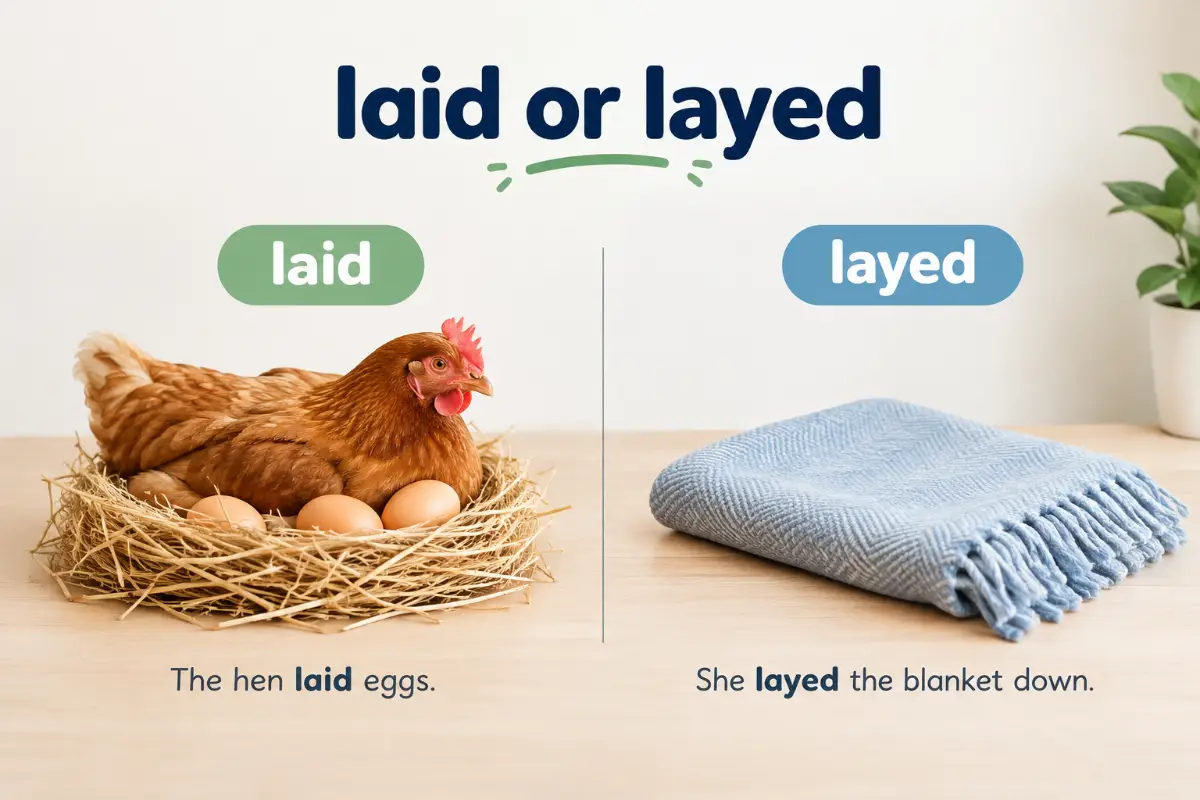
If you’ve ever paused while writing a sentence like I have laid down or I layed down you’re not alone. Laid or layed is one of the most common past tense spelling questions in English because lay and lie already have confusing verb forms. Add the incorrect spelling layed into the mix and even experienced writers can hesitate.
The short answer is simple: laid is the correct past tense and past participle of the verb lay when you mean to put something down or place it somewhere. Layed is not the standard spelling for this verb.
However, the confusion goes deeper than one spelling mistake. English has two closely related verbs: lay, which usually takes an object, and lie, which means to rest or recline. Their past forms are different, and that difference causes many errors in everyday speech, emails, and formal writing.
This guide explains the difference between laid and layed, shows how laid works in real sentences, and clears up the related confusion between lay, lie, laid, and laying. You’ll also learn why layed appears online, how to remember the correct form, and how professional editors handle these verbs.
Many readers also check Input Or Imput Which Spelling Is Correct 2026.
Quick Answer
Laid is the correct past tense and past participle of lay when the verb means to put or place something. Layed is not the standard English form of that verb. For example, write She laid the book on the table, not She layed the book on the table. The related verb lie has the past tense lay.
Laid Or Layed Comparison Table
|
Feature
|
Laid
|
Layed
|
| — | — | — |
|
Standard English spelling
|
Correct
|
Incorrect for the ordinary verb lay
|
|
Meaning
|
Put or placed something
|
Not the standard past form of lay
|
|
Part of speech
|
Verb form
|
Nonstandard spelling in this context
|
|
Base verb
|
Lay
|
Lay
|
|
Past tense
|
Laid
|
Not layed
|
|
Past participle
|
Laid
|
Not layed
|
|
Present participle
|
Laying
|
Not laying with an extra change
|
|
Common context
|
Placing objects or arranging things
|
Usually a spelling mistake
|
|
Example
|
He laid the keys on the desk.
|
He layed the keys on the desk. ✗
|
The Main Rule
Use laid when you mean put something down.
She laid the blanket on the grass.
Do not use layed as the past tense of lay in standard English.
She layed the blanket on the grass. ✗
There is one important detail to remember: laid also belongs to the verb lay in its past participle form.
They have laid the foundation.
That sentence is correct because have laid uses the past participle.
What Does Laid Mean
Laid is the past tense and past participle of lay. The verb lay means to put or place something in a particular position.
Because lay is a transitive verb, it normally takes a direct object. That means someone lays something.
Simple Definition
Laid means put or placed something somewhere.
Examples Of Laid
- She laid the keys beside the door.
- He laid the baby gently in the crib.
- We laid the documents on the conference table.
- The workers laid new tiles across the floor.
- I laid my jacket over the chair.
In each sentence, the subject places something. The object makes the meaning clear.
Laid As A Past Participle
Laid also works with helping verbs such as has, have, and had.
- She has laid the papers on your desk.
- They had laid the groundwork before the meeting.
- The company has laid new cables beneath the road.
- We had laid the table before the guests arrived.
The form stays laid. It does not become layed.
What Does Layed Mean
In ordinary modern English, layed is not the correct past tense or past participle of lay.
If you want to say that someone put or placed something somewhere, use laid.
Incorrect.
He layed the book on the shelf.
Correct.
He laid the book on the shelf.

Why Does Layed Appear Online
You may still see layed in social media posts, informal messages, comments, or user generated content. People often create it by applying a familiar spelling pattern.
For example, many regular verbs form the past tense with ed.
- Play becomes played.
- Stay becomes stayed.
- Clean becomes cleaned.
- Walk becomes walked.
Someone may assume that lay follows the same pattern and write layed. However, lay is an irregular verb, so its past form is laid.
Is Layed Ever A Word
In specialized or historical contexts, layed may appear as a rare form connected with other uses of lay or in older texts. It can also occur as a surname or in proper names. Those unusual appearances do not make layed the standard past tense of the everyday verb lay.
For normal writing, the rule is straightforward.
Use laid.
Which One Is Correct
Laid is the correct spelling. Layed is incorrect when used as the past tense or past participle of the verb lay.
Use laid when someone puts, places, arranges, or sets something down.
|
Incorrect
|
Correct
|
| — | — |
|
She layed the phone on the desk.
|
She laid the phone on the desk.
|
|
We layed the books on the floor.
|
We laid the books on the floor.
|
|
He has layed the tiles.
|
He has laid the tiles.
|
|
They layed the foundation last year.
|
They laid the foundation last year.
|
A Quick Test
Ask yourself:
Did someone put or place something?
If yes, use laid.
I laid the package by the front door.
If you mean that a person rested or reclined, you may need lay or lain instead. That is a different verb, and we’ll cover it next.
The Real Source Of Confusion
The hardest part of this topic is not just laid versus layed. It’s the relationship between lay and lie.
These two verbs have different meanings and different forms.
Lay Means To Put Something Somewhere
Lay means to put or place something. It normally needs an object.
|
Tense
|
Form
|
Example
|
| — | — | — |
|
Present
|
Lay
|
I lay the book on the desk.
|
|
Past
|
Laid
|
I laid the book on the desk.
|
|
Past participle
|
Laid
|
I have laid the book on the desk.
|
|
Present participle
|
Laying
|
I am laying the book on the desk.
|
Lie Means To Rest Or Recline
Lie means to rest in a flat or reclining position. It usually does not take a direct object.
|
Tense
|
Form
|
Example
|
| — | — | — |
|
Present
|
Lie
|
I lie on the sofa.
|
|
Past
|
Lay
|
I lay on the sofa yesterday.
|
|
Past participle
|
Lain
|
I have lain on the sofa all afternoon.
|
|
Present participle
|
Lying
|
I am lying on the sofa.
|
This table explains why English learners often feel stuck. The past tense of lie is lay, while the past tense of lay is laid.
Compare The Meaning
Lay.
I lay the baby in the crib.
Someone places the baby somewhere.
Lie.
The baby lies in the crib.
The baby rests there.
Past tense of lie.
The baby lay in the crib.
The baby rested there in the past.
Past tense of lay.
I laid the baby in the crib.
Someone placed the baby there.
The object is the key. If you can ask laid what? or laid whom?, you’re probably using lay correctly.
Lay Laid And Lain Explained
These three forms often appear together in grammar questions.
Lay
Lay is the base form of the verb that means to put or place.
Please lay the folder on my desk.
It can also be the past tense of lie.
Yesterday I lay on the beach for two hours.
The sentence meaning tells you which verb you’re using.
Laid
Laid is the past tense and past participle of lay.
She laid the flowers on the table.
She has laid the flowers on the table.
Lain
Lain is the past participle of lie.
He has lain in bed all morning.
It does not mean placed. It means rested or reclined.
Laying
Laying is the present participle of lay.
She is laying the books on the shelf.
It means placing something.
Lying
Lying is the present participle of lie when lie means to rest.
She is lying on the bed.
It means resting or reclining.
A Complete Verb Chart
|
Meaning
|
Base form
|
Past tense
|
Past participle
|
Present participle
|
| — | — | — | — | — |
|
Put or place
|
Lay
|
Laid
|
Laid
|
Laying
|
|
Rest or recline
|
Lie
|
Lay
|
Lain
|
Lying
|
Important: Lie can also mean to say something untrue. That is a separate verb with a different set of forms.
|
Meaning
|
Base form
|
Past tense
|
Past participle
|
| — | — | — | — |
|
Say something untrue
|
Lie
|
Lied
|
Lied
|
For example.
He lied about the missing money.
That verb has nothing to do with laid.
Grammar Rules For Using Laid
Understanding the grammar behind laid will help you avoid mistakes in both casual and formal writing.
Laid Usually Takes A Direct Object
A direct object receives the action of the verb.
She laid the towel on the chair.
The question is What did she lay?
Answer: The towel.
More examples.
- The chef laid the ingredients on the counter.
- He laid his phone beside the laptop.
- The gardener laid fresh mulch around the plants.
- We laid the papers in alphabetical order.
- The technician laid the cable along the wall.

Laid Can Be Used In Passive Voice
In passive sentences, the object becomes the subject of the sentence.
The foundation was laid in 1920.
The bricks were laid carefully.
New rules have been laid out for employees.
The form remains laid.
Laid In Phrasal Verbs
Several common expressions use laid as part of a phrasal verb or fixed phrase.
Lay out means to arrange or present something.
She laid out the materials for the workshop.
Lay down means to put something down or establish a rule.
The company laid down clear safety rules.
Lay off means to dismiss workers from employment.
The company laid off several employees.
Lay aside means to put something away or stop considering it for a time.
He laid aside his notes and listened carefully.
Lay the groundwork means to prepare the basis for something.
The early research laid the groundwork for the discovery.
Lay the foundation means to create the basis for future progress.
Their work laid the foundation for the new system.
Laid In Expressions
The word also appears in familiar expressions.
Laid-back.
This means relaxed or easygoing.
She’s known for her laid-back personality.
Laid to rest.
This can mean buried after death or brought to an end.
The rumor was finally laid to rest.
Laid bare.
This means exposed or revealed clearly.
The investigation laid bare the problems in the system.
Laid off.
This means dismissed from a job.
Hundreds of workers were laid off during the downturn.
These expressions are all standard. Their meanings depend on the phrase rather than the basic idea of placing something.
Need another quick comparison? Read Shakey or Shaky Which Spelling Is Correct.
Spelling Rules And Why Laid Is Irregular
Many English verbs form their past tense by adding ed, but not all verbs follow that pattern.
Regular Verbs
Regular verbs usually add ed.
- Walk becomes walked.
- Open becomes opened.
- Call becomes called.
- Clean becomes cleaned.
Irregular Verbs
Irregular verbs change in other ways.
- Go becomes went.
- Take becomes took.
- Buy becomes bought.
- Lay becomes laid.
The spelling laid is part of the verb’s established form. English speakers learn it as an irregular pattern rather than creating it with a regular ed ending.
Why Not Layed
The form layed looks logical if you treat lay like a regular verb. But English spelling depends on the history and established forms of individual verbs.
The correct pattern is.
Lay → laid → laid.
Not.
Lay → layed → layed.
Is Laid Spelled With One Or Two Y’s
Laid has no y.
Correct.
She laid the book down.
Incorrect.
She layed the book down.
The word laying is different because it keeps the y.
She is laying the book down.
This contrast can cause another spelling mistake. The past form is laid, but the present participle is laying.
Pronunciation Guide
The two forms are also easy to distinguish in speech.
Laid
IPA.
/leɪd/
Syllables.
One syllable.
Rhymes with.
Made. Paid. Shade. Trade.
Examples.
She laid the keys on the counter.
The workers laid the bricks carefully.
Layed
The spelling layed is not the standard form of the verb. If someone pronounces it as a regular ed form, it may sound like laid in many varieties of English. That similarity can reinforce the spelling mistake.
The important point is that pronunciation does not justify the spelling layed. Standard writing uses laid.
Laying
IPA.
/ˈleɪɪŋ/
Syllables.
Two syllables.
She is laying the table.
Lying
IPA.
/ˈlaɪɪŋ/
Syllables.
Two syllables.
He is lying on the couch.
The vowel sound changes, which helps distinguish laying from lying.
Word Origin And History
The confusion becomes easier to understand when you look at the history of these verbs.
The Origin Of Lay
The verb lay comes from Old English lecgan, meaning to place or put something down. Over time, its forms developed into the modern pattern.
Lay → laid → laid.
The past form laid is not a recent spelling choice. It has a long history in English.
The Origin Of Lie
The verb lie, meaning to rest or recline, comes from a different Old English verb, licgan.
Its modern forms developed as.
Lie → lay → lain.
The two verbs became closely connected in appearance and meaning, but they retained different grammatical patterns.
Why Their Forms Overlap
The present form lay and the past form lay belong to different verbs.
That is why these sentences are both correct.
I lay the book on the table every morning.
Yesterday I lay on the sofa.
The first sentence uses lay as the present form of put. The second uses lay as the past form of rest.
English learners often expect every verb to have one clear form for each tense. These two verbs don’t make that easy.
Real Life Examples Of Laid
The following examples show how native speakers use laid in different settings.
Daily Conversation
- I laid your keys on the kitchen counter.
- She laid the baby down for a nap.
- He laid his coat over the back of the chair.
- We laid the picnic blanket under the tree.
- I laid the groceries on the table while I looked for my phone.
Workplace Communication
- The manager laid out the new schedule during the meeting.
- The team laid the groundwork for the next stage of the project.
- The company laid off several employees after the merger.
- The engineer laid the cables beneath the floor.
- The report laid out the risks in clear language.
Emails
- I’ve laid the revised documents on your desk.
- As discussed, I’ve laid out the proposed timeline below.
- The team has laid the foundation for a smoother process.
- We laid out the next steps in the attached summary.
Academic Writing
- The study laid the groundwork for later research.
- The author laid out the central argument in the opening chapter.
- The researchers laid the samples on a clean surface before testing them.
- The paper explains how the treaty laid the foundation for future cooperation.
Literature And Journalism
- The workers laid the stones along the old road.
- The article laid bare the weaknesses in the policy.
- The novel describes how the villagers laid flowers at the memorial.
- The investigation laid out a detailed account of the events.
Social Media And Informal Writing
- I laid down the rules and everyone agreed.
- Just laid out my plans for the weekend.
- She laid the funniest story on us during dinner.
- We laid the snacks out before the movie started.
These examples show that laid works in everyday speech as well as formal writing. The verb is not limited to physical objects. It can also describe ideas, plans, rules, evidence, and foundations.
Common Mistakes With Laid And Layed
Mistake One: Adding Ed To Lay
Incorrect.
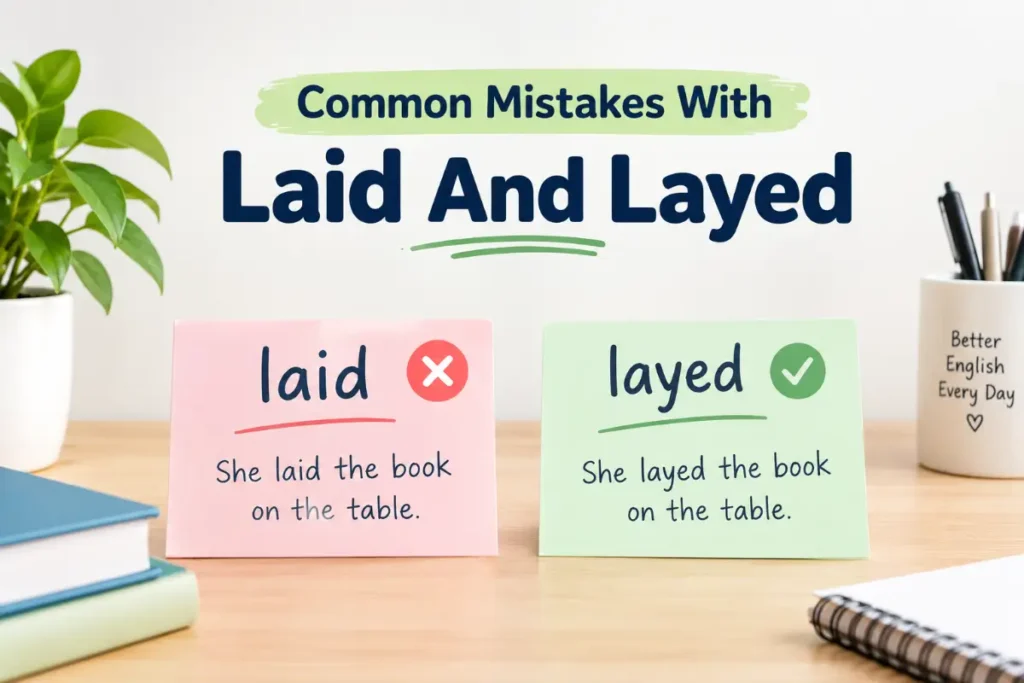
She layed the clothes on the bed.
Correct.
She laid the clothes on the bed.
The verb is irregular. Use its established past form.
Mistake Two: Confusing Lay With Lie
Incorrect.
I laid down because I was tired.
This sentence is common in informal speech, but if you mean I rested or reclined, the traditional standard form is.
I lay down because I was tired.
Here lay is the past tense of lie.
However, the distinction can become complicated in modern usage because many speakers use lay down in ways that blur the traditional grammar rule. In careful formal writing, keep the difference clear.
Mistake Three: Using Laid Without An Object
Incorrect in the intended meaning.
I laid on the bed yesterday.
If you mean you rested on the bed, the traditional standard form is.
I lay on the bed yesterday.
If you mean you placed something on the bed, add an object.
I laid the blanket on the bed yesterday.
Mistake Four: Using Layed In Formal Writing
Incorrect.
The committee layed out its recommendations.
Correct.
The committee laid out its recommendations.
Professional writing should always use laid in this context.
Mistake Five: Confusing Laid And Lied
These words sound different and come from different verbs.
Laid means placed.
She laid the papers on the desk.
Lied means said something untrue.
She lied about the missing papers.
The difference is important in both writing and speech.
Memory Tricks To Remember Laid
A few simple memory tricks can make this spelling stick.
Think Of Paid
Laid rhymes with paid.
Lay → laid.
Pay → paid.
If you remember paid, you can remember the spelling of laid. Both end with aid.
Remember The Three Forms
Use this short pattern.
Lay → laid → laid.
Say it aloud a few times. The repetition helps you remember that the past tense and past participle are identical.
Use The Placement Test
Ask.
Did someone put something somewhere?
If yes, choose laid.
He laid the book on the shelf.
If someone simply rested, you may need lay or lain.
He lay on the shelf.
That sentence would be unusual in real life, but the grammar illustrates the difference.
Keep This Mini Chart Nearby
|
Meaning
|
Correct form
|
| — | — |
|
Put something now
|
Lay
|
|
Put something in the past
|
Laid
|
|
Have put something
|
Laid
|
|
Rest now
|
Lie
|
|
Rested in the past
|
Lay
|
|
Have rested
|
Lain
|
Related Words And Expressions
Understanding related vocabulary helps you recognize the same word family in different contexts.
Words Related To Lay
- Lay.
- Laid.
- Laying.
- Layer.
- Layout.
- Layaway.
- Layperson.
- Layman.
- Laywoman.
- Laying out.
Some of these words have developed meanings beyond the basic verb lay.
Synonyms For Laid
Depending on the sentence, synonyms include.
- Placed.
- Put.
- Set.
- Arranged.
- Positioned.
- Spread.
- Deposited.
- Established.
For example.
She laid the documents on the table.
Can become.
She placed the documents on the table.
However, not every synonym works in every expression. Laid off cannot simply become placed off, and laid bare has its own meaning.
Opposites And Contrasting Actions
Depending on context, contrasting verbs may include.
- Picked up.
- Removed.
- Lifted.
- Took away.
- Collected.
- Raised.
For example.
He laid the book on the desk.
He picked the book up from the desk.
Frequently Confused Forms
|
Word
|
Meaning
|
| — | — |
|
Lay
|
Put or place something
|
|
Laid
|
Past form of lay
|
|
Laying
|
Putting or placing
|
|
Lie
|
Rest or recline
|
|
Lay
|
Past form of lie
|
|
Lain
|
Past participle of lie
|
|
Lying
|
Resting or reclining
|
|
Lied
|
Said something untrue
|
Expert Editor’s Note
Professional editors recommend treating laid as the only standard past tense and past participle of lay when the verb means put or place.
Major English dictionaries list lay with the forms laid and laid. They also distinguish it from lie, whose forms include lay and lain. That distinction matters because many apparent spelling mistakes actually come from choosing the wrong verb.
In formal writing, use laid in sentences such as.
The committee laid out its recommendations.
The researchers have laid the samples on the table.
The project laid the foundation for future work.
If you mean resting, use the appropriate form of lie.
I lay down yesterday.
I have lain down to rest.
Native speakers often blur lay and lie in casual conversation. That doesn’t change the recommendation for careful writing. When accuracy matters, identify the meaning first, then choose the verb form.
The most reliable editorial rule is simple.
If the action means putting or placing something, use laid for the past tense. Never replace it with layed.
Frequently Asked Questions
Is Laid Or Layed The Correct Spelling
Laid is the correct spelling for the past tense and past participle of lay when it means to put or place something. Layed is not the standard form. Write She laid the book on the desk, not She layed the book on the desk.
Is Layed A Word In English
Layed can appear in rare historical uses, proper names, or nonstandard writing, but it is not the standard past tense of the everyday verb lay. For ordinary English writing, use laid.
Is Laid The Past Tense Of Lay
Yes. Laid is both the past tense and past participle of lay when the verb means to put or place something. The standard verb pattern is lay, laid, laid.
What Is The Difference Between Lay And Lie
Lay means to put or place something and normally takes an object. Lie means to rest or recline and usually does not take an object. The past tense of lay is laid, while the past tense of lie is lay.
Is It Correct To Say I Layed Down
No. If you mean that you rested or reclined, the traditional standard form is I lay down for the past tense. If you mean you placed something down, use I laid the item down.
What Is The Past Tense Of Lay
The past tense of lay, meaning to put or place something, is laid. Its past participle is also laid. Example: She laid the keys on the table and She has laid the keys on the table.
Why Do People Write Layed
People often write layed because they apply the regular ed spelling pattern to lay. They may also confuse lay with lie. However, standard English uses laid as the past form of lay.
How Can I Remember Laid
Remember the pattern lay, laid, laid. You can also connect laid with paid, since both rhyme and end in aid. If the verb means putting or placing something, choose laid for the past tense.
Still confused? Compare Different or Diffrent: Which Spelling Is Correct 2026 Guide.
Conclusion
The answer to laid or layed is clear: laid is the correct standard form when you mean that someone put or placed something.
The verb follows this pattern.
Lay → laid → laid.
The spelling layed is not the standard past tense or past participle of lay. The bigger challenge is separating lay from lie. Remember that lay means to put something somewhere, while lie means to rest or recline.
When you pause over the spelling, ask yourself what action you mean. If someone placed something, laid is the word you need.
A small spelling choice can make a big difference in clear writing.

Editorial Reviewer & Proofreader
Grace Mitchell reviews Gramlify’s articles for clarity, consistency, and readability. She is passionate about creating accurate, approachable content that helps English learners build confidence.