

The words fliers vs flyers can cause confusion because both spellings are correct in English. The tricky part is that they don’t always mean the same thing. In some contexts they refer to people or things that fly. In another common context they describe printed advertising materials.
The difference also depends on the kind of English you’re writing. Flyer is the more common spelling for a small printed advertisement in American English. Flier is also correct and has a long history of use. When the word refers to someone who flies or something connected with flying, both forms can appear.
That leaves writers with a practical question: Which spelling should you use in an email, a school assignment, a marketing campaign, or a sentence about air travel?
This guide explains the meaning, spelling, pronunciation, grammar, regional preferences, and real world usage of flier and flyer. You’ll learn when the words are interchangeable, when they aren’t, and how to choose the clearest form without second guessing yourself.
You may also want to read Laid Or Layed Which One Is Correct 2026 Guide.
Quick Answer
Flier and flyer are both correct spellings. In American English, flyer is especially common for a printed advertisement or handbill, while flier is also used for a person or thing that flies. For advertising, choose flyer for broad American usage. For other meanings, use the spelling preferred by your dictionary or style guide.
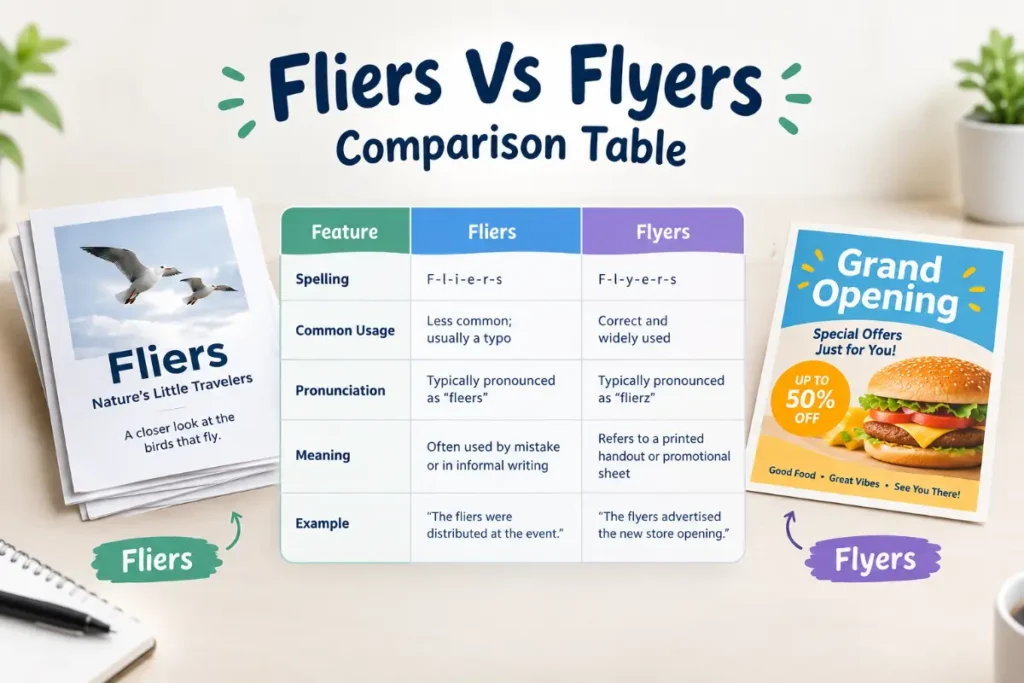
Fliers Vs Flyers Comparison Table
|
Feature
|
Fliers
|
Flyers
|
| — | — | — |
|
Singular form
|
Flier
|
Flyer
|
|
Part of speech
|
Noun
|
Noun
|
|
Main meanings
|
People or things that fly; sometimes printed advertisements
|
People or things that fly; printed advertisements
|
|
Printed advertisement
|
Correct
|
Correct and widely used in American English
|
|
Person who flies
|
Correct
|
Correct
|
|
Pronunciation
|
Usually the same
|
Usually the same
|
|
American English
|
Common
|
Very common
|
|
British English
|
Common in some uses
|
Also used
|
|
Formal writing
|
Correct
|
Correct
|
|
Plural form
|
Fliers
|
Flyers
|
|
Example
|
The airline offers discounts to frequent fliers.
|
We handed out flyers for the event.
|
Important: The table compares the plural forms. The singular words are flier and flyer.
What Does Flier Mean
Flier is a noun with two main uses. It can describe a person or thing that flies. It can also refer to a printed advertisement or handbill.
The spelling has been used in English for centuries. In American English it remains a familiar choice, especially in expressions related to air travel.
Flier As A Person Who Flies
A flier can mean someone who flies an aircraft or someone who travels by air.
For example.
- She is an experienced flier who travels for work every month.
- Frequent fliers may receive airline rewards.
- The young flier trained for years before entering the competition.
In these examples, the word refers to a person connected with flying.
Flier As A Printed Advertisement
Flier can also mean a single sheet of paper used to advertise an event, product, service, or announcement.
For example.
- The community center posted a flier about the weekend concert.
- I picked up a flier for a local cooking class.
- The charity created a colorful flier to promote its fundraiser.
This meaning is correct, although flyer is often the preferred spelling for advertising materials in American English.
What Does Flyer Mean
Flyer is also a noun. It has the same two broad meanings as flier.
It can describe a person or thing that flies.
Flyer As A Person Who Flies
A flyer can refer to someone who flies an aircraft or travels by air.
Examples.
- He’s a nervous flyer who prefers short flights.
- The pilot is a skilled flyer with decades of experience.
- Frequent flyers often know the best airport shortcuts.
Flyer As A Printed Advertisement
In American English, flyer is especially common for a printed promotional sheet.
Examples.
- We designed a flyer for the store’s grand opening.
- The school sent home a flyer about the spring festival.
- She posted flyers around the neighborhood to advertise the lost dog.
- The restaurant distributed flyers announcing its new lunch menu.
If you’re writing about marketing, promotions, events, or local advertising for a US audience, flyer is usually the most familiar choice.
Which One Is Correct
Both flier and flyer are correct spellings. Neither is automatically a misspelling.
The best choice depends on the meaning and the style you want to follow.
Use Flyer For Advertising In American English
When you’re referring to a printed advertisement, flyer is a strong default for American readers.
For example.
We need to print 500 flyers for the community event.
This spelling is common in marketing, schools, businesses, and everyday conversation.
Use Flier For A Person Who Flies
Flier is a traditional and established spelling for someone who flies.
For example.
She’s a frequent flier who travels across the country for work.
However, frequent flyer is also completely correct and is widely used in airline programs and travel writing.
Can You Use Flier For An Advertisement
Yes. Flier is not wrong when you mean a printed advertisement.
For example.
The library created a flier announcing its new reading program.
Still, if your audience is mainly American and you’re writing promotional content, flyer may look more familiar and natural.
Why People Confuse Fliers And Flyers
The confusion comes from the fact that these words have the same pronunciation and overlap in meaning. Unlike many spelling differences, this isn’t a case of one form being correct and the other being incorrect.
They Sound The Same
In standard American English, flier and flyer are usually pronounced the same.
That means listeners can’t normally tell which spelling you’re using. The difference only becomes visible in writing.
Both Words Can Mean A Printed Advertisement
This is one of the biggest sources of confusion.
A person might write.
I made a flier for the event.
Another might write.
I made a flyer for the event.
Both sentences are understandable and grammatically correct. The second version is more common in many American contexts.
Both Words Can Describe Someone Who Flies
The same overlap appears in travel language.
- Frequent flier.
- Frequent flyer.
Both expressions are established. Airline companies often use frequent flyer in program names and customer materials, but frequent flier is also found in dictionaries and published writing.
Different Style Guides Prefer Different Forms
Some publishers choose one spelling for consistency. Others accept both.
This matters in professional writing because consistency often matters more than choosing a single universally correct form. If your organization uses flyer throughout its marketing materials, switching to flier in one document may create unnecessary inconsistency.

Key Differences Between Flier And Flyer
The two spellings overlap so much that their differences are mostly about usage preference rather than meaning.
Meaning
Both can mean.
- A person who flies.
- A person who travels by air.
- A printed advertisement.
- A handbill or promotional sheet.
The surrounding sentence tells the reader which meaning applies.
Spelling
Flier uses the traditional spelling with ie.
Flyer uses the spelling with y.
Neither spelling changes the pronunciation in ordinary English.
Regional Preference
American English commonly uses flyer for advertising materials. British English also uses flyer for many advertising contexts. Flier remains established in both varieties, especially in expressions connected with flying.
Tone And Register
Neither word is inherently more formal than the other.
However, flyer may feel more familiar in marketing and advertising. Flier may feel more traditional in expressions such as frequent flier.
Function In A Sentence
Both are countable nouns.
Examples.
- I handed out a flyer.
- I handed out a flier.
- She is a frequent flyer.
- She is a frequent flier.
Their grammar works the same way. The difference is mainly spelling and preferred usage.
Grammar Explanation
Understanding the grammar is simple because flier and flyer are both nouns.
Singular Forms
Use flier or flyer when referring to one person or one printed item.
Examples.
- I saw a flyer outside the library.
- She is an experienced flier.
- The company printed a flier for the promotion.
- He’s a frequent flyer.
Plural Forms
Add s to create the plural.
- Flier becomes fliers.
- Flyer becomes flyers.
Examples.
- The volunteers distributed flyers.
- Frequent fliers can earn travel points.
- Several flyers were placed on the tables.
- The airport lounge was full of frequent fliers.
Articles
Because these words are countable nouns, use a or an when referring to one nonspecific item or person.
Examples.
- A flyer.
- A flier.
- An experienced flier.
- A frequent flyer.
Use the when referring to a specific person or item.
Examples.
- The flyer on the desk is for the concert.
- The flier sitting near the window is our pilot.
Possessives
You can form possessives in the usual way.
Examples.
- The flyer’s design looks professional.
- The flier’s passport was checked at the gate.
- The flyers’ colors matched the company logo.
- The fliers’ seats were near the front of the plane.
The apostrophe depends on the noun’s number and possession. The spelling difference doesn’t change the rule.
Spelling Rules And Usage Patterns
There isn’t a special spelling rule that makes one form correct and the other wrong. The two forms developed as accepted variants.
Still, a few practical spelling patterns are worth remembering.
Flier Uses The Traditional Ending
The spelling flier follows the same general pattern found in words built from fly and related forms.
Examples include.
- Flier.
- Fliers.
This spelling is especially familiar in expressions related to aviation and travel.
Flyer Uses The Y Ending
The spelling flyer is also established and widely used.
Examples include.
- Flyer.
- Flyers.
This version is especially common in American advertising language.
No Hyphen Is Needed
Neither flier nor flyer requires a hyphen.
Correct.
- Event flyer.
- Frequent flyer program.
- Airline flier.
- Promotional flier.
The phrase frequent flyer program is normally written without a hyphen because frequent modifies flyer and the phrase functions naturally as a noun expression.
Don’t Change The Spelling Based On Plural Use
The plural forms simply add s.
Correct.
- One flyer.
- Two flyers.
- One flier.
- Two fliers.
Avoid inventing forms such as flyes or flires. Those aren’t standard plurals.
Many readers also check Contractor Vs Contracter Which Spelling Is Correct 2026.
Pronunciation Guide
Since the two words are usually homophones, pronunciation won’t help you decide which spelling to write.
Flier
IPA
/ˈflaɪər/
Syllables
Fly er.
Stress
The first syllable receives the main stress.
Flyer
IPA
/ˈflaɪər/
Syllables
Fly er.
Stress
The first syllable receives the main stress.
Common Pronunciation Mistake
Some learners may try to pronounce flier differently because of its spelling. In standard American English, the ie does not create a separate sound from the y in flyer.
Both words generally sound like fly er.
Word Origin And History
The history of these words explains why both spellings survived.
The Root Word Fly
Both forms come from fly, which has Old English roots. The verb has long referred to moving through the air. Over time, English speakers formed nouns for people and things connected with flying.
The Ending Er
The ending er often creates a noun that refers to a person or thing performing an action.
Examples include.
- Teach becomes teacher.
- Drive becomes driver.
- Run becomes runner.
- Fly becomes flier or flyer.
The spelling developed in more than one accepted form.
Why Both Spellings Remain
English spelling has never followed one perfectly consistent system. Different regions, publishers, and periods have favored different forms.
As a result, flier and flyer both became established in dictionaries and published writing. Neither is a modern error created by the internet.
British American Canadian And Australian English
Regional usage matters most when you’re choosing a preferred spelling for a particular audience.
American English
In the United States, flyer is especially common for a printed advertisement.
Examples.
- A promotional flyer.
- A concert flyer.
- A store flyer.
- A real estate flyer.
Flier is also correct and remains common in phrases such as frequent flier.
British English
British English uses flyer for advertising materials and also recognizes flier in established usage.
For example.
- The shop handed out flyers.
- The airline offers benefits to frequent flyers.
You may also encounter flier in travel and aviation contexts.
Canadian English
Canadian English generally recognizes both spellings. Flyer is common for advertising materials while flier remains an accepted alternative.
Australian English
Australian English also uses both forms. Flyer is common in advertising and event promotion. Flier appears in aviation and other contexts connected with flying.
Practical Regional Advice
If you’re writing for a broad English speaking audience, either spelling is understandable. If you’re writing specifically for Americans and referring to a printed advertisement, flyer is usually the safest default.
Real Life Examples Of Flier And Flyer
The following examples show how both spellings work in natural sentences.
Daily Conversation
- Did you see the flyer for the food festival.
- I picked up a flier about free language classes.
- She’s a nervous flyer who hates turbulence.
- My dad is a frequent flier.
- The gym left flyers at the front desk.
Workplace
- Our marketing team designed a flyer for the new service.
- The sales representative handed out flyers at the trade show.
- We need a simple flier that explains the membership options.
- The airline offers special rewards to frequent flyers.
- The event coordinator approved the final flyer.
Emails
- I’ve attached the flyer for next week’s workshop.
- Could you review the flier before we send it to customers.
- Please share the event flyer with the department.
- The airline emailed its frequent flyers about the schedule change.
Academic Writing
- The student analyzed a political campaign flyer.
- The museum distributed a flier explaining the exhibition.
- The study examined how advertising flyers influence local shopping habits.
Journalism
- The newspaper reported that volunteers handed out flyers across the city.
- A flier posted outside the station announced the public meeting.
- The article described the pilot as an experienced flyer.
Social Media
- Our new event flyer is ready.
- Share this flyer with anyone who loves live music.
- Looking for a frequent flyer who knows the best travel tips.
- The campaign posted a digital flier on its social media page.
Literature And Creative Writing
- A faded flyer clung to the noticeboard outside the theater.
- The young flier watched the clouds disappear beneath the aircraft.
- A handbill or flier can reveal a lot about the culture of a particular era.
Note: In creative writing, the spelling can reflect a publication’s style or the writer’s preference. Both forms remain valid.
Common Mistakes To Avoid

Mistake One Treating Flyer As The Only Correct Form
Flyer is common, especially in American advertising, but flier is not automatically wrong.
Correct.
The library printed a flier for the reading club.
Mistake Two Treating Flier As An Error
Flier is a legitimate English spelling. It appears in dictionaries and published writing.
Correct.
She’s a frequent flier who travels for work.
Mistake Three Assuming The Words Have Different Pronunciations
They are usually pronounced the same. The spelling difference doesn’t normally change the sound.
Mistake Four Using The Wrong Plural
The correct plurals are.
- Flier becomes fliers.
- Flyer becomes flyers.
Mistake Five Mixing Spellings In One Document
Using both forms in the same document isn’t grammatically wrong. However, switching between them without a reason can make your writing look inconsistent.
For example, if your marketing campaign uses flyer, keep that spelling throughout the campaign unless a quoted name or official title requires something else.
Memory Tricks
A simple memory trick can help you choose the spelling quickly.
Think Of Flyer For Advertising
Imagine a flyer flying from one person to another as it spreads news about an event.
Flyer equals a common choice for advertising.
This isn’t a strict grammar rule. It’s a practical reminder for American English.
Think Of Flier For Flying
The spelling flier may help you remember expressions such as.
- Frequent flier.
- Experienced flier.
- Airline flier.
Again, this is a memory aid rather than a rule. Flyer is also correct in these contexts.
Remember Both Are Valid
The most important trick is to avoid thinking of one as the correct spelling and the other as the mistake.
Instead, remember.
Flier and flyer are both correct. Choose the form that fits your audience and style guide.
Related Words And Frequently Confused Terms
Understanding nearby words can make the distinction easier.
Related Words
- Fly.
- Flying.
- Flight.
- Airplane.
- Aviation.
- Pilot.
- Passenger.
- Airline.
- Advertisement.
- Handbill.
- Brochure.
- Leaflet.
Similar Words For A Printed Flyer
Depending on the context, you might use.
- Handbill.
- Leaflet.
- Advertisement.
- Promotional sheet.
- Circular.
- Notice.
These words aren’t always exact synonyms. A brochure, for example, is often folded and contains more information than a typical flyer.
Similar Words For A Person Who Flies
Depending on the context, you might use.
- Pilot.
- Aviator.
- Air traveler.
- Passenger.
- Flight crew member.
These terms aren’t interchangeable in every sentence. A pilot operates an aircraft, while a passenger travels in one.
Expert Editor’s Note
A professional editor would not mark flier as an error simply because flyer appears more often in a particular document.
Both spellings are established. The better choice depends on meaning, audience, publication style, and consistency.
For American marketing content, flyer is often the clearest default because readers see it frequently in phrases such as event flyer, sales flyer, and promotional flyer.
For aviation or travel writing, both frequent flier and frequent flyer are acceptable. Many organizations use frequent flyer because it is familiar in airline branding and customer communication.
The most useful editorial rule is simple.
Choose one accepted spelling and use it consistently within the same piece of writing.
If you’re following a house style guide, follow that guide. If you’re writing for a general US audience without a required style, flyer is a practical choice for advertisements, while either form works for someone who flies.
For another common grammar confusion, see Coachs Or Coaches Which Spelling Is Correct 2026.
Conclusion
The answer to fliers vs flyers is that both spellings are correct.
Flier and flyer can describe a person or thing that flies. Both can also refer to a printed advertisement. The main difference is usage preference rather than correctness.
For American advertising and promotional materials, flyer is usually the most familiar choice. For travel and aviation, both flier and flyer are accepted.
The biggest mistake is assuming that one spelling is always wrong. Instead, consider the meaning, your audience, and the style of the publication.
When both spellings can fly, clarity and consistency should be your guide.

Editorial Reviewer & Proofreader
Grace Mitchell reviews Gramlify’s articles for clarity, consistency, and readability. She is passionate about creating accurate, approachable content that helps English learners build confidence.