
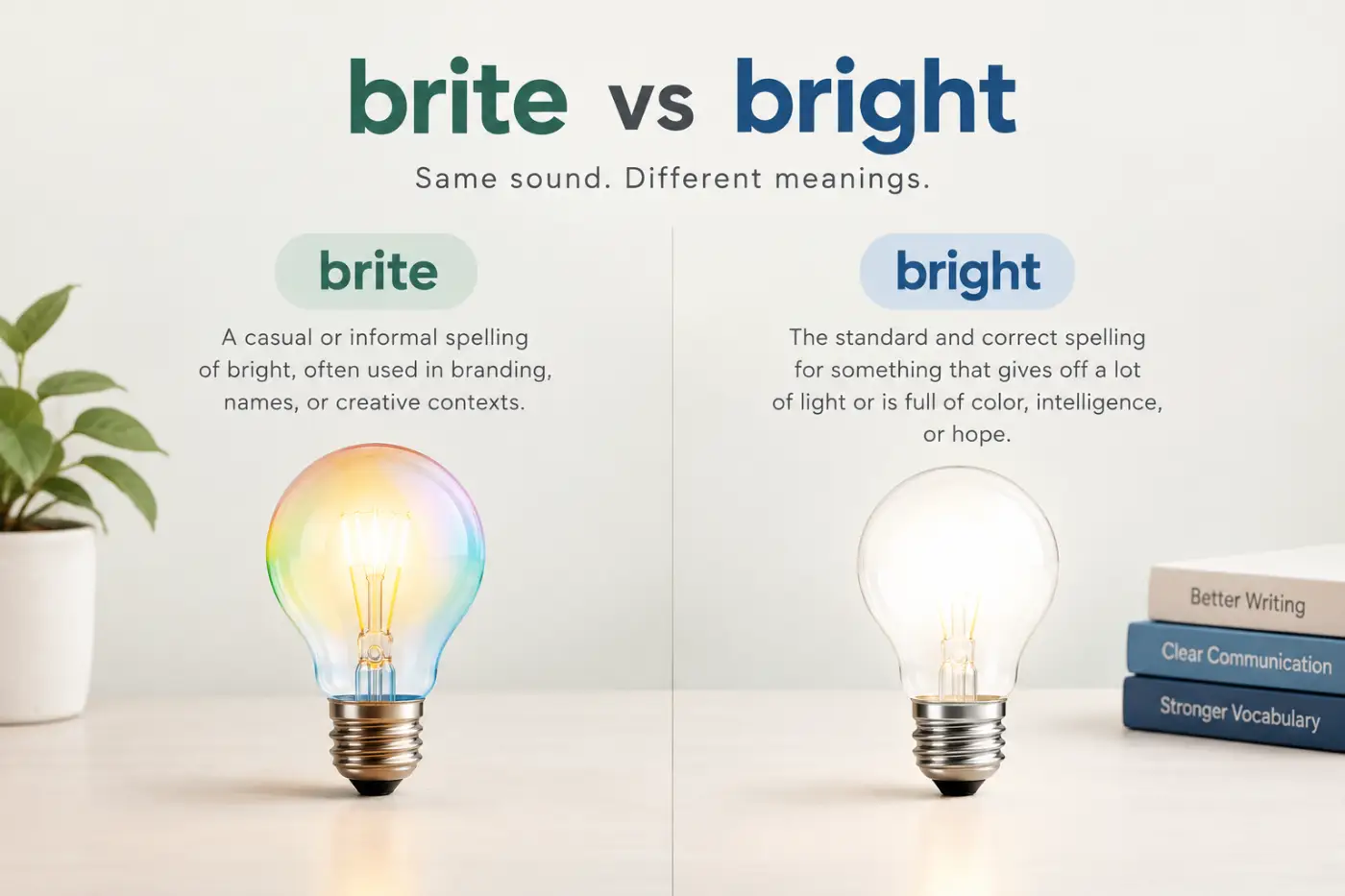
The difference between brite vs bright can look tiny on the page. Yet that extra gh matters when you’re writing standard English. If you mean something full of light, a vivid color, an intelligent person, or a hopeful future, bright is the standard word.
You may still see brite in product names, company names, advertisements, and other stylized forms. That can make the spelling look like an accepted alternative. In most ordinary writing, however, it isn’t the form you want. Bright is the spelling used in standard English. Cambridge gives it the pronunciation /braɪt/ in both British and American English and lists meanings related to light, color, intelligence, and happiness.
The confusion mainly comes from sound. Both forms can represent the same pronunciation. English has plenty of words where pronunciation doesn’t give you enough information to choose the spelling. In this guide, you’ll learn the difference between brite and bright, how bright works in a sentence, why brite appears in names, and how to remember the correct spelling without second guessing yourself.
A related grammar guide is Planing or Planning Which Spelling Is Correct 2026 Guide.
Quick Answer
Bright is the standard English spelling. Use it when you mean full of light, vivid in color, intelligent, cheerful, or promising. Brite is mainly a stylized spelling found in brand names, product names, and advertising. It can appear as a creative name, but it shouldn’t replace bright in normal school, workplace, academic, or professional writing.
Brite vs Bright Comparison
| Feature | Bright | Brite |
|---|---|---|
| Standard English spelling | Yes | No |
| Common dictionary word | Yes | Usually not as the standard adjective |
| Meaning | Light, vivid, intelligent, cheerful, promising | Usually represents the idea of bright |
| Part of speech | Mainly adjective and also noun or adverb in specific uses | Usually a stylized name or spelling |
| Pronunciation | /braɪt/ | Often /braɪt/ when used as a spelling of bright |
| Formal writing | Appropriate | Generally avoid |
| Academic writing | Appropriate | Generally avoid |
| Workplace writing | Appropriate | Generally avoid |
| Brand names | Yes | Common |
| Product names | Yes | Common |
| Regional spelling | Standard in American and British English | Not a British or American spelling difference |
| Main use | Ordinary English | Branding and creative naming |
The key point is that brite vs bright do not have equal status in standard English. Bright is the ordinary English word. Brite can appear as a deliberate spelling choice in a name or brand. Etymonline records brite as a spelling variant of bright and notes its use in advertising.

What Does Bright Mean
Bright is an adjective with several common meanings. Its central idea is connected to light and visibility. From that basic meaning, English developed several figurative uses.
Cambridge defines bright as full of light or shining. It also uses the word for strong colors, intelligent people, and situations that offer hope or happiness.
Bright Means Full Of Light
Use bright for something that gives off a lot of light or reflects a strong amount of light.
Examples include:
The sun is bright this morning.
That lamp is too bright for my eyes.
We walked into a bright room.
The moon looked bright against the dark sky.
The kitchen has large windows and feels bright all day.
This is the most direct meaning of the word.
Bright Means Strong In Color
Bright can also describe a color that is strong, vivid, or easy to notice.
For example:
She wore a bright yellow dress.
The children painted the wall bright blue.
I bought a bright green backpack.
His shoes were bright red.
The room has bright orange curtains.
Cambridge specifically lists this color meaning and gives examples involving bright red, bright yellow, and other vivid colors.
Bright Means Intelligent
English also uses bright to describe someone who learns quickly or understands things easily.
For example:
Maya is a bright student.
He’s very bright and learns new skills quickly.
She had a bright idea during the meeting.
The teacher knew the child was bright.
This meaning is common in everyday American English. It can sound warm and natural when describing someone’s ability.
Bright Means Hopeful
Bright can describe something that looks promising or positive.
For example:
She has a bright future ahead of her.
The team has a bright season ahead.
Things are starting to look brighter.
The company has a bright outlook.
This figurative use connects the idea of light with hope. A bright future is imagined as a future that has good possibilities ahead.
What Does Brite Mean
Brite needs a little more care because it doesn’t function like a normal alternative spelling in ordinary English sentences.
You may see Brite in a company name, product name, service name, trademark, advertising phrase, or deliberately creative spelling. Etymonline records brite as a spelling variant of bright and notes that advertisers used the form as early as the early twentieth century.
That history explains something important. Brite isn’t simply a random spelling mistake that appeared because someone forgot the gh. It has been used intentionally as a shortened or stylized form.
For example, a company might choose a name such as:
Brite Dental
Brite Cleaning
Brite Media
Brite Kids
Those names use spelling as part of their identity. The unusual spelling helps a name stand out.
The same principle applies to product names. A manufacturer might choose a creative spelling because it looks shorter or more distinctive on packaging.
That does not turn brite into the standard spelling of the adjective.
If you are writing a normal sentence, use bright.
Which One Is Correct
Bright is the correct standard spelling when you are using the ordinary English word.
Use bright in:
• School assignments.
• College papers.
• Business emails.
• Reports.
• Articles.
• Resumes.
• Formal letters.
• Academic writing.
• General conversation.
• Everyday messages.
For example:
The office is bright and comfortable.
She is a bright student.
We chose a bright blue color.
He has a bright future.
The room became bright when the curtains opened.
Use Brite only when the spelling is part of an official name or deliberate creative wording.
For example:
I bought the product from Brite Cleaning.
Her dentist works at Brite Dental.
The company launched a new Brite product.
In those examples, Brite functions as part of a name. Changing it to Bright could actually change the official name.
A useful editorial rule is simple: If you’re describing something, write bright. If you’re reproducing a name, copy the official spelling of that name.
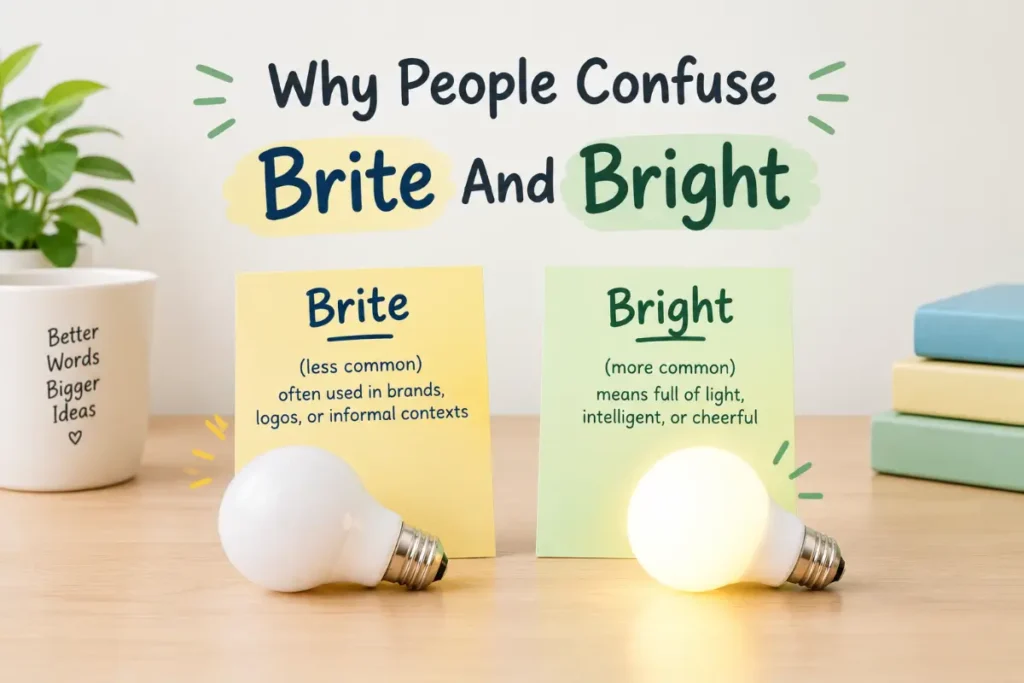
Why People Confuse brite vs bright
The biggest reason is pronunciation.
Bright is pronounced /braɪt/ in both British and American English. Cambridge breaks the pronunciation into /b/, /r/, /aɪ/, and /t/.
The spelling brite can represent the same sound. Once you hear the word without seeing it written, you lose the visual clue provided by the letters gh.
That creates a familiar English spelling problem.
Someone hears:
Bright.
They may mentally spell:
Brite.
The problem becomes more likely in quick texting, online searches, informal messages, or situations where a person learned the word mainly through speech.
Sound Does Not Always Tell You The Spelling
English spelling often preserves historical forms that pronunciation has changed over time.
The gh in bright is a good example. Modern speakers don’t pronounce the gh as a separate sound. The whole word is simply /braɪt/. Yet those letters remain part of the standard spelling.
That can feel strange to English learners. The spelling looks longer than the sound.
Still, this pattern is normal in English.
Compare:
right
night
light
sight
bright
These words share a useful visual pattern. The igh sequence often represents the /aɪ/ sound.
So the extra letters in bright aren’t random decoration. They belong to a long established spelling pattern.
Bright Spelling And The Igh Pattern
One of the easiest ways to remember bright is to connect it with other familiar words ending in ight.
Think of:
light
night
right
sight
tight
fight
might
bright
This pattern gives you a strong spelling memory.
If you write brite because the word sounds like /braɪt/, stop and think of light and right.
You probably wouldn’t write:
lite
rite
in standard English when you mean the ordinary words light and right.
That same spelling pattern helps you remember bright.
There are exceptions and special names across English, so the pattern isn’t an absolute spelling rule. Still, it’s a useful memory aid for everyday writing.
Bright Pronunciation Guide
The standard pronunciation of bright is:
IPA: /braɪt/
Syllables: One syllable.
Stress: The entire word carries the natural stress because it has only one syllable.
The vowel sound is the same basic sound you hear in eye.
You can think of the word as:
B + R + eye + T.
That isn’t a formal pronunciation guide. It’s simply a useful learning trick.
Cambridge lists /braɪt/ for both UK and US English.
A common mistake is to pronounce the word as if the gh has its own sound. It doesn’t. The modern word has a single syllable and ends with the /t/ sound.
Learn the difference in Mentioned Vs Mentionned Which Spelling Is Correct 2026 Guide.
Is Brite A Misspelling
In an ordinary sentence, brite is generally a nonstandard spelling of bright.
Still, calling every appearance of brite a simple spelling error would miss an important part of English usage. Writers and businesses sometimes choose alternative spellings intentionally. Etymonline documents brite as a spelling variant and specifically connects it with advertising.
So context matters.
If a student writes:
The room was brite.
A teacher would normally correct brite to bright.
If a company is officially called:
Brite Solutions.
You should preserve Brite when referring to that company.
The difference comes down to function. One is the standard spelling of an English adjective. The other can be a deliberate name or stylistic spelling.
Why Brands Use Brite
Brands care about visual identity. A short or unusual spelling can make a name easier to distinguish.
The spelling Brite has a few natural advantages for naming.
First, it looks shorter than bright.
Second, it keeps the familiar sound.
Third, readers can usually connect it with the idea of brightness.
Fourth, an unusual spelling can make a product name feel distinctive.
This is common in commercial naming. Businesses often alter familiar words to create names that look unique.
That doesn’t change standard grammar.
Think of it like a person choosing a creative spelling for a name. The unusual spelling can be correct for that name while still being wrong as the ordinary spelling of a common word.
That distinction is useful for editors. A proper name should be checked against the organization’s own published spelling. A common adjective should follow standard dictionary usage.
Suggested internal link opportunity: [Finaly or Finally The Correct Spelling] can help readers who are also comparing a standard English spelling with a sound based mistake.
Expert Editors Note
A professional editor would normally make the decision quickly.
If the sentence needs the ordinary adjective meaning full of light, vivid, intelligent, cheerful, or promising, write bright.
If the word is part of a proper name, check the official name and preserve its spelling.
That approach is more reliable than trying to decide based only on appearance.
Dictionary evidence supports this approach. Cambridge lists bright as an established word for strong light, vivid color, intelligence, happiness, and hope. It also gives the pronunciation /braɪt/ in British and American English.
The historical evidence adds another useful detail. Brite isn’t simply an accidental internet spelling. Etymonline records it as a spelling variant of bright and documents its use in advertising.
So an editor shouldn’t say that every appearance of brite is automatically a mistake.
The better rule is simple.
Use bright as the standard English word. Preserve Brite when it’s an official or intentional name.
A Simple Test For Choosing Bright
When you’re unsure, ask yourself what job the word is doing.
If you’re describing light, use bright.
If you’re describing a color, use bright.
If you’re describing intelligence, use bright.
If you’re describing hope or a promising future, use bright.
If you’re writing a brand or product name, check the official spelling.
This gives you a quick decision system:
• Ordinary adjective: bright.
• Official name: copy the official spelling.
That’s all most writers need.
Memory Tricks For Bright
The easiest memory trick is:
Bright has right inside it.
Think:
right → bright.
Another useful connection is:
light → bright.
Both words belong to the familiar ight spelling pattern.
You can also remember this sentence:
The bright light is right.
It links three familiar words with the same spelling pattern.
If you see Brite in a product name, don’t let it overwrite the spelling in your memory. Think of it as a name using a creative spelling.
That small mental distinction can save you from repeating the mistake later.
Common Questions About Brite And Bright
Is bright the correct spelling
Yes. Bright is the standard English spelling when you mean full of light, strong in color, intelligent, cheerful, or promising. Cambridge lists these meanings and gives the standard pronunciation /braɪt/. Use bright in normal writing, including schoolwork, professional communication, articles, reports, and everyday messages.
Is brite a real English word
Brite can appear in English as a spelling variant and as part of names, especially in advertising and branding. Etymonline records brite as a spelling variant of bright and documents its use in advertising. It shouldn’t normally replace bright in an ordinary sentence.
Are brite and bright pronounced the same
When brite is being used as a stylized spelling of bright, it commonly represents the same /braɪt/ sound. Bright itself is pronounced /braɪt/ in both British and American English according to Cambridge. The shared pronunciation explains much of the spelling confusion.
Is brite an American spelling of bright
No. Brite isn’t a standard American spelling that replaces bright. American English uses bright. British English also uses bright. Brite mainly appears as a creative spelling in names, branding, advertising, and other special contexts.
Can I use brite in an essay
For a normal essay, use bright. For example, write The room was bright rather than The room was brite. If you’re referring to an organization, product, or other proper name that officially uses Brite, keep the official spelling of that name.
Why does bright have gh if we don’t pronounce it
The spelling reflects the history of English. Bright developed from older English and Germanic forms that contained sounds and spelling patterns that changed over time. Modern pronunciation no longer gives the gh its own sound, but the letters remain part of the established spelling.
What does bright mean when describing a person
When bright describes a person, it usually means intelligent or quick to learn. For example, She is a bright student means that she learns and understands things quickly. Cambridge lists this as an established meaning of bright.
What does bright mean in bright future
In bright future, bright means hopeful or promising. The expression suggests that good possibilities lie ahead. For example, She has a bright future means that her abilities or circumstances suggest she may have a successful and positive future.
Is bright an adjective or a noun
Bright is mainly an adjective. It can also function as a noun in specific uses. For example, American English uses brights informally for a car’s powerful headlights. Cambridge records this noun use and notes full beam as the common British English equivalent.
What is the adverb form of bright
The usual adverb is brightly. For example, you can write The stars were shining brightly or She smiled brightly. Brightly is used for actions connected with light, vivid color, and happiness or hope.
Is bright the same in British and American English
Yes. The adjective is spelled bright in both major varieties of English. Cambridge lists /braɪt/ for both British and American pronunciation. Some related expressions can differ, such as the American use of brights for powerful car headlights compared with British full beam.
How can I remember to spell bright correctly
Connect bright with light, right, and night. These familiar words share the ight pattern. You can also remember that bright has right inside it. When you mean the ordinary adjective, choose bright. Save Brite for a name or intentional creative spelling.
A Practical Editing Checklist
Before submitting an essay, email, article, or report, check the sentence.
Ask:
- Am I describing something as full of light?
Use bright.
- Am I describing a vivid color?
Use bright.
- Am I describing someone’s intelligence?
Use bright.
Check the official spelling.
This quick check covers almost every real world situation.
Still confused? Compare Courtesy Vs Curtesy Which Word Is Correct 2026.
Final Verdict On Brite And Bright
Bright is the correct standard spelling for the ordinary English word.
Use it for light, vivid colors, intelligence, cheerful qualities, hopeful situations, and promising futures. The word has a long history in English and remains a common part of modern vocabulary. Cambridge documents its major meanings and its /braɪt/ pronunciation in British and American English.
Brite has a different role. It can appear as a stylized spelling in advertising, branding, product names, and other creative contexts. Its history as a spelling variant is documented, so it isn’t accurate to treat every appearance as a random typing error.
The biggest mistake is using Brite simply because it sounds right.
When you’re writing an ordinary sentence, choose bright.
When you’re copying an official name, copy the name exactly.
Once you separate standard vocabulary from creative naming, the choice becomes easy.
If you mean the word that shines, think bright and write it right.

Editorial Reviewer & Proofreader
Grace Mitchell reviews Gramlify’s articles for clarity, consistency, and readability. She is passionate about creating accurate, approachable content that helps English learners build confidence.