
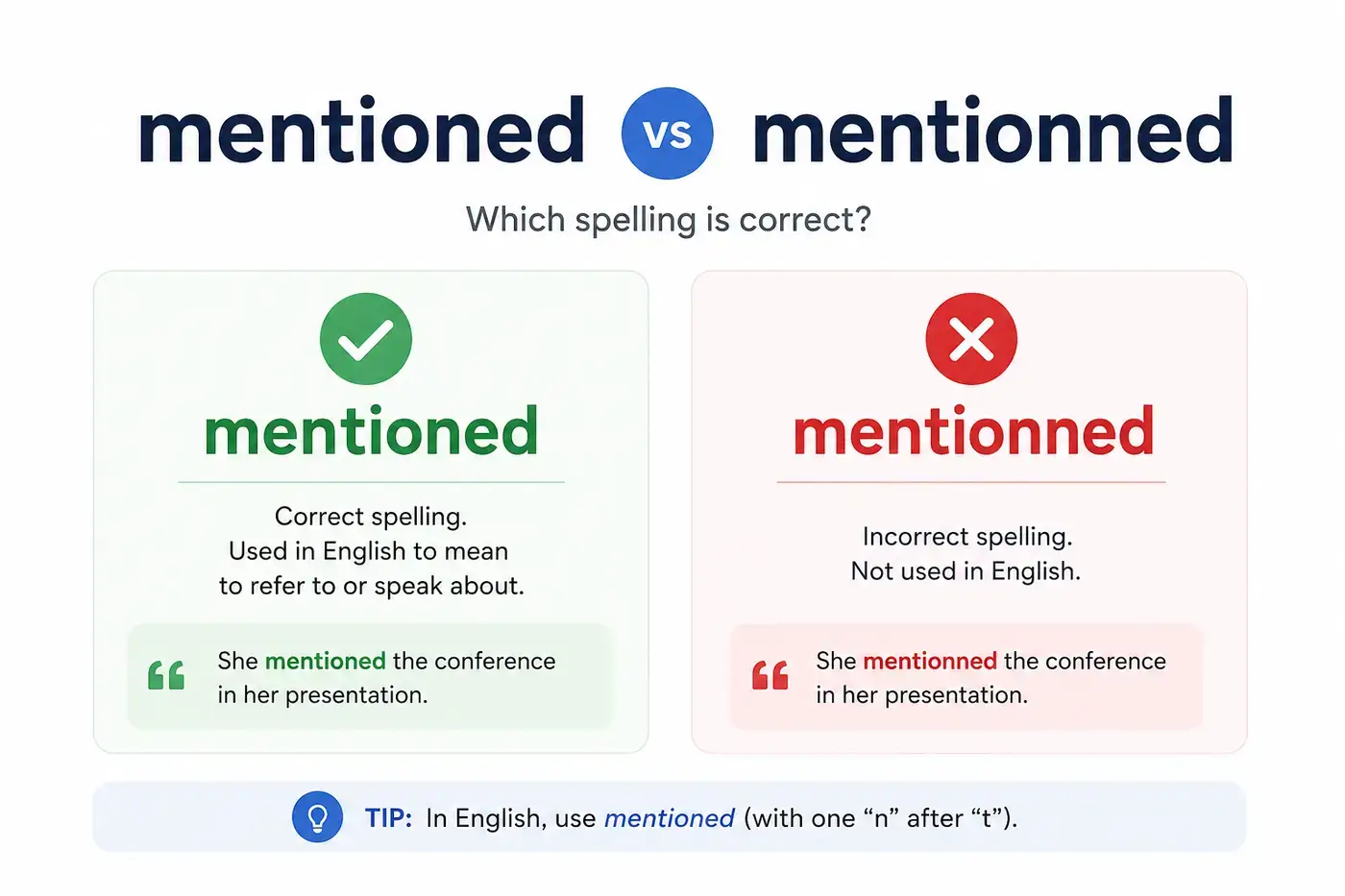
If you’ve searched for mentioned vs mentionned you’re probably wondering if both spellings are correct or if one is simply a common typo. The short answer is simple. Mentioned is the correct English spelling. Mentionned is incorrect and should never appear in standard English writing.
The confusion usually comes from spelling rules. English sometimes doubles the final consonant before adding ed. Think of words like planned or stopped. Because of those patterns many learners assume mention follows the same rule and write mentionned. It doesn’t.
Once you understand why the spelling stays the same you’ll avoid this mistake in emails school assignments business writing and everyday conversations.
This guide explains the correct spelling the grammar behind it common mistakes pronunciation practical examples and expert writing tips. By the end you’ll know exactly why mentioned is correct and you’ll never hesitate when using this word again.
Suggested Internal Link: Occurred Vs Occured Which Spelling Is Correct.
A related grammar guide is Combatting Or Combating Which Spelling Is Correct 2026.
Quick Answer
Mentioned is the correct spelling in English. It is the past tense and past participle of the verb mention. Mentionned is a misspelling and is not accepted in American English British English Canadian English or Australian English.
Mentioned Vs Mentionned Comparison Table
| Feature | Mentioned | Mentionned |
|---|---|---|
| Correct spelling | Yes | No |
| Part of speech | Verb | Not a standard English word |
| Meaning | Referred to something or someone | Misspelling |
| Grammar | Past tense and past participle of mention | Incorrect |
| Used in dictionaries | Yes | No |
| Accepted in formal writing | Yes | No |
| Common in English speaking countries | Yes | No |
| Example | She mentioned the meeting yesterday. | She mentionned the meeting yesterday. ✘ |
What Does Mentioned Mean
Mentioned is the past tense and past participle of the verb mention. It means to refer to someone or something briefly during speaking or writing.
Simple Definition
Mentioned means talked about or referred to someone or something.
How People Use Mentioned
People use mentioned every day in conversations emails reports articles and academic writing.
Examples.
- She mentioned your name during the meeting.
- He mentioned the weather before leaving.
- My teacher mentioned an important grammar rule.
- They mentioned the new project in yesterday’s email.
- The article mentioned several useful resources.
Mentioned In Different Contexts
Daily conversation.
I mentioned your idea to my friends.
Workplace.
The manager mentioned the deadline during the presentation.
Emails.
As mentioned in my previous email the report is ready.
Academic writing.
The researcher mentioned several earlier studies.
Journalism.
The newspaper mentioned the event in today’s edition.
Which One Is Correct
The correct spelling is mentioned.
The spelling mentionned is always incorrect in English.
Correct examples.
✔ She mentioned my suggestion.
✔ They mentioned the schedule yesterday.
✔ Nobody mentioned the price.
Incorrect examples.
✘ She mentionned my suggestion.
✘ They mentionned the schedule yesterday.
Professional editors dictionaries teachers and style guides all recommend using mentioned because it follows standard English spelling rules.
Why Mentionned Is Incorrect
Many English learners believe the letter n should double before adding ed.
That rule works for some verbs but not for mention.
Compare these words.
| Base Verb | Past Tense |
|---|---|
| Plan | Planned |
| Stop | Stopped |
| Mention | Mentioned |
| Open | Opened |
| Visit | Visited |
The difference comes from English spelling rules.
The stress in mention falls on the first syllable.
MEN tion
Because the final syllable is not stressed the last n does not double before adding ed.
This is the same pattern found in many English verbs.
- Open becomes opened.
- Visit becomes visited.
- Listen becomes listened.
- Happen becomes happened.
- Mention becomes mentioned.
Understanding this single rule prevents one of the most common spelling mistakes English learners make.
Why People Confuse Mentioned And Mentionned
There are several reasons this mistake appears so often.
Similar Looking Words
The incorrect spelling differs by only one extra n. Many people overlook the mistake during typing or proofreading.
Confusing Spelling Rules
English doubles the final consonant in some verbs but not in others.
That makes learners wonder if mention follows the same pattern.
It does not.
Influence From Other Languages
French uses spellings with double consonants more frequently than English.
People who also write in French sometimes transfer those spelling habits into English.
Keyboard Typing Errors
Fast typing often produces an extra n without the writer noticing.
Spell check usually catches the mistake but not every writing platform corrects it automatically.
Internet Copying
Once an incorrect spelling appears online other writers sometimes copy it without checking a reliable dictionary.
That spreads the mistake even though it remains incorrect.
Key Differences Between Mentioned And Mentionned
Although these words look almost identical only one belongs in correct English.
| Feature | Mentioned | Mentionned |
|---|---|---|
| Correct English spelling | Yes | No |
| Found in dictionaries | Yes | No |
| Used by native speakers | Yes | No |
| Accepted in formal writing | Yes | No |
| Grammar | Correct past tense and past participle | Misspelling |
| Appears in school and business writing | Yes | No |
The simplest way to remember the difference is this.
If you are writing in English always use mentioned.
Never use mentionned.
Grammar Explanation
Understanding the grammar makes the correct spelling easy to remember.
Mention Is A Regular Verb
The base form is mention.
Like most regular English verbs it forms the past tense by adding ed.
| Verb Form | Example |
|---|---|
| Base verb | Mention |
| Present simple | Mention |
| Present participle | Mentioning |
| Past tense | Mentioned |
| Past participle | Mentioned |
Examples.
- I mention important details during meetings.
- She is mentioning your suggestion.
- They mentioned the new policy yesterday.
- The issue has been mentioned several times.
Notice that every correct past form uses mentioned.
Why The Letter N Does Not Double
English doubles the final consonant only in certain situations.
Generally the rule applies when all three conditions are true.
- The word ends with one vowel followed by one consonant.
- The final syllable receives the main stress.
- You add a suffix such as ed or ing.
For example.
| Base Word | Correct Form |
|---|---|
| Stop | Stopped |
| Plan | Planned |
| Prefer | Preferred |
The word mention does not follow this pattern because the stress falls on the first syllable.
MEN tion
Since the last syllable is not stressed the final n stays single.
That is why the correct spelling is mentioned.
Spelling Rule You Should Remember
A useful spelling rule is this.
Do not double the final consonant if the stress is not on the last syllable.
This rule applies to many common verbs.
| Base Word | Correct Past Form |
|---|---|
| Visit | Visited |
| Listen | Listened |
| Open | Opened |
| Happen | Happened |
| Enter | Entered |
| Mention | Mentioned |
Learning this pattern will help you avoid many spelling mistakes beyond this single word.
A related grammar guide is Chefs Or Cheves Which Spelling Is Correct 2026.
Pronunciation Guide
The pronunciation stays the same no matter where you use the word.
Mentioned
IPA
American English.
/ˈmen ʃənd/
Syllables
Men tioned.
Stress
The first syllable receives the strongest stress.
Common Pronunciation Mistakes
Some learners pronounce every written letter separately.
Native speakers usually pronounce the ending softly.
The word sounds like.
MEN shund.
Listening to native speakers and repeating the word aloud helps build confidence.
Word Origin
The word mention has a long history.
It comes from the Latin word mentio meaning a reference or reminder.
Later it entered Old French before becoming part of Middle English.
Over time English speakers created the regular verb mention and its past tense mentioned.
The incorrect spelling mentionned has never become part of standard English dictionaries.
British American Canadian And Australian English
Many spelling differences exist across English speaking countries.
Examples include.
- Color and colour.
- Center and centre.
- Traveler and traveller.
This is not one of those cases.
Every major variety of English uses mentioned.
The spelling mentionned is incorrect in.
- American English.
- British English.
- Canadian English.
- Australian English.
No respected dictionary or style guide accepts mentionned.
Real Life Examples
The best way to remember the correct spelling is to see it in real situations.
Daily Conversation
- She mentioned your birthday yesterday.
- Nobody mentioned the weather.
- He mentioned that restaurant again.
- I mentioned your idea to my family.
Workplace
- The manager mentioned the new deadline.
- Sarah mentioned an easier solution during the meeting.
- Our client mentioned a few changes.
- The report mentioned every important detail.
Emails
- As mentioned earlier the files are attached.
- You mentioned this issue last week.
- Thanks for mentioning the missing document.
- Nobody mentioned the updated schedule.
Academic Writing
- The author mentioned several previous studies.
- The textbook mentioned the same grammar rule.
- The professor mentioned another research paper.
Journalism
- The article mentioned rising prices.
- The reporter mentioned eyewitness accounts.
- The newspaper mentioned the event on its front page.
Social Media
- You mentioned my name in your post.
- Someone mentioned this movie yesterday and now I want to watch it.
These examples all use the correct spelling and show how naturally mentioned fits into everyday English.
Common Mistakes People Make
Many spelling mistakes happen because English has several rules for adding endings to verbs. Here are the mistakes editors see most often.
Adding An Extra N
Incorrect.
She mentionned the answer.
Correct.
She mentioned the answer.
The verb mention never doubles the final n before adding ed.
Forgetting The Past Tense
Incorrect.
Yesterday he mention the problem.
Correct.
Yesterday he mentioned the problem.
Always use the past tense when talking about something that already happened.
Confusing Mentioned With Mentioning
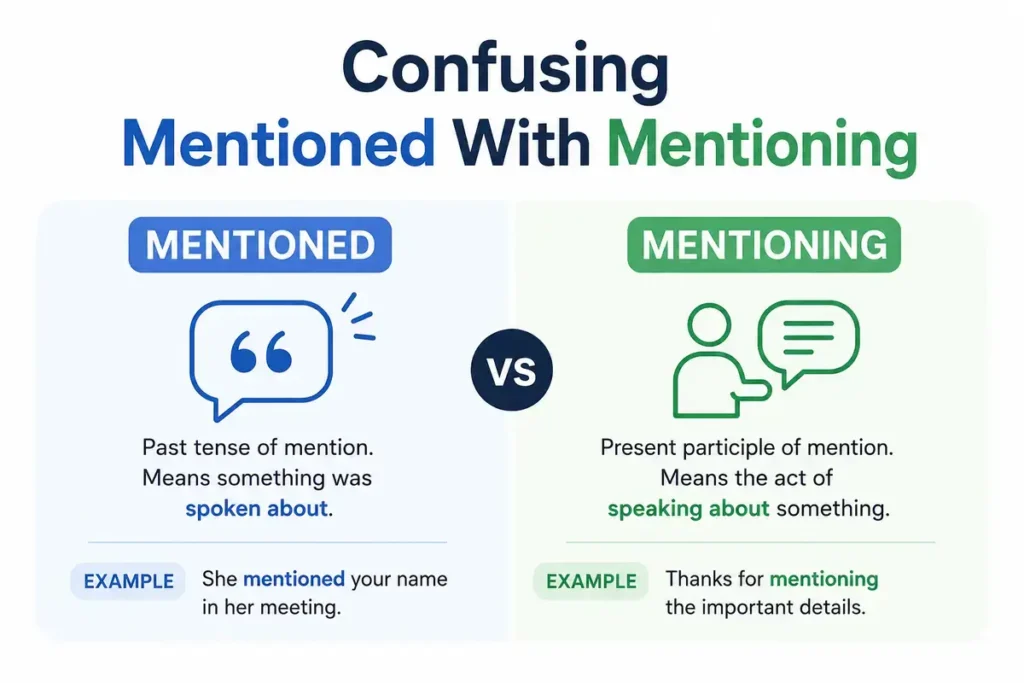
These words have different grammar functions.
Mentioned is the past tense or past participle.
Mentioning is the present participle.
Correct examples.
- She mentioned the issue yesterday.
- She is mentioning the issue now.
Believing Mentionned Is British English
This is a common internet myth.
British English also uses mentioned.
No major English speaking country accepts mentionned as the correct spelling.
Easy Memory Tricks
Simple tricks make the correct spelling easy to remember.
Think About The Base Word
The verb is mention.
Simply add ed.
Mention plus ed equals mentioned.
Nothing else changes.
Compare Similar Words
These verbs follow the same pattern.
- Listen becomes listened.
- Open becomes opened.
- Visit becomes visited.
- Enter becomes entered.
- Mention becomes mentioned.
Remember The Stress Rule
The stress falls on the first syllable.
MEN tion
Because the last syllable is not stressed the final n stays single.
That one rule helps you spell many English verbs correctly.
Related Words
Learning related words improves both spelling and vocabulary.
Synonyms
- Referred to.
- Spoke about.
- Brought up.
- Cited.
- Noted.
- Discussed.
- Introduced.
- Pointed out.
Related Forms
- Mention.
- Mentioning.
- Mentions.
- Mentionable.
- Mentioner.
Frequently Confused Words
- Occurred and Occured.
- Preferred and Prefered.
- Referred and Refered.
- Traveling and Travelling.
- Judgment and Judgement.
Learning these patterns makes spelling much easier over time.
Expert Editor’s Note
Professional editors recommend using mentioned every time.
Major dictionaries style guides and grammar references all recognize mentioned as the only correct spelling.
The mistake mentionned usually appears because writers apply the wrong doubling rule. Experienced proofreaders often spot this error immediately because it stands out in formal writing.
If you are writing an email school paper business report website article or social media post choose mentioned with confidence.
Correct spelling makes your writing look more professional and easier to trust.
Frequently Asked Questions
Is Mentioned Or Mentionned Correct?
Mentioned is correct. Mentionned is a spelling mistake and should not be used in English writing.
Why Is Mentionned Wrong?
The verb mention does not double the final n before adding ed because the final syllable is not stressed.
Is Mentionned Accepted In British English?
No. British English American English Canadian English and Australian English all use mentioned.
Is Mentioned A Regular Verb?
Yes. Mention is a regular verb. Its past tense and past participle are formed by adding ed.
How Do You Spell Mentioned Correctly?
Start with mention and simply add ed.
Mention plus ed equals mentioned.
What Does Mentioned Mean?
It means referred to or talked about someone or something in speech or writing.
Why Do People Add Another N?
Many learners confuse mention with verbs like plan and stop that double the final consonant before adding ed. The spelling rule is different for mention.
Still confused? Compare Nosey or Nosy Which Spelling Is Correct 2026.
Conclusion
The answer to mentioned vs mentionned is straightforward.Mentioned is the correct spelling in every major variety of English. It is the past tense and past participle of the verb mention.Mentionned is always incorrect and should be avoided in formal and informal writing.The easiest way to remember the rule is to start with the base verb mention and simply add ed. There is no reason to add another n.Once you understand this spelling pattern you’ll avoid the mistake every time and write with greater confidence.

Editorial Reviewer & Proofreader
Grace Mitchell reviews Gramlify’s articles for clarity, consistency, and readability. She is passionate about creating accurate, approachable content that helps English learners build confidence.
1 thought on “Mentioned Vs Mentionned Which Spelling Is Correct 2026 Guide”