

Planing or planning? The correct spelling depends on the meaning you want to express. Planning is the correct form when you mean organizing something in advance. Planing is also a real English word, but it has a different meaning connected to smoothing wood or moving across the surface of water.
These two words look almost identical. The extra n in planning makes a difference in spelling and meaning. That small detail can cause confusion in school assignments, workplace emails, personal messages, and everyday writing.
If you’ve ever wondered if planning needs one n or two, you’re not alone. The answer becomes easier once you understand the base word, the spelling rule, and the context in which each form belongs.
This guide explains the difference between planing and planning in clear, practical English. You’ll learn how to choose the correct word, understand the doubling rule, pronounce both forms, avoid common mistakes, and use each spelling naturally in real sentences. We’ll also look at related words, dictionary meanings, and examples from formal and informal writing.
By the end, you’ll know why planning is the right choice for making arrangements and why planing still has a valid place in English vocabulary.
Learn the difference in Commit Vs Comit Which Spelling Is Correct 2026 Guide.
Quick Answer
Planning is correct when you mean preparing or organizing something in advance. Planing is a different word that refers to smoothing wood with a plane or gliding over water. The extra n in planning comes from doubling the final consonant of plan before adding the suffix ing.
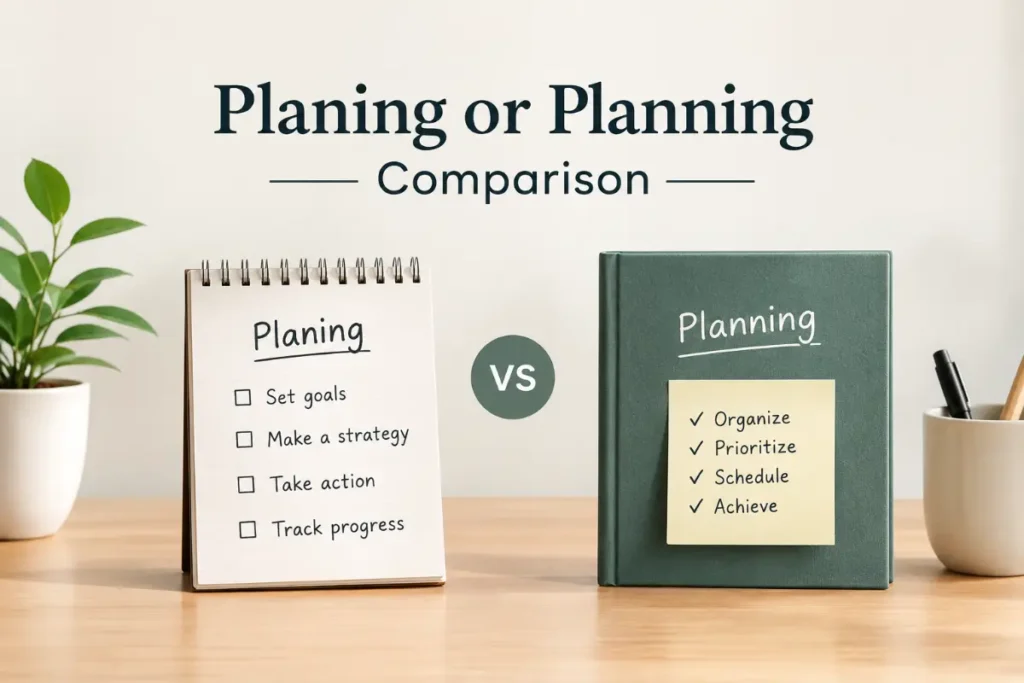
Planing or Planning Comparison
The two spellings represent different words with different meanings. Understanding that difference is more useful than simply memorizing the number of letters.
|
Feature
|
Planning
|
Planing
|
| — | — | — |
|
Correct spelling
|
Planning
|
Planing
|
|
Main meaning
|
Organizing or preparing in advance
|
Smoothing wood or gliding over water
|
|
Base word
|
Plan
|
Plane
|
|
Part of speech
|
Verb form and gerund
|
Verb form and gerund
|
|
Pronunciation
|
/ˈplænɪŋ/
|
/ˈpleɪnɪŋ/
|
|
Syllables
|
Two
|
Two
|
|
Common context
|
School, work, travel, events
|
Woodworking, carpentry, boating
|
|
Example
|
We are planning a trip.
|
The carpenter is planing the wood.
|
|
Common use
|
Very frequent in everyday English
|
Less common and more specialized
|
The most important distinction is the base word.
- Plan + ing = planning.
- Plane + ing = planing.
The final e in plane disappears before the suffix ing. The final consonant in plan doubles because it follows a common English spelling rule.
Definitions Of Planing And Planning
Before studying the spelling rule, it helps to understand the meaning of each word separately.
What Does Planning Mean
Planning means thinking about a future action and deciding what steps you need to take. It comes from the verb plan.
Planning can involve making arrangements, setting goals, organizing resources, or deciding how to complete a task.
For example:
- We are planning a family vacation.
- She is planning her next project.
- The teacher is planning a lesson.
- They spent the afternoon planning the event.
In each sentence, planning refers to preparing for something that has not happened yet or organizing an activity that requires decisions.
Planning is common in daily conversation and professional writing. People plan meals, meetings, budgets, trips, lessons, celebrations, and long term goals.
What Does Planing Mean
Planing is the form of the verb plane. It generally means using a tool called a plane to smooth or shape wood.
A carpenter may plane a rough board to create a flat and even surface. The process removes thin layers of wood.
For example:
- The carpenter is planing the wooden door.
- He spent the morning planing a rough board.
- Planing the surface made the table smoother.
Planing can also describe a boat or watercraft moving across the surface of water at speed. In that context, the word relates to planing as a boating term.
For example:
- The speedboat is planing across the lake.
- The boat began planing after the engine gained speed.
This meaning is much less common in ordinary conversation than planning in the sense of preparing for the future.
Which One Is Correct
Planning is correct when you mean organizing or preparing for something. Planing is correct when you mean smoothing wood or describing a boat moving across water.
Both spellings are legitimate. The right choice depends on the base verb and the meaning of the sentence.
Use planning when the action involves decisions or preparation.
We are planning a birthday party.
Use planing when the action involves a woodworking tool.
The carpenter is planing the wooden board.
The two words aren’t interchangeable. Replacing one with the other can change the meaning or make a sentence incorrect.
A useful editing habit is to identify the action before checking the spelling. Ask yourself what the person or object is doing. If someone is preparing for an event, use planning. If someone is smoothing wood, use planing.
Why People Confuse Planing And Planning
The confusion comes from the close visual relationship between the two spellings. Both begin with the same letters and end in ing. Only the base word and the number of n letters separate them.
Visual Similarity
The words look almost the same on the page.
- Planing.
- Planning.
When readers move quickly through a sentence, they may overlook the extra n. Writers can also type the wrong form without noticing the difference during proofreading.
This problem becomes more common when someone knows the general spelling pattern but hasn’t learned the connection between the base word and its meaning.
Different Base Words
The words come from different verbs.
Plan means to organize or prepare for something.
Plane means to smooth a surface using a plane or to move across water in a planing motion.
Adding ing creates different results because English spelling rules affect each base word differently.
|
Base verb
|
Add ing
|
Result
|
| — | — | — |
|
Plan
|
plan + ing
|
Planning
|
|
Plane
|
plane + ing
|
Planing
|
Learning the base words helps prevent confusion. Instead of trying to remember the spelling of planning as an isolated word, connect it to plan.
Fast Typing And Autocorrect
Typing quickly can lead to missing or adding a letter. Autocorrect tools may also fail to catch the error because both planing and planning are valid English words.
That point matters. A spelling checker may not flag planing when you intended planning because planing appears in dictionaries and has legitimate uses.
For that reason, proofreading requires more than checking for misspelled words. You also need to check if the word fits the meaning of the sentence.
Social Media And Informal Writing
Short messages and casual posts often encourage fast writing. People may skip proofreading or rely on predictive text. As a result, the wrong form can appear in messages and online discussions.
However, the confusion isn’t caused by a regional spelling difference. American English and British English use planning for the same meaning of organizing something in advance. The distinction between planing and planning comes from their different base words.
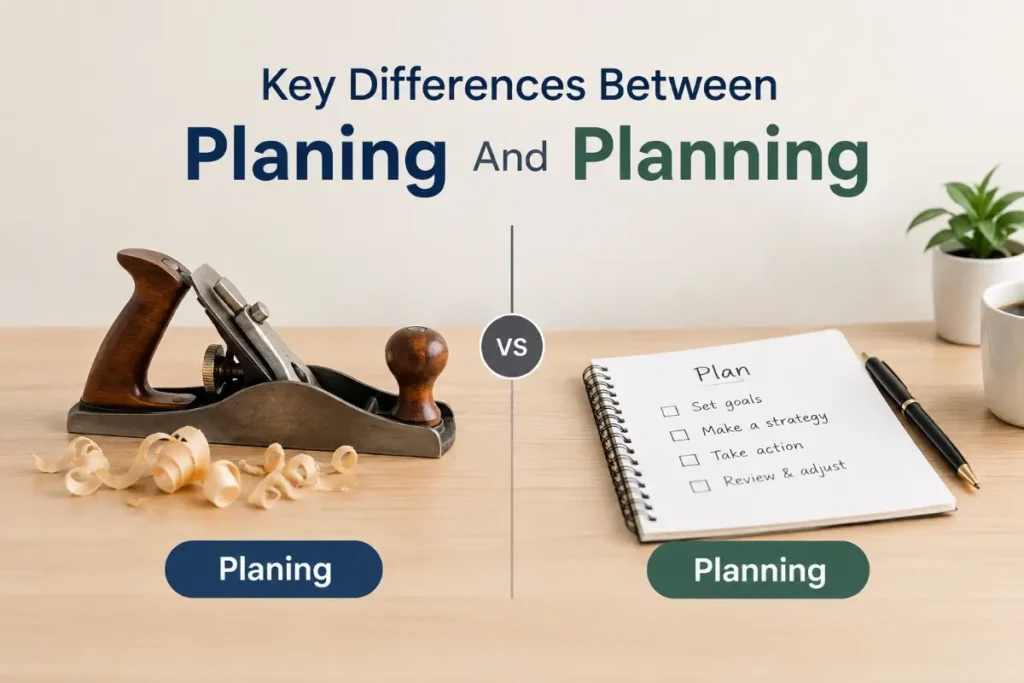
Key Differences Between Planing And Planning
The main differences involve meaning, spelling, pronunciation, and context.
Meaning
Planning refers to preparing or organizing something.
Planing refers to smoothing wood or moving across water in a particular way.
These meanings are unrelated in ordinary usage. The words share a similar appearance, but they describe different actions.
Spelling
Planning contains two n letters before the final ing ending.
Planing contains one n and comes from plane after the final e is removed.
The spelling reflects the different base verbs rather than a choice between American and British English.
Pronunciation
The two words have different vowel sounds.
Planning is pronounced /ˈplænɪŋ/. The first syllable sounds like the vowel in cat.
Planing is pronounced /ˈpleɪnɪŋ/. The first syllable contains the long a sound found in plane.
The spelling difference helps distinguish the words when speaking. Still, listeners often rely on context to understand the intended meaning.
Context
Planning appears in everyday situations such as work, school, travel, family life, and personal goals.
Planing usually appears in technical or specialized contexts involving woodworking or boating.
For most general writing tasks, planning will be the word you need when discussing preparation.
Grammar Explanation For Planning
Planning is the present participle and gerund form of the verb plan.
It can work as part of a verb phrase or as a noun that names an activity.
Planning As Part Of A Verb
Use planning with a form of be to describe an action in progress.
Examples:
- I am planning a trip.
- She is planning a meeting.
- They were planning a surprise.
- We have been planning the event for weeks.
In these sentences, planning describes an activity that is happening or has been happening over time.
Planning As A Gerund
A gerund is an ing form that functions as a noun.
Examples:
- Planning takes time.
- Careful planning can prevent problems.
- We discussed planning for the next semester.
- Good planning makes difficult tasks easier.
In these sentences, planning names an activity rather than simply describing an action in progress.
Planning With Common Prepositions
English speakers use planning with several common prepositions and phrases.
- Planning for the future.
- Planning a trip.
- Planning to study.
- Planning on attending.
- Planning ahead.
- Planning around a schedule.
The choice depends on the intended meaning and sentence structure.
For example:
We are planning to visit Chicago.
Here, planning to visit introduces a future action.
We are planning a visit to Chicago.
Here, planning a visit uses a noun phrase as the object of the verb.
Both forms are natural, but they follow different structures.
The Spelling Rule Behind Planning
The spelling of planning follows a common English rule for adding ing to certain short verbs.
When a verb ends in a single consonant preceded by a single vowel and the final syllable is stressed, English often doubles the final consonant before adding a suffix that begins with a vowel.
The word plan becomes planning because the final consonant n is doubled.
Plan Becomes Planning
The base word is:
Plan.
Add the suffix:
Plan + ing.
Double the final consonant:
Planning.
The result contains two n letters.
This spelling helps preserve the short vowel sound in the base word. It also follows a pattern found in other common words.
|
Base verb
|
Correct form
|
| — | — |
|
Run
|
Running
|
|
Sit
|
Sitting
|
|
Stop
|
Stopping
|
|
Begin
|
Beginning
|
|
Plan
|
Planning
|
Not every verb follows exactly the same pattern. The spelling depends on the structure of the base word, stress, and the conventions of English spelling.
Why Planing Has One N
Planing comes from plane, not plan.
When adding ing to plane, the final e is removed.
Plane + ing = planing.
The word does not double the n because the base word ends in e and the spelling follows a different pattern.
This distinction is important for learners. The words may look similar, but the spelling process starts with different base forms.
Pronunciation Guide For Planing And Planning
Pronunciation helps you recognize the difference between these words in conversation. The first vowel sound changes because the words come from different base verbs.
How To Pronounce Planning
Planning is pronounced /ˈplænɪŋ/.
- Syllables: plan ning.
- Stress: The first syllable receives the main stress.
- First vowel: The short a sound as in cat.
- Ending: The ing ending sounds like /ɪŋ/.
Say it naturally:
PLAN ning.
Examples:
- Planning a vacation.
- Planning a meeting.
- Planning a lesson.
The first part sounds like the word plan. Keeping that connection in mind can help you remember the spelling.
How To Pronounce Planing
Planing is pronounced /ˈpleɪnɪŋ/.
- Syllables: plane ing.
- Stress: The first syllable receives the main stress.
- First vowel: The long a sound as in plane.
- Ending: The ing ending sounds like /ɪŋ/.
Say it naturally:
PLANE ing.
Examples:
- Planing a wooden surface.
- Planing a rough board.
- A boat planing across the water.
The first syllable sounds like plane. That pronunciation connects the word to its base verb.
Common Pronunciation Mistake
Some learners pronounce planning as if it came from plane. This can produce a long vowel sound that doesn’t match the intended word.
Remember the contrast:
- Planning: /ˈplænɪŋ/.
- Planing: /ˈpleɪnɪŋ/.
You don’t need to exaggerate the sounds in everyday speech. Focus on recognizing the short vowel in planning and the long vowel in planing.
Real Life Examples Of Planning
Planning is a common word across many parts of life. The following examples show how native speakers use it in different situations.
Daily Conversation
- I’m planning a trip to California next month.
- Are you planning anything special for the weekend?
- We’re planning dinner with our friends tonight.
- She is planning her next vacation.
- I’m planning to clean the house tomorrow.
Workplace Writing
- Our team is planning the next product launch.
- We’re planning a meeting for Thursday morning.
- The manager is planning the department budget.
- Careful planning helped us finish the project on time.
- The company is planning several changes to its schedule.
Emails And Messages
- I’m planning to send the report by Friday.
- We’re planning a follow up meeting next week.
- Thank you for planning the event so carefully.
- I’m planning to review the document this afternoon.
- The team is planning a response to the client’s request.
Academic Writing
- The study examines the role of planning in student success.
- Lesson planning helps teachers organize classroom activities.
- Strategic planning can support long term research goals.
- The project requires careful planning and regular review.
- Planning before writing can improve the structure of an essay.
These examples show that planning works naturally in casual conversation and formal writing. The word doesn’t change its spelling based on the level of formality.
A related grammar guide is Holistic Or Wholistic Which Spelling Should You Use 2026.
Real Life Examples Of Planing
Planing appears less often in everyday writing, but it has clear technical uses.
Woodworking
- The carpenter is planing the edge of the board.
- Planing the wood created a smooth surface.
- The craftsman used a hand plane for planing.
- The workshop teaches beginners how to plane timber.
- The board needs more planing before it can be finished.
Boating
- The speedboat began planing across the lake.
- The boat reaches planing speed after accelerating.
- The hull is designed to support planing at higher speeds.
- The captain adjusted the throttle to maintain planing.
- The boat moved into a planing position near the shore.
The context makes the intended meaning clear. A carpenter may be planing wood, while a project manager may be planning a schedule.
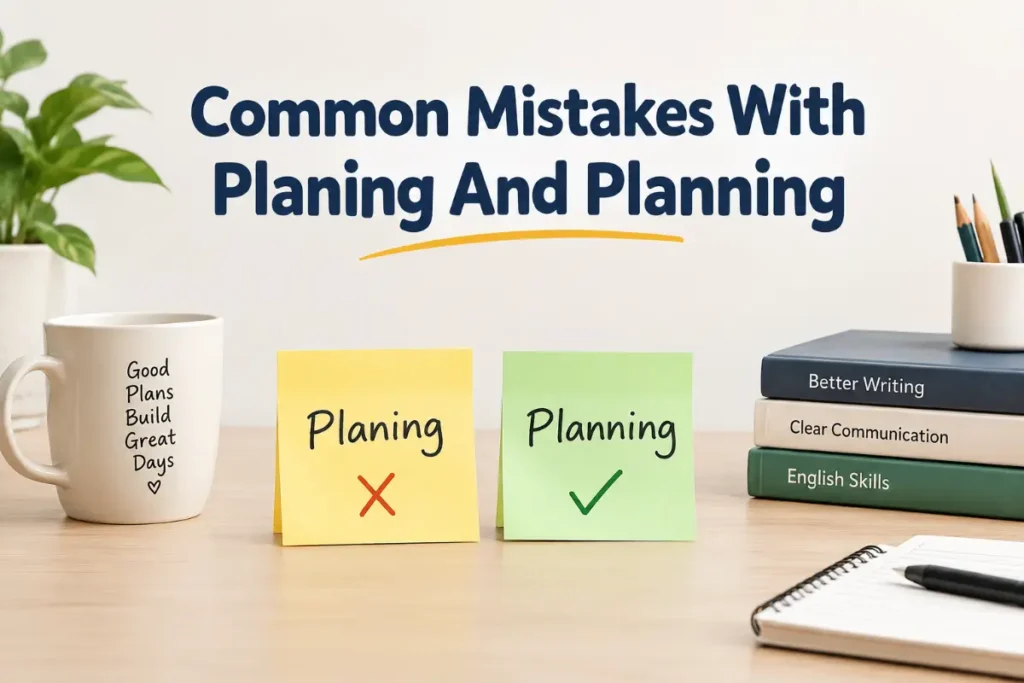
Common Mistakes With Planing And Planning
The most frequent error is using planing when you mean preparing for something.
Mistake One Using Planing For Preparation
Incorrect:
We are planing a wedding.
Correct:
We are planning a wedding.
The intended meaning involves organizing a wedding. Therefore, planning is the correct form.
Mistake Two Adding An Extra N To Planing
Incorrect:
The carpenter is planning the wood.
Correct:
The carpenter is planing the wood.
The first sentence suggests the carpenter is organizing the wood rather than smoothing it. If the action involves a woodworking plane, use planing.
Mistake Three Assuming Planing Is A Misspelling
Planing isn’t always an error. It is a valid word with its own meaning.
For example:
The carpenter spent the morning planing the door.
Calling planing incorrect in this sentence would be a mistake. Good proofreading considers meaning and context rather than judging a word by appearance alone.
Mistake Four Applying The Wrong Spelling Rule
Some learners assume that every verb ending in a consonant must double its final letter before adding ing. English spelling rules are more specific than that.
Compare:
- Plan becomes planning.
- Open becomes opening.
- Visit becomes visiting.
- Plane becomes planing.
The spelling depends on the structure of the base word. Learning the pattern helps, but checking the original verb remains essential.
Memory Tricks For Planing And Planning
A simple memory trick can help you choose the right word quickly.
Remember The Extra N For Preparation
Think of the phrase:
Planning needs an extra n because preparing takes another step.
This is a memory aid rather than a spelling rule. The actual reason comes from the spelling pattern for plan plus ing.
You can also connect planning with common phrases:
- Planning a trip.
- Planning a meeting.
- Planning ahead.
- Planning for the future.
If the sentence involves preparation, your mind should connect it with planning.
Connect Planing With Plane
Planing comes from plane.
Picture a carpenter holding a plane against a wooden board. The word planing contains the sound and spelling connection to plane.
You can remember:
Plane makes planing.
The final e disappears before ing.
Use A Quick Context Check
When you aren’t sure, ask:
- Am I organizing or preparing something? Use planning.
- Am I smoothing wood or describing a boat moving across water? Use planing.
This quick check works better than guessing from the number of letters.
British And American English
Planing and planning follow the same spelling distinction in American and British English.
Planning is used for organizing or preparing something in both varieties.
Planing is used for the woodworking and boating meanings in both varieties.
The spelling difference isn’t a case of American English using one form and British English using another. You should use planning when writing for an American audience, and you should use the same form in British, Canadian, or Australian English when you mean preparation.
Some English words do have regional spelling differences. For example, American English often uses color, while British English commonly uses colour. However, planing and planning aren’t part of that pattern.
Canadian And Australian English
Canadian and Australian English also use planning for organizing something in advance.
They use planing for the same specialized meanings associated with woodwork and boats.
The important lesson is to focus on the meaning and base word. Regional English doesn’t change the core distinction between these spellings.
Related Words And Expressions
Understanding related vocabulary can strengthen your spelling and word choice.
Words Related To Planning
- Plan.
- Planner.
- Planned.
- Planning.
- Plan ahead.
- Make arrangements.
- Prepare.
- Organize.
- Schedule.
- Strategy.
These words connect to the idea of thinking ahead and preparing for a task or event.
For example:
We planned the trip carefully.
Our travel planner created a detailed schedule.
Good preparation makes the process easier.
Words Related To Planing
- Plane.
- Planed.
- Planing.
- Woodworking.
- Carpentry.
- Smooth.
- Surface.
- Timber.
- Hull.
- Boating.
These words relate to the physical process of smoothing wood or the movement of a boat over water.
Synonyms For Planning
The best synonym depends on the context.
|
Word
|
Meaning
|
| — | — |
|
Preparing
|
Getting ready for something
|
|
Organizing
|
Arranging people or things
|
|
Scheduling
|
Choosing times for activities
|
|
Arranging
|
Making practical preparations
|
|
Designing
|
Creating a plan or structure
|
|
Strategizing
|
Developing a plan to reach a goal
|
These words overlap with planning, but they aren’t always interchangeable.
For example, scheduling a meeting means choosing a time. Planning a meeting may involve choosing the agenda, inviting participants, and deciding what needs to happen.
Common Phrases With Planning
Native speakers often use planning in familiar combinations.
- Planning ahead.
- Planning a project.
- Planning a trip.
- Planning for the future.
- Planning to attend.
- Planning on doing something.
- Careful planning.
- Strategic planning.
- Financial planning.
- Lesson planning.
Learning these phrases can make your writing sound more natural because you learn the word in the context where people actually use it.
Expert Editor’s Note On Planing And Planning
As an editor, I’d recommend starting with the meaning of the sentence before checking the spelling. Both words are correct, so a standard spell checker alone may not identify the problem.
For general writing about preparation, planning is the natural choice. It appears in everyday conversation, professional documents, educational materials, and formal reports.
For woodworking, planing is the appropriate technical term. It describes a specific process rather than a general act of preparation.
A useful proofreading technique is to identify the base verb:
- Plan means to prepare or organize.
- Plane means to smooth a surface or move across water in a planing motion.
The suffix ing changes the form of the verb, but the base meaning remains important.
Professional editors also pay attention to common word combinations. Planning a project, planning a trip, and planning for the future are familiar expressions. Planing a board and planing wood belong to a more specialized vocabulary.
The key lesson is simple. Don’t correct a word simply because it looks unusual. Check its meaning and context first.
Etymology And Word Origin
The two words have different histories because they come from different base words.
The Origin Of Plan
The word plan entered English through French and ultimately connects to a Latin word associated with a level or flat surface. Over time, plan developed meanings related to a drawing, a design, and a proposed course of action.
The modern verb plan refers to thinking ahead and deciding what to do.
Planning is the ing form of that verb.
The Origin Of Plane
The word plane has several related historical connections. The woodworking sense refers to a tool used to make a surface smooth and even. The word also has a history connected to the idea of flatness.
The verb plane developed from the use of the tool. Planing describes the action of using it.
The boating sense of planing is connected to the movement of a vessel across water. It describes a physical action rather than the process of preparing for an event.
The important point for English learners is that the two words have separate base forms. Their similar appearance doesn’t mean they share the same meaning.
Planning In Formal And Informal Writing
Planning works in many types of writing. The level of formality changes the surrounding vocabulary, but the spelling stays the same.
Informal Writing
In casual messages, people often use planning to discuss personal activities.
I’m planning a movie night this weekend.
Are you planning to come to the party?
These sentences sound natural in everyday conversation.
Professional Writing
In workplace communication, planning often refers to tasks, projects, schedules, and business goals.
The team is planning the next phase of the project.
We are planning a meeting to discuss the budget.
The word works well in professional writing because it describes a clear action.
Academic Writing
Academic writing may use planning to describe preparation, research methods, or educational activities.
Effective planning can improve the quality of a research project.
Lesson planning supports organized classroom instruction.
Journalism And Public Communication
News articles and public reports may use planning when describing decisions, projects, and future actions.
City officials are planning improvements to the public transportation system.
The organization is planning a new community program.
In these examples, planning communicates an action that is under preparation. The surrounding context explains the scale and purpose of the plan.
Common Questions About Planing And Planning
Is planning spelled with one n or two ns?
Planning is spelled with two n letters before ing. It comes from the verb plan. The final consonant doubles when the suffix is added. For example, plan becomes planning, just as run becomes running. Use planning when you mean organizing or preparing something in advance.
Is planing a real word?
Yes. Planing is a real English word. It comes from plane and refers to smoothing wood with a plane or describing a boat moving across water. It isn’t a spelling mistake in the right context. However, use planning when you mean preparing for an event, task, or future activity.
Why does planning have two ns?
Planning has two ns because the final consonant in plan doubles before the suffix ing is added. The word follows a common English spelling pattern. The base word is plan, so the correct form is plan plus ing, which produces planning.
What is the difference between planing and planning?
Planning means organizing or preparing for something. Planing means smoothing wood with a plane or moving across water in a planing motion. The words come from different base verbs. Planning comes from plan, while planing comes from plane.
Is planing the British spelling of planning?
No. Planing isn’t a British spelling alternative to planning. Both American and British English use planning for the act of preparing or organizing something. Planing has a different meaning in both varieties. The distinction is based on the base word and meaning rather than regional spelling.
How do you pronounce planing and planning?
Planning is pronounced /ˈplænɪŋ/ and begins with the short vowel sound in plan. Planing is pronounced /ˈpleɪnɪŋ/ and begins with the long vowel sound in plane. Both words have two syllables, with the main stress on the first syllable.
Is planning a verb or a noun?
Planning can function as a verb form or a noun. In I’m planning a trip, it forms part of the verb phrase. In careful planning saves time, it functions as a gerund that names an activity. Its grammatical role depends on how it appears in the sentence.
What is the past tense of plan?
The past tense of plan is planned, with two ns. For example, we planned the trip last week. The spelling follows the same doubling pattern used in planning. The word planed is different because it is the past tense of plane.
Is planed related to planning?
Planed is the past tense of plane, while planning is the ing form of plan. For example, the carpenter planed the wood yesterday, but the manager planned the project last week. The spelling and meaning depend on the base verb.
How can I remember the difference between planing and planning?
Connect planning with plan and planing with plane. If you mean preparing for something, use planning. If you mean smoothing wood or describing a boat moving across water, use planing. Remembering the base word is more reliable than memorizing the spelling alone.
Internal Linking Opportunities
If you’re building an English learning website, these two related articles would fit naturally alongside this topic.
1. Planned or Planed Which Spelling Is Correct
This article could explain the difference between the past tense of plan and the past tense of plane. It would help readers who understand planning but confuse planned with planed.
2. Running or Runing Which Spelling Is Correct
This topic could explain consonant doubling when adding ing. It would provide a useful next step for readers who want to understand spelling patterns in English verbs.
Use the actual URLs of your published articles when adding these internal links. The anchor text should describe the topic clearly and match the destination page.
Many readers also check Different or Diffrent: Which Spelling Is Correct 2026 Guide.
Conclusion
Planning is the correct spelling when you mean preparing or organizing something in advance. Planing is also correct, but it refers to smoothing wood or describing a boat moving across water.
The difference comes from the base verbs. Plan becomes planning, while plane becomes planing. The extra n in planning follows a common spelling pattern, and the final e in plane disappears before ing is added.
The biggest mistake is treating planing as an incorrect version of planning. Instead, check the meaning of the sentence. If you’re discussing a trip, project, meeting, or future goal, use planning. If you’re discussing woodworking or a boat’s movement, use planing.
Remember the base word and the spelling becomes easier.

Editorial Reviewer & Proofreader
Grace Mitchell reviews Gramlify’s articles for clarity, consistency, and readability. She is passionate about creating accurate, approachable content that helps English learners build confidence.