
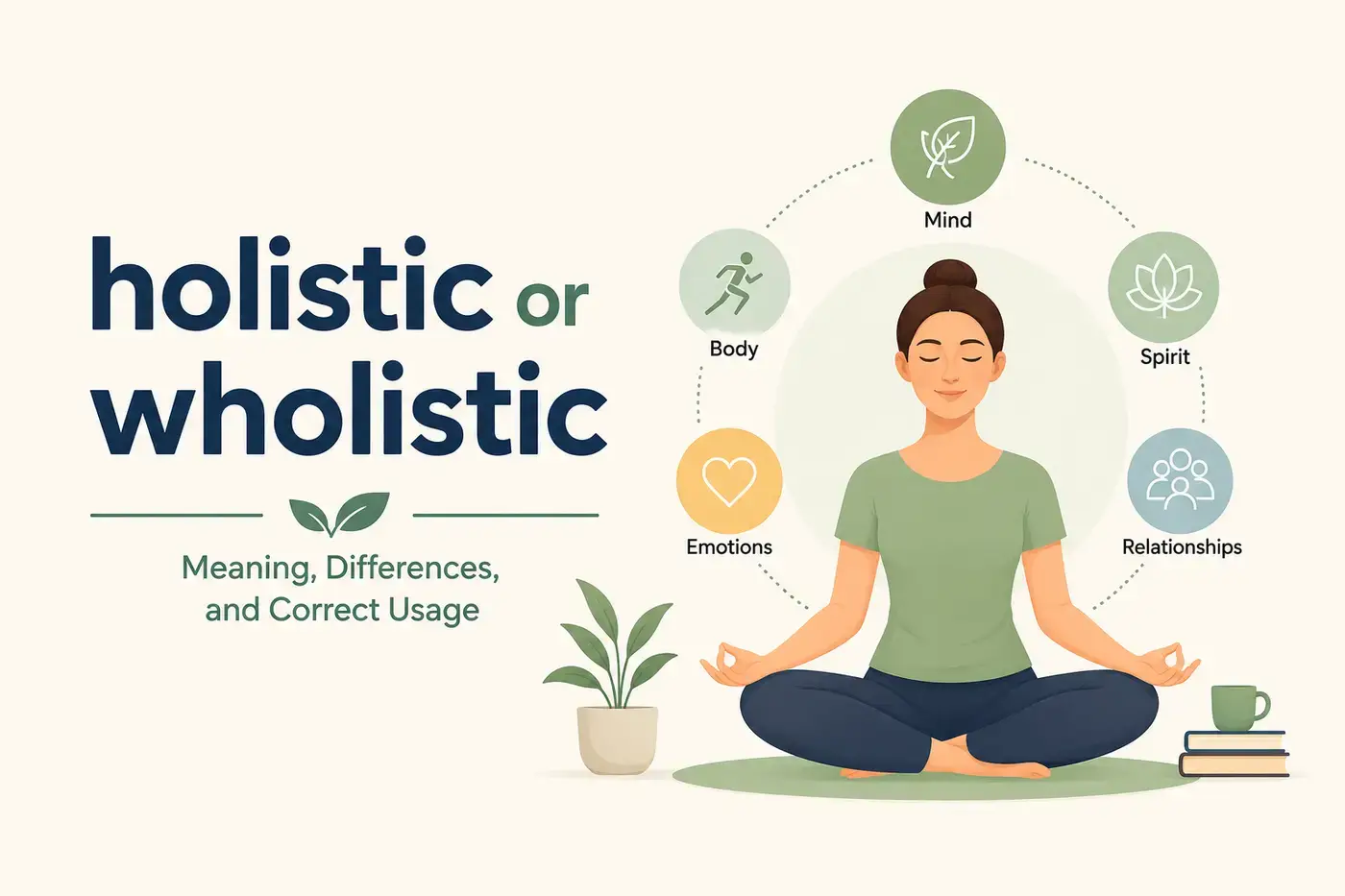
If you’ve searched for holistic or wholistic, you’re probably trying to figure out which spelling is correct. The good news is that both words exist in English. The tricky part is knowing which one people actually use and which one editors recommend.
Most dictionaries, style guides, and professional writers prefer holistic. It’s the standard spelling you’ll find in books, academic journals, healthcare, education, psychology, business, and everyday writing. Wholistic is an accepted variant, but it’s much less common. Some writers choose it to emphasize the idea of the whole person or the whole system.
The confusion happens because both words have the same pronunciation and nearly identical meanings. At first glance, wholistic seems more logical because it contains the word whole. Still, English doesn’t always follow what looks most logical. Usage, history, and convention matter just as much.
This guide explains the difference between holistic and wholistic, why two spellings exist, which one dictionaries recommend, and when each spelling makes sense. You’ll also find grammar tips, real world examples, and practical advice that helps you choose the right word with confidence.
You may also want to read Courtesy Vs Curtesy Which Word Is Correct 2026.
Quick Answer
Holistic is the standard and preferred spelling in modern English. It appears in dictionaries, style guides, academic writing, healthcare, education, and professional communication. Wholistic is an accepted alternative spelling with the same meaning, but it is much less common and is usually chosen to emphasize the idea of treating the whole person or system.
Holistic Or Wholistic Comparison Table
| Feature | Holistic | Wholistic |
|---|---|---|
| Correct spelling | Yes | Yes |
| Preferred spelling | Yes | No |
| Meaning | Treating the whole rather than individual parts | Same meaning |
| Part of speech | Adjective | Adjective |
| Pronunciation | Same | Same |
| Formal writing | Strongly preferred | Less common |
| Academic writing | Standard choice | Rare |
| Healthcare | Very common | Occasionally used |
| Everyday English | Common | Uncommon |
| Example | Holistic healthcare improves overall well being. | Wholistic healthcare considers every aspect of life. |
What Does Holistic Mean
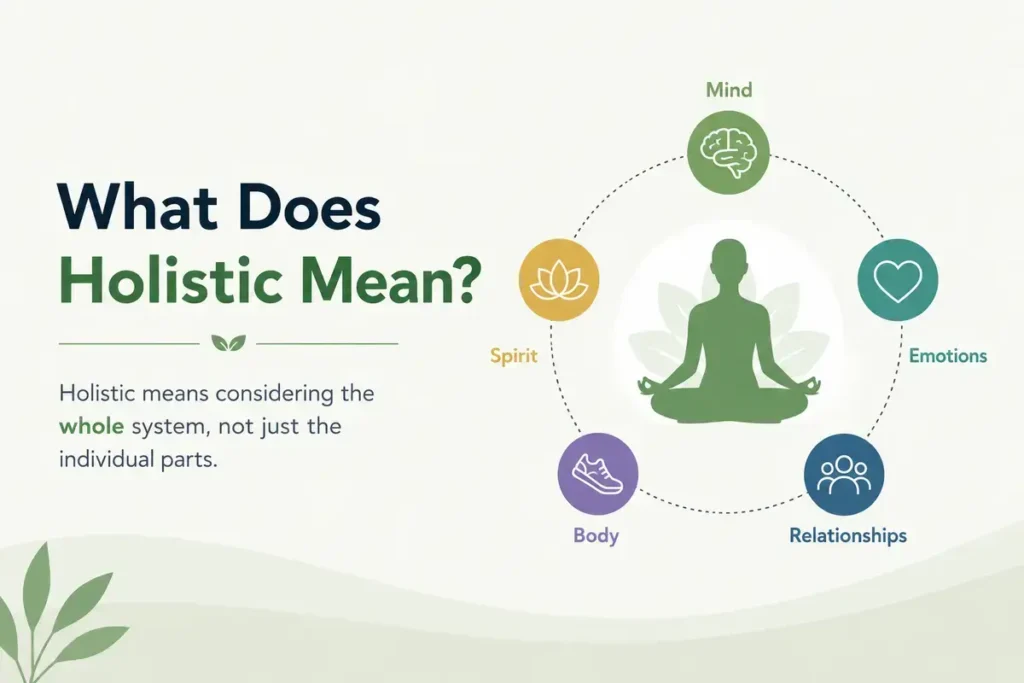
Holistic is an adjective that describes an approach that looks at the complete picture instead of focusing on one part alone.
The word is widely used in medicine, education, psychology, nutrition, business, environmental science, and personal development. It suggests that every part of a system is connected and should be understood together.
Simple Definition
Holistic means considering the whole person, whole system, or whole situation instead of looking at individual parts separately.
Common Uses Of Holistic
People often use holistic when discussing health, learning, problem solving, leadership, and wellness.
Examples include.
- The doctor recommended a holistic treatment plan.
- Our school follows a holistic approach to education.
- The company adopted a holistic business strategy.
- Good leaders take a holistic view of every challenge.
- A holistic diet focuses on overall health instead of one single nutrient.
Holistic In Different Contexts
Daily conversation.
She prefers a holistic approach to staying healthy.
Healthcare.
The clinic offers holistic wellness programs.
Workplace.
Managers need a holistic understanding of the business.
Education.
Teachers encourage holistic learning that develops both knowledge and life skills.
Environmental science.
Scientists use a holistic approach to study ecosystems.
What Does Wholistic Mean
Wholistic has the same meaning as holistic. It also describes an approach that considers the complete person or the complete system.
Some writers intentionally choose wholistic because it clearly reminds readers of the word whole. This spelling appears most often in wellness communities, alternative medicine, personal development, and spiritual writing.
Simple Definition
Wholistic means treating or understanding something as a complete whole.
Common Uses Of Wholistic
Although less common, wholistic still appears in modern English.
Examples include.
- The therapist believes in a wholistic healing process.
- Their program promotes wholistic wellness.
- She follows a wholistic lifestyle.
- The retreat encourages wholistic personal growth.
- The coach takes a wholistic view of mental and physical health.
Many editors would replace these examples with holistic because it is the standard spelling.
Which One Is Correct
Both holistic and wholistic are correct English words.
However, holistic is the spelling you should use in almost every situation.
Professional editors, dictionaries, universities, publishers, and healthcare organizations overwhelmingly prefer holistic. It is the accepted standard in formal and informal writing.
Use wholistic only if an organization, publication, or brand specifically prefers that spelling or if you intentionally want to emphasize the idea of the whole person.
For example.
✔ Holistic healthcare improves quality of life.
✔ Our clinic provides holistic nutrition counseling.
The following sentences are also correct, but most editors would recommend changing them.
✔ Wholistic wellness focuses on mind, body, and spirit.
✔ She believes in wholistic healing.
Unless you have a specific reason, choose holistic.
Why People Confuse Holistic And Wholistic
The confusion is understandable because both words sound exactly the same and share the same meaning.
Several factors contribute to the mix up.
The Word Whole
Many people naturally connect the meaning with the word whole. Because of that, wholistic looks more logical even though holistic became the standard spelling.
Identical Pronunciation
There is no pronunciation difference between the two spellings.
Most people cannot tell which spelling is intended unless they see the word written.
Similar Meaning
Unlike many spelling comparisons, these words do not have different definitions.
They communicate the same basic idea, which makes choosing between them even more confusing.
Wellness And Alternative Medicine
Some wellness practitioners intentionally use wholistic to highlight complete healing of the mind, body, and spirit.
This has helped keep the alternative spelling alive despite its lower frequency.
Internet Searches
People often assume the less common spelling must be wrong because it appears less often online.
In reality, wholistic is accepted by several dictionaries, but holistic remains the dominant spelling across nearly every type of writing.
Key Differences Between Holistic And Wholistic
| Feature | Holistic | Wholistic |
|---|---|---|
| Meaning | Considering the whole | Same meaning |
| Dictionary status | Standard spelling | Accepted variant |
| Frequency | Very common | Much less common |
| Professional writing | Preferred | Rare |
| Academic use | Standard | Uncommon |
| Healthcare publications | Preferred | Occasionally used |
| Reader expectation | Familiar | Less familiar |
The biggest difference is not meaning. It is usage.
Both spellings describe the same idea, but holistic is the spelling most native speakers expect to see. Choosing it makes your writing look more natural, professional, and consistent.
Grammar Explanation
Both holistic and wholistic are adjectives. They describe nouns and explain that something considers the complete person, system, or situation instead of focusing on individual parts.
Because they share the same meaning, the grammar is identical. The only real difference is the preferred spelling.
Holistic As An Adjective
Use holistic before a noun or after a linking verb.
Examples.
- We support a holistic approach to healthcare.
- The school’s teaching method is holistic.
- She believes holistic nutrition improves long term health.
Wholistic As An Adjective
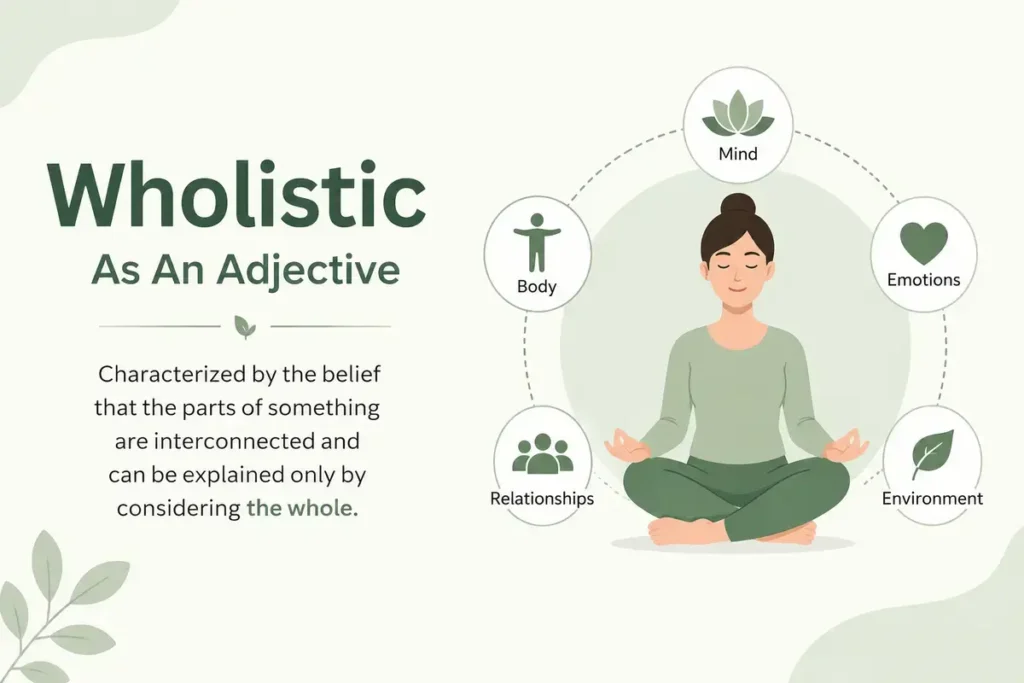
Wholistic follows the same grammar rules.
Examples.
- The clinic promotes wholistic healing.
- Their philosophy is wholistic.
- She prefers a wholistic wellness program.
The grammar is correct in all three examples, but most editors would replace wholistic with holistic unless the organization intentionally uses that spelling.
Can You Use These Words As Nouns
No.
Neither word functions as a noun in standard English.
Incorrect.
She is a holistic.
Correct.
She believes in holistic healthcare.
Spelling Rules
Unlike many confusing English words, holistic and wholistic are not examples of British and American spelling differences.
Instead, they represent a standard spelling and a less common variant.
Here are the important spelling rules.
- Holistic is the preferred spelling in dictionaries and style guides.
- Wholistic is an accepted alternative spelling.
- Both words have the same meaning.
- Choose one spelling and stay consistent throughout your writing.
- Formal writing almost always favors holistic.
If you’re writing for school, work, publishing, or professional communication, holistic is the safest choice.
Learn the difference in Offered vs Offerred Which Spelling Is Correct (2026 Guide).
Pronunciation Guide
The pronunciation is exactly the same for both spellings.
Holistic
IPA
American English
/həˈlɪs.tɪk/
Syllables
Ho lis tic.
Stress
The second syllable receives the primary stress.
Wholistic
IPA
American English
/həˈlɪs.tɪk/
Syllables
Who lis tic.
Stress
The second syllable also carries the primary stress.
Common Pronunciation Mistakes
Some learners pronounce the w in wholistic because they see the word whole.
Modern English speakers normally pronounce holistic and wholistic exactly the same.
Word Origin And History
Understanding the history explains why holistic became the dominant spelling.
The word comes from the Greek word holos, which means whole or entire.
In the 1920s, the South African statesman and philosopher Jan Smuts popularized the term holism in his book about evolution and philosophy.
From holism, English developed the adjective holistic.
Later, some writers created the spelling wholistic to make the connection with the English word whole more obvious.
Even though the idea makes sense, the original spelling holistic had already become established in dictionaries, universities, and professional writing.
That is why it remains the preferred spelling today.
British American Canadian And Australian English
There is almost no regional difference.
English speakers in the United States, the United Kingdom, Canada, Australia, and New Zealand overwhelmingly use holistic.
The spelling wholistic appears occasionally in wellness organizations, alternative medicine, and spiritual communities across these countries, but it is never the dominant form.
Professional Writing
Preferred spelling.
Holistic.
Academic Writing
Preferred spelling.
Holistic.
Medical Writing
Preferred spelling.
Holistic.
Everyday Conversation
Most people naturally say and write holistic, although wholistic is still recognized.
Real Life Examples
Seeing these words in real situations makes the difference much easier to remember.
Daily Conversation
- I prefer a holistic approach to healthy living.
- She believes holistic habits improve daily life.
- His doctor recommended holistic care.
- They attended a wholistic wellness retreat.
Workplace
- Our company takes a holistic view of customer experience.
- Good managers use holistic thinking before making decisions.
- The consultant recommended a holistic business strategy.
- Their nonprofit promotes wholistic community development.
Emails
- We need a holistic plan before launching the project.
- Thank you for sharing your holistic perspective.
Academic Writing
- Researchers support a holistic approach to child development.
- The paper explains holistic education in modern classrooms.
Healthcare
- The hospital provides holistic patient care.
- Holistic medicine often combines lifestyle changes with traditional treatment.
- The therapist believes in holistic recovery.
Journalism
- Experts recommend holistic environmental policies.
- The article discusses holistic nutrition.
Social Media
- I’m trying a holistic lifestyle this year.
- Her holistic wellness tips are practical and easy to follow.
- Their wholistic retreat helped me slow down and recharge.
Notice something interesting.
Almost every published example naturally uses holistic. The few examples with wholistic usually come from organizations that intentionally prefer that spelling.
Common Mistakes People Make
Many writers know both spellings exist but still choose the wrong one for formal writing.
These are the mistakes editors notice most often.

Thinking Wholistic Is The Standard Spelling
Incorrect assumption.
Wholistic is the official spelling.
Correct.
Holistic is the standard spelling used by dictionaries, publishers, universities, and professional editors.
Assuming Wholistic Is Wrong
Some people believe wholistic is a misspelling.
It is not.
Most modern dictionaries recognize it as a valid alternative spelling. It simply appears far less often than holistic.
Mixing Both Spellings
Avoid switching between the two spellings in the same article or document.
Choose one spelling and stay consistent.
If you are writing for a broad audience, holistic is almost always the better choice.
Believing They Have Different Meanings
Both words describe the same idea.
The difference is spelling preference, not definition.
Easy Memory Tricks
These simple tricks make the correct spelling easy to remember.
Think About Holism
The noun is holism.
The adjective naturally becomes holistic.
Since the root word does not begin with wh, neither should the adjective.
Remember Professional Writing
If you are writing for school, work, publishing, or business, think.
Professional equals holistic.
Remember The Dictionary Rule
When in doubt, choose the spelling you are most likely to find in a dictionary heading.
That spelling is holistic.
Related Words
Learning related vocabulary helps you understand the topic more deeply.
Synonyms
- Comprehensive.
- Integrated.
- Complete.
- Balanced.
- Unified.
- Whole person.
- All inclusive.
Opposites
- Partial.
- Limited.
- Isolated.
- Narrow.
- Fragmented.
Related Expressions
- Holistic healthcare.
- Holistic education.
- Holistic medicine.
- Holistic development.
- Holistic thinking.
- Holistic wellness.
- Holistic approach.
Frequently Confused Words
- Holism and holistic.
- Whole and holistic.
- Comprehensive and holistic.
- Integrated and holistic.
- Alternative medicine and holistic medicine.
Understanding these related terms improves both your vocabulary and your writing.
Expert Editor’s Note
From an editor’s perspective, the safest recommendation is simple.
Use holistic in almost every situation.
Major dictionaries, publishing houses, universities, healthcare organizations, and professional style guides consistently treat holistic as the standard spelling.
The spelling wholistic is still legitimate, but many readers see it far less often. Because of that, it may look unusual or even incorrect to people who are unfamiliar with it.
Some wellness organizations intentionally choose wholistic because they want to emphasize treating the whole person. If you are writing for one of those organizations, matching their preferred style is appropriate.
For everyone else, holistic is the clearer and more recognizable choice.
Frequently Asked Questions
Is Holistic Or Wholistic Correct?
Both spellings are correct. Holistic is the standard spelling used in modern English, while wholistic is an accepted alternative that appears much less often.
Which Spelling Should I Use In Professional Writing?
Choose holistic. It is the preferred spelling in business, healthcare, education, academic writing, journalism, and publishing.
Is Wholistic A Misspelling?
No. It is a recognized variant spelling found in several dictionaries. It simply is not the standard form used by most writers and editors.
Why Do Some People Prefer Wholistic?
Some writers believe the spelling makes the connection with the word whole easier to understand. It is especially common in wellness, coaching, and alternative medicine communities.
Do Holistic And Wholistic Mean Different Things?
No. They have the same meaning. Both describe an approach that considers the complete person, system, or situation instead of focusing on individual parts.
Is Holistic Used In American And British English?
Yes. Holistic is the preferred spelling in American English, British English, Canadian English, Australian English, and other major varieties of English.
Which Spelling Appears More Often?
By a very large margin, holistic is the more common spelling. It dominates books, news articles, academic papers, professional websites, and everyday writing.
A related grammar guide is Pentoxide Vs Pentaoxide Which Spelling Is Correct 2026 Guide.
Conclusion
The answer to holistic or wholistic is straightforward.
Both spellings are correct, but holistic is the standard form that dictionaries, editors, educators, healthcare professionals, and publishers recommend.
Use wholistic only if you are following the style preference of a specific organization or intentionally highlighting the idea of treating the whole person.
For nearly every other situation, holistic is the spelling your readers expect to see.
Choosing the standard spelling makes your writing clearer, more professional, and easier to trust.

Editorial Reviewer & Proofreader
Grace Mitchell reviews Gramlify’s articles for clarity, consistency, and readability. She is passionate about creating accurate, approachable content that helps English learners build confidence.
1 thought on “Holistic Or Wholistic Which Spelling Should You Use 2026”