

If you’ve ever typed choosing or chosing and stopped to check the spelling you’re not alone. The two forms look almost identical. The difference is just one letter. Yet that missing letter changes a correct English word into a spelling mistake.
The correct form is choosing. It is the present participle and gerund form of choose. The word means selecting something or deciding between two or more possibilities. The spelling follows a simple pattern. Start with choose. Remove only the final silent e before adding ing. The two o letters stay.
That gives you choose → choosing.
The incorrect form chosing often appears because writers connect it with chose. Chose is the simple past form of choose and contains only one o. However the ing form does not come from chose. It comes from the base verb choose.
This guide explains the spelling rule in plain English. You’ll learn the meaning and grammar of choosing. You’ll also see why chosing is wrong. Along the way you’ll get practical examples for everyday speech schoolwork professional writing and academic English.
A related grammar guide is Imbed Vs Embed Which Spelling Is Correct 2026.
Quick Answer
Choosing is the correct spelling. Chosing is a misspelling. Choosing comes from the verb choose. When you add ing you remove only the final silent e and keep both o letters. The correct formation is choose → choos → choosing. Use choosing in everyday formal academic and professional writing.
Choosing or Chosing Comparison
| Feature | Choosing | Chosing |
|---|---|---|
| Standard English spelling. | Correct. | Incorrect. |
| Base word. | Choose. | Incorrectly formed from choose or confused with chose. |
| Meaning. | Selecting or deciding between possibilities. | No separate standard meaning. |
| Part of speech. | Present participle or gerund. | Not a standard English form. |
| Pronunciation. | /ˈtʃuːzɪŋ/. | No standard pronunciation. |
| Formal writing. | Correct. | Avoid it. |
| Informal writing. | Correct. | Still incorrect. |
| Common context. | Decisions selections and ongoing actions. | Usually a spelling error. |
| Correct example. | She is choosing a new laptop. | Not applicable. |
The key difference is simple. Choosing is a real English word. Chosing is not an alternative spelling used in standard English.
Cambridge Dictionary lists choosing as the present participle of choose. Cambridge also gives choose as a verb meaning to decide what you want from two or more things or possibilities.

What Does Choosing Mean
Choosing means selecting one person thing action or possibility from a group of options.
The base verb choose describes the act of deciding. The form choosing describes that action as ongoing or treats the action as a noun like activity.
Consider these examples.
She is choosing a dress for the wedding.
Here choosing describes an action happening now.
Choosing a college takes careful thought.
Here choosing refers to the activity of making that decision.
They spent the afternoon choosing furniture.
Here choosing describes an ongoing activity in the past.
The exact meaning depends on the sentence. In every case the central idea is selection or decision making.
Cambridge defines choose as a verb used when someone decides what they want from two or more things or possibilities. It also shows that choose can appear before a noun or with an infinitive.
Choosing As An Ongoing Action
The most familiar use of choosing appears in continuous verb forms.
I am choosing a new phone.
She is choosing a restaurant.
They are choosing their seats.
In these examples choosing works with a form of be to describe an action in progress.
The pattern is simple.
am + choosing.
is + choosing.
are + choosing.
was + choosing.
were + choosing.
The spelling stays the same in each case.
Choosing As A Gerund
Choosing can also act as a noun like form.
Choosing the right words matters.
Choosing a career can take time.
Choosing carefully can prevent mistakes.
In these sentences the word names an activity. Traditional grammar often calls this use a gerund.
The spelling does not change. You still write choosing.
This distinction matters because English learners sometimes think choosing is only a verb form. Its grammatical role can change depending on the sentence.
Which One Is Correct
Choosing is correct. Chosing is incorrect.
There is no standard English situation in which you should use chosing instead of choosing.
If you’re writing a school assignment use choosing.
If you’re writing a business email use choosing.
If you’re writing an academic paper use choosing.
If you’re sending a text message use choosing.
If you’re writing a social media post use choosing.
The level of formality does not change the spelling.
Cambridge lists choosing as the present participle of choose. That gives us a reliable dictionary based answer rather than a guess based on how the word sounds.
A useful correction looks like this.
Incorrect: She is chosing a new apartment.
Correct: She is choosing a new apartment.
The mistake is easy to fix. Restore the second o.
Why People Confuse Choosing And Chosing
The spelling mistake makes sense once you look at the forms of the verb.
The verb choose has several important forms.
| Verb form | Correct word | Example |
|---|---|---|
| Base form. | Choose. | I choose the blue one. |
| Third person present. | Chooses. | She chooses the blue one. |
| Simple past. | Chose. | She chose the blue one. |
| Past participle. | Chosen. | She has chosen the blue one. |
| Present participle. | Choosing. | She is choosing the blue one. |
The biggest source of confusion is chose.
A learner may remember that choose becomes chose in the past. Since chose contains one o the learner may incorrectly build the ing form from it.
That produces this incorrect pattern.
chose + ing = chosing.
But English does not form the present participle from the simple past form.
The correct pattern is this.
choose → choosing.
That small distinction clears up the whole problem.
The Sound Does Not Help Much
Spelling mistakes often happen because English pronunciation does not always reveal every letter.
Choosing is pronounced /ˈtʃuːzɪŋ/ in standard dictionary notation. The first syllable carries the main stress and the vowel sound is the long oo sound found in words such as food and moon.
When you hear choosing you cannot reliably count the letters in the spelling. The two o letters represent the vowel sound. That makes this a spelling issue rather than a pronunciation issue.
This is one reason careful writers sometimes need to pause and check the written form.
Fast Typing Can Cause The Error
Double letters create many ordinary typing mistakes.
When people type quickly they may see the word mentally as choose and then remove the final e. If they do not look closely they may accidentally remove one of the o letters too.
That produces chosing.
The mistake is especially easy to miss because the incorrect version still looks familiar.
A quick visual check can prevent it.
C H O O S I N G.
If you’re writing about selecting something the word needs both o letters.
The Spelling Rule Behind Choosing
The spelling becomes much easier once you understand what happens to the final e.
The base verb is:
choose
The word ends with a silent e.
When the ing ending is added the final e is removed.
So the formation is:
choose → choos → choosing.
Only the final e disappears.
The two o letters remain.
That is the detail many learners miss.
You are not changing choose into chos.
You are changing choose into choos before adding ing.
So:
choose + ing becomes choosing after the final e is removed.
The same broad spelling pattern appears in many familiar verbs.
make → making.
write → writing.
take → taking.
move → moving.
use → using.
lose → losing.
choose → choosing.
Notice the pattern. The final e disappears. The rest of the useful spelling pattern remains.
That is why chosing is not the result of the normal spelling rule.
Why The Two Os Stay
This point deserves extra attention because it solves the spelling problem.
Look closely at choose.
The letters are:
C H O O S E.
The final e is the letter that disappears before ing.
That leaves:
C H O O S.
Add ing.
You get:
C H O O S I N G.
The two o letters were never supposed to disappear.
Think of the final e as the only letter that needs to step aside. The two o letters are part of the core spelling of choose and remain in choosing.
This also explains why building the word from chose causes trouble.
Chose is spelled:
C H O S E.
But chose is the past tense.
It is not the base form used to create the ing form.

Choose Chose Chosen And Choosing
These four forms belong to the same verb family but they perform different jobs.
Choose
Choose is the base form.
I choose the window seat.
Please choose one answer.
You can choose any color.
It can describe a present decision or appear after helping verbs such as will and can.
I will choose later.
You can choose now.
Chose
Chose is the simple past form.
I chose the window seat yesterday.
She chose the red dress.
They chose a different route.
It describes a completed choice in the past.
Chosen
Chosen is the past participle.
It often appears with forms of have or in passive constructions.
She has chosen a new apartment.
They had chosen the winner before lunch.
He was chosen for the team.
Choosing
Choosing is the present participle and can also function as a gerund.
She is choosing a new apartment.
They were choosing their seats.
Choosing carefully can save money.
Cambridge lists choose with the irregular forms chose and chosen. That irregular pattern is another reason learners can find the verb family confusing.
A Simple Test For Choosing
When you’re unsure about the spelling ask yourself one question.
What is the base verb?
If the answer is choose then the ing form is choosing.
Do not start with chose.
Do not remove one of the o letters.
Do not keep the final e.
Use this simple sequence.
Choose.
Remove the final e.
Keep both o letters.
Add ing.
Choosing.
That four step method is more reliable than trying to remember the spelling by sound alone.
Real Life Examples Of Choosing
The best way to make a spelling rule stick is to see the word doing real work in different kinds of sentences.
Daily Conversation
I’m choosing what to wear tonight.
Are you choosing the chicken or the pasta?
We’re still choosing where to eat.
She’s choosing a movie for us.
I had a hard time choosing between the two colors.
These examples show how naturally choosing appears in everyday speech.
Workplace Writing
The hiring team is choosing a new software system.
We’re choosing a vendor based on price and service.
The manager is choosing the final candidates this week.
Choosing the right supplier can affect the project budget.
The team spent several days choosing a new office location.
In professional writing choosing is completely normal. There is no need to replace it with a more complicated word simply to sound formal.
Email Writing
We’re currently choosing the best date for the meeting.
Thank you for your patience while we’re choosing the final design.
The committee is choosing between three proposals.
I’m having trouble choosing the right option from the list.
These sentences work well because choosing clearly describes an action or decision.
Academic Writing
Choosing an appropriate research method requires careful planning.
Researchers should consider several factors when choosing a sample.
Choosing reliable sources is an important part of academic writing.
Students may struggle when choosing a topic for their final paper.
Academic writing does not require replacing simple words with unnecessarily complex ones. Choosing is clear precise and widely accepted.
Journalism
Voters are choosing between several candidates in the local election.
Consumers are choosing smaller devices as technology changes.
Families are choosing different ways to reduce household costs.
The word works naturally in reporting because it describes decisions and selections.
Social Media
Choosing a favorite photo is harder than it looks.
Still choosing between these two outfits.
Choosing peace today.
Social media writing can be informal but the spelling remains choosing.
Choosing Between Two Things
A common structure is choosing between.
Use it when someone must select one option from two or more possibilities.
She is choosing between two colleges.
We’re choosing between the blue sofa and the gray sofa.
They’re choosing between two possible dates.
I’m choosing between two job offers.
The pattern is:
choosing between + options.
Cambridge gives examples of choose used with between when someone makes a decision involving alternatives.
You can also use choosing with from.
She is choosing a dress from the new collection.
We are choosing from five available plans.
They’re choosing from several restaurants.
The meaning stays focused on selection.
Choosing To Do Something
Another useful structure is choosing to + verb.
This means deciding to do something.
She is choosing to stay home.
He is choosing to study tonight.
They are choosing to work remotely.
I’m choosing to focus on the most important task.
Cambridge specifically recognizes the structure choose to do something for deciding to do an action.
This construction appears often in everyday conversation and professional writing.
Choosing The Right Word
Choosing also appears in discussions about language itself.
Choosing the right word can make your writing clearer.
Good editors spend time choosing precise language.
Choosing simple words often makes an explanation easier to understand.
This use connects naturally with writing advice because choosing is about making a deliberate selection.
You might choose a word because it is more precise. You might choose a phrase because it sounds more natural. You might choose a shorter sentence because it communicates the idea faster.
In all of these cases choosing is the correct form.
Common Mistakes With Choosing
Spelling is the main issue but it is not the only mistake learners can make with this verb.
Mistake One
Incorrect: I am chose a new phone.
Correct: I am choosing a new phone.
After am you need the ing form for a continuous action.
Mistake Two
Incorrect: I have choosing a new phone.
Correct: I have chosen a new phone.
After have you need the past participle chosen.
Mistake Three
Incorrect: I choosing a new phone.
Correct: I am choosing a new phone.
A continuous verb phrase normally needs a form of be before choosing.
Mistake Four
Incorrect: I am chosing a new phone.
Correct: I am choosing a new phone.
The second o is missing in the incorrect version.
Mistake Five
Incorrect: I was choose a new phone.
Correct: I was choosing a new phone.
The word after was needs the ing form when the sentence describes an action in progress.
These mistakes show why spelling and grammar sometimes overlap. Knowing the spelling of choosing is useful. Knowing how the whole verb family works is even better.
Choosing And Select
Choose and select are close in meaning.
Cambridge lists select as a verb meaning to choose a small number of things or to choose after careful consideration.
Compare these sentences.
She is choosing a dress.
She is selecting a dress.
Both can be correct.
The difference is mainly about tone and context. Choose is one of the most common everyday words for making a selection. Select can sound more deliberate or procedural.
You might say:
Choose your seat.
A form or computer interface might say:
Select your seat.
Both communicate the basic idea of making a selection.
Cambridge describes choose as the most common general word for deciding among possibilities and notes that select often suggests careful choice.
Choosing And Picking
Pick is another common synonym.
I’m choosing a movie.
I’m picking a movie.
Both sound natural.
Choose works across casual professional and academic contexts. Pick is often more conversational.
You might say:
Please choose one answer.
You could also say:
Pick one answer.
The second sentence sounds more informal.
Cambridge identifies pick and select as related words for choosing and notes that they can carry different shades of context.
Choosing And Deciding
Choose and decide are closely related but they do not always work in exactly the same grammatical pattern.
I’m choosing a restaurant.
This focuses on selecting one restaurant.
I’m deciding where to eat.
This focuses more broadly on reaching a decision.
You can also say:
I chose the restaurant.
I decided to eat there.
The words overlap but they highlight slightly different parts of the decision process.
Choosing In Formal Writing
Choosing is fully acceptable in formal writing.
You do not need to replace it with words such as selecting or determining simply because you are writing for a professional or academic audience.
For example:
Choosing an appropriate method is essential to the study.
This sentence is clear and professional.
You could write:
Selecting an appropriate method is essential to the study.
That is also correct.
The better choice depends on the intended meaning and tone. Good editing is not about making every sentence sound formal. It is about making every sentence accurate and easy to understand.
Choosing In Informal Writing
Choosing is equally natural in casual English.
I’m still choosing what to order.
We’re choosing a movie tonight.
I can’t stop choosing snacks.
There is no special informal spelling such as chosing.
This is important because some spelling mistakes become accepted informal variants over time. Chosing has not become such a variant in standard English.
If you see it online it is best understood as a misspelling.
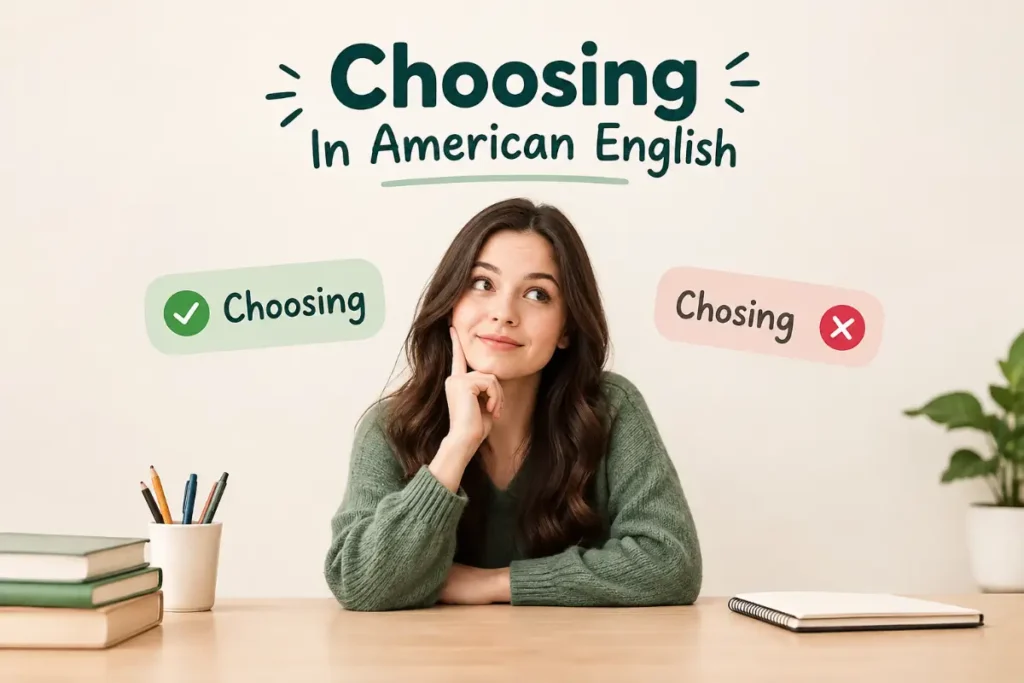
Choosing In American English
For a US audience the standard spelling is choosing.
American English does not use chosing as a regional spelling.
The same standard spelling applies in British English Canadian English and Australian English.
There is no regional spelling difference here.
This matters because some English words genuinely have regional spelling differences. Words such as color and colour or organize and organise can vary by region. Choosing is not one of those cases.
You should write:
choosing.
Not:
chosing.
Pronunciation Guide
The standard pronunciation of choosing is /ˈtʃuːzɪŋ/. Cambridge gives the pronunciation of the base verb choose as /tʃuːz/ in both UK and US English.
You can think of the pronunciation in two parts.
CHOO.
ZING.
The main stress falls on the first syllable.
The first vowel has the long oo sound.
The ending sounds like the ending in words such as running or working.
A useful point for learners is that pronunciation cannot tell you how many o letters appear in the spelling. You need to remember the written form.
Spelling Patterns To Remember
The easiest spelling rule is not complicated.
When you turn choose into choosing:
Drop the final e.
Keep the two o letters.
Add ing.
This gives:
choose → choosing.
Compare it with similar forms.
| Base verb | Correct ing form |
|---|---|
| Use. | Using. |
| Lose. | Losing. |
| Move. | Moving. |
| Make. | Making. |
| Write. | Writing. |
| Choose. | Choosing. |
The pattern is useful because it focuses your attention on the exact part of the word that changes.
Many readers also check Chefs Or Cheves Which Spelling Is Correct 2026.
Why Chosing Looks So Convincing
A spelling mistake can look believable when it follows part of a real pattern.
Chosing looks as if it could come from chose.
That makes the error easy to understand.
The learner sees:
choose.
Then remembers:
chose.
Then tries to form the ing word.
The brain may accidentally blend the two forms.
But the grammar gives us a reliable path.
Choose is the base form.
Choosing is the ing form.
Chose is the past form.
Chosen is the past participle.
Once those four forms are connected in your mind the spelling becomes much easier.
A Useful Editing Trick
If you spot chosing in your own writing do not simply correct the missing letter.
Check the whole sentence.
Ask yourself:
Am I talking about an action happening now?
If yes you may need choosing.
Am I talking about a completed past decision?
If yes you may need chose.
Am I using have has had or a passive structure?
You may need chosen.
For example:
She is choosing a new car.
She chose a new car yesterday.
She has chosen a new car.
The three sentences are grammatically different even though they describe related actions.
This is the kind of check a careful editor makes. Spelling is only one part of accurate word use.
Etymology And Word Origin
The history of choose helps explain why the modern verb has such an unusual set of forms.
The verb comes from Old English ceosan. Historical sources connect it with a Proto Germanic root associated with choosing and with an older Indo European root connected with tasting and choosing. The verb developed through several historical forms before reaching modern English.
The modern forms are not simply created by adding regular endings to one unchanged spelling.
That history helps explain why learners encounter:
choose.
chose.
chosen.
choosing.
The past forms developed through older irregular patterns. Modern English still keeps some of that history.
The noun choice has a related but separate history. It developed through Middle English and Old French forms connected with selecting or making a choice.
This background can explain the unusual word family but you don’t need to memorize the history to spell choosing correctly.
For practical writing the key point remains:
choose → choosing.
Memory Tricks For Choosing
A good memory trick should make the spelling easier rather than create another rule to remember.
Keep The Double O
Think:
Choose has two Os. Choosing keeps two Os.
Only the final e disappears.
This is probably the easiest memory trick.
Remember The Word Family
Keep these four forms together:
choose.
chose.
chosen.
choosing.
If you connect choosing with choose rather than chose you’re much less likely to drop the second o.
Use The Remove And Add Test
Write:
choose.
Cross out only the final e.
You now have:
choos.
Add ing.
You get:
choosing.
This works especially well when you’re checking an important document.
Connect It With Choose
The word choosing keeps the same core spelling as choose.
That visual connection is stronger than trying to memorize the entire word separately.
Common Misspellings Related To Choose
Choosing isn’t the only form of this verb that people misspell.
Chosing
Incorrect: Chosing.
Correct: Choosing.
The second o is missing.
Chooseing
Incorrect: Chooseing.
Correct: Choosing.
This mistake happens when someone keeps the final e before adding ing.
Choosen
Incorrect: Choosen.
Correct: Chosen.
This mistake comes from treating chosen as if it followed a regular spelling pattern.
Chosse
Incorrect: Chosse.
Correct: Choose.
This is usually a typing mistake.
Choise
Incorrect: Choise.
Correct: Choice.
This confusion involves the noun rather than the verb.
A useful editing habit is to check the meaning and grammatical role before correcting the spelling.
Choosing And Choice
These words are closely related but they aren’t interchangeable.
Choosing is an ing form of the verb choose.
Choice is a noun.
Compare:
Choosing a college can be stressful.
The choice of college can be stressful.
The first sentence names the action.
The second names the decision or option.
Cambridge defines choice as an act or possibility of choosing. It also uses choice for a person or thing that has been chosen and for a range of options.
This distinction can help prevent another common mistake.
Don’t write:
I am choice a restaurant.
Write:
I am choosing a restaurant.
Don’t automatically replace every use of choosing with choice. The two words perform different grammatical jobs.
Related Words
The word family around choose includes several useful forms.
Choose means to make a selection.
Chooses is the third person singular present form.
Chose is the simple past form.
Chosen is the past participle.
Choosing is the present participle and gerund form.
Choice is a related noun.
Chooser can refer to a person who chooses.
You can also use related verbs such as pick, select, decide, and opt.
These words overlap but they aren’t always identical in tone or structure.
Similar Expressions
choose between.
choose from.
choose to do something.
have a choice.
make a choice.
of your choice.
These expressions all connect to the broader idea of selection and decision making.
Choosing And Opting
Opting is another word that can express a decision.
Compare:
She is choosing the smaller apartment.
She is opting for the smaller apartment.
Both sentences describe a decision. However opting for often highlights the option selected rather than the general act of making a choice.
The expression opt for is especially common in professional and formal writing.
For example:
The company is opting for a simpler design.
You wouldn’t normally replace choosing with opting in every sentence. The grammatical patterns differ.
choosing a design.
opting for a design.
That small difference matters in polished writing.
Choosing And Preferring
Prefer also relates to choices but has a different meaning.
I am choosing the blue shirt.
This tells us which shirt I’m selecting.
I prefer the blue shirt.
This tells us which shirt I like more.
Someone can prefer one option but choose another.
For example:
I prefer the blue shirt but I’m choosing the black one because it’s easier to match.
That sentence shows the difference clearly.
Preference describes what you like more. Choosing describes the decision you make.
Choosing And Deciding
Choose and decide often appear in the same situations but they focus on different parts of the process.
I’m choosing a restaurant.
The focus is on selecting one restaurant.
I’m deciding where to eat.
The focus is on reaching a decision about the meal.
The grammar also differs.
You can say:
I chose the restaurant.
But you can say:
I decided to eat there.
The common structure is:
choose + noun.
decide + to + verb.
For example:
She chose the blue dress.
She decided to buy the blue dress.
Both sentences are natural but they aren’t structured in exactly the same way.
Choosing And Selecting
Selecting is a close synonym of choosing.
We are choosing a new supplier.
We are selecting a new supplier.
Both are grammatically correct.
Choose is usually the more natural everyday word. Select can sound more deliberate or procedural.
For example a website might say:
Choose your preferred language.
A form might say:
Select your preferred language.
Both are standard English.
The choice between them depends on context and tone rather than correctness.
British American Canadian And Australian English
There is no major regional spelling difference between American English and other major English varieties for choosing.
US English uses:
choosing.
British English uses:
choosing.
Canadian English uses:
choosing.
Australian English uses:
choosing.
The spelling stays the same.
This makes choosing different from words that genuinely vary across English speaking regions.
For example:
color and colour have regional spelling differences.
center and centre can differ by variety.
choosing does not follow that pattern.
So if you’re writing for an American audience you should use choosing. If you’re writing for British Canadian or Australian readers you should still use choosing.
Choosing In Digital Writing
Modern typing creates new opportunities for small spelling errors.
Autocorrect can catch some mistakes but it shouldn’t be treated as a perfect editor. A misspelled word can survive if a device doesn’t recognize the intended correction.
Search engines and social platforms can also expose readers to repeated misspellings. Seeing chosing many times can make it look familiar. Familiarity isn’t proof of correctness.
The same issue appears with other common spelling mistakes.
A word can become visually familiar simply because people use it incorrectly.
For careful writing the better test is simple:
Check a reliable dictionary.
For English learners the dictionary is much more useful than counting how many times a spelling appears online.
Social Media And Internet Misconceptions
Internet writing often contains typos.
That’s normal. People write quickly on social media and messaging platforms. They may skip proofreading or rely on autocorrect.
The problem starts when repeated mistakes are treated as alternative spellings.
Chosing sometimes appears online because people type it incorrectly. That doesn’t give it a separate standard meaning.
A useful rule is:
Online frequency does not determine dictionary status.
If you’re unsure about a word check an established dictionary or a trusted language reference.
This is especially important for learners because online content mixes edited writing with casual messages comments and unproofread posts.
Choosing In Literature
Choosing is also common in literary and narrative writing.
She stood by the doorway choosing between two paths.
He spent the evening choosing which memories to keep.
Choosing silence seemed easier than explaining everything.
In literary writing the word can describe both a practical decision and a deeper personal act.
The spelling remains unchanged.
Style can change the emotional force of a sentence but it doesn’t change the spelling rule.
Choosing In Journalism
Journalists often use choosing when describing decisions made by consumers organizations communities or individuals.
Consumers are choosing smaller homes as housing costs rise.
The company is choosing a different approach to customer service.
Families are choosing new ways to manage household expenses.
The word is useful because it describes an observable action without adding unnecessary judgment.
For clear informational writing that directness is valuable.
Choosing In Academic Writing
Academic writers often discuss the process of choosing a method sample source or framework.
Examples include:
Choosing an appropriate research method requires careful planning.
Students should explain their reasoning when choosing a topic.
Researchers must consider several factors when choosing a sample.
Choosing reliable sources can improve the quality of an academic paper.
In academic prose precision matters. If you’re describing an act of selection choosing is often exactly the word you need.
There’s no benefit in replacing it with a longer word simply to make the sentence sound scholarly.
Choosing In Professional Writing
Professional communication benefits from the same principle.
Use the word that says exactly what you mean.
We are choosing a new supplier.
The team is choosing between two proposals.
Management is choosing the final design.
These sentences are direct and easy to understand.
You could use selecting in some of these examples but you don’t need to. Good business writing isn’t a vocabulary contest.
Clear language gets the job done.
A Practical Proofreading Method
When editing your own work use this quick three step check.
Step One
Look at the word.
Is it choosing or chosing?
If you see chosing correct it to choosing.
Step Two
Look at the surrounding verb.
Ask if the sentence needs choose chose chosen or choosing.
For example:
I will choose.
I chose.
I have chosen.
I am choosing.
Step Three
Read the sentence aloud.
Listen for the meaning rather than the spelling.
Ask yourself if you’re talking about a general action a past decision a completed result or an action in progress.
This catches grammar problems that a simple spell check may miss.
Quick Reference For The Choose Family
| Meaning | Correct form | Example |
|---|---|---|
| Base verb. | Choose. | Please choose one. |
| Present third person. | Chooses. | She chooses carefully. |
| Simple past. | Chose. | She chose the red one. |
| Past participle. | Chosen. | She has chosen the red one. |
| Present participle. | Choosing. | She is choosing the red one. |
| Related noun. | Choice. | It was a difficult choice. |
Keep this table in mind when editing.
The forms may look similar but each one has a different grammatical job.
Expert Editor’s Note
A professional editor would mark chosing as an error and replace it with choosing.
The reason is clear. Choosing is the established present participle of choose. The spelling follows the standard pattern in which the final silent e is removed before the ing ending is added.
The important editorial lesson goes beyond this one word.
When a spelling problem involves an irregular verb don’t build the new form from the past tense.
That is exactly what causes trouble here.
Choose is the base form.
Chose is the past form.
Chosen is the past participle.
Choosing is the present participle.
The forms belong to one verb family but they aren’t interchangeable.
Dictionaries support this distinction. Cambridge lists the principal forms of choose and identifies choosing as its present participle. Merriam Webster likewise treats choose as an irregular verb with the past forms chose and chosen.
For polished writing the practical recommendation is simple.
Write choosing.
If you find chosing in a draft don’t treat it as a regional variant or an acceptable informal form. Correct it.
FAQs About Choosing And Chosing
Is choosing or chosing correct
Choosing is correct. Chosing is a spelling error. Choosing is formed from the base verb choose. Remove the final e and add ing while keeping both o letters. The correct sequence is choose → choosing. Chose is the past tense and should not be used as the starting point for the ing form.
Why is chosing wrong
Chosing is wrong because it doesn’t follow the spelling pattern for the present participle of choose. The base verb contains two o letters and only its final e is removed before ing is added. That produces choosing. Chosing usually results from confusion with chose which is the simple past form.
How do you remember the spelling of choosing
Remember that choose has two Os and choosing keeps both Os. Only the final e disappears. You can also build the word mentally as choose minus e plus ing. That gives choos + ing and produces choosing. Connecting choosing with the base verb choose is more reliable than connecting it with chose.
What are the four forms of choose
The main forms are choose, chose, chosen, and choosing. Choose is the base form. Chose is the simple past. Chosen is the past participle. Choosing is the present participle and can also work as a gerund. Learning these forms together makes the spelling and grammar easier to remember.
Can choosing be a noun
Yes. Choosing can function as a gerund which is an ing form that acts like a noun. In Choosing a college takes time the word choosing names the activity of selecting a college. It can also function as part of a verb phrase as in She is choosing a college.
Is choose a regular verb
No. Choose is an irregular verb because its past forms don’t follow the regular pattern of simply adding ed. Its simple past is chose and its past participle is chosen. Its present participle is choosing which follows the usual spelling process for removing the final e before adding ing.
Is chooseing ever correct
No. Chooseing is not the standard spelling. The final e in choose is removed before ing is added. The correct form is choosing. If you find yourself writing chooseing check the end of the base verb and remove the e before adding the ending.
Is choosing used in American English
Yes. Choosing is standard in American English. The spelling is also standard in British Canadian and Australian English. There is no regional spelling variation for this word. US writers should use choosing in casual communication professional documents academic work and edited publications.
What is the difference between choosing and selecting
Choosing and selecting can both describe making a choice. Choose is more common in everyday English while select can sound more deliberate or procedural. For example Choose your seat sounds natural in conversation. Select your seat is also correct and often appears in forms websites and instructions.
What is the difference between choosing and deciding
Choosing often focuses on selecting an option while deciding focuses on reaching a decision. You can say I’m choosing a restaurant or I’m deciding where to eat. The grammar also differs in common patterns. We say choose a restaurant but often say decide to eat.
What is the difference between choosing and choice
Choosing is an ing form of the verb choose. Choice is a noun. In Choosing a career takes time the word names the activity. In Choosing a career was a difficult choice the first word describes the action while choice names the decision. They are related but they have different grammatical roles.
Still confused? Compare Grately vs Greatly Which Word Is Correct 2026 Guide.
Final Takeaway
The correct spelling is choosing.
The incorrect spelling is chosing.
The easiest rule is to start with choose. Remove only the final e and add ing.
Choose → choosing.
Keep both o letters.
If you remember only one thing from this guide remember this:
Choose has two Os. Choosing keeps two Os.
Don’t let the past tense chose trick you into dropping one of them. Once you keep the whole word family together the spelling becomes much easier.
Choose the right spelling. Keep both Os. Keep your writing clear.

Editorial Reviewer & Proofreader
Grace Mitchell reviews Gramlify’s articles for clarity, consistency, and readability. She is passionate about creating accurate, approachable content that helps English learners build confidence.