
If you’re wondering about pricy or pricey you’re not alone. Both spellings appear in English writing and both are used to describe something that costs a lot of money. That makes this pair different from a simple correct versus incorrect spelling question.
The key point is that pricey is the more common and widely recognized spelling, especially in American English. However pricy is also a legitimate spelling and major dictionaries recognize it as an alternative. Cambridge lists pricey as the main form and identifies pricy as another spelling.
So you don’t need to treat pricy as a spelling error. Still, if you want the safest choice for general writing, pricey is usually the better option.
The two forms have the same basic meaning. Both mean expensive. They’re both adjectives and they’re normally used in informal or conversational English. Oxford also identifies pricey as an informal adjective meaning expensive.
This guide explains the difference between pricy and pricey. You’ll learn how each spelling works, why the extra e appears in pricey, how to pronounce the word, how to form pricier and priciest, and which form makes the most sense in different types of writing.
You’ll also see natural examples from everyday conversation, work, academic writing, journalism, emails, and social media.
Quick Answer
Pricey is the more common spelling of the adjective meaning expensive. Pricy is also an accepted alternative spelling. Both mean the same thing and are pronounced the same way. For general American English writing, pricey is usually the safest and most familiar choice.
Pricy And Pricey Comparison
| Feature | Pricy | Pricey |
|---|---|---|
| Spelling | Correct alternative | Correct and more common |
| Meaning | Expensive | Expensive |
| Part of speech | Adjective | Adjective |
| Pronunciation | /ˈpraɪsi/ | /ˈpraɪsi/ |
| Comparative | Pricier | Pricier |
| Superlative | Priciest | Priciest |
| Register | Informal | Informal |
| Main use | Describes something expensive | Describes something expensive |
| American English | Used | Very familiar |
| British English | Used | Used |
| Meaning difference | None | None |
| Recommended general choice | Acceptable | Usually preferred |
Cambridge lists pricey as an informal adjective and gives pricy as an alternative spelling. It also lists pricier and priciest as the comparative and superlative forms.
That distinction matters because many spelling questions assume that one form must be wrong. In this case the issue is mainly usage preference rather than correctness.
What Does Pricey Mean
Pricey means expensive.
It describes something that costs a relatively large amount of money. The word often carries a conversational tone. Someone might call a restaurant pricey when they think the meal costs more than expected. They might call a car pricey when its price feels high.
Oxford defines pricey as an informal word meaning expensive. Cambridge gives the same basic meaning and also marks it as informal.
For example:
That restaurant is pretty pricey.
This means:
That restaurant is pretty expensive.
The two sentences communicate almost the same idea. The main difference is tone. Pricey sounds more casual and conversational than expensive.
You can use it before a noun:
We stayed at a pricey hotel.
You can also use it after a linking verb:
The hotel was pricey.
It works naturally with adverbs such as very, quite, pretty, too, and fairly.
The tickets were pretty pricey.
That neighborhood is becoming quite pricey.
The repairs were too pricey for us.
Oxford specifically lists patterns such as very pricey, too pricey, fairly pricey, quite pricey, and pretty pricey.
What Does Pricy Mean
Pricy means the same thing as pricey.
It is an alternative spelling of the adjective. Cambridge explicitly identifies pricy as another form of pricey.
So this sentence is grammatically and lexically valid:
That apartment is too pricy for my budget.
You can also write:
That apartment is too pricey for my budget.
Both sentences mean that the apartment costs more than the speaker wants or can afford to pay.
The important point is that pricy does not have a different meaning. It isn’t a shorter form with a different tone. It’s simply another spelling of the same adjective.
Which One Is Correct
Both pricy and pricey are correct.
However pricey is generally the better choice for broad everyday use because it is the main dictionary form presented by major learner dictionaries. Cambridge gives pricey as the headword and lists pricy as an alternative. Oxford also gives pricey as its main entry.
If you’re writing a casual email, blog post, article, social media caption, or everyday message, pricey will look familiar to most readers.
If you encounter pricy in edited writing, don’t automatically mark it as wrong. It is an accepted spelling.
A useful editorial rule is simple:
Use pricey as your default. Recognize pricy as a valid alternative.
That approach gives you consistency without incorrectly treating an accepted spelling as an error.
Why People Confuse Pricy And Pricey
The confusion comes from the spelling rather than the meaning.
Both words are pronounced exactly the same way. Both function as adjectives. Both describe something expensive. The only visible difference is the extra e in pricey.
That tiny difference can make the pair surprisingly tricky.
Visual similarity
The two spellings look almost identical:
pricy
pricey
When you read quickly you may barely notice the missing e. This can make it difficult to remember which form you have seen more often.
Pronunciation similarity
There is no pronunciation clue to help you choose.
Both are pronounced /ˈpraɪsi/.
The word has two syllables:
PRICE y
The first syllable carries the main stress.
Since the sound is identical, you have to remember the spelling separately.
Keyboard mistakes
Typing also plays a role.
A writer who knows the word is pronounced like price may naturally type pricey. Another writer may shorten the spelling and type pricy.
Autocorrect can make the situation even less obvious because different software and dictionaries may recognize both forms.
The spelling of price
The base noun is price. That makes pricey feel visually natural because it keeps the full spelling of price before adding the ending.
Compare:
price + y = pricey
That pattern helps explain why many writers instinctively prefer pricey.
At the same time English spelling often removes or changes letters when suffixes are added. So the shorter form pricy does not look impossible or illogical.
Internet influence
Online writing exposes readers to both forms. Product reviews, shopping articles, forums, social media posts, and casual comments can use either spelling.
As a result, readers may see pricy often enough to wonder if pricey is wrong or if the two forms have different meanings.
They don’t.
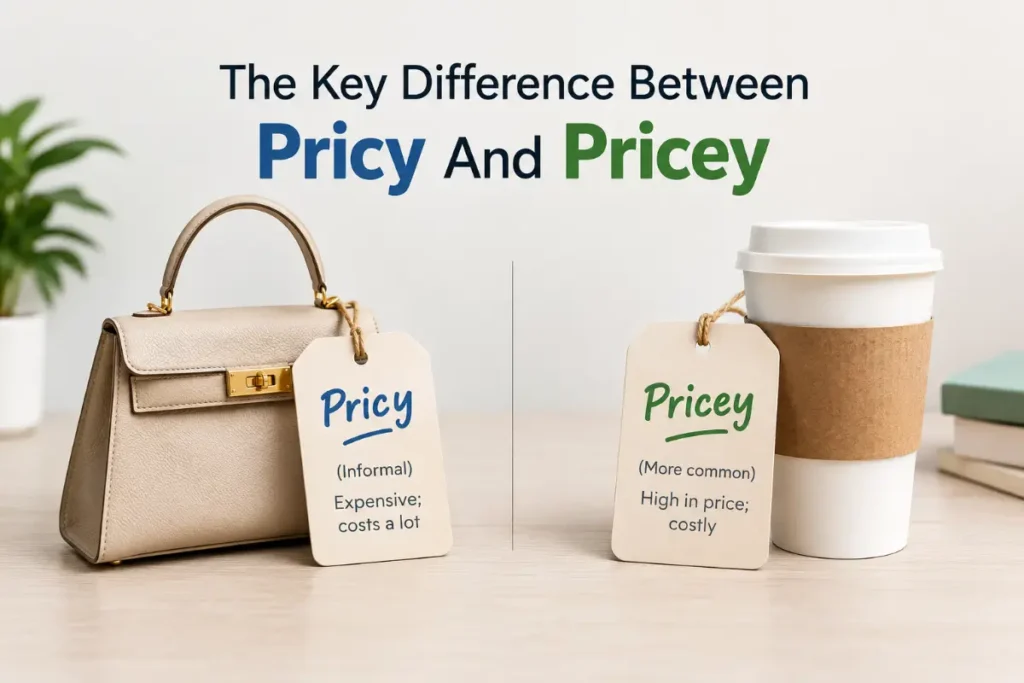
The Key Difference Between Pricy And Pricey
There is no difference in meaning between pricy and pricey.
Both mean expensive.
The main difference is spelling preference and familiarity.
Pricey is the more familiar standard form for many readers. Pricy is an accepted alternative. Cambridge recognizes both forms while Oxford uses pricey as its main entry.
This means you should not create a meaning distinction that English dictionaries do not make.
For example:
The restaurant is pricey.
and
The restaurant is pricy.
Both mean:
The restaurant is expensive.
The choice is mainly editorial.
Is Pricey Formal Or Informal
Pricey is informal.
Oxford and Cambridge both identify the word as informal.
That does not make it incorrect or careless. It simply means the word has a conversational flavor.
You might naturally say:
This coffee shop is a little pricey.
That sounds perfectly normal in conversation.
For a formal academic paper you may prefer:
This coffee shop is relatively expensive.
In a business report you might write:
The service has a higher cost than competing options.
The choice depends on the audience and purpose.
Pricey Vs Expensive
Pricey and expensive are close in meaning but not identical in tone.
Expensive is the broad and neutral choice. Oxford describes expensive as the general word for something that costs a lot of money.
Pricey is more informal.
Compare these sentences:
The equipment is expensive.
The equipment is pricey.
The first sounds neutral and suitable for almost any context. The second sounds more conversational.
That makes expensive a safer choice for formal writing.
However pricey can add a subtle personal reaction. It can suggest that the speaker feels the price is noticeably high.
The coffee was expensive.
This states a fact about cost.
The coffee was pricey.
This can sound more like a casual judgment about the cost.
The difference is small but useful.
Pricey Vs Costly
Costly also means expensive but often carries a more formal tone.
Oxford describes costly as rather formal and notes that it can refer to something that costs a lot of money or causes a loss.
For example:
The repairs were costly.
This can mean the repairs required a lot of money.
But costly can also describe consequences:
The mistake was costly.
Here costly can mean the mistake caused serious loss or problems.
Pricey is more directly about a high price.
That jacket is pricey.
The focus is the price.
That mistake was costly.
The focus may be the consequences.
That difference makes the two words useful in different situations.
Grammar Of Pricy And Pricey
Both pricy and pricey are adjectives.
An adjective describes or modifies a noun.
You can place either form before a noun:
We booked a pricey hotel.
She bought a pricy laptop.
You can also use the adjective after a linking verb:
The hotel was pricey.
The laptop seemed pricey.
The tickets became pricey after the first batch sold out.
The grammar does not change because of the spelling.
Using Pricey Before A Noun
When pricey comes directly before a noun it describes the cost of that noun.
Examples include:
a pricey restaurant
a pricey car
a pricey vacation
a pricey apartment
a pricey subscription
a pricey mistake
The adjective doesn’t change based on the noun.
You do not write:
priceys restaurant
or
pricey restaurants
The plural belongs to the noun:
pricey restaurants
The adjective stays pricey.
Using Pricey After A Linking Verb
You can also place pricey after verbs such as be, seem, look, feel, and become.
The meal was pricey.
The tickets seem pricey.
That watch looks pricey.
The service became pricey after the upgrade.
The adjective describes the subject.
This pattern is common in natural conversation.
Comparative Form
The comparative form is pricier.
You use pricier when comparing two things or groups.
This hotel is pricier than the one we stayed at last year.
The downtown location is pricier than the suburban location.
Organic produce can be pricier than conventional produce.
Cambridge lists pricier as the comparative form of pricey.
Notice something important here.
You do not normally write:
more pricey
The standard comparative form is pricier.
Superlative Form
The superlative form is priciest.
Use it when comparing three or more things or when identifying the highest price within a group.
That was the priciest restaurant on our trip.
This is the priciest model in the range.
The downtown apartments are among the priciest in the area.
Cambridge identifies priciest as the superlative of pricey.
Why Is It Pricier But Not Priceyer
This is one of the most useful spelling patterns to remember.
The base form is:
pricey
The comparative is:
pricier
The superlative is:
priciest
The final y changes to i before the comparative or superlative ending.
The pattern is:
pricey → pricier → priciest
The same general spelling pattern appears in many adjectives ending in consonant plus y:
happy → happier → happiest
easy → easier → easiest
busy → busier → busiest
So if you know this pattern you can remember the forms more easily.
Is Pricier Spelled Correctly
Yes.
Pricier is the standard comparative form of pricey.
It means more expensive.
This model is pricier than the older one.
You may also see the comparative used with than:
The new plan is pricier than the basic plan.
You can use much, far, slightly, a little, or similar words to show the degree of difference:
The new model is slightly pricier.
The premium version is much pricier.
The downtown hotel is far pricier.
Is Priciest Spelled Correctly
Yes.
Priciest is the superlative form.
It means most expensive within a comparison.
That was the priciest meal of the weekend.
This is one of the priciest neighborhoods in the city.
The spelling follows the same y to i pattern used in pricier.
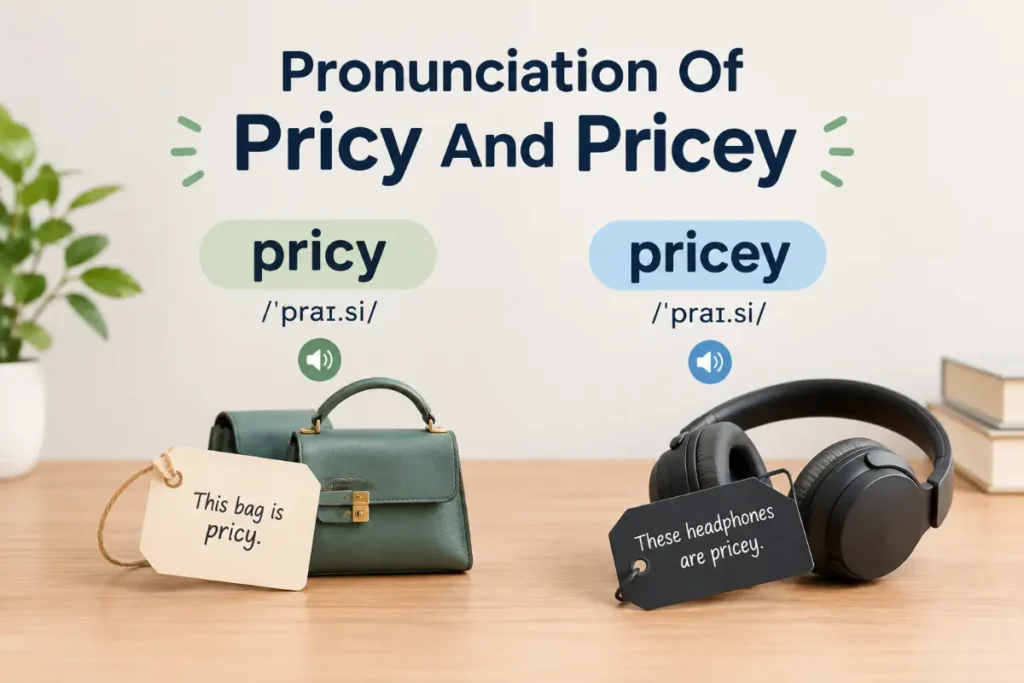
Pronunciation Of Pricy And Pricey
Both spellings have the same pronunciation.
The pronunciation is:
/ˈpraɪsi/
There are two syllables:
PRICE y
The main stress falls on the first syllable.
The opening sound is the same as the word price.
The final syllable sounds like the ending in words such as easy and busy.
The important point for learners is that pricy and pricey are not pronounced differently.
The extra e in pricey does not create an extra sound.
Spelling Rules For Pricy And Pricey
The spelling difference is easy to understand once you separate the base word from the adjective ending.
The base noun is price.
The adjective pricey keeps the visible connection to price.
The alternative pricy removes the e.
Both forms are established in English.
There is no useful rule that says one spelling is grammatically correct and the other is wrong. Dictionary evidence is more helpful here than trying to force the word into a single spelling pattern. Cambridge explicitly records both forms.
British And American English
Both pricey and pricy occur in English varieties on both sides of the Atlantic.
There is no simple British versus American rule that says Americans must use one spelling and British speakers must use the other.
For American readers pricey is a familiar everyday word. Oxford’s American dictionary labels pricey as an informal American English adjective meaning expensive.
Cambridge also provides American pronunciation and usage information for pricey.
Canadian and Australian English also use pricey naturally. The core meaning and grammar remain the same.
So regional English does not give you a reliable reason to reject pricy.
Twenty Natural Examples
The easiest way to understand the word is to see it in real sentences.
- That restaurant is a little pricey, but the food is excellent.
- We found a less pricey hotel near the airport.
- The new phone looks great, but it’s too pricey for me.
- This neighborhood has become surprisingly pricey.
- The tickets were pretty pricey for a weekday event.
- Her favorite coffee shop is slightly pricey.
- The repairs turned out to be more pricey than we expected.
- That apartment is much pricier than the one next door.
- The premium plan is pricier but includes more features.
- We chose the cheaper option because the original package was too pricey.
- The downtown hotel was the priciest place we considered.
- That was one of the priciest meals I’ve had this year.
- Some private schools in the area are extremely pricey.
- The jacket is stylish but a bit pricey.
- My editor suggested a more affordable alternative to the pricey service.
- The company moved to a less pricey office.
- I like the design but don’t want to pay such a pricey subscription.
- The new equipment is pricier than the older model.
- We expected the resort to be pricey during the holiday season.
- That store sells some of the priciest furniture in town.
You could replace most of these examples with pricy and keep the same meaning.
For instance:
That restaurant is a little pricy.
The new phone is too pricy.
The downtown hotel was the priciest option.
The grammar stays the same.
Pricey In Everyday Conversation
Pricey works especially well in casual speech.
Imagine a friend asks:
How was the restaurant?
You might answer:
The food was great but it was pretty pricey.
That sounds natural and relaxed.
You probably wouldn’t choose costly in that conversation unless you had a particular reason. You might say expensive because it is neutral. You might say pricey because it feels more conversational.
This is one reason the word appears often in reviews and casual recommendations.
Pricey In Workplace Writing
You can use pricey in informal workplace communication.
For example:
The current software is getting pricey.
That sentence works well in an internal message.
However a formal report may benefit from a more neutral word:
The current software has become significantly more expensive.
The choice isn’t about correctness. It’s about register.
Professional writing should match the audience. A word can be perfectly correct and still be less suitable for a formal document.
Pricey In Academic Writing
Academic writing usually favors precise and neutral vocabulary.
Because pricey is informal, expensive is often the better choice in formal academic prose.
For example:
The intervention is expensive to maintain.
This sounds more academic than:
The intervention is pricey to maintain.
The second sentence isn’t necessarily grammatically wrong. It simply has a casual tone that may not fit the genre.
That distinction is useful for English learners. Correct English and appropriate English aren’t always the same thing.
Pricey In Emails
The word works naturally in casual emails.
The venue looks great but it’s a little pricey.
It can also work in professional emails when the tone is relaxed:
The first option is a little pricey, so I’ve added two alternatives.
For formal client communication you may prefer:
The first option is relatively expensive, so I’ve included two alternatives.
The more formal version sounds measured and neutral.
Pricey In Journalism
Journalists may use pricey in headlines or lighter articles because it is short and familiar.
The word can create a conversational tone without requiring a long explanation.
For example:
Shoppers are looking for alternatives to pricey groceries.
The word is compact and immediately understandable.
Still, more formal financial or economic reporting may use expensive, high cost, or higher priced depending on the subject.
Pricey In Social Media
Pricey fits social media particularly well.
People often use it to express a quick reaction:
Cute place. Pretty pricey though.
Or:
This little café is pricey but worth it.
The word is short, familiar, and conversational.
That makes it a natural choice for captions, comments, reviews, and casual posts.
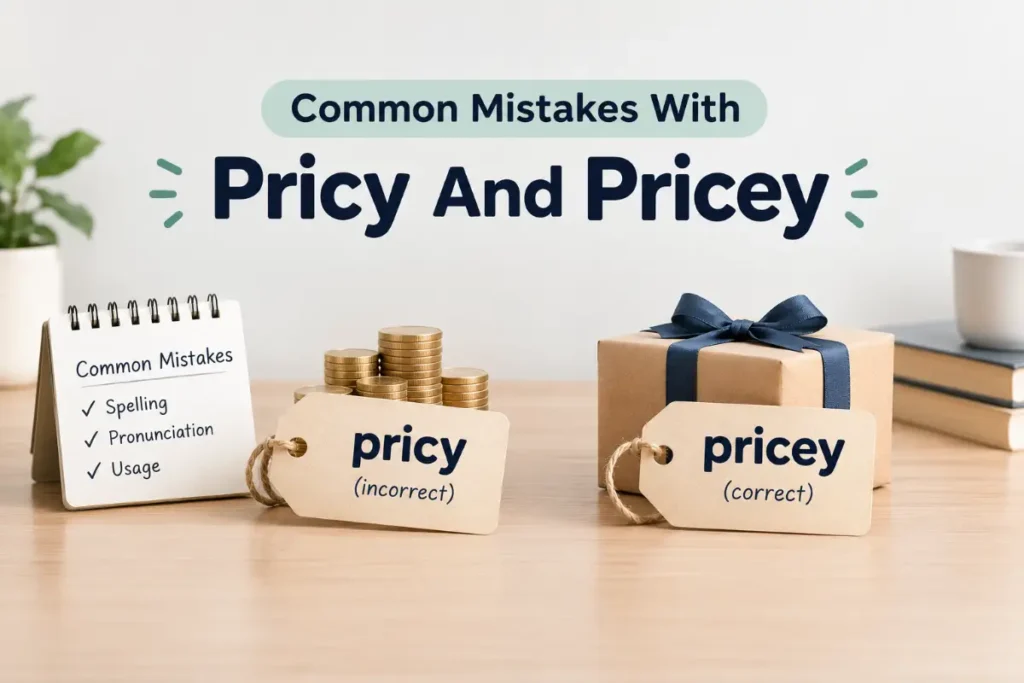
Common Mistakes With Pricy And Pricey
The biggest mistake is assuming that pricy is always wrong.
It isn’t.
Major dictionaries recognize pricy as an alternative spelling. Cambridge lists it directly alongside pricey.
Another mistake is assuming that the two forms have different meanings.
They don’t.
A third mistake is using priceyer or priceyest.
The correct forms are:
pricey
pricier
priciest
You should also avoid changing the adjective for plural nouns.
Incorrect:
priceys restaurants
Correct:
pricey restaurants
The adjective stays unchanged.
Common Spelling Errors
Here are several forms to avoid:
pricey is correct.
pricy is also correct.
pricier is correct.
priciest is correct.
priceyer is not the standard comparative form.
priceyest is not the standard superlative form.
The spelling pattern becomes much easier when you remember the y to i change:
pricey → pricier → priciest
Common Meaning Mistake
Do not assume that pricey means overpriced.
These words are related but they aren’t identical.
Pricey means expensive.
Overpriced means too expensive for the value being offered. Oxford defines overpriced as costing more than it is worth.
For example:
The restaurant is pricey.
This tells us that the restaurant costs a lot.
The restaurant is overpriced.
This adds an opinion about value. It suggests that the price is too high for what you receive.
That distinction matters.
A luxury hotel can be pricey without being overpriced. Someone may think the high price is justified by the location, service, or quality.
Pricy And Pricey In Formal Writing
If you’re choosing one form for polished general writing, pricey is the safer default.
If you’re writing something formal, you may want to replace both forms with expensive.
For example:
Casual:
The service is pricey.
Neutral:
The service is expensive.
Formal:
The service involves relatively high costs.
The best choice depends on the context.
Professional editing isn’t just about finding errors. It is also about selecting words that fit the audience and purpose.
A Simple Memory Trick
Use this memory trick:
Pricey keeps price visible.
Look at:
price → pricey
The word price is right there inside pricey.
That makes pricey easy to remember.
For the comparative and superlative, remember:
Pricey gets pricier and then priciest.
The y changes to i.
You can compare it with:
easy → easier → easiest
happy → happier → happiest
busy → busier → busiest
Once you see the pattern, the spelling becomes much less mysterious.
Related Words
Several words sit close to pricey in meaning but have different shades of use.
Expensive means costing a lot of money and is the broadest neutral choice.
Costly can mean expensive and often has a more formal tone. It can also describe something that causes a serious loss or negative consequence.
Overpriced means more expensive than the value justifies.
High priced means having a high price. Oxford lists high priced as a synonym for expensive.
Cheap is an opposite of expensive when it refers to a low price.
Inexpensive also means not expensive.
These words aren’t interchangeable in every sentence because they carry different tones and implications.
Pricey And Expensive
Use pricey when you want an informal and conversational tone.
Use expensive when you want a neutral word that works in almost any setting.
This restaurant is pricey.
This restaurant is expensive.
Both are correct.
The first sounds more casual. The second is more neutral.
Pricey And Overpriced
Use pricey to describe a high price.
Use overpriced when you think the price is too high for the value.
The laptop is pricey.
This says the laptop costs a lot.
The laptop is overpriced.
This suggests the laptop costs more than it should.
That extra idea of value is important.
Pricey And Costly
Use pricey for casual comments about price.
Use costly in more formal contexts or when talking about serious financial consequences.
The hotel is pricey.
The legal dispute was costly.
The second sentence has a more formal tone and can suggest consequences rather than simply a high sticker price.
Internal Linking Opportunity
A natural internal link could point readers to an article about expensive vs costly because these words overlap with pricey but differ in tone and meaning.
Another useful internal link could cover pricier vs most expensive to help readers understand comparative and superlative forms.
Expert Editor’s Note
From an editing perspective, I would not correct pricy to pricey simply because I prefer the latter.
That would be too strong.
The dictionary evidence supports both forms. Cambridge identifies pricey as the main entry and gives pricy as an alternative spelling. Oxford uses pricey as its main entry and defines it as an informal adjective meaning expensive.
For most general American English content, I would choose pricey.
Why?
It is familiar. It clearly preserves the connection to price. It is easy for readers to recognize. It also appears as the principal form in the major learner dictionaries checked for this guide.
Still, an editor should not label pricy as a misspelling.
That is an important distinction.
A spelling can be less common without being incorrect.
For consistency, choose one form and use it consistently throughout a document. If your publication normally uses pricey, keep that spelling throughout the article. If a quotation or source uses pricy, there is no need to change it simply because the spelling differs.
Frequently Asked Questions
Is pricy a correct spelling
Yes. Pricy is a correct alternative spelling of pricey. Cambridge lists pricy as another spelling of the informal adjective pricey. Both forms mean expensive and have the same pronunciation.
Is pricey more correct than pricy
No. Both spellings are accepted. However pricey is the more familiar main form in major learner dictionaries. For general American English writing, it is usually the safest default. Pricy remains a legitimate alternative rather than an error.
Does pricey mean expensive
Yes. Pricey means expensive. It is an informal adjective used for something that costs a lot of money. For example, The restaurant is pricey means The restaurant is expensive. Oxford and Cambridge both give expensive as the core meaning.
Are pricy and pricey pronounced the same
Yes. Both forms are pronounced /ˈpraɪsi/. They have two syllables with the main stress on the first syllable. The extra e in pricey does not create an additional sound.
What is the comparative form of pricey
The comparative form is pricier. For example, you can say, This hotel is pricier than the other one. Cambridge lists pricier as the comparative form of pricey.
What is the superlative form of pricey
The superlative form is priciest. For example, That was the priciest restaurant we visited. Cambridge identifies priciest as the superlative form of pricey.
Is priceyer correct
No. The standard comparative form is pricier, not priceyer. The final y changes to i before the comparative ending. The same pattern appears in words such as happy, happier and easy, easier.
Is pricey formal English
Pricey is correct English but it is informal. Oxford and Cambridge both label it as informal. In formal academic or professional writing, expensive is often a better choice because it has a more neutral tone.
Is pricey American English
Yes. Pricey is used in American English. Oxford’s American English dictionary lists it as an informal adjective meaning expensive. Cambridge also provides American pronunciation and usage information for the word.
Is pricy a British spelling
Not specifically. Pricy is an alternative spelling rather than a spelling reserved for British English. Both forms can appear across English varieties. There isn’t a simple regional rule that makes pricy British and pricey American.
Should I use pricy or pricey
For most general writing, pricey is the easiest choice. It is the main form listed by major learner dictionaries and is highly familiar to readers. Use pricy if you prefer it or need to follow an established house style. Just keep the spelling consistent.
Final Takeaway
The answer to pricy or pricey is straightforward once you separate correctness from preference.
Both spellings are correct.
Pricey is the more common and familiar default. Pricy is an accepted alternative. Both mean expensive. Both are adjectives. Both have the same pronunciation. Both can form the comparative pricier and the superlative priciest. Cambridge explicitly recognizes pricy as an alternative spelling while Oxford uses pricey as its main entry.
If you’re writing for a broad American audience, I’d normally choose pricey.
If you see pricy, don’t treat it as a typo.
The bigger lesson is useful far beyond this one word. English contains many spelling variations that look like mistakes until you check reliable dictionary evidence. Good editing isn’t about changing every unfamiliar form. It’s about knowing the difference between an actual error and a legitimate variation.
When in doubt, remember this simple rule:

Editorial Reviewer & Proofreader
Grace Mitchell reviews Gramlify’s articles for clarity, consistency, and readability. She is passionate about creating accurate, approachable content that helps English learners build confidence.