
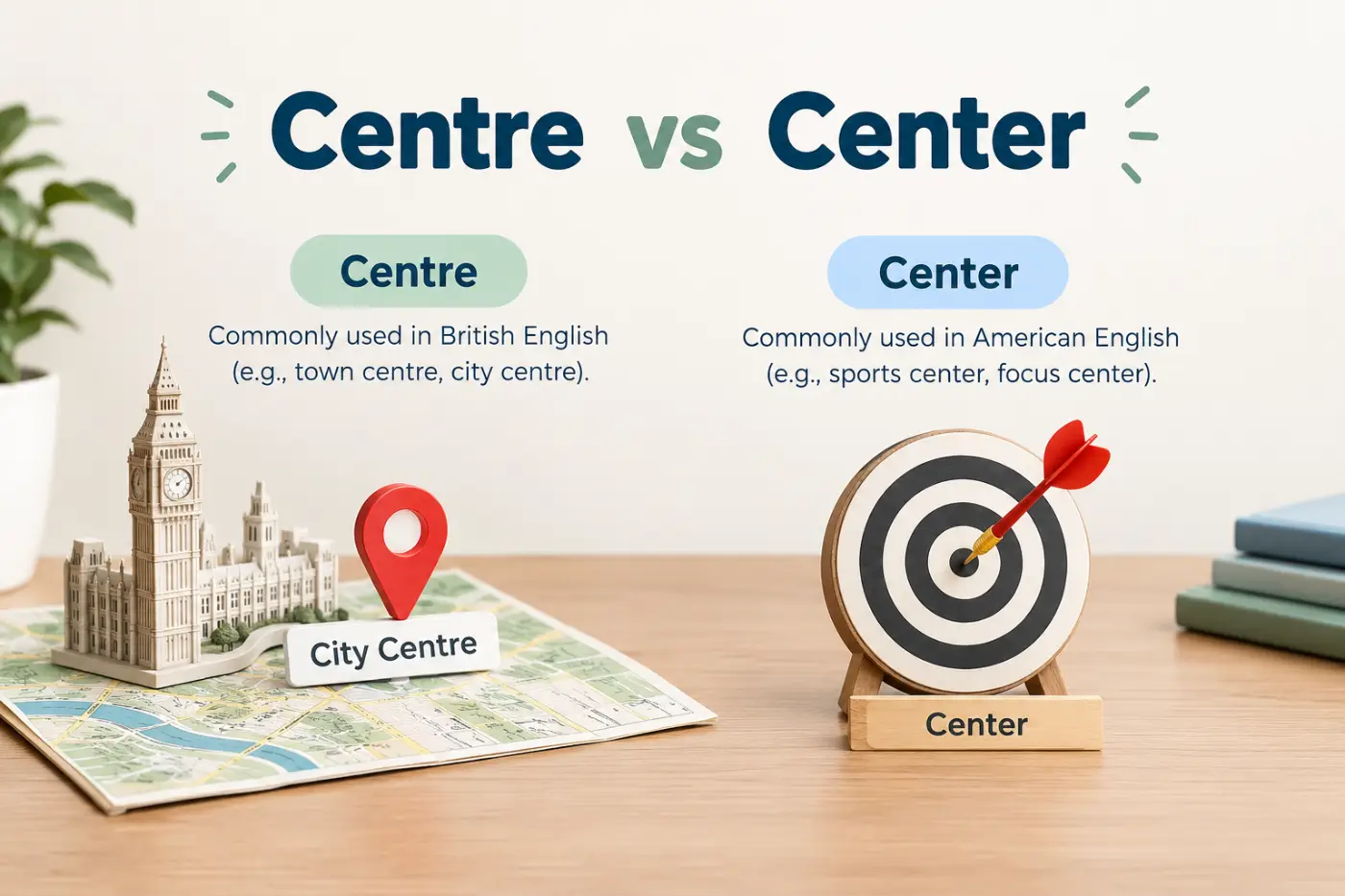
If you’ve ever stopped while writing the word centre and wondered if center is the correct spelling instead, you’re not alone. Centre and center are both correct spellings. The difference comes mainly from regional English. Centre is the standard spelling in British English while center is the standard spelling in American English.
The two forms have the same meaning and can work as both nouns and verbs. You can use them for the middle point of something. You can also use them for a place that provides a particular service or activity. For example, British English uses shopping centre while American English normally uses shopping center.
The tricky part is that neither spelling is simply right or wrong. The correct choice depends on the variety of English you’re writing in and the style you need to follow.
In this guide, you’ll learn the exact difference between centre vs center. You’ll see how each spelling works in British and American English. You’ll also learn about Canadian and Australian usage, pronunciation, grammar, word history, common mistakes, useful examples, and simple ways to remember the difference.
If you’re writing for a US audience, center will usually be your natural choice. If you’re following British English, centre is the standard form.
You may also want to read Sapphire Or Saphire Which Spelling Is Correct 2026 Guide.
Quick Answer
Centre and center are both correct. Centre is the standard British English spelling, while center is the standard American English spelling. They have the same basic meanings and pronunciation. Use center for most US writing and centre for British English and other varieties that follow the British spelling pattern.
Centre vs Center At a Glance
| Feature | Centre | Center |
|---|---|---|
| Correct spelling | Yes | Yes |
| Main regional use | British English | American English |
| Meaning | Middle or central place | Middle or central place |
| Part of speech | Noun and verb | Noun and verb |
| Pronunciation | Essentially the same | Essentially the same |
| Formality | Standard | Standard |
| US writing | Usually not preferred | Standard |
| UK writing | Standard | Usually not preferred |
| Canadian English | Common | Also used in some contexts |
| Australian English | Standard | Usually not preferred |
| Example | shopping centre | shopping center |
The most important point is simple. Centre and center are spelling variants of the same word. Cambridge lists centre as the UK spelling of center and center as the US spelling of centre.
What Does Centre Mean
Centre is the standard British English spelling of the word meaning the middle point or central part of something.
It can describe a physical location.
The table stood in the centre of the room.
It can also describe a place created for a particular activity or service.
The town has a new health centre.
The word can have a more abstract meaning too. Something can be the centre of attention when it receives the most attention from other people.
She became the centre of attention at the party.
Cambridge also lists centre as a noun and a verb. As a verb it means to put something in the middle of an area.
For example:
Centre the image on the page.
In British English you may also see expressions such as:
town centre
city centre
shopping centre
community centre
sports centre
health centre
research centre
These are all standard British English combinations.
What Does Center Mean
Center has the same core meaning as centre. It is the standard American English spelling.
As a noun it can mean the middle point or part of something.
She stood in the center of the room.
It can also mean a place or building designed for a particular purpose.
The city opened a new community center.
The word has several specialized uses. In sports it can refer to a player who occupies a central position. In politics it can describe a position between opposing extremes.
Common American English combinations include:
shopping center
community center
medical center
research center
fitness center
visitor center
service center
distribution center
The meaning stays the same when you switch from center to centre. The spelling changes because the variety of English changes.
Which One Is Correct
Both centre and center are correct spellings.
The choice depends on the variety of English you’re using.
Use center when writing standard American English.
The new shopping center opened last week.
Use centre when writing standard British English.
The new shopping centre opened last week.
Neither spelling is an error in its own regional system. The problem appears when you mix spelling systems in the same piece of formal writing.
For example, an American writer might normally use:
center
color
neighbor
theater
A British writer might normally use:
centre
colour
neighbour
theatre
Cambridge identifies centre and center as one of the standard British and American spelling differences.
So if your teacher asks for British English, choose centre. If your workplace follows American English, choose center.
Why People Confuse Centre and Center
The confusion comes from a simple fact. English has more than one standard spelling system.
British and American English share most vocabulary. However, they developed different spelling conventions over time. Words such as centre and center show this difference clearly.
The Words Look Almost Identical
Only the final two letters change position.
centre
center
That small difference can make the words easy to confuse during proofreading.
The problem becomes even more noticeable because both words mean the same thing.
They Sound Almost Identical
For most speakers, centre and center have the same basic pronunciation. Cambridge gives British pronunciation around /ˈsen.tə/ and American pronunciation around /ˈsen.t̬ɚ/.
Because the sound doesn’t give most writers a useful clue, spelling becomes the main issue.
Regional English Changes the Expected Spelling
A British reader expects centre in standard British writing.
An American reader expects center.
That expectation can make the other spelling look unusual even though it isn’t inherently incorrect.
For example, an American reader may see:
The town centre was crowded.
The sentence is understandable. However, town center would fit standard American spelling better.
A British reader would naturally write:
The town centre was crowded.
The spelling reflects the writer’s variety of English.
Keyboard Habits Can Add Confusion
People who regularly switch between American and British English may type one version automatically.
This can happen during international work. It can also happen when someone reads material from several countries.
Autocorrect can reinforce the problem because software often follows a selected language setting.
If your document uses American English, your spell checker may prefer center. A British English setting may prefer centre.
Online Writing Blends English Varieties
The internet has made regional spelling differences less visible.
A US reader can easily encounter British websites. A British writer can work for an American company. A global company may publish one website for several English speaking markets.
As a result, writers sometimes learn both spellings without learning when each one belongs.
The answer isn’t to memorize one spelling as universally correct. The better approach is to identify the English variety you’re using.
Key Differences Between Centre and Center
The main difference is spelling rather than meaning.
Meaning
Both words can mean the middle point or central part of something.
The lamp was in the centre of the table.
The lamp was in the center of the table.
The meaning is unchanged.
Both can also describe a place that serves a particular purpose.
The children visited a community centre.
The children visited a community center.
Again, the meaning is unchanged.
Part of Speech
Both forms can function as nouns and verbs.
As nouns:
The centre was crowded.
The center was crowded.
As verbs:
Centre the title on the page.
Center the title on the page.
Cambridge lists both words as nouns and verbs.
Region
This is the biggest practical difference.
Centre is associated with British English.
Center is associated with American English.
Cambridge explicitly identifies centre as the UK spelling and center as the US spelling.
Formality
Neither word is more formal than the other.
A British government document can use centre.
An American academic paper can use center.
A US business email can use center.
A UK business report can use centre.
The spelling reflects regional convention rather than formality.
Pronunciation
The two spellings are generally pronounced alike within the same variety of English.
British English commonly has a pronunciation represented as /ˈsen.tə/.
American English commonly has /ˈsen.t̬ɚ/.
The spelling difference does not create a major difference in everyday pronunciation.
Centre vs Center in Grammar
The spelling difference doesn’t change the basic grammar.
Both forms can act as countable nouns.
The center is closed today.
The centres are closed today.
American English normally uses the plural centers.
British English normally uses centres.
The same pattern applies when the word is used as a verb.
Center the text.
Centre the text.
The tense changes normally.
She centered the image.
She is centering the image.
British English commonly uses:
She centred the image.
She is centring the image.
The exact spelling of derived forms follows the spelling system being used.
This is important because choosing centre in one sentence and then using an American derived form can create an inconsistent style.
For example:
The text was centred on the page.
This fits British spelling.
In American English:
The text was centered on the page.
The same grammatical idea appears in both versions.
Centre and Center as Nouns
As nouns, both words have several common meanings.
The Middle of Something
The vase is in the centre of the table.
The vase is in the center of the table.
A Place for an Activity
She works at a community centre.
She works at a community center.
A Main Area of Activity
London is an important financial centre.
New York is a major financial center.
A Central Position in Sports
American English commonly uses center for certain sports positions.
He plays center for the basketball team.
British English can use centre in sports contexts where that spelling fits the regional variety.
The precise sports terminology can vary by sport and country. The spelling still follows the local English system.
A Political Position
Both forms can refer to the political center or centre.
The debate moved toward the political center.
The debate moved toward the political centre.
The underlying meaning is the same. Cambridge includes the political sense in its definition of center.
Centre and Center as Verbs
Both spellings can also function as verbs.
The basic meaning is to place something in the middle.
American English:
Center the heading on the page.
British English:
Centre the heading on the page.
The verb can also describe something focusing on a particular subject.
The discussion centered on education.
British English can use:
The discussion centred on education.
This distinction becomes especially useful when proofreading formal documents.
A writer may correctly know the noun centre but accidentally write the verb as centered. That creates a mixed spelling style.
For consistent British English, use:
centre
centred
centring
For consistent American English, use:
center
centered
centering
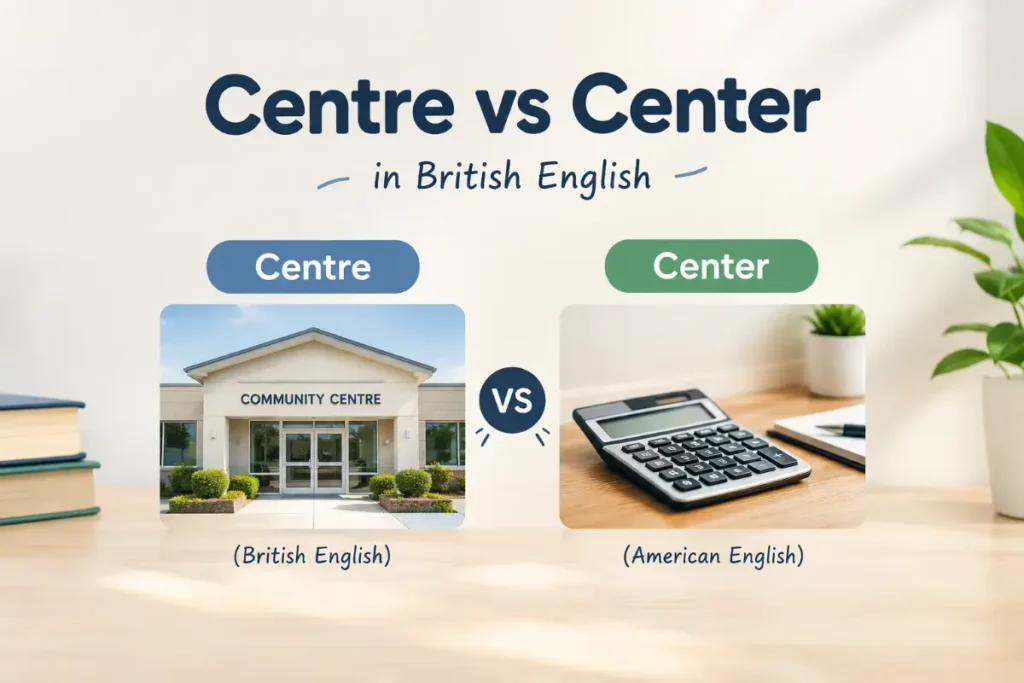
Centre vs Center in British English
British English uses centre as the standard spelling.
This applies to everyday words and formal terms.
Common examples include:
town centre
city centre
shopping centre
health centre
community centre
sports centre
garden centre
research centre
call centre
conference centre
Cambridge gives centre as the UK form and lists many common compounds such as business centre, shopping centre, service centre, and data centre.
British English also uses the related spelling pattern in words such as centred and centring.
So a British writer might say:
The image is centred on the page.
An American writer would normally write:
The image is centered on the page.
The difference follows the same regional spelling principle.
Centre vs Center in American English
American English uses center as the standard spelling.
Common examples include:
shopping center
community center
medical center
research center
fitness center
visitor center
service center
distribution center
conference center
data center
American English also uses related forms such as centered and centering.
For example:
Please center the heading.
The discussion centered on the main issue.
The image is centered on the page.
Cambridge identifies center as the American spelling of centre.
If your target audience is in the United States, center is the natural default.
Centre vs Center in Canadian English
Canadian English deserves a little more care because it does not fit neatly into a simple British versus American split.
Canadian English has its own conventions and can preserve features associated with British English while also sharing many forms with American English. Cambridge defines Canadian English as the English spoken and written in Canada rather than treating it as simply another name for British or American English.
For centre, Canadian usage commonly follows the British spelling pattern.
You may see:
shopping centre
community centre
recreation centre
health centre
At the same time, Canadian English has broader spelling variation in different contexts. A Canadian writer should follow the style guide used by the employer, school, publication, or organization.
The safest professional rule is consistency.
If a Canadian document uses centre, keep related spellings consistent throughout the document. Don’t switch randomly between centre and center.
Centre vs Center in Australian English
Australian English generally follows the British spelling centre.
You’ll commonly see expressions such as:
shopping centre
city centre
community centre
health centre
service centre
regional centre
The spelling fits the broader Australian preference for many British English forms.
So if you’re writing for an Australian audience, centre is normally the appropriate choice.
Centre vs Center in Formal Writing
Formal writing does not make one spelling more correct than the other.
The key is to match your spelling to the English variety and editorial style required for the document.
For a US academic paper:
The research center collected the data.
For a US business report:
A professional editor usually looks at the entire document rather than correcting one word in isolation.
If a document uses color, labor, and neighbor, then center is likely the consistent choice.
If it uses colour, labour, and neighbour, then centre is likely the consistent choice.
This broader pattern gives you a useful proofreading clue.
Spelling Rules for Centre and Center
There isn’t a complicated spelling rule that tells you when to use centre or center.
The difference comes from regional spelling conventions.
The easiest rule is:
British English uses centre.
American English uses center.
This difference also appears in several related words.
| British English | American English |
|---|---|
| centre | center |
| centred | centered |
| centring | centering |
| centralised | centralized |
| organisation | organization |
| colour | color |
| theatre | theater |
| metre | meter |
The final pair needs special care because meter can have different meanings. In American English meter can mean a measuring device or a unit of measurement. British English uses metre for the unit of measurement while meter remains available for certain other meanings.
The important lesson is not to treat every spelling difference as an isolated fact. Many belong to a larger regional pattern.
Cambridge lists centre and center alongside other common British and American spelling differences.
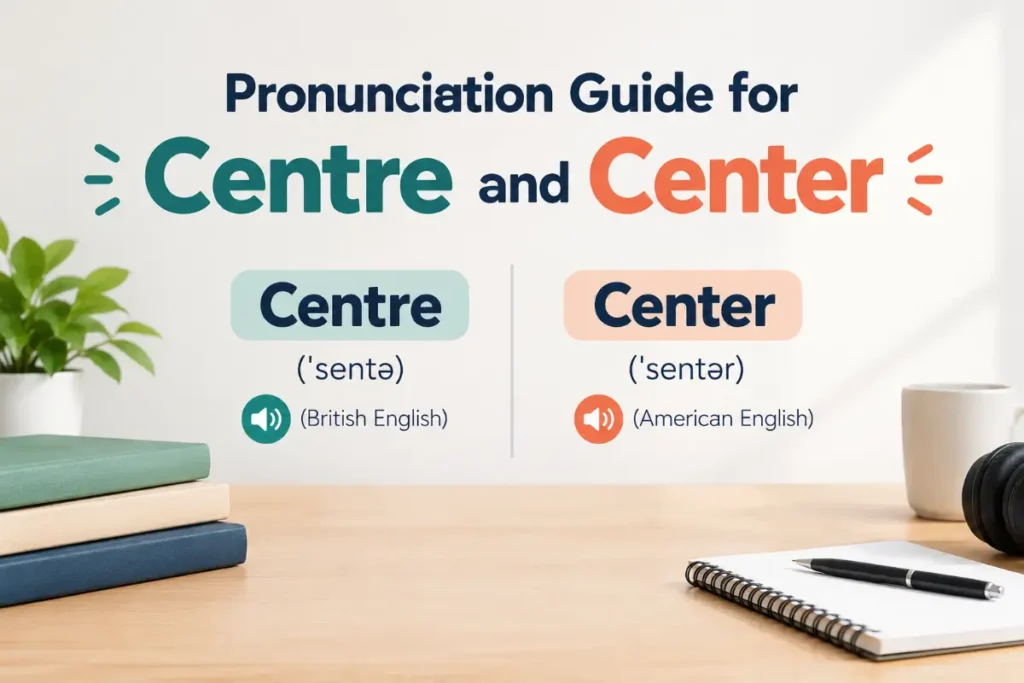
Pronunciation Guide for Centre and Center
The pronunciation of centre and center is very similar.
Cambridge gives the British pronunciation of centre as approximately:
/ˈsen.tə/
The American pronunciation of center is approximately:
/ˈsen.t̬ɚ/.
The word has two syllables.
The main stress falls on the first syllable:
CEN ter
The spelling does not normally give you a reason to pronounce the words differently.
A common mistake is to pronounce centre as if the spelling requires an extra sound. It doesn’t.
Think of the two forms as two written versions of the same everyday word.
The Word Origin of Centre and Center
The history of centre and center helps explain why the two spellings exist.
The word ultimately comes through French from Latin centrum. The Latin term comes from Greek kentron, a word connected with a sharp point and the point of a compass.
That historical path matters because English did not develop its vocabulary from one single source. Words entered English through different languages and then changed over time.
The re ending in centre reflects the French influenced spelling tradition. The er ending in center became established in American English.
The modern difference is therefore not a difference in meaning. It is the result of different spelling conventions developing in different varieties of English.
A related grammar guide is Dought Vs Doubt Which Word Is Correct 2026 Guide.
Real Life Examples of Centre and Center
Seeing the words in natural sentences is one of the best ways to understand the difference.
Daily Conversation
- The café is near the center of town.
- The hotel is close to the city centre.
- Meet me at the center of the park.
- The station is in the town centre.
- There’s a shopping center across the street.
- The new shopping centre is opening on Saturday.
Workplace Writing
- The customer service center received the request.
- The customer service centre received the request.
- Our research center focuses on renewable energy.
- Our research centre focuses on renewable energy.
- Please send the report to the training center.
- Please send the report to the training centre.
Academic Writing
- The study was conducted at a university research center.
- The study was conducted at a university research centre.
- The results were centered on three main themes.
- The results were centred on three main themes.
Emails
- The meeting will take place at the conference center.
- The meeting will take place at the conference centre.
- Please contact the service center for assistance.
- Please contact the service centre for assistance.
General Writing
- Place the image in the center of the page.
- Place the image in the centre of the page.
- The statue stands at the center of the square.
- The statue stands at the centre of the square.
- The story centers on a young teacher.
- The story centres on a young teacher.
Notice the pattern. The meaning stays stable while the spelling changes with the regional variety of English.
Common Mistakes With Centre and Center
Most mistakes involve consistency rather than meaning.
Mistake One
The shopping centre opened in New York.
This sentence is understandable. However, if you’re writing standard American English, shopping center is the expected spelling.
Better for US English:
The shopping center opened in New York.
Mistake Two
The shopping center opened in London.
Again, the meaning is clear. However, standard British English normally uses shopping centre.
Better for British English:
The shopping centre opened in London.
Mistake Three
Mixing regional spellings in one document.
For example:
The research centre analyzed the data using color coded charts.
This sentence mixes British centre and American analyzed and color.
A British version could be:
The research centre analysed the data using colour coded charts.
An American version could be:
The research center analyzed the data using color coded charts.
The exact style can depend on the publication or organization. The important point is consistency.
Mistake Four
Assuming one spelling is always wrong.
You may see someone mark centre as incorrect because they learned American English.
That correction would be misleading.
Centre is correct British English.
Likewise, calling center incorrect simply because you learned British English would also be wrong.
Mistake Five
Changing the spelling inside a proper name
Proper names require special care.
An organization may officially use Center even when its broader regional English uses other conventions. A proper name should normally be reproduced according to the organization’s official spelling.
For example, if a US institution officially includes Center in its name, don’t change it to Centre just to make the spelling look British.
Names are fixed labels. Regional spelling rules do not give you permission to rewrite them.
Memory Tricks for Centre and Center
You don’t need a complicated mnemonic.
The easiest memory trick is:
Centre goes with British English.
Center goes with American English.
You can also connect centre with other British spellings that use re.
centre
theatre
metre
Then connect center with common American forms that use er.
center
theater
meter
This isn’t a universal spelling rule. It’s a memory aid for common regional differences.
Another useful trick is to think about your reader.
If you’re writing for the United States, type center.
If you’re writing for the United Kingdom, type centre.
That simple habit will prevent most mistakes.
Related Words and Expressions
Several words and expressions belong to the same word family.
Central
Central means related to the center or centre.
The hotel has a central location.
Centrally
Centrally means in a central position or manner.
The hotel is centrally located.
Centralize
Centralize is the common American spelling.
The company plans to centralize its operations.
British English commonly uses centralise.
The company plans to centralise its operations.
Centralized and Centralised
American English:
centralized
British English:
centralised
Centerpiece and Centrepiece
American English commonly uses:
centerpiece
British English commonly uses:
centrepiece
The meaning is the same. It refers to an object placed in a central position and often used as a main decorative feature.
Centered and Centred
American English:
centered
British English:
centred
Centering and Centring
American English:
centering
British English:
centring
These forms follow the same regional spelling pattern.
Expert Editor’s Note
From an editing perspective, centre vs center is not a question of finding one universally correct spelling.
The first question should always be: Which English variety does this document follow?
For US readers, center is the standard choice.
For UK readers, centre is the standard choice.
Cambridge explicitly identifies center as the US spelling and centre as the UK spelling. Its grammar material also places the pair among standard British and American spelling differences.
A good editor also checks related words.
If a document uses color, neighbor, and theater, then center will normally fit the same American spelling system.
If it uses colour, neighbour, and theatre, then centre will normally fit the British spelling system.
The strongest editorial habit is consistency. Don’t switch between regional systems simply because both forms appear in dictionaries.
There’s another important point. A dictionary entry can tell you that a spelling is valid. It doesn’t automatically tell you that it’s the best choice for every audience.
That’s why professional proofreading considers audience, publication style, geographic market, proper names, and the surrounding spelling system.
When Should You Use Centre
Use centre when you’re writing standard British English or another variety that follows British spelling conventions.
Choose it for:
UK websites
British schoolwork
British academic writing
UK business documents
British journalism
Australian English
Many Canadian contexts
For example:
The new health centre opened in April.
The city centre is busy during the afternoon.
The research centre published its findings.
When Should You Use Center
Use center when you’re writing standard American English.
Choose it for:
US websites
American schoolwork
US academic writing
American business documents
US journalism
American marketing copy
For example:
The new health center opened in April.
The city center is busy during the afternoon.
The research center published its findings.
If your audience is mainly in the United States, center should be your default spelling.
Internal Linking Opportunities
If this article belongs to an English learning website, two useful internal links would fit naturally.
British English vs American English spelling differences would help readers who want to understand the larger spelling system behind words such as centre and center.
Theatre vs Theater explained would give readers another clear example of the same British and American spelling pattern.
Place the first link after the introduction when readers are ready to understand regional English. Place the second link near the conclusion after the reader understands the basic difference.
Centre vs Center in Style Consistency
Consistency becomes especially important in long documents.
Imagine you’re editing a 2,000 word report.
The first page says:
research center
The middle says:
research centre
The final section says:
research center
A reader can understand all three. Still, the document looks less carefully edited because the spelling shifts without a clear reason.
A polished document should normally establish one regional spelling system and maintain it.
This matters even more in:
Academic papers.
Company websites.
Government documents.
Books.
Training materials.
News articles.
Professional reports.
Educational resources.
The spelling itself is small. The consistency signal is not.
Does Centre Mean Something Different From Center
No. In ordinary usage, centre and center have the same core meanings.
Both can refer to:
The middle of something.
A central position.
A place for a particular activity.
A main area of activity.
A central point of attention.
A central position in some sports.
A political position between opposing extremes.
The difference is primarily regional spelling.
Cambridge gives matching definitions for the British and American forms.
Is Centre British or American
Centre is British English.
It is the standard spelling used in British English.
The shopping centre is crowded.
American English normally uses:
The shopping center is crowded.
Cambridge lists centre as the UK spelling of center.
Is Center British or American
Center is American English.
It is the standard spelling used in American English.
The shopping center is crowded.
British English normally uses:
The shopping centre is crowded.
Cambridge identifies center as the US spelling.
Is Centre Spelled Wrong in America
Not exactly.
An American reader will understand centre, and the spelling is valid in British English. However, center is the normal American spelling.
So if you’re writing for a US audience, use center unless you’re reproducing a proper name or an official title that uses centre.
Is Center Spelled Wrong in Britain
No.
Center is a valid English spelling because it is the standard American form. However, British English normally uses centre.
In formal British writing, centre will usually fit the expected regional spelling system better.
Do Centre and Center Sound the Same
They are generally pronounced the same or almost the same within ordinary speech.
Cambridge gives the British pronunciation as approximately /ˈsen.tə/ and the American pronunciation as approximately /ˈsen.t̬ɚ/.
The main difference you notice between the two forms is spelling rather than pronunciation.
Is Center the American Spelling of Centre
Yes.
Center is the standard American English spelling of centre.
The two words share the same basic meanings and grammatical functions.
This is one of many British and American spelling differences in English.
Other familiar examples include:
colour and color
neighbour and neighbor
theatre and theater
labour and labor
defence and defense
Cambridge includes these kinds of spelling differences in its British and American English guidance.
Which Spelling Should You Learn
If you’re learning English for life in the United States, learn center as your main spelling.
If you’re learning British English, learn centre.
You don’t need to treat the other form as a mistake. Instead, learn to identify the regional spelling.
That skill will help you with many other English words too.
A related grammar guide is Unphased Or Unfazed Which Word Is Correct 2026 Guide.
Final Takeaway on Centre vs Center
Centre and center are both correct. The difference is regional.
Use centre in standard British English and in varieties that follow British spelling conventions.
Use center in standard American English.
The words have the same basic meaning, the same core grammatical roles, and very similar pronunciation. The main issue is consistency.
If you’re writing for Americans, center is the natural choice.
If you’re writing for British readers, centre is the natural choice.
The biggest mistake isn’t choosing one form over the other. It’s mixing regional spellings without a clear reason.
Once you connect centre with British English and center with American English, the choice becomes much easier.
Same meaning. Different regional spelling. Choose the form that matches your audience and stay consistent.
Frequently Asked Questions
Is Centre or Center Correct
Both are correct spellings. Centre is the standard British English form while center is the standard American English form. Neither word is an incorrect version of the other. The right choice depends on the English variety you’re using and the style requirements of your publication, school, workplace, or audience.
What Is the Difference Between Centre and Center
The main difference is regional spelling. Both words can mean the middle point of something or a place designed for a particular activity. British English normally uses centre, while American English normally uses center. The pronunciation and basic meanings are essentially the same.
Is Centre British English
Yes. Centre is the standard British English spelling. It appears in common expressions such as city centre, shopping centre, health centre, and community centre. Australian English also commonly follows this spelling. Canadian English can use centre as well depending on the context and style being followed.
Is Center American English
Yes. Center is the standard American English spelling. American writers use it in expressions such as shopping center, community center, medical center, and research center. The spelling also appears in related forms such as centered and centering.
Do Centre and Center Have the Same Meaning
Yes. In normal usage they have the same basic meanings. Both can refer to the middle of something, a central position, or a place connected with a particular activity. Both can also function as nouns and verbs. The main difference is the regional spelling convention rather than meaning.
How Do You Spell Center in British English
In standard British English, the word is usually spelled centre. For example, British English uses shopping centre and city centre. The American spelling center is still recognizable to British readers, but centre is the conventional British form.
How Do You Spell Centre in American English
In standard American English, the word is spelled center. For example, American English uses shopping center and city center. Centre is understood in the United States, but it usually appears as a British spelling or as part of a proper name rather than standard US spelling.
Should I Use Centre or Center in a US Essay
Use center for a standard US essay. American English normally uses center along with related spellings such as centered and centering. The main goal is consistency. If your assignment follows a specific style guide or your school requires another English variety, follow that requirement instead.
Should I Use Centre or Center in a UK Essay
Use centre for a standard UK essay. British English normally uses centre, along with related forms such as centred and centring. Also check the rest of your spelling so the document follows the same regional system. Consistency matters more than treating one variety as universally correct.
Does Center Have a Different Pronunciation From Centre
Usually not in any major way. The pronunciation can vary by regional accent, but the two spellings represent the same word. Cambridge gives approximately /ˈsen.tə/ for the British form and /ˈsen.t̬ɚ/ for the American form. The spelling difference is much more noticeable than the pronunciation difference.

Editorial Reviewer & Proofreader
Grace Mitchell reviews Gramlify’s articles for clarity, consistency, and readability. She is passionate about creating accurate, approachable content that helps English learners build confidence.