
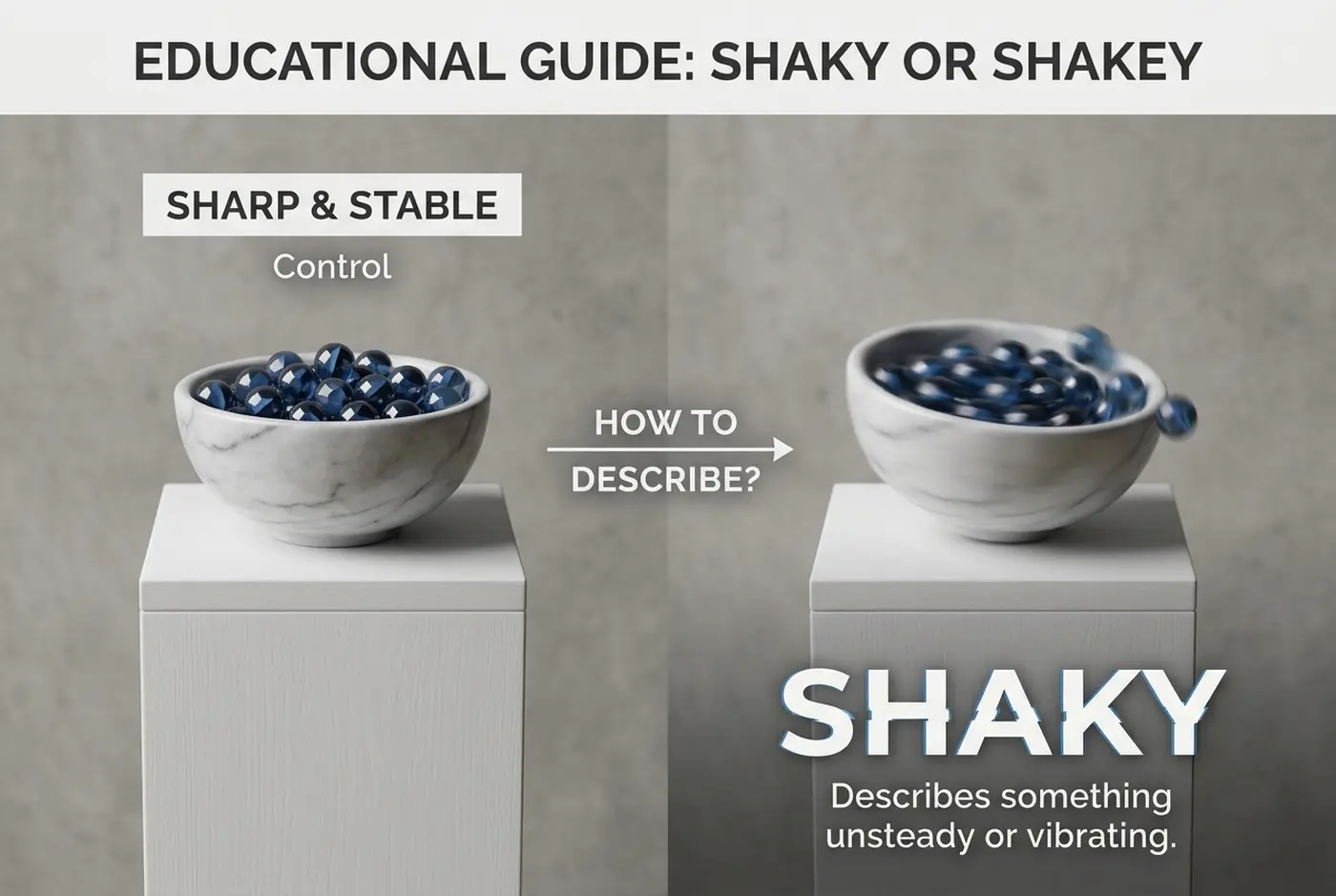
If you’re unsure about shakey or shaky you’re not alone. The two forms look almost identical and sound the same in ordinary speech. That makes the extra e easy to overlook when you’re typing quickly. However, standard English uses shaky when you mean something that trembles, feels unstable, or seems uncertain.
For example, you can write shaky hands, a shaky voice, a shaky ladder, or a shaky argument. Major dictionaries including Cambridge and Oxford list shaky as the adjective. Dictionary.com also gives shaky as the standard form and traces it to shake plus the suffix -y.
The spelling shakey can still appear in real life. You may encounter it as a name, username, brand name, informal spelling, or typo. It isn’t the standard spelling of the common English adjective.
This guide explains the difference between shakey and shaky in plain English. You’ll learn which spelling to use, why the mistake happens, how the word is pronounced, how shaky works in sentences, and how related forms such as shakier, shakiest, shakily, and shakiness are spelled.
If you’re writing an email, school assignment, article, report, or professional document, shaky is the form you should choose.
For another common grammar confusion, see Shiny Vs Shiney Which Spelling Is Correct 2026.
Quick Answer
Shaky is the correct standard spelling. It’s an adjective meaning trembling, unsteady, weak, unstable, or uncertain. Shakey is not the standard spelling of this adjective in modern English. Use shaky hands, a shaky voice, a shaky ladder, or a shaky argument. Dictionaries such as Cambridge and Oxford list shaky.
Shakey or Shaky Comparison
| Feature | Shaky | Shakey |
|---|---|---|
| Standard English spelling | Yes | No |
| Common adjective | Yes | No |
| Meaning | Trembling or unstable | No standard adjective meaning |
| Part of speech | Adjective | Usually a nonstandard spelling or proper name |
| Pronunciation | /ˈʃeɪki/ | Usually intended to sound like shaky |
| Formal writing | Recommended | Avoid |
| Academic writing | Recommended | Avoid |
| Everyday writing | Recommended | Avoid |
| Dictionary form | Yes | Not the standard adjective |
| Comparative | shakier | Not standard |
| Superlative | shakiest | Not standard |
| Adverb | shakily | Not shakeyly |
| Noun | shakiness | Not shakeyness |
The key point is simple. Shaky belongs in standard English when you need the adjective.
Cambridge gives the pronunciation as /ˈʃeɪ.ki/ and defines shaky in several related ways. It can describe uncontrolled movement. It can describe someone who feels upset. It can also describe something weak or unstable.
Oxford likewise lists shaky as an adjective and gives the related forms shakier and shakiest.
What Shaky Means
Shaky is an adjective formed from the verb shake. Its meaning changes slightly depending on the context.
At its most literal level it describes something that shakes or trembles.
Her hands were shaky after the long flight.
Here shaky describes physical movement.
The word can also describe a voice.
He answered in a shaky voice.
In this sentence the voice may sound weak or unsteady because of fear, nervousness, emotion, illness, or physical weakness.
The word also has a figurative meaning. Something can be shaky when it isn’t firm, reliable, secure, or convincing.
The company is in a shaky financial position.
Here nobody is physically shaking. The word describes instability.
Cambridge identifies these major uses as movement, emotional upset, and weakness or instability. Oxford also lists meanings connected with physical weakness, lack of stability, uncertainty, and likely failure.
That range of meanings makes shaky a useful everyday adjective.
Why Shakey Looks Correct
The spelling shakey feels plausible because English contains many words where adding a vowel before a suffix seems natural.
For example:
- make + y = makey is not standard.
- smoke + y = smokey can appear in some informal or brand contexts.
- hike + y = not the standard form.
- shake + y = shaky.
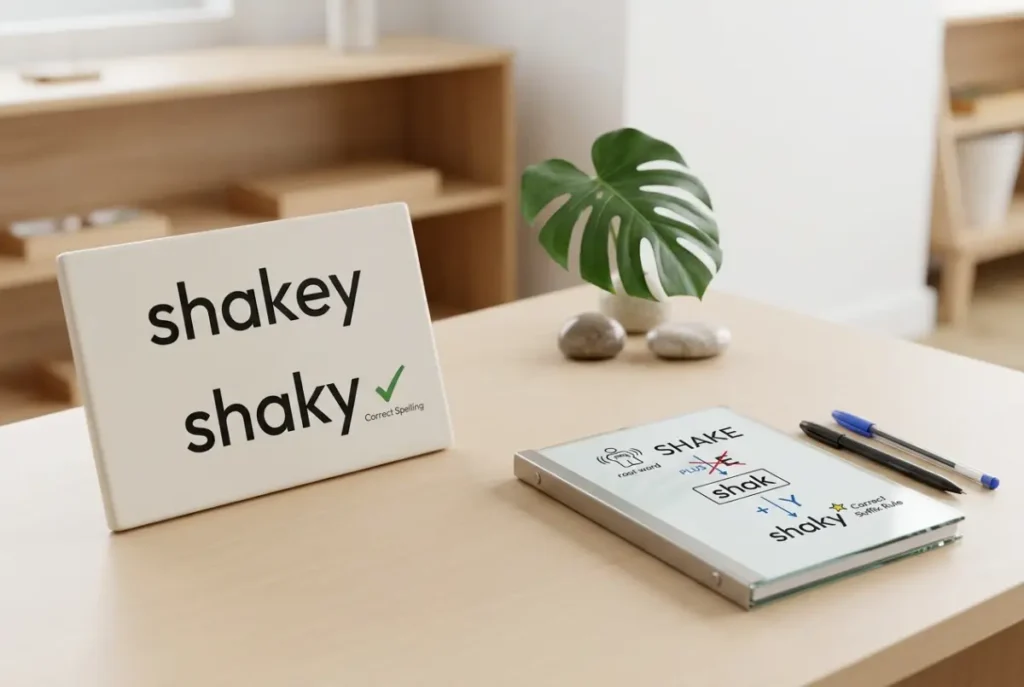
The important pattern is that shake loses its final e before the suffix y is added.
The base word is:
shake
The adjective is:
shaky
Not:
shakey
This is a common spelling pattern in English. The final silent e in a word often disappears before certain suffixes that begin with a vowel sound or letter.
Compare these forms:
- shake → shaky
- noise → noisy
- ice → icy
- spice → spicy
- taste → tasty
- grease → greasy
- ease → easy
These examples show why the spelling can feel confusing at first. English spelling isn’t always perfectly predictable. Still, once you recognize the pattern, shake → shaky becomes easier to remember.
Is Shakey Ever Correct
For the ordinary adjective meaning trembling or unstable, shakey is not the standard spelling.
That doesn’t mean the sequence of letters can never appear in English.
A word can function as a proper name. Someone might have Shakey as a nickname or use it as a username. A company or fictional character could also use the spelling as a creative name.
Those special uses don’t change the standard spelling of the adjective.
If your sentence means something is trembling or unstable, use shaky.
Correct:
I had a shaky hand while signing the form.
Correct:
The old bridge looked shaky.
Correct:
His explanation was shaky.
Incorrect in standard English:
I had a shakey hand while signing the form.
Incorrect in standard English:
The old bridge looked shakey.
A useful editorial rule is simple. If you can replace the word with unsteady, unstable, or trembling, you almost certainly need shaky.
Shaky As An Adjective
The word shaky is an adjective. That means it modifies a noun or follows a linking verb to describe a person, thing, condition, or situation.
It can appear before a noun:
She had shaky hands.
We heard a shaky voice.
They crossed a shaky bridge.
The project had a shaky beginning.
It can also appear after linking verbs such as be, seem, look, and feel.
His hands were shaky.
The ladder looks shaky.
The agreement seems shaky.
I felt shaky after the interview.
Oxford gives examples involving a shaky voice, shaky legs, an unstable ladder, uncertain memories, and a shaky business situation.
This flexibility makes shaky useful in both everyday conversation and formal writing.
The Different Meanings Of Shaky
The word has several closely connected meanings.
Shaky Can Mean Trembling
This is the most literal meaning.
Something that moves with small uncontrolled movements can be described as shaky.
The child wrote with shaky hands.
The camera produced shaky footage.
Her signature looked shaky.
Cambridge describes this sense as movement involving quick short movements from side to side that aren’t controlled.
Shaky Can Mean Physically Weak
A person can feel shaky after illness, exhaustion, fear, or strong emotion.
I felt shaky when I stood up.
She was still shaky after the long day.
This use focuses on the person’s physical condition.
Oxford describes shaky as feeling weak while shaking.
Shaky Can Mean Unstable
Something can be shaky when it isn’t firm or secure.
That table looks shaky.
The ladder feels shaky.
The old fence is shaky.
This use is literal because the physical object lacks stability.
Shaky Can Mean Uncertain
The word also works in a figurative sense.
His memory of the event is shaky.
The evidence is shaky.
Their argument rests on shaky assumptions.
Here shaky suggests that something cannot be trusted with confidence.
Shaky Can Mean Likely To Fail
You can also use the word for a situation that doesn’t look successful or secure.
The business had a shaky start.
Their relationship was already shaky.
The team’s performance looked shaky in the first half.
Oxford includes this sense and describes something shaky as not seeming very successful or likely to fail.
Shaky Pronunciation
Shaky is pronounced:
/ˈʃeɪki/
You can think of it as two syllables:
SHAKE ee
The first syllable carries the main stress.
The pronunciation is essentially the same in American and British English. Cambridge lists /ˈʃeɪ.ki/ for both varieties.
The first part sounds like shake.
The second part sounds like the final sound in words such as happy and easy.
Say it slowly:
shake + ee
Then say it naturally:
shaky
The spelling may cause confusion but the pronunciation doesn’t create a meaningful difference between shaky and the nonstandard spelling shakey. Someone who writes shakey usually intends the same pronunciation.
That is one reason the spelling mistake can survive in informal writing.
Shaky And Shake
The relationship between shake and shaky is important.
Shake is mainly a verb and noun.
As a verb:
Please shake the bottle.
The ground began to shake.
His hands started to shake.
As a noun:
Give the bottle a shake.
I felt a slight shake.
Shaky is an adjective:
The bottle felt shaky in my hand.
His voice sounded shaky.
The building looked shaky.
The adjective describes a quality connected with shaking or instability.
This distinction also helps explain the spelling. Shaky is not simply shake with an extra letter added. English spelling changes when the suffix y is attached.
The Spelling Rule Behind Shaky
The spelling of shaky follows a useful English pattern.
When a word ends in a silent e and receives the adjective suffix y, the final e is normally removed.
So:
shake + y → shaky
The same pattern appears in several familiar words.
ice + y → icy
noise + y → noisy
spice + y → spicy
taste + y → tasty
grease + y → greasy
The final e isn’t needed before y.
This is why shakey looks tempting but doesn’t follow the normal spelling pattern for the standard adjective.
Shaky In American English
For a US audience, shaky is the standard spelling.
You can use it in casual conversation:
I’m still a little shaky after that presentation.
You can also use it in professional writing:
The proposal is based on shaky evidence.
The word isn’t slang. It is a standard English adjective.
Dictionary.com identifies shaky as an American English adjective and lists meanings involving trembling, insecurity, and unreliability. It also gives shakier as the comparative and shakiest as the superlative.
So there is no American spelling rule that changes shaky to shakey.
Shaky In British English
British English also uses shaky.
Cambridge gives the same spelling and pronunciation and includes meanings related to movement, emotional upset, weakness, and instability.
So this isn’t a British versus American spelling difference.
American English:
shaky
British English:
shaky
Canadian English:
shaky
Australian English:
shaky
The standard spelling stays the same across these major varieties of English.
Shaky Grammar and Sentence Structure
Because shaky is an adjective it normally describes a noun or follows a linking verb. It can describe something that trembles feels unstable lacks confidence or seems unreliable.
The basic pattern is:
shaky + noun
shaky hands
a shaky voice
a shaky bridge
a shaky argument
a shaky plan
You can also place shaky after linking verbs such as be look feel seem and become.
Her hands were shaky.
The ladder looks shaky.
His voice sounded shaky.
The plan seems shaky.
My legs felt shaky.
You can also modify the adjective with words such as very slightly extremely rather and a little.
The evidence is very shaky.
My hands were slightly shaky.
His confidence seemed a little shaky.
This makes shaky flexible enough for everyday speech professional writing journalism and academic discussion.
Shaky Comparative and Superlative Forms
The comparative form of shaky is shakier.
The superlative form is shakiest.
For example:
This table is shakier than the other one.
Her voice became shakier as she continued speaking.
That was the shakiest bridge on the trail.
The spelling changes because the final y becomes i before the comparative and superlative endings.
The pattern is:
shaky → shakier → shakiest
The same spelling pattern appears in familiar adjectives.
happy → happier → happiest
easy → easier → easiest
noisy → noisier → noisiest
shaky → shakier → shakiest
So avoid forms such as shakyer and shakyest.
Shaky Adverb and Noun Forms
The main related forms are shakily and shakiness.
Shakily is an adverb. It describes how an action happens.
She walked shakily across the room.
He spoke shakily after the announcement.
The plane landed shakily.
Shakiness is a noun. It describes the quality or state of being shaky.
The shakiness of the bridge worried everyone.
I noticed some shakiness in his voice.
The team’s shakiness became obvious during the second half.
The word family is useful to remember:
shake → shaky → shakily → shakiness
Each form has a different grammatical job.
Real Life Examples of Shaky
Seeing shaky in different situations makes its meaning easier to understand. The word can describe physical movement as well as confidence evidence plans performance and other abstract ideas.
Daily Conversation
- My hands were shaky after the long drive.
- I felt a little shaky before going on stage.
- That chair looks shaky.
- Her voice sounded shaky on the phone.
- I had a shaky start this morning.
Workplace Writing
- The company had a shaky financial position.
- The proposal rests on shaky evidence.
- His presentation got off to a shaky start.
- The team’s confidence looked shaky after the delay.
- The original plan now seems shaky.
Academic Writing
- The study relies on a shaky assumption.
- The argument becomes shaky when the evidence is examined closely.
- The author’s conclusion rests on shaky evidence.
- The historical record for this period is somewhat shaky.
- The theory remains shaky because several claims lack support.
Emails and Professional Communication
- I’m still a little shaky on the new software.
- The connection was shaky during the meeting.
- Our timeline looks shaky because two suppliers are delayed.
Journalism
- The agreement remains shaky after weeks of disagreement.
- The team’s early performance was shaky but improved later.
These examples show why shaky is more versatile than it first appears. It can describe something that physically moves. It can also describe something weak uncertain unstable or poorly supported.
Shaky in Formal Writing
Some writers assume that shaky sounds too casual for formal writing. That isn’t always the case.
The word is standard English and can appear in serious writing. Still a more precise word may fit better in academic or technical work.
For example:
The evidence is shaky.
This sentence is clear and natural.
A more precise academic version could be:
The evidence is unreliable.
Another option is:
The evidence lacks sufficient support.
The best choice depends on the exact idea you want to express.
Good editing doesn’t mean replacing ordinary words with complicated ones. It means choosing the clearest word for the context.
If you’re writing for a general audience shaky may sound more natural than a formal alternative. If you’re writing a research paper a more specific term can sometimes communicate the point more accurately.
Shaky Evidence
One of the most common figurative uses of shaky is shaky evidence.
This phrase describes evidence that isn’t strong or reliable enough to support a confident conclusion.
The claim is based on shaky evidence.
You can also write:
shaky reasoning
shaky assumptions
shaky arguments
shaky foundations
These expressions come from the physical idea of stability.
Imagine a table with one loose leg. You wouldn’t trust it to support something heavy. In the same way an argument built on weak evidence may not provide a secure foundation for a conclusion.
This is a useful example of how English develops figurative meanings from physical experiences.
On Shaky Ground
On shaky ground is a common English expression.
It means that a person’s position or an idea is uncertain weak or poorly supported.
The company is on shaky ground financially.
You’re on shaky ground if you make that claim without evidence.
The argument is on shaky ground.
The expression can work in both literal and figurative contexts.
Literal shaky ground isn’t stable.
Figurative shaky ground describes an idea position relationship or situation that lacks stability.
This phrase is especially common in everyday conversation journalism business writing and academic discussion.
Common Mistakes With Shaky
The most common spelling mistake is adding an unnecessary e.
Incorrect:
The building looks shakey.
Correct:
The building looks shaky.
However spelling isn’t the only issue. Writers sometimes choose the wrong related form.
Mistake One
Incorrect:
She spoke shaky.
Correct:
She spoke shakily.
The adverb shakily describes how she spoke.
Mistake Two
Incorrect:
His hands were shakily.
Correct:
His hands were shaky.
The adjective shaky describes the noun hands.
Mistake Three
Incorrect:
The situation became more shakyer.
Correct:
The situation became shakier.
The comparative form is shakier.
Mistake Four
Incorrect:
That was the most shakiest part.
Correct:
That was the shakiest part.
Don’t combine most with the superlative shakiest.
Mistake Five
Incorrect:
The evidence is shakey.
Correct:
The evidence is shaky.
The same spelling rule applies to physical and figurative meanings.

Why People Type Shakey
The spelling shakey is easy to understand as a mistake because it looks visually plausible.
The base word is shake. A writer may simply add y and produce shakey.
That approach feels logical but it doesn’t match the standard spelling pattern.
The correct form is:
shake → shaky
The final silent e disappears before y.
Another reason for the confusion is pronunciation. Shaky and shakey are normally intended to sound the same. Speech therefore gives writers no useful clue about the spelling.
Online writing can make the problem worse. A misspelled form may appear in usernames comments captions or other informal content. Repeated exposure can make an incorrect spelling look familiar.
Autocorrect can also contribute to confusion. Spell checking tools don’t replace knowledge of standard usage because names usernames and informal forms can affect what a device accepts.
Shakey and Internet Usage
You may find shakey across websites and social media. That doesn’t make it the standard spelling of the adjective.
The internet contains many forms of language that don’t follow edited English. These include:
- usernames
- nicknames
- creative spellings
- fictional names
- brand names
- typos
- informal posts
- user generated content
This creates an important lesson for English learners.
Online frequency doesn’t automatically establish correct spelling.
When you encounter an unfamiliar spelling check a reputable dictionary and look at examples from edited sources.
For the adjective meaning trembling unstable or uncertain the standard form is shaky.
A related grammar guide is Comprable Vs Comparable Which Spelling Is Correct 2026.
Shaky in American English
For a US audience shaky is the standard spelling.
You can use it in casual conversation:
I’m still a little shaky after that presentation.
You can also use it in professional writing:
The proposal is based on shaky evidence.
The word isn’t slang. It is a standard English adjective.
There is no American spelling rule that changes shaky to shakey.
Shaky in British English
British English also uses shaky.
The spelling doesn’t change between the two major varieties.
American English:
shaky
British English:
shaky
Canadian English:
shaky
Australian English:
shaky
This means you don’t need a regional spelling rule for this word.
The confusion is about standard spelling rather than American versus British English.
Shaky Versus Unsteady
Shaky and unsteady overlap but they aren’t always identical.
Shaky often suggests trembling or a lack of confidence.
Her voice was shaky.
Unsteady often focuses more directly on balance or controlled movement.
He walked with unsteady steps.
Both words can describe an unstable object.
a shaky ladder
an unsteady ladder
However shaky has a wider figurative range.
shaky evidence
shaky reasoning
shaky finances
shaky confidence
In these examples the word describes something that lacks a secure foundation.
Shaky Versus Trembling
Trembling focuses strongly on physical movement.
His hands were trembling.
Shaky can describe the same condition.
His hands were shaky.
The important difference is range.
You can have:
shaky evidence
shaky reasoning
shaky finances
shaky confidence
The word trembling doesn’t normally work in these expressions.
So use trembling when physical movement is the main idea. Use shaky when you need a broader word that can also describe weakness uncertainty or instability.
Shaky Versus Uncertain
Shaky and uncertain can overlap when you describe ideas plans or situations.
The agreement is shaky.
The agreement is uncertain.
The nuance isn’t exactly the same.
Uncertain directly tells the reader that something isn’t known settled or definite.
Shaky suggests that something lacks stability and may not hold together.
For example:
His memory is uncertain.
This emphasizes doubt about what he remembers.
His memory is shaky.
This can suggest that his memory isn’t reliable or clear.
The second version is more vivid and conversational.
Shaky Versus Unstable
Unstable is often more neutral and technical.
The structure is unstable.
Shaky sounds more conversational.
The structure looks shaky.
Both can be correct. The right choice depends on the context and the exact meaning.
In technical writing unstable may be more precise.
In general writing shaky may sound more natural.
This distinction is useful for editors because good word choice isn’t only about dictionary definitions. Register and context matter too.
Shaky Word Origin
The word shaky comes from shake combined with the adjective suffix y.
The history of shake goes much further back. English has used forms of the verb for centuries. The basic idea has stayed connected to movement and trembling while the adjective shaky later developed broader meanings linked to instability and uncertainty.
That development is easy to see in modern English.
A shaky bridge isn’t physically secure.
A shaky argument isn’t well supported.
A shaky agreement isn’t secure or certain.
A shaky financial position isn’t stable.
English often builds abstract meanings from physical experiences. Stability works the same way. Something can be physically firm or mentally and figuratively firm.
Shaky Word Family
Learning the related forms of shaky can help you avoid several common spelling and grammar mistakes.
Shake
Shake is mainly a verb and noun.
Please shake the bottle.
The ground began to shake.
Give the bottle a shake.
Shaky
Shaky is an adjective.
The table looks shaky.
His voice sounded shaky.
Shakier
Shakier is the comparative form.
This chair is shakier than the other one.
Shakiest
Shakiest is the superlative form.
That was the shakiest bridge on the trail.
Shakily
Shakily is the adverb.
She walked shakily across the room.
Shakiness
Shakiness is the noun.
The shakiness of the platform worried everyone.
Shaken
Shaken is the past participle of shake. It can also work as an adjective.
He was badly shaken by the experience.
These forms show how one word family can change according to grammar.
Spelling Patterns to Remember
The most useful pattern is:
shake → shaky
The final silent e disappears before the adjective ending y.
This pattern appears in other familiar words.
ice → icy
spice → spicy
noise → noisy
taste → tasty
grease → greasy
So when you see shake and need the adjective form don’t simply attach y to the entire spelling.
Think:
shake minus e plus y = shaky
The same idea helps with the comparative and superlative forms.
shaky → shakier → shakiest
The final y changes to i before er and est.
Memory Tricks for Shaky
If shakey keeps sneaking into your writing try this simple memory trick.
Think of the phrase:
Shake without the e becomes shaky.
You can also connect the word with familiar examples.
ice → icy
spice → spicy
noise → noisy
shake → shaky
Another useful memory line is:
A shaky thing shakes.
If you mean something that trembles or lacks stability remember shaky.
You don’t need a complicated spelling rule. A small pattern is enough.
Common Mistakes With Related Forms
Writers sometimes learn shaky correctly but make mistakes with its other forms.
Shaky and Shakily
Use shaky when it describes a noun.
She had a shaky voice.
Use shakily when it describes an action.
She spoke shakily.
A quick test is to ask what the word describes.
If it describes what something is like use the adjective.
If it describes how an action happens use the adverb.
Shakier and Shakiest
Use shakier to compare two things.
This ladder is shakier than that one.
Use shakiest when comparing three or more things or identifying the extreme example.
This is the shakiest ladder in the building.
Avoid shakyer and shakyest.
Shakiness
Use shakiness when you need a noun.
The shakiness of his voice was noticeable.
Don’t write shakeyness.
The standard form is shakiness.
Shaky and Steady
The opposite of shaky often depends on the context.
For physical movement the natural opposite may be steady.
Her hands were shaky.
Her hands were steady.
For an object the opposite may be stable.
The ladder is shaky.
The ladder is stable.
For an argument the opposite may be strong or well supported.
The argument is shaky.
The argument is well supported.
For a financial situation the opposite may be secure or stable.
The company’s finances are shaky.
The company’s finances are stable.
This is a useful reminder that antonyms depend on meaning. English rarely gives you one perfect opposite for every use of a word.
Shaky in Everyday Expressions
Several common expressions use shaky naturally.
Shaky Ground
The company is on shaky ground.
This means the company’s position isn’t secure.
Shaky Start
The project got off to a shaky start.
This means the beginning was weak or unsuccessful.
Shaky Confidence
Her confidence was shaky after the criticism.
This suggests that her confidence wasn’t strong or secure.
Shaky Evidence
The claim depends on shaky evidence.
This means the evidence isn’t strong or reliable enough.
Shaky Foundations
The argument has shaky foundations.
This means the basic ideas supporting the argument are weak.
These expressions show why shaky is useful far beyond physical movement.
Is Shaky Informal
Shaky is standard English. It isn’t an informal misspelling or slang form.
The word can appear in everyday conversation.
I felt shaky after the presentation.
It can also appear in journalism.
The agreement remains shaky.
It can appear in professional writing.
The proposal relies on shaky assumptions.
It can even appear in academic discussion when the writer wants a clear and accessible description.
Still context matters. An academic writer may choose unsupported or unreliable when those words describe the evidence more precisely.
The goal isn’t to make writing sound formal at all costs. The goal is to make the meaning clear.
Is Shaky Appropriate for Academic Writing
Yes. Shaky is grammatically correct and can appear in academic writing.
However academic writers should think carefully about precision.
Compare:
The study is based on shaky evidence.
with:
The study is based on evidence that lacks sufficient empirical support.
The second sentence is more specific. The first is shorter and easier to understand.
A professional editor would choose based on the purpose of the paper and the intended audience.
Don’t replace a perfectly useful word simply because it sounds ordinary. Clear writing usually beats complicated writing.
Shaky in Social Media and Informal Writing
On social media shaky can describe emotions situations confidence or physical movement.
My hands are shaky after that roller coaster.
That excuse is pretty shaky.
My Wi Fi is shaky today.
Confidence looking shaky right now.
Informal writing often allows shorter phrases and more expressive language. The spelling still remains shaky.
The casual nature of a sentence doesn’t turn shakey into the standard spelling.
Does Autocorrect Accept Shakey
Some spelling tools may flag shakey while others may treat it differently depending on their dictionaries and learned language data.
Don’t use an autocorrect result as the final authority on spelling.
A spell checker can recognize names proper nouns unusual terms and user specific vocabulary. It can also miss errors that resemble legitimate words.
When you need the standard form check a respected dictionary.
For the adjective meaning trembling unstable or uncertain the standard spelling is shaky.
Shakey as a Name
There is one important qualification.
Shakey can appear as a name or creative label.
A person might use it as a nickname. A fictional character might have that name. A username or brand might deliberately use the spelling.
In those cases the spelling is part of the name itself.
That doesn’t make shakey the standard spelling of the adjective.
Compare this with any unusual personal name. Names can use spellings that differ from ordinary dictionary words.
So if you encounter Shakey as someone’s chosen name don’t automatically correct it.
If you are writing the adjective meaning unsteady or unstable use shaky.
Expert Editor’s Note
If I were editing a US English article I’d use shaky whenever the writer means trembling unstable uncertain weak or unreliable.
The standard dictionaries support this spelling and document several meanings. Cambridge describes physical movement as well as emotional and figurative uses. Oxford also lists meanings connected with physical weakness instability uncertainty and possible failure.
The spelling issue is therefore straightforward.
Shaky is the standard adjective.
Shakier is the comparative.
Shakiest is the superlative.
Shakily is the adverb.
Shakiness is the noun.
From an editorial perspective the bigger issue isn’t usually the spelling itself. It’s choosing the right form for the sentence.
Consider these examples:
Her hands were shaky.
She wrote shakily.
His hands became shakier.
That was the shakiest part.
The shakiness was obvious.
Each form has a different grammatical function.
A good proofreader checks both spelling and sentence structure. Getting one right doesn’t automatically guarantee the other.
Which One Is Correct
Shaky is the correct standard spelling.
Use shaky when you mean:
- trembling.
- physically unsteady.
- weak.
- unstable.
- uncertain.
- poorly supported.
- likely to fail.
Examples include:
shaky hands.
a shaky voice.
a shaky bridge.
a shaky argument.
shaky evidence.
a shaky financial position.
Shakey isn’t the standard spelling of this adjective.
If you see Shakey used as a personal name or creative name that’s a separate matter. Names can have their own spellings.
Shakey or Shaky in a Sentence
Use these examples as a quick final check.
Correct: My hands were shaky.
Incorrect: My hands were shakey.
Correct: She spoke in a shaky voice.
Incorrect: She spoke in a shakey voice.
Correct: The ladder looks shaky.
Incorrect: The ladder looks shakey.
Correct: His argument is shaky.
Incorrect: His argument is shakey.
Correct: The situation became shakier.
Incorrect: The situation became shakyer.
Correct: That was the shakiest part.
Incorrect: That was the shakyest part.
Correct: He answered shakily.
Incorrect: He answered shakeyly.
Correct: The shakiness was noticeable.
Incorrect: The shakeyness was noticeable.
The pattern becomes much easier once you remember the word family.
Frequently Asked Questions
Is Shakey a Correct Spelling
Shakey isn’t the standard spelling of the common adjective. If you mean trembling unstable weak or uncertain use shaky. You may still see Shakey used as a name nickname username or creative spelling. Those uses don’t change the standard English adjective.
Is Shaky the Correct Word
Yes. Shaky is the standard adjective. It can describe physical trembling such as shaky hands. It can also describe weak or unstable ideas and situations such as shaky evidence or a shaky agreement.
Why Is Shaky Spelled Without an E
The standard spelling comes from shake plus y with the final silent e removed. The same general pattern appears in words such as icy spicy noisy and tasty. So the standard form is shaky rather than shakey.
How Do You Pronounce Shaky
Shaky has two syllables and is pronounced /ˈʃeɪki/. The stress falls on the first syllable. It sounds roughly like SHAKE ee. The pronunciation doesn’t normally distinguish shaky from the nonstandard spelling shakey because writers who use shakey generally intend the same sound.
What Is the Comparative Form of Shaky
The comparative form is shakier.
For example:
This table is shakier than the other one.
The final y changes to i before er. Avoid shakyer.
What Is the Superlative Form of Shaky
The superlative form is shakiest.
For example:
That was the shakiest bridge on the trail.
Avoid shakyest. The standard spelling changes the final y to i before est.
Is Shaky an Adjective
Yes. Shaky is an adjective. It can describe people objects situations ideas evidence and performances.
Examples include:
shaky hands.
a shaky bridge.
a shaky argument.
shaky evidence.
a shaky start.
What Is the Adverb Form of Shaky
The adverb is shakily.
Use it to describe how someone performs an action.
She walked shakily across the room.
He answered shakily.
Don’t use shakeyly.
What Is the Noun Form of Shaky
The noun is shakiness.
It describes the quality or condition of being shaky.
The shakiness of the platform worried the passengers.
Don’t write shakeyness.
Is Shaky Used in Formal Writing
Yes. Shaky is standard English and can appear in formal writing. However academic and technical writers may sometimes choose more precise words such as unsupported uncertain unstable or unreliable when those words communicate the intended meaning more accurately.
Is Shakey an American Spelling
No. Shakey isn’t a standard American spelling of shaky. American English uses shaky. British Canadian and Australian English also use shaky as the standard spelling.
Need another quick comparison? Read Until Or Untill Which Spelling Is Correct 2026 Guide.
Final Takeaway
The answer to shakey or shaky is simple: shaky is the standard spelling.
Use shaky when something trembles:
shaky hands.
Use it when something isn’t physically stable:
a shaky ladder.
Use it when an idea or situation isn’t secure:
a shaky argument.
The easiest spelling trick is to remember:
shake → shaky
Drop the final e before adding y.
Then remember the related forms:
shaky → shakier → shakiest
shaky → shakily → shakiness
The main mistake to avoid is writing shakey simply because it looks like the base word shake with an extra letter added. Standard English doesn’t use that form for the adjective.
When you need the ordinary English word for something trembling unstable or uncertain keep the spelling steady: shaky.

Editorial Reviewer & Proofreader
Grace Mitchell reviews Gramlify’s articles for clarity, consistency, and readability. She is passionate about creating accurate, approachable content that helps English learners build confidence.