
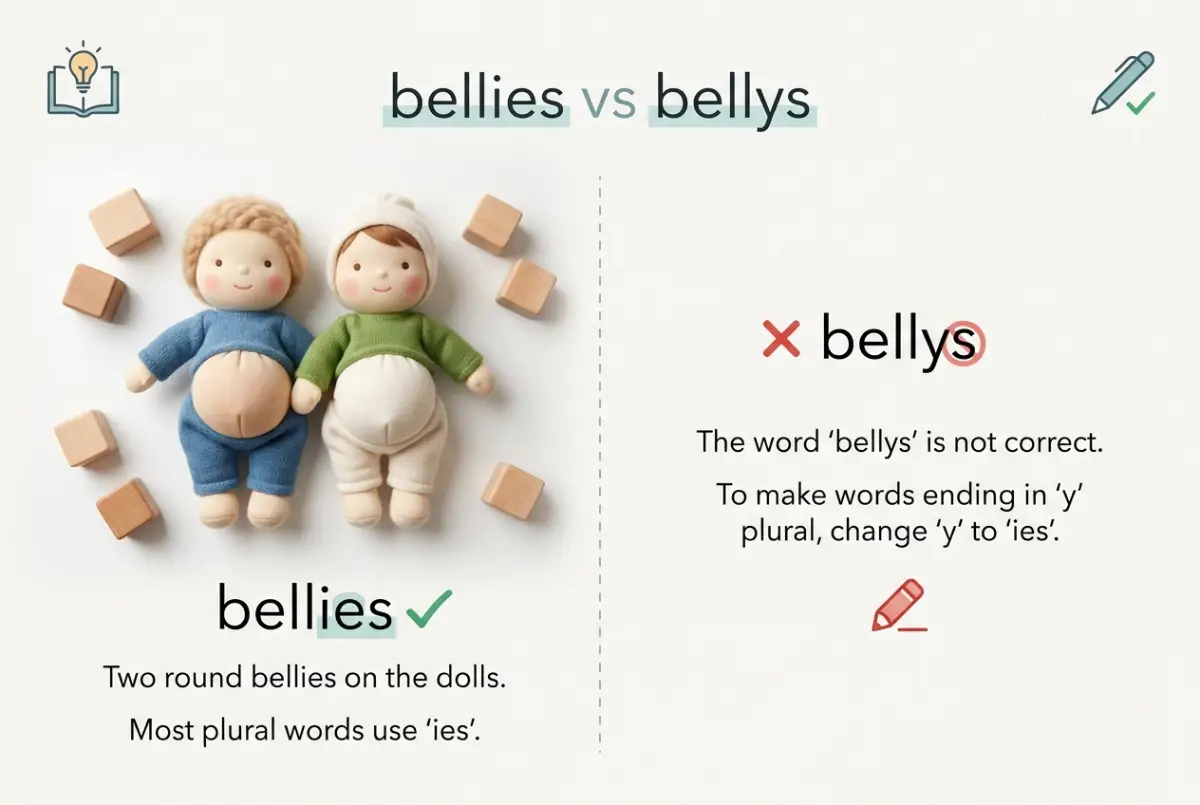
If you’re unsure about bellies vs bellys you’re dealing with a very common English spelling pattern. The correct plural of belly is bellies. The spelling bellys is not the standard plural form of the noun.
The confusion comes from the final y. Many English nouns simply take s when they become plural. For example, toy becomes toys and day becomes days. However, words that end in a consonant followed by y follow a different spelling pattern. The y changes to i before the plural ending es. That gives us belly → bellies.
This article explains exactly why that change happens and how to remember it. You’ll also see the meaning of belly, examples from everyday English, related words, pronunciation guidance, common mistakes, and practical editing advice. The goal is simple. By the end, you’ll know instantly which spelling to use in formal writing, casual conversation, schoolwork, emails, and online content.
For another common grammar confusion, see Whiny Vs Whiney Which Spelling Is Correct 2026.
Quick Answer
Bellies is the correct plural spelling of belly. Belly ends in a consonant followed by y, so the plural changes y to i and adds es. Therefore, belly becomes bellies. Bellys is not the standard English plural spelling.
Bellies Vs Bellys Comparison
| Feature | Bellies | Bellys |
|---|---|---|
| Correct spelling | Yes | No |
| Singular form | Belly | Belly |
| Plural form | Bellies | Not standard |
| Part of speech | Noun | Incorrect plural form |
| Meaning | More than one belly | Intended to mean more than one belly |
| Pronunciation | /ˈbeliz/ | Not normally used |
| Grammar | Standard plural | Incorrect spelling |
| Common context | Everyday and formal writing | Usually a spelling mistake |
| Regional use | Standard in English varieties | Not a standard regional variant |
| Example | The babies had full bellies. | The babies had full bellys. |
The distinction is straightforward. Bellies is the accepted plural form. Cambridge lists bellies as the plural of belly, and its English grammar guidance explains that nouns ending in a consonant plus y normally change y to i and add es.
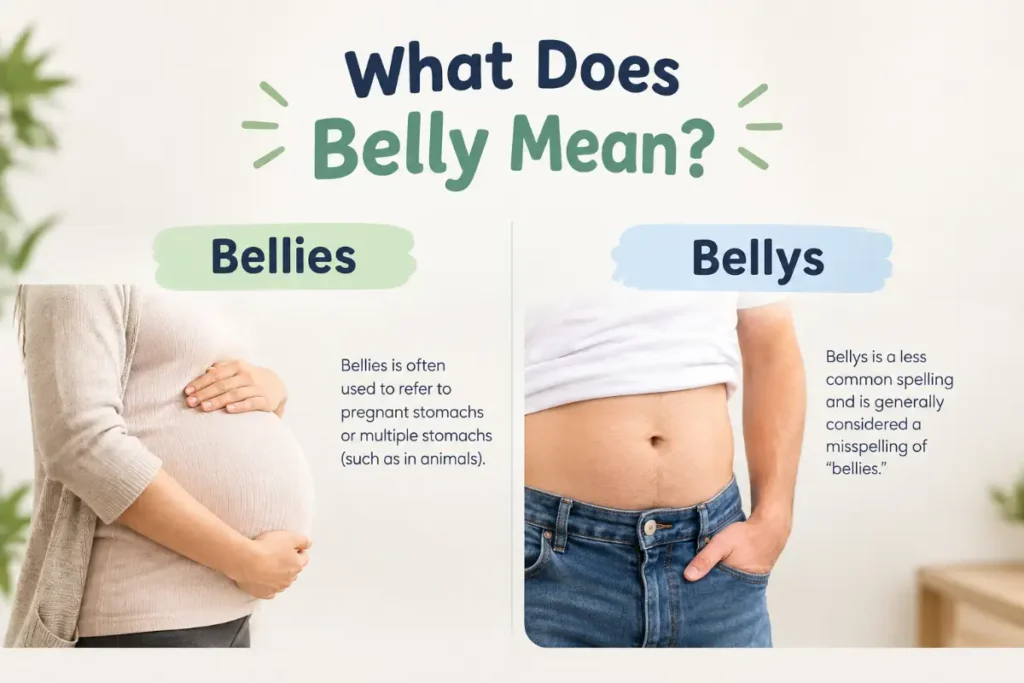
What Does Belly Mean
Belly is a countable noun that commonly refers to the stomach or the front part of the body between the chest and legs. It can describe a person or an animal.
Cambridge gives belly as an informal noun for the stomach or the front part of the body. Collins also defines it as the stomach or abdomen and notes that the word can have an informal or literary feel in British English.
For example:
The baby was lying on her belly.
My belly is full after dinner.
The dog was sleeping on its belly.
The word can also describe a rounded or swollen part of something. In this sense it doesn’t have to refer to a human body.
You might see expressions such as the belly of a ship or the belly of a cave. These uses connect to the older idea of a rounded or bulging part.
The plural bellies simply means more than one belly.
For example:
The puppies had round bellies.
The children rubbed their full bellies after lunch.
The animals had swollen bellies.
The word is common in everyday English. However, stomach and abdomen may be more suitable in medical or highly formal writing. Collins lists belly as a synonym of stomach and notes that abdomen is the more formal anatomical term.
Why Bellies Is The Correct Plural
The key spelling rule is easy once you spot the pattern.
When a noun ends in a consonant + y, English normally changes the y to i and adds es to form the plural.
So:
belly → bellies
The same pattern appears in many common nouns.
| Singular | Plural |
|---|---|
| Belly | Bellies |
| Baby | Babies |
| City | Cities |
| Family | Families |
| Story | Stories |
| Country | Countries |
| Party | Parties |
| Library | Libraries |
| Puppy | Puppies |
| Activity | Activities |
Cambridge explains this spelling rule directly. When a noun ends in a consonant plus y, the standard plural changes y to i and adds es.
This is why bellys doesn’t follow the normal pattern.
There is one important comparison to remember. If a noun ends in a vowel + y, English usually keeps the y and adds s.
For example:
boy → boys
toy → toys
key → keys
day → days
journey → journeys
Notice the difference.
In belly, the letter before y is l, which is a consonant.
In boy, the letter before y is o, which is a vowel.
That small detail controls the plural spelling.
Belly Vs Bellies
Belly is singular. Bellies is plural.
Use belly when you’re talking about one belly.
The baby has a round belly.
My belly hurts after that meal.
The cat sleeps with its belly facing upward.
Use bellies when you’re talking about two or more bellies.
The babies have round bellies.
The puppies had full bellies.
The animals were lying on their bellies.
This distinction is the same as many other singular and plural noun pairs.
Baby → babies
City → cities
Story → stories
Belly → bellies
The plural spelling changes because the base noun ends in a consonant followed by y.
This isn’t an optional style choice. You shouldn’t switch between bellies and bellys depending on the tone of the sentence. Standard English uses bellies.
A professional editor would correct bellys to bellies in ordinary English prose.
Why People Write Bellys
The spelling bellys usually appears because the writer remembers only part of the plural rule.
Many learners know that English often forms plurals by adding s.
For example:
book → books
car → cars
table → tables
window → windows
That rule works often enough that it’s easy to apply it too broadly.
A learner may look at belly and think:
belly + s = bellys
The problem is that English has a special spelling pattern for nouns ending in a consonant plus y.
The same mistake can happen with many other words.
You may see:
babys instead of babies
citys instead of cities
familys instead of families
partys instead of parties
storys instead of stories
These forms are understandable, but they aren’t standard plural spellings.
Another reason the mistake can feel natural is pronunciation. Bellies and the intended pronunciation of bellys sound very similar. When two spellings point toward the same sound, visual memory becomes more important.
Typing also plays a role. People often type quickly on phones and keyboards. A familiar singular word followed by s can feel like a quick plural solution.
Autocorrect can sometimes reinforce a mistake if a typed form isn’t corrected immediately. Social media also exposes readers to informal or incorrect spellings that may look familiar simply because they’ve appeared many times.
Familiarity doesn’t make a spelling standard.
If you see bellys online, the safest conclusion is that the writer intended bellies.
The Spelling Rule For Words Ending In Y
The easiest way to master bellies is to learn the wider rule rather than memorize this one word.
Consonant Plus Y
When a noun ends in a consonant followed by y, change y to i and add es.
Examples include:
belly → bellies
baby → babies
puppy → puppies
city → cities
country → countries
party → parties
company → companies
library → libraries
enemy → enemies
family → families
The pattern is consistent enough to be one of the most useful spelling rules for English learners.
Vowel Plus Y
When a noun ends in a vowel followed by y, keep the y and add s.
Examples include:
boy → boys
toy → toys
day → days
key → keys
journey → journeys
monkey → monkeys
This gives you a useful test.
Look at the letter immediately before y.
If it is a consonant:
consonant + y → ies
If it is a vowel:
vowel + y → ys
For belly, the ending is ly. The l is a consonant. Therefore:
belly → bellies
Not:
belly → bellys
This simple check can prevent a large number of spelling mistakes.
Grammar Explanation For Bellies
Belly is a countable noun. That means you can talk about one belly or more than one belly.
The singular form is:
belly
The plural form is:
bellies
You can use determiners with the singular form.
a belly
the belly
my belly
her belly
its belly
You can also use possessive forms with the plural.
the babies’ bellies
the puppies’ bellies
the animals’ bellies
When you have several people or animals and each has a belly, bellies is normally the natural plural form.
For example:
The children held their bellies after laughing.
The word bellies doesn’t indicate tense because it is a noun. Tense belongs to the verb in the sentence.
Compare:
The children rubbed their bellies.
The children are rubbing their bellies.
The children will rub their bellies.
The noun stays bellies. The verb changes to show time.
You can also use belly as a verb in English. As a verb, it can describe something swelling or bulging outward. The noun and verb are related but serve different grammatical roles. Etymological records trace the verb to the noun and show historical uses connected with swelling.
For most learners, though, the spelling question bellies vs bellys concerns the plural noun.
Pronunciation Of Belly And Bellies
The pronunciation difference is useful because it reinforces the spelling.
Belly is pronounced approximately:
/ˈbeli/
It has two syllables:
bel · ly
The stress falls on the first syllable.
Bellies is approximately:
/ˈbeliz/
It also has two syllables:
bel · lies
The plural ending has an extra vowel sound.
The final sound in bellies is similar to the ending in words such as babies, cities, and stories.
You can hear the same spelling pattern across these words:
baby → babies
city → cities
story → stories
belly → bellies
The pronunciation doesn’t create a major regional difference between standard American and British English for this plural. The main issue is spelling rather than accent.
If you’re learning American English, pronounce belly with the same basic vowel pattern you hear in bell followed by the unstressed y sound. Then pronounce bellies with the added plural sound at the end.
The spelling and pronunciation work together once you learn the pattern.
Is Bellys Ever Correct
For standard English writing, bellys is not the correct plural of belly.
You may encounter the spelling online, in user generated content, in usernames, in informal posts, or in text written by learners. Those appearances don’t establish bellys as a standard English plural.
A dictionary entry for belly gives the plural as bellies. Cambridge also explicitly lists bellies as the plural form.
There can be unusual situations in which a sequence of letters resembles a word without functioning as its ordinary grammatical plural. For example, a brand name or username could deliberately use a nonstandard spelling. That doesn’t change the normal English rule.
So if you’re writing an article, school assignment, email, report, caption, product description, or professional document, use bellies.
Real Life Examples Of Bellies
Seeing the word in different settings makes the spelling easier to remember.
Daily Conversation
- The babies have full bellies after lunch.
- The puppies slept with their bellies against the warm blanket.
- We laughed so hard that our bellies hurt.
- The kittens rolled onto their bellies.
- The children had muddy bellies after playing outside.
Workplace Writing
- The report discusses how food affects the animals’ bellies and overall condition.
- The photographs show the animals with visibly swollen bellies.
- The caretaker checked the puppies’ bellies before feeding them.
- The guide explains how the animals protect their bellies while resting.
Emails
- The kittens arrived with full bellies and plenty of energy.
- The puppies’ bellies looked healthy after their meals.
- Please check the animals’ bellies during the routine inspection.
Academic Writing
- The study examined changes in the animals’ bellies during feeding.
- The researchers recorded the size of the subjects’ bellies.
- The observations showed visible differences between the animals’ bellies.
In highly formal academic writing, abdomen may be more precise than belly when the discussion concerns anatomy. Collins identifies abdomen as the formal anatomical term.
Literature
- The children laughed until their bellies ached.
- The travelers rested after filling their bellies with warm food.
- The animals curled up with their bellies close to the ground.
Journalism
- The rescued puppies arrived hungry with thin bellies.
- The animals were photographed resting on their bellies.
Social Media
- Full bellies and happy faces make the best ending to a family dinner.
- These puppies have the roundest little bellies.
- We ate too much and now our bellies need a break.
These examples show an important point. The spelling stays bellies across different types of writing. The context can change. The plural spelling doesn’t.
Common Mistakes With Bellies
The most common mistake is simple:
bellys ❌
bellies ✓
However, learners can make several related mistakes.
Adding Only S
The first mistake is treating belly like toy.
Incorrect:
The children had full bellys.
Correct:
The children had full bellies.
The writer has added s without changing the final y.
Changing Every Y To I
The opposite mistake is applying the rule too widely.
For example:
The boys played with their toies.
That is incorrect.
The correct spelling is:
The boys played with their toys.
Why? Because toy ends in a vowel plus y. It takes s rather than changing y to i.
Using Belly When Bellies Is Needed
Another issue is number agreement.
The puppies have a round belly.
This can be grammatically possible if the phrase describes a shared or collective idea. However, when you mean that each puppy has its own belly, the natural plural form is:
The puppies have round bellies.
The plural noun matches the plural idea.
Using Bellies When Belly Is Needed
The reverse can also happen.
The baby has a round bellies.
That is incorrect.
The singular subject is talking about one belly, so the noun should be singular:
The baby has a round belly.
The safest method is to ask yourself one question.
Are you talking about one belly or more than one?
One gives you belly.
More than one gives you bellies.
Still confused? Compare Provider Vs Providor Which Word Is Correct 2026 Guide.
Bellies In Formal And Informal Writing
The word belly is common and natural, but its tone depends on context.
In everyday American English, belly sounds normal and conversational.
My belly is full.
The baby has a cute little belly.
My stomach hurts.
In a medical report, abdomen is usually more precise.
The patient reported pain in the abdomen.
In a casual conversation, belly can sound warmer and less clinical.
My belly is still full from dinner.
The plural bellies works the same way.
You can use it in casual writing:
The kids had full bellies after Thanksgiving dinner.
You can also use it in descriptive or literary writing:
The animals rested on their bellies.
In technical writing, a more specific anatomical term may be better.
This is an important editorial point. Correct spelling and appropriate word choice are two different questions.
Bellies is correctly spelled. That doesn’t mean bellies is always the best word for every context.
If the subject is anatomy, medicine, or a scientific measurement, abdomens may be more precise. If the writing is personal, conversational, descriptive, or informal, bellies can sound perfectly natural.
Bellies In American And British English
The spelling bellies is standard in both American and British English.
There is no major US and UK spelling split here. You don’t need one form for American English and another for British English.
Cambridge lists bellies as the plural of belly, while Collins describes belly as an informal or literary term in British English.
The main difference concerns tone and context rather than plural spelling.
In American English, belly is common in everyday speech.
The baby has a full belly.
In British English, the word is also understood and used. Depending on context, speakers may choose stomach, tummy, or abdomen instead.
Canadian and Australian English also use belly and bellies as standard English forms.
So the spelling rule doesn’t change by region.
American English: bellies.
British English: bellies.
Canadian English: bellies.
Australian English: bellies.
The same plural formation applies.
Bellies And Related Words
Learning related vocabulary can make the meaning clearer.
Stomach
Stomach can refer to the internal organ where food is digested. In everyday English, it can also refer to the front part of the body around that area.
My stomach feels full.
Collins lists belly as a synonym of stomach in relevant senses.
Abdomen
Abdomen is a more formal anatomical term.
The doctor examined the patient’s abdomen.
Use abdomen when precision matters.
Tummy
Tummy is informal and often sounds friendly or child focused.
The baby has a little tummy.
Collins describes tummy as an informal or childish word for the stomach.
Gut
Gut can refer to the digestive system or the abdominal area. It has several informal uses and can sound more direct.
He has a strong gut.
The meaning depends heavily on context.
Midsection
Midsection refers broadly to the middle part of the body.
She strengthened her midsection through regular exercise.
It isn’t an exact synonym for belly in every sentence.
Abdomen And Belly
A useful rule for writers is this:
Use belly for a conversational or descriptive tone.
Use abdomen for precise anatomical writing.
Use stomach when you’re talking about digestion or everyday physical sensations.
Use tummy for a gentle or child focused tone.
Use midsection when you’re referring broadly to the middle of the body.
The best word depends on your audience and purpose.
Belly Related Expressions
Belly appears in many familiar English expressions.
Belly Laugh
A belly laugh is a deep and hearty laugh.
Her joke gave everyone a real belly laugh.
Collins lists belly laughter among common expressions associated with the word.
Belly Button
A belly button is the small depression or raised area at the center of the abdomen.
The plural is belly buttons.
Notice something important here. The plural belongs to button, not belly.
The babies’ belly buttons were healing normally.
This doesn’t become bellies buttons.
Belly Dance
Belly dance refers to a style of dance associated with movements of the torso and abdomen.
The plural can be belly dances when discussing multiple dances or performances.
Belly Fat
Belly fat refers to fat around the abdominal area.
The phrase is normally treated as a mass noun when discussing body fat generally.
Regular exercise can help reduce belly fat.
Full Belly
A full belly means that someone has eaten enough food and feels satisfied.
After dinner, everyone had a full belly.
The plural is:
After dinner, everyone had full bellies.
Collins lists expressions such as full belly, belly fat, belly laughter, empty bellies, and pregnant belly among common collocations.
Why The Y Changes To I
The spelling change in belly → bellies isn’t random.
English spelling uses several patterns for forming plurals. One of the most common is the consonant plus y pattern.
When a noun ends in consonant plus y, the plural usually changes the final y to i and adds es.
Think of the transformation as:
belly
Remove the final y.
Add i.
Add es.
Result:
bellies
The same structure appears in:
baby → babies
family → families
city → cities
party → parties
country → countries
This rule is taught in standard English grammar references. Cambridge specifically gives examples such as baby to babies, opportunity to opportunities, and reply to replies when explaining the consonant plus y plural pattern.
There are exceptions and special cases elsewhere in English spelling. Still, belly → bellies follows the ordinary rule cleanly.
The Difference Between Bellies And Bellys
There is no difference in meaning between bellies and the intended meaning of bellys.
The difference is correctness.
Bellies is the standard plural spelling.
Bellys is a nonstandard spelling.
That means this isn’t a case like color and colour, where both spellings have established regional use.
It also isn’t like gray and grey, where both forms are accepted in different varieties of English.
Instead, the relationship is closer to a correct spelling and a common spelling mistake.
The correct form is:
belly → bellies
If you’re editing an article and find bellys, change it to bellies unless the unusual spelling is deliberately part of a name, username, title, or other proper form.
Etymology And Word Origin
The history of belly explains why the modern word looks different from its oldest forms.
Etymological sources trace belly to Old English forms such as belg, bylig, and bælg. These words referred to a leather bag, pouch, pod, husk, or similar rounded container. The history connects the word to a Germanic root associated with swelling.
Over time, the meaning developed toward the body.
By around the twelfth century, belly was being used for the stomach. By the late fourteenth century, it could refer to the abdomen or the front part of the body.
That history also helps explain some figurative uses. A belly is a rounded or swollen part of the body, and English later extended the word to other rounded or bulging things.
The history is interesting because the modern spelling looks simple while the word itself has a long linguistic journey.
The plural form has also developed through English spelling changes over time. Modern English now uses the familiar bellies pattern.
Memory Tricks For Bellies
If you keep forgetting the spelling, use a short mental rule.
The Consonant Test
Look at the letter before y.
In belly, the letter is l.
L is a consonant.
So:
consonant + y = ies
That gives:
belly → bellies
The Baby Connection
Remember:
baby → babies
Then connect it with:
belly → bellies
Both words end in consonant plus y.
The Family Connection
Think:
family → families
belly → bellies
The spelling pattern is the same.
The One Letter Rule
Tell yourself:
The y changes when a consonant comes before it.
That short sentence is enough for most everyday writing.
The Visual Check
If you’re unsure, write the pair:
belly
bellies
The second form may look unusual at first, but after you see it repeatedly, it becomes much easier to recognize.
Expert Editor’s Note
From an editing perspective, bellies is the form to use in standard English.
A professional proofreader wouldn’t treat bellys as an alternative spelling. The standard plural formation changes the final y to i and adds es because belly ends in a consonant plus y. Cambridge explicitly supports this spelling pattern and lists bellies as the plural form.
There is also an important distinction between spelling and style.
Bellies is correct.
The choice between bellies, stomachs, abdomens, tummies, and related words depends on context.
For general American writing, belly is natural and easy to understand. For medical or scientific writing, abdomen can provide greater precision. Collins identifies abdomen as the formal anatomical term and describes belly as informal or literary in relevant British usage.
So if I were proofreading a general audience article, I wouldn’t change bellies simply because it sounds informal. I’d keep it when the tone calls for natural everyday English.
If I found bellys, I would correct the spelling.
That distinction matters because good editing isn’t just about finding errors. It’s also about preserving a writer’s intended voice while making sure the language follows standard usage.
Common Questions About Bellies
Is Bellies The Correct Plural Of Belly
Yes. Bellies is the standard plural of belly. The noun ends in a consonant followed by y, so English changes the y to i and adds es. The result is bellies. Cambridge dictionaries list bellies as the plural form. The spelling bellys is not the standard plural in English.
Is Bellys Ever A Correct English Word
Belys is not the standard plural spelling of belly. You may encounter bellys online in informal writing, user names, social media posts, or spelling mistakes. Those uses don’t make it a standard plural. For ordinary writing, schoolwork, professional documents, websites, and published content, use bellies.
Why Does Belly Become Bellies
The change follows a standard English plural rule. When a noun ends in a consonant followed by y, the y usually changes to i and es is added. Therefore belly becomes bellies. The same pattern appears in baby and babies, city and cities, and family and families.
What Is The Difference Between Belly And Bellies
Belly is singular and refers to one belly. Bellies is plural and refers to more than one. For example, the baby has a round belly refers to one baby and one belly. The babies have round bellies refers to several babies and several bellies. The spelling changes because the noun follows the consonant plus y plural rule.
How Do You Pronounce Bellies
Bellies is commonly pronounced /ˈbeliz/. It has two syllables with stress on the first syllable. The word sounds similar to other plural forms ending in ies, such as babies, cities, and stories. The main spelling issue is not pronunciation but remembering that the final y changes to ie before the plural ending.
Is Bellies Used In American English
Yes. Bellies is a standard plural form in American English. The same spelling also appears in British, Canadian, and Australian English. The word belly can sound informal compared with abdomen, but that doesn’t make bellies incorrect or nonstandard. Choose the word based on the tone and purpose of your writing.
Should I Use Bellies Or Stomachs
Both can be correct, but they aren’t always identical in tone or meaning. Bellies sounds more conversational and can describe the outside area of the body. Stomachs often refers to the digestive organ or the general stomach area. In medical and scientific writing, abdomens may be more precise. Choose the word that best fits your context.
Is Bellies A Formal Word
Bellies is grammatically standard, but belly can sound informal in some contexts. That doesn’t make it unsuitable for all formal writing. In academic or medical writing, terms such as abdomen may be more precise. In literary, descriptive, journalistic, or general writing, bellies can be completely natural.
What Is The Rule For Words Ending In Y
When a noun ends in a consonant plus y, change the y to i and add es. For example, baby becomes babies and city becomes cities. When a noun ends in a vowel plus y, normally keep the y and add s. For example, boy becomes boys and toy becomes toys.
What Is The Correct Spelling In A Sentence
The correct spelling is bellies.
The puppies had full bellies after dinner.
The spelling bellys should be corrected in standard English writing. If you are proofreading an article, assignment, email, or website, replace bellys with bellies.
Related Words And Frequently Confused Forms
Understanding nearby words can help you build a stronger vocabulary around belly.
| Word | Meaning | Typical use |
|---|---|---|
| Belly | Stomach or abdominal area | Everyday English |
| Bellies | Plural of belly | Everyday and descriptive writing |
| Stomach | Digestive organ or stomach area | General and medical contexts |
| Abdomen | Anatomical area of the body | Formal and medical writing |
| Tummy | Informal word for stomach | Casual and child focused contexts |
| Gut | Digestive system or abdominal area | Informal English |
| Midsection | Middle part of the body | General description |
| Paunch | A large protruding belly | Descriptive writing |
Collins lists belly among the related terms for stomach and identifies abdomen as the formal anatomical term.
You can also compare bellies with other plural forms that follow the same spelling rule.
Baby → babies
Body → bodies
Party → parties
Story → stories
Family → families
City → cities
Country → countries
These examples reinforce the same pattern.
The opposite pattern appears in words such as:
Boy → boys
Toy → toys
Day → days
Key → keys
The difference depends on the letter before the final y.
A Simple Rule To Remember
If you’re writing quickly and suddenly wonder if bellys looks right, stop for one second.
Look at the ending:
belly
Ask yourself what comes before the y.
It’s l.
That’s a consonant.
So change:
y → i
Then add:
es
You get:
bellies
This small habit is more useful than trying to memorize dozens of individual spellings.
English has many spelling rules that become easier once you understand the pattern behind them. Bellies is a good example because the word looks irregular only until you identify the consonant plus y rule.
Learn the difference in Dutchess vs Duchess Which Spelling Is Correct 2026 Guide.
Final Verdict On Bellies Vs Bellys
The correct spelling is bellies.
Belly is the singular noun.
Bellies is the plural noun.
Bellys is not the standard plural spelling.
The reason is simple. Belly ends in a consonant plus y, so the standard plural formation changes y to i and adds es.
Remember this pattern:
belly → bellies
baby → babies
city → cities
family → families
If you need a quick test, look at the letter before the final y. A consonant usually leads to ies in the plural. A vowel usually keeps the y and takes s.
So when you’re writing about several stomachs or abdominal areas, choose bellies.
The safest editorial rule is simple: if you mean more than one belly, write bellies.

Editorial Reviewer & Proofreader
Grace Mitchell reviews Gramlify’s articles for clarity, consistency, and readability. She is passionate about creating accurate, approachable content that helps English learners build confidence.