
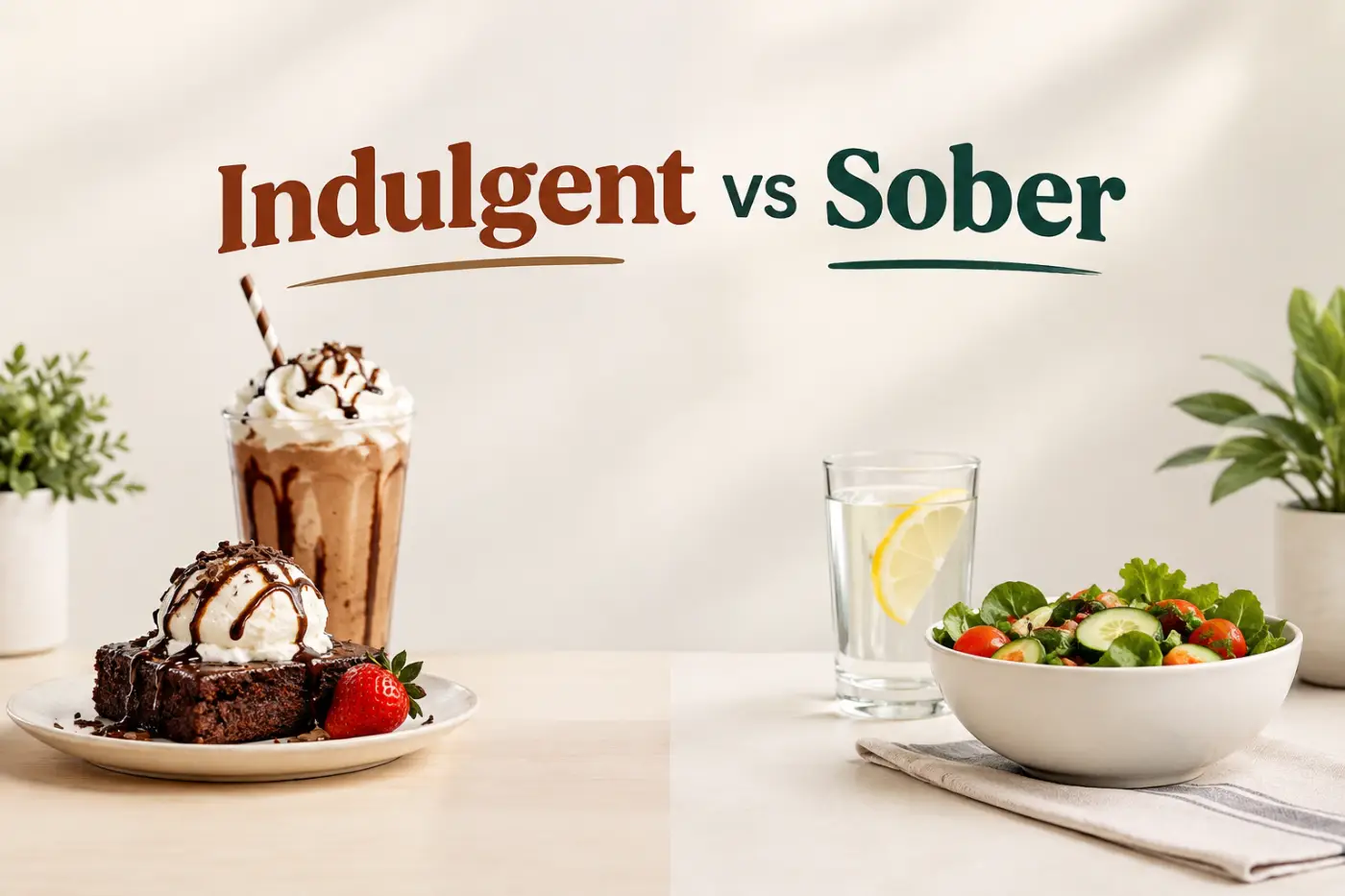
Choosing between indulgent and sober can be tricky because the two words describe very different attitudes and ways of living. One often suggests pleasure, comfort, and enjoyment, while the other can describe self control, seriousness, or a state free from alcohol. If you’ve seen these words in a book, an article, or a conversation, understanding their context will help you choose the right one.
The main difference between indulgent vs sober is that indulgent describes a willingness to allow pleasure, satisfy desires, or overlook someone’s mistakes. In contrast, sober commonly means not affected by alcohol, but it can also describe a serious, calm, and practical attitude.
For example, an indulgent parent might let a child stay up late to watch a favorite movie. A sober parent might consider the child’s need for sleep and set a firm bedtime. Neither word automatically means good or bad. The meaning depends on the situation.
These words can also describe food, spending habits, relationships, decisions, and writing styles. An indulgent meal may include rich desserts, while a sober assessment focuses on facts rather than excitement.
In this guide, you’ll learn what each word means, how to use it naturally, and how to avoid common mistakes. You’ll also see practical examples that show how context changes the meaning.
Related reading opportunity: Link to an article about affect vs effect here to help readers understand the difference between commonly confused English words.
You may also want to read It Is Must vs It Is a Must: Which One Is Correct in 2026?.
Quick Answer for Indulgent vs Sober
Indulgent means allowing pleasure, satisfying desires, or being lenient toward someone. Sober means not affected by alcohol or describes a serious, calm, and realistic approach. For example, an indulgent person may spend money on luxuries for enjoyment, while a sober person may carefully assess the cost before making a decision.
Indulgent vs Sober Comparison Table
The easiest way to understand these words is to compare their main meanings and typical uses.
| Feature | Indulgent | Sober |
|---|---|---|
| Main meaning | Allowing pleasure or giving in to desires | Free from alcohol’s effects or serious and realistic |
| Part of speech | Adjective | Adjective and noun in specific uses |
| Pronunciation | in DUL junt | SOH bur |
| Common context | Pleasure parenting food and spending | Alcohol seriousness judgment and design |
| Tone | Often warm or approving but sometimes critical | Often neutral serious or cautionary |
| Personal behavior | Permissive generous or self pleasing | Restrained practical or clear headed |
| Parenting | Allowing a child extra freedom | Taking a serious and measured approach |
| Food | Rich luxurious or especially enjoyable | Restrained simple or not overly rich in some contexts |
| Decision making | Prioritizing enjoyment or personal wishes | Considering facts and possible risks |
| Opposite ideas | Strict restrained or self denying | Intoxicated frivolous or overly playful depending on context |
| Example | She was indulgent with her grandchildren. | He gave a sober assessment of the risks. |
Remember: These words aren’t direct opposites in every situation. Indulgent focuses on pleasure, permission, or leniency. Sober focuses on sobriety, seriousness, or practical judgment. Their meanings overlap only in certain contexts where restraint and pleasure are being contrasted.
What Does Indulgent Mean?
Indulgent is an adjective that describes someone or something that allows, provides, or enjoys pleasure, comfort, or personal satisfaction. It can also describe a person who is forgiving or lenient toward another person’s behavior.
The word often carries a positive meaning, especially when it describes kindness, generosity, or a well deserved treat. However, it can suggest excessive permission or a lack of discipline when someone allows too much.
For example, an indulgent friend might encourage you to order dessert after a difficult week. An indulgent manager might overlook repeated mistakes instead of addressing them. The first example sounds caring, while the second may suggest poor judgment.
The Main Meanings of Indulgent
The word has several related meanings that depend on context.
1. Allowing pleasure or enjoyment.
An indulgent experience gives you something enjoyable, comfortable, or luxurious.
Example: We planned an indulgent weekend at a quiet resort.
This sentence suggests relaxation and pleasure rather than strict routines or responsibilities.
2. Being lenient toward someone.
An indulgent person may forgive mistakes or allow behavior that another person would restrict.
Example: Her indulgent grandfather let her choose the family movie every Friday.
The grandfather is giving her extra freedom. The word doesn’t necessarily mean he is irresponsible.
3. Giving in to personal desires.
People sometimes describe themselves as indulgent when they allow themselves a treat or spend time on something they enjoy.
Example: I was indulgent and bought the expensive chocolate cake.
Here, the speaker admits to choosing pleasure instead of restraint. The sentence may sound playful rather than critical.
4. Providing rich or luxurious pleasure.
Food, holidays, experiences, and even certain forms of entertainment can be indulgent.
Example: The restaurant served an indulgent dessert made with chocolate mousse and fresh cream.
In this context, the word describes something rich and satisfying. It doesn’t imply that the dessert is wrong or unhealthy.
Is Indulgent a Positive or Negative Word?
Indulgent can be positive neutral or negative. The surrounding sentence determines its tone.
Consider these examples.
- Positive: My aunt was indulgent when she gave us an extra day at the beach.
- Neutral: The hotel offers an indulgent spa package for weekend guests.
- Negative: His indulgent attitude toward missed deadlines frustrated the entire team.
In the first sentence, indulgence expresses generosity. In the second, it describes a luxurious experience.
This difference matters when writing for a professional audience. If you call a manager indulgent, readers might interpret it as praise for compassion or criticism of weak leadership. Add context to make your meaning clear.
Common Word Forms of Indulgent
Learning related word forms can help you use the adjective more accurately.
| Word | Part of speech | Meaning | Example |
|---|---|---|---|
| Indulge | Verb | Allow yourself or someone else a pleasure | I indulge in a good book on Sundays. |
| Indulgent | Adjective | Permissive or pleasure giving | She has an indulgent attitude toward desserts. |
| Indulgently | Adverb | In a permissive or forgiving manner | He smiled indulgently at the child’s question. |
| Indulgence | Noun | An act of pleasure or giving in to a desire | A long bath is my favorite indulgence. |
| Self indulgent | Adjective | Focused too much on personal pleasure | The speech felt self indulgent. |
In American English, self indulgent is commonly written without a hyphen in many modern contexts. Follow the style guide used by your publication if it specifies a different form.
What Does Sober Mean?
Sober is an adjective with two major uses. It can describe a person who isn’t affected by alcohol or another intoxicating substance. It can also describe someone or something serious, calm, restrained, and realistic.
The meaning changes with context. If someone says, “He is sober now,” they may mean that he is no longer intoxicated. If someone says, “She offered a sober opinion,” they mean that she gave a serious and balanced view.
The word can also function as a noun in expressions such as a sober, referring to a person who is not drinking or is recovering from alcohol use. This use is less common than the adjective and depends on the sentence.
The Main Meanings of Sober
1. Not affected by alcohol.
This is one of the most familiar meanings of sober.
Example: He waited until he was completely sober before driving.
The sentence means he waited until alcohol was no longer affecting him. It doesn’t mean he simply felt more serious or had stopped drinking for a few minutes.
2. Serious and thoughtful.
Sober can describe a person’s expression, mood, or behavior when they aren’t playful or excited.
Example: The news left the entire room in a sober mood.
Here, sober communicates seriousness. It has nothing to do with alcohol.
3. Realistic and based on facts.
A sober judgment considers evidence, limitations, and risks instead of relying on wishful thinking.
Example: The committee prepared a sober review of the project’s costs.
The committee assessed the situation carefully. The word suggests balance and realism rather than pessimism.
4. Plain or restrained in appearance.
Sober can describe colors, clothing, design, or decoration that avoids bright or showy details.
Example: He chose a sober navy suit for the formal meeting.
The suit looks restrained and appropriate for a serious occasion. The description doesn’t suggest that the person is avoiding alcohol.
5. Calm and controlled.
A sober response avoids exaggeration and emotional overreaction.
Example: She gave a sober response to the unexpected criticism.
The sentence suggests that she stayed calm and considered her words carefully.
Is Sober Always Related to Alcohol?
No. Although sobriety is strongly associated with alcohol, the adjective sober has several established meanings.
Compare these examples.
- Alcohol: The driver was sober when the police arrived.
- Judgment: We need a sober estimate of the repair costs.
- Mood: The memorial service had a sober atmosphere.
- Appearance: The office uses sober colors and simple furniture.
- Communication: The report offers a sober account of the event.
Only the first sentence directly refers to alcohol. In the other examples, sober describes seriousness, restraint, or realism.
A useful writing tip is to check the noun that follows the adjective. A sober driver usually refers to alcohol or intoxication. A sober assessment usually refers to careful judgment.
Common Word Forms of Sober
| Word | Part of speech | Meaning | Example |
|---|---|---|---|
| Sober | Adjective | Not intoxicated or serious and restrained | He remained sober throughout the event. |
| Sober | Verb | To make or become more serious or less excited | The warning sobered the group. |
| Soberly | Adverb | In a serious or restrained way | She spoke soberly about the risks. |
| Sobriety | Noun | The state of being sober | He valued his sobriety. |
| Sober minded | Adjective | Practical and thoughtful | She is a sober minded leader. |
The verb sober also appears in the expression sober up. It can mean to become less affected by alcohol or to become more realistic about a situation.
Example: The unexpected bill sobered him up quickly.
This sentence is figurative. The bill made him take the situation more seriously. It doesn’t mean he had consumed alcohol.
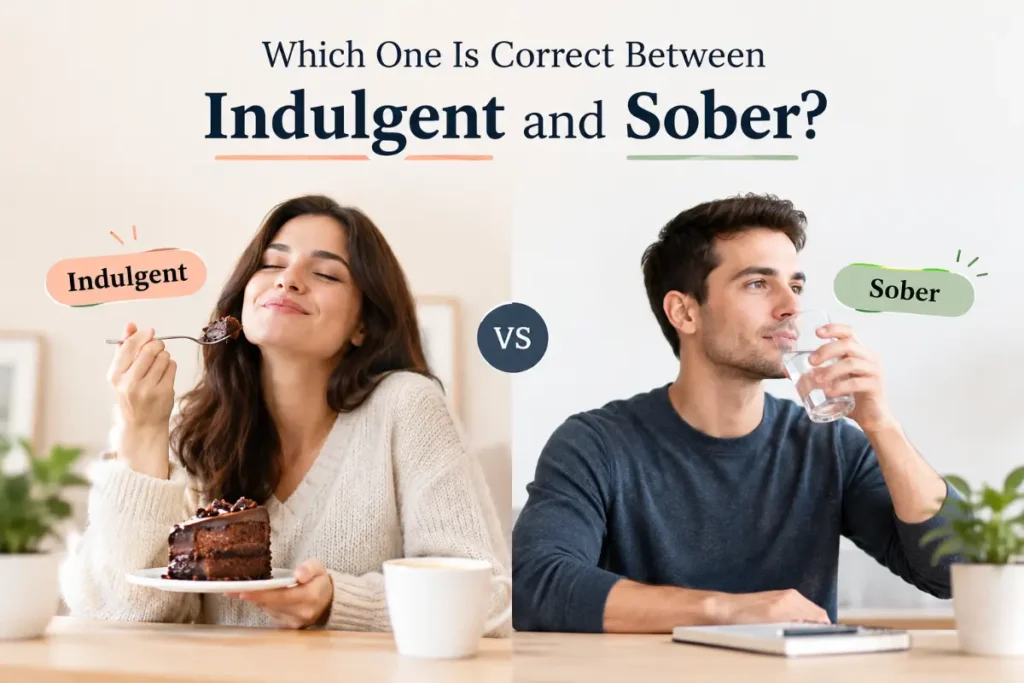
Which One Is Correct Between Indulgent and Sober?
Both indulgent and sober are correct English words. Neither spelling is wrong. However, they express different ideas, so you must choose the word that matches your intended meaning.
Use indulgent when you want to describe pleasure, luxury, generosity, or leniency. Use sober when you mean freedom from alcohol’s effects, seriousness, restraint, or realistic judgment.
Consider these examples.
- Correct: The hotel offers an indulgent weekend package.
- Correct: The manager gave a sober assessment of the company’s finances.
- Correct: Her parents were indulgent when they allowed an extra hour of screen time.
- Correct: The doctor advised him to remain sober before driving.
Using one word in place of the other can change the entire message.
For example, an indulgent review might suggest a review that is generous in its praise. A sober review suggests a careful and realistic evaluation. Both phrases are grammatical, but they communicate different attitudes.
When to Choose Indulgent
Choose indulgent when the sentence focuses on pleasure, permission, comfort, or forgiveness.
Common expressions include:
- An indulgent dessert.
- An indulgent parent.
- An indulgent lifestyle.
- An indulgent smile.
- An indulgent attitude.
- An indulgent weekend.
- An indulgent treat.
Example: After months of hard work, Maya treated herself to an indulgent vacation.
The adjective emphasizes the pleasure and comfort she allowed herself.
When to Choose Sober
Choose sober when the sentence focuses on alcohol, seriousness, restraint, or clear judgment.
Common expressions include:
- A sober driver.
- A sober assessment.
- A sober mood.
- A sober decision.
- A sober reflection.
- A sober appearance.
- A sober warning.
Example: The team conducted a sober review of the project’s financial risks.
The adjective suggests that the team examined the facts carefully instead of focusing only on the project’s potential success.
The Key Differences Between Indulgent and Sober
The biggest difference is the idea each word emphasizes. Indulgent centers on allowing pleasure or being lenient. Sober centers on freedom from intoxication or a serious and restrained approach.
Several smaller differences can help you choose the right word in everyday writing.
Difference in Meaning
Indulgent suggests giving in to desires or allowing someone to enjoy something. It can also describe a generous attitude toward another person’s mistakes.
Sober suggests being unaffected by alcohol or approaching a situation with seriousness and realism.
Examples:
- Her indulgent attitude made every family gathering feel special.
- His sober attitude helped the team focus on the problem.
The first sentence emphasizes warmth and permission. The second emphasizes focus and practical judgment.
Difference in Tone
Indulgent often sounds warm, affectionate, luxurious, or playful. However, it can sound critical when it suggests excessive permission or self gratification.
Sober usually sounds serious, calm, restrained, or realistic. It may convey maturity and responsibility, but it can also make a situation feel solemn.
Compare these sentences.
- She gave her son an indulgent smile.
- She gave her son a sober look.
The first suggests affection or gentle amusement. The second suggests seriousness or concern.
The difference comes from the attitude conveyed by the adjective, not from the grammar.
Difference in Context
Indulgent often appears in descriptions of food, family life, spending, entertainment, and personal choices.
Sober frequently appears in discussions of alcohol, safety, business decisions, news, serious events, and formal writing.
| Context | Natural use | Example |
|---|---|---|
| Food | Indulgent | We ordered an indulgent chocolate dessert. |
| Parenting | Indulgent | Her indulgent father rarely said no. |
| Financial planning | Sober | We need a sober estimate of the costs. |
| Alcohol safety | Sober | The driver must remain sober. |
| Formal clothing | Sober | He wore a sober gray suit. |
| Personal spending | Indulgent | Buying designer shoes was an indulgent choice. |
| Serious news | Sober | The report offered a sober account of the crisis. |
| Relaxation | Indulgent | They booked an indulgent spa treatment. |
These patterns are useful because English speakers often choose words based on familiar combinations. Learning the adjective alongside common nouns makes your writing sound more natural.
Difference in Grammar
Both words function mainly as adjectives. They can appear before nouns or after linking verbs.
Examples:
- The meal was indulgent.
- The report was sober.
- She seemed indulgent.
- His response remained sober.
Both adjectives can also be modified by adverbs.
- The parents were extremely indulgent.
- The editor was remarkably sober in her assessment.
However, the words have different related forms. Indulgent comes from the verb indulge, while sober can function as both an adjective and a verb.
For example:
- The manager indulged the customer’s request.
- The news sobered the manager.
The first sentence describes allowing a request. The second describes making someone more serious or realistic.
Difference in Formality
Both words are suitable for formal and informal writing.
Indulgent appears in casual conversations about treats and family behavior. It also appears in professional discussions of consumer spending, luxury services, and parenting.
Sober appears in everyday conversation about alcohol. It is also common in journalism, business writing, academic discussion, and serious commentary.
Examples:
- Casual: I had an indulgent weekend and ate all my favorite foods.
- Professional: The report provides a sober analysis of the proposed investment.
- Casual: He’s finally sober after the party.
- Formal: The committee adopted a sober approach to evaluating the evidence.
The formality depends on the context and the phrase, not simply on the word itself.
Grammar Explanation for Indulgent and Sober
Understanding how these adjectives fit into sentences helps prevent awkward wording. Both are flexible, but each has patterns that English speakers use more often.
Using Adjectives Before Nouns
An adjective can appear directly before a noun to describe it.
Examples:
- An indulgent meal.
- An indulgent grandmother.
- A sober conversation.
- A sober decision.
In these examples, the adjective tells readers what kind of meal, person, conversation, or decision they should imagine.
You can use more than one adjective when needed, but avoid stacking descriptions that add little meaning.
Awkward: We had a very extremely indulgent luxurious meal.
Better: We had an indulgent meal.
The shorter version is clearer because the main idea already communicates pleasure and richness.
Using Adjectives After Linking Verbs
Adjectives can follow linking verbs such as be, seem, look, feel, and remain.
Examples:
- The dinner was indulgent.
- His explanation seemed sober.
- She remained sober throughout the evening.
- The atmosphere felt sober after the announcement.
In these sentences, the adjectives describe the subject rather than an action.
Be careful with the sentence She looked sober. It could mean that she appeared serious, or it could mean that she appeared not to be intoxicated. Context makes the intended meaning clear.
Using Indulgent With Prepositions
The adjective indulgent often appears with the preposition toward or of, depending on the sentence structure.
Examples:
- The teacher was indulgent toward students who needed extra time.
- Her indulgent treatment of the children surprised their relatives.
- He was indulgent toward his own weaknesses.
In American English, toward is common. Towards is also correct, though it is more strongly associated with British usage.
You can also use indulgent with when describing someone’s leniency in a particular area.
Example: My parents were indulgent with my spending habits.
This means they allowed more spending than another person might have permitted.
Using Sober With Nouns and Verbs
Sober frequently modifies nouns related to thought, judgment, behavior, appearance, and alcohol.
Examples:
- A sober assessment.
- A sober judgment.
- A sober conversation.
- A sober person.
- A sober driver.
The word also functions as a verb.
Example: The unexpected result sobered the researchers.
Here, sobered means that the result made the researchers more serious or realistic.
Another common expression is sober up.
Example: He needed time to sober up before making an important decision.
This sentence usually refers to the effects of alcohol. In figurative use, it can mean that someone needs to stop thinking unrealistically.
Comparative and Superlative Forms
Both adjectives can take comparative and superlative forms, but the natural choice depends on meaning and sentence structure.
| Form | Indulgent | Sober |
|---|---|---|
| Base form | Indulgent | Sober |
| Comparative | More indulgent | Soberer or more sober |
| Superlative | Most indulgent | Soberest or most sober |
For indulgent, English speakers usually prefer more indulgent and most indulgent.
Examples:
- This hotel offers a more indulgent experience than the budget hotel.
- It was the most indulgent meal of our trip.
For sober, both the regular forms soberer and soberest and the phrases more sober and most sober are possible. The phrasing with more or most often sounds more natural in formal writing, especially when describing an attitude or judgment.
Examples:
- Her second assessment was more sober than the first.
- He offered the most sober analysis of the situation.
When comparing a person’s alcohol status, don’t assume that a comparative adjective measures safety. Someone who is less intoxicated may still be impaired and unfit to drive.
Can Indulgent and Sober Be Nouns?
Indulgent is an adjective, not the usual noun for a person who enjoys pleasure. The related noun indulgence describes an act of pleasure or giving in to a desire.
Example: A weekend away is a rare indulgence for her.
Sober can also appear as a noun in limited expressions, especially in discussions of recovery or drinking habits. However, the noun sobriety is more widely useful when referring to the state of being sober.
Example: Maintaining sobriety was an important goal for him.
In general writing, use the adjective forms when describing a person, decision, or experience. Use indulgence and sobriety when the sentence requires a noun.
Spelling and Pronunciation Guide
Indulgent and sober are both standard spellings in American English. Neither word is an alternative regional spelling of the other.
How to Spell Indulgent
The correct spelling is indulgent.
It contains the word stem indulg followed by the adjective ending ent.
Related forms include:
- Indulge.
- Indulgent.
- Indulgently.
- Indulgence.
A common spelling mistake is to write indulgeant. This is incorrect. The adjective uses the ending gent, not geant.
Example: Her indulgent attitude made the trip more enjoyable.
Remember that the noun is indulgence, while the adjective is indulgent. The ending changes with the grammatical role.
How to Spell Sober
The correct spelling is sober.
Related forms include:
- Sober.
- Soberly.
- Sobriety.
- Sobering.
- Sobered.
A common mistake is to write sobber when someone means the adjective sober. The standard spelling has one b.
Examples:
- He stayed sober during the event.
- The news was sobering.
- She spoke soberly about the risks.
Notice that sobering can describe something that makes people take a situation seriously.
Example: The sobering statistics changed the way the team approached the problem.
Pronunciation of Indulgent
In American English, indulgent is commonly pronounced /ɪnˈdʌldʒənt/.
It has three syllables:
in DUL gent.
The main stress falls on the second syllable. The middle sound resembles the vowel in cup, and the sound represented by g is the same sound heard in judge.
A common mistake is to put the stress on the first syllable or pronounce every vowel too strongly. In natural speech, the final syllable is usually unstressed.
Pronunciation of Sober
In American English, sober is commonly pronounced /ˈsoʊbər/.
It has two syllables:
SOH ber.
The first syllable receives the main stress. The opening vowel has the same general sound as the vowel in go.
Avoid pronouncing the word as two equally stressed syllables. The first syllable carries the main emphasis.
Does Pronunciation Change the Meaning?
The pronunciation of each word stays essentially the same across its main meanings.
For example, sober has the same pronunciation when it refers to alcohol and when it describes a serious opinion. The context changes the meaning, not the sound.
Likewise, indulgent sounds the same when it describes a generous parent or a luxurious dessert.
This is important for English learners because the main challenge is vocabulary and context rather than pronunciation differences between the two words.
Learn the difference in Farther vs Further: Meaning, Differences, and Examples.
Etymology and Word Origin
The histories of indulgent and sober help explain why their meanings developed in different directions.
The Origin of Indulgent
Indulgent comes through French and Latin word forms associated with allowing, yielding, or being accommodating.
Its Latin background is connected to indulgere, a verb meaning to be kind or accommodating, or to grant something. English developed related forms such as indulge and indulgence.
Over time, the word gained its familiar meanings of allowing pleasure, satisfying desires, and treating someone leniently.
That history helps explain why indulgent can describe both a person and an experience. An indulgent parent allows extra freedom, while an indulgent dessert offers rich pleasure.
The shared idea is giving something extra rather than enforcing strict limits.
The Origin of Sober
Sober entered English through French from Latin sobrius, meaning sober or temperate.
Its original associations included moderation and restraint. Those ideas remain visible in modern English.
When a person is sober, they aren’t affected by alcohol. When a person offers a sober opinion, they show restraint and avoid exaggeration.
The word’s serious and realistic meanings grew from this broader idea of self control.
What Word History Tells Us
The two words developed around different central ideas.
- Indulgent emphasizes allowing, granting, or enjoying.
- Sober emphasizes restraint, moderation, and seriousness.
Their histories support their modern meanings, but word origins shouldn’t replace current usage. The best way to choose between them is still to examine the sentence and the meaning you want to express.
British vs American English
The meanings of indulgent and sober are broadly consistent in American and British English. Neither word is limited to one variety, and neither has a standard American or British spelling alternative.
Indulgent in American and British English
American and British speakers use indulgent to describe generosity, leniency, luxury, and pleasure.
Examples:
- American English: She planned an indulgent weekend in California.
- British English: She planned an indulgent weekend in Cornwall.
The location changes, but the meaning remains the same.
Sober in American and British English
Both varieties use sober to describe a person who isn’t intoxicated and an attitude that is serious or realistic.
Examples:
- American English: The report offers a sober view of the housing market.
- British English: The report offers a sober view of the housing market.
The sentence works naturally in both varieties.
Canadian and Australian English
Canadian and Australian English also use indulgent and sober with these standard meanings.
For example, a Canadian writer might describe an indulgent holiday meal, while an Australian journalist might refer to a sober assessment of a public issue.
Regional differences are more likely to appear in surrounding vocabulary or preferred expressions than in the meanings or spelling of these two words.
For a general US audience, you can confidently use both words in their standard forms. There is no need to change their spelling for British, Canadian, or Australian readers.

Real Life Examples of Indulgent and Sober
The best way to learn the difference is to see how each word works in everyday sentences. The examples below cover conversation, family life, work, education, journalism, and online communication.
Daily Conversation
- My grandmother was indulgent and let us have ice cream before dinner.
- After a long week, I wanted an indulgent evening with takeout and a movie.
- He stayed sober because he was responsible for driving everyone home.
- Her sober response helped calm the argument.
- I bought myself an indulgent coffee with extra cream and chocolate.
These examples show how indulgent often connects with pleasure, while sober can refer to alcohol or a serious attitude.
Family and Relationships
- Their indulgent parents rarely turned down a reasonable request.
- She gave her brother an indulgent smile when he forgot the lyrics.
- The family had a sober conversation about their financial problems.
- His sober advice helped me think clearly about the situation.
- An indulgent approach to every mistake can make it harder for children to learn responsibility.
The last example shows how indulgent can carry a negative meaning when leniency becomes excessive.
Workplace and Business
- The director requested a sober assessment of the company’s expenses.
- The hotel promoted an indulgent package for guests who wanted a relaxing weekend.
- Her manager was indulgent about occasional scheduling changes but expected everyone to meet deadlines.
- The board took a sober look at the risks before approving the investment.
- An indulgent budget for office celebrations may leave less money for essential projects.
In professional writing, sober assessment and sober look are useful phrases for careful analysis. Indulgent package and indulgent budget focus on comfort or extra spending.
Emails and Professional Communication
- Thank you for your sober assessment of the proposal and its possible risks.
- We have planned an indulgent team lunch to celebrate the successful launch.
- Before committing to the purchase, please provide a sober estimate of the total cost.
- The revised proposal offers a more indulgent experience for premium customers.
- I appreciate your sober approach to resolving this disagreement.
These examples show that both words can fit formal messages. The important point is to match the adjective to the purpose of the sentence.
Academic Writing
- The study provides a sober analysis of the limits of the available evidence.
- The researcher warns against an indulgent interpretation of the results.
- An indulgent reading of the data may overlook important weaknesses in the research design.
- The author adopts a sober tone when discussing the study’s limitations.
In academic writing, indulgent interpretation can suggest that a reader is too generous toward the evidence. A sober analysis is more restrained and critical.
Journalism and Social Media
- The article offers a sober account of the economic challenges facing the region.
- Her post described an indulgent vacation filled with fine food and comfortable hotels.
- The interview took a sober turn when the discussion shifted to public safety.
- I treated myself to an indulgent dessert after finishing my exams.
- The journalist urged readers to take a sober view of the campaign promises.
- His indulgent attitude toward online spending became a topic of discussion among his followers.
These sentences illustrate how the words appear in modern communication. Indulgent often creates an image of pleasure or generosity, while sober encourages readers to think about seriousness and realism.
Common Mistakes With Indulgent and Sober
Even though indulgent and sober have clear definitions, writers sometimes misuse them because they focus on the general mood of a sentence instead of the exact meaning.
Here are the most common mistakes and how to correct them.
Mistake 1 Using Indulgent When You Mean Serious
Incorrect for the intended meaning: The committee gave an indulgent assessment of the safety risks.
This sentence suggests that the committee treated the risks leniently or interpreted them generously.
Better: The committee gave a sober assessment of the safety risks.
Use sober when you mean careful, realistic, and serious. Use indulgent when you mean permissive or generous.
Mistake 2 Using Sober When You Mean Luxurious
Awkward: We enjoyed a sober dinner filled with rich desserts and luxurious dishes.
This sentence is confusing because sober dinner usually suggests a serious or restrained atmosphere rather than a rich meal.
Better: We enjoyed an indulgent dinner filled with rich desserts and luxurious dishes.
If you mean that the dinner was formal and serious, sober dinner might work in a suitable context. However, indulgent dinner is more natural when you want to emphasize pleasure and rich food.
Mistake 3 Assuming Indulgent Always Means Good
Indulgent can express kindness, but it can also suggest that someone allows too much.
Example: His indulgent management style allowed repeated missed deadlines.
The sentence criticizes the manager’s lack of limits. It doesn’t praise generosity.
To avoid confusion, examine the outcome. If indulgence provides a reasonable treat, it may sound positive. If it encourages harmful or irresponsible behavior, it may sound negative.
Mistake 4 Assuming Sober Always Means Not Drinking
Sober has several meanings. It can refer to alcohol, but it can also describe a serious opinion, a restrained design, or a realistic assessment.
Example: The analyst offered a sober view of the company’s future.
This doesn’t mean the analyst was discussing alcohol. It means the analyst presented a serious and realistic view.
Always check the noun or situation surrounding the word.
Mistake 5 Confusing Sober With Sad
A sober mood can be serious, thoughtful, or solemn. However, it doesn’t automatically mean that someone is sad.
Example: The team adopted a sober attitude after reviewing the results.
The team may be concerned or disappointed, but the sentence only confirms that its attitude became serious.
Use sad when you want to express unhappiness directly. Use sober when you want to emphasize seriousness or restraint.
Mistake 6 Using the Wrong Word Form
Writers sometimes confuse indulgent with indulgence or sober with sobriety.
Incorrect: Her sober was important to the family.
Correct: Her sobriety was important to the family.
Incorrect: The indulgent of the meal made it memorable.
Correct: The indulgence of the meal made it memorable.
Remember that indulgent and sober usually describe nouns, while indulgence and sobriety function as nouns themselves.
Mistake 7 Treating the Words as Exact Opposites
Indulgent and sober aren’t direct opposites in every context.
For example, an indulgent meal and a sober assessment describe entirely different things. One focuses on pleasure, while the other focuses on judgment.
If you want to describe the opposite of indulgent, consider strict, restrained, or self denying. If you want the opposite of sober in the alcohol related sense, intoxicated is more precise.
Choose an opposite based on the specific meaning rather than assuming one word always reverses the other.
Memory Tricks to Remember Indulgent vs Sober
A simple memory trick can help you recall the correct word without memorizing a long definition.
Remember Indulgent With Pleasure
Think of the phrase indulgent treats.
An indulgent treat gives you something enjoyable, rich, or luxurious. The word can also describe a person who allows someone else to enjoy extra freedom.
For example, an indulgent parent might allow an extra hour of television. An indulgent meal might include several rich courses.
Remember this connection.
Indulgent means allowing extra pleasure or freedom.
Remember Sober With Seriousness
Think of the phrase sober judgment.
A sober judgment considers facts, risks, and consequences. It doesn’t rely on excitement or wishful thinking.
For example, a sober investor examines the risks before spending money. A sober driver isn’t affected by alcohol.
Remember this connection.
Sober means not intoxicated or serious and realistic.
Use a Two Question Test
When you’re unsure which word to use, ask yourself these two questions.
- Am I describing pleasure, luxury, generosity, or leniency?Choose indulgent.
- Am I describing alcohol, seriousness, restraint, or realistic judgment?Choose sober.
This test works well for most everyday sentences.
Practice With Short Sentences
Complete each sentence with the more suitable word.
- The hotel offered an ______ spa experience.
- We needed a ______ assessment of the financial risks.
- Her ______ grandfather allowed her to choose the family movie.
- The driver remained ______ throughout the trip.
Answers:
- Indulgent.
- Sober.
- Indulgent.
- Sober.
The goal isn’t simply to memorize definitions. It’s to connect each word with the situation it describes.
Related Words Synonyms and Opposites
Understanding related vocabulary helps you express your meaning more precisely. Although some synonyms overlap with indulgent and sober, they don’t all work in the same sentences.
Synonyms for Indulgent
The best synonym depends on the intended meaning.
| Synonym | Meaning | Example |
|---|---|---|
| Lenient | Not strict | The teacher was lenient about the deadline. |
| Permissive | Allowing considerable freedom | The parents took a permissive approach. |
| Forgiving | Willing to overlook mistakes | She was forgiving when he arrived late. |
| Generous | Willing to give more than expected | They offered generous support. |
| Luxurious | Providing great comfort or pleasure | We booked a luxurious hotel. |
| Self indulgent | Focused on personal pleasure | The holiday felt self indulgent. |
| Pampering | Providing extra comfort or attention | They enjoyed a pampering weekend. |
| Indulgent | Allowing pleasure or being lenient | He gave his daughter an indulgent smile. |
These words aren’t interchangeable in every situation.
For example, generous often suggests kindness or giving. Permissive emphasizes freedom and a lack of strict limits. Luxurious focuses on comfort and quality.
If you describe a hotel as indulgent, readers may picture an experience designed for pleasure. If you call it luxurious, they may focus more on its comfort and quality.
Opposites of Indulgent
Common opposites include:
- Strict.
- Restrained.
- Disciplined.
- Self controlled.
- Unforgiving.
- Frugal.
Each word contrasts with a different meaning of indulgent.
A strict parent sets clear limits. A restrained lifestyle limits pleasure or excess. A frugal person avoids unnecessary spending.
For example, frugal is a useful opposite when indulgent refers to expensive purchases. However, it isn’t a natural opposite when indulgent describes a forgiving smile.
Synonyms for Sober
Sober also has several meanings, so its synonyms depend on the context.
| Synonym | Meaning | Example |
|---|---|---|
| Serious | Not playful or casual | She gave a serious answer. |
| Realistic | Based on actual conditions | We need a realistic budget. |
| Levelheaded | Calm and sensible | He remained levelheaded during the crisis. |
| Practical | Focused on what works | She offered practical advice. |
| Restrained | Controlled and not excessive | The design used restrained colors. |
| Clear headed | Able to think clearly | He felt clear headed after resting. |
| Temperate | Moderate and self controlled | The writer favored a temperate response. |
| Sober | Serious or not intoxicated | They held a sober discussion. |
These synonyms differ in tone. Realistic emphasizes facts and limitations. Levelheaded emphasizes calm judgment. Restrained suggests control and moderation.
When referring to alcohol, not intoxicated is often more precise than a general synonym such as serious.
Opposites of Sober
The most suitable opposite depends on the intended meaning.
When sober refers to alcohol, useful opposites include:
- Intoxicated.
- Drunk.
- Under the influence.
When sober describes a serious or restrained attitude, possible contrasts include:
- Playful.
- Lighthearted.
- Frivolous.
- Extravagant.
- Excitable.
For example, intoxicated is the clearest opposite in a sentence about alcohol. Lighthearted may contrast with a sober mood. Extravagant may contrast with a sober design.
No single opposite fits every meaning of sober.
Related Expressions and Common Word Pairs
English speakers often use these expressions with the two adjectives.
Expressions with indulgent
- Indulgent lifestyle.
- Indulgent dessert.
- Indulgent parent.
- Indulgent smile.
- Self indulgent behavior.
- Indulge in a treat.
- Give in to temptation.
Expressions with sober
- Sober assessment.
- Sober judgment.
- Sober reflection.
- Sober mood.
- Sober driver.
- Sober up.
- A sobering experience.
Learning these expressions can help you choose the right word more quickly. They also provide natural phrases for conversation, articles, emails, and academic writing.
Expert Editor’s Note
As an editor, I would not treat indulgent and sober as competing spellings or interchangeable adjectives. Both are standard English words, but they communicate different ideas.
The first editorial question should always be simple. What does the writer want the reader to understand?
If the writer describes a meal, a holiday, or a personal treat, indulgent may be the most natural choice. If the writer discusses evidence, financial risks, serious events, or alcohol, sober may be more suitable.
What Dictionaries Tell Us
Major English dictionaries distinguish the words by meaning rather than spelling.
Indulgent is associated with allowing pleasure, giving in to desires, or treating someone leniently. Sober is associated with not being intoxicated and with seriousness, restraint, or practical judgment.
These established meanings explain why the words cannot replace each other without changing the message.
For publication, consult a reputable dictionary such as Merriam Webster, Cambridge Dictionary, or Oxford Learner’s Dictionaries when checking a specific meaning or usage example.
What Professional Editors Recommend
A professional editor should focus on precision rather than choosing the word that sounds more sophisticated.
For example, consider this sentence.
The committee took an indulgent view of the project’s financial risks.
This sentence may be correct if the committee was too generous in its interpretation of those risks. If the writer means that the committee examined the risks carefully, however, sober would be more appropriate.
The revised sentence would read as follows.
The committee took a sober view of the project’s financial risks.
The change makes the intended meaning clearer.
Which Word Sounds More Natural to Native Speakers?
Neither word is more natural in every situation. Native speakers choose the adjective that matches the meaning and the noun it describes.
An indulgent dessert sounds natural because desserts can provide pleasure. A sober assessment sounds natural because assessments can be serious and realistic.
An indulgent assessment is also possible when the writer means a generous or overly forgiving evaluation. A sober dessert is possible in an unusual literary context, but it isn’t the normal choice for describing rich food.
The best editorial rule is to choose the word that communicates the intended idea with the least confusion.
Frequently Asked Questions
1. What is the main difference between indulgent and sober?
Indulgent describes allowing pleasure, giving in to desires, or being lenient toward someone. Sober means not affected by alcohol or describes a serious, restrained, and realistic attitude. For example, an indulgent holiday focuses on comfort and enjoyment, while a sober assessment focuses on facts and possible consequences.
2. Are indulgent and sober opposites?
Not in every context. They can contrast when a sentence compares pleasure with restraint, but they aren’t direct opposites in all uses. Strict or restrained may be a better opposite of indulgent, while intoxicated is a more precise opposite of sober when the topic is alcohol.
3. Can a person be both indulgent and sober?
Yes. The words describe different qualities, so they can apply to the same person. Someone can remain sober while enjoying an indulgent meal. A person can also be indulgent toward family members while making sober decisions about work or money.
4. Does indulgent always have a positive meaning?
No. Indulgent can suggest generosity, affection, comfort, or pleasure. However, it can also criticize someone who allows too much or focuses excessively on personal desires. The surrounding sentence determines the tone. An indulgent parent may sound loving, while an indulgent manager may seem unwilling to enforce reasonable standards.
5. Does sober only refer to alcohol?
No. Sober can describe a person who isn’t affected by alcohol, but it can also mean serious, restrained, calm, or realistic. A sober assessment is a careful evaluation. A sober mood is serious or solemn. In these examples, the word has nothing to do with drinking.
6. What is an example of an indulgent sentence?
An example is, “After finishing the project, she treated herself to an indulgent weekend at a luxury hotel.” Here, indulgent describes an experience centered on comfort and pleasure. Another example is, “His indulgent grandmother let him choose the dessert,” which shows leniency and generosity.
7. What is an example of a sober sentence?
An example is, “The board conducted a sober review of the company’s financial risks.” Here, sober means serious, balanced, and realistic. Another example is, “The driver remained sober throughout the evening,” where the word means not affected by alcohol.
8. Is indulgent formal or informal?
Indulgent works in both formal and informal writing. People use it casually to describe desserts, vacations, and family behavior. It also appears in professional discussions about spending, parenting, and consumer experiences. The tone depends on the context, not simply on the word itself.
9. Is sober formal or informal?
Sober works in everyday conversation and formal writing. It commonly describes a person who isn’t intoxicated, but phrases such as sober analysis, sober judgment, and sober assessment are also useful in journalism, academic writing, and business communication.
10. What is the noun form of indulgent?
The main noun related to indulgent is indulgence. It refers to an act of allowing pleasure or giving in to a desire. For example, “A long weekend away is a rare indulgence for her.” The verb is indulge, and the adverb is indulgently.
11. What is the noun form of sober?
The noun most commonly associated with sober is sobriety. It refers to the state of being sober, especially in relation to alcohol use. For example, “He worked hard to maintain his sobriety.” The adjective remains sober, while soberly is the related adverb.
12. Are indulgent and sober spelled differently in British and American English?
No. Both words use the same standard spelling in American and British English. Canadian and Australian English also use these spellings. Writers don’t need to change either word for a regional audience, although surrounding expressions may vary.
Related Articles to Link Internally
Use these two internal linking opportunities to help readers explore related vocabulary topics.
After the introduction
Suggested anchor text: Commonly Confused English Words and Their Meanings.
Place this link after the introductory paragraphs for readers who want to improve their understanding of confusing English vocabulary.
Before the conclusion
Suggested anchor text: Strict vs Lenient Understanding the Difference.
Place this link before the conclusion because strict and lenient relate closely to the permissive meaning of indulgent. Make sure the destination article covers this comparison before publishing the link.
A related grammar guide is Preform Vs Perform Which Word Is Correct 2026 Guide.
Conclusion
The difference between indulgent vs sober comes down to meaning and context. Indulgent describes pleasure, generosity, or a willingness to allow something. Sober describes freedom from alcohol’s effects or a serious, restrained, and realistic approach.
Both words are correct, and neither is a replacement for the other. An indulgent dessert offers pleasure, while a sober assessment examines facts and risks. An indulgent parent may allow extra freedom, while a sober conversation focuses on a serious issue.
To choose the right word, identify the idea you want to communicate before looking at the sentence as a whole. Avoid assuming that indulgent is always positive or that sober always refers to alcohol.
Remember this simple rule. Indulgent makes room for pleasure, while sober keeps its feet on the ground.

Vocabulary & Language Research Writer
Ethan Parker researches English vocabulary, word meanings, slang, idioms, and commonly confused words. His goal is to help readers understand how English is actually used in everyday conversations and writing.