

A good metaphor can turn an ordinary description of school into something vivid and memorable. Instead of saying that school helps students learn, you could say that school is a garden where young minds grow. That simple comparison creates a picture of students developing their knowledge, skills, and confidence over time.
If you’re looking for a metaphor for school for an essay, classroom assignment, poem, speech, or creative writing project, the best choice depends on the message you want to express. School can be a bridge to the future, a key that unlocks opportunities, a journey full of discoveries, or a workshop where students build their abilities.
In this guide, you’ll find meaningful school metaphors, simple explanations, and original examples you can use in your own writing. You’ll also learn how metaphors differ from similes, how to create your own comparisons, and how to choose language that fits your audience.
Some metaphors celebrate the excitement of learning. Others describe exams, homework, friendship, challenges, and personal growth. By the end, you’ll have plenty of ideas to make your writing more expressive and show what school means to you.
Related reading opportunity: Link to an existing article about [similes and metaphors with examples] to help readers understand figurative language.
A related grammar guide is Metaphor for Sadness to Express Deep Emotions (2026 Guide).
Quick Answer
A metaphor for school describes school as something else to show what it means or how it feels. For example, school is a garden where young minds grow compares education to gardening. Other useful metaphors include a bridge to the future, a key to opportunity, a journey of discovery, and a workshop for building skills.
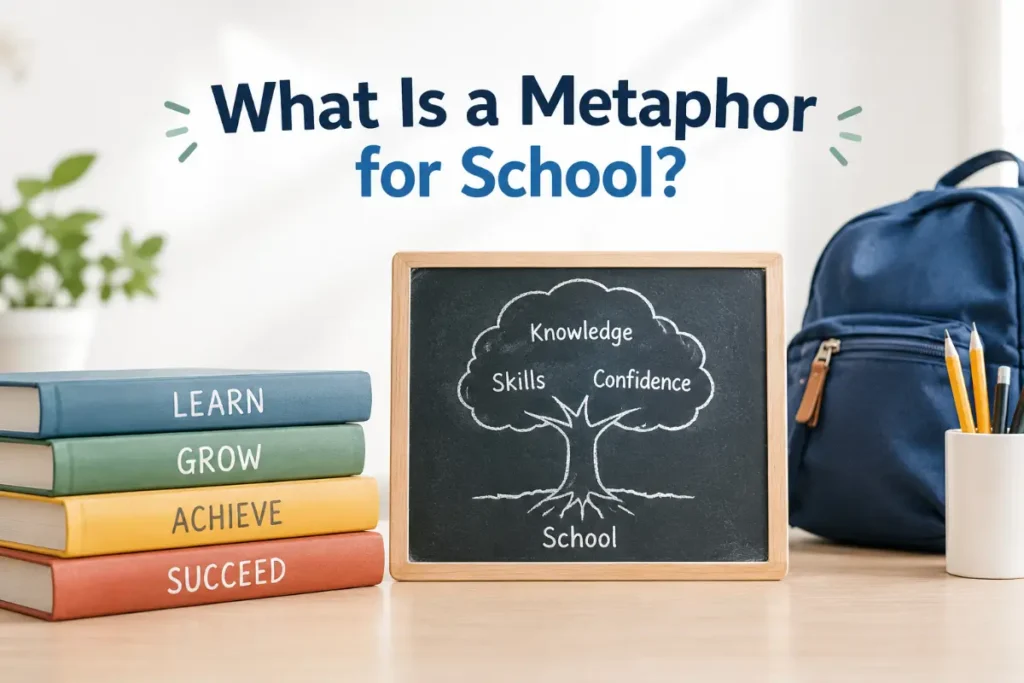
What Is a Metaphor for School
A metaphor for school is a figure of speech that describes a school or the experience of learning by directly comparing it to something different. The comparison helps readers understand an idea through a familiar image.
For example, consider this sentence.
School is a launching pad for future success.
A school isn’t a real launching pad. Instead, the metaphor suggests that education prepares students to move toward their goals, explore new possibilities, and begin exciting careers.
Metaphors make writing more interesting because they give abstract ideas a concrete shape. Rather than simply telling readers that school is important, you can show how it opens doors, plants seeds of knowledge, or builds a foundation for the future.
Why Writers Use School Metaphors
School involves more than classrooms, books, teachers, and exams. It also includes curiosity, friendship, personal growth, frustration, discovery, and preparation for adult life.
A carefully chosen metaphor can express several of these ideas in just a few words.
- To explain learning. Calling school a garden suggests that knowledge grows with care and practice.
- To show opportunity. Describing school as a key suggests that education can open doors to new experiences.
- To express challenges. Comparing school to a mountain climb shows that reaching a goal can require patience and effort.
- To create emotion. Calling school a second home can express comfort, friendship, and belonging.
- To strengthen creative writing. Describing a classroom as a beehive of ideas creates a lively image of students working together.
The most effective metaphor connects the image to a clear message. If you want to emphasize personal growth, a garden may work better than a race. If you want to highlight determination, a mountain may be a stronger choice.
Best Metaphors for School With Meanings
These metaphors work well for school essays, speeches, classroom activities, yearbook messages, and everyday writing. Each one highlights a different part of the educational experience.
1. School Is a Garden of Knowledge
This metaphor compares school to a garden where students grow like plants. Teachers provide guidance, lessons supply knowledge, and practice helps students develop their abilities.
Example: Our school is a garden of knowledge where every student has room to grow.
Meaning: Education helps students develop their talents and understanding over time.
Best for: Essays about education, personal growth, and the role of teachers.
2. School Is a Bridge to the Future
A bridge connects two places. In this metaphor, school connects students’ present lives with their future goals.
Example: School is the bridge that carries us from childhood dreams to adult opportunities.
Meaning: Education helps students prepare for future careers, responsibilities, and experiences.
Best for: Graduation speeches, motivational essays, and discussions about the value of education.
3. School Is a Key That Unlocks Doors
A key opens a lock. Similarly, education can give students access to knowledge, skills, and opportunities they might not otherwise discover.
Example: Every lesson is a key that unlocks another door to possibility.
Meaning: Learning can expand a person’s choices and help them explore new paths.
Best for: Short school assignments, inspirational writing, and speeches about educational opportunity.
4. School Is a Journey of Discovery
A journey involves movement, new experiences, unexpected turns, and destinations. School offers a similar experience as students explore subjects, discover interests, and learn from mistakes.
Example: School is a journey of discovery, and every lesson takes us somewhere new.
Meaning: Education is an ongoing process rather than a single achievement.
Best for: Essays about lifelong learning, curiosity, and personal development.
5. School Is a Workshop for the Mind
A workshop is a place where people create, repair, and improve things. This metaphor presents school as a place where students develop their thinking skills through practice and effort.
Example: Our classroom is a workshop where young minds shape ideas into understanding.
Meaning: Students strengthen their abilities by asking questions, solving problems, and applying what they learn.
Best for: Writing about critical thinking, creativity, and problem solving.
6. School Is a Lighthouse in a Sea of Questions
A lighthouse helps guide ships through dark or difficult waters. School can play a similar role by helping students find direction when they face unfamiliar ideas or confusing problems.
Example: School is a lighthouse that guides us through the sea of questions surrounding the world.
Meaning: Teachers and lessons help students find reliable information and make sense of complex subjects.
Best for: Reflective essays and writing about teachers as guides.
7. School Is a Stepping Stone to Success
A stepping stone helps someone move across an obstacle or reach another place. School can provide the knowledge and experience students need to move toward their goals.
Example: Every school year is a stepping stone toward the future we want to build.
Meaning: Each stage of education contributes to long term development.
Best for: Essays about ambition, careers, and achievement.
8. School Is a Treasure Chest of Knowledge
A treasure chest holds valuable things. This metaphor suggests that books, lessons, experiences, and conversations contain discoveries worth collecting.
Example: The school library is a treasure chest filled with stories, facts, and fresh ideas.
Meaning: Education gives students access to valuable information and experiences.
Best for: Elementary school writing, reading assignments, and creative descriptions of libraries.
9. School Is a Training Ground for Life
A training ground is a place where people practice before facing real challenges. School helps students build academic knowledge and develop skills such as teamwork, communication, and responsibility.
Example: School is a training ground where we practice the skills that life will demand.
Meaning: Education prepares students for challenges beyond the classroom.
Best for: Essays about life skills, independence, and preparation for adulthood.
10. School Is a Map for the Future
A map shows possible routes and helps travelers plan their journeys. School can help students understand their interests, explore career options, and make informed decisions.
Example: School is a map that helps us discover possible paths toward our dreams.
Meaning: Education can provide direction without deciding every step of a student’s life.
Best for: Career planning, graduation messages, and motivational writing.
More School Metaphors for Essays and Creative Writing
11. School Is a Seedbed of Ideas
A seedbed gives seeds the conditions they need to grow. School gives students opportunities to develop early interests into deeper knowledge and useful skills.
Example: Our school is a seedbed of ideas where small questions grow into big discoveries.
Meaning: Education encourages curiosity and helps students develop their potential.
12. School Is a Compass for Young Minds
A compass helps travelers find direction. School can help students understand their values, explore choices, and make thoughtful decisions.
Example: Education is a compass that helps young minds find their direction in a changing world.
Meaning: Learning gives students guidance as they make decisions about their lives.
13. School Is a Factory of Dreams
A factory turns raw materials into finished products. This metaphor presents school as a place where students develop their ambitions through learning, practice, and effort.
Example: School is a factory of dreams where determination turns ideas into achievements.
Meaning: Education helps students turn their goals into practical plans.
14. School Is a Puzzle Waiting to Be Solved
A puzzle consists of pieces that gradually form a complete picture. School subjects often work in a similar way because each lesson adds another piece to a student’s understanding.
Example: School is a puzzle, and every new lesson helps us see the bigger picture.
Meaning: Learning involves connecting separate facts and ideas.
15. School Is a Window to the World
A window allows people to see beyond the room they’re in. School introduces students to different cultures, scientific discoveries, historical events, and ways of thinking.
Example: School is a window to the world, opening our eyes to places and ideas we’ve never known.
Meaning: Education expands our understanding beyond personal experience.
16. School Is a Building Under Construction
A building takes time to complete. Similarly, students develop their knowledge and abilities gradually, with every lesson adding another part to their foundation.
Example: School is a building under construction, and every experience adds another brick to our future.
Meaning: Personal development takes time, patience, and steady effort.
17. School Is a Spark That Ignites Curiosity
A spark can start a fire. In this metaphor, a lesson or an inspiring teacher can awaken a student’s interest in a subject.
Example: One science experiment became the spark that ignited my curiosity about space.
Meaning: Education can inspire students to explore ideas independently.
18. School Is a River of Learning
A river keeps moving, passing through different landscapes along the way. School can represent the continuous flow of knowledge and the changes students experience as they grow.
Example: School is a river of learning that carries us toward new discoveries.
Meaning: Education is an ongoing process filled with new experiences.
19. School Is a Stage for Young Talent
A stage gives performers a place to show their abilities. School provides opportunities for students to demonstrate their talents through presentations, sports, music, science fairs, and other activities.
Example: Our school is a stage where every student has a chance to shine.
Meaning: Education creates opportunities for students to discover and share their strengths.
20. School Is a Lighthouse of Opportunity
A lighthouse helps people navigate difficult conditions. School can help students recognize opportunities and find ways to pursue their ambitions.
Example: Education is a lighthouse of opportunity, showing us possible paths through life’s challenges.
Meaning: Learning can provide direction and hope during uncertain times.
Metaphor for School
Section 2 of 3
More Creative Metaphors for School
School can represent growth, discovery, teamwork, pressure, and the excitement of learning something new. The following metaphors offer fresh ways to describe these experiences in essays, poems, classroom assignments, and speeches.
21. School Is a Launchpad for Dreams
A launchpad gives a rocket the starting point it needs to travel into space. School can give students a starting point for exploring their ambitions and building a future.
Example: My school is a launchpad for dreams that once seemed impossible.
Meaning: Education helps students prepare to pursue their goals.
22. School Is a Library of Life Lessons
A library holds books filled with information and stories. School also offers lessons that extend beyond textbooks, including patience, honesty, teamwork, and responsibility.
Example: School is a library of life lessons that teaches us more than what’s written on a page.
Meaning: Students gain knowledge and learn how to handle everyday situations.
23. School Is a Ladder of Opportunity
A ladder helps people climb toward a higher place. Each grade, lesson, and achievement can represent another step toward a student’s goals.
Example: Every school year is another rung on the ladder of opportunity.
Meaning: Education can help students develop the skills they need to advance in life.
24. School Is a Greenhouse for Growing Minds
A greenhouse provides a suitable environment for plants to develop. A supportive school can offer students the guidance, encouragement, and resources they need to grow.
Example: Our school is a greenhouse where young minds receive the care they need to flourish.
Meaning: Students often learn best when they feel supported and encouraged.
25. School Is a Treasure Map to Success
A treasure map gives clues that help someone find something valuable. School can introduce students to knowledge, abilities, and opportunities that help them work toward success.
Example: School is a treasure map, and every lesson brings us closer to discovering our potential.
Meaning: Education helps students explore possibilities and recognize their strengths.
26. School Is a Theater of Discovery
A theater brings stories, characters, and ideas to life. School can create a similar experience through experiments, discussions, performances, and hands on activities.
Example: Every classroom is a theater of discovery where new ideas take center stage.
Meaning: Learning becomes more memorable when students actively participate.
27. School Is a Factory of Possibilities
A factory produces useful things from raw materials. School helps students develop their abilities and turn early interests into practical skills.
Example: School is a factory of possibilities where curiosity becomes creativity and effort becomes progress.
Meaning: Education gives students opportunities to develop their potential.
28. School Is a Bridge Between Questions and Answers
A bridge connects two sides. School connects what students don’t know with the understanding they gain through lessons, practice, and discussion.
Example: Our classroom is a bridge between confusing questions and clear answers.
Meaning: Education helps students move from uncertainty toward understanding.
29. School Is a Playground for Ideas
A playground encourages children to explore, experiment, and interact. School can offer a similar space for testing ideas, asking questions, and learning from mistakes.
Example: Our classroom is a playground for ideas where imagination has room to run.
Meaning: Learning can be enjoyable when students feel free to explore and think creatively.
30. School Is a Compass and Map for Life
A compass shows direction, while a map helps travelers understand possible routes. Together, they represent the guidance and knowledge students gain through education.
Example: School gives us a compass for making wise choices and a map for exploring our future.
Meaning: Education can help students make informed decisions without choosing their path for them.
Metaphors for School Life and the Classroom
These comparisons focus on the daily experience of attending school. They’re especially useful for personal narratives, descriptive essays, and creative assignments.
31. The Classroom Is a Beehive of Activity
A beehive is full of movement and cooperation. A busy classroom can feel similar when students discuss ideas, complete tasks, and work together.
Example: The classroom became a beehive of activity as students prepared for the science fair.
Meaning: The classroom is lively, active, and full of teamwork.
32. The School Hallway Is a River of Students
A river flows continuously in one direction. During passing periods, students can move through hallways in a similar stream.
Example: The school hallway became a river of students rushing toward their next classes.
Meaning: The hallway is crowded with students moving from place to place.
33. The School Bell Is a Starting Gun
A starting gun signals the beginning of a race. The school bell can serve a similar role by signaling the beginning of a lesson or the rush to another classroom.
Example: The school bell was a starting gun, and everyone hurried toward their next class.
Meaning: The bell triggers a quick change in activity.
34. Homework Is a Daily Workout for the Brain
A workout strengthens the body through practice. Homework can strengthen thinking skills when students use it to review concepts and solve problems.
Example: Math homework is a daily workout for my brain.
Meaning: Homework provides practice that can improve understanding and problem solving.
35. The Library Is a Sanctuary of Knowledge
A sanctuary is a peaceful place where people can feel safe or find quiet. A school library can offer students a calm space to read, research, and concentrate.
Example: The school library was a sanctuary of knowledge away from the noise of the busy hallways.
Meaning: The library offers a peaceful setting for learning.
36. The Cafeteria Is a Melting Pot of Cultures
A melting pot brings different people or traditions together. A school cafeteria can reflect the different backgrounds, tastes, and experiences of its students.
Example: Our cafeteria is a melting pot of cultures, with different foods and stories at every table.
Meaning: Students from different backgrounds share the same space and learn about one another.
37. The Classroom Is a Laboratory of Ideas
A laboratory is a place for testing and investigation. In a classroom, students can examine questions, test solutions, and learn from the results.
Example: Our classroom is a laboratory of ideas where every question deserves investigation.
Meaning: Learning involves exploration, experimentation, and critical thinking.
38. The School Playground Is a Stage for Friendship
A stage gives people a place to express themselves. The playground provides a setting for students to build friendships through games, conversations, and shared experiences.
Example: The playground became a stage for friendship as new students joined the game.
Meaning: Informal school activities help students connect with one another.
39. The Teacher Is a Gardener of Young Minds
A gardener helps plants grow by providing care and suitable conditions. Teachers guide students by explaining ideas, offering feedback, and encouraging progress.
Example: My teacher is a gardener of young minds, helping every student discover a talent worth developing.
Meaning: Teachers support intellectual and personal growth.
40. A School Project Is a Puzzle With Many Pieces
A puzzle requires several pieces to create a complete picture. A school project may require research, planning, writing, teamwork, and careful editing.
Example: Our history project was a puzzle with many pieces, and each team member contributed something important.
Meaning: Successful projects often depend on combining different skills and ideas.
Metaphors for School Challenges
School isn’t always easy. Students face difficult tests, deadlines, confusing lessons, and moments of self doubt. These metaphors can help writers describe those challenges in a vivid and relatable way.
41. Exams Are Mountains to Climb
A mountain climb requires preparation, effort, and persistence. Exams can feel similar when students must study difficult material and manage their time.
Example: Final exams were mountains to climb, but every hour of preparation brought me closer to the summit.
Meaning: Exams can be challenging, but preparation helps students make progress.
42. Homework Is a Mountain of Tasks
A mountain can represent something large and difficult to overcome. When several assignments pile up, homework can feel like an enormous obstacle.
Example: After the weekend, I faced a mountain of homework waiting on my desk.
Meaning: The student has many assignments to complete.
43. A Difficult Subject Is a Locked Door
A locked door prevents someone from entering until they find a way to open it. A challenging subject can feel similar until a student discovers the right explanation or method.
Example: Algebra was a locked door until my teacher showed me how to solve the equations.
Meaning: A difficult topic may become understandable with the right guidance and practice.
44. A Bad Grade Is a Speed Bump on the Road to Success
A speed bump slows a vehicle but doesn’t necessarily stop it. A disappointing grade can interrupt progress without defining a student’s future.
Example: My first failing quiz was a speed bump on the road to success, not the end of the journey.
Meaning: Mistakes can become opportunities to improve.
45. School Stress Is a Storm in the Mind
A storm brings confusion, noise, and turbulence. Heavy school pressure can create similar feelings when assignments, exams, and personal responsibilities compete for attention.
Example: Before finals week, my mind became a storm of deadlines and unanswered questions.
Meaning: The student feels overwhelmed by academic pressure.
46. A Confusing Lesson Is a Maze
A maze contains twists, turns, and paths that aren’t always easy to follow. A difficult lesson can feel like a maze until the student finds a clear route through the material.
Example: The chemistry lesson was a maze of unfamiliar terms until we worked through the examples together.
Meaning: The subject seems complicated but can become clearer with guidance.
47. Procrastination Is an Anchor
An anchor holds a boat in place. Procrastination can hold students back by preventing them from starting or finishing important work.
Example: Procrastination became an anchor that kept me from reaching my academic goals.
Meaning: Delaying tasks makes progress harder.
48. Distractions Are Roadblocks to Learning
A roadblock prevents travelers from moving forward. Noise, phone notifications, and unrelated activities can interrupt concentration.
Example: Constant phone alerts were roadblocks on my path to understanding the lesson.
Meaning: Distractions make it harder to focus and learn.
49. A Tough School Year Is a Long Winter
Winter can represent a difficult period that requires patience and endurance. A challenging school year may feel similar when progress seems slow and motivation fades.
Example: That school year was a long winter, but I emerged stronger and better prepared.
Meaning: Difficult experiences can help students develop resilience.
50. Failure Is a Teacher in Disguise
A teacher helps people learn. Failure can serve a similar purpose by revealing mistakes and showing students what they need to change.
Example: My failed experiment was a teacher in disguise, showing me why my original plan didn’t work.
Meaning: Mistakes can provide valuable lessons when students reflect and improve.
Metaphors for School Friendship and Community
School is also a place where students learn to cooperate, build relationships, and feel part of a group. These metaphors work well for essays about belonging, teamwork, diversity, and school spirit.
51. A Class Is a Team of Dream Builders
A team combines different strengths to reach a shared goal. A class can do the same through group projects, discussions, and shared achievements.
Example: Our class is a team of dream builders, with every student bringing a different strength to the table.
Meaning: Students can support one another while working toward their goals.
52. A School Is a Family of Learners
A family can provide support, encouragement, and a sense of belonging. This metaphor describes a school community where people care about one another and work together.
Example: Our school is a family of learners who celebrate one another’s successes.
Meaning: The school offers a supportive community.
53. Diversity Is the Spice of the Classroom
Spices add different flavors to a meal. Students with different backgrounds, interests, and experiences can bring variety to classroom discussions.
Example: Diversity is the spice of our classroom, making every discussion richer and more interesting.
Meaning: Different perspectives can improve the learning experience.
54. Friendship Is the Glue That Holds a Class Together
Glue joins separate pieces into one structure. Friendship can connect students and help create a stronger classroom community.
Example: Friendship was the glue that held our class together during a difficult school year.
Meaning: Positive relationships can strengthen cooperation and belonging.
55. Teamwork Is the Engine of Group Projects
An engine provides the power that keeps a machine moving. Teamwork helps a group make progress by combining effort, ideas, and responsibility.
Example: Teamwork was the engine that drove our science project from a rough idea to a winning presentation.
Meaning: Cooperation helps a group reach its goals.
56. The School Is a Tapestry of Talents
A tapestry combines many threads to create a larger design. A school brings together students with different abilities, interests, and strengths.
Example: Our school is a tapestry of talents, woven together by creativity, kindness, and hard work.
Meaning: Each student contributes something valuable to the community.
57. Classmates Are Stars in the Same Sky
Stars shine individually while sharing the same sky. Students can pursue their own goals while supporting their classmates.
Example: My classmates are stars in the same sky, each shining in a different way.
Meaning: People can have different talents and still belong to the same community.
58. The Teacher Is the Captain of the Classroom
A captain guides a team toward a shared destination. Teachers organize learning, explain expectations, and help students navigate challenges.
Example: Our teacher was the captain of the classroom, guiding us through every stage of the project.
Meaning: Teachers provide leadership and direction.
59. A School Event Is a Symphony of Effort
A symphony combines different instruments to create a complete piece of music. A school event also depends on people performing different roles.
Example: The school festival was a symphony of effort, with students, teachers, and families contributing to its success.
Meaning: A successful event requires many people working together.
60. School Spirit Is the Heartbeat of a Community
A heartbeat keeps a living body moving. School spirit brings energy and shared pride to a school community.
Example: School spirit was the heartbeat of our campus during the annual sports competition.
Meaning: Shared enthusiasm helps connect students and staff.
How to Choose the Best Metaphor for School
The best metaphor isn’t always the most creative one. It should match the point you’re trying to make and the audience you’re writing for.
Use this guide to find a suitable comparison.
| Your writing goal | Recommended metaphor | Why it works |
|---|---|---|
| Explain the value of education | School is a key that unlocks doors | Highlights new opportunities |
| Describe personal growth | School is a garden | Shows gradual development |
| Write a graduation speech | School is a bridge to the future | Connects education with future goals |
| Describe a busy classroom | The classroom is a beehive | Creates an image of activity |
| Explain difficult exams | Exams are mountains to climb | Shows effort and challenge |
| Celebrate classmates | A class is a tapestry of talents | Emphasizes different strengths |
| Describe an inspiring teacher | A teacher is a gardener | Highlights guidance and care |
| Write about lifelong learning | School is a journey of discovery | Suggests continued exploration |
| Discuss teamwork | Teamwork is the engine of a project | Shows how cooperation drives progress |
| Describe school pressure | School stress is a storm in the mind | Expresses emotional difficulty |
Choose a Metaphor That Matches Your Message
Before choosing a metaphor, ask yourself what you want readers to understand.
- If you want to show growth, use a garden, greenhouse, or growing tree.
- If you want to show progress, use a bridge, ladder, road, or journey.
- If you want to show knowledge, use a library, treasure chest, or light.
- If you want to show difficulty, use a mountain, maze, storm, or obstacle.
- If you want to show community, use a family, team, tapestry, or symphony.
- If you want to show inspiration, use a spark, lighthouse, or open window.
Keep your audience in mind, too. A simple metaphor such as school is a garden works well for younger students. An older student writing a reflective essay might prefer school is a bridge between curiosity and understanding.
How to Write Your Own School Metaphor
Creating an original metaphor is easier than it sounds. You don’t need complicated words or an unusual comparison. You need a clear idea and an image that helps readers see it.
Step 1 Identify What You Want to Describe
Start with one part of school life.
You might want to describe learning, friendship, teachers, exams, the classroom, or the feeling of starting a new school year.
For example, your central idea might be that learning takes time.
Step 2 Think of Something That Shares the Same Quality
Ask what else grows gradually.
A tree, a garden, and a building under construction all suggest slow development.
Now you have a possible metaphor.
Learning is a tree that grows stronger with every season.
The tree represents the gradual development of knowledge and experience.
Step 3 Add a Meaningful Detail
A basic metaphor can become more vivid when you add a detail that supports its message.
Basic version.
School is a garden.
More descriptive version.
School is a garden where curiosity takes root and knowledge blossoms.
The second version creates a clearer picture because it connects familiar gardening actions with the learning process.
Step 4 Make Sure the Comparison Makes Sense
A metaphor should help readers understand your idea rather than confuse them.
For example, school is a refrigerator of knowledge might work in a playful poem, but it doesn’t clearly express the usual experience of learning.
By contrast, school is a library of possibilities suggests that students can explore many ideas and discover different paths.
Creative writing allows unusual comparisons, but the connection should still serve a purpose.
Step 5 Read It Aloud
Read your sentence as if you were sharing it with a classmate or teacher.
Does it sound natural? Does the comparison create a clear picture? Can you explain what it means?
If the answer is yes, your metaphor is probably doing its job.
Related reading opportunity: Before the conclusion of the article, link to an existing guide on [how to write metaphors with simple examples] for readers who want to practice creating their own figurative language.
You may also want to read Metaphor For Happy With Meanings And Creative Examples.
Metaphor vs Simile for School
Metaphors and similes both compare two different things. The main difference is how they make the comparison.
A metaphor says that one thing is another thing in a figurative sense. A simile compares two things using words such as like or as.
| Type | Example | Explanation |
|---|---|---|
| Metaphor | School is a garden. | School is directly described as a garden. |
| Simile | School is like a garden. | School is compared to a garden using like. |
| Metaphor | Exams are mountains. | Exams represent difficult challenges. |
| Simile | Exams are like mountains. | Exams are compared to mountains. |
| Metaphor | My teacher is a lighthouse. | The teacher represents guidance. |
| Simile | My teacher shines like a lighthouse. | The teacher’s guidance is compared to a lighthouse’s light. |
Which One Should You Use
Use a metaphor when you want a direct, memorable comparison.
For example, My classroom is a beehive of ideas creates a lively picture of students sharing thoughts and working together.
Use a simile when you want to make the comparison more explicit.
For example, My classroom is like a beehive because everyone is busy sharing ideas explains the connection more directly.
Both forms are correct. Choose the one that best fits your writing style and assignment.
Metaphor for School
Section 3 of 3
Short Metaphors for School Assignments
Sometimes, a school assignment needs just one strong sentence. These short metaphors are easy to understand, simple to remember, and useful for elementary school students, middle school students, and older learners.
Each example includes a brief explanation so you can choose the one that fits your topic.
20 Short School Metaphors
- School is a garden. Students grow through learning and experience.
- School is a bridge. Education connects students to future opportunities.
- School is a key. Knowledge opens doors to new possibilities.
- School is a journey. Learning takes place one step at a time.
- School is a treasure chest. Lessons contain valuable knowledge.
- School is a lighthouse. Education helps students find direction.
- School is a launchpad. Learning prepares students to pursue their dreams.
- School is a workshop. Students develop and practice useful skills.
- School is a ladder. Each achievement helps students move forward.
- School is a window. Education reveals new ideas and experiences.
- School is a seedbed. Young ideas begin to grow.
- School is a compass. Learning helps students make informed choices.
- School is a stepping stone. Each stage prepares students for the next.
- School is a puzzle. Every lesson adds another piece of understanding.
- School is a spark. A good lesson can awaken curiosity.
- School is a map. Education helps students explore possible paths.
- School is a foundation. Early learning supports future development.
- School is a training ground. Students practice skills for life.
- School is a stage. Students discover and share their talents.
- School is a world of discovery. Every subject offers something new to explore.
Metaphors for School in Sentences
A metaphor becomes more useful when you see how it works in a complete sentence. The following examples show how to include school metaphors in everyday writing.
Daily Conversation
- School is my second home because I feel safe and supported there.
- Our classroom is a beehive of activity before the science fair.
- The school library is a treasure chest waiting to be explored.
- My teacher is a lighthouse who guides me through difficult lessons.
- Homework is a workout for my brain.
School Essays
- School is a garden where knowledge takes root and curiosity blossoms.
- Education is a bridge that connects childhood dreams with future opportunities.
- Every school year is another chapter in the story of my life.
- My school is a foundation on which I am building my future.
- The classroom is a laboratory where ideas are tested and understanding grows.
Motivational Writing
- Education is a key that unlocks doors to new opportunities.
- Every lesson is a stepping stone on the path to success.
- School is a launchpad that helps students reach for their dreams.
- A difficult exam is a mountain that rewards preparation and persistence.
- Failure is a teacher that reveals what we need to improve.
Creative Writing
- The school hallway was a river of students flowing toward their next classes.
- The school bell was a starting gun that sent everyone racing toward the day.
- My classroom was a garden of bright ideas and growing dreams.
- The school library was an ocean of stories waiting to be discovered.
- Friendship was the glue that held our class together during a difficult year.
These examples work because the comparison has a clear purpose. The metaphor adds meaning instead of simply making the sentence longer.
Common Mistakes When Using School Metaphors
Metaphors can strengthen writing, but a weak comparison can confuse readers. Avoid these common mistakes to make your examples clearer and more effective.
1. Confusing Metaphors With Similes
A metaphor makes a direct figurative comparison. A simile uses words such as like or as.
Incorrect explanation: School is like a garden is a metaphor.
Correct explanation: School is like a garden is a simile, while School is a garden is a metaphor.
Both can work well in an essay. Just identify them correctly when your teacher asks you to distinguish between the two.
2. Choosing a Comparison That Doesn’t Fit
A metaphor should support the idea you’re trying to communicate.
For example, School is a refrigerator of dreams doesn’t create a clear connection for most readers. It might work in a humorous poem, but it would be an unusual choice for a serious essay about education.
A clearer alternative is School is a greenhouse where dreams grow.
3. Mixing Too Many Metaphors
Combining unrelated images in one sentence can make writing difficult to follow.
Confusing example: School is a garden, a rocket, and an ocean that builds a ladder to success.
Improved example: School is a garden where knowledge grows and dreams take root.
The improved sentence develops one main image instead of jumping between several unrelated comparisons.
4. Using Clichés Without Adding Meaning
Some metaphors are familiar because writers use them often. Examples include a key to success, a bridge to the future, and a foundation for life.
These expressions aren’t wrong. However, adding a meaningful detail can make them more personal.
Basic example: School is a bridge to the future.
More vivid example: School is a bridge that carries us from the questions of childhood toward the choices of adulthood.
The second version explains the comparison in a more specific way.
5. Forgetting the Audience
A metaphor for a young child’s assignment should be easy to understand. A metaphor for a high school essay can explore more complex ideas.
For a younger student, school is a garden where we grow is a strong choice.
For an older student, school is a meeting place for curiosity, discipline, and discovery may better suit a reflective essay.
Choose language your readers can understand without needing a dictionary.
6. Treating Every Metaphor as a Literal Fact
A metaphor isn’t meant to describe something literally.
When you write my teacher is a lighthouse, you aren’t claiming that your teacher is an actual lighthouse. You’re suggesting that the teacher provides guidance and helps students find their way.
Understanding the figurative meaning prevents confusion and makes it easier to create original comparisons.
Memory Tricks for School Metaphors
If you struggle to remember metaphors during a test or writing assignment, connect each image with the idea it represents.
| Image | Remember it as | Main idea |
|---|---|---|
| Garden | Growing | Learning and development |
| Bridge | Connecting | Future opportunities |
| Key | Opening | Access to knowledge |
| Mountain | Climbing | Challenges and effort |
| Lighthouse | Guiding | Direction and support |
| Puzzle | Connecting pieces | Understanding |
| Ladder | Moving upward | Progress |
| Treasure chest | Finding valuables | Knowledge and discovery |
| Foundation | Building | Preparation for the future |
| Spark | Starting a fire | Inspiration and curiosity |
| Tapestry | Weaving threads | Diversity and community |
| Compass | Finding direction | Choices and guidance |
A simple memory technique is to think of the action associated with the object.
- Gardens help things grow, so a garden represents learning.
- Bridges connect places, so a bridge represents opportunity.
- Keys open locks, so a key represents access.
- Mountains require climbing, so a mountain represents effort.
- Lighthouses guide ships, so a lighthouse represents support.
Once you remember the connection, you can build your own sentence around it.
Related Figurative Language for School
Metaphors belong to a wider group of writing techniques called figurative language. Learning the differences can help you choose the right device for your assignment.
Simile
A simile compares two things using like or as.
Example: The classroom was as busy as a beehive.
This comparison helps readers picture a lively classroom.
Personification
Personification gives human actions or qualities to something that isn’t human.
Example: The school bell shouted for everyone to return to class.
A bell cannot literally shout, but the sentence makes its sound feel more vivid.
Hyperbole
Hyperbole uses deliberate exaggeration to express a feeling or create humor.
Example: I have a mountain of homework that reaches the moon.
The sentence exaggerates the amount of homework to show how overwhelming it feels.
Symbolism
Symbolism uses an object, person, place, or action to represent a broader idea.
Example: A graduation cap can symbolize achievement and a new beginning.
The cap is a real object that represents something larger than itself.
Analogy
An analogy explains an idea by comparing it with another situation that shares a useful similarity.
Example: Learning is like building a house because both require a strong foundation before more complex parts can be added.
An analogy usually explains the relationship in more detail than a short metaphor does.
Frequently Asked Questions
What Is the Best Metaphor for School
One of the most versatile metaphors is school is a garden where young minds grow. It presents education as a process of development and highlights the role of teachers, practice, and curiosity. For a graduation speech, school is a bridge to the future may work better because it connects education with new opportunities.
What Is a Simple Metaphor for School for Kids
A simple example is school is a garden. It means students grow by learning new things and practicing their skills. Other easy examples include school is a key, school is a journey, and school is a treasure chest of knowledge. These comparisons are easy for children to understand and use in short assignments.
What Is a Good Metaphor for School in an Essay
School is the foundation of a student’s future is a useful choice for an essay about the value of education. It suggests that the knowledge and skills students develop at school can support later achievements. You can expand the metaphor by explaining how reading, writing, problem solving, and teamwork help build that foundation.
What Is a Metaphor for a Teacher
A teacher can be described as a gardener of young minds. This metaphor suggests that teachers help students grow by providing guidance, encouragement, and opportunities to learn. Another option is a lighthouse in a sea of questions, which emphasizes a teacher’s role in helping students navigate confusing topics.
What Is a Metaphor for a Classroom
The classroom is a laboratory of ideas is an effective metaphor. It suggests that students explore questions, test solutions, and learn through discussion and experimentation. For a lively classroom, you could use a beehive of activity. For a creative classroom, a playground for ideas is another good option.
What Is a Metaphor for Learning
Learning is a journey of discovery describes learning as an ongoing process filled with new experiences. Each lesson represents another step, and each discovery opens up new possibilities. Another strong option is learning is a tree that grows stronger with time, which emphasizes practice, patience, and steady development.
What Is a Metaphor for School Being Difficult
School is a mountain to climb is a clear metaphor for academic challenges. It suggests that students need effort, preparation, and persistence to reach their goals. You could also describe a difficult subject as a locked door that becomes easier to open when students find the right method or receive helpful guidance.
What Is a Metaphor for School Friendship
Friendship is the glue that holds a class together highlights the importance of trust, kindness, and cooperation. It suggests that positive relationships help students feel connected and supported. Another option is classmates are stars in the same sky, which celebrates individual talents while showing that everyone belongs to a larger community.
How Do You Start a Metaphor About School
Begin by identifying the idea you want to express. If you want to describe growth, think of a garden or tree. If you want to describe opportunity, consider a bridge or key. Then write a direct comparison, such as school is a garden where curiosity takes root. Finally, make sure the image supports your message.
What Is the Difference Between a Metaphor and a Simile About School
A metaphor makes a direct figurative comparison, as in school is a garden. A simile uses a comparison word such as like or as, as in school is like a garden. Both can communicate the same idea, but a metaphor usually makes the comparison more directly, while a simile signals the comparison explicitly.
Expert Editor’s Note
As an editor, I’d recommend choosing a school metaphor based on the main idea of your sentence rather than picking the fanciest phrase.
For an essay about the benefits of education, school is a foundation for the future communicates a clear message. For a personal narrative about a supportive teacher, my teacher is a lighthouse may feel more natural.
Also, keep the comparison consistent. If you begin with a garden, develop the ideas of seeds, roots, growth, and blossoms rather than suddenly switching to rockets and oceans. This makes your writing easier to follow.
Finally, explain the metaphor when your assignment requires analysis. The sentence school is a garden is the figurative comparison. Explaining that students grow through lessons, practice, and encouragement shows that you understand its meaning.
Conclusion
A metaphor for school can turn a simple sentence about education into an image that readers remember. School can be a garden where knowledge grows, a bridge to future opportunities, a key that opens doors, or a mountain that teaches persistence.
The best choice depends on your purpose. Use a garden to describe growth, a lighthouse to describe guidance, a puzzle to describe understanding, or a tapestry to celebrate the different talents within a school community.
When you write your own metaphor, focus on one clear idea and connect it to an image your reader can picture. Avoid mixing unrelated comparisons or choosing a phrase just because it sounds impressive.
Remember that school isn’t just a place where students collect facts. It’s a place where they build skills, discover possibilities, and grow into who they want to become.
For another common grammar confusion, see Metaphor for Anxiety (2026 Guide).

Editorial Reviewer & Proofreader
Grace Mitchell reviews Gramlify’s articles for clarity, consistency, and readability. She is passionate about creating accurate, approachable content that helps English learners build confidence.