
I’ll structure the article in three sections, as requested, while keeping your writing rules in place. The focus will be on useful, original metaphors that help readers describe anxiety in everyday conversation, creative writing, poetry, and personal reflection.
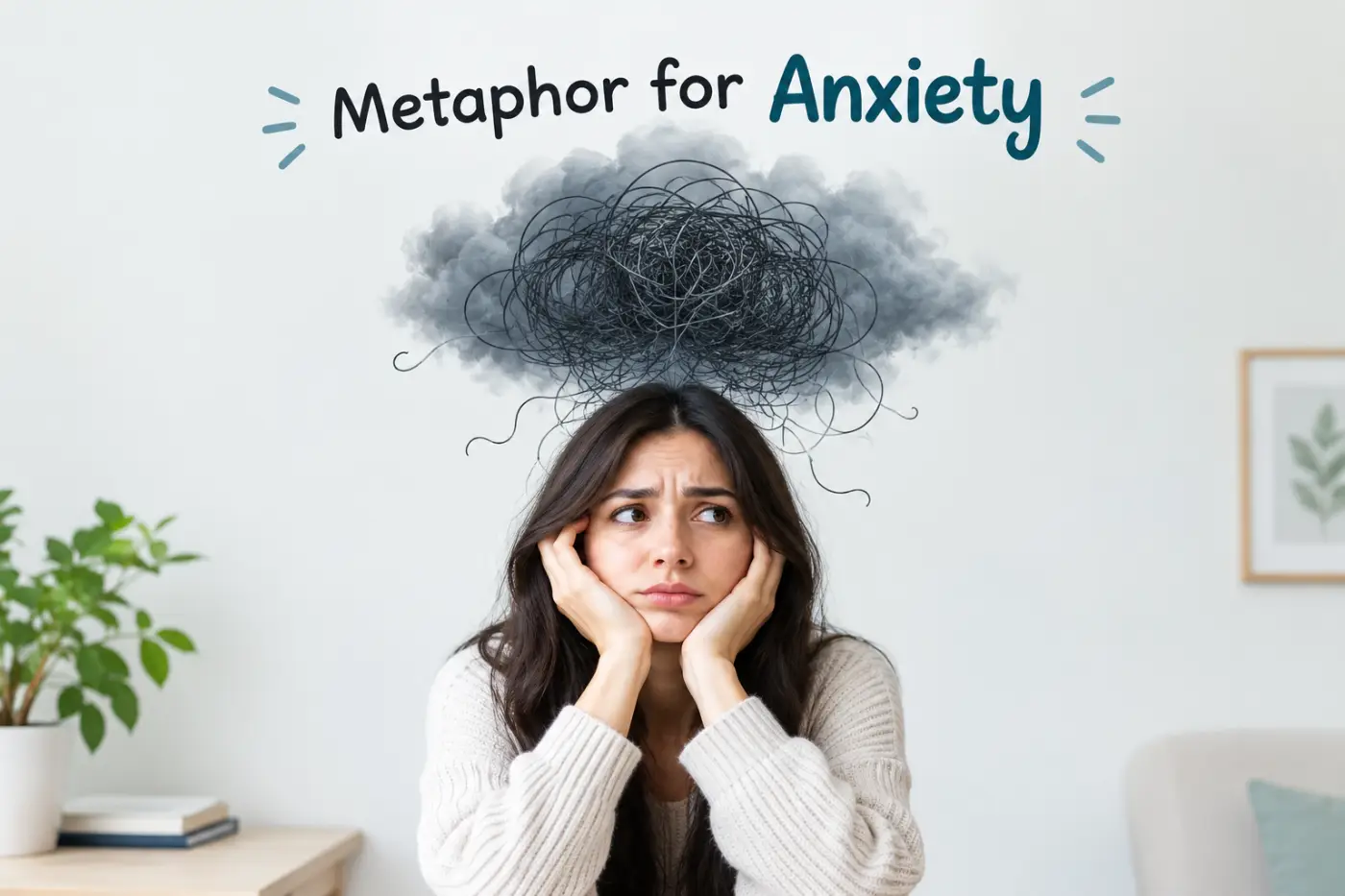
Anxiety can feel like standing on the edge of a storm that nobody else can see. Your thoughts race, your chest tightens, and even a simple task can feel like climbing a mountain with a heavy backpack. Finding the right metaphor for anxiety helps put these hard to explain feelings into words.
A good metaphor does more than describe worry. It gives an invisible emotion a shape, a sound, or a physical presence. Anxiety might feel like a tangled ball of yarn, a smoke alarm that keeps ringing, or a shadow that follows you into every room. Each image reveals a different part of the experience.
You might need an anxiety metaphor for a school assignment, a poem, a novel, a journal entry, or a conversation with someone you trust. Perhaps you want to explain nervousness before a big event. Or maybe you’re searching for a powerful image that captures the feeling of being overwhelmed by thoughts about the future.
This guide explores different metaphors for anxiety, explains what they mean, and shows you how to use them naturally. You’ll find simple comparisons, creative expressions, examples for writers, and practical tips for choosing an image that fits your feelings.
The goal isn’t to make anxiety sound dramatic. It’s to make a difficult emotion easier to understand, describe, and communicate.
Suggested internal link: Add a link to an existing article about [metaphors for emotions and feelings] after this introduction.
Need another quick comparison? Read Metaphor for Change and Powerful Examples to Describe.
Quick Answer
A metaphor for anxiety describes anxious feelings by comparing them to something familiar without using the words like or as. For example, anxiety can be a storm inside your mind, a ticking clock, a heavy backpack, or a smoke alarm that won’t stop ringing. These images help communicate fear, tension, uncertainty, and overwhelming thoughts.
What Is a Metaphor for Anxiety
A metaphor for anxiety is a figure of speech that describes worry, fear, nervousness, or emotional tension through an image. Instead of simply saying that someone feels anxious, you compare the feeling to something readers can picture or understand.
For example, consider this sentence.
Anxiety was a storm raging inside her mind.
Anxiety isn’t an actual storm. However, the image suggests powerful emotions, racing thoughts, and a sense of losing control. Readers can imagine the intensity of the feeling without needing a long explanation.
Metaphors work because people often understand abstract emotions through familiar experiences. Most people know what a storm looks like, how a heavy load feels, or how exhausting it can be to hear an alarm that won’t stop.
The best metaphors connect those familiar experiences to the emotional experience you’re trying to describe.
How an anxiety metaphor works
A metaphor connects two different ideas through a shared quality.
Consider these examples.
- Anxiety is a storm. Both can feel powerful, unpredictable, and difficult to control.
- Anxiety is a heavy backpack. Both can make ordinary activities feel harder.
- Anxiety is a tangled knot. Both can create a sense of confusion and tension.
- Anxiety is a broken alarm. Both can signal danger long after the situation seems safe.
- Anxiety is a fog. Both can make it difficult to see a clear path forward.
Notice that each metaphor highlights a different part of anxiety. A storm suggests intensity, while fog suggests confusion. A backpack communicates burden, and an alarm suggests constant alertness.
That distinction matters. If you choose a metaphor that matches the feeling you’re describing, your writing becomes clearer and more memorable.
Metaphor vs simile for anxiety
Metaphors and similes both compare ideas, but they do it differently.
| Figure of speech | Example | How it works |
|---|---|---|
| Metaphor | Anxiety is a storm. | Directly describes anxiety as something else. |
| Simile | Anxiety is like a storm. | Uses like to make the comparison. |
| Personification | Anxiety knocked on my door again. | Gives anxiety a human action. |
| Literal description | I felt anxious before the interview. | Describes the feeling directly. |
All four approaches can work well. However, a metaphor often creates a stronger mental image because it presents the comparison directly.
For example, saying My anxiety is a locked room can suggest isolation, helplessness, or feeling trapped. The reader must explore the image to understand the emotion, which gives the sentence more depth.
The Best Metaphors for Anxiety
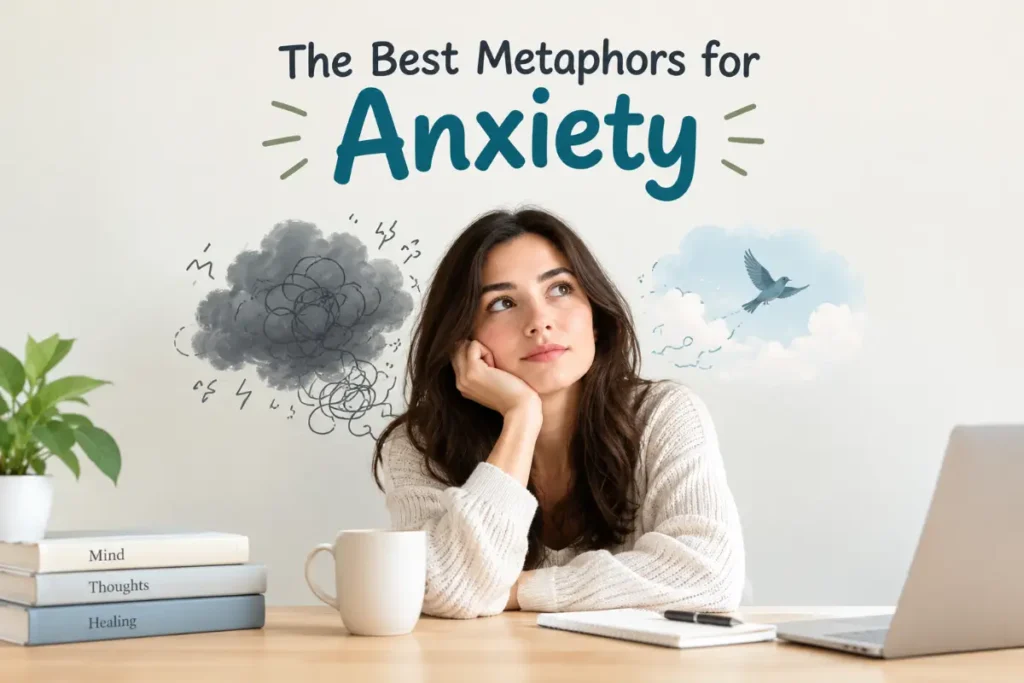
These metaphors work well in everyday conversation, personal writing, creative work, and reflective essays. Each one captures a slightly different experience.
Anxiety is a storm inside my mind.
This metaphor describes racing thoughts and powerful emotions that seem to arrive all at once. It works especially well when anxiety feels intense or unpredictable.
Example: A small worry became a storm inside my mind before I even left the house.
Anxiety is a weight on my shoulders.
This image captures the burden of carrying worries throughout the day. It suggests that even ordinary responsibilities can feel harder when your mind is already full.
Example: I carried my anxiety like a weight on my shoulders from morning until night.
Anxiety is a fog that hides the road ahead.
Use this metaphor to describe uncertainty and difficulty thinking clearly. It suits situations where someone worries about the future or struggles to make a decision.
Example: Anxiety covered the future in fog, making every choice feel uncertain.
Anxiety is a knot I can’t untangle.
This metaphor expresses mental confusion and repetitive thinking. Each attempt to solve one worry seems to create another.
Example: Every time I tried to untangle my thoughts, the knot grew tighter.
Anxiety is an alarm that never switches off.
This image describes a mind that stays alert even when there’s no immediate danger. It’s useful for explaining constant worry or an ongoing sense of unease.
Example: My anxiety was a smoke alarm that screamed every time life produced a little heat.
Metaphors for Anxiety That Feels Overwhelming
Sometimes anxiety feels larger than a single worry. It can take over your attention, drain your energy, or make ordinary responsibilities seem impossible. These metaphors help describe that sense of being overwhelmed.
Anxiety is a wave that keeps pulling me under
A wave suggests force, movement, and a struggle to stay above water. This metaphor works when anxious feelings arrive in powerful bursts.
Example: Every new deadline sent another wave of anxiety crashing over me.
You can also adapt the image to show a changing emotional state.
I kept my head above water until another wave of worry swept through my mind.
This variation suggests that the person is trying to cope, even though the pressure keeps returning.
Anxiety is a mountain I have to climb
A mountain represents a challenge that looks difficult before the journey even begins. It can describe the dread someone feels before a presentation, an exam, a difficult conversation, or a major life change.
Example: Getting through the workday felt like climbing a mountain before sunrise.
This metaphor is particularly useful when the person can see the task ahead but feels unsure about having enough energy to face it.
Anxiety is a room with walls that keep closing in
This image suggests pressure, restriction, and a loss of personal space. It can express the feeling that worries are taking over every part of life.
Example: With every unanswered email, the room of my anxiety seemed to shrink.
The metaphor creates a sense of urgency because the space becomes smaller as the pressure grows.
Anxiety is a wave of static in my head
Static interferes with a clear signal. As a metaphor, it describes mental noise that makes it difficult to focus on a conversation, follow instructions, or organize thoughts.
Example: I tried to listen to the meeting, but anxiety filled my mind with static.
This image works well in workplace writing because it conveys distraction without requiring a long explanation.
Anxiety is a backpack filled with invisible stones
This metaphor combines the idea of a burden with the fact that other people might not see it.
Example: I walked into class carrying a backpack full of invisible stones, each one another thing I was afraid to get wrong.
It can be especially effective in personal essays because it acknowledges that someone may look calm while carrying a great deal of worry.
Metaphors for Anxiety and Overthinking
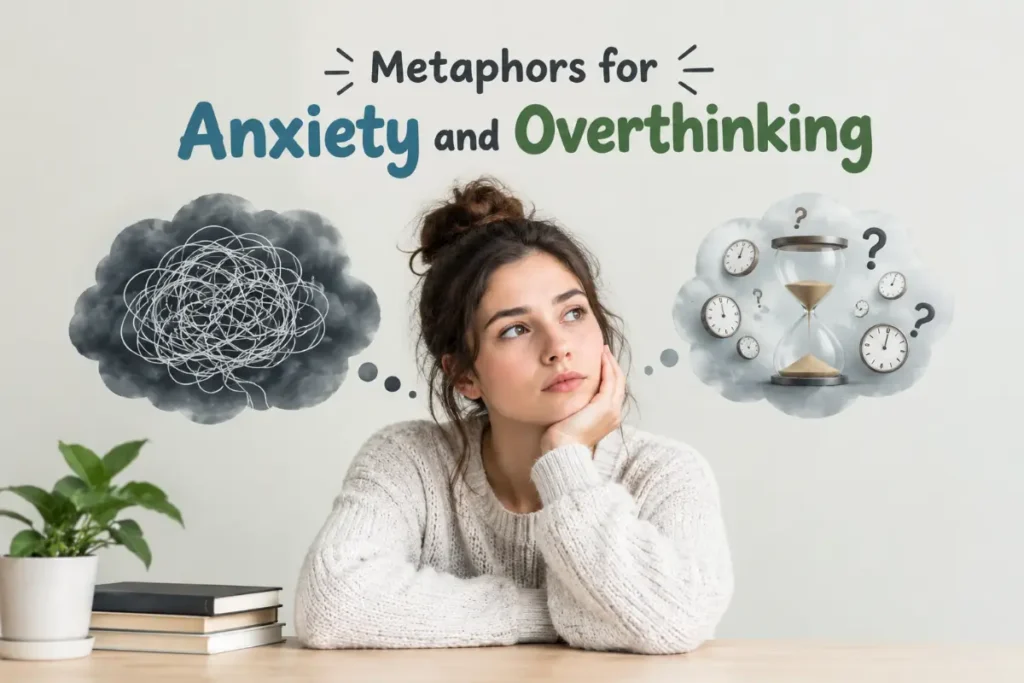
Overthinking often involves replaying conversations, imagining future problems, and searching for certainty that may not be available. The following metaphors describe the repetitive nature of anxious thoughts.
Anxiety is a hamster wheel
A hamster wheel moves continuously without taking the runner anywhere. It captures the frustration of thinking about the same problem again and again without reaching a useful conclusion.
Example: I spent the entire evening running on the hamster wheel of my anxiety, reviewing a conversation that had already ended.
This is a strong choice for casual writing because most readers understand the image immediately.
Anxiety is a record stuck on repeat
An old record that repeats the same section provides a simple image for persistent thoughts.
Example: The thought that I had disappointed everyone played like a record stuck on repeat.
This metaphor works well when one particular fear keeps returning, even after the person has tried to move on.
Anxiety is a courtroom inside my head
This metaphor presents the mind as a courtroom where every action becomes evidence and every mistake becomes a charge.
Example: My mind turned into a courtroom where every awkward sentence was used against me.
It can describe self criticism, fear of judgment, and the habit of treating minor mistakes as proof of personal failure.
Anxiety is a maze with no exit
A maze suggests confusion, repeated wrong turns, and difficulty finding a way forward.
Example: Trying to predict every possible outcome felt like walking through a maze that kept building new walls.
This image is useful for describing decision making when a person keeps examining every option but cannot settle on a choice.
Anxiety is a browser with too many tabs open
This modern metaphor compares the mind to a computer struggling to manage too many active tasks.
Example: My brain felt like a browser with forty tabs open, and every tab was playing a different warning.
The image works particularly well in social media posts, informal essays, and conversations about everyday stress. It’s easy to visualize, relatable to many readers, and a little humorous without dismissing the feeling.
Metaphors for Anxiety About the Future
Future focused anxiety often involves imagining problems before they happen. These metaphors help describe uncertainty, anticipation, and the feeling of waiting for something to go wrong.
Anxiety is a shadow following me into tomorrow
A shadow stays close, even when the scenery changes. This metaphor suggests that worry about the future follows someone through daily life.
Example: Even on a good day, anxiety followed me like a shadow stretching into tomorrow.
Anxiety is a clock that ticks too loudly
A loud clock draws attention to every passing second. It can represent pressure, deadlines, impatience, and fear that time is running out.
Example: As the interview approached, the clock of my anxiety grew louder with every passing minute.
This image fits scenes involving waiting rooms, exams, appointments, and important decisions.
Anxiety is a train approaching in the dark
An approaching train suggests something that feels powerful and difficult to stop. The darkness adds uncertainty because the person cannot see exactly what is coming.
Example: My presentation sat ahead of me like a train approaching through the dark.
This metaphor is most effective when the person feels that an important event is approaching faster than they can prepare.
Anxiety is a weather forecast filled with warnings
A forecast predicts what might happen. When every prediction points toward danger, it becomes an image for expecting the worst.
Example: My mind became a weather station that predicted storms even when the sky was clear.
This metaphor is useful for describing the habit of anticipating problems before there’s clear evidence that they’ll occur.
Anxiety is a bridge covered in mist
A bridge connects two places, but mist can hide the other side. This image captures the uncertainty involved in change, such as starting a new job, moving to a new city, or entering a new stage of life.
Example: Leaving my familiar routine felt like crossing a bridge that disappeared into the mist.
Unlike a storm metaphor, this image can express anxiety mixed with hope. The destination may be promising, but the path remains unclear.
Metaphors for Anxiety in the Body
Anxiety isn’t only a collection of thoughts. People may also notice a racing heart, tense muscles, shallow breathing, or a restless feeling. Metaphors can help describe these physical sensations without turning a personal experience into a medical claim.
Anxiety is a drum beating inside my chest
A drum creates a strong, repeated sound. This metaphor describes the feeling of a racing heart or the intense physical anticipation that can accompany nervousness.
Example: My heart became a drum beating too loudly for me to hear my own thoughts.
This works well in fiction because the reader can almost hear the character’s heartbeat.
Anxiety is a thousand bees buzzing under my skin
A swarm of bees suggests restless energy, movement, and an inability to settle down.
Example: A thousand invisible bees seemed to buzz beneath my skin as I waited for my name to be called.
Use this image when you want to express agitation or physical restlessness. It’s more vivid than simply saying someone felt nervous.
Anxiety is a fist gripping my stomach
A clenched fist suggests pressure and tension. It can help describe the uneasy sensation someone feels before an uncomfortable event.
Example: Anxiety wrapped a fist around my stomach as I reached for the office door.
The image is direct and easy to understand. It also fits naturally into first person storytelling.
Anxiety is a wire pulled too tight
A stretched wire can snap if the tension continues. This metaphor describes feeling strained, irritable, or close to an emotional breaking point.
Example: By Friday afternoon, I felt like a wire stretched so tight that one more demand might make me snap.
The image works well when several small pressures have accumulated over time.
Anxiety is a storm trapped beneath my skin
This metaphor combines internal pressure with the force of a storm. It suggests that someone is trying to appear calm while experiencing intense feelings.
Example: I smiled through the conversation, but a storm churned beneath my skin.
This is useful in fiction, personal essays, and poetry because it contrasts outward behavior with inner experience.
Metaphors for Anxiety in Social Situations
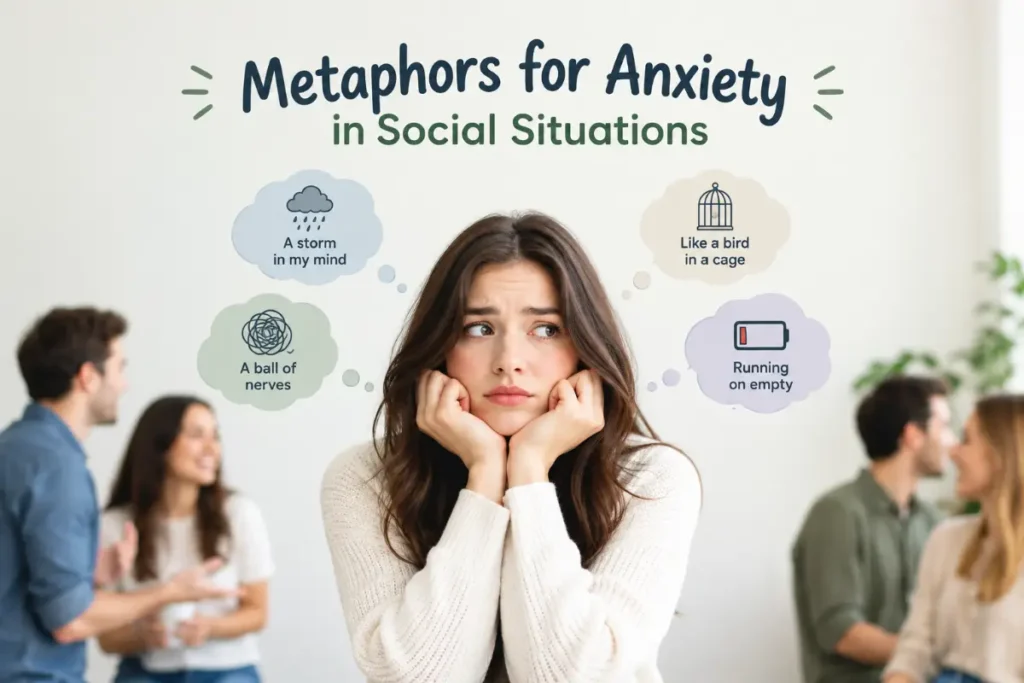
Social anxiety can involve worrying about how others see you, replaying conversations, or feeling uncomfortable when attention turns toward you. These metaphors help communicate those experiences without assuming that everyone experiences social situations in the same way.
Anxiety is a spotlight I never asked for
A spotlight draws attention to one person. This metaphor describes feeling exposed or watched, even during an ordinary interaction.
Example: Walking into the party felt like stepping beneath a spotlight I had never asked for.
It’s particularly useful when writing about introductions, public speaking, or entering a room full of unfamiliar people.
Anxiety is an audience waiting for me to make a mistake
This image presents a social situation as a performance in which everyone seems ready to judge the speaker.
Example: Every conversation felt like a stage, and my anxiety imagined an audience waiting for me to forget my lines.
The metaphor captures fear of embarrassment and the pressure to say the perfect thing.
Anxiety is a mask that gets heavier with every smile
A mask hides what’s underneath. This image can describe the effort of appearing relaxed when someone feels nervous inside.
Example: I kept smiling at work, but my anxiety made the mask feel heavier every hour.
This metaphor is powerful because it highlights the gap between how a person appears and how they feel.
Anxiety is a microphone turned up too high
A microphone amplifies sound. This metaphor describes the way a small concern can feel enormous when attention focuses on it.
Example: I stumbled over one word, and my anxiety turned the mistake into a microphone blaring through the entire room.
The image works well when describing embarrassment or the habit of magnifying minor social mistakes.
Anxiety is a wall between me and everyone else
A wall separates people and makes connection more difficult.
Example: I wanted to join the conversation, but anxiety built a wall between me and the people around me.
This metaphor is useful for describing hesitation, isolation, or difficulty reaching out to others.
Metaphors for Anxiety in Poetry and Creative Writing
Poetry and fiction often need more than a familiar image. A strong metaphor can help establish mood, reveal a character’s inner life, or carry a theme throughout a piece of writing.
The most effective creative metaphors don’t just name an emotion. They give the emotion something to do.
Anxiety is a bird trapped in a cage
A trapped bird suggests fear, restless movement, and a desire for freedom.
Example: Anxiety was a small bird beating its wings against the cage of my ribs.
The cage gives the feeling a physical boundary, while the bird’s movement suggests that the emotion refuses to remain still.
Anxiety is a garden overrun with weeds
A garden needs attention, but weeds can spread until they crowd out the plants. This metaphor describes how small worries may grow and take up more mental space over time.
Example: I left one worry unattended, and soon anxiety had filled the garden of my mind with weeds.
This image is useful in reflective writing because it suggests that worries can grow gradually rather than appearing all at once.
Anxiety is a candle flickering in a draft
A flickering candle suggests vulnerability and instability. It can describe the struggle to feel steady when uncertainty keeps disturbing your peace.
Example: My confidence flickered like a candle in a draft each time someone questioned my decision.
This metaphor can convey quiet tension without relying on dramatic images of storms or disasters.
Anxiety is an ocean beneath a frozen lake
The surface appears still, but powerful movement continues underneath.
Example: My face remained calm, but anxiety moved like an ocean beneath a frozen lake.
This is particularly effective for characters who hide their feelings or struggle to explain what they’re experiencing.
Anxiety is a locked door inside my mind
A locked door suggests separation, frustration, and the feeling that something remains inaccessible.
Example: I knew there was a way to explain my fears, but anxiety kept the words behind a locked door.
This image can work in poetry, memoir, and stories about communication.
Anxiety is a garden of unfinished thoughts
This metaphor suggests that thoughts begin but never reach completion. Each one demands attention before the previous one has settled.
Example: My mind became a garden of unfinished thoughts, with every idea waiting for sunlight.
The image has a softer tone than a maze or storm. It may suit reflective writing that explores confusion without making the character seem powerless.
Short Metaphors for Anxiety
Sometimes you need a quick, memorable phrase rather than a full sentence. Short metaphors are useful in captions, journal entries, poems, dialogue, and personal essays.
Here are 20 concise options with their meanings.
| Metaphor | What it suggests |
|---|---|
| A mind in a storm. | Intense emotional activity. |
| A knot in my thoughts. | Confusion and tension. |
| A shadow of doubt. | Worry that lingers. |
| A cage of what ifs. | Feeling trapped by possibilities. |
| A restless engine. | Thoughts that won’t slow down. |
| A foggy window. | Difficulty seeing clearly. |
| A ticking time bomb. | A sense of mounting pressure. |
| A storm behind a smile. | Hidden distress. |
| A backpack of worries. | Emotional burden. |
| A broken compass. | Difficulty finding direction. |
| A runaway train. | Thoughts that feel hard to control. |
| A locked gate. | Difficulty moving forward. |
| A buzzing wire. | Restlessness and tension. |
| A loop with no ending. | Repetitive thoughts. |
| A room without windows. | Feeling confined or stuck. |
| A siren in the distance. | Anticipation of danger. |
| A tangled fishing line. | Complicated worries. |
| A flickering light. | Uncertainty or instability. |
| A restless tide. | Feelings that rise and fall. |
| A storm cloud overhead. | Persistent unease. |
These phrases are starting points, not fixed definitions. A reader might interpret a broken compass as confusion, uncertainty, or a loss of direction. The surrounding sentence should make your intended meaning clear.
Still confused? Compare Metaphor for School That Makes Learning Come Alive (2026 Guide).
Metaphors for Anxiety in Everyday Conversation
You don’t need poetic language to describe anxiety effectively. Everyday metaphors can make a difficult feeling easier to explain to friends, family members, or coworkers.
Here are natural examples you can adapt to your own voice.
- My brain feels like a browser with too many tabs open.
- Anxiety is sitting in the passenger seat and grabbing the steering wheel.
- My thoughts are running on a treadmill.
- Worry is a backpack I forgot how to put down.
- My mind keeps turning small problems into mountains.
- Anxiety is a smoke alarm that goes off when I make toast.
- My thoughts are a radio that won’t stop changing stations.
- Worry keeps knocking on the door of my mind.
- My brain is a washing machine full of unfinished thoughts.
- Anxiety feels like trying to catch water with my hands.
These expressions are conversational because they draw on familiar objects and situations. They can also add a little humor to a difficult subject without suggesting that anxiety itself is funny.
For instance, the smoke alarm metaphor describes an alarm system that reacts too strongly to a small trigger. It doesn’t imply that the person’s feelings are imaginary. It simply gives the experience a recognizable image.
Metaphors for Anxiety in the Workplace
Workplace anxiety can involve deadlines, performance reviews, public speaking, difficult conversations, or the pressure to meet expectations. The right metaphor helps communicate the source of the pressure without making the writing sound overly dramatic.
Here are useful examples.
- The deadline hung over my desk like a dark cloud.
- My inbox became a mountain I couldn’t see the top of.
- Anxiety followed me into every meeting like an unwanted assistant.
- Each unanswered message felt like another weight on the scale.
- My thoughts became a crowded intersection with every signal flashing red.
- The presentation was a cliff edge I kept approaching in my mind.
- I felt like a tightrope walker carrying a stack of fragile plates.
- My workload became a river that kept rising.
- Anxiety turned every small decision into a maze.
- My confidence was a flickering office light that refused to stay steady.
In professional writing, choose metaphors that clarify rather than distract. A simple image such as a mountain of work often communicates more effectively than an elaborate comparison that takes several sentences to explain.
For example, an employee writing a reflective report might say:
The growing workload felt like a river after heavy rain. Each new task raised the water level, leaving me less room to think clearly.
The image gives the reader a sense of pressure building over time. It also provides a natural way to discuss the need for better priorities or support.
Metaphors for Anxiety in Academic Writing
Academic writing usually favors clear explanations over decorative language. Still, a carefully chosen metaphor can help readers understand an abstract idea, especially in reflective essays, literary analysis, psychology discussions, and narrative research.
Consider these examples.
For an essay about uncertainty.
Anxiety can act as a fog that makes future choices appear less clear.
For a literary analysis.
The recurring image of a locked door represents the character’s growing sense of emotional confinement.
For a personal reflection.
I approached the final examination with a mind crowded by competing voices.
For a discussion of workplace pressure.
Unresolved tasks accumulated like stones in a backpack, making each new responsibility feel heavier.
For an analysis of a character.
The storm outside mirrors the character’s internal struggle, turning the setting into a reflection of emotional tension.
Notice that academic metaphors work best when the writer explains their purpose. In a literary analysis, you should connect the image to the text and support your interpretation with evidence. In a research paper, you should avoid using a metaphor as a substitute for precise findings or technical definitions.
A metaphor can make an idea easier to grasp. It cannot replace evidence.
Section Three
How to Choose the Right Metaphor for Anxiety
The strongest metaphor isn’t always the most dramatic or original. It’s the one that captures the feeling you want your reader to understand.
Start by identifying the main feature of the anxiety you’re describing. Is it intense, repetitive, exhausting, confusing, or tied to an upcoming event? Once you know the central feeling, choose an image that naturally expresses it.
| If anxiety feels like… | Consider this metaphor |
|---|---|
| Too much pressure. | A mountain on my shoulders. |
| Repeating thoughts. | A record stuck on repeat. |
| Uncertainty. | Fog covering the road. |
| Fear of an upcoming event. | A clock ticking too loudly. |
| Physical restlessness. | Bees buzzing under my skin. |
| Social discomfort. | A spotlight I can’t escape. |
| Hidden emotional pain. | A storm behind a smile. |
| Feeling trapped. | A room with closing walls. |
| Too many responsibilities. | A backpack full of stones. |
| Constant alertness. | An alarm that won’t switch off. |
Match the metaphor to the emotional intensity
A gentle metaphor may suit mild nervousness. A more forceful image may better communicate intense fear or pressure.
For example, a fluttering butterfly in my stomach suggests nervous anticipation. By contrast, a storm tearing through my mind suggests a more intense internal experience.
Neither image is automatically better. The right choice depends on the context and the emotional effect you want.
Consider your audience
A casual reader may connect immediately with a browser full of tabs. A poetry reader might respond more strongly to a bird trapped in a cage. A professional audience may prefer a mountain of tasks or a growing backlog.
Choose an image your readers can understand without stopping to decode it.
Keep the comparison consistent
A metaphor becomes confusing when the image changes without a clear reason.
For example, this sentence mixes too many pictures.
Anxiety was a storm, a mountain, a locked door, and a train that swallowed my thoughts.
Each image could work on its own, but together they compete for attention.
A clearer version would be:
Anxiety was a storm gathering inside my mind, growing louder each time I tried to ignore it.
This sentence develops one central image. As a result, the reader can follow the description more easily.
Add a specific detail
A general metaphor can be memorable, but a concrete detail makes it feel personal.
Instead of writing:
Anxiety was a storm.
Try:
Anxiety was a storm rattling the windows of my mind while I sat perfectly still at the kitchen table.
The second sentence gives the reader a scene. The contrast between the internal storm and the still person makes the feeling more vivid.
Common Mistakes When Using Metaphors for Anxiety
Metaphors can strengthen writing, but they can also make it confusing or unintentionally dismissive. Watch out for these common problems.
Choosing a metaphor that doesn’t fit
A metaphor should reflect the experience you’re describing.
If you want to communicate mental confusion, a broken compass or thick fog may work better than a ticking bomb. The bomb suggests urgency and danger, while the compass suggests uncertainty.
Better approach: Identify the central feeling first, then choose an image that reflects it.
Making every metaphor dramatic
Writers sometimes assume that anxiety requires storms, explosions, darkness, or disasters. Those images can work, but they don’t describe every experience.
Anxiety can also feel like a phone vibrating in a quiet room or a tiny stone in a shoe that never stops bothering you.
Better approach: Use the intensity of the image to match the intensity of the scene.
Mixing too many images
Too many comparisons can make the writing feel cluttered.
Better approach: Choose one central metaphor and develop it with a few related details.
Treating a metaphor as a medical definition
Calling anxiety an alarm system is a way to explain a feeling. It isn’t a complete clinical explanation of anxiety or an account of every person’s experience.
Better approach: Use metaphors to communicate personal feelings, not to diagnose someone or make universal claims about mental health.
Using familiar expressions without adding anything new
Phrases such as a storm inside my mind and a weight on my shoulders are easy to understand. However, they may feel predictable if you use them repeatedly.
Better approach: Add a personal detail or a fresh angle. For example, My anxiety was a storm that kept changing direction, so I never knew which window to close.
Confusing a metaphor with a literal statement
A sentence such as Anxiety is a cage is figurative. It describes the feeling of restriction rather than an actual physical cage.
Better approach: Make sure the surrounding context helps the reader recognize the comparison.
How to Create Your Own Metaphor for Anxiety
You don’t need to be a poet to create a memorable metaphor. Start with an honest description of the feeling, then connect it to an everyday object, place, or experience.
Follow these steps.
Step one. Name the feeling.
Ask yourself what the anxiety feels like. Does it involve pressure, confusion, repetition, restlessness, or anticipation?
Step two. Find a familiar image.
Think about something that shares the same quality. Pressure might remind you of a heavy backpack. Repetition might suggest a looping video. Uncertainty might resemble walking through fog.
Step three. Make a direct comparison.
Write a simple sentence.
My anxiety is a tangled ball of string.
Step four. Add an action or detail.
Develop the image to show how the feeling behaves.
Every time I tried to solve one worry, another strand tightened around the knot.
Step five. Read it aloud.
Check that the sentence sounds natural and expresses the intended feeling. Remove any words that don’t strengthen the image.
Here are a few examples of the process.
| Feeling | Starting image | Developed metaphor |
|---|---|---|
| Repetitive thoughts. | A spinning wheel. | My worries spun like a wheel that never reached the ground. |
| Uncertainty. | A dark hallway. | Anxiety turned the hallway ahead into a path with no visible end. |
| Pressure. | A heavy bag. | Each new responsibility added another stone to my already heavy bag. |
| Restlessness. | A buzzing phone. | My mind vibrated with worries like a phone that never stopped receiving alerts. |
| Fear of judgment. | A stage. | Anxiety pushed me onto a stage where I imagined every mistake being watched. |
You can use these examples as inspiration, but your own details will make the writing more distinctive. A metaphor drawn from a familiar place or personal memory may communicate more than a dramatic image chosen only for effect.
Related Words and Expressions for Anxiety
Metaphors work alongside other forms of figurative language. Understanding the differences can help you choose the right expression.
| Term | Meaning | Example |
|---|---|---|
| Simile. | Compares two things using like or as. | My anxiety felt like a storm. |
| Personification. | Gives a nonhuman idea a human action or quality. | Anxiety whispered doubts into my ear. |
| Symbolism. | Uses an object or image to represent a larger idea. | A locked door represents emotional isolation. |
| Hyperbole. | Uses deliberate exaggeration for effect. | I worried about a million things at once. |
| Idiom. | An established expression with a figurative meaning. | I had butterflies in my stomach. |
| Imagery. | Uses descriptive language that appeals to the senses. | A cold knot tightened beneath my ribs. |
These devices can overlap. For example, Anxiety knocked at my door personifies anxiety by giving it a human action. It also creates a metaphorical scene in which anxiety acts like an unwelcome visitor.
Useful synonyms for anxiety
The word anxiety can describe several related feelings. Choosing a more precise word may help you find a better metaphor.
- Worry. Concern about a problem or possible outcome.
- Nervousness. Uneasiness before an event or situation.
- Apprehension. Concern about something that may happen.
- Unease. A general feeling that something isn’t right.
- Dread. Strong fear or reluctance about an anticipated event.
- Tension. A feeling of strain or pressure.
- Restlessness. Difficulty settling down or feeling at ease.
- Uncertainty. Not knowing what to expect or what will happen next.
These words aren’t exact substitutes in every sentence. For instance, dread often conveys stronger anticipation of something unpleasant than ordinary nervousness. Choosing the most precise word can make the metaphor more effective.
Opposites and contrasting images
Writers can also use contrast to show a change in emotional state.
| Anxiety image | Contrasting image |
|---|---|
| A raging storm. | A quiet lake. |
| Thick fog. | A clear morning. |
| A tangled knot. | A loose thread. |
| A heavy backpack. | An open hand. |
| A locked room. | An open doorway. |
| A loud alarm. | A quiet room. |
| A restless tide. | Still water. |
Contrast can create a sense of relief, growth, or a new perspective.
For example:
For weeks, my thoughts had been a storm at sea. Then, one quiet morning, the water inside me finally began to settle.
The image doesn’t claim that anxiety disappears permanently. Instead, it communicates a moment of calm.
Suggested internal link: Before the conclusion, link to a related article about [similes for anxiety and nervousness] if you have a relevant page on your site.
Expert Editor’s Note
As an editor, I’d recommend choosing clarity before complexity. A metaphor should help readers understand the feeling, not make them work harder to figure out what the sentence means.
The most effective metaphor usually has three qualities.
First, it creates a clear mental picture. Readers should be able to imagine the storm, maze, backpack, or alarm without needing an explanation of the object itself.
Second, it matches the emotional context. A storm can convey intensity, while a locked door can convey restriction. These images aren’t interchangeable, even though both can represent anxiety.
Third, it fits the writing style. A casual blog post can use a browser with too many tabs open. A poem might use a bird beating its wings against a cage. An academic essay may need a restrained metaphor followed by a clear explanation.
There’s no single correct metaphor for anxiety. Dictionaries can explain the meanings of words such as metaphor, anxiety, and simile, but they don’t establish one universally correct creative comparison. The best choice depends on the context, the writer’s purpose, and the experience being described.
One final editorial point matters. Don’t assume that a person who looks calm feels calm inside. A metaphor can communicate the difference between outward behavior and private feelings, but the writer should avoid presenting one person’s experience as universal.
Frequently Asked Questions
What is the best metaphor for anxiety?
One useful metaphor is anxiety is a storm inside my mind. It conveys intense thoughts and emotions that may feel difficult to control. However, the best choice depends on the experience. A fog may better describe uncertainty, while a heavy backpack can express the burden of carrying worries throughout the day.
What is a simple metaphor for anxiety?
A simple metaphor is anxiety is a weight on my shoulders. It compares worry to a physical burden, making the feeling easy to picture. Other simple options include a storm in my mind, a knot in my thoughts, and an alarm that won’t switch off.
What is a good metaphor for overthinking?
A hamster wheel is a useful metaphor for overthinking because it suggests repeated effort without meaningful progress. You might write, My mind ran on a hamster wheel, returning to the same worry every few minutes. A record stuck on repeat also works well when one thought keeps coming back.
What is a metaphor for feeling overwhelmed?
A mountain of responsibilities is a familiar metaphor for feeling overwhelmed. It suggests that the amount of work or worry feels too large to manage easily. You could also describe the experience as a wave pulling you under or a room whose walls keep closing in.
What is a metaphor for anxiety in poetry?
Poetry can use images such as a bird trapped in a cage, an ocean beneath a frozen lake, or a candle flickering in a draft. These comparisons let a poet describe hidden tension, vulnerability, or emotional movement. Choose an image that supports the poem’s mood and develop it with clear sensory details.
What is a metaphor for social anxiety?
A spotlight that you never asked for is a useful metaphor for social anxiety. It conveys the feeling of being exposed or watched in social situations. Another option is a wall between you and everyone else, which can describe the feeling of wanting to connect but struggling to do so.
What is the difference between a metaphor and a simile for anxiety?
A metaphor makes a direct comparison, as in Anxiety is a storm. A simile uses words such as like or as, as in Anxiety feels like a storm. Both devices can communicate emotion, but metaphors often create a more direct image.
Can a metaphor for anxiety be funny?
Yes. Humor can make an experience easier to discuss without dismissing the person’s feelings. For example, My brain is a browser with forty tabs open, and one of them is playing music I can’t find. This image captures mental overload in a familiar, playful way.
How do I write my own metaphor for anxiety?
Start by naming the feeling you want to describe. Then choose an object or experience that shares one of its qualities. If your anxiety involves repetitive thoughts, you might compare it to a looping video. Add a specific detail that makes the image personal, then remove anything that distracts from the main comparison.
Can metaphors help explain anxiety to other people?
Metaphors can help people describe difficult feelings in language others can picture. Saying that worry feels like carrying a heavy backpack may communicate emotional strain more clearly than a vague statement about having a hard day. Still, people experience anxiety differently, so it’s best to explain what the image means to you.
Many readers also check Metaphor for Time and the Best Ways to Describe It (2026).
Conclusion
A good metaphor for anxiety turns an invisible feeling into something readers can picture. Anxiety might be a storm inside your mind, a tangled knot of thoughts, a heavy backpack, or an alarm that never switches off. Each image reveals a different part of the experience.
The key is to match the metaphor to the feeling. Use fog for uncertainty, a hamster wheel for repetitive thoughts, a spotlight for social discomfort, or a mountain for overwhelming pressure. Keep the comparison clear, avoid mixing too many images, and add personal details when you want the writing to feel fresh.
Most importantly, remember that no single metaphor can capture every person’s experience. Choose the words that best express the feeling you’re trying to communicate.
Sometimes, the right image gives a difficult feeling a voice.

Editorial Reviewer & Proofreader
Grace Mitchell reviews Gramlify’s articles for clarity, consistency, and readability. She is passionate about creating accurate, approachable content that helps English learners build confidence.