
Have you ever paused while writing an email because you couldn’t remember if you needed stationary or stationery? You’re not alone. These two words look almost identical and sound exactly the same in standard English pronunciation. However, they have very different meanings. Choosing the wrong one can change your sentence and make your writing look less polished.
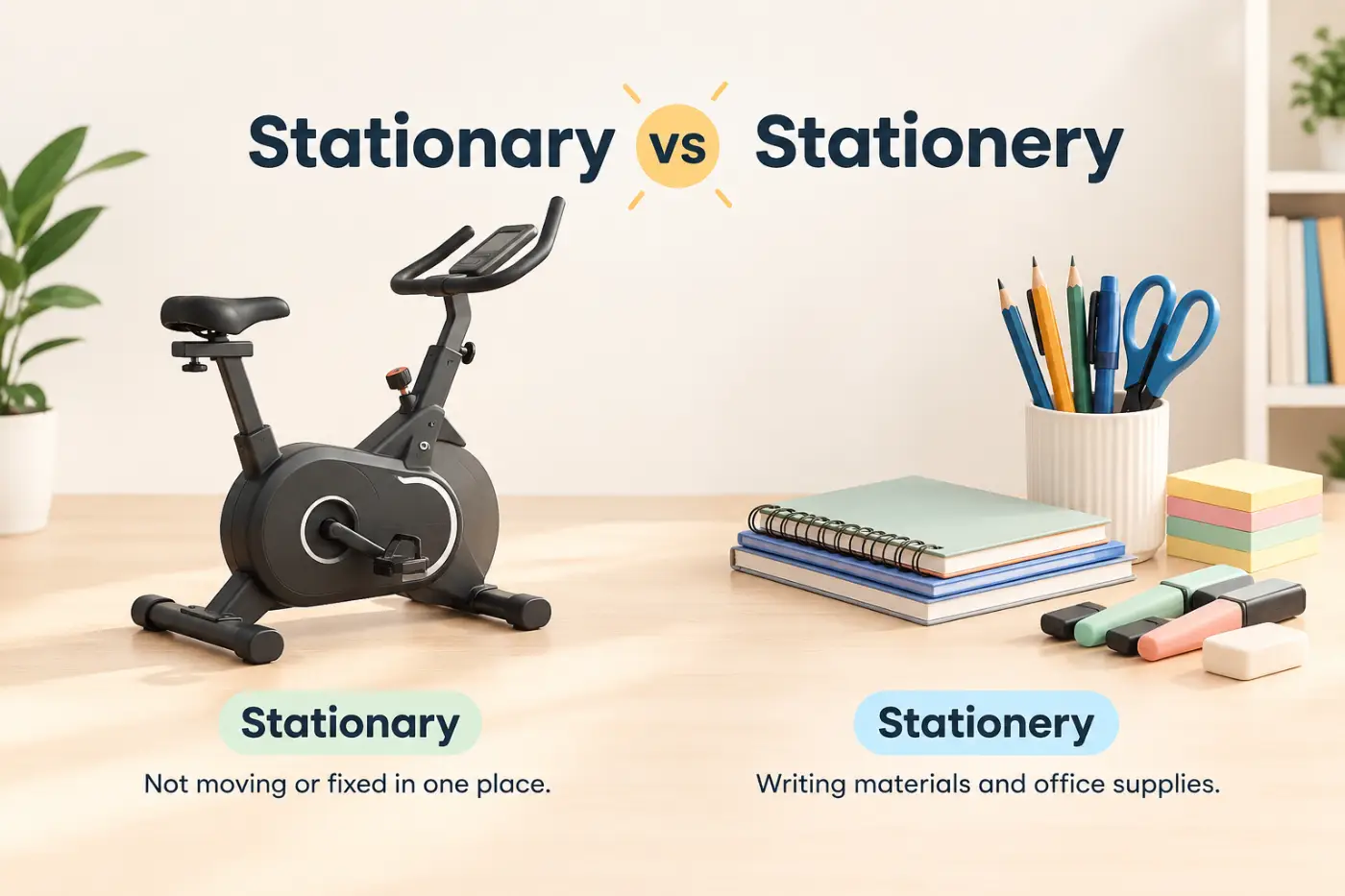
The difference between stationary vs stationery comes down to one simple idea. Stationary means staying in one place or not moving. Stationery refers to writing materials such as paper, envelopes, pens, and notepads. You might keep a stationary bike in your home gym, but you’d use stationery to write a thank you note.
The good news is that you don’t need to memorize complicated grammar rules to get these words right. A simple memory trick can help you remember the difference for years. In this guide, you’ll learn what each word means, how to spell it correctly, when to use it, and how to avoid common mistakes in everyday conversations, emails, school assignments, and professional writing.
You’ll also find natural examples, pronunciation tips, word origins, and answers to common questions. By the end, you’ll be able to choose the correct word with confidence.
Many readers also check Extensible Vs Extendible Which Word Is Correct 2026.
Quick Answer
Stationary means not moving or staying in one place. Stationery means writing materials such as paper, envelopes, pens, and notepads. Both words sound alike, but their meanings differ. Use stationary to describe a person or object that stays still. Use stationery when talking about supplies for writing, mailing, or office work.
Stationary vs Stationery at a Glance
| Feature | Stationary | Stationery |
|---|---|---|
| Meaning | Not moving or staying in one place | Writing and office supplies |
| Part of speech | Adjective | Noun |
| Pronunciation | /ˈsteɪʃəneri/ | /ˈsteɪʃəneri/ |
| Main use | Describes a person or thing that remains still | Names materials used for writing |
| Common examples | Stationary car, stationary bike, stationary object | Office stationery, wedding stationery, personalized stationery |
| Memory clue | Ends in ary, like a fixed position | Ends in ery, like paper and stationery supplies |
| Correct example | The car remained stationary. | I bought new stationery for school. |
| Common mistake | Using it to mean writing supplies | Using it to mean something that does not move |
Both spellings are correct English words. Neither is a misspelling of the other. The right choice depends on the meaning you want to express.
What Does Stationary Mean
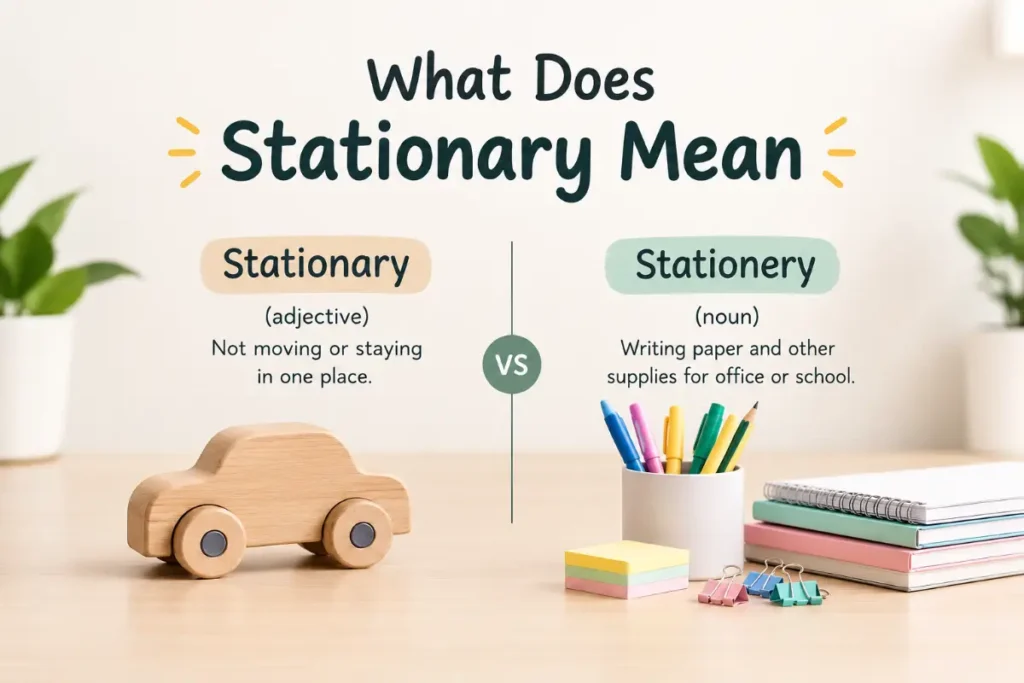
Stationary is an adjective that describes something that isn’t moving or remains in one position. It can refer to a person, vehicle, object, machine, or even a condition that stays unchanged.
For example, imagine a car waiting at a red light. The car isn’t moving, so you can describe it as stationary. Similarly, a stationary camera stays in one position instead of following a person or object.
The word also appears in science, mathematics, medicine, and business. In these fields, it can describe an object at rest, a value that stays constant, or a process that shows little or no change.
How to Use Stationary in a Sentence
Use stationary when you want to describe a lack of movement or change.
Here are some common examples.
- The truck remained stationary at the entrance.
- Please keep the camera stationary during the recording.
- The exercise room has a stationary bike.
- The patient stayed stationary while the technician took the scan.
- The company reported stationary sales throughout the quarter.
In each example, stationary describes a condition or state. It tells the reader that something isn’t moving or changing in the expected way.
Stationary in Everyday English
In everyday conversation, stationary often describes vehicles, equipment, people, and objects.
For example, you might tell a friend that a bus has been stationary for ten minutes because traffic has stopped. You might also explain that you prefer a stationary exercise bike because you can work out at home.
The word can describe something that remains in place even if it could move under other conditions. A parked car, for instance, is stationary while it stays parked.
However, stationary doesn’t always mean permanently fixed. It usually describes the situation at a particular time.
Stationary in Science and Technical Writing
Stationary also has specialized meanings in technical subjects. The exact meaning depends on the field.
In physics, a stationary object may be one that remains at rest relative to a chosen reference point. In mathematics, a stationary point is a point on a curve where the derivative is zero. In statistics, a stationary time series has statistical properties that remain stable over time under a specified definition.
These technical uses share a general idea of stillness or stability, but they aren’t interchangeable definitions. In formal writing, use the meaning that fits your subject.
Is Stationary an Adjective or a Noun
In ordinary modern English, stationary is an adjective. It describes a noun rather than naming a thing by itself.
For example:
- The stationary vehicle blocked the driveway.
- We installed a stationary camera.
- The machine remained stationary.
In each sentence, stationary describes a vehicle, camera, or machine.
You may encounter stationary in technical expressions such as stationary point or stationary distribution. It still functions as an adjective in these phrases.
What Does Stationery Mean
Stationery is a noun that refers to writing materials and related paper products. These supplies include paper, envelopes, notepads, letter paper, and other items used for writing, correspondence, and office tasks.
For example, if you buy a pack of envelopes and a notebook for school, you’ve bought stationery. If a business orders branded letterhead and envelopes for customer correspondence, it has ordered stationery.
The word can refer to a single collection of supplies or to stationery as a general category. You usually don’t need to make it plural when discussing writing materials as a group.
How to Use Stationery in a Sentence
Use stationery when you mean writing supplies or paper products.
Here are some natural examples.
- I need to buy stationery before school starts.
- She ordered personalized stationery for her wedding.
- The office keeps extra stationery in the supply closet.
- He wrote the letter on elegant stationery.
- Our company uses stationery printed with its logo.
Notice that stationery names the materials themselves. It doesn’t describe something that remains still.
What Items Count as Stationery
Stationery can include a range of writing and paper products.
Common examples include:
- Paper and notepads.
- Envelopes and letter paper.
- Notebooks and writing pads.
- Greeting cards and thank you cards.
- Personalized letterhead.
- Wedding invitations and matching envelopes.
- Business cards and printed correspondence materials.
The exact range depends on the context. A school supply store might use stationery to describe notebooks, pens, pencils, and similar products. A printing company might use the term mainly for paper goods such as letterhead, envelopes, and invitations.
In everyday American English, people often say office supplies when they mean a broader range of products, including staplers, folders, tape, and other equipment. Stationery usually focuses more closely on writing materials and paper products.
Stationery in Business and Professional Writing
Stationery often appears in business communication, branding, and formal correspondence.
For example, a company might print its logo on letterhead and envelopes to create branded stationery. A law firm may use official stationery for client letters. A small business might order personalized stationery to give its correspondence a consistent appearance.
In this context, stationery can help establish a professional identity. However, the word still refers to the physical or printed materials rather than the company’s location or status.
Is Stationery Singular or Plural
Stationery is generally an uncountable noun when it refers to writing materials as a category. That means you usually don’t say a stationery or three stationeries.
Instead, use expressions such as:
- A set of stationery.
- Some new stationery.
- Three packs of stationery.
- Several stationery items.
- A box of writing paper and envelopes.
You can count individual products within the category. For example, you can buy three notebooks or five envelopes.
This distinction matters in professional writing because stationery names a group of materials, while individual items can take regular plural forms.
Which One Is Correct
Both stationary and stationery are correct spellings. The difference lies in their meanings and grammatical roles.
Choose stationary when you mean still, unmoving, or remaining in one position.
Choose stationery when you mean writing materials, paper products, or related office supplies.
Consider these two sentences.
- The vehicle remained stationary throughout the inspection.
- The manager ordered new stationery for the office.
Both sentences use the correct word because each spelling matches the intended meaning.
A common mistake is to assume that one spelling is British English and the other is American English. That’s not true. Both words are standard in American English, British English, Canadian English, and Australian English.
The distinction also doesn’t depend on formality. You can use stationary in a casual conversation or a formal report. You can use stationery in an informal shopping list or a professional business letter.
The meaning determines the spelling, not the audience or writing style.

Why People Confuse Stationary and Stationery
Stationary and stationery are examples of homophones. Homophones are words that sound alike but have different meanings and spellings.
Their pronunciation makes the difference difficult to hear. If someone says either word aloud, you generally need context to determine the intended meaning.
Several factors make the confusion especially common.
The Words Look Almost Identical
Both words begin with station and end with a similar sequence of letters. Only the final letters differ.
- Stationary ends in ary.
- Stationery ends in ery.
That small difference is easy to overlook when typing quickly. It’s also easy to miss during proofreading because your brain often recognizes the intended meaning instead of examining each letter.
They Sound the Same
In standard English pronunciation, stationary and stationery are homophones. Their vowel sounds and stress patterns match.
As a result, listening alone won’t usually tell you which spelling someone intends. You need to pay attention to the sentence.
For example, the sentence I bought new stationery refers to writing supplies. The sentence The vehicle stayed stationary describes a vehicle that didn’t move.
The surrounding words provide the clue.
Spell Check Doesn’t Always Catch the Error
A basic spell checker may accept both words because both are correctly spelled English words. If you use stationery to describe a parked car, the software might not flag the sentence.
This is a context error rather than a simple spelling error. The letters form a valid word, but the word doesn’t fit the meaning.
For important writing, check both spelling and meaning. Grammar tools can help, but they don’t always catch every misuse of a homophone.
Autocorrect Can Choose the Wrong Word
Typing quickly on a phone or computer can lead to the wrong ending. Autocorrect may also replace one word with the other if it guesses the wrong meaning.
This often happens in short messages where context is limited. A sentence such as Please order more stationary for the office may look acceptable at first glance, even though stationery is the intended word.
Read the full sentence before sending it. A quick meaning check can prevent a small mistake from reaching a client, teacher, or colleague.
People Remember the Sound but Forget the Meaning
Many English learners memorize words by pronunciation. That works well for some vocabulary, but it can cause trouble with homophones.
If you remember that both words sound like stationer ee, you still need to connect each spelling with its meaning.
The easiest solution is to learn them in pairs with clear examples. Associate stationary with a car that doesn’t move and stationery with paper used to write a letter.
Online Examples Can Reinforce Mistakes
Social media posts, online listings, and informal messages sometimes use stationary and stationery incorrectly. Repeated exposure can make the wrong spelling seem familiar.
However, seeing a word used online doesn’t prove that the usage is correct. When you need a reliable answer, consult a trusted dictionary and examine the word’s role in the sentence.
The key is simple. Don’t judge the spelling by how familiar it looks. Judge it by the meaning it expresses.
The Key Differences Between Stationary and Stationery
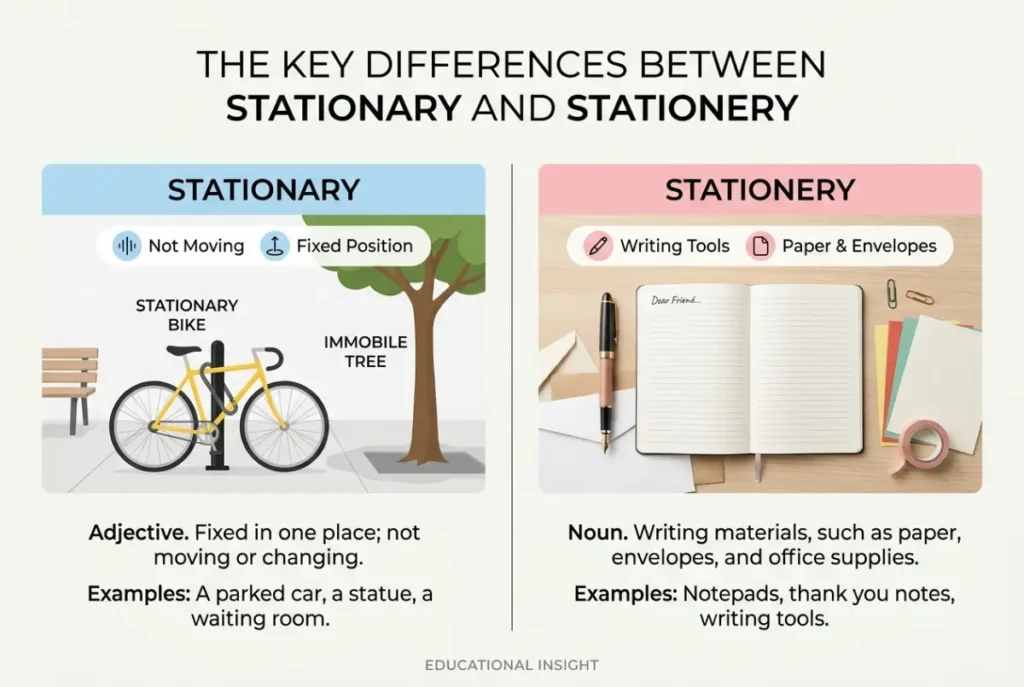
The easiest way to distinguish stationary from stationery is to look at what each word does in a sentence. One describes a state of stillness. The other names a group of writing materials.
Difference in Meaning
Stationary describes a lack of movement or change. Stationery refers to supplies used for writing and correspondence.
Compare these examples.
- The bicycle remained stationary outside the store.
- I bought new stationery at the store.
In the first sentence stationary explains the bicycle’s position. In the second stationery identifies the products the speaker purchased.
Difference in Grammar
Stationary is an adjective. It modifies a noun by describing its condition or position.
Stationery is a noun. It names a category of products.
| Sentence | Word | Grammatical role |
|---|---|---|
| The car stayed stationary. | Stationary | Adjective |
| The stationary camera recorded the scene. | Stationary | Adjective |
| She bought new stationery. | Stationery | Noun |
| The stationery arrived yesterday. | Stationery | Noun |
Understanding the part of speech helps you identify the correct word in more complex sentences.
For example in the phrase stationary equipment stationary describes the equipment. In the phrase office stationery stationery names the supplies.
Difference in Context
The words often appear in different settings.
| Context | Correct word | Example |
|---|---|---|
| Transportation | Stationary | The bus remained stationary. |
| Exercise | Stationary | He bought a stationary bike. |
| Photography | Stationary | Keep the camera stationary. |
| Office supplies | Stationery | We ordered office stationery. |
| Personal letters | Stationery | She used floral stationery. |
| Weddings | Stationery | They selected elegant wedding stationery. |
| Business correspondence | Stationery | The letter arrived on company stationery. |
Context can help you choose the right spelling quickly. If the sentence discusses movement position or stability stationary is usually the word you need. If it discusses paper writing or correspondence supplies stationery is the better choice.
Difference in Formal and Informal Writing
Neither word is more formal than the other. Both are standard English words suitable for casual and professional writing.
For example you might say The car was stationary at the traffic light during a casual conversation. You could also write The vehicle remained stationary during the safety inspection in a formal report.
Likewise stationery works in a casual sentence such as I need more stationery and a professional sentence such as The company ordered personalized stationery for client correspondence.
The spelling depends on the meaning rather than the level of formality.
Stationary vs Stationery Pronunciation Guide
Stationary and stationery are pronounced the same way in standard American English. They are homophones so you cannot usually identify the intended spelling from the sound alone.
The International Phonetic Alphabet represents their common pronunciation as:
/ˈsteɪʃəneri/
The pronunciation can vary slightly among speakers and accents but the two words generally remain identical in speech.
How to Break the Words Into Syllables
Both words have four syllables in a common pronunciation.
Sta · tion · ar · y
Sta · tion · er · y
The main stress falls on the first syllable. The opening sound resembles stay followed by the sound of shun and the remaining unstressed syllables.
For many American speakers the ending sounds close to uh ree. Some speakers reduce or blend the unstressed sounds but this doesn’t change the spelling distinction.
Common Pronunciation Mistakes
A frequent mistake is to assume that the different final letters must create different spoken sounds. In normal usage they don’t.
Another mistake is to stress the final syllable. Both words usually carry their main stress at the beginning.
If you’re learning English practice the words in complete sentences instead of repeating them alone.
Try saying these examples aloud.
- The car remained stationary.
- I ordered new stationery.
You’ll hear that the words sound alike. The surrounding sentence supplies the meaning.
For a more reliable vocabulary habit learn the pronunciation and spelling together with a short definition. This approach works especially well for homophones such as stationary and stationery.
Many readers also check Implicit Vs Complicit Differences Meanings And Correct 2026.
The Word Origin of Stationary and Stationery
The two words share a historical connection. Their origins help explain why their spellings are so similar even though their modern meanings differ.
Where Stationary Comes From
Stationary developed from Latin roots associated with standing or remaining in a place. The Latin word stationarius referred to something connected with a station or fixed position.
English adopted stationary with the sense of standing still or remaining in one place. Over time the word became common in descriptions of vehicles objects equipment and other things that don’t move.
Today the same central idea appears in everyday and technical language. A stationary vehicle stays in place while a stationary point in mathematics has a specific technical meaning related to a function.
Where Stationery Comes From
Stationery has a related history. The word developed from the term stationer which once referred to a person who sold books paper and writing materials.
In medieval Europe stationers were associated with the trade in books and other written materials. Their work often involved supplying the tools and materials people needed to write copy and produce documents.
The word stationery eventually became associated with writing supplies and paper products.
This history explains the connection between stationery and a stationer. A stationer sells stationery.
Why the Two Spellings Survived
The words developed from related historical roots but took on different meanings. Their endings now help distinguish those meanings in writing.
Stationary refers to stillness or a fixed position. Stationery refers to writing materials.
The similar spelling reflects their shared history rather than a modern difference in pronunciation.
Understanding this connection can make the words easier to remember. Still you don’t need to memorize their Latin roots to use them correctly. The modern meanings and memory tricks are usually enough for everyday writing.
Stationary and Stationery in American and British English
The distinction between stationary and stationery stays the same across major varieties of English. American British Canadian and Australian writers use the two spellings to express the same basic meanings.
There is no standard regional rule that makes stationary correct in the United States and stationery correct in the United Kingdom. Both words belong to the standard vocabulary of each variety.
American English
In American English stationary means still or unmoving. Stationery refers to writing materials.
Examples include:
- The truck remained stationary at the intersection.
- I bought school stationery before classes started.
- The company printed its logo on personalized stationery.
American stores may also use terms such as office supplies paper goods and writing supplies. These expressions can overlap with stationery although office supplies may cover a wider range of products.
British English
British English uses the same spelling distinction.
Examples include:
- The vehicle remained stationary.
- She purchased stationery for her new office.
- The wedding stationery included invitations and envelopes.
British writers may use stationery in contexts involving paper pens envelopes and correspondence. The core meaning remains the same as in American English.
Canadian and Australian English
Canadian and Australian English also distinguish stationary from stationery in the same way.
In both varieties stationary describes something that stays still. Stationery names writing materials.
Regional vocabulary may differ in other areas of English but these two words don’t require a regional spelling choice. Writers in Canada and Australia can follow the same rule used in the United States and the United Kingdom.
Is One Spelling More Common Than the Other
Both words are established English vocabulary but their frequency depends on the subject and context.
Stationary appears in discussions about traffic exercise equipment machinery science and movement. Stationery appears in shopping office administration education printing and personal correspondence.
A search for stationary bike will naturally favor stationary. A search for wedding stationery will favor stationery.
This difference in subject matter explains why one spelling may appear more often on a particular website or in a specific document. It doesn’t mean one spelling is more correct than the other.
For spelling decisions meaning matters more than frequency.
Real Life Examples of Stationary vs Stationery
Examples make the difference easier to remember. The following sentences show how both words work in daily conversations, workplace messages, academic writing, journalism, and social media.
Everyday Conversation
- The car stayed stationary while we waited for the light to change.
- I need to buy some stationery before school starts.
- Is that a stationary bike or a regular bicycle?
- She picked out colorful stationery for her birthday letters.
- Please keep the camera stationary while I take the picture.
Workplace and Business Writing
- The delivery truck remained stationary outside the warehouse.
- We ordered new stationery with the company logo.
- Please store the stationery in the supply cabinet.
- The machine must remain stationary during the inspection.
- Our office needs more envelopes and other stationery supplies.
Emails and Professional Correspondence
- I’ve ordered additional stationery for the new employees.
- Please keep the equipment stationary during the test.
- The invitation will be printed on personalized stationery.
- We noticed that the vehicle remained stationary for several minutes.
- The company will use branded stationery for its formal letters.
Academic Writing and Education
- The experiment required a stationary object as a reference point.
- Students should bring notebooks and other stationery to class.
- The researcher kept the camera stationary to improve consistency.
- The teacher asked the class to label each stationery item.
- The mathematical model identifies a stationary point on the curve.
Journalism and Online Content
- Traffic cameras showed the vehicle remaining stationary for several minutes.
- The retailer announced a new collection of stationery for students.
- The photographer used a stationary camera to capture the event.
- The shop sells personalized stationery for weddings and special occasions.
- Engineers examined the stationary equipment after the power failure.
Social Media and Casual Messages
- My new stationery makes writing letters more fun.
- This stationary bike is perfect for rainy day workouts.
- I bought cute stationery for my journal.
- The car was stationary for so long that we thought it had broken down.
- New stationery always makes the first day of school feel special.
These examples cover a range of situations, but the rule stays consistent. Stationary describes a state of stillness. Stationery refers to writing materials.
Common Mistakes With Stationary and Stationery
Even experienced writers sometimes confuse these words. The good news is that most mistakes come from a small number of habits that you can correct.
Mistake One Using Stationary for Writing Supplies
Incorrect: I bought new stationary for my desk.
Correct: I bought new stationery for my desk.
The sentence refers to writing materials, so stationery is the right choice.
Mistake Two Using Stationery to Describe Something That Does Not Move
Incorrect: The car remained stationery during the inspection.
Correct: The car remained stationary during the inspection.
The sentence describes the car’s lack of movement. It needs the adjective stationary.
Mistake Three Assuming One Word Is Incorrect
Some writers think stationery is a misspelling of stationary or that stationary is an incorrect version of stationery.
Both assumptions are wrong. Each word has its own meaning and grammatical role. Neither is a variant spelling of the other.
Mistake Four Treating Them as Regional Spellings
Stationary is not exclusively American English, and stationery is not exclusively British English.
Both spellings are standard across American, British, Canadian, and Australian English. You don’t need to change the spelling to match your audience’s location.
Mistake Five Trusting Spell Check Without Checking Meaning
A spell checker may accept both words because both are valid. However, it may not recognize that you used the wrong word in context.
For example, The office ordered stationary might pass a basic spelling check. If the writer means paper and envelopes, the sentence needs stationery.
Read the sentence for meaning as well as spelling.
Mistake Six Making Stationery Plural Incorrectly
Stationery usually functions as an uncountable noun when it refers to writing supplies.
Incorrect: I bought three stationeries.
Better: I bought three packs of stationery.
You can count individual items or packages, but stationery itself usually remains unchanged.
Easy Memory Tricks for Stationary and Stationery
You don’t need a complicated rule to remember these words. A few simple associations can help you choose the right spelling quickly.
Remember the A in Stationary
The word stationary contains an a before the final letters. Connect that letter with the idea of a fixed location or a place where something stays.
Think of a car that remains stationary at a traffic light.
The car doesn’t move. Stationary describes its position.
Remember the E in Stationery
The word stationery contains an e before the final letters. Connect it with envelopes, which are common stationery items.
Think of stationery, envelopes, and letters.
This trick gives you a quick visual reminder when you’re writing.
Use a Simple Two Word Association
Remember these two pairs.
- Stationary means still.
- Stationery means supplies.
Repeat the pairs a few times and use each word in a sentence. Connecting the word with its meaning helps you remember more reliably than memorizing the spelling alone.
Test Yourself With Context
Ask yourself one question before choosing the word.
Am I describing something that isn’t moving or naming writing materials.
If you’re describing a lack of movement, choose stationary. If you’re naming paper, envelopes, or similar products, choose stationery.
This approach works in emails, essays, reports, and everyday messages.
Related Words and Expressions
Learning related vocabulary can help you understand the difference more clearly and expand your English skills.
Words Related to Stationary
These words describe stillness, stability, or a lack of movement.
- Still.
- Motionless.
- Immobile.
- Fixed.
- Unmoving.
- At rest.
- Unchanged.
- Stable.
These terms aren’t exact replacements in every sentence. For example, immobile often suggests that something cannot move, while stationary may simply describe its current position.
Similarly, stable can mean steady or unlikely to change rather than physically motionless.
Choose the word that best matches your intended meaning.
Words Related to Stationery
These words refer to writing materials, paper products, and related supplies.
- Paper.
- Envelopes.
- Letterhead.
- Notepads.
- Notebooks.
- Writing supplies.
- Office supplies.
- Correspondence materials.
Office supplies is a broader term than stationery. It can include items such as staplers, folders, and tape, which aren’t always considered stationery.
Opposites of Stationary
The opposite of stationary depends on the context.
For physical movement, moving, mobile, and in motion can express the opposite idea.
For something that remains unchanged, changing, shifting, or fluctuating may be more appropriate.
For example, a stationary vehicle is not moving. A moving vehicle is traveling from one place to another.
Is There an Opposite of Stationery
Stationery doesn’t have a direct grammatical opposite. It names a category of products rather than describing a condition.
Depending on the context, you might contrast stationery with digital communication tools, electronic documents, or digital note taking.
For example, a company might choose digital invitations instead of printed stationery. That is a practical contrast rather than a strict pair of opposites.
Other Commonly Confused Words
Stationary and stationery belong to a larger group of English words that sound alike but have different meanings.
Here are a few useful comparisons.
| Word pair | Main difference |
|---|---|
| Principal and principle | Principal can mean a school leader or the main thing. Principle means a rule or belief. |
| Complement and compliment | Complement means to complete or improve. Compliment means praise. |
| Affect and effect | Affect is usually a verb meaning to influence. Effect is usually a noun meaning a result. |
| Their and there | Their shows possession. There refers to a place or introduces a statement. |
| Weather and whether | Weather refers to atmospheric conditions. The other word introduces alternatives or uncertainty. |
Learning these pairs can improve spelling, grammar, and proofreading skills. Focus on meaning and sentence structure rather than relying on sound alone.
An Expert Editor’s Note on Stationary and Stationery
Professional editors don’t treat stationary and stationery as competing spellings. They treat them as two different words that happen to sound alike.
The first step is to identify the intended meaning. If the sentence describes movement or position, stationary is the correct choice. If it refers to paper products or writing supplies, stationery is the correct choice.
Standard dictionaries distinguish the words by meaning and part of speech. Style guides generally expect writers to use the correct word for the context rather than follow a regional spelling preference.
For business writing, academic work, and published content, I recommend checking the entire sentence instead of relying only on a spell checker. A sentence can contain a perfectly spelled word that still communicates the wrong idea.
For example, the phrase stationary supplies may be understandable in context, but stationery supplies is the correct expression when you mean paper and writing materials.
Likewise, stationery vehicle is incorrect when you mean a vehicle that isn’t moving. The adjective stationary fits that meaning.
When proofreading, look for the word’s role in the sentence. Then confirm that the spelling matches the intended meaning. This simple process catches errors that basic spelling tools may miss.
Frequently Asked Questions
Is it stationary or stationery.
Both spellings are correct, but they have different meanings. Stationary means still or unmoving. Stationery refers to writing materials such as paper, envelopes, and notepads. Choose the word that matches your sentence rather than assuming one spelling is always correct.
What is the easiest way to remember stationary vs stationery.
Remember that stationary describes something that stays still. For stationery, think of envelopes and other writing supplies. The letter E can remind you of envelopes, while the letter A can help you associate stationary with a fixed position.
Is stationery the same as office supplies.
Not exactly. Stationery usually refers to writing materials and paper products such as notebooks, envelopes, letterhead, and notepads. Office supplies is a broader category that may also include staplers, folders, tape, and other workplace items.
Can I use stationary as a noun.
In ordinary modern English, stationary is mainly an adjective. It describes a person, object, or condition that remains still. Some specialized terms may use the word in established expressions, but for everyday writing, treat stationary as an adjective.
Is stationery countable or uncountable.
Stationery is generally uncountable when it refers to writing materials as a category. You would normally say some stationery or a pack of stationery rather than a stationery or three stationeries. However, individual products such as notebooks and envelopes are countable.
Do stationary and stationery sound the same.
Yes. They are homophones in standard English pronunciation. Both words usually have the same pronunciation and first syllable stress. Since the sound doesn’t reveal the spelling, you need to use the sentence’s meaning to choose the correct word.
Is stationary British or American English.
Stationary is standard in both British and American English. It means still or unmoving. Stationery is also standard in both varieties and refers to writing materials. Canadian and Australian English follow the same distinction.
What does wedding stationery mean.
Wedding stationery refers to printed paper materials used for wedding communication and events. These may include invitations, save the date cards, RSVP cards, menus, place cards, and thank you notes. The materials often share a design or theme.
What is a stationary bike.
A stationary bike is exercise equipment designed for cycling in one place. Unlike a regular bicycle used for outdoor travel, it stays in a fixed position while the rider pedals. Stationary describes the bike’s position, not the rider’s movement.
Why doesn’t spell check correct stationary and stationery.
Spell check tools often recognize both words as valid English spellings. They may not detect a mistake if the selected word is spelled correctly but doesn’t match the intended meaning. Context aware writing tools can catch some of these errors, but careful proofreading remains important.
Still confused? Compare Signer or Signor Which Word Is Correct (2026).
Conclusion
The difference between stationary and stationery is simple once you connect each spelling with its meaning.
Stationary means still or unmoving. Stationery means writing materials. Both words are correct, and neither belongs exclusively to British or American English.
When you write about a parked car, a fixed camera, or a stationary bike, choose stationary. When you discuss paper, envelopes, notebooks, or office writing supplies, choose stationery.
Remember the envelope trick for stationery and the idea of staying still for stationary. If you’re ever unsure, pause and check what the sentence means before choosing the spelling.
One small letter can change the meaning of a sentence, but one simple memory trick can help you get it right every time.

Vocabulary & Language Research Writer
Ethan Parker researches English vocabulary, word meanings, slang, idioms, and commonly confused words. His goal is to help readers understand how English is actually used in everyday conversations and writing.