
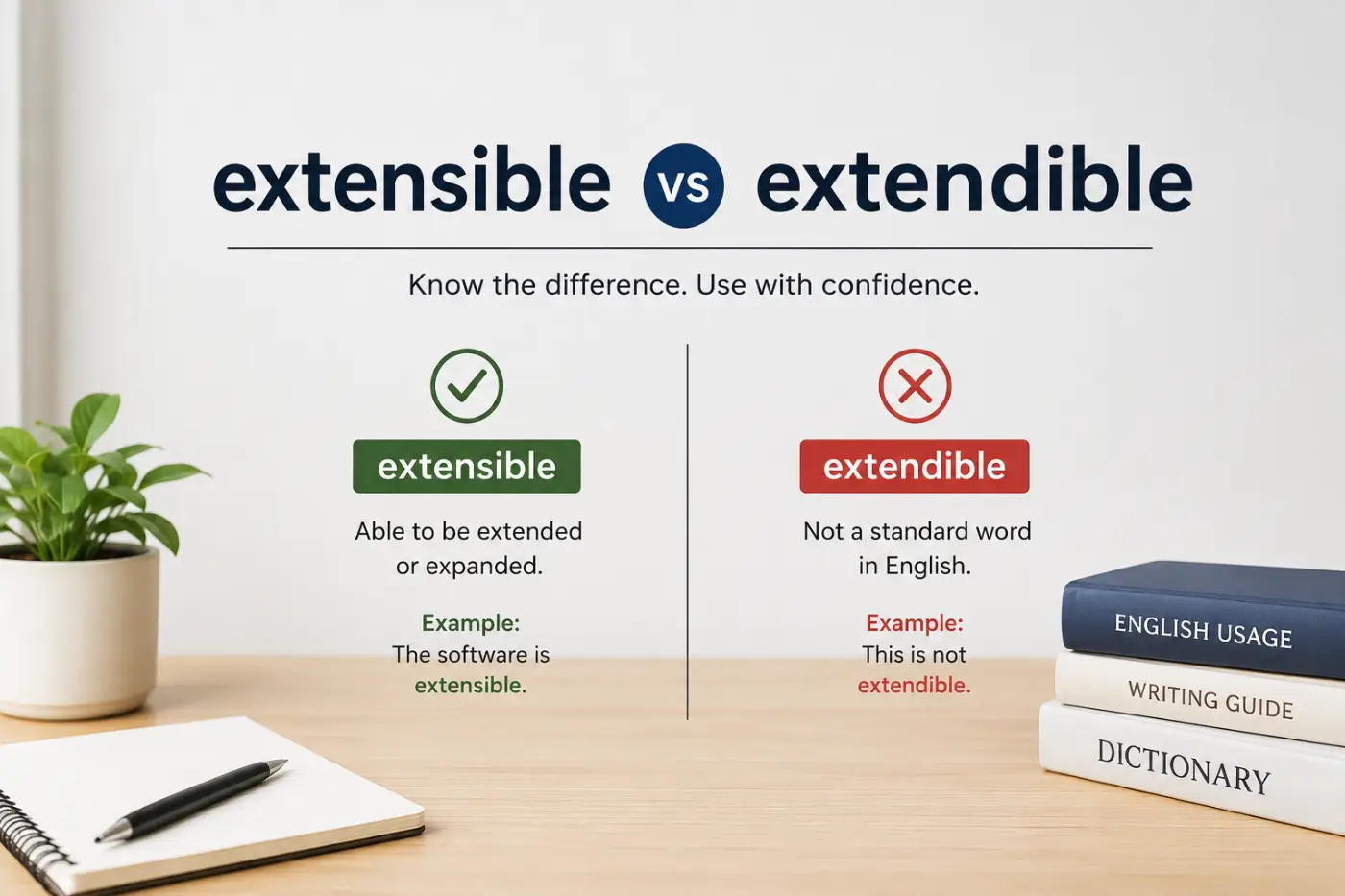
If you’ve searched for extensible vs extendible, you’re probably trying to figure out if one spelling is wrong or if both are acceptable. The short answer is simple. Both words are correct English adjectives. The difference is not grammar but usage.
Although the two words share the same meaning, extensible has become the preferred choice in modern English. It appears far more often in software development, engineering, technical writing, business documents, and academic publications. Extendible still exists and remains correct, but it is much less common.
The confusion comes from the verb extend. Many English learners naturally expect the adjective to become extendible, just as access becomes accessible. Instead, English also developed the form extensible, which gradually became the standard choice in many fields.
Understanding this difference helps you sound more natural and professional. It also prevents you from wondering if your spelling checker or editor is flagging the wrong word.
In this guide, you’ll learn the meaning of each word, discover why both exist, understand which spelling experts recommend, and see plenty of real examples that make the distinction easy to remember.
Learn the difference in Drier Vs Dryer Which Word Is Correct 2026 Guide.
Quick Answer
Extensible and extendible are both correct English words that mean capable of being extended or expanded. Today, extensible is the preferred spelling in most professional, technical, and academic writing. Extendible is less common but remains grammatically correct and appears in some dictionaries and publications.
Extensible Vs Extendible Comparison Table
| Feature | Extensible | Extendible |
|---|---|---|
| Correct spelling | Yes | Yes |
| Meaning | Able to be extended | Able to be extended |
| Part of speech | Adjective | Adjective |
| Modern usage | Very common | Less common |
| Technical writing | Preferred | Rare |
| Academic writing | Preferred | Occasionally used |
| Everyday English | Common | Uncommon |
| Formal writing | Recommended | Acceptable but less natural |
| Example | The software has an extensible design. | The framework has an extendible structure. |
What Does Extensible Mean
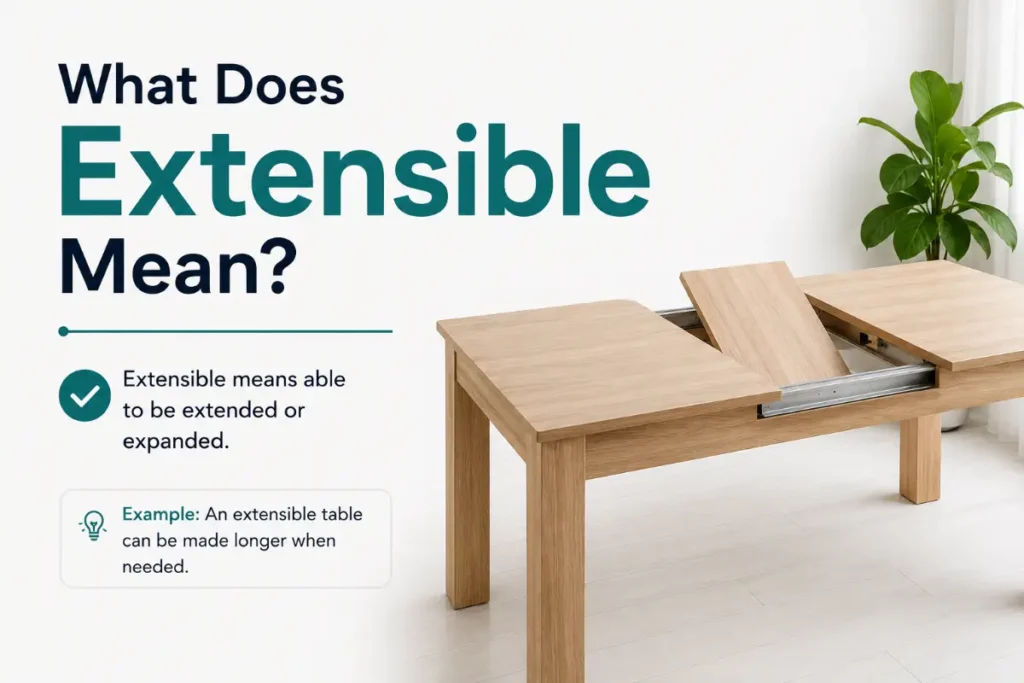
Extensible describes something that can be expanded, enlarged, modified, or extended without changing its basic structure.
The word is especially common in technology, engineering, architecture, education, and business because many systems are designed to grow over time.
Simple Definition
Extensible means able to be extended or expanded later.
Common Contexts
People often use extensible when talking about systems, software, products, frameworks, plans, and designs that can easily accept future improvements.
Examples include.
- The application uses an extensible architecture.
- We built an extensible database for future updates.
- The learning platform has an extensible design.
- Our business model is highly extensible.
- The framework allows developers to create extensible plugins.
What Does Extendible Mean
Extendible has exactly the same dictionary meaning as extensible.
It also means capable of being extended or enlarged.
The difference is frequency rather than meaning. Native speakers simply choose extensible much more often, especially in professional writing.
Simple Definition
Extendible means able to be extended.
Where You May See It
Although less common today, extendible still appears in older publications, engineering documents, patents, product descriptions, and some regional publications.
Examples include.
- The ladder has an extendible frame.
- They designed an extendible antenna.
- The table includes extendible sections.
- The bridge uses an extendible support system.
- The manufacturer introduced an extendible handle.
Every sentence above is grammatically correct. Many editors, however, would naturally replace extendible with extensible in modern writing unless referring to a product name or existing documentation.
Which One Is Correct
Both extensible and extendible are correct English words.
If your goal is to write naturally and match modern English usage, choose extensible.
Professional editors, software developers, engineers, technical writers, and academic authors overwhelmingly prefer extensible because it has become the established standard across many industries.
Use extendible only when.
- You are following existing company terminology.
- You are quoting an original source.
- A product or brand officially uses that spelling.
- You want to preserve historical wording.
For almost every new piece of writing, extensible is the better choice.
Why Extensible Is More Common
Many English words ending in ible developed different spellings over hundreds of years. English borrowed vocabulary from Latin and French, then gradually standardized certain forms.
Although extendible follows the spelling of the verb extend, the adjective extensible became more widely accepted through technical writing and scientific literature.
Today you’ll see extensible in.
- Software documentation.
- Programming languages.
- Cloud computing.
- Engineering manuals.
- Academic journals.
- Product documentation.
- Business reports.
- Technical standards.
This widespread professional use has made extensible the spelling most native speakers expect.
Extensible Vs Extendible In Software Development
Software development offers one of the clearest examples of modern usage.
Developers regularly describe software as extensible when it allows new features without rewriting the entire system.
Examples include.
- An extensible plugin system.
- An extensible programming framework.
- An extensible API.
- An extensible application.
- An extensible content management system.
Although extendible software would still be understood, it sounds unusual because nearly all technical documentation uses extensible.
For that reason, developers, technical editors, and documentation teams almost always recommend extensible.

Why People Confuse Extensible And Extendible
The confusion is easy to understand because both words come from the verb extend and share the same meaning.
Unlike many spelling pairs where one word is wrong, extensible and extendible are both correct. The challenge is knowing which one sounds more natural today.
Several factors add to the confusion.
They Mean The Same Thing
Most spelling comparisons involve a correct and incorrect form. This pair is different because both words mean capable of being extended.
That leaves writers wondering if one spelling is outdated or preferred.
They Look Almost Identical
Only two letters separate the words.
Extensible.
Extendible.
When reading quickly, many people do not notice the difference.
Spell Checkers Rarely Help
Many spelling tools accept both words because dictionaries recognize each one.
As a result, writers receive no warning even if they use the less common spelling.
Technical Writing Prefers One Form
Software documentation, engineering manuals, and programming books almost always use extensible.
Someone who learns the word in a technical setting may assume extendible is incorrect, even though it is not.
Key Differences Between Extensible And Extendible
| Feature | Extensible | Extendible |
|---|---|---|
| Meaning | Able to be extended | Able to be extended |
| Grammar | Adjective | Adjective |
| Modern popularity | Very high | Low |
| Technical writing | Preferred | Rare |
| Academic writing | Preferred | Occasionally used |
| Dictionary status | Correct | Correct |
| Recommended for new writing | Yes | Usually no |
The biggest difference is usage.
Their meanings are the same, but extensible has become the standard choice in modern English.
Grammar Explanation
From a grammar standpoint, these words work exactly the same way.
Both are adjectives.
They describe nouns that can be enlarged, expanded, or modified.
Examples.
- The software is extensible.
- The framework is extendible.
- We need an extensible solution.
- They created an extendible platform.
In every example above, the adjective describes the noun.
The grammar never changes.
Only the preferred spelling changes.
You may also want to read Prescribe vs Proscribe: The Difference Explained (2026 Guide).
Spelling Pattern
English sometimes creates more than one adjective from the same verb.
Examples include.
- Collectable and collectible.
- Preventable and preventible.
- Connectable and connectible.
Over time, one spelling often becomes more popular.
The same thing happened with extensible.
Although extendible follows the spelling of the verb extend, English gradually favored extensible in professional writing.
Language does not always follow perfect spelling logic. Usage often decides which form becomes standard.
Pronunciation Guide
Both words are pronounced almost the same.
Extensible
IPA
American English
/ɪkˈstɛn.sə.bəl/
Syllables
Ex ten si ble.
Primary stress
The second syllable carries the main stress.
Extendible
IPA
American English
/ɪkˈstɛn.də.bəl/
Syllables
Ex ten di ble.
Primary stress
The second syllable also receives the main stress.
Common Pronunciation Mistakes
Some speakers pronounce both words exactly the same in everyday conversation.
Others slightly emphasize the middle syllable in extendible because of the extra d sound.
Native speakers rarely misunderstand either pronunciation because context makes the meaning clear.
Word Origin
Understanding the history explains why two spellings exist.
Both words come from the Latin verb extendere, meaning to stretch out or spread.
As English developed, the verb became extend.
Later, English formed two adjectives.
Extendible developed directly from the English verb.
Extensible came through the Latin adjective pattern ending in ible.
Over time, publishers, academics, engineers, and software developers increasingly adopted extensible.
That widespread professional use made it the dominant spelling today.
British American Canadian And Australian English
Unlike many spelling comparisons, this is not a British versus American English issue.
English speakers in the United States, the United Kingdom, Canada, Australia, and New Zealand recognize both words.
Professional writers across all of these regions generally prefer extensible.
Regional differences are minimal.
The preference comes from industry standards rather than geography.
Real Life Examples
Seeing these words in context makes the difference much easier to remember.
Daily Conversation
- The shelves are extensible, so we can add more space later.
- The table has an extendible leaf for extra guests.
- We need an extensible storage system.
- The design should stay extensible as our needs grow.
Workplace
- Our developers built an extensible platform.
- The new framework is highly extensible.
- The engineer suggested an extensible solution for future upgrades.
- We replaced the old extendible model with a newer extensible version.
Emails
- Please choose an extensible design for the next release.
- We need software that remains extensible over time.
Academic Writing
- The researchers proposed an extensible architecture.
- The paper describes an extensible classification model.
Engineering
- The bridge includes extensible support components.
- The machine features an extendible arm.
- The manufacturer redesigned the extensible frame.
Technology
- The API is fully extensible.
- Developers appreciate extensible applications.
- Modern programming languages encourage extensible code.
Product Descriptions
- The suitcase includes an extendible handle.
- The product features an extensible storage system.
These examples show an important pattern.
Physical objects like ladders, handles, and tables sometimes appear with extendible, especially in product descriptions.
Software, engineering, science, and professional writing almost always use extensible.
Common Mistakes
Even experienced writers sometimes hesitate when choosing between extensible and extendible. Most mistakes come from assuming one spelling must be wrong.
Here are the errors editors see most often.
Thinking Extendible Is Incorrect
Incorrect assumption.
Only extensible is a real word.
Correct understanding.
Both extensible and extendible are correct English words. The difference is that extensible is much more common in modern writing.
Using Extendible In Technical Documentation
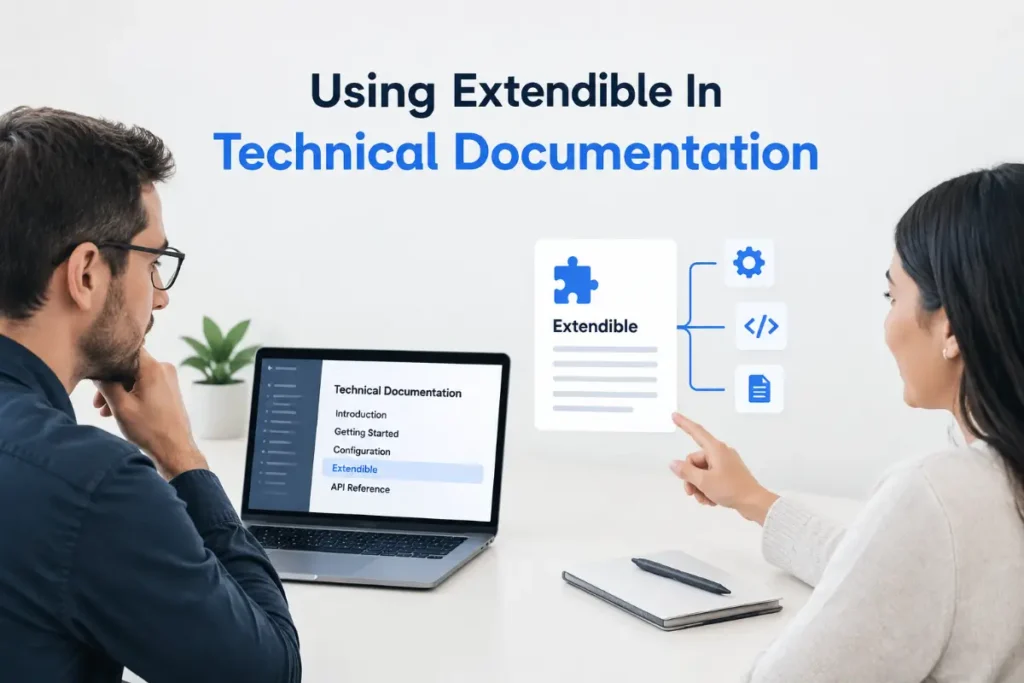
Grammatically, this is acceptable.
However, software developers, engineers, and technical writers usually expect to see extensible.
Example.
Preferred.
The framework provides an extensible architecture.
Less common.
The framework provides an extendible architecture.
Both sentences are correct, but the first sounds more natural to professionals.
Mixing The Two Spellings
Choose one spelling and stay consistent throughout the document.
Switching back and forth can distract readers and make your writing appear less polished.
Assuming The Words Have Different Meanings
They do not.
Both words describe something that can be extended, expanded, or modified.
The difference lies in preference and frequency, not definition.
Memory Tricks
Simple memory tricks make this pair easy to remember.
Think About Experts
Most experts write extensible.
The shared beginning ex can remind you of expert.
Remember Technology
If you are writing about software, programming, engineering, or technology, choose extensible almost every time.
That single habit will match the language used in most technical documentation.
Use One Easy Rule
Ask yourself one question.
Am I writing for modern readers?
If the answer is yes, extensible is usually the safest choice.
Related Words
Learning related vocabulary strengthens your understanding.
Synonyms
- Expandable.
- Adaptable.
- Flexible.
- Adjustable.
- Scalable.
- Configurable.
- Modular.
- Customizable.
Related Technical Terms
- Extension.
- Extend.
- Expansion.
- Scalability.
- Modularity.
- Plugin.
- Framework.
- Architecture.
Frequently Confused Words
- Extendable and expandable.
- Flexible and extensible.
- Configurable and customizable.
- Modular and scalable.
Each word has its own nuance, so choose the one that best matches your meaning.
Expert Editor’s Note
Professional editors recognize both extensible and extendible as correct.
Still, correctness is only part of good writing. Natural usage matters just as much.
Major dictionaries include both spellings, but style guides and technical publications overwhelmingly favor extensible. That preference has become even stronger in software development, engineering, and scientific writing.
If you are writing a new article, report, manual, website, or academic paper, extensible is almost always the better choice.
Reserve extendible for product names, historical documents, direct quotations, or organizations that officially use that spelling.
Choosing the form readers expect makes your writing feel smoother and more professional.
Frequently Asked Questions
Is Extensible Or Extendible Correct?
Both are correct English adjectives. They have the same meaning. Extensible is the preferred spelling in modern professional, academic, and technical writing, while extendible appears much less often.
Which Spelling Do Software Developers Use?
Developers almost always use extensible. It is the standard term for software, APIs, frameworks, databases, and applications designed to support future features or extensions.
Is Extendible Outdated?
Not completely. It still appears in dictionaries and some publications. However, it has become much less common than extensible, especially in modern technical writing.
Do The Two Words Have Different Meanings?
No. They mean exactly the same thing. Both describe something capable of being extended or expanded. The difference is simply which spelling has become more popular.
Which Word Should I Use In Formal Writing?
Choose extensible. It is the spelling most editors, academics, engineers, and professional writers expect to see.
Is This A British And American English Difference?
No. Both British and American English recognize both spellings. The preference for extensible is shared across the United States, the United Kingdom, Canada, Australia, and other English speaking countries.
Can I Use Extendible In Everyday Writing?
Yes. Readers will understand it. Even so, extensible usually sounds more natural because it appears far more often in books, articles, technical documents, and online resources.
Many readers also check Loot Vs Lute Which Word Should You Use 2026.
Conclusion
The answer to extensible vs extendible is refreshingly simple.
Both words are correct. Both mean capable of being extended.
The difference comes down to modern usage.
Extensible has become the standard choice across software development, engineering, academic writing, business communication, and most professional documents.
Extendible remains a valid alternative, but it appears much less often and may sound dated in some contexts.
If you are writing something new and want the spelling that feels most natural to today’s readers, choose extensible.
One consistent choice can make your writing clearer, stronger, and more professional.

Vocabulary & Language Research Writer
Ethan Parker researches English vocabulary, word meanings, slang, idioms, and commonly confused words. His goal is to help readers understand how English is actually used in everyday conversations and writing.