
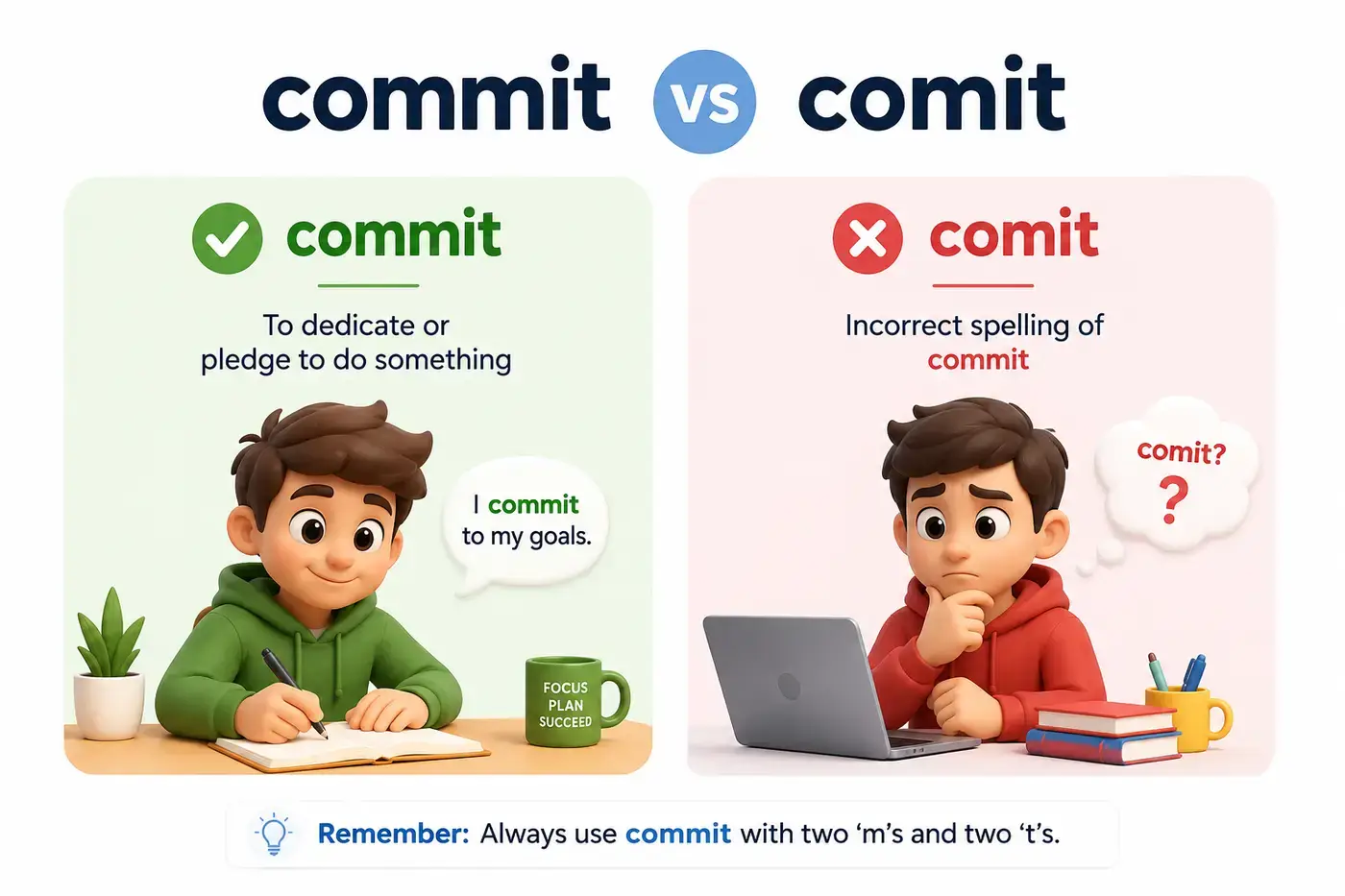
Many English learners search for commit vs comit because the two spellings look almost identical. One small letter creates the difference, but only one form is correct in modern English.
The correct spelling is commit. The word comit is a common spelling mistake and is not accepted as a standard English word. This confusion usually happens because English has many words where a single doubled letter changes the spelling pattern.
The word commit appears often in daily conversations, workplace writing, academic texts, and formal communication. It can mean promising to do something, dedicating yourself to a goal, sending someone to a place, or carrying out an action such as a crime.
In this guide, you’ll learn the correct spelling, meaning, pronunciation, grammar rules, word origin, common mistakes, and real examples. You’ll also discover why people write comit by mistake and how to remember the correct form every time.
Understanding small spelling differences like this helps you write with more confidence and avoid mistakes that can affect professional and academic writing.
You may also want to read Ingage Vs Engage Which Spelling Is Correct 2026 Guide.
Quick Answer
Commit is the correct spelling. Comit is incorrect and should not be used in standard English. The word commit means to dedicate yourself to something, promise an action, or carry out an act. The double letter m is required in all common forms of the word.
Commit Vs Comit Comparison Table
| Feature | Commit | Comit |
|---|---|---|
| Correct spelling | Yes | No |
| Part of speech | Verb | Not a standard English word |
| Meaning | To dedicate, promise, send, or carry out an action | No accepted meaning |
| Pronunciation | kuh MIT | Not applicable |
| Usage | Common in everyday and formal writing | Incorrect spelling |
| Grammar forms | Commit, commits, committed, committing | None |
| Formal writing | Accepted | Avoid |
| Example | She decided to commit to the project. | She decided to comit to the project. Incorrect |

What Does Commit Mean
Commit is a verb that means to give your time, effort, loyalty, or attention to something. It can also mean to perform or carry out an action.
The meaning changes slightly depending on the context.
Commit Meaning As A Promise Or Dedication
When you commit to something, you make a serious decision to support it or continue with it.
Examples.
- She decided to commit to learning Spanish.
- He committed himself to improving his writing skills.
- The company will commit more resources to customer service.
In these examples, commit shows dedication and responsibility.
Commit Meaning In Relationships
People often use commit when talking about serious relationships.
Examples.
- He is ready to commit to the relationship.
- They decided to commit to each other.
Here, the word means giving loyalty and accepting responsibility.
Commit Meaning As An Action
Commit can also mean to do or perform something.
Examples.
- Someone committed a crime.
- The athlete committed a violation during the game.
- The company committed an error in the report.
In these situations, commit refers to carrying out an action, often something serious or official.
Commit Meaning In Technology
In computer science, commit has a specific meaning.
A developer commits changes to a project when they save a set of updates to a version control system.
Example.
The developer committed the new code after testing it.
This usage is common in software development.
What Does Comit Mean
Comit is not a correct English word.
It is usually a spelling error caused by forgetting the second m in commit.
Incorrect.
She wants to comit to the new plan.
Correct.
She wants to commit to the new plan.
The mistake is easy to make because many English words use a single consonant before endings. However, commit follows a different spelling pattern and keeps the double consonant.
Which One Is Correct Commit Or Comit
The correct word is commit.
The spelling comit is incorrect in English.
The reason is simple. The original word contains a double m, and that spelling remains when the word is used in its base form.
Correct examples.
- I want to commit to this goal.
- She commits to every project she starts.
- They committed to the agreement.
- He is committing his time to charity work.
Incorrect example.
- I want to comit to this goal.
The incorrect spelling may still appear online because of typing mistakes, autocorrect errors, or rushed writing. Professional editors and dictionaries use only commit.
Why People Confuse Commit And Comit
The confusion between these two spellings is common because English spelling patterns can feel unpredictable.
The Double Letter Problem
Many learners forget when a consonant should appear twice.
For example.
- Commit.
- Occur.
- Address.
- Necessary.
English has many words where double letters are part of the correct spelling.
Fast Typing Mistakes
When people type quickly, they often miss repeated letters.
Since commit has two identical consonants together, the second m is easy to skip.
Pronunciation Does Not Show The Difference
The pronunciation of commit does not clearly reveal the double m.
Both letters create one sound, so listeners cannot hear the spelling.
This is why people who learn English through speaking may accidentally write comit.
Similar Word Patterns
Some English words use one consonant before endings.
Examples.
- Limit.
- Visit.
- Credit.
Learners may incorrectly apply the same pattern to commit.
However, the correct spelling must be memorized.
Autocorrect And Online Errors
Spell check tools often fix comit automatically. This can make some writers think both versions are acceptable.
They are not.
Only commit is recognized as the standard English spelling.
Key Differences Between Commit And Comit
There is only one real difference.
Commit is a correct English verb.
Comit is a spelling mistake.
The comparison is not about meaning, grammar, or pronunciation because comit has no standard English usage.
Meaning Difference
Commit.
A verb meaning to dedicate, promise, or carry out an action.
Comit.
No accepted English meaning.
Grammar Difference
Commit can change forms.
Examples.
- Commit.
- Commits.
- Committed.
- Committing.
Comit has no grammatical forms because it is not a recognized word.
Usage Difference
Commit appears in:
- Conversations.
- Emails.
- Books.
- Academic writing.
- Professional documents.
Comit should not appear in any type of standard writing.
Grammar Explanation Of Commit
Commit is a verb. It describes an action or state of dedication.
Commit As A Regular Verb
Commit follows regular verb patterns, but its spelling changes slightly in some forms.
Base form.
Commit.
Example.
I will commit to the plan.
Third person singular.
Commits.
Example.
She commits to every deadline.
Past tense.
Committed.
Example.
They committed to the agreement last year.
Present participle.
Committing.
Example.
He is committing more time to training.
Why Does Commit Become Committed
When adding endings like ed or ing, the final consonant is doubled.
This happens because the word ends with a stressed short vowel sound followed by a single consonant.
Commit becomes.
Commit + ing = committing.
The double m remains because it protects the original pronunciation and spelling pattern.
Sentence Structure With Commit
Commit is often followed by words like:
- To.
- Yourself.
- A noun.
- An action.
Examples.
Commit + to + noun.
She committed to the project.
Commit + yourself + to + noun.
He committed himself to his studies.
Commit + noun.
The company committed additional funds.
Formal And Informal Usage
Commit works in both formal and informal English.
Formal example.
The organization committed additional resources to research.
Informal example.
I need to commit to going to the gym.
The meaning stays the same, but the context changes how the word sounds.
Spelling Rules For Commit
Understanding the spelling pattern behind commit helps prevent the common mistake of writing comit.
The most important rule is simple:
Commit always keeps the double m.
The word follows a spelling pattern where a short stressed vowel sound comes before a final consonant. In these cases, English often doubles the final consonant when adding certain endings.
Examples.
- Commit becomes committed.
- Commit becomes committing.
- Admit becomes admitted.
- Permit becomes permitting.
The doubled consonant helps maintain the correct pronunciation and spelling structure.
Why The Double M Matters
The second m is not optional. It is part of the original spelling.
Incorrect.
I want to comit to this opportunity.
Correct.
I want to commit to this opportunity.
Removing one letter changes the word into a spelling error.
Commit With Common Suffixes
The spelling changes slightly when adding endings.
Base form.
Commit.
Third person singular.
Commits.
Past tense.
Committed.
Present participle.
Committing.
Notice that the double m stays in every form.
Pronunciation Guide For Commit
Pronunciation often causes spelling confusion because the double letter cannot be heard.
Commit Pronunciation
IPA
American English: /kəˈmɪt/
British English: /kəˈmɪt/
Syllables
Com mit.
The word has two syllables.
Stress Pattern
The stress falls on the second syllable.
kuh MIT.
The second part sounds stronger than the first.
Common Pronunciation Mistakes
Some learners pronounce the first syllable too strongly.
Incorrect pattern.
COM mit.
Correct pattern.
kuh MIT.
The correct pronunciation keeps the first syllable weak and places emphasis on the second syllable.

Many readers also check Conex Or Connex Which Spelling Is Correct 2026 Guide.
Word Origin Of Commit
The history of commit explains why the spelling looks the way it does.
The word comes from the Latin word committere, meaning to bring together, entrust, or connect.
It entered English through Old French before becoming part of modern English vocabulary.
Over time, the meaning expanded.
Originally, commit carried the idea of sending something together or placing something into another person’s care.
Today, English uses the word in several ways.
- Commit to a responsibility.
- Commit a crime.
- Commit information to memory.
- Commit changes in software.
The spelling remained connected to its Latin roots, including the double consonant.
British American Canadian And Australian English
The spelling commit is the same across major English varieties.
There is no regional spelling difference between American English and British English.
Speakers in:
- The United States.
- The United Kingdom.
- Canada.
- Australia.
all use commit.
The pronunciation may have small regional differences, but the spelling remains unchanged.
Examples.
American English.
She committed to the project.
British English.
She committed to the project.
Canadian English.
They committed more resources to education.
Australian English.
He committed to improving his skills.
The incorrect spelling comit is not accepted in any major English variety.
Real Life Examples Of Commit
Seeing the word in different situations makes its meaning clearer.
Daily Conversation
- I need to commit to my fitness goals.
- She finally committed to learning a new language.
- Are you ready to commit to this decision?
- He doesn’t want to commit until he knows all the details.
Workplace Examples
- The company committed more money to employee training.
- Our team is committed to completing the project on time.
- She committed herself to improving customer support.
- The manager committed to reviewing the policy.
Email Examples
- We are committed to providing better service.
- I want to commit more time to this important task.
- The team committed to finishing the report before Friday.
Academic Writing
- Researchers committed years to studying the problem.
- The author committed significant effort to the research.
- Students must commit themselves to consistent learning.
Journalism
- The organization committed additional funds to disaster relief.
- Authorities reported that a crime had been committed.
- The athlete committed a violation during the match.
Social Media
- I’m ready to commit to this new challenge.
- She committed to making positive changes this year.
- Good results come when people commit to their goals.
Common Mistakes With Commit
Even fluent writers sometimes make mistakes with this word.
Mistake One Writing Comit Without The Second M
Incorrect.
The company will comit more resources.
Correct.
The company will commit more resources.
This is the most common error.
Mistake Two Confusing Commit And Commitment
The noun form is commitment, not comitment.
Correct.
Her commitment to education is inspiring.
Incorrect.
Her comitment to education is inspiring.
The double m appears in both forms.
Mistake Three Using The Wrong Verb Pattern
Some learners write:
Incorrect.
She committed to improve her skills.
Better.
She committed to improving her skills.
After commit to, English usually uses a noun or an ing form.
Examples.
Correct.
He committed to the project.
Correct.
He committed to working harder.
Mistake Four Confusing Committed And Dedicated
These words are close but not always identical.
Committed means strongly devoted or responsible.
Dedicated often suggests strong effort and loyalty.
Example.
She is committed to her career.
She is dedicated to helping others.
Both can work in many situations, but the tone may change.

Memory Tricks To Remember Commit
A good memory trick makes spelling easier.
Remember The Double M
Think:
Commit means make a serious promise, so it needs a serious double m.
The extra letter reminds you that the word represents a strong action or decision.
Break The Word Apart
Commit.
Com + mit.
The middle double letter stays visible.
Avoid thinking of it as:
Co + mit.
That pattern creates the common mistake.
Connect It With Related Words
Remember these together.
- Commit.
- Commitment.
- Committed.
- Committing.
All of them keep the double m.
Related Words And Expressions
Learning related vocabulary helps build a stronger understanding of commit.
Words Related To Commit
- Commitment.
- Committed.
- Committing.
- Dedicate.
- Promise.
- Devote.
- Pledge.
- Participate.
Synonyms Of Commit
Depending on the context, similar words include:
- Dedicate.
- Devote.
- Promise.
- Assign.
- Perform.
- Carry out.
- Entrust.
Opposites Of Commit
Some opposite ideas include:
- Avoid.
- Reject.
- Abandon.
- Withdraw.
- Refuse.
Common Expressions With Commit
- Commit to a goal.
- Commit to a relationship.
- Commit a crime.
- Commit an error.
- Commit something to memory.
- Commit resources.
- Commit time and effort.
Each expression has a slightly different meaning, so context matters.
Expert Editor’s Note
Professional editors treat commit and comit as a simple case of correct spelling versus spelling error.
Major dictionaries list commit as the accepted English word. The spelling comit does not appear as a standard modern English entry.
When editing professional documents, emails, academic papers, or published content, always correct comit to commit.
A useful editing habit is to check words with repeated letters carefully. Many spelling mistakes happen because writers hear a word correctly but forget how it looks on the page.
Native speakers rarely notice the missing letter when reading quickly because the meaning is clear. However, polished writing depends on accurate spelling.
The best approach is simple:
Remember the double m and you will always write commit correctly.
Frequently Asked Questions
Is Commit The Correct Spelling?
Yes. Commit is the correct spelling in English. It is a verb used to describe dedication, responsibility, or carrying out an action. The spelling comit is incorrect and should not be used in professional, academic, or everyday writing.
Why Does Commit Have Two M Letters?
The double m in commit comes from its spelling history and pronunciation pattern. English keeps the double consonant to maintain the original form of the word. Similar words like committed and commitment also keep the double m.
Is Comit Ever A Correct Word?
No. Comit is not a standard English word. It usually appears because someone accidentally leaves out one letter while typing or writing. If you see comit in a sentence, it should almost always be corrected to commit.
How Do You Use Commit In A Sentence?
You can use commit when talking about dedication, promises, or actions. For example, you can say, “She decided to commit to her new career goal.” You can also use it for actions like “The person committed a crime” or “The developer committed new code.”
What Is The Difference Between Commit And Commitment?
Commit is a verb that describes an action. Commitment is a noun that describes the promise, responsibility, or dedication created by that action.
Examples.
I will commit to this project.
My commitment to this project is strong.
How Do You Pronounce Commit?
Commit is pronounced as /kəˈmɪt/. It has two syllables: com mit. The stress falls on the second syllable, which sounds stronger than the first part.
Is Commit Used The Same Way In British And American English?
Yes. Both British English and American English use the spelling commit. There is no regional spelling difference. The pronunciation may have small accent differences, but the meaning and spelling remain the same.
Why Do People Write Comit Instead Of Commit?
People usually write comit because they forget the second m, type too quickly, or apply the wrong spelling pattern from other words. Since the extra letter cannot be heard in pronunciation, the mistake is easy to make.
Practical Writing Tips For Using Commit Correctly
Strong writing often depends on small details. A missing letter can make your content look less professional, especially in emails, reports, and academic work.
Use these simple habits to avoid mistakes.
- Check words with double letters carefully.
- Remember related forms like commitment and committed.
- Use spell check tools but do not depend on them completely.
- Read important writing slowly before publishing.
- Learn common spelling patterns instead of memorizing random words.
A good writer does not only focus on big ideas. Small spelling choices also build trust with readers.
Internal Linking Opportunities
- Suggested anchor text: Common English Spelling Mistakes And How To Avoid Them
- Suggested anchor text: Commitment Meaning And Correct Usage In English
Learn the difference in Offered vs Offerred Which Spelling Is Correct (2026 Guide).
Conclusion
The answer to commit vs comit is clear. Commit is the correct English spelling, while comit is a spelling mistake.
The word commit is a useful verb with several meanings. It can describe dedication to a goal, loyalty in a relationship, responsibility at work, or carrying out an action. Its spelling always includes the double m.
The most common mistake is dropping the second m because the pronunciation does not reveal the spelling. Remembering the related words committed and commitment can help you keep the correct spelling in mind.
When you write, choose accuracy over guessing. A small letter can make a big difference in clear communication.
Correct spelling builds confidence, and commit is one word you can always write with certainty.

Editorial Reviewer & Proofreader
Grace Mitchell reviews Gramlify’s articles for clarity, consistency, and readability. She is passionate about creating accurate, approachable content that helps English learners build confidence.