
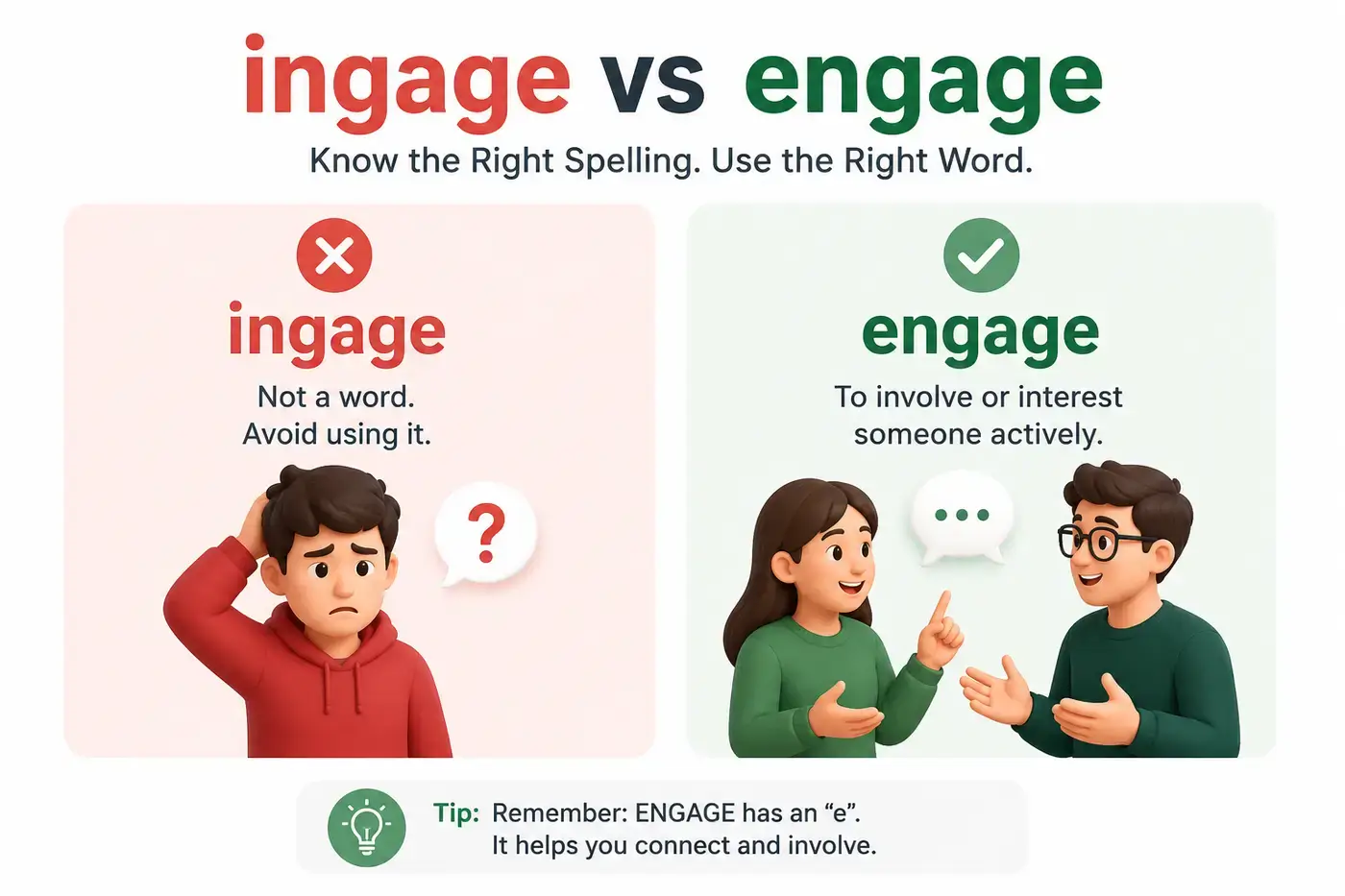
If you’ve searched for ingage vs engage, you’re probably trying to find out if ingage is a real English word or simply a spelling mistake. The short answer is simple. Engage is the correct spelling. Ingage is a misspelling and should not be used in standard English.
This confusion is more common than you might think. The words sound almost identical in everyday speech, especially in fast conversations. Since the first vowel sound is unstressed, many people write ingage instead of engage. Autocorrect sometimes catches the mistake, but not every writing tool does. As a result, the incorrect spelling continues to appear in emails, social media posts, school assignments, and even business documents.
Fortunately, the difference is easy to remember once you understand how the word is formed. Learning the correct spelling also improves your writing, makes your communication more professional, and helps you avoid an error that editors notice immediately.
In this guide, you’ll learn the difference between ingage vs engage, why people confuse them, how to spell the word correctly every time, and how to use engage naturally in everyday English.
Need another quick comparison? Read Prooving Vs Proving Which Spelling Is Correct 2026.
Quick Answer
Engage is the correct English spelling. Ingage is a misspelling and is not recognized by standard dictionaries. Use engage when you mean to participate, involve, attract attention, begin an activity, or connect with someone. Avoid ingage in all formal and informal writing.
Ingage Vs Engage Comparison Table
| Feature | Engage | Ingage |
|---|---|---|
| Correct spelling | Yes | No |
| Dictionary word | Yes | No |
| Part of speech | Verb | Not a standard English word |
| Meaning | To involve connect attract or begin | None |
| Used in formal writing | Yes | No |
| Used in everyday English | Yes | No |
| Found in dictionaries | Yes | No |
| Example | Please engage with the audience. | Incorrect spelling |
What Does Engage Mean
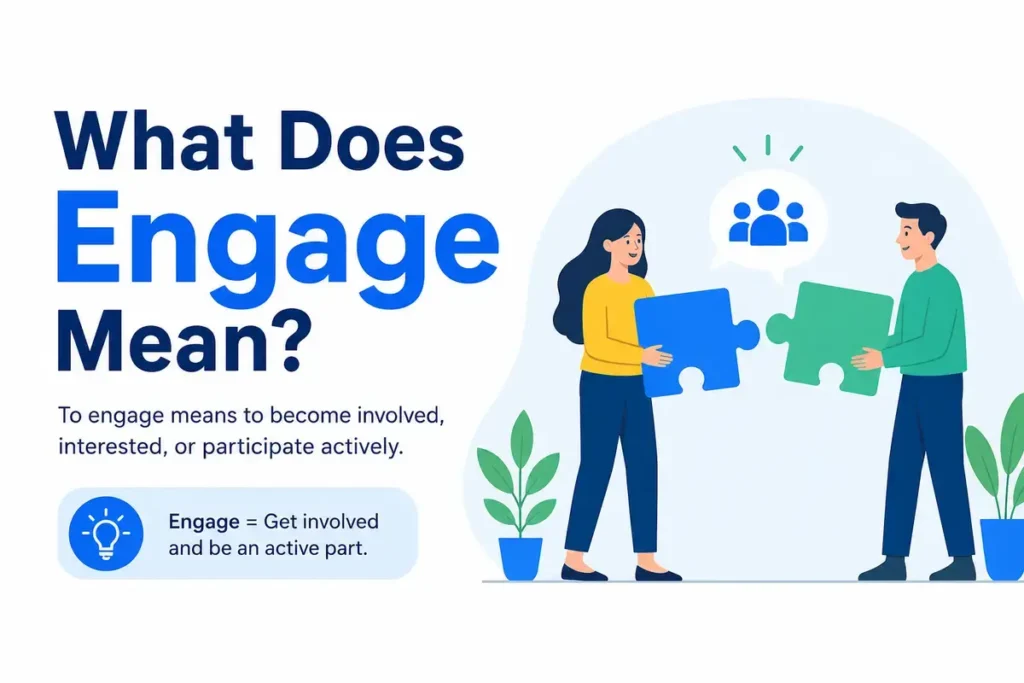
Engage is a verb with several related meanings. Although the exact meaning changes with the situation, the idea always involves becoming connected, involved, interested, or active.
Simple Definition
Engage means to take part, attract someone’s attention, connect with something, or start doing something.
Common Meanings Of Engage
The word has several everyday uses.
- To take part in an activity.
- To attract someone’s attention.
- To involve someone in a conversation or task.
- To connect two things together.
- To begin a fight, discussion, or action.
The intended meaning becomes clear from the surrounding words.
Examples Of Engage In Daily Life
- Please engage in the discussion.
- Good teachers know how to engage every student.
- The speaker quickly engaged the audience.
- We should engage with our customers more often.
- The team engaged in careful planning before the project started.
- Parents can engage children by asking thoughtful questions.
- The company wants to engage new clients through helpful content.
- The volunteers engaged with local families during the event.
Is Ingage A Real Word
No. Ingage is not a standard English word.
It does not appear as the accepted spelling in major English dictionaries. When you see ingage, it is almost always a spelling mistake for engage.
Spell checkers, grammar tools, professional editors, teachers, and publishers all recommend replacing ingage with engage.
If you are writing an email, report, essay, website article, or business document, always use engage.
Which One Is Correct
The correct spelling is engage.
Use engage in every type of English writing, including:
- School assignments.
- Business emails.
- Academic papers.
- News articles.
- Blog posts.
- Social media.
- Professional reports.
Avoid ingage because it is simply a misspelling.
Examples.
✔ We encourage students to engage in classroom activities.
✔ Managers should engage employees through clear communication.
✘ Please ingage with our latest survey.
✘ The teacher tried to ingage every student.
The last two examples contain a spelling error. Replacing ingage with engage makes both sentences correct.
Why People Write Ingage Instead Of Engage
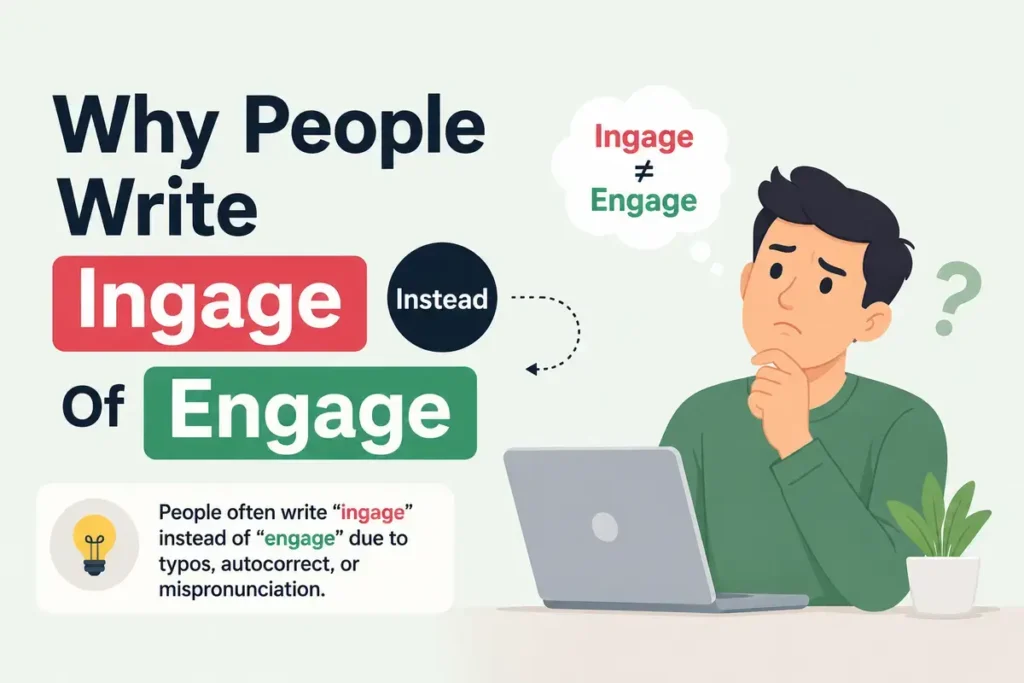
The mistake usually happens for simple reasons rather than poor grammar.
Similar Pronunciation
The first vowel sound in engage is weak and unstressed. In fast speech it may sound closer to an i sound, leading some people to write ingage.
Hearing Before Seeing
Many English learners hear the word long before they read it. They naturally spell it based on pronunciation instead of checking the standard spelling.
Typing Quickly
Fast typing often produces common spelling mistakes. Missing or changing one letter is easy when writing emails or text messages.
Limited Vocabulary
Some learners know the word from conversation but have never seen it written correctly. They simply guess the spelling.
Internet Errors
Incorrect spellings spread quickly online. Seeing ingage in comments or social media can make it appear acceptable even though it is not.
Ingage Vs Engage Key Differences
Although ingage and engage look similar, only one belongs in correct English. Understanding the differences helps you avoid one of the most common spelling mistakes.
| Feature | Engage | Ingage |
|---|---|---|
| Standard English | Yes | No |
| Dictionary entry | Yes | No |
| Correct spelling | Yes | No |
| Used by professional writers | Yes | No |
| Accepted in academic writing | Yes | No |
| Accepted in business writing | Yes | No |
| Should you use it | Yes | Never |
The difference is simple.
Engage is a real English verb.
Ingage is a misspelling.
Grammar Explanation
The word engage is a verb. A verb shows an action or a state.
Depending on the sentence, engage can appear in different verb forms.
| Verb Form | Example |
|---|---|
| Base form | Please engage with your audience. |
| Third person singular | She engages every student. |
| Present participle | They are engaging with customers. |
| Past tense | The team engaged in discussions yesterday. |
| Past participle | We have engaged a consultant. |
Since ingage is not a standard English word, it has no correct verb forms.
Common Grammar Patterns
You will often see engage used with different prepositions.
Engage in
Means to participate.
Examples.
- Students engage in classroom discussions.
- We engage in regular training sessions.
Engage with
Means to communicate or interact.
Examples.
- Good leaders engage with their teams.
- Brands should engage with customers online.
Engage someone
Means to attract someone’s attention or interest.
Examples.
- The story engaged every reader.
- The teacher engaged the entire class.
Spelling Rules
The spelling of engage follows normal English spelling patterns.
The word begins with the prefix en.
The prefix en appears in many English verbs.
Examples include.
- Enable.
- Encourage.
- Enclose.
- Enrich.
- Enlarge.
Notice that these words begin with en, not in.
This makes engage easier to remember.
Why The Mistake Happens
Many English words beginning with en are pronounced with a relaxed vowel sound.
Because of this, some people hear engage and mistakenly write ingage.
The pronunciation changes slightly in fast speech, but the spelling never changes.
You may also want to read Fliers Vs Flyers Which Spelling Is Correct 2026 Guide.
Pronunciation Guide
Engage
IPA
American English.
/ɪnˈɡeɪdʒ/
Syllables
En gage.
Word stress
The second syllable receives the strongest stress.
Common Pronunciation Mistakes
Some learners pronounce the first syllable too strongly.
Others assume the spelling should match the sound they hear.
Remember that English pronunciation and spelling do not always match perfectly.
The pronunciation may sound similar to in, but the spelling remains en.
Word Origin
The history of engage explains why it begins with en instead of in.
The word entered English through French.
Its earlier forms came from Old French engagier, which meant to pledge, commit, or bind.
The French prefix en remained part of the spelling when the word entered English.
Over time, the meaning expanded.
Today engage can mean to participate, involve, connect, occupy attention, hire someone, or begin an activity.
The spelling has stayed the same throughout its history.
British American Canadian And Australian English
There is no spelling difference across major English varieties.
Writers in the United States, the United Kingdom, Canada, Australia, and New Zealand all use engage.
No major dictionary accepts ingage as a regional spelling.
This means the rule is universal.
No matter where you write English, always spell the word engage.
Real Life Examples
Seeing the word in natural sentences makes it easier to remember.
Daily Conversation
- I love talking with people who engage in thoughtful conversations.
- Please engage with everyone at the meeting.
- Kids learn faster when lessons engage their curiosity.
- The game engaged everyone for hours.
Workplace
- Great managers engage every member of the team.
- We need to engage new clients this quarter.
- The trainer engaged employees through interactive activities.
- Our marketing campaign engaged thousands of customers.
Emails
- We hope you’ll engage in tomorrow’s workshop.
- Please engage with the attached document before the meeting.
Academic Writing
- Teachers should engage students through meaningful discussions.
- Researchers engaged participants over a six month period.
Journalism
- The interview engaged readers from beginning to end.
- Community leaders engaged local residents before making changes.
Social Media
- The post engaged thousands of followers within a few hours.
- Questions usually engage more people than simple announcements.
- Brands that engage honestly often build stronger communities.
Literature
- The novel immediately engaged its readers.
- The author engaged difficult themes with remarkable clarity.
- Every chapter engaged the reader’s imagination.
Common Mistakes
Understanding common errors helps you avoid them.
Writing Ingage Instead Of Engage
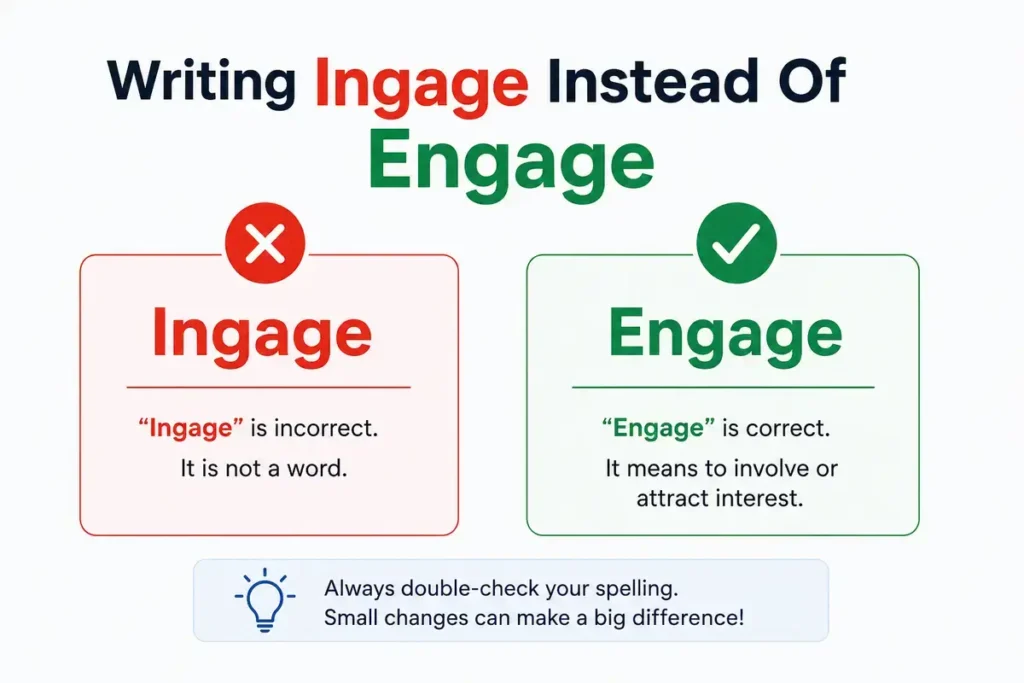
Incorrect.
Please ingage with our newsletter.
Correct.
Please engage with our newsletter.
Believing Ingage Is British English
This is false.
British English also uses engage.
Assuming Spell Check Always Finds The Error
Most writing tools catch ingage, but not all of them do.
Always proofread important documents before sending them.
Mixing Engage And Enrage
These words look similar but have different meanings.
Engage means to involve or participate.
Enrage means to make someone very angry.
Examples.
✔ The speaker engaged the audience.
✔ The decision enraged many residents.
Memory Tricks To Remember The Correct Spelling
Simple memory tricks can stop this mistake for good.
Remember The Prefix
Many common English verbs begin with en.
Think about these words.
- Enable.
- Encourage.
- Enrich.
- Enclose.
- Enforce.
- Engage.
Since these words all begin with en, it becomes easier to remember that engage follows the same pattern.
Think Of The Phrase
Engage everyone.
If you can remember that short phrase, you’ll naturally remember the correct spelling.
Picture The Letter E
The letter E can remind you of everyone.
You engage everyone, not ingage everyone.
Related Words
Learning related words expands your vocabulary and helps you understand how engage works in different situations.
Synonyms
Depending on the context, engage can mean:
- Involve.
- Participate.
- Connect.
- Attract.
- Interest.
- Occupy.
- Interact.
- Hire.
- Commit.
- Join.
Opposites
- Ignore.
- Avoid.
- Withdraw.
- Disconnect.
- Separate.
- Neglect.
Related Forms
- Engagement.
- Engaged.
- Engaging.
- Engages.
- Reengage.
- Disengage.
Frequently Confused Words
English learners often confuse engage with these words.
- Enrage.
- Encourage.
- Entice.
- Involve.
- Interact.
Understanding the differences makes your writing more accurate.
Expert Editor’s Note
Professional editors immediately recognize ingage as a spelling error.
Major dictionaries, including leading American and British references, list engage as the only correct spelling. Style guides and proofreading standards also recommend using engage in every form of writing.
Although pronunciation can make the first vowel sound less clear, spelling never changes.
If you’re editing an important document, searching your work for ingage is a quick way to catch this common mistake before publishing.
Good spelling builds credibility. One corrected word can make your writing look more polished and professional.
Frequently Asked Questions
Is Ingage Ever Correct?
No. Ingage is not a standard English word. It is a spelling mistake. Always use engage in formal and informal writing.
Why Do People Spell Engage As Ingage?
The mistake usually comes from pronunciation. The first vowel sound is weak, so many people hear an i sound instead of an e. Fast typing can also cause the error.
Is Ingage Listed In Any Dictionary?
No major English dictionary accepts ingage as the correct spelling. Dictionaries list it only as a common misspelling of engage.
Is Engage A Verb Or A Noun?
Engage is primarily a verb. It means to involve, connect, participate, attract attention, or begin an activity. The related noun is engagement.
Is Engage Used In Business English?
Yes. It is one of the most common business verbs. Companies often talk about engaging customers, engaging employees, and engaging stakeholders through meaningful communication.
Can I Use Engage In Academic Writing?
Yes. Engage is appropriate in academic essays, research papers, presentations, and professional reports. It is widely accepted in formal English.
How Can I Remember The Correct Spelling?
Remember that many English verbs begin with en, including enable, encourage, and engage. This simple pattern makes the correct spelling easy to recall.
Still confused? Compare Affend Vs Offend Which Word Is Correct 2026.
Conclusion
The answer to ingage vs engage is straightforward.
Engage is the only correct spelling in standard English. Ingage is a common spelling mistake that appears because the word’s pronunciation can be misleading.
If you want your writing to sound clear and professional, always choose engage. It works in everyday conversations, business communication, academic writing, journalism, and online content.
A simple way to avoid the mistake is to remember that many English verbs begin with en. Once that pattern becomes familiar, you’ll spell engage correctly every time.
Good writing starts with small details, and choosing the correct spelling is one of the easiest ways to make a strong impression.

Editorial Reviewer & Proofreader
Grace Mitchell reviews Gramlify’s articles for clarity, consistency, and readability. She is passionate about creating accurate, approachable content that helps English learners build confidence.
1 thought on “Ingage Vs Engage Which Spelling Is Correct 2026 Guide”