
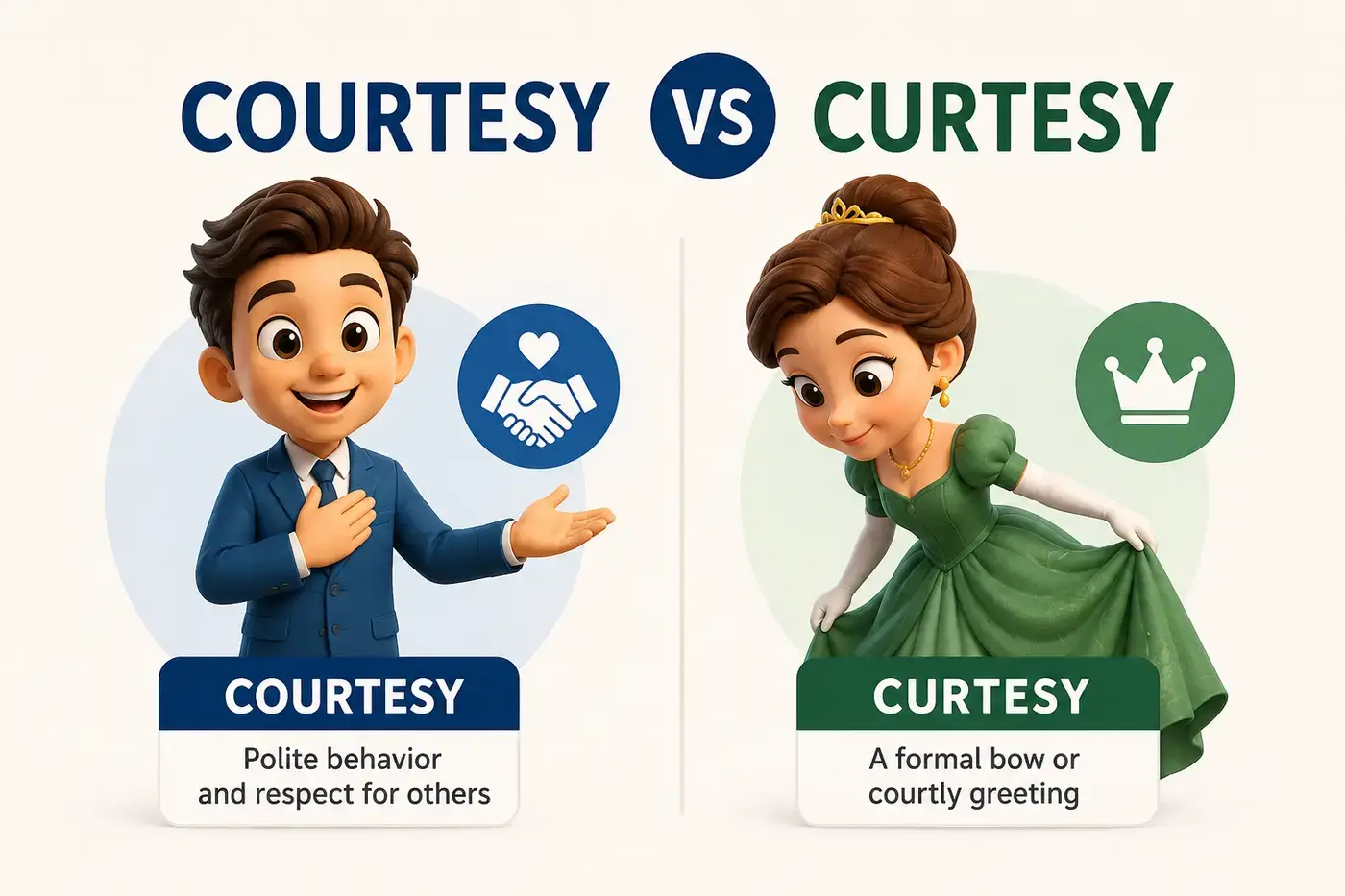
Have you ever typed courtesy vs curtesy and wondered if both spellings are acceptable? You are not alone. These two words look almost identical, but only one is the standard English spelling used for politeness, respect, and good manners.
The confusion happens because the letters are arranged so closely. Many people accidentally replace courtesy with curtesy while typing, reading quickly, or relying on autocorrect. The mistake becomes more common because English has many words with silent letters and unusual spelling patterns.
The correct word is courtesy. It refers to polite behavior, respect, kindness, or a helpful action given to someone. The spelling curtesy is generally considered incorrect in modern English when you mean good manners.
In this guide, you’ll learn the difference between courtesy and curtesy, why people confuse them, how to remember the correct spelling, where the word comes from, and how native speakers use it in everyday, professional, and formal writing.
Understanding this small spelling difference can improve your writing accuracy and help you avoid a common English mistake.
For another common grammar confusion, see Conex Or Connex Which Spelling Is Correct 2026 Guide.
Quick Answer
Courtesy is the correct spelling for polite behavior, respect, kindness, or a thoughtful action. Curtesy is usually a misspelling in modern English. Use courtesy in formal writing, conversations, emails, and professional communication.
Courtesy Vs Curtesy Comparison Table
| Feature | Courtesy | Curtesy |
|---|---|---|
| Correct spelling | Yes | No in modern English |
| Meaning | Polite behavior, respect, kindness, or a helpful gesture | Usually a spelling mistake |
| Part of speech | Noun | Not commonly accepted as a standard word |
| Pronunciation | KUR tuh see | Often confused with courtesy |
| Usage | Everyday speech, professional writing, formal communication | Rare and outdated usage |
| Common context | Courtesy call, courtesy service, common courtesy | Usually incorrect when referring to manners |
| Formal writing | Recommended | Avoid |
| Example | Thank you for your courtesy. | Incorrect: Thank you for your curtesy. |
What Does Courtesy Mean
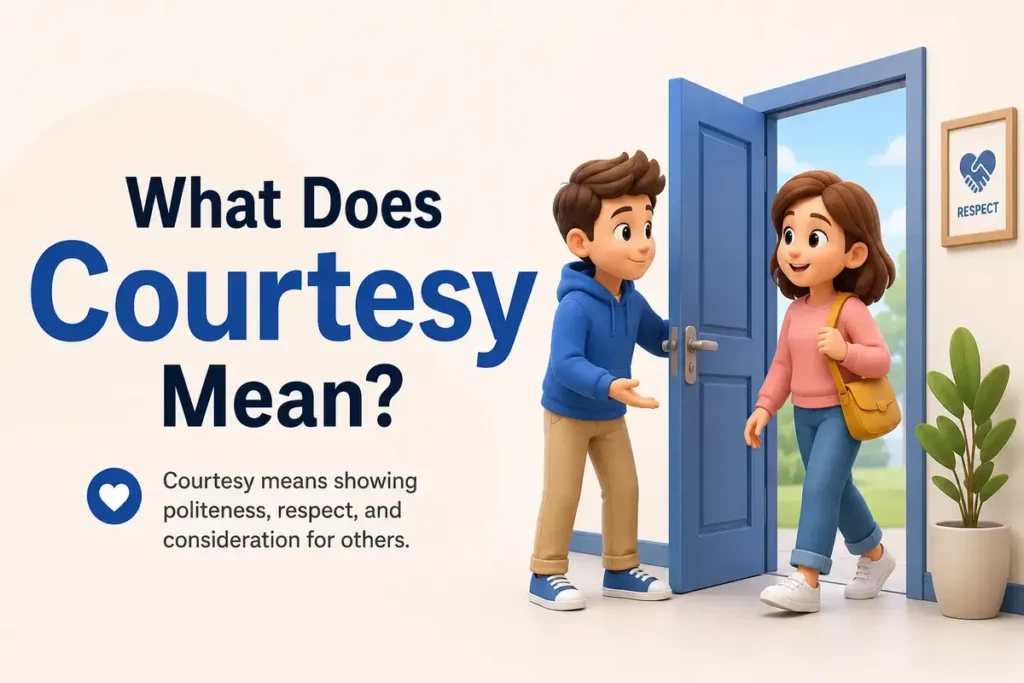
Courtesy is a noun that means polite behavior, respect, or consideration toward other people.
It describes actions that show kindness and good manners. Courtesy does not require a big gesture. Small actions like saying thank you, holding a door open, or listening carefully can all be examples of courtesy.
Simple Definition
Courtesy means showing respect and kindness through your words and actions.
Courtesy In Everyday Use
People use courtesy in many common situations.
Examples:
- She thanked the driver for his courtesy.
- A little courtesy can make a difficult conversation easier.
- He treated every customer with courtesy and respect.
- Common courtesy means being polite to others.
- The neighbor showed courtesy by keeping the noise low.
Courtesy In Professional Communication
Courtesy plays an important role in workplaces because respectful communication builds trust.
Examples:
- Thank you for your courtesy during the meeting.
- The company offered a courtesy call before the appointment.
- Professional emails should always maintain a tone of courtesy.
- The manager handled the complaint with patience and courtesy.
- Good workplace courtesy creates a positive environment.
Common Phrases With Courtesy
The word courtesy appears in many everyday expressions.
Common Courtesy
This means basic politeness and respect that people normally expect.
Example:
Please use common courtesy and clean up after yourself.
Courtesy Call
A courtesy call is a polite phone call made to provide information, check on someone, or offer assistance.
Example:
The hotel made a courtesy call to confirm our reservation.
Courtesy Of
This phrase means something is provided by someone or something.
Examples:
The photos are courtesy of the museum.
We received free tickets courtesy of the sponsor.
What Does Curtesy Mean
In modern English, curtesy is not the correct spelling when you are talking about manners or politeness.
Most uses of curtesy are simply spelling mistakes caused by confusion with courtesy.
However, historical English records sometimes show similar spellings connected to older forms of words. These rare historical uses do not represent standard modern English.
For everyday writing, emails, school assignments, business documents, and online content, use courtesy.
Which One Is Correct
The correct spelling is courtesy.
Use:
✔ Thank you for your courtesy.
The staff provided excellent courtesy service.
✔ She showed great courtesy during the discussion.
Avoid:
✘ Thank you for your curtesy.
✘ His curtesy made everyone feel welcome.
The spelling curtesy may look reasonable because English contains many words where letters change unexpectedly. However, modern dictionaries and style guides recognize courtesy as the correct form for politeness and respectful behavior.
Why People Confuse Courtesy And Curtesy
The confusion between these words comes from several common language patterns.
Similar Appearance
The two spellings differ by only one letter. When people read quickly, the missing letter o can go unnoticed.
Courtesy.
Curtesy.
The difference looks small, but it changes the accuracy of your writing.
Pronunciation Confusion
Many English learners spell words based on sound. Since the first syllable of courtesy is not strongly pronounced, some people leave out the ou spelling pattern.
English often keeps letters that are not obvious from pronunciation.
Examples:
- Favorite.
- Business.
- Wednesday.
- Courtesy.
Autocorrect Problems
Typing quickly on phones or computers can create spelling errors. If a person types a similar pattern, autocorrect may not always catch the mistake.
Always check important emails, documents, and articles instead of trusting automatic corrections completely.
Limited Reading Exposure
People who hear a word more often than they see it written may create their own spelling based on pronunciation.
Reading quality English sources helps build accurate spelling habits.
Internet Mistakes
A spelling error repeated online can sometimes look correct because many people use it. Search engines may show both forms, but popularity does not always mean accuracy.
Key Differences Between Courtesy And Curtesy
The main difference is simple.
Courtesy is a real modern English word.
Curtesy is not the standard spelling for polite behavior.
Meaning Difference
Courtesy means respect, kindness, or good manners.
Curtesy does not carry this meaning in normal modern English.
Grammar Difference
Courtesy works as a noun.
Examples:
- Her courtesy impressed everyone.
- Thank you for your courtesy.
Curtesy does not function as a standard noun in modern writing.
Usage Difference
Courtesy appears in:
- Daily conversations.
- Workplace communication.
- Customer service.
- Formal writing.
- Academic writing.
Curtesy should generally be avoided.
Grammar Explanation Of Courtesy
Understanding how courtesy works in a sentence helps you use it correctly.
Courtesy As A Noun
A noun names a person, place, thing, or idea.
Courtesy is an abstract noun because it describes an idea or quality rather than a physical object.
Examples:
- Courtesy improves communication.
- His courtesy was appreciated.
- The company values courtesy.
Singular And Plural Form
The singular form is:
Courtesy.
The plural form is:
Courtesies.
Examples:
- Her courtesy made a strong impression.
- The hotel offers many courtesies to guests.
Possessive Form
The possessive form shows ownership.
Examples:
- The customer appreciated the employee’s courtesy.
- The company’s courtesy policy helps staff communicate better.
Common Sentence Patterns
Courtesy often appears after words like:
- With.
- Of.
- For.
Examples:
- He acted with courtesy.
- The service was provided courtesy of the company.
- Thank you for your courtesy.
Spelling Rules Behind Courtesy
The spelling of courtesy can seem unusual because English pronunciation and spelling do not always match perfectly.
The word follows a common pattern where letters represent the word’s history rather than only its sound.
The correct spelling contains:
C O U R T E S Y
A helpful point to remember is that courtesy begins with cour, not cur.
Think of related words:
- Court.
- Courtesy.
- Courteous.
- Courteously.
The shared cour spelling connects these words.
You may also want to read Developed Vs Developped Which Spelling Is Correct 2026.
Pronunciation Guide For Courtesy
Correct pronunciation helps you recognize the word when speaking and writing.
Courtesy Pronunciation
IPA
American English: /ˈkɝː.tə.si/
British English: /ˈkɜː.tə.si/
Syllables
Cour te sy.
The stress falls on the first syllable.
COUR tuh see.
Many learners pronounce every letter clearly and say something like “cow ur tee see.” Native speakers usually pronounce it more smoothly.
Common Pronunciation Mistakes
A few common mistakes include:
- Adding extra stress to the middle syllable.
- Pronouncing the word exactly as it is spelled.
- Dropping the first vowel sound and creating the incorrect spelling curtesy.
Remember that English spelling often keeps letters that are not strongly heard in everyday speech.
Etymology And Word Origin Of Courtesy
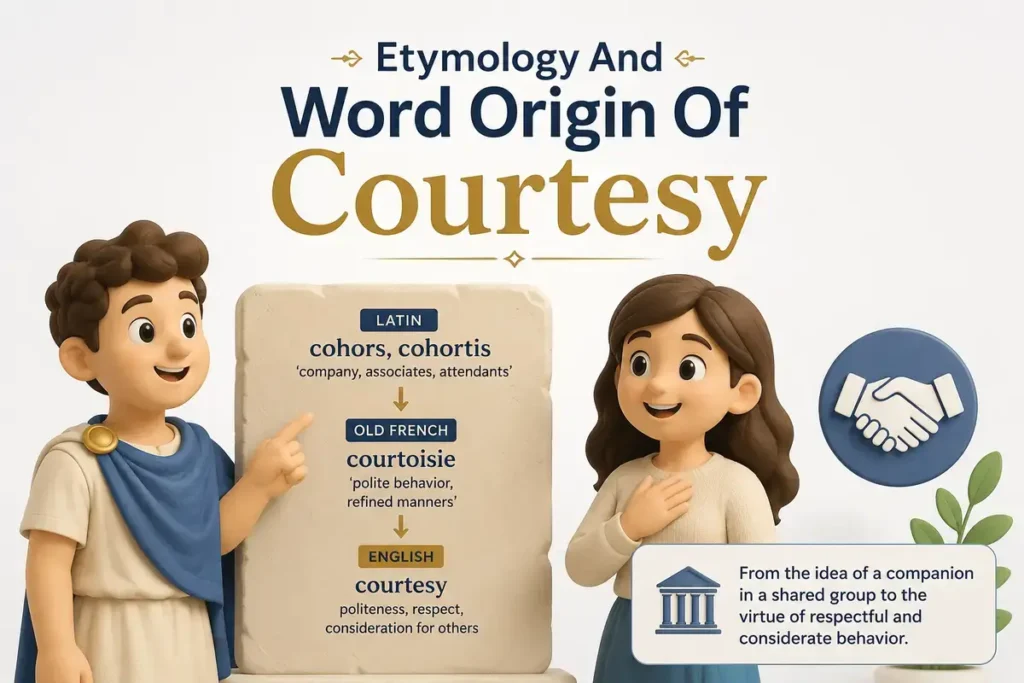
The history of courtesy explains why the spelling contains the letters our.
The word comes from Old French courtoisie, which meant polite behavior connected with court life.
It developed from the word court, referring to a royal or noble household. In medieval times, people associated court life with manners, respect, and proper social behavior.
Over time, the meaning expanded.
The word moved from describing behavior at a royal court to describing general politeness and respectful actions in everyday life.
Related words include:
- Court.
- Courteous.
- Courteously.
- Courtesy.
The shared spelling helps show their connection.
Courtesy In British And American English
The word courtesy is used in both British and American English.
There is no spelling difference between the two varieties.
Examples:
American English:
Thank you for your courtesy.
British English:
Thank you for your courtesy.
Canadian English and Australian English also use the same spelling.
The differences appear more in expressions and communication styles rather than spelling.
Formal Writing
In formal writing, courtesy is common and appropriate.
Examples:
- The company appreciates your courtesy and cooperation.
- We thank you for your courtesy during this process.
- The letter was written with courtesy and professionalism.
Informal Writing
In casual conversations, people often use phrases like:
- Thanks for your courtesy.
- I appreciate the courtesy.
- That was very courteous of you.
The word works well in both casual and professional settings.
Real Life Examples Of Courtesy
Seeing the word in different situations helps you understand its natural use.
Daily Conversation
- Your courtesy made my day easier.
- A little courtesy can improve any conversation.
- He thanked the waiter for his courtesy.
- Good manners are a simple form of courtesy.
Workplace Examples
- The employee handled the customer complaint with courtesy.
- Professional courtesy helps teams work together.
- The manager thanked everyone for their courtesy during the transition.
- The company provides a courtesy reminder before appointments.
- Treating coworkers with courtesy creates a respectful workplace.
Email Examples
- Thank you for your courtesy and quick response.
- I appreciate the courtesy you showed during our discussion.
- Your courtesy in handling this matter was greatly appreciated.
- Please accept my thanks for your courtesy.
Academic Writing
- Social courtesy plays an important role in human relationships.
- The study examines how courtesy affects communication.
- Researchers often connect courtesy with social respect and cooperation.
Journalism Examples
- The article praised the athlete’s courtesy toward fans.
- The interview showed the speaker’s honesty and courtesy.
- The report highlighted the importance of public courtesy.
Social Media Examples
- Thank you for your kindness and courtesy.
- Online conversations need more patience and courtesy.
- A simple message of courtesy can brighten someone’s day.
Common Mistakes With Courtesy
Even experienced writers sometimes make spelling or usage mistakes.
Writing Curtesy Instead Of Courtesy
Incorrect:
Thank you for your curtesy.
Correct:
Thank you for your courtesy.
The missing o is the main spelling error.
Confusing Courtesy With Courteous
These words are connected but have different grammar roles.
Courtesy is a noun.
Example:
Her courtesy impressed everyone.
Courteous is an adjective.
Example:
She was courteous to every guest.
A helpful rule:
Courtesy is the action.
Courteous describes the person performing the action.
Using Courtesy When You Mean Free
Some learners confuse the phrase courtesy of with a general meaning of free.
Example:
The tickets were provided courtesy of the company.
This means the company provided the tickets.
Adding Unnecessary Plurals
Incorrect:
He showed many courtesy during the meeting.
Correct:
He showed great courtesy during the meeting.
Use courtesies only when talking about separate acts of kindness.
Example:
The hotel offered several courtesies to its guests.
Memory Tricks To Remember Courtesy
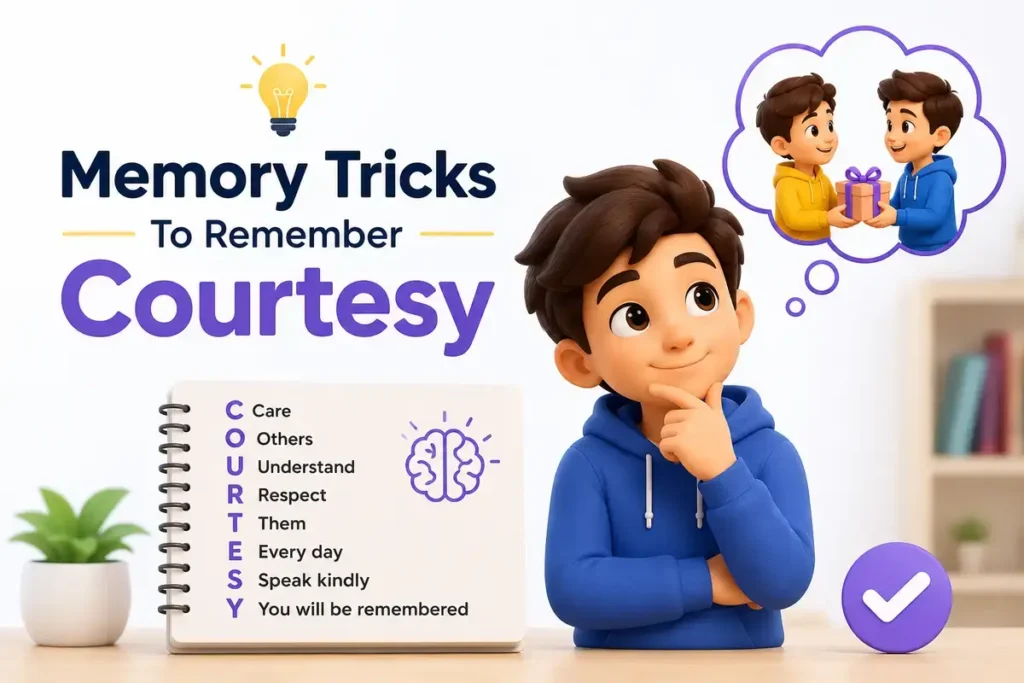
Spelling becomes easier when you connect words with ideas.
Remember The Court Connection
Think:
Court → Courteous → Courtesy.
All three words share the same beginning.
A royal court was historically linked with good manners and respectful behavior.
Remember The Extra O
The correct spelling has one extra vowel.
Courtesy has:
C O U R T E S Y.
Think:
Good manners deserve an extra O.
Connect Courtesy With Courteous
If you know the adjective courteous, you can remember the noun courtesy.
Examples:
She is courteous.
She shows courtesy.
Related Words And Similar Expressions
Understanding related vocabulary helps you use courtesy naturally.
Synonyms For Courtesy
- Politeness.
- Respect.
- Kindness.
- Consideration.
- Good manners.
- Civility.
- Respectfulness.
Opposites Of Courtesy
- Rudeness.
- Disrespect.
- Impoliteness.
- Insensitivity.
- Hostility.
Related Expressions
Common Courtesy
Basic polite behavior expected in society.
Example:
Using common courtesy means treating people with respect.
Professional Courtesy
Respectful behavior between people in the same workplace or profession.
Example:
Doctors often show professional courtesy toward colleagues.
Courtesy Copy
A copy of a message sent to someone for information.
Example:
I added my manager as a courtesy copy.
Courtesy Visit
A polite visit made to show respect or maintain a relationship.
Example:
The ambassador made a courtesy visit.
Expert Editor’s Note
Professional editors look at spelling accuracy, meaning, and audience.
For modern English writing, courtesy is the only spelling you should use for politeness, respect, or kindness.
Major dictionaries list courtesy as the standard word. The form curtesy appears mainly as an error or in rare historical contexts, so it does not belong in normal writing.
If you are writing an email, article, school assignment, report, or professional document, choose courtesy.
Native speakers recognize the word instantly because it appears in many familiar phrases such as common courtesy, courtesy call, and courtesy of.
Good editing is often about small details. A single missing letter can change the quality of your writing.
Frequently Asked Questions
Is Courtesy Or Curtesy Correct?
Courtesy is the correct spelling in modern English when referring to politeness, respect, or kindness. Curtesy is usually a misspelling and should be avoided in everyday writing.
Is Curtesy Ever A Real Word?
Yes, but only in a historical legal sense. Curtesy was once a legal term in English common law that referred to a husband’s life interest in his deceased wife’s property under certain conditions. That meaning is now largely obsolete and unrelated to politeness.
Why Do People Spell Courtesy As Curtesy?
The mistake usually happens because the words sound similar. Fast typing, pronunciation, and unfamiliarity with the correct spelling cause many people to leave out the o in courtesy.
How Can I Remember The Correct Spelling?
Think of the word court. Both court and courtesy begin with cour. Since courtesy originally came from the manners expected at a royal court, this connection makes the spelling much easier to remember.
Is Courtesy Formal Or Informal?
Courtesy works in both formal and informal English. It appears in business emails, academic writing, customer service, everyday conversations, and official documents.
What Is The Difference Between Courtesy And Courteous?
Courtesy is a noun that refers to polite behavior or respect.
Courteous is an adjective that describes someone who behaves politely.
Example:
She showed great courtesy.
She was courteous to everyone.
Is Courtesy Used In American And British English?
Yes. American English, British English, Canadian English, and Australian English all use the spelling courtesy. There is no regional spelling difference.
What Are Some Common Expressions With Courtesy?
Native speakers often use phrases such as common courtesy, professional courtesy, courtesy call, courtesy reminder, and courtesy of. These expressions are widely accepted in both spoken and written English.
Need another quick comparison? Read Focussing Or Focusing Which Spelling Is Correct 2026 Guide.
Conclusion
The answer to courtesy vs curtesy is straightforward.
Courtesy is the correct spelling for politeness, respect, kindness, and thoughtful behavior. It is the form used in dictionaries, style guides, schools, workplaces, and everyday communication.Curtesy is usually a spelling mistake when you mean good manners. Although it has an old legal meaning, that usage is obsolete and rarely appears outside historical discussions.The easiest way to remember the correct spelling is to connect courtesy with court and courteous. All three words share the same beginning and a common history.When in doubt, choose courtesy. One extra letter keeps your writing accurate, professional, and easy to understand.

Editorial Reviewer & Proofreader
Grace Mitchell reviews Gramlify’s articles for clarity, consistency, and readability. She is passionate about creating accurate, approachable content that helps English learners build confidence.
1 thought on “Courtesy Vs Curtesy Which Word Is Correct 2026”