
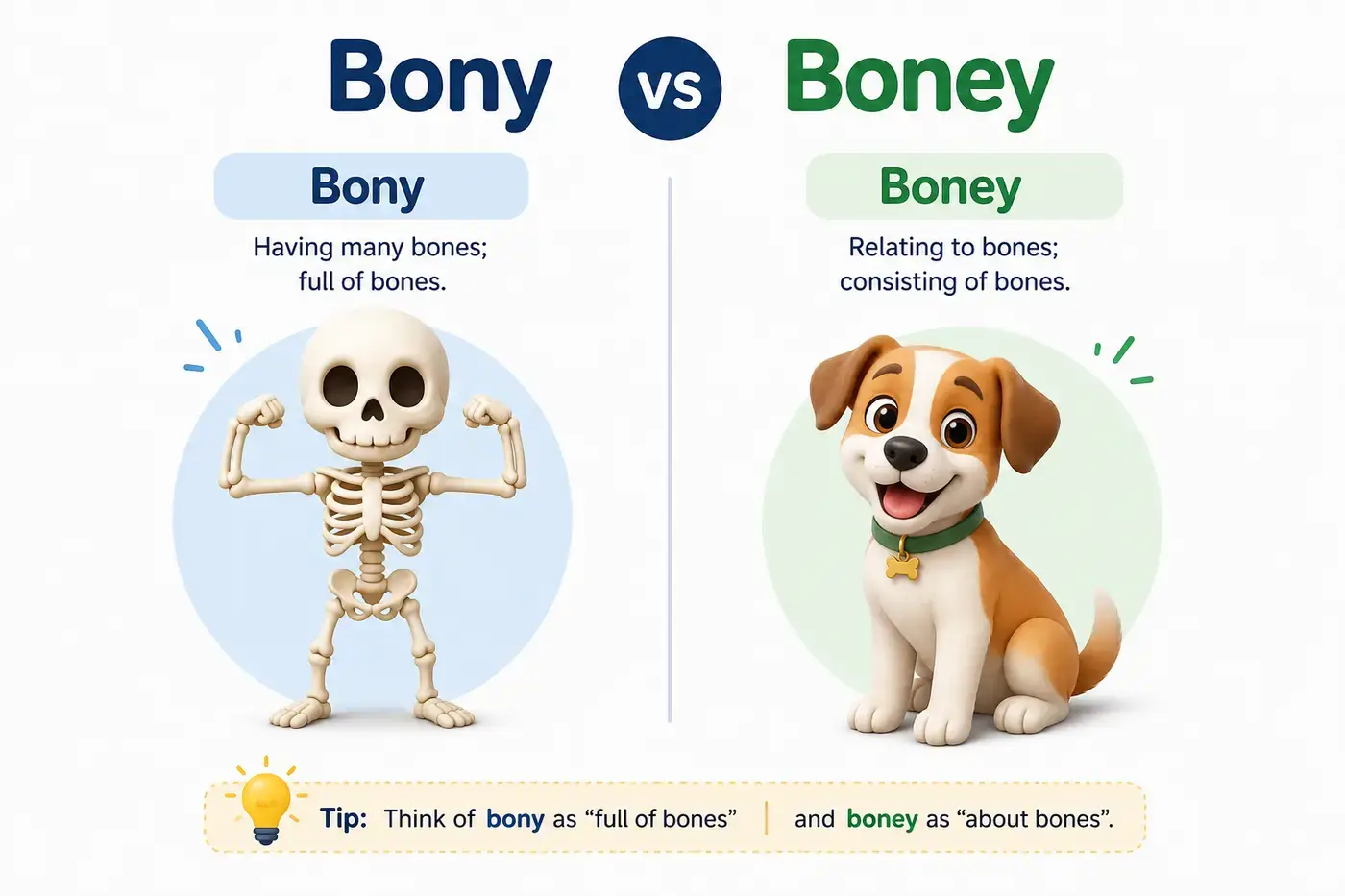
English has many word pairs that look almost identical but carry different meanings. Bony vs boney is one of those confusing pairs. Many writers wonder if one spelling is wrong, if both words are acceptable, or when to use each form.
The short answer is that both bony and boney can be correct, but they are not always used in the same way. Bony is the standard and much more common spelling. It usually describes something related to bones or something with a noticeable bone structure. Boney is a less common variant that can describe something full of bones or something resembling bone, but many style guides and editors prefer bony in most situations.
The confusion happens because English often allows different spellings to develop over time. The ending y can sometimes change to ey in certain words, especially when speakers try to show pronunciation or create a visual connection with the base word.
In this guide, you’ll learn the difference between bony vs boney, their meanings, grammar rules, spelling patterns, examples, common mistakes, and how professional writers choose the correct form.
Learn the difference in Busing Or Bussing Which Spelling Is Correct (2026 Guide).
Quick Answer
Bony is the preferred and most common spelling. It means related to bones, containing bones, or having a thin appearance where bones are noticeable. Boney is a less common variant that has the same basic meaning in some contexts, but most modern writing uses bony.
Bony Vs Boney Comparison Table
| Feature | Bony | Boney |
|---|---|---|
| Correct spelling | Yes | Yes but less common |
| Common usage | Very common | Rare |
| Meaning | Related to bones or showing bones clearly | Similar meaning but less preferred |
| Part of speech | Adjective | Adjective |
| Pronunciation | BOH nee | BOH nee |
| Formal writing | Preferred choice | Less common |
| Everyday use | Natural and widely accepted | Unusual |
| Example | She has a bony hand. | The old creature had a boney structure. |
What Does Bony Mean
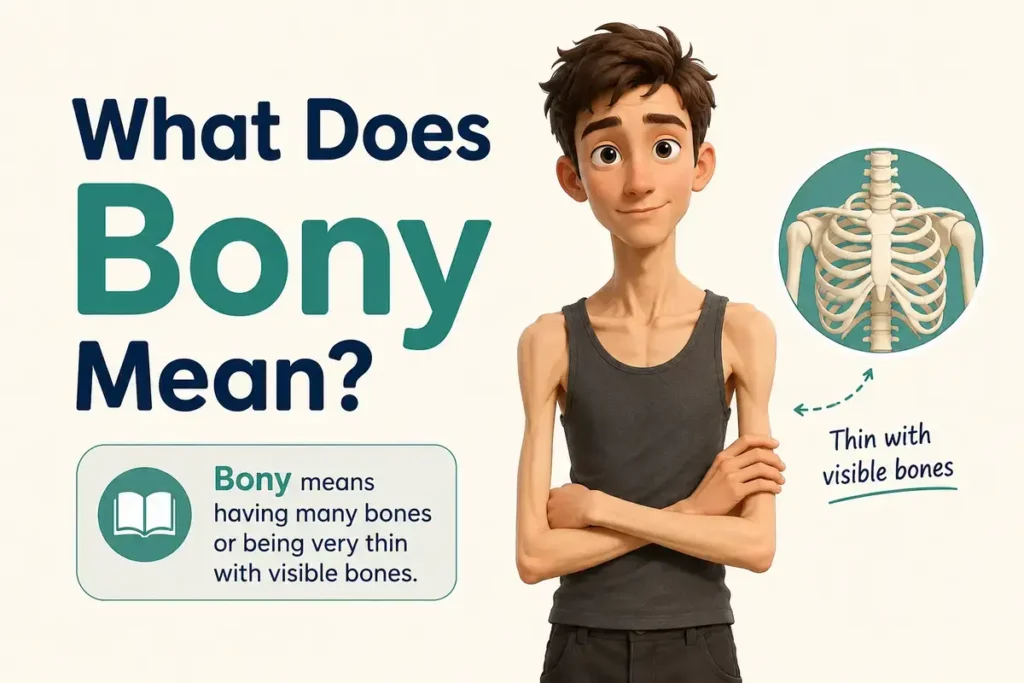
Bony is an adjective that describes something connected to bones or something that has a lot of visible bone structure.
It is the standard spelling used in modern English.
Bony Definition
- Related to bones.
- Made of or containing bones.
- Having bones that are easy to see because of a lack of flesh or body fat.
Bony Meaning In Different Contexts
The meaning changes slightly depending on how it is used.
Describing A Person
When describing a person, bony usually means thin with visible bones.
Examples:
- The old man had bony hands.
- After losing weight, her shoulders looked bony.
- The doctor examined his bony fingers.
In these examples, the word focuses on physical appearance.
Describing Body Parts
Bony often describes parts of the body where bones are naturally noticeable.
Examples:
- Bony knees.
- Bony elbows.
- Bony wrists.
- Bony fingers.
Describing Structures
Bony can also describe things connected to the skeleton.
Examples:
- The researcher studied the bony structure of the animal.
- The bird has a lightweight bony frame.
- The museum displayed bony remains from ancient creatures.
What Does Boney Mean
Boney is a variant spelling of bony. It appears in some dictionaries, but it is far less common in modern English.
Most writers choose bony because it is shorter, cleaner, and more widely accepted.
Boney Definition
Boney means:
- Containing bones.
- Having a bone like appearance.
- Related to bones.
The meaning overlaps with bony, but the spelling is less common.
Examples Of Boney Usage
- The animal left behind a boney skeleton.
- Scientists discovered a boney structure inside the fossil.
- The artwork showed a boney figure.
Although these sentences are understandable, many editors would naturally write:
- The animal left behind a bony skeleton.
- Scientists discovered a bony structure inside the fossil.
- The artwork showed a bony figure.
The spelling bony usually sounds more natural to native English speakers.
Which One Is Correct
Both spellings exist, but bony is the correct choice for most writing situations.
Use bony when you want the standard modern spelling.
Examples:
- Her bony fingers moved slowly across the page.
- The doctor examined the bony area near the injury.
- The skeleton had a strong bony structure.
Use boney only when a specific dictionary, publication style, or personal preference allows the less common variant.
For professional writing, academic work, emails, and general communication, bony is the safer choice.
Why People Confuse Bony And Boney
The confusion comes from several language patterns.
Similar Appearance
The two words differ by only one letter. When people see the base word bone, they naturally want to add y and create boney.
This happens because many English words keep the spelling of their root word.
For example:
- Money.
- Honey.
- Journey.
Because these words end with ey, some writers assume boney follows the same pattern.
However, English spelling does not always follow a simple pattern.
The Base Word Bone Creates Confusion
The word bone ends with an e, so writers often think adding y should keep that letter.
They may write:
Bone + y = boney.
But the standard adjective formation removes the silent e.
Bone + y = bony.
This pattern appears in other English words.
Examples:
- Ice becomes icy.
- Noise becomes noisy.
- Taste becomes tasty.
The silent e often disappears before adding y.
Pronunciation Similarity
Both words are pronounced the same.
Because pronunciation gives no clue, writers must rely on spelling and usage.
Internet And Informal Writing
Online writing sometimes spreads uncommon spellings. When people repeatedly see boney on websites or social media, they may assume it is the preferred spelling.
Frequency matters. The more common spelling in edited writing is usually the better choice.
Key Differences Between Bony And Boney
The main difference is not meaning. The main difference is usage and frequency.
Spelling
Bony is the standard spelling.
Boney is a rare variant.
Grammar
Both words function as adjectives.
They describe a noun.
Examples:
- A bony hand.
- A boney hand.
The grammar works in both sentences, but the first sounds more natural.
Writing Style
Professional writers usually choose bony because readers recognize it immediately.
In formal writing, consistency and familiarity matter.
Frequency
You will see bony much more often in:
- Books.
- Newspapers.
- Medical writing.
- Academic texts.
- Dictionaries.
Boney appears much less frequently.
Bony Vs Boney Grammar Explanation
Understanding the grammar behind bony vs boney makes the spelling choice much easier. Both words work as adjectives, which means they describe a person, animal, object, or condition.
An adjective gives more information about a noun.
Examples:
- A bony hand.
- A bony structure.
- A boney appearance.
In each example, the adjective explains something about the noun.
Bony As An Adjective
Bony describes something connected to bones or something where bones are noticeable.
Examples:
- The old man had bony fingers.
- The bird has a lightweight bony frame.
- The injury affected the bony part of the shoulder.
The word does not change based on singular or plural nouns.
Examples:
- A bony arm.
- Two bony arms.
- A bony skeleton.
- Several bony structures.
Boney As An Adjective
Boney also works as an adjective, but it is less common.
Examples:
- The artist created a boney figure.
- The fossil showed a boney shape.
- The creature had a boney appearance.
Although these sentences are understandable, many editors would replace boney with bony.
Spelling Rules For Bony
The spelling of bony follows an important English pattern.
When a word ends with a silent e and you add y to create an adjective, the final e often disappears.
The pattern looks like this:
Bone + y = bony.
Similar examples include:
- Ice + y = icy.
- Noise + y = noisy.
- Taste + y = tasty.
- Ease + y = easy.
The final e is removed because keeping it would make the spelling look unusual and less natural.
Why Boney Looks Possible
The spelling boney feels natural because many English words end in ey.
Examples:
- Honey.
- Money.
- Key.
- Valley.
However, those words do not follow the same rule. They are not formed by adding y to another word.
The word bony comes from bone, so it follows adjective formation rules.
Still confused? Compare Copys Or Copies Which Is Correct 2026.
Pronunciation Guide For Bony And Boney
Both spellings have the same pronunciation.
Bony Pronunciation
IPA:
/ˈboʊni/
Syllables:
Bo ny.
Stress pattern:
The first syllable receives the main stress.
Boney Pronunciation
IPA:
/ˈboʊni/
Syllables:
Bo ney.
Stress pattern:
The first syllable receives the main stress.
Since both words sound identical, pronunciation does not help you choose the correct spelling. Meaning and writing habits are the deciding factors.
Word Origin Of Bony And Boney
Understanding the history of these words explains why the spelling developed this way.
Origin Of Bone
The word bone comes from Old English bān, which referred to the hard structure inside the body.
Over centuries, the word remained connected with:
- The skeleton.
- Body structure.
- Hard internal parts of animals and humans.
Development Of Bony
English speakers formed bony by adding the adjective ending y to bone.
The meaning developed naturally:
Bone became bony.
Similar examples:
- Cloud became cloudy.
- Dirt became dirty.
- Rain became rainy.
The adjective describes something connected with or showing the original noun.
Development Of Boney
The spelling boney developed as a variant because speakers connected the word visually with bone.
English has many spelling variations that appeared through history because people wrote words based on sound, appearance, or regional habits.
Today, bony remains the preferred spelling.
British Vs American English
The difference between bony and boney is not mainly about British or American English.
Both English varieties recognize bony as the standard form.
American English
American writers almost always use:
✔ Bony.
Example:
The dog had a bony body after being sick.
British English
British writers also prefer:
✔ Bony.
Example:
The skeleton revealed a bony structure.
Canadian And Australian English
Canadian and Australian English follow the same pattern.
Bony is the normal spelling in professional and everyday writing.
The choice is based on style rather than region.
Real Life Examples Of Bony Usage
Seeing the word in different situations helps you understand how native speakers use it.
Daily Conversation
- His bony fingers were easy to notice.
- The cat became bony after losing too much weight.
- Her bony shoulders made her jacket look loose.
- The child had small but bony hands.
Workplace
- The doctor examined the bony area near the injury.
- The research team studied the bony structure of the animal.
- The medical report described changes in the bony tissue.
- The engineer analyzed the bony framework of the model.
Emails And Professional Writing
- The scan showed a change in the bony structure.
- Please review the report about the bony development of the specimen.
- The specialist explained the condition affecting the bony region.
Academic Writing
- Scientists studied the bony remains of ancient animals.
- The article discusses the evolution of bony structures.
- Researchers compared the bony features of different species.
Literature
- The character was described as having long bony fingers.
- The writer created an image of a thin figure with bony hands.
- The story described a mysterious creature with a bony face.
Journalism
- The article reported the discovery of bony fossils.
- Experts examined the bony remains found at the site.
- The photograph showed a bony animal affected by poor nutrition.
Common Mistakes With Bony And Boney
Even fluent speakers sometimes hesitate between these spellings.
Mistake 1 Using Boney In Formal Writing
Incorrect:
The scientist studied the boney structure of the fossil.
Better:
The scientist studied the bony structure of the fossil.
The standard spelling looks more professional and familiar.
Mistake 2 Thinking Boney Is Always Wrong
While bony is preferred, boney is not simply a random spelling mistake. It exists as a variant form.
The issue is not correctness alone. It is about choosing the form that readers expect.
Mistake 3 Keeping The Silent E
Some writers think:
Bone + y = boney.
This mistake happens because English learners often apply a simple adding rule.
Remember:
Silent e often disappears before adding y.
Mistake 4 Confusing Bony With Bonny
These words look similar but have different meanings.
Bony means related to bones.
Bonny means attractive, pleasant, or beautiful, especially in some British and Scottish uses.
Examples:
- The horse had a bony frame.
- The child had a bonny smile.
They are not interchangeable.
Memory Tricks To Remember Bony Vs Boney
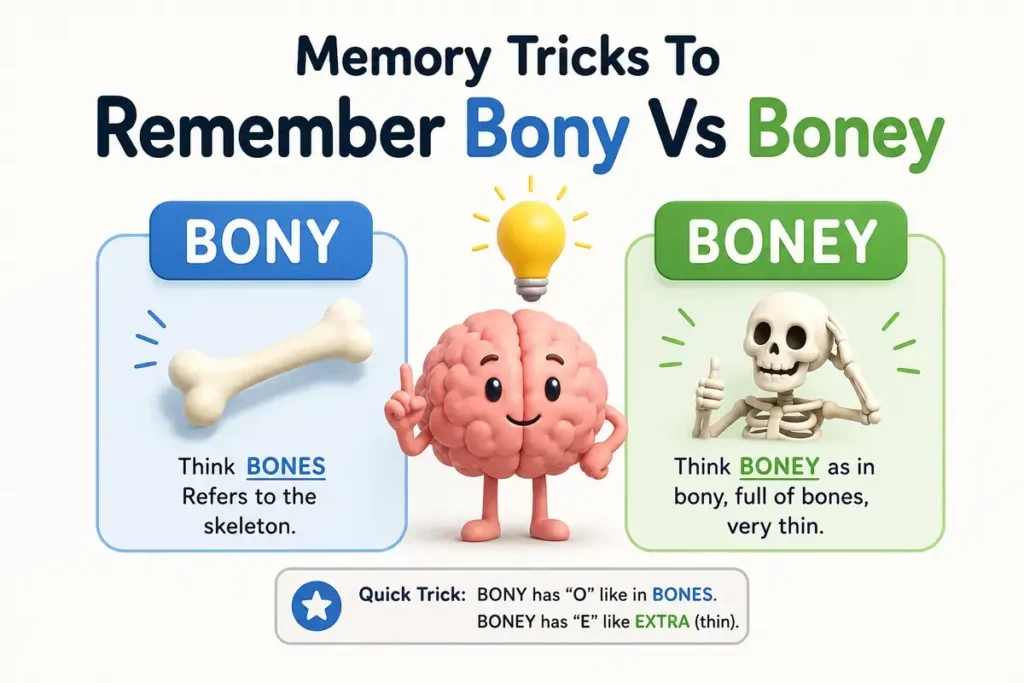
Remembering the correct spelling becomes easier when you connect the word with its meaning.
Think About The Silent E
The word starts with bone.
When you add y to many words ending in silent e, the e disappears.
Examples:
- Bone becomes bony.
- Ice becomes icy.
- Smoke becomes smoky.
- Shine becomes shiny.
This simple pattern helps you choose bony confidently.
Connect Bony With Body Bones
The spelling bony looks shorter and cleaner, just like the word bone after removing the silent letter.
Think:
Bone plus y equals bony.
The word stays connected to the body part it describes.
Remember Boney Is Less Common
If you are writing an article, report, email, or school assignment, choose bony first.
A useful reminder:
Bony is the normal choice. Boney is the uncommon choice.
Related Words And Similar Expressions
Understanding related vocabulary helps you avoid confusion.
Words Related To Bony
Bone
A hard structure inside the body that supports and protects organs.
Example:
The human body has more than two hundred bones.
Bony
Connected with bones or showing bones clearly.
Example:
The animal had a bony frame.
Boneless
Without bones.
Example:
The restaurant serves boneless chicken.
Skeleton
The complete framework of bones in a body.
Example:
Scientists studied the dinosaur skeleton.
Skeletal
Related to the skeleton.
Example:
The doctor examined the skeletal system.
Synonyms For Bony
Depending on the meaning, these words can replace bony.
When Describing Thin Appearance
- Skinny.
- Thin.
- Lean.
- Gaunt.
- Frail.
Example:
Her bony hands looked delicate.
Similar:
Her thin hands looked delicate.
When Describing Structure
- Osseous.
- Skeletal.
- Bone related.
Example:
The study examined bony tissue.
Similar:
The study examined skeletal tissue.
Opposites Of Bony
The opposite depends on the context.
For Body Appearance
- Plump.
- Rounded.
- Full.
- Soft.
Example:
His bony face changed after gaining weight.
For Structure
- Soft.
- Flexible.
- Non skeletal.
Expert Editor’s Note
From an editor’s perspective, bony is the clear winner for everyday and professional writing.
Most dictionaries list bony as the primary spelling. Some dictionaries recognize boney as a variant, but it appears far less often.
Professional writers usually choose the spelling readers expect. Since bony is more familiar, it creates less confusion and makes the sentence look more polished.
For academic writing, medical writing, journalism, and educational content, bony is the recommended choice.
A skilled editor also checks the meaning before correcting a word. If a writer uses boney, the editor should understand that the writer likely means bony, not automatically treat it as a spelling error.
Good editing is not only about rules. It is about clarity.
Frequently Asked Questions
Is Bony Or Boney The Correct Spelling?
Both spellings exist, but bony is the standard and most common spelling. It is the form preferred in modern English writing. Boney is a rare variant and is usually avoided in formal communication.
Does Boney Mean The Same As Bony?
Yes. In many contexts, boney has the same meaning as bony. Both can describe something related to bones or something with visible bones. The difference is mainly frequency and style.
Is Bony An Adjective?
Yes. Bony is an adjective because it describes a noun. Examples include bony fingers, bony hands, bony structure, and bony remains.
Why Is Bony Spelled Without An E?
The silent e in bone is removed when the adjective ending y is added. This follows a common English spelling pattern where words ending in silent e often drop the e before adding y.
Is Boney A Spelling Mistake?
Not always. Boney appears as a variant spelling in some references. However, it is uncommon, and most writers choose bony because it is the accepted modern form.
What Is The Difference Between Bony And Bonny?
Bony relates to bones or a thin appearance. Bonny means attractive, pleasant, or beautiful, especially in some British and Scottish English uses. They have different meanings despite looking similar.
How Do You Pronounce Bony And Boney?
Both words are pronounced the same way: BOH nee. The pronunciation does not change, so spelling and context help you choose the right form.
Should I Use Bony In Formal Writing?
Yes. Bony is the better choice for formal writing, academic work, professional documents, and general communication. It is more familiar and widely accepted.
For another common grammar confusion, see Encorporate Vs Incorporate Which Spelling Is Correct 2026.
Conclusion
The answer to bony vs boney is simple. Both spellings can appear in English, but bony is the standard choice that works best in most situations.
Use bony when describing something related to bones, a visible bone structure, or a thin appearance. Use boney only if you are following a source that specifically uses the less common variant.
The biggest mistake is assuming the word should keep the silent e from bone. English spelling often changes when endings are added.

Editorial Reviewer & Proofreader
Grace Mitchell reviews Gramlify’s articles for clarity, consistency, and readability. She is passionate about creating accurate, approachable content that helps English learners build confidence.
1 thought on “Bony Vs Boney Which Spelling Is Correct 2026 Guide”