
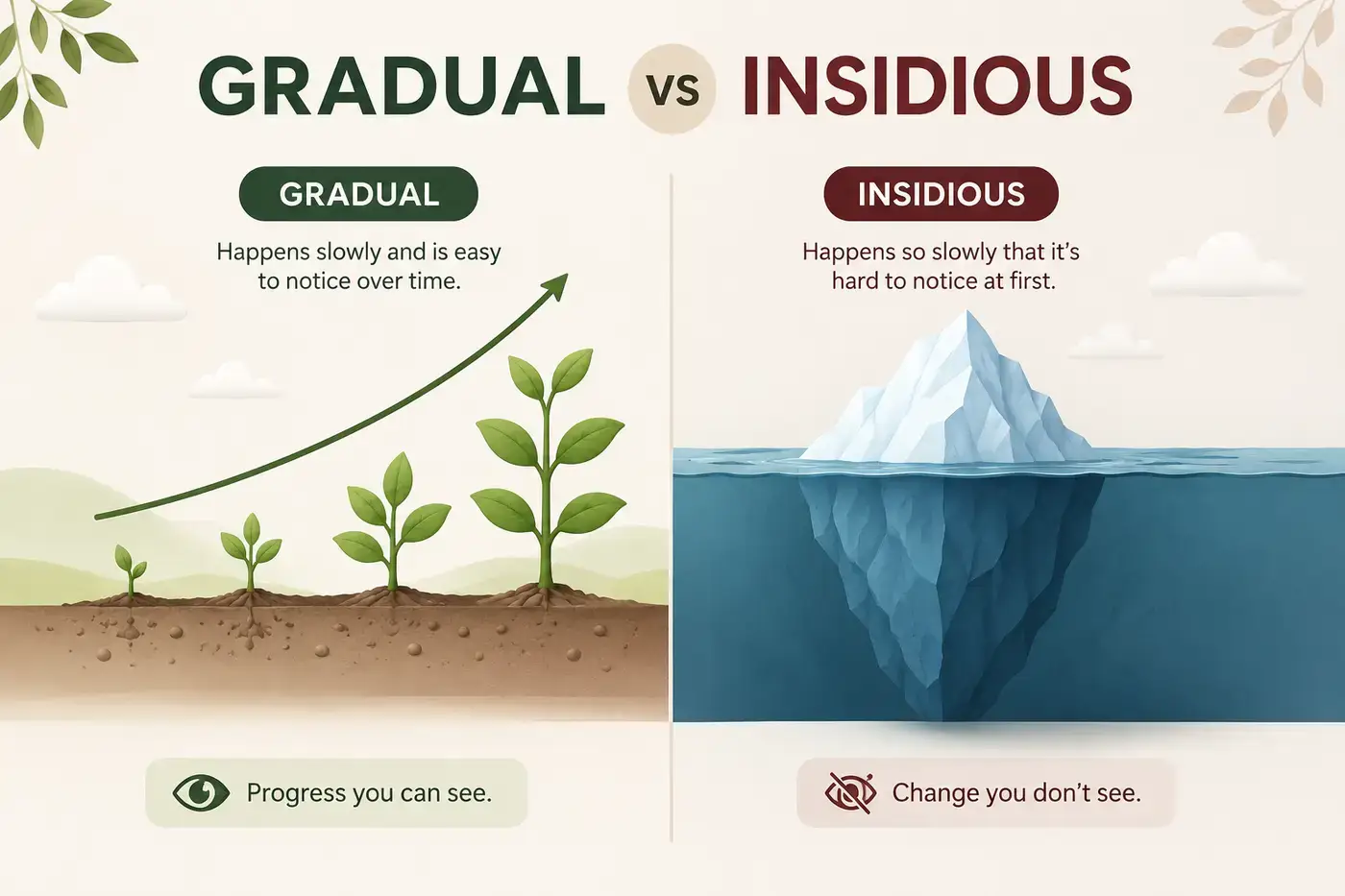
Many English learners confuse gradual vs insidious because both words describe something that happens slowly. At first glance, they seem interchangeable, but they carry very different meanings. One describes a slow process that usually happens in a noticeable or natural way. The other describes a slow change that often causes harm while staying hidden.
The confusion happens because both words connect with the idea of time. A gradual change may take weeks months or years, while an insidious change can also develop slowly over time. The difference is not speed alone. The real difference is the intention, effect, and feeling behind the change.
A gradual change is often neutral or positive. For example, a person may experience gradual improvement in their health. An insidious change is usually negative because it slowly creates damage, problems, or danger without being obvious at first.
In this guide, you’ll learn the exact difference between gradual and insidious, how native speakers use these words, common mistakes to avoid, grammar rules, pronunciation, examples, and expert writing tips.
Understanding this difference will help you choose the right word in everyday conversations, professional writing, academic work, and formal communication.
A related grammar guide is Investor Vs Investee Which Word Is Correct 2026 Guide.
Quick Answer
Gradual means something happens slowly over time, usually through small steps and without sudden changes. Insidious means something develops slowly in a harmful or deceptive way, often without being noticed at first. Both words describe slow processes, but gradual is usually neutral or positive, while insidious is usually negative.
Gradual Vs Insidious Comparison Table
| Feature | Gradual | Insidious |
|---|---|---|
| Part of speech | Adjective | Adjective |
| Main meaning | Happening slowly over time | Developing slowly while causing harm |
| Emotional tone | Neutral or positive | Negative |
| Focus | The speed or process of change | Hidden danger or harmful effects |
| Common contexts | Growth, improvement, change, learning | Disease, problems, threats, corruption |
| Pronunciation | /ˈɡrædʒ.u.əl/ | /ɪnˈsɪd.i.əs/ |
| Formality | Common in formal and informal writing | More common in formal writing |
| Example | She made gradual progress in English. | The disease had an insidious effect on his health. |
| Similar words | Slow, steady, progressive | Harmful, hidden, deceptive |
| Opposites | Sudden, rapid | Open, harmless, obvious |
What Does Gradual Mean
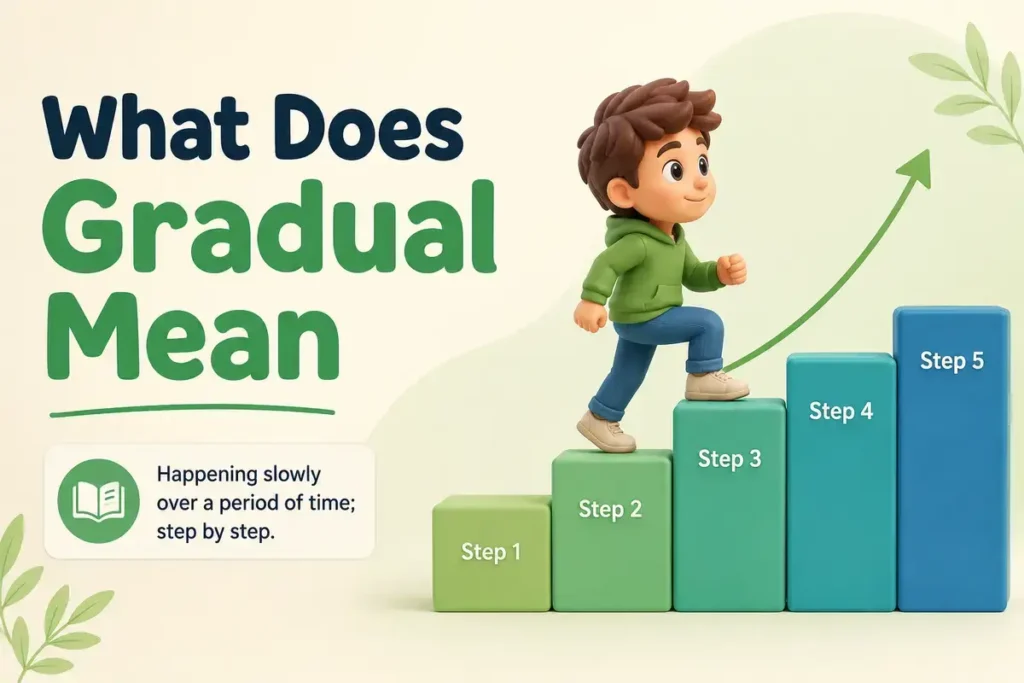
Gradual means happening slowly and steadily over a period of time. It describes a change that occurs step by step rather than suddenly.
The word focuses on the process and speed of change. It does not automatically suggest anything good or bad.
Simple Definition
Gradual means developing slowly through small changes over time.
Meaning And Usage Of Gradual
People use gradual when something increases, decreases, improves, or changes little by little.
Examples:
- The patient showed gradual improvement after treatment.
- Climate changes often happen through gradual shifts over many years.
- She made gradual progress while learning a new language.
- The company saw gradual growth after launching its new product.
- His confidence grew through gradual practice.
In these examples, the changes are slow but not hidden or harmful.
Gradual In Different Contexts
Everyday Conversation
People often use gradual to describe personal growth or lifestyle changes.
Example:
My fitness improved through gradual changes in my daily routine.
Workplace
Professionals use gradual when discussing slow progress, development, or transitions.
Example:
The team noticed gradual improvement in customer satisfaction.
Academic Writing
Researchers often use gradual to explain slow patterns or developments.
Example:
The study found a gradual increase in temperature levels.
Health And Medicine
Doctors use gradual to describe symptoms or recovery that develops slowly.
Example:
The patient experienced gradual recovery after surgery.
Learning And Skills
Teachers often recommend gradual progress because strong skills develop over time.
Example:
Language learning requires gradual improvement through regular practice.
What Does Insidious Mean
Insidious means developing slowly in a way that is harmful, dangerous, or difficult to notice.
Unlike gradual, this word carries a negative meaning. It suggests that something harmful is spreading or becoming stronger while people may not realize the danger immediately.
Simple Definition
Insidious means slowly causing harm while remaining hidden or unnoticed.
Meaning And Usage Of Insidious
The word is often used for problems, diseases, behaviors, or influences that gradually create damage.
Examples:
- The disease had an insidious effect because symptoms appeared very slowly.
- The organization faced an insidious problem that damaged trust over time.
- Experts warned about the insidious spread of misinformation.
- Stress can have an insidious impact on mental and physical health.
- The harmful habit developed in an insidious way.
In each example, the slow development creates a negative result.
Insidious In Different Contexts
Health And Medicine
Doctors often use insidious for illnesses that develop quietly.
Example:
Some diseases have an insidious beginning and may not show clear warning signs.
Society And Culture
Writers use insidious to describe hidden social problems.
Example:
The article discussed the insidious effects of online manipulation.
Workplace
The word can describe problems that slowly damage an organization.
Example:
Poor communication created an insidious workplace issue.
Literature And Journalism
Authors often choose insidious when describing hidden threats or villains.
Example:
The novel follows an insidious plan that slowly affects the entire community.
Which One Is Correct
Both gradual and insidious are correct English words. The correct choice depends on the meaning you want to express.
Use gradual when you only want to describe a slow change.
Use insidious when you want to describe a slow change that is harmful, dangerous, or difficult to detect.
Compare these examples:
✔ The company experienced gradual growth.
This means the company grew slowly over time.
✔ The company faced an insidious problem.
This means a hidden problem slowly caused damage.
Incorrect use:
✘ The student made insidious progress in mathematics.
Progress is usually positive, so gradual is the better choice.
✔ The student made gradual progress in mathematics.
Incorrect use:
✘ The disease showed gradual effects that were dangerous and hidden.
This sentence may need insidious because the focus is on hidden harm.
✔ The disease had insidious effects that were difficult to detect.
Why People Confuse Gradual And Insidious
The confusion happens because both words describe changes that happen slowly. However, their emotional meaning separates them.
Both Words Describe Slow Development
The biggest connection is time.
A gradual process takes place little by little.
An insidious process also develops little by little.
This shared idea makes the words appear similar.
People Focus Only On Speed
Many learners remember only one part of the definition: slow.
They forget that insidious adds another meaning: harmful or hidden.
Slow does not always mean dangerous.
A gradual sunrise is beautiful.
An insidious disease is dangerous.
Similar Use In Descriptions
Both words often appear before nouns connected with change.
Examples:
Gradual change.
Insidious change.
Gradual effect.
Insidious effect.
The nouns may look similar, but the meaning changes completely.
Dictionary Definitions Can Feel Similar
Some dictionary definitions use words like slow, gradual, or developing over time when explaining insidious. This can confuse learners.
The important detail is the hidden negative impact.
Key Differences Between Gradual And Insidious
Meaning Difference
Gradual focuses on slow movement or development.
Insidious focuses on slow development with harmful consequences.
Emotional Tone Difference
Gradual is usually neutral.
It can describe positive things.
Example:
Gradual improvement.
Insidious is almost always negative.
Example:
Insidious damage.
Context Difference
Gradual appears in many everyday situations.
Examples:
- Gradual improvement.
- Gradual change.
- Gradual increase.
- Gradual learning.
Insidious appears in situations involving danger or harm.
Examples:
- Insidious disease.
- Insidious threat.
- Insidious influence.
- Insidious corruption.
Function Difference
Both words are adjectives, but they describe different qualities.
Gradual describes how quickly something happens.
Insidious describes how harmful or hidden something becomes.
Simple Memory Rule
Remember this:
Gradual means slow.
Insidious means slow and harmful.
That one difference will help you avoid most mistakes.
Grammar Explanation Of Gradual And Insidious
Understanding the grammar behind gradual vs insidious makes their difference much clearer. Both words are adjectives, which means they describe nouns. However, they describe different qualities.
Gradual describes the speed or process of change.
Insidious describes the hidden and harmful nature of change.
How Gradual Works In A Sentence
The adjective gradual usually appears before a noun or after linking verbs like become, seem, or appear.
Examples:
- The company experienced a gradual increase in sales.
- Her recovery was gradual.
- There has been a gradual improvement in his writing skills.
- The transition to remote work was gradual.
In each sentence, gradual explains that something happened slowly over time.
How Insidious Works In A Sentence
The adjective insidious also describes nouns, but it adds the idea of hidden danger or damage.
Examples:
- The illness had an insidious beginning.
- The internet can spread insidious forms of misinformation.
- The company discovered an insidious problem in its system.
- The habit created an insidious effect on his health.
The word usually appears with negative ideas because it suggests something harmful that develops quietly.
Sentence Structure And Usage Rules
Both words follow normal adjective placement rules.
Before A Noun
This is the most common structure.
Examples:
- A gradual change can be easier to manage.
- An insidious threat can remain unnoticed for years.
- The gradual process improved the results.
- The insidious influence affected many people.
After A Linking Verb
Both words can follow verbs like be, seem, and appear.
Examples:
- The changes were gradual.
- The effects seemed insidious.
- The recovery appeared gradual.
- The problem became insidious over time.
Can Gradual And Insidious Be Used As Adverbs
Yes, both words have related adverb forms.
Gradually
Gradually means slowly over time.
Examples:
- She gradually improved her speaking skills.
- The weather gradually became warmer.
- The company gradually expanded into new markets.
Insidiously
Insidiously means in a hidden and harmful way.
Examples:
- The disease spread insidiously.
- The false information was insidiously shared online.
- The problem grew insidiously without anyone noticing.
The adverb forms keep the same difference as the adjectives.
Spelling Rules For Gradual And Insidious
Both words follow common English spelling patterns.
Spelling Of Gradual
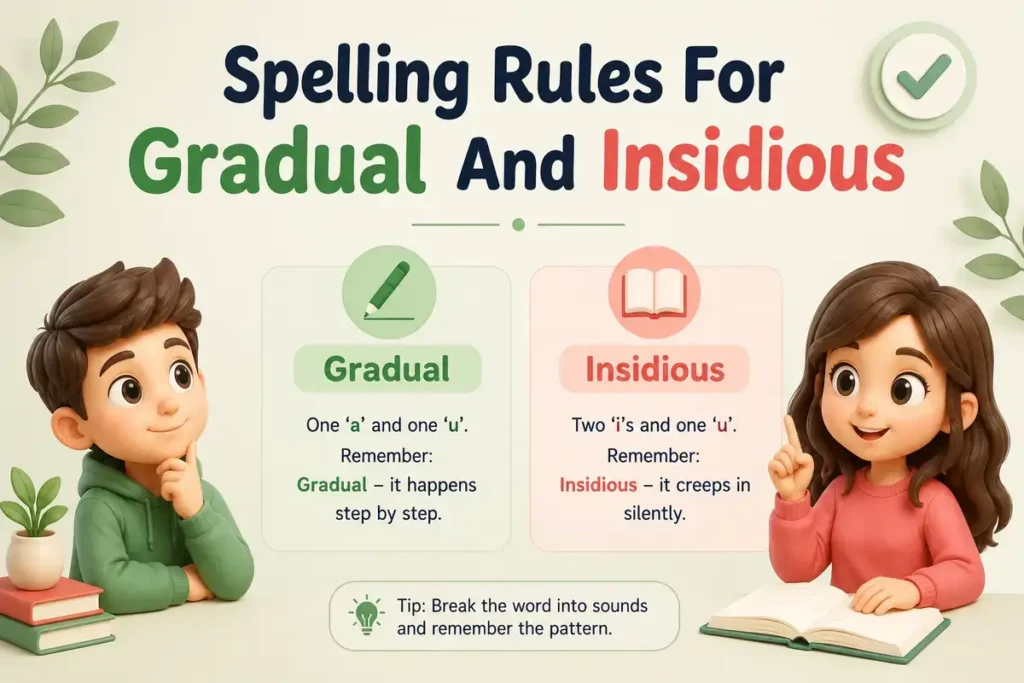
The word gradual comes from the Latin root connected with steps or stages.
The spelling stays consistent when adding related forms.
Examples:
- Gradual.
- Gradually.
- Gradualness.
The most common mistake is adding extra letters or writing graduall incorrectly.
Correct:
✔ Gradual improvement.
Incorrect:
✘ Graduall improvement.
Spelling Of Insidious
The word insidious has a less familiar spelling, which makes it harder for some learners.
Common mistakes include:
Incorrect:
✘ Insidous.
✘ Insiduous.
Correct:
✔ Insidious.
A helpful way to remember it is to focus on the middle sound.
In sid i ous.
The spelling includes sid, not sidu.
A related grammar guide is Laser Or Lazer Which Spelling Is Correct 2026.
Pronunciation Guide
Correct pronunciation helps prevent confusion.
Gradual Pronunciation
IPA:
/ˈɡrædʒ.u.əl/
Syllables:
Grad u al.
Stress pattern:
The first syllable receives the main stress.
The pronunciation sounds like:
GRAD yoo uhl.
Common mistake:
Some learners pronounce it as gra doo al with equal stress on every part. Native speakers usually emphasize the first syllable.
Insidious Pronunciation
IPA:
/ɪnˈsɪd.i.əs/
Syllables:
In sid i ous.
Stress pattern:
The second syllable receives the main stress.
The pronunciation sounds like:
in SID ee us.
Common mistakes:
- Saying in SID yous.
- Stressing the first syllable too strongly.
Word Origin And History
Understanding the origin of these words helps explain why their meanings developed differently.
Origin Of Gradual
The word gradual comes from the Latin word gradus, meaning step or degree.
The original idea was connected with moving step by step.
English later developed the meaning of something happening slowly in stages.
Related words include:
- Grade.
- Graduate.
- Gradation.
All of these words connect with the idea of levels or steps.
Example:
A student graduates by moving through different levels of education.
A gradual change also happens through different stages.
Origin Of Insidious
The word insidious comes from Latin insidiae, meaning a trap or ambush.
The original meaning was connected with something hidden that waited to cause harm.
Over time, English developed the modern meaning:
Something harmful that develops quietly and is difficult to notice.
This history explains why insidious almost always carries a negative feeling.
British American Canadian And Australian English
There is no spelling difference between gradual and insidious in major English varieties.
Speakers in the United States, United Kingdom, Canada, and Australia use the same forms.
The difference appears mainly in usage and context.
American English
American speakers commonly use gradual in everyday situations.
Example:
The company saw gradual growth.
Insidious appears more often in serious contexts.
Example:
The disease had an insidious effect.
British English
British writers use both words in the same way.
Example:
The gradual decline of the industry.
The insidious nature of the threat.
Canadian And Australian English
Both words are also standard in Canadian and Australian English.
There is no regional spelling variation.
Real Life Examples Of Gradual And Insidious
Seeing these words in different situations makes their meanings easier to remember.
Daily Conversation
- My confidence grew gradually after practicing every day.
- The weather gradually became cooler.
- His health improved through gradual lifestyle changes.
- The stress had an insidious effect on his happiness.
- She noticed an insidious pattern in his behavior.
Workplace Examples
- The team made gradual progress toward its goal.
- The company introduced gradual changes to improve productivity.
- The manager preferred a gradual transition instead of sudden changes.
- Poor communication created an insidious problem inside the department.
- The organization faced an insidious loss of trust among employees.
Academic Writing Examples
- Researchers observed a gradual increase in population growth.
- The study examines gradual changes in human behavior.
- Scientists warned about the insidious effects of pollution.
- The paper explores the insidious influence of propaganda.
Health Examples
- The patient showed gradual improvement after treatment.
- Doctors monitored the gradual recovery process.
- Some diseases develop in an insidious way.
- The condition can have insidious symptoms that appear slowly.
Social Media And Modern Usage
- The creator discussed the gradual growth of her online audience.
- Experts warned about the insidious spread of false information.
- His skills developed gradually through years of practice.
- The platform faced criticism for its insidious design choices.
Common Mistakes With Gradual And Insidious
Even experienced writers sometimes misuse gradual vs insidious because both words describe slow development. The main mistake is focusing only on the speed of change and ignoring the meaning behind it.
A slow change is not automatically insidious. It becomes insidious only when it involves hidden harm, danger, or a negative influence.
Mistake One Using Insidious For Positive Changes
Incorrect.
The student made insidious progress in English.
Correct.
The student made gradual progress in English.
Why?
Progress is usually positive. Gradual describes slow improvement, while insidious suggests something harmful.
Mistake Two Using Gradual For Hidden Danger
Incorrect.
The disease had a gradual effect that doctors could not detect.
Better.
The disease had an insidious effect that doctors could not detect.
Why?
The important idea is not only that the disease developed slowly. The key point is that it developed quietly and caused harm.
Mistake Three Thinking Both Words Mean Slow
This is the most common misunderstanding.
Gradual means:
Slow and steady.
Insidious means:
Slow, hidden, and harmful.
A gradual sunrise is pleasant.
An insidious disease is dangerous.
Mistake Four Using Insidious Too Often
Some writers choose insidious because it sounds stronger or more advanced. However, it should only appear when there is a hidden negative effect.
Incorrect.
The company experienced an insidious increase in profits.
Correct.
The company experienced gradual growth in profits.
Mistake Five Confusing Insidious With Immediate Danger
Insidious does not mean sudden or obvious.
Incorrect idea:
An insidious attack happens quickly.
Better understanding:
An insidious problem develops quietly and becomes serious over time.

Memory Tricks To Remember The Difference
Simple memory techniques can make these words easier to remember.
Remember The First Letter
Think of:
G for gradual growth.
Growth usually happens step by step.
Examples:
- Gradual improvement.
- Gradual learning.
- Gradual progress.
Think of:
I for insidious injury.
Insidious often involves something harmful.
Examples:
- Insidious disease.
- Insidious threat.
- Insidious damage.
Use The Slow Test
Ask yourself:
Is this only about time?
Use gradual.
Example:
The building process was gradual.
Ask yourself:
Is this slow change causing hidden harm?
Use insidious.
Example:
The corruption was insidious.
Remember The Feeling
Words carry emotional meaning.
Gradual feels calm.
Insidious feels dangerous.
This emotional difference helps native speakers choose the correct word naturally.
Related Words And Similar Expressions
Understanding related vocabulary improves accuracy.
Words Similar To Gradual
Slow
Means happening over a longer period.
Example:
The slow recovery continued for months.
Steady
Means continuing at a stable pace.
Example:
She made steady progress.
Progressive
Means developing step by step.
Example:
The company made progressive changes.
Incremental
Means happening through small additions.
Example:
The team made incremental improvements.
Words Similar To Insidious
Hidden
Means difficult to notice.
Example:
The hidden problem affected the results.
Harmful
Means causing damage.
Example:
The harmful effects became clear later.
Sneaky
A casual word for something dishonest or difficult to detect.
Example:
The sneaky trick fooled many people.
Deceptive
Means misleading or creating a false impression.
Example:
The advertisement used deceptive methods.
Opposites
Opposites Of Gradual
- Sudden.
- Rapid.
- Immediate.
- Abrupt.
Example:
The change was sudden, not gradual.
Opposites Of Insidious
- Open.
- Obvious.
- Visible.
- Harmless.
Example:
The danger was obvious, not insidious.
Expert Editor’s Note
Professional editors look beyond dictionary definitions and consider the feeling a word creates.
Gradual is a neutral word. It simply explains that something develops slowly. It works well in academic writing, business reports, health discussions, and everyday communication.
Insidious is a stronger word. It adds a warning. When writers use it, readers expect something negative, hidden, or damaging.
Many style guides recommend avoiding dramatic words unless they accurately describe the situation. Calling a normal slow change insidious can make writing sound exaggerated.
A skilled writer chooses gradual for ordinary slow development and saves insidious for situations involving hidden harm.
Frequently Asked Questions
What Is The Difference Between Gradual And Insidious?
Gradual describes something that happens slowly over time without suggesting good or bad results. Insidious describes something that develops slowly while causing harm or danger. The main difference is that gradual focuses on the process, while insidious focuses on hidden negative effects.
Can Gradual And Insidious Be Used Interchangeably?
No. They are not interchangeable. A gradual change may be positive, negative, or neutral. An insidious change is almost always negative because it involves a harmful effect that develops quietly.
Is Insidious Always A Negative Word?
Yes, in modern English, insidious almost always carries a negative meaning. It is commonly used for diseases, threats, harmful influences, and problems that grow unnoticed.
Is Gradual A Positive Word?
Not always. Gradual is neutral. It can describe positive changes like gradual improvement or negative changes like gradual decline. The word only explains that something happens slowly.
How Do You Pronounce Insidious?
Insidious is pronounced as /ɪnˈsɪd.i.əs/. The stress falls on the second syllable. It sounds like in SID ee us.
Which Word Is Better For Formal Writing?
Both words work in formal writing when used correctly. Gradual is common in research and professional documents. Insidious is appropriate when describing hidden risks, harmful patterns, or serious problems.
What Is A Good Synonym For Gradual?
Good synonyms include slow, steady, progressive, and incremental. The best choice depends on the context and the type of change being described.
What Is A Good Synonym For Insidious?
Good synonyms include hidden, harmful, deceptive, and stealthy. These words highlight the secret or damaging nature of something.
Learn the difference in Ballot Or Bullet Which Word Is Correct 2026 Guide.
Conclusion
The difference between gradual vs insidious comes down to more than just speed.
Gradual means something develops slowly through small steps. It is usually neutral and often describes progress, growth, or change.
Insidious means something develops slowly while creating hidden harm or danger. It carries a negative meaning and warns the reader about a problem that may not be easy to notice.
The biggest mistake is thinking both words simply mean slow. Remember the deeper difference:
Gradual describes slow change. Insidious describes slow hidden harm.
When you choose the word that matches the meaning, your writing becomes clearer, more accurate, and more natural.

Vocabulary & Language Research Writer
Ethan Parker researches English vocabulary, word meanings, slang, idioms, and commonly confused words. His goal is to help readers understand how English is actually used in everyday conversations and writing.
1 thought on “Gradual Vs Insidious The Real Difference Explained”