
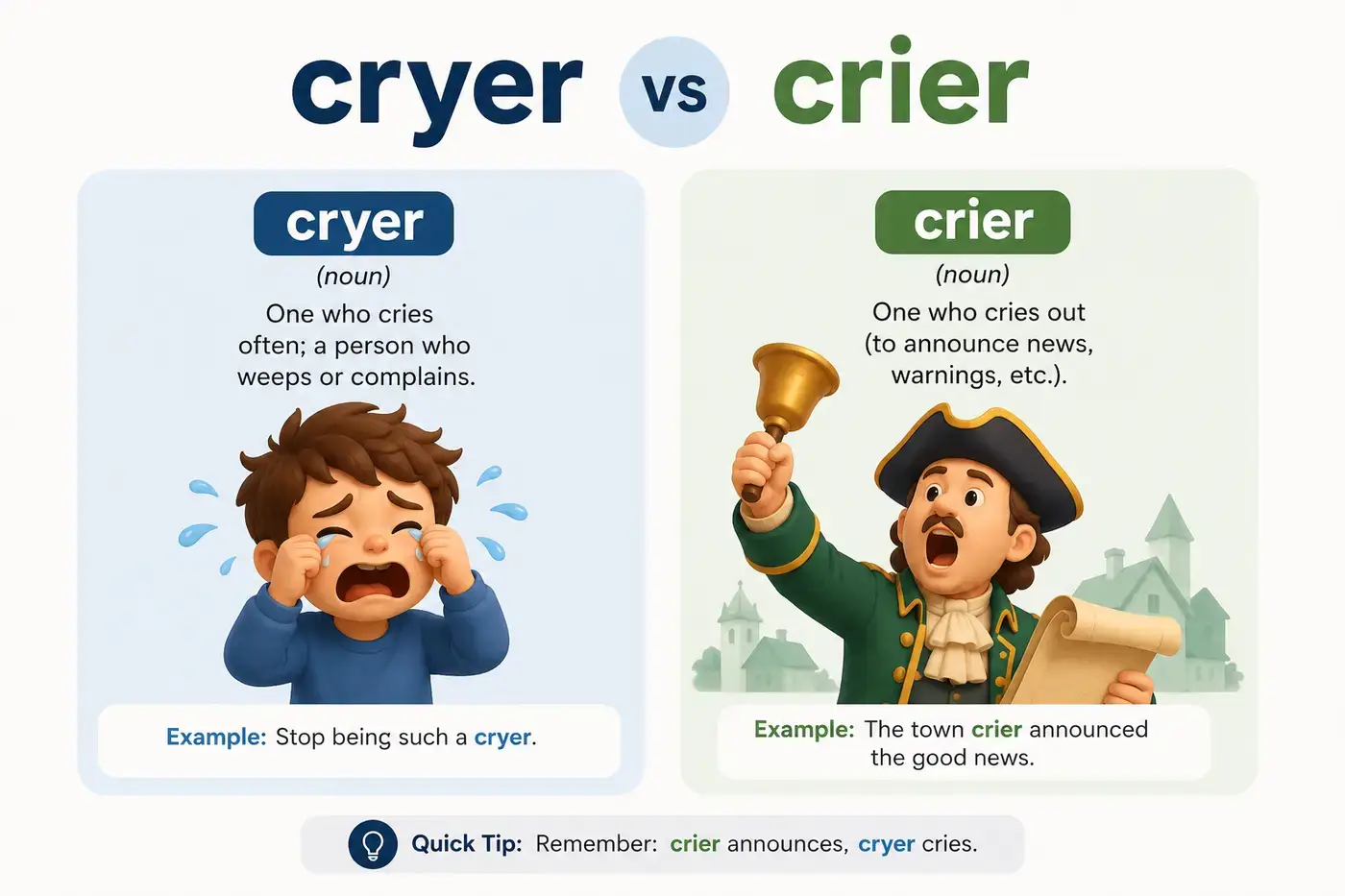
If you’ve searched for cryer vs crier, you’re probably trying to figure out which spelling is correct. At first glance, both words seem possible because they come from the verb cry. Still, only one spelling is accepted in standard English for most situations.
The confusion often starts when people add a suffix to cry. English spelling rules are not always obvious, and words ending in y can change in different ways. As a result, many writers type cryer instead of crier, especially in emails, online posts, and school assignments.
The good news is that the rule is straightforward once you understand it. In nearly every context, crier is the correct spelling. It refers to someone who cries frequently or a person who publicly announces news, such as a town crier. Cryer is generally considered a misspelling, although it occasionally appears as a surname.
In this guide, you’ll learn the difference between cryer vs crier, why people mix them up, the spelling rule behind the correct form, real world examples, grammar tips, and practical ways to remember the right spelling every time.
For another common grammar confusion, see Pentoxide Vs Pentaoxide Which Spelling Is Correct 2026 Guide.
Quick Answer
Crier is the correct English spelling. It is the noun form of the verb cry and refers to someone who cries or someone who makes public announcements, such as a town crier. Cryer is usually a spelling mistake unless it is used as a person’s last name.
| Feature | Crier | Cryer |
|---|---|---|
| Standard English spelling | Yes | No in most contexts |
| Meaning | A person who cries or makes public announcements | Usually a misspelling of crier |
| Part of speech | Noun | Not a standard common noun |
| Dictionary recognition | Yes | Generally only as a surname |
| Formal writing | Correct | Avoid |
| Everyday writing | Correct | Incorrect |
| Example | The town crier rang the bell. | The town cryer rang the bell. ✘ |
What Does Crier Mean
A crier is a noun with two common meanings.
The first describes a person who cries often or easily.
The second refers to someone who publicly announces news or official messages. Historically, this person was known as a town crier.
Simple Definition
A crier is someone who cries or someone whose job is to announce information in public.
Everyday Meaning
People often use crier when talking about emotions.
Examples.
- My little brother has always been a crier.
- I’m not much of a crier, even during sad movies.
- She admitted she was a crier after emotional speeches.
Historical Meaning
Before newspapers and the internet, towns relied on a town crier to share important news.
Examples.
- The town crier walked through the streets ringing a bell.
- Every announcement came from the town crier.
- The museum recreated the life of a traditional town crier.
What Does Cryer Mean
In standard English, cryer is not the accepted spelling of the noun formed from cry.
Most dictionaries do not list it as a common noun because crier already fills that role.
The main exception is when Cryer appears as a family name.
For example.
- Jon Cryer is a well known American actor.
When referring to a person’s surname, Cryer is completely correct because names follow their own spelling traditions.
Outside of proper names, professional editors, dictionaries, and style guides recommend using crier.
Cryer Vs Crier Which One Is Correct
The correct choice is almost always crier.
Use crier when talking about someone who cries.
✔ She’s always been a crier.
✔ He’s never been much of a crier.
Use crier when referring to someone who announces public news.
✔ The town crier welcomed visitors.
Do not use cryer unless it is part of someone’s name.
✘ She’s a cryer.
✘ The village cryer made the announcement.
Those spellings should be corrected to crier.
Why Does Crier Use I Instead Of Y
This question confuses many English learners.
The answer comes from a common English spelling rule.
When a verb ends in y, adding certain suffixes changes the y to i.
Examples include.
| Verb | Noun |
|---|---|
| Carry | Carrier |
| Marry | Marriage |
| Dry | Drier |
| Cry | Crier |
Notice the pattern.
The final y changes to i before the ending.
That is why crier is correct instead of cryer.
There are exceptions to English spelling rules, but this word is not one of them.
Definitions At A Glance
Crier
Part of speech
Noun.
Meaning
A person who cries frequently or a person who publicly announces information.
Common contexts
- Daily conversation.
- History.
- Literature.
- Journalism.
- Education.
Cryer
Part of speech
Proper noun in most cases.
Meaning
Usually a surname rather than a standard English noun.
Common contexts
- Family names.
- Personal identities.
- Entertainment.
When you’re ready, I’ll write Section 2, covering:
- Why people confuse cryer vs crier
- Key differences
- Grammar explanation
- Spelling rules
- Pronunciation guide
- Word origin
- British and American English
- 20+ real life examples
- Internal linking opportunity
Why People Confuse Cryer Vs Crier
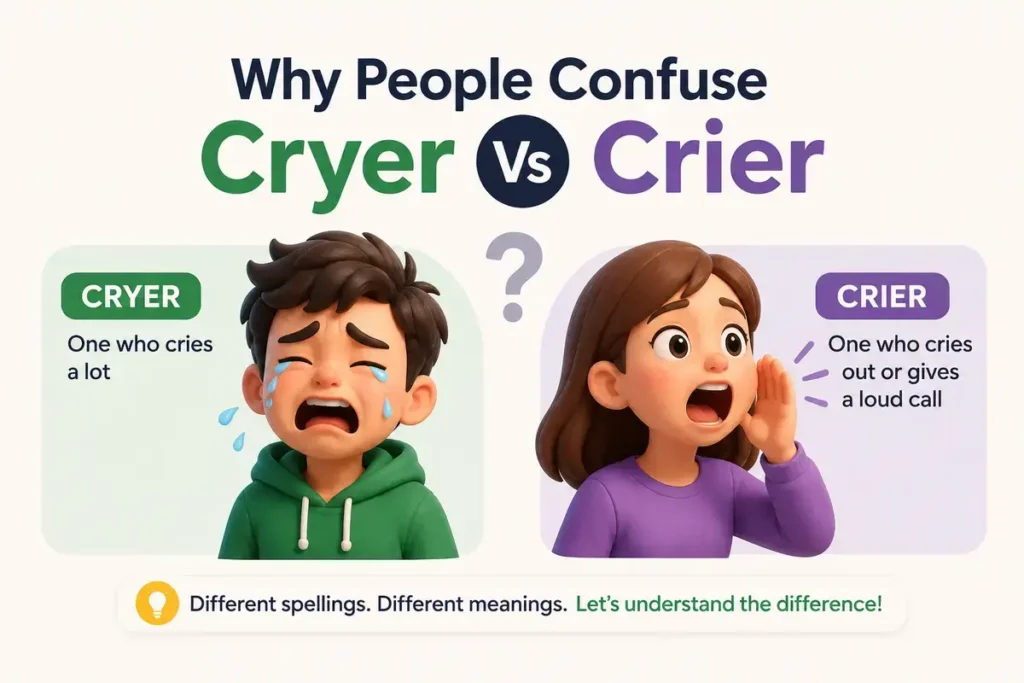
The confusion between cryer and crier is understandable. The words look almost identical and sound exactly the same. If you only hear the word in conversation, there is no clue about its spelling.
Another reason is that English spelling rules are not always obvious. Many people simply add er to the verb cry and assume the result should be cryer. English follows a different rule in this case.
Proper names also add to the confusion. Some people have the surname Cryer, so writers often assume it is an accepted spelling for the common noun. It is not.
Once you learn the spelling rule, the difference becomes easy to remember.
Cryer Vs Crier Key Differences
| Feature | Crier | Cryer |
|---|---|---|
| Correct spelling | ✔ Yes | ✘ No for the common noun |
| Part of speech | Noun | Usually a proper noun |
| Meaning | A person who cries or announces public news | Usually a family name |
| Dictionary entry | Yes | Generally only as a surname |
| Formal writing | Recommended | Avoid |
| Everyday writing | Correct | Incorrect except for names |
The simplest rule is this.
Use crier for the English noun.
Use Cryer only when it is part of someone’s name.
Grammar Explanation
Grammar makes the correct choice clear.
Crier Is A Noun
A noun names a person, place, thing, or idea.
The word crier names a person.
Examples.
- She’s a crier during emotional movies.
- My nephew is not a crier.
- The town crier greeted everyone.
Because it names a person, crier can follow articles like a, an, and the.
Cry Is The Verb
The base word is the verb cry.
Examples.
- Babies cry when they are tired.
- Don’t cry over small problems.
When you need the noun for a person who performs the action, English changes the spelling to crier.
Cryer Is Not The Standard Noun
Although cryer looks logical, professional editors and dictionaries do not recommend it as the common noun.
In edited English, replace cryer with crier unless you are writing a surname.
Spelling Rule
The spelling follows a common English pattern.
When a word ends with a consonant followed by y, the y often changes to i before certain suffixes.
Look at these examples.
| Base Word | Correct Form |
|---|---|
| Carry | Carrier |
| Dry | Drier |
| Marry | Marriage |
| Cry | Crier |
Notice the pattern.
The y changes to i before the ending is added.
That is why crier is the accepted spelling.
Many readers also check Sapphire Or Saphire Which Spelling Is Correct 2026 Guide.
Pronunciation Guide
Pronunciation cannot help you choose the correct spelling because both forms sound the same.
Crier
IPA
American English.
/ˈkraɪ.ər/
Syllables
Cri er.
Stress Pattern
The first syllable receives the main stress.
Common Pronunciation Mistakes
Most learners pronounce crier correctly. The challenge comes from spelling, not pronunciation.
Word Origin
The word crier has been part of English for centuries.
It comes from the Old French verb crier, meaning to call out or proclaim. That word traces back to Latin and eventually became the English noun crier.
Originally, a crier referred to someone who announced laws, market news, and royal proclamations in public places.
Later, English speakers also began using crier for someone who cries easily.
The spelling cryer never became the accepted common noun, although it continues to exist as a surname.
British And American English
There is no spelling difference between British and American English.
The same rule applies in Canada, Australia, and New Zealand.
Every major English dictionary uses crier as the correct spelling.
If you are writing an email, school paper, business document, or published article, always choose crier.
Real Life Examples
These examples show how native speakers naturally use crier.
Daily Conversation
- My daughter has always been a crier.
- I’m not much of a crier during sad movies.
- He’s never been a crier, even as a child.
- Our baby is only a crier when she’s hungry.
Workplace
- Nobody expects the boss to be a crier during meetings.
- She’s not a crier under pressure.
- Even experienced leaders can become criers after emotional events.
Emails
- I’m not usually a crier, but your message really touched me.
- Thanks for understanding that I’m a crier during goodbyes.
Academic Writing
- The town crier played an important role before newspapers existed.
- Historians often mention the town crier as an official messenger.
Journalism
- The town crier opened the annual festival.
- Visitors gathered around the town crier to hear the announcement.
Literature
- The old town crier rang a bell before speaking.
- The novel describes the lonely town crier walking through empty streets.
Social Media
- I’m such a crier when dogs reunite with their owners.
- Anybody else become a crier after having kids?
- That ending turned me into a crier.
- The town crier costume looked incredible.
- Even my toughest friend admitted she was a crier after watching that movie.
Common Mistakes
Many writers make the same mistakes when using cryer and crier. Most of them come from guessing the spelling instead of following the English rule.
Writing Cryer Instead Of Crier
Incorrect.
✘ My son is a cryer.
Correct.
✔ My son is a crier.
The noun formed from cry is crier, not cryer.
Assuming Both Spellings Are Correct
Some people believe cryer is simply an American spelling while crier is British.
This is incorrect.
English speaking countries use crier as the standard spelling.
Confusing A Surname With A Dictionary Word
Seeing the last name Cryer often leads people to believe it is also the correct common noun.
For example, Jon Cryer is an American actor. His surname is correct because family names follow their own spelling traditions.
That does not make cryer the correct spelling for someone who cries.
Forgetting The Spelling Rule
Many people remember the verb cry but forget that the final y changes to i in the noun crier.
Learning this one rule prevents the mistake in almost every situation.

Memory Tricks
Simple memory tricks make the correct spelling easy to remember.
Think About Carrier
Most people know the word carrier.
Carry becomes carrier.
Cry becomes crier.
Both words change the y before adding the ending.
Remember The Town Crier
Picture an old town crier ringing a bell in the village square.
History books, museums, and dictionaries all spell it town crier.
If you remember that famous expression, you’ll never write town cryer.
Replace It With Person Who Cries
If you can replace the word with person who cries, the correct spelling is always crier.
Related Words
Building related vocabulary helps you remember the correct word and improves your English.
Synonyms For Crier
- Weeper.
- Mourner.
- Sobber.
- Complainer in some contexts.
- Town announcer in historical contexts.
Related Words
- Cry.
- Crying.
- Cried.
- Tears.
- Sob.
- Weep.
- Wail.
- Lament.
- Herald.
- Messenger.
Frequently Confused Words
- Dryer vs Drier.
- Carrier vs Career.
- Adviser vs Advisor.
- Buyer vs Byer.
- Mourner vs Warner.
Learning these pairs strengthens your understanding of English spelling patterns.
Expert Editor’s Note
Professional editors consistently recommend crier when referring to someone who cries or someone who announces public news.
Major dictionaries, including Merriam Webster, Cambridge, and Oxford, recognize crier as the standard spelling.
Editors treat cryer as a spelling error unless it is part of a person’s legal name.
If you are writing an essay, business email, blog post, or professional document, choosing crier will always be the safest option.
When proofreading, pay extra attention to words formed from verbs ending in y. They often follow predictable spelling rules, and crier is a perfect example.
Frequently Asked Questions
Is Cryer Or Crier Correct?
Crier is the correct spelling in standard English. It refers to a person who cries or someone who publicly announces news. Cryer is generally incorrect unless it is used as a surname.
Is Cryer A Real Word?
Yes, but mainly as a family name. It is not the accepted spelling for the common noun that comes from the verb cry.
Why Is It Crier Instead Of Cryer?
English changes the final y to i when forming this noun. That spelling rule gives us crier, just as carry becomes carrier.
What Is A Town Crier?
A town crier was an official messenger who announced important news before newspapers, radio, and television became common. Many historic towns still have ceremonial town criers today.
Can I Use Cryer In Formal Writing?
No. Unless you are referring to someone’s surname, professional writing should always use crier.
Is There A Difference Between British And American English?
No. Both British and American English use crier. The spelling does not change across major English speaking countries.
What Does Crier Mean?
A crier is someone who cries easily or someone who publicly announces information. The intended meaning depends on the context.
Many readers also check Potatoes Or Potatos Which Spelling Is Correct 2026.
Conclusion
The answer to cryer vs crier is simple.
Crier is the correct spelling in standard English. It refers to someone who cries or a person who announces public news, such as a town crier.
Cryer is generally a misspelling unless it appears as someone’s surname.
The easiest way to remember the difference is to think about the well known phrase town crier. Once that spelling sticks in your mind, choosing the correct word becomes automatic.

Editorial Reviewer & Proofreader
Grace Mitchell reviews Gramlify’s articles for clarity, consistency, and readability. She is passionate about creating accurate, approachable content that helps English learners build confidence.
1 thought on “Cryer Vs Crier Which Spelling Is Correct 2026”