

If you’ve searched for busyness vs business, you’re probably trying to figure out which spelling fits your sentence. The confusion is easy to understand. The two words look almost identical, they sound similar in everyday speech, and both come from the adjective busy. Still, they have completely different meanings.
Many English learners accidentally write business when they mean the state of being busy. Others spell busyness as business because the pronunciation is so close. Spellcheck does not always catch the mistake because both are valid English words.
The good news is the difference is simple once you understand how each word works.
Busyness refers to the state or condition of being busy. Business usually refers to a company, trade, work, or commercial activity. They are never interchangeable.
In this guide, you’ll learn the meaning of each word, the grammar behind them, why people confuse them, practical spelling tips, natural examples, and expert editing advice. By the end, you’ll know exactly which word belongs in every situation.
Suggested Internal Link: Busy Vs Busying Difference Explained.
For another common grammar confusion, see Scrapped Or Scraped Which Word Is Correct 2026 Guide.
Quick Answer
Busyness means the state of being busy or having a lot to do. Business refers to a company, trade, profession, or commercial activity. Both are correct English words, but they have different meanings and grammar. Choose busyness when talking about someone’s level of activity and business when referring to work or commerce.
Busyness Vs Business Comparison Table
| Feature | Busyness | Business |
|---|---|---|
| Correct spelling | Yes | Yes |
| Part of speech | Noun | Noun |
| Meaning | The state of being busy | Commerce, work, company, profession |
| Common use | Time management, daily life | Work, finance, trade |
| Formal writing | Less common | Very common |
| Everyday conversation | Moderate | Very common |
| Can replace the other | No | No |
| Example | Her busyness kept her from calling. | He owns a successful business. |
What Does Busyness Mean
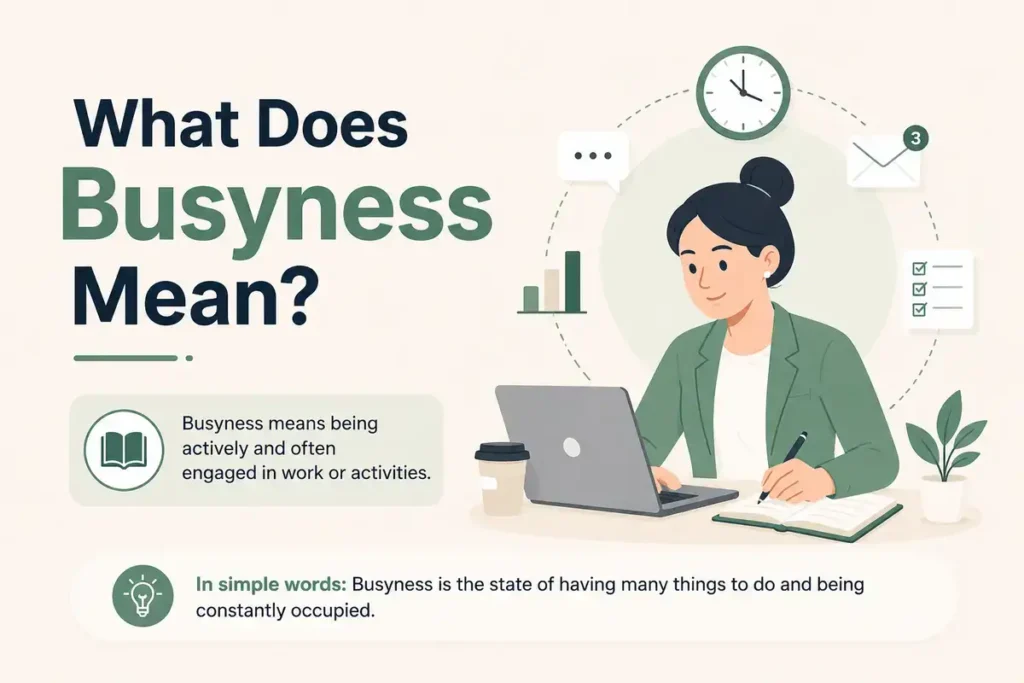
Busyness is a noun that describes the condition of having many tasks, responsibilities, or activities.
It focuses on how occupied someone is rather than the work itself.
Simple Definition
Busyness means being busy or having very little free time.
When To Use Busyness
Use busyness when describing someone’s schedule, workload, or lifestyle.
Examples.
- Her busyness made it difficult to answer every email.
- I understand your busyness this week.
- His busyness kept him away from family dinners.
- The busyness of the holiday season can feel overwhelming.
- Despite her busyness, she always found time to help others.
Notice that busyness describes a condition, not a company or job.
What Does Business Mean
Business is a noun with several related meanings. It can refer to a company, commercial activity, someone’s profession, or an important matter.
It is one of the most common nouns in English.
Simple Definition
Business means trade, work, commerce, or an organization that sells goods or services.
Common Uses
Examples.
- She started her own business last year.
- Our business continues to grow every month.
- He’s traveling for business.
- Mind your own business.
- Business has been slow this season.
Although the meanings change slightly depending on the sentence, they all relate to work, commerce, or personal affairs instead of the condition of being busy.
Which One Is Correct
Both busyness and business are correct English words.
The correct choice depends entirely on your meaning.
Choose busyness when talking about someone’s full schedule or lack of free time.
Choose business when talking about a company, work, trade, profession, or commercial activity.
For example.
✔ Her busyness surprised everyone.
✔ Their business expanded into three new cities.
✘ Her business prevented her from taking a break.
This sentence sounds incorrect if you mean she had too much to do.
✔ Her busyness prevented her from taking a break.
Why People Confuse Busyness And Business
This pair causes confusion for several reasons.
They Sound Very Similar
In natural conversation, the pronunciation is almost identical. Many speakers cannot hear a clear difference unless they pay close attention.
They Share The Same Root Word
Both words come from busy, making them look closely related.
Spelling Creates Confusion
The letters ness and ness seem like they should appear together after busy, yet English changes the spelling before adding the suffix.
Many writers expect business to mean “being busy” because of its spelling.
Autocorrect And Typing Habits
Spellcheck often accepts both words because both exist in English. That means the mistake may remain unnoticed.
Everyday Exposure
People read business every day in news articles, advertisements, and conversations. Busyness appears much less often, so writers naturally remember the more familiar spelling.
Busyness Vs Business Key Differences
| Feature | Busyness | Business |
|---|---|---|
| Describes | A condition | Work or commerce |
| Focus | Being occupied | Trade, company, profession |
| Common context | Personal schedules | Economy, careers, companies |
| Frequency | Less common | Extremely common |
| Typical question answered | How busy is someone | What work or company is involved |
The easiest way to remember the difference is simple.
If you can replace the word with being busy, use busyness.
If you can replace it with company, work, or commerce, use business.
Grammar Explanation
Although both words are nouns, they serve different purposes.
Busyness Is An Abstract Noun
Abstract nouns describe ideas, qualities, or conditions.
Examples include.
- Happiness.
- Kindness.
- Darkness.
- Busyness.
Examples in sentences.
- Her busyness increased during tax season.
- My busyness kept me away from social events.
The noun refers to a condition rather than something physical.
Business Is A Common Noun
Business names an activity, organization, or occupation.
Examples.
- Their business employs fifty people.
- Family business requires careful planning.
- International business continues to change rapidly.
Unlike busyness, business often has a plural form.
Examples.
- Small businesses create many jobs.
- Local businesses support community events.
Busyness rarely appears in the plural because it refers to a general state instead of countable objects.
Spelling Rule Behind Busyness
Many learners wonder why busyness keeps the letter y, while other words change it.
The answer lies in English spelling patterns.
The adjective is busy.
When adding the suffix ness, the spelling changes to busyness, not busyiness.
This follows a long established English spelling convention.
Compare these examples.
| Adjective | Noun |
|---|---|
| Happy | Happiness |
| Lazy | Laziness |
| Busy | Busyness |
Although the spelling looks unusual at first, busyness is the correct dictionary form.
Many people mistakenly type business because it looks more familiar, but the meanings are completely different.
Learn the difference in Signer or Signor Which Word Is Correct (2026).
Pronunciation Guide
Although busyness and business look similar, their pronunciation is almost the same in everyday English. That is one reason people confuse them.
Busyness
IPA
American English
/ˈbɪz.i.nəs/
Syllables
Bus y ness.
Stress
The first syllable receives the primary stress.
Business
IPA
American English
/ˈbɪz.nəs/
Syllables
Busi ness.
Stress
The first syllable receives the primary stress.
Common Pronunciation Mistake
Many learners pronounce business exactly as it is spelled.
Incorrect.
Bus i ness.
Correct.
Biz ness.
The middle vowel is reduced in natural speech, giving the word its familiar pronunciation.
Word Origin And History
Understanding where these words came from makes their meanings much easier to remember.
Origin Of Busy
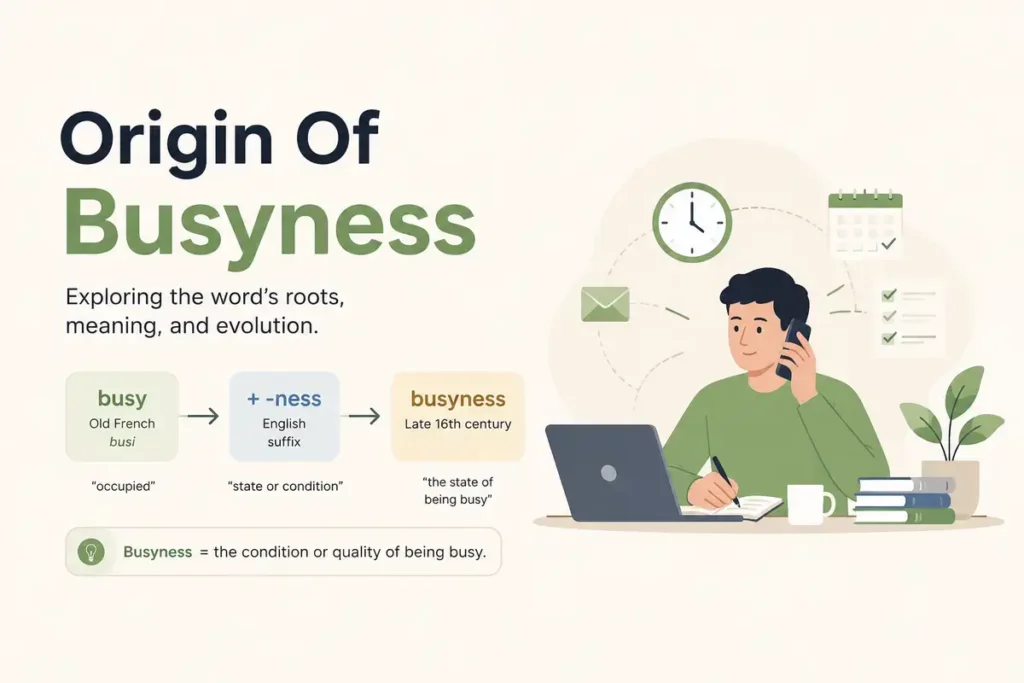
The adjective busy comes from Old English and originally described someone who was occupied, active, or constantly engaged in work.
Over time, English speakers created different nouns from the same root, but each developed its own meaning.
Origin Of Busyness
The suffix ness forms abstract nouns that describe a state or quality.
Examples include.
- Kindness.
- Happiness.
- Sadness.
- Busyness.
So busyness literally means the state of being busy.
Origin Of Business
Centuries ago, business also referred to being busy. As English evolved, its meaning gradually shifted toward occupation, trade, commerce, and professional work.
Today, most native speakers associate business with companies, careers, money, or professional activities rather than simply being occupied.
British American Canadian And Australian English
There is no spelling difference across major English speaking countries.
American English, British English, Canadian English, Australian English, and New Zealand English all use busyness and business with the same meanings.
The only noticeable difference is frequency.
Business appears constantly in newspapers, websites, television, and professional writing.
Busyness appears much less often because writers frequently choose phrases like being busy, busy schedule, or heavy workload instead.
Real Life Examples
Seeing both words in real situations makes the difference much easier to remember.
Daily Conversation
- Her busyness has kept her away from family gatherings.
- Their family business has served the town for fifty years.
- I understand your busyness this month.
- My uncle recently sold his business.
Workplace
- The team’s busyness increased before the product launch.
- Our business hired three new employees.
- His busyness made scheduling a meeting difficult.
- Business has been excellent this quarter.
Emails
- Thank you for your patience despite my busyness.
- We’re excited to discuss your business proposal.
- I appreciate your understanding during this period of busyness.
- The business agreement has been approved.
Academic Writing
- Researchers measured workplace busyness during the study.
- She earned a degree in international business.
Journalism
- The article explored the growing busyness of modern city life.
- Small business owners welcomed the new tax changes.
Literature
- His busyness became a symbol of modern life.
- The family business passed from one generation to the next.
Social Media
- Sorry I’ve been quiet lately. Life’s busyness caught up with me.
- Support your local business whenever you can.
Common Mistakes
Editors regularly notice the same errors.
Using Business When You Mean Busyness
Incorrect.
Her business kept her from attending the party.
Correct.
Her busyness kept her from attending the party.
The sentence talks about having too much to do, not owning a company.

Using Busyness For A Company
Incorrect.
His busyness is growing every year.
Correct.
His business is growing every year.
Here you’re talking about a company.
Assuming Business Means Being Busy
Many learners believe business simply means “being busy.”
That meaning disappeared from everyday English long ago. Today, native speakers almost always understand business as work, trade, commerce, or a company.
Spelling Busyness As Busyiness
Incorrect.
Busyiness.
Correct.
Busyness.
The correct noun drops the extra vowel before adding ness.
Memory Tricks
These simple tricks make the difference easy to remember.
Think About The Meaning
If the sentence means being busy, choose busyness.
If it means company, job, or trade, choose business.
Remember The Suffix
The ending ness usually creates a quality or condition.
Examples.
- Happiness.
- Kindness.
- Darkness.
- Busyness.
That pattern tells you the word describes a state.
Associate Business With Money
Whenever you hear business, picture a company, office, customer, or store.
That image helps separate it from the idea of being occupied.
Ask Yourself One Question
Are you describing someone’s schedule?
Use busyness.
Are you talking about work or commerce?
Use business.
Related Words
Expanding your vocabulary helps you understand the difference between busyness and business more clearly.
Synonyms For Busyness
- Activity.
- Occupation.
- Workload.
- Full schedule.
- Hustle.
- Packed timetable.
- Constant activity.
Synonyms For Business
- Company.
- Enterprise.
- Trade.
- Commerce.
- Profession.
- Occupation.
- Organization.
Related Words
- Busy.
- Busily.
- Occupied.
- Occupation.
- Employment.
- Commerce.
- Industry.
- Work.
Frequently Confused Words
- Busy and busily.
- Busyness and business.
- Occupation and profession.
- Trade and commerce.
- Job and career.
Knowing these related words helps you choose the most natural expression for each situation.
Expert Editor’s Note
Professional editors treat busyness and business as completely different words because they communicate different ideas.
Major dictionaries recognize both spellings as correct.
Use busyness when referring to the condition of having many tasks or responsibilities.
Use business when referring to a company, trade, work, or professional activity.
One editorial observation is worth remembering. Native speakers often replace busyness with phrases such as being busy, busy schedule, or heavy workload because they sound smoother in everyday writing. That does not make busyness incorrect. It simply appears less often than business.
When editing your own writing, stop for a moment and ask yourself if you are talking about a person’s schedule or about work and commerce. That quick check usually prevents the mistake.
Frequently Asked Questions
Is Busyness A Correct Word?
Yes. Busyness is a correct English noun. It refers to the condition of being busy or having many responsibilities. Although it is less common than business, dictionaries recognize it as the standard spelling.
Is Business The Same As Busyness?
No. Business usually refers to a company, trade, work, or commercial activity. Busyness refers to the state of being occupied. The two words have different meanings and cannot replace each other.
Why Do People Spell Busyness As Business?
The confusion comes from their similar pronunciation and shared root word busy. Since business appears much more often in everyday English, many writers accidentally choose the more familiar spelling.
Which Word Should I Use In Formal Writing?
Use the word that matches your meaning. If you are discussing a company or commerce, write business. If you mean the condition of being busy, busyness is grammatically correct. Many professional writers also use phrases like being busy or heavy workload instead of busyness.
Is Busyness Used In American And British English?
Yes. American, British, Canadian, and Australian English all recognize busyness. It is simply less common than business in every major variety of English.
Can Business Mean Being Busy?
Not in modern English. Historically, the word had a broader meaning, but today native speakers almost always use business to refer to work, commerce, or a company.
What Is The Easiest Way To Remember The Difference?
Think about the meaning. If the sentence refers to a person’s schedule or lack of free time, choose busyness. If it refers to work, trade, customers, or a company, choose business.
Many readers also check Village Vs Subdivision Differences Explained Clearly 2026.
Conclusion
The difference between busyness and business is straightforward once you focus on meaning instead of spelling.
Busyness describes the state of being busy. It refers to a full schedule, constant activity, or having many responsibilities.
Business refers to a company, trade, profession, or commercial activity. It is one of the most frequently used nouns in English.
The most common mistake is using business when talking about someone’s busy schedule. A quick meaning check will help you avoid that error every time.
When you think about being busy, choose busyness. When you think about work or commerce, choose business. That simple rule will keep your writing accurate and natural.

Vocabulary & Language Research Writer
Ethan Parker researches English vocabulary, word meanings, slang, idioms, and commonly confused words. His goal is to help readers understand how English is actually used in everyday conversations and writing.
1 thought on “Busyness Vs Business Which Word Should You Use”