
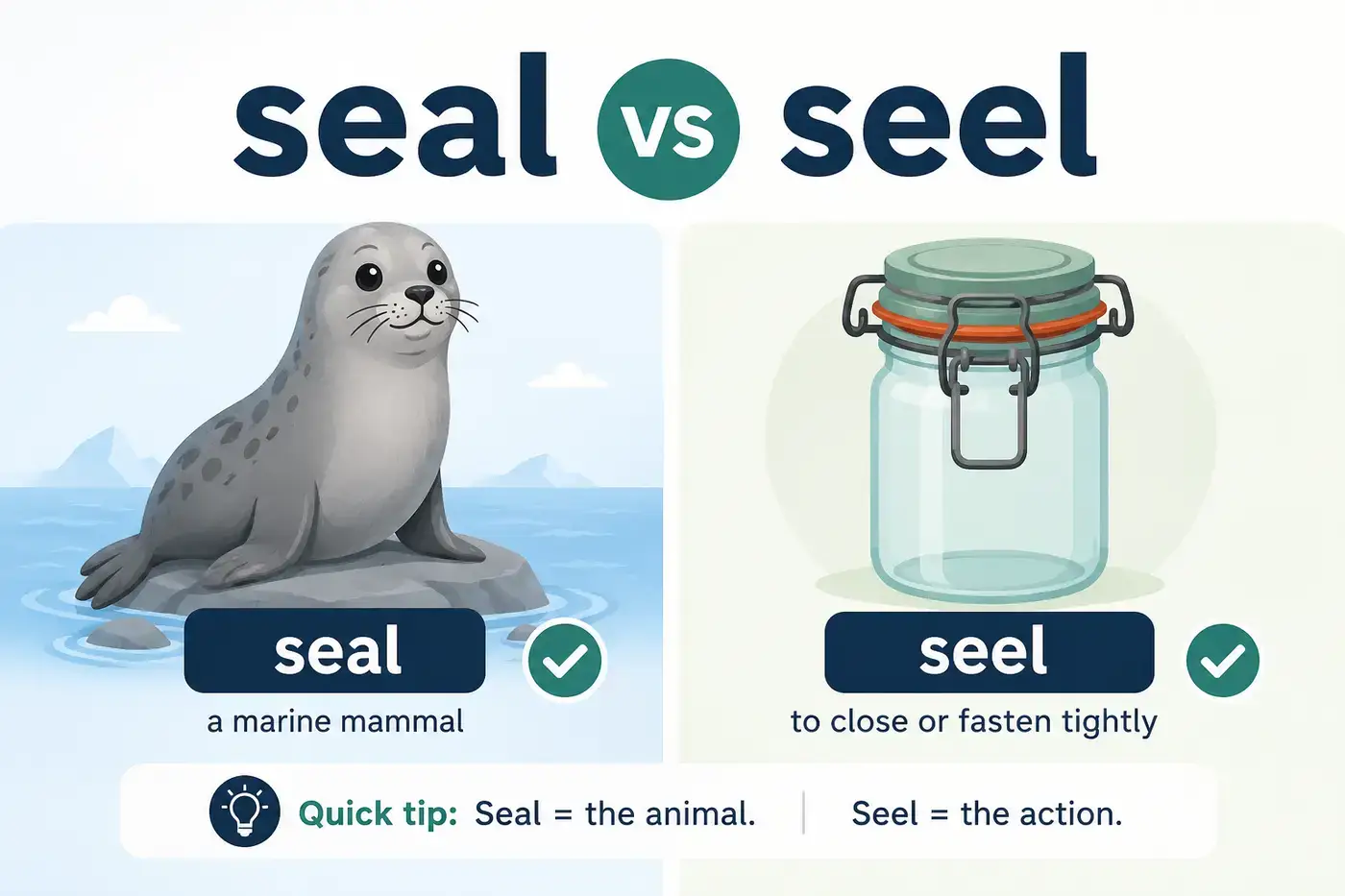
If you’ve searched for seal vs seel, you’re probably trying to figure out which spelling is correct. The short answer is simple. Seal is the correct English word in almost every situation, while seel is an old and extremely rare word that most people never use.
The confusion happens because the two words look similar and differ by only one letter. A typing mistake, autocorrect, or simple spelling error can easily turn seal into seel. Some people also come across seel in old books or historical texts and wonder if it’s another accepted spelling. It isn’t in modern English.
Understanding the difference helps you avoid spelling mistakes in school assignments, emails, business writing, and everyday conversations. It also gives you confidence when reading older literature where unfamiliar words sometimes appear.
This guide explains the meaning of both words, why people confuse them, how dictionaries treat each spelling, and when each one belongs in a sentence. You’ll also find grammar tips, real world examples, and practical advice to help you remember the correct spelling every time.
Suggested Internal Link: Commonly Misspelled English Words You Should Know.
For another common grammar confusion, see Bachelor Vs Batchelor Which Spelling Is Correct 2026.
Quick Answer
Seal is the correct spelling in modern English. It can refer to a marine animal, an official stamp, something that closes a container, or the act of closing something tightly. Seel is an obsolete English word that survives mainly in historical literature and should not replace seal in modern writing.
Seal Vs Seel Comparison Table
| Feature | Seal | Seel |
|---|---|---|
| Modern English | Yes | No in everyday English |
| Correct spelling | Yes | Only in historical contexts |
| Part of speech | Noun and verb | Verb |
| Meaning | Animal, official mark, closure, close tightly | To sew or close the eyes of a falcon in old falconry |
| Common usage | Very common | Extremely rare |
| Formal writing | Yes | Only when discussing history or literature |
| Everyday conversation | Yes | Almost never |
| Dictionary status | Standard English | Obsolete or archaic |
| Example | Please seal the envelope. | The falconer seels the bird before training. |
What Does Seal Mean
Seal is a standard English word with several meanings. The intended meaning depends on the sentence.
Seal As A Noun
The word seal can refer to different things.
- A marine mammal that lives in oceans and spends time both in the water and on land.
- An official stamp or mark used to show authenticity.
- A tight covering that prevents air, water, or other substances from passing through.
Examples
- We watched a seal swim near the shore.
- The document carried the official company seal.
- Check the rubber seal before closing the container.
- The broken seal caused the bottle to leak.
- Every passport includes an official government seal.
Seal As A Verb
As a verb, seal means to close something tightly or make it secure.
Examples
- Please seal the package before shipping it.
- The workers sealed the window to stop the rain.
- Don’t forget to seal the food container.
- The lawyer asked everyone to seal the confidential records.
- The team sealed the agreement with a handshake.
What Does Seel Mean
Seel is an old English verb that almost disappeared from modern use.
Historically, it meant to sew or stitch the eyelids of a falcon shut temporarily during training. Falconers used this practice centuries ago to calm birds before training them.
Outside historical writing, seel is rarely used today. Most English speakers never encounter it unless they read older literature or study medieval hunting traditions.
Historical Example
- The falconer seels the hawk before beginning its training.
Literary Example
Some older English texts use seel when describing traditional falconry practices.
In modern English, writers almost always choose seal instead.
Which One Is Correct
For almost every modern situation, seal is the correct spelling.
Use seal when talking about:
- A sea animal.
- Closing an envelope or package.
- An official stamp.
- Making something airtight or waterproof.
- Confirming or finalizing an agreement.
Use seel only if you’re writing about historical falconry, medieval customs, or quoting older literary works.
For example.
✔ Please seal the envelope before mailing it.
✔ The seal balanced a ball on its nose.
✘ Please seel the package.
✘ I saw a seel at the aquarium.
The last two examples are incorrect because seel is not the modern spelling for any common meaning of seal.
Why People Confuse Seal And Seel
The confusion is surprisingly common because the words differ by only one letter. When people type quickly or rely on memory, the extra e can slip into the word.
Several factors contribute to the mix up.
- Visual similarity. Seal and seel look almost identical at a glance.
- Typing mistakes. The letters a and e sit close together in many typing patterns and are easy to confuse.
- Autocorrect and spell check. Some devices fail to flag seel because it exists as a historical English word.
- Rare encounters with older texts. Readers may see seel in literature or historical documents and assume it is a modern variant of seal.
- Pronunciation similarity. Both words are pronounced the same way in modern English, which removes an important clue that usually helps distinguish spellings.
Key Differences Between Seal And Seel
| Feature | Seal | Seel |
|---|---|---|
| Meaning | Animal, stamp, closure, or close tightly | Historical falconry term |
| Modern usage | Very common | Extremely rare |
| Grammar role | Noun and verb | Verb only |
| Formal writing | Standard choice | Used only in historical discussion |
| Pronunciation | /siːl/ | /siːl/ |
The easiest way to remember the difference is simple.
Seal belongs in modern English.
Seel belongs in historical English.
Grammar Explanation
Understanding the grammar makes the distinction much clearer.
Seal As A Noun
As a noun, seal names a person, place, thing, or idea.
Examples.
- The seal rested on the rock.
- The king pressed his seal onto the document.
- The jar has a tight seal.
Seal As A Verb
As a verb, seal describes an action.
Examples.
- Please seal the envelope.
- Workers sealed the roof before the storm arrived.
- The judge ordered the records to be sealed.
Seel As A Verb
Seel functions only as a verb in historical usage.
Example.
The falconer seels the hawk before training it.
Because this meaning is specialized and outdated, most modern grammar books do not discuss it in detail.
Spelling Rule That Helps Most Writers
Think about the common English word seal first. It appears in everyday vocabulary related to animals, envelopes, contracts, food containers, and construction.
The spelling uses the vowel pattern ea as in meal, real, and team.
The spelling seel does not follow a productive modern pattern and survives mainly as a historical form.
Pronunciation Guide
Both words share the same pronunciation.
Seal
- IPA: /siːl/
- Syllables: one.
- Stress: the single syllable receives full stress.
Seel
- IPA: /siːl/
- Syllables: one.
- Stress: the single syllable receives full stress.
Because they sound identical, pronunciation cannot help you choose the correct spelling. Context and meaning must guide your choice.
Word Origin And History
Origin Of Seal
The modern word seal comes through Old English and ultimately traces back to Germanic roots. Over centuries it developed several meanings related to marks of authority, closing something securely, and the marine mammal we know today.
Origin Of Seel
Seel comes from an older Germanic verb meaning to close or bind. In medieval English it became associated with falconry, specifically the practice of sewing a bird’s eyelids shut temporarily during training.
As falconry became less central to daily life, the word faded from ordinary English.
British American Canadian And Australian English
There is no meaningful regional difference here.
Speakers in the United States, the United Kingdom, Canada, Australia, and New Zealand all use seal as the standard modern spelling.
Seel remains rare and historical across all major English varieties.
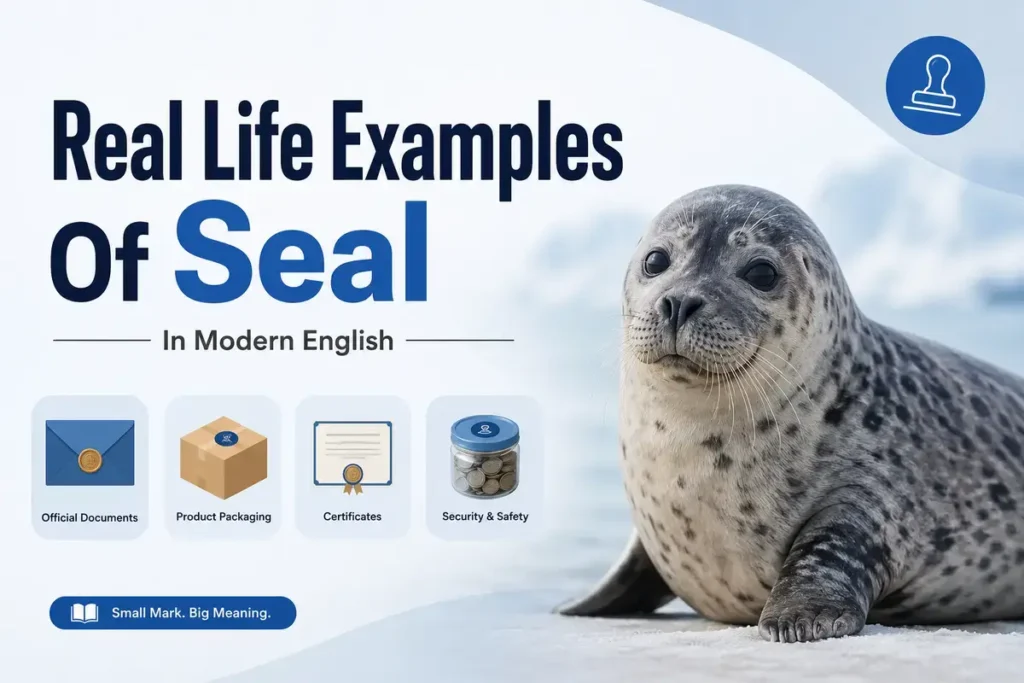
Real Life Examples Of Seal In Modern English
Seeing the word in natural sentences helps reinforce the correct spelling.
Daily Conversation
- I saw a seal at the aquarium yesterday.
- Please seal the bag before putting it away.
- The seal on this bottle is broken.
- That seal swims faster than I expected.
- Can you seal the leftovers and place them in the fridge?
Workplace
- The manager asked us to seal the confidential files.
- Check the door seal before starting the machine.
- We need an official seal on the contract.
- The technician replaced the damaged seal.
- Please seal the package before pickup.
Emails
- Could you seal and sign the envelope before mailing it?
- The legal department requested a sealed copy of the agreement.
- Please verify that the container seal is intact.
Academic Writing
- Researchers studied the behavior of Arctic seals.
- The royal seal authenticated the document.
Journalism
- Officials placed a seal on the evidence box.
- Wildlife experts rescued an injured seal from the beach.
Social Media
- Just watched a playful seal dive into the water.
- Make sure you seal the paint can tightly.
- That bakery always seals its boxes perfectly.
Notice that every modern example uses seal, not seel.
Suggested Internal Link: Difference Between Seal and Deal. This is another pair that learners often confuse because the words look and sound similar.
A related grammar guide is Conex Or Connex Which Spelling Is Correct 2026 Guide.
Common Mistakes With Seal And Seel
Many spelling errors happen because seal and seel look alike. Since seel is a real but obsolete word, some spell checkers may not flag it as an error.
These are the mistakes editors see most often.
Using Seel Instead Of Seal
Incorrect.
Please seel the envelope before mailing it.
Correct.
Please seal the envelope before mailing it.
Thinking Seel Is An Alternative Spelling
Some writers assume seel is an older British spelling of seal.
It is not.
English speaking countries all use seal in modern writing.
Confusing Seal With Similar Sounding Words
People sometimes mix seal with words like seel, deal, peel, and steel because they sound similar. Always focus on the meaning of the sentence before choosing a spelling.
Easy Memory Tricks
A simple memory trick can save you from making this mistake again.
Remember The Animal
Everyone knows the marine animal is spelled seal.
If you’re talking about the animal, the official stamp, or closing something tightly, the spelling is always seal.
Think About Sealing An Envelope
You seal an envelope before mailing it.
The word has the same spelling every time.
Remember Seel Is Historical
The extra e belongs to history.
If your sentence is not about medieval falconry or an old literary text, you almost certainly need seal.
Related Words
Learning related words builds stronger vocabulary.
Words Related To Seal
- Sealant.
- Sealed.
- Sealing.
- Waterproof.
- Secure.
- Close.
- Stamp.
- Emblem.
Synonyms For Seal As A Verb
- Close.
- Secure.
- Fasten.
- Lock.
- Protect.
Synonyms For Seal As A Noun
- Stamp.
- Emblem.
- Mark.
- Badge.
- Insignia.
Frequently Confused Words
- Seal and Seel.
- Seal and Deal.
- Seal and Steel.
- Sale and Sail.
- Complement and Compliment.
Expert Editor’s Note
Professional editors consistently recommend seal for modern English.
Leading dictionaries describe seel as an obsolete or archaic verb connected with falconry. It no longer appears in ordinary communication, business writing, journalism, or academic English except when discussing history or quoting older works.
If your goal is clear, natural English, choose seal every time unless you are intentionally writing about historical falconry.
This is also the spelling preferred by newspapers, educational publishers, style guides, and professional proofreaders.
Frequently Asked Questions
Is Seal Or Seel Correct?
Seal is the correct spelling for modern English. Seel is an obsolete word that survives mainly in historical writing.
Is Seel A Real Word?
Yes. Seel is a genuine English word, but it is archaic. It originally referred to sewing a falcon’s eyelids shut during training. Most modern speakers never use it.
Can I Use Seel Instead Of Seal?
No. In modern English, seal is the correct spelling for animals, official stamps, containers, agreements, and closing something tightly.
Why Do People Spell Seal As Seel?
The words are pronounced the same way and differ by only one letter. Typing mistakes, memory slips, and unfamiliarity with the obsolete word often cause the confusion.
Is There A British Spelling Difference?
No. American, British, Canadian, Australian, and New Zealand English all use seal as the standard spelling.
How Can I Remember The Correct Spelling?
Think about a seal swimming in the ocean or sealing an envelope. Both use the same spelling with ea.
Does Seel Appear In Dictionaries?
Yes. Major dictionaries include seel, but they clearly label it as obsolete or archaic.
Still confused? Compare Dieing Vs Dying Which Spelling Is Correct 2026.
Conclusion
The difference between seal vs seel is straightforward.
Seal is the correct spelling for modern English. It refers to the marine mammal, an official mark, a protective closure, or the action of closing something securely.
Seel is an obsolete verb connected with traditional falconry. Outside historical writing, it has almost disappeared from everyday English.
The easiest rule to remember is simple.
If you’re writing for school, work, business, or everyday communication, always choose seal. Save seel for discussions about historical language or medieval falconry.
Using the correct spelling keeps your writing clear, accurate, and easy for every reader to understand.

Editorial Reviewer & Proofreader
Grace Mitchell reviews Gramlify’s articles for clarity, consistency, and readability. She is passionate about creating accurate, approachable content that helps English learners build confidence.
1 thought on “Seal Vs Seel Which Spelling Is Correct 2026 Guide”