
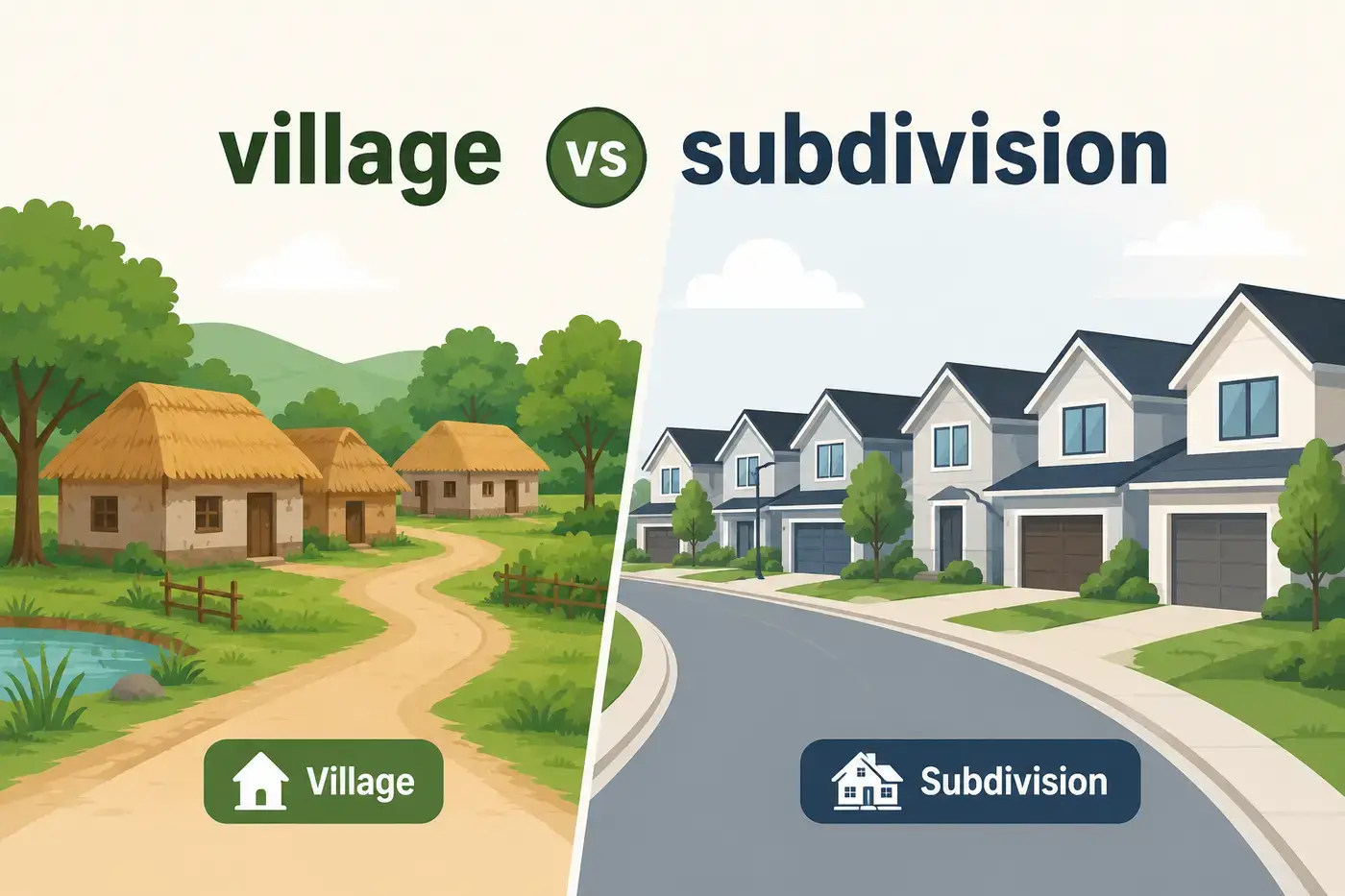
If you’ve searched for village vs subdivision, you’re probably trying to figure out what makes these two communities different. At first glance, both are places where people live. Both have homes, streets, and neighbors. Still, they are not the same.
The confusion usually starts because people use the terms interchangeably in casual conversation. A real estate listing might describe a neighborhood as a subdivision, while someone living there simply calls it a village. In other cases, a village is an official municipality with its own local government, while a subdivision is only a planned residential development inside a larger city, town, or county.
Knowing the difference matters. It can affect property ownership, local services, zoning rules, taxes, governance, and even the way addresses are described. It also helps English learners choose the correct word in conversation, writing, and professional communication.
This guide explains the meaning of each term, shows when to use each one, compares them side by side, and answers the questions people ask most often. By the end, you’ll know exactly when to say village and when subdivision is the better choice.
Suggested Internal Link: Neighborhood Vs Community Explained.
You may also want to read Lacs or Lakhs Which Spelling Is Correct (2026).
Quick Answer
A village is a small community or an officially recognized municipality that may have its own local government. A subdivision is a planned residential area created by dividing a larger piece of land into individual lots for homes. A subdivision can exist inside a village, town, or city, but it is not a type of local government.
Village Vs Subdivision Comparison Table
| Feature | Village | Subdivision |
|---|---|---|
| Meaning | A small community or municipality | A planned residential development |
| Part of speech | Noun | Noun |
| Purpose | A place where people live and form a community | A housing development divided into lots |
| Local government | Often yes | No |
| Planning | May grow naturally or be historically established | Planned and developed before construction |
| Size | Small to medium | Usually smaller than a village |
| Contains homes | Yes | Yes |
| Contains parks and roads | Often | Usually |
| Can include businesses | Yes | Sometimes |
| Example | They moved to a quiet village. | They bought a home in a new subdivision. |
What Does Village Mean
A village is a small settlement where people live together as a community. In many countries, a village is smaller than a town but larger than a hamlet.
In places like the United States and Canada, a village can also be an officially incorporated municipality with its own local government, elected officials, and public services.
Simple Definition
A village is a small community where people live together. It may also have legal boundaries and its own local government.
Common Characteristics Of A Village
- Smaller than most towns and cities.
- Has a strong sense of community.
- May include homes, schools, churches, parks, and local businesses.
- Often has historical or cultural significance.
- May operate its own local government.
Examples Of Village In Sentences
- My grandparents have lived in the same village for fifty years.
- The village celebrates its annual festival every summer.
- Visitors enjoyed walking through the historic village.
- The village council approved the new playground.
- She prefers the peaceful lifestyle of a village.
What Does Subdivision Mean
A subdivision is a residential development created when a developer divides a large piece of land into smaller lots for houses or other buildings.
Unlike a village, a subdivision is mainly a planning and real estate term. It describes how land is organized rather than how it is governed.
Many subdivisions include sidewalks, parks, community entrances, and homeowner associations, but they remain part of a larger city, town, village, or county.
Simple Definition
A subdivision is a planned neighborhood built by dividing land into individual residential lots.
Common Characteristics Of A Subdivision
- Designed by a developer.
- Built according to local planning regulations.
- Contains residential lots and streets.
- May include shared amenities.
- Usually belongs to a larger municipality.
Examples Of Subdivision In Sentences
- They purchased a house in a newly developed subdivision.
- The subdivision includes walking trails and playgrounds.
- Traffic increased after the subdivision expanded.
- Every home in the subdivision follows similar design guidelines.
- The subdivision has a homeowner association that maintains common areas.
Village Vs Subdivision Which One Is Correct
Both village and subdivision are correct English words. They simply describe different things.
Choose village when referring to a community, municipality, or settlement.
Choose subdivision when referring to a planned housing development.
For example.
✔ They moved to a quiet village after retiring.
✔ Their new house is located in a subdivision outside the city.
These words are not interchangeable because they describe different concepts.
A subdivision may exist inside a village.
A village may contain several subdivisions.
Understanding this relationship helps you use both terms accurately.
Village Vs Subdivision Key Differences
Although both describe places where people live, their meanings are quite different.
Purpose
A village exists as a community.
A subdivision exists as a housing development.
Governance
Many villages have their own local government.
Subdivisions do not govern themselves. They follow the rules of the municipality where they are located.
Development
Some villages have existed for hundreds of years.
Most subdivisions are planned and built by developers before residents move in.
Identity
People often identify with their village because it represents a community.
A subdivision usually identifies a particular neighborhood within a larger community.
Services
Villages may provide services like police, road maintenance, water, and public parks.
A subdivision may have shared amenities, but municipal services usually come from the surrounding local government.
Grammar Explanation
Both village and subdivision are common nouns.
They name places rather than describe them.
Examples.
✔ The village is expanding.
✔ The subdivision has two entrances.
Both words can be singular or plural.
Singular.
The village is growing.
The subdivision is nearly complete.
Plural.
Several villages surround the lake.
Three new subdivisions were approved this year.
Both words also work naturally with articles.
A village.
The village.
A subdivision.
The subdivision.
Because they are countable nouns, they normally require an article or another determiner when used in the singular.
Correct.
We visited a beautiful village.
Incorrect.
We visited beautiful village.
Understanding this grammar pattern helps your writing sound natural and grammatically correct.
Why People Confuse Village And Subdivision
Many people think village and subdivision mean the same thing because both describe places where people live. In reality, they refer to different concepts.
A village describes a community or municipality.
A subdivision describes how land is divided and developed for housing.
Here are the most common reasons people mix them up.
Both Contain Homes
From the outside, a village and a subdivision can look similar. Both have streets, houses, parks, and families. This makes people assume the words are interchangeable.
Real Estate Listings
Property advertisements often mention subdivisions because buyers want to know the neighborhood. At the same time, local residents may refer to the entire area as a village.
Local Usage
Some people use the word village to describe any small residential area. Others use subdivision for every neighborhood. Local habits can blur the difference.
Government Terms
A village may be an official municipality with legal boundaries.
A subdivision has no municipal authority. It simply identifies a planned residential development.
Village Vs Subdivision In Everyday Life
The easiest way to understand the difference is to imagine buying a new home.
Suppose you purchase a house in Maple Grove Subdivision.
Your mailing address might still be in Oak Hill Village.
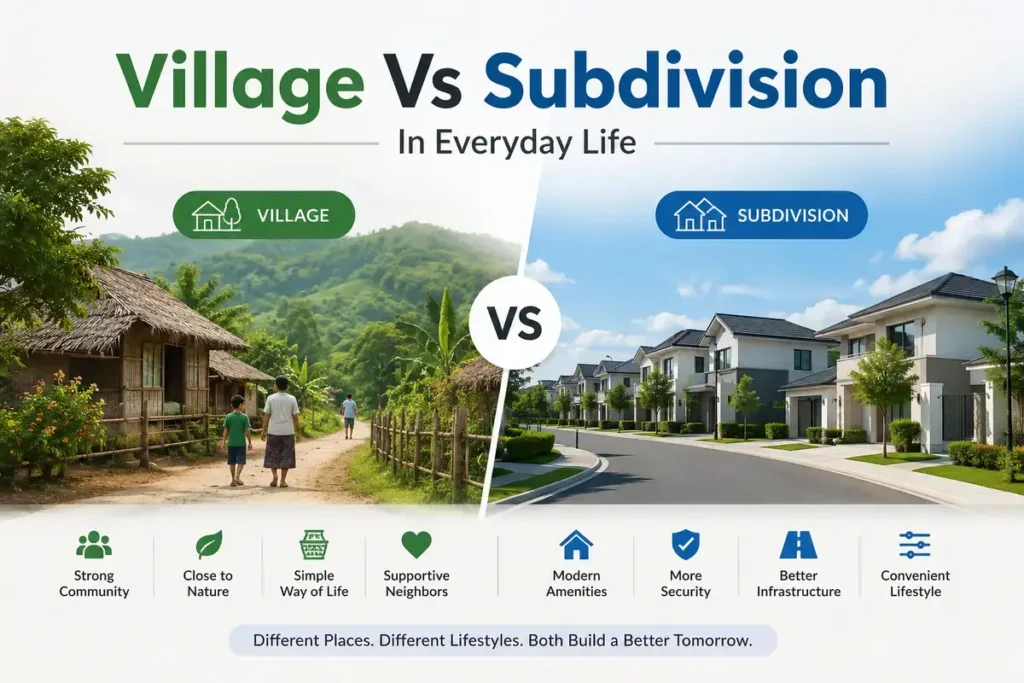
This means your subdivision is part of the village.
The subdivision describes your neighborhood.
The village describes your municipality or community.
The same relationship exists in many cities and towns across North America.
Word Usage And Context
Choosing the right word depends on what you want to describe.
Use village when discussing a community, municipality, or settlement.
Examples.
- The village opened a new public library.
- Everyone knows each other in the village.
- Tourists visit the village every spring.
- The village repaired several roads this year.
- The village hosts a weekly farmers market.
Use subdivision when discussing housing developments or neighborhoods.
Examples.
- A new subdivision is under construction.
- The subdivision includes a community pool.
- Every lot in the subdivision has underground utilities.
- Their subdivision added a walking trail.
- Property values increased throughout the subdivision.
You may also want to read Touchbase Or Touch Base Which One Is Correct 2026 Guide.
Key Differences Between Village And Subdivision
| Feature | Village | Subdivision |
|---|---|---|
| Primary purpose | Community and municipality | Residential development |
| Created by | History or government | Land developer |
| Local government | Often yes | No |
| Legal status | May be incorporated | Not incorporated separately |
| Community identity | Strong | Usually neighborhood based |
| Contains neighborhoods | Yes | No |
| Can exist inside another municipality | Sometimes | Always |
Grammar Explanation
Both village and subdivision are countable nouns.
They follow the same grammar rules.
Singular Forms
- The village is growing rapidly.
- The subdivision has two entrances.
Plural Forms
- Several villages surround the national park.
- New subdivisions continue to appear outside the city.
Articles
Because both are singular countable nouns, they usually need an article.
Correct.
- We visited a beautiful village.
- They purchased a home in a subdivision.
Incorrect.
- We visited beautiful village.
- They purchased home in subdivision.
Adding the article makes the sentence grammatically complete.
Pronunciation Guide
Village
IPA
American English
/ˈvɪlɪdʒ/
Syllables
Vil lage.
Stress
The first syllable receives the primary stress.
Subdivision
IPA
American English
/ˌsʌbdɪˈvɪʒən/
Syllables
Sub di vi sion.
Stress
The strongest stress falls on the third syllable.
Common Pronunciation Mistakes
Some English learners pronounce the ending of village like lage. Native speakers pronounce it with a soft j sound.
For subdivision, avoid placing equal stress on every syllable. The strongest emphasis belongs on vi.
Word Origin
Understanding the history of each word makes the meanings easier to remember.
Village
The word village comes from Old French village, which developed from the Latin word villa, meaning a country house or rural estate.
Over time, the meaning expanded to describe a small community where people lived together.
Subdivision
The word subdivision combines the prefix sub, meaning under or part of, with division, meaning separation into parts.
Its modern meaning developed through land planning and property development, where large areas of land are divided into smaller building lots.
British American Canadian And Australian English
The meanings of village and subdivision stay consistent across major English speaking countries.
The way people use subdivision varies slightly.
American English
Subdivision commonly refers to a planned residential neighborhood.
Canadian English
The meaning is almost identical to American English. Municipal planning documents frequently use the term.
British English
People more often say housing estate or residential development, although subdivision is understood in planning and legal contexts.
Australian English
Terms like housing estate and residential estate are more common, but subdivision is widely used in land development and property law.
Real Life Examples
Daily Conversation
- We spent the weekend exploring a nearby village.
- Their subdivision has beautiful walking paths.
- My aunt moved to a quiet village after retirement.
- Children ride their bikes safely around the subdivision.
Workplace
- The company plans to build another subdivision next year.
- Our office works closely with the village council.
- Engineers inspected roads throughout the subdivision.
- The village approved the new development plan.
Emails
- The subdivision meeting begins at six this evening.
- The village office will respond next week.
Academic Writing
- Researchers studied population growth in rural villages.
- The report analyzed several suburban subdivisions.
Journalism
- The village celebrated its bicentennial anniversary.
- A new subdivision will add more than two hundred homes.
Social Media
- Life in our village feels peaceful every day.
- We finally bought our dream home in this subdivision.
Literature
- The small village became the heart of the story.
- Every subdivision reflected the city’s rapid expansion.
Everyday Life
- The village market attracts visitors from nearby towns.
- Families enjoy the playground inside the subdivision.
Common Mistakes People Make
Many writers understand the basic meanings of village and subdivision, but they still use them incorrectly in everyday writing. These mistakes usually happen because both words describe places where people live.
Calling Every Neighborhood A Village
Incorrect.
We bought a house in a beautiful village inside the city.
Better.
We bought a house in a beautiful subdivision inside the city.
If you are referring to a planned residential neighborhood, subdivision is usually the correct choice.
Calling Every Small Community A Subdivision
Incorrect.
The subdivision has existed for more than two hundred years.
Better.
The village has existed for more than two hundred years.
A subdivision is normally created by developers. Historic communities are generally called villages.
Assuming A Village Cannot Have Subdivisions
Some people believe a village and a subdivision cannot exist together.
In reality, a village may contain several subdivisions. The subdivision identifies the neighborhood, while the village identifies the larger community or municipality.
Confusing Municipality With Neighborhood
A municipality governs an area.
A neighborhood identifies part of that area.
Many villages are municipalities.
Subdivisions are neighborhoods within municipalities.
Easy Memory Tricks
These simple tricks make the difference easy to remember.
Think Community Vs Development
A village is a community.
A subdivision is a development.
Remember The Builder
If a developer divided land into housing lots, think subdivision.
If people are talking about a town or community, think village.
Ask Yourself One Question
Are you describing the entire community or just one neighborhood?
If you mean the community, choose village.
If you mean the planned housing area, choose subdivision.
Related Words
Expanding your vocabulary helps you choose the most accurate word.
Words Related To Village
- Town.
- Hamlet.
- Municipality.
- Community.
- Settlement.
- Borough.
Words Related To Subdivision
- Neighborhood.
- Housing development.
- Residential community.
- Housing estate.
- Residential development.
- Planned community.
Frequently Confused Words
- Village and town.
- Neighborhood and subdivision.
- Community and municipality.
- Hamlet and village.
- District and subdivision.
Understanding these related terms makes your writing more precise.
Expert Editor’s Note
Professional editors choose these words based on meaning instead of size alone.
Use village when discussing a community, municipality, or settlement. This is the preferred choice in news articles, academic writing, travel guides, and government documents.
Use subdivision when discussing residential planning, real estate, land development, or neighborhoods created by developers.
Major dictionaries define village as a small community or municipality and subdivision as land divided into smaller parts, especially for development. Native speakers follow the same distinction in everyday English.
When you are unsure, ask yourself what you are describing.
If it is the community, use village.
If it is the housing development, use subdivision.
Frequently Asked Questions
Is A Village The Same As A Subdivision?
No. A village is a community or municipality. A subdivision is a planned residential development. A subdivision can exist inside a village, town, or city, but the two terms describe different things.
Which Word Should I Use In A Real Estate Listing?
Use subdivision when referring to the housing development. Use village only if you are describing the municipality or community where the property is located.
Can A Village Have More Than One Subdivision?
Yes. Many villages contain multiple subdivisions. Each subdivision is a separate neighborhood within the same village.
Is A Subdivision A Legal Municipality?
No. A subdivision has no independent municipal government. It falls under the authority of a city, town, village, or county.
Which Word Is More Common In American English?
Both are common. Village usually refers to a municipality or small community. Subdivision is widely used in real estate, construction, and urban planning.
What Is The Difference Between A Neighborhood And A Subdivision?
A neighborhood is any area where people live. A subdivision is a neighborhood that was intentionally planned and developed by dividing land into residential lots.
Is Every Village Rural?
No. Many villages are located in rural areas, but some exist within metropolitan regions and function as incorporated municipalities.
Can A Subdivision Include Parks And Community Facilities?
Yes. Many subdivisions include parks, playgrounds, walking trails, clubhouses, and other shared amenities. These features are planned as part of the residential development.
You may also want to read Fair Vs Good Which Word Should You Use 2026.
Conclusion
Understanding village vs subdivision becomes simple once you know what each word represents.
A village is a community or municipality where people live and often share local government and public services.
A subdivision is a planned residential neighborhood created by dividing land into individual housing lots.
The biggest mistake is treating these words as synonyms. They describe different parts of the same living environment and often exist together.
The next time you describe a place, think about its purpose first.
If you mean the community, choose village.
If you mean the planned housing development, choose subdivision.
That simple habit will help you use both words naturally and confidently.

Vocabulary & Language Research Writer
Ethan Parker researches English vocabulary, word meanings, slang, idioms, and commonly confused words. His goal is to help readers understand how English is actually used in everyday conversations and writing.
1 thought on “Village Vs Subdivision Differences Explained Clearly 2026”