
Choosing between fair vs good can feel easy until you put either word into a real sentence. You might say a movie was fair, a meal was good, or a person’s work was fair. Yet the two words don’t express the same level of approval, and they can carry very different meanings depending on context.
The confusion comes from one simple fact. Fair and good can both describe something positively. A fair result can be acceptable. A good result is usually better than acceptable. Fair can also describe justice, appearance, weather, size, or skin tone. Good has an even wider range of meanings and can describe quality, behavior, ability, health, morality, usefulness, or general satisfaction.
So which word should you choose?
Use good when you want to say something has a positive quality or meets a solid standard. Use fair when you mean something is reasonable, acceptable, impartial, or somewhere around the middle of a quality scale.
This guide explains the difference between fair vs good with clear definitions, grammar rules, examples, common mistakes, pronunciation, word origins, and practical advice for everyday and formal English.
Many readers also check Fair vs Good: What’s the Real Difference? (2026).
Quick Answer
Good usually means satisfactory or positive and often suggests a higher level of quality. Fair can mean acceptable or average, but it also means reasonable and impartial. The right word depends on context. A good answer is strong or correct, while a fair answer may be acceptable but still have room for improvement.
Fair Vs Good Comparison Table
| Feature | Fair | Good |
|---|---|---|
| Main meaning | Acceptable, reasonable, or impartial | Positive, satisfactory, or high quality |
| Part of speech | Adjective, adverb, noun, verb | Adjective, noun, adverb |
| Common meaning as an evaluation | Average or acceptable | Positive or better than average |
| Can describe justice | Yes | Yes, in some expressions |
| Can describe quality | Yes | Yes |
| Can describe behavior | Yes | Yes |
| Can mean impartial | Yes | No |
| Can mean morally right | Sometimes | Yes |
| Common phrase | Fair price | Good price |
| Common question | Was the result fair? | Was the result good? |
| Typical tone | Neutral or moderate | Positive |
| Formal use | Very common | Very common |
What Does Fair Mean
Fair has several meanings in English. This makes it one of those everyday words that can confuse learners even when they understand the basic definition.
When people evaluate quality, fair often means acceptable but not especially impressive. It can suggest an average result or a result with clear room for improvement.
For example:
The restaurant was fair.
This usually means the restaurant was okay. It wasn’t terrible, but the speaker isn’t giving it strong praise.
Compare it with:
The restaurant was good.
Now the speaker is expressing clear approval.
However, fair doesn’t always mean average. In other contexts, it means just, reasonable, or impartial.
For example:
The judge made a fair decision.
Here, fair means the decision was just and reasonable. It doesn’t mean the decision was average.
Fair Means Acceptable
When someone rates a product, service, performance, or experience, fair can mean acceptable.
Examples include:
- The movie was fair.
- His performance was fair.
- The food was fair.
- The service was fair.
- Her test result was fair.
In these examples, the speaker usually isn’t enthusiastic. The word sits somewhere around the middle of the evaluation scale.
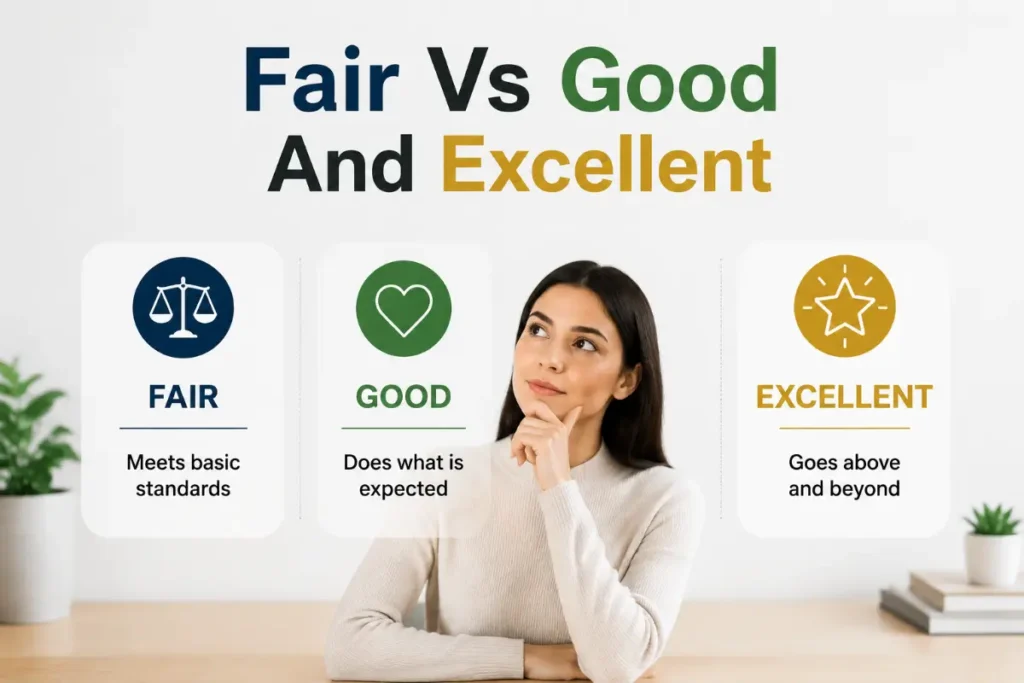
A useful mental scale looks like this:
Poor → Fair → Good → Excellent
This isn’t an absolute rule. People use rating words differently. Still, this scale gives English learners a helpful starting point.
Fair Means Reasonable
Fair can also mean reasonable or acceptable under the circumstances.
Consider this sentence:
That’s a fair price for the car.
The speaker isn’t necessarily saying the price is cheap or excellent. The meaning is closer to reasonable for what you’re getting.
Another example is:
She asked a fair question.
The question isn’t necessarily a good one in terms of quality. It is reasonable and appropriate.
Fair Means Just
Fair also describes equal or impartial treatment.
Examples include:
The teacher was fair to every student.
Everyone deserves a fair chance.
The rules need to be fair.
The referee made a fair decision.
In these sentences, fair has nothing to do with average quality. It refers to justice and equal treatment.
Fair Can Describe Appearance
In some contexts, fair can describe light skin, light hair, or a light color.
For example:
She has fair hair.
The child has fair skin.
This use is correct but can be sensitive or context dependent when describing people. In modern American English, speakers often choose more specific terms such as light skin or blond hair when those details matter.

Fair Can Describe Weather
Fair weather means pleasant or generally clear weather.
For example:
We had fair weather during the trip.
This meaning appears often in weather reports and traditional expressions.
So when you see fair, don’t automatically translate it as okay. Context decides the meaning.
What Does Good Mean
Good is one of the most common and useful adjectives in English. It usually expresses a positive judgment about quality, behavior, ability, usefulness, or experience.
If someone says:
The movie was good.
They generally mean they liked it or thought it had solid quality.
The word doesn’t always mean excellent. It simply gives a positive evaluation.
Good Means Positive Quality
Use good when something meets a positive standard.
Examples include:
- This is a good book.
- She did a good job.
- We had a good meal.
- He’s a good teacher.
- That’s a good idea.
The exact level of quality depends on the speaker and context.
A good movie could be enjoyable without being a masterpiece. A good employee could perform reliably without being the company’s top performer.
Good Means Skilled
Good can describe someone’s ability.
For example:
She’s good at math.
He’s good at fixing cars.
I’m good at explaining difficult ideas.
In these sentences, good means skilled or capable.
The common structure is:
good at + noun or activity
Examples:
He is good at cooking.
She is good at tennis.
They are good at solving problems.
Avoid saying:
She is good in math.
In standard American English, good at math is the natural expression.
Good Means Morally Right
Good can also describe someone’s character or behavior.
Examples include:
He’s a good person.
She was good to her parents.
They did a good thing.
Here, good refers to moral character or positive behavior.
This meaning differs sharply from the justice meaning of fair.
Compare:
The teacher was fair.
This means the teacher treated students justly.
The teacher was good.
This could mean the teacher was kind, effective, skilled, or generally positive.
The sentence doesn’t tell us exactly which meaning the speaker intends. Context supplies the answer.
Which One Is Correct
Both fair and good are correct English words. Neither is a replacement for the other in every situation.
Choose good when you want to express positive quality, ability, behavior, or satisfaction.
Choose fair when you mean acceptable, average, reasonable, impartial, or just.
Consider these examples.
The food was fair.
The food was acceptable but probably not impressive.
The food was good.
The food was enjoyable or high quality.
Now look at a different pair.
The price was fair.
The price was reasonable.
The price was good.
The price was favorable or attractive to the buyer.
The difference becomes even clearer with people.
She’s a fair manager.
This could mean she treats employees impartially.
She’s a good manager.
This usually means she manages people or work effectively.
Neither sentence simply means the other.
Why People Confuse Fair And Good
The confusion usually comes from their use as general evaluation words.
When someone asks:
How was it?
A speaker might answer:
Fair.
Or:
Good.
Both can respond to the question, but they give different levels or types of evaluation.
Both Can Describe Quality
A movie can be fair.
A movie can also be good.
A meal can be fair.
A meal can also be good.
A performance can be fair.
A performance can also be good.
Because both words work in these situations, learners sometimes assume they are synonyms.
They aren’t.
Fair Often Sounds More Moderate
In an evaluation, fair tends to sound restrained.
If your friend asks:
Did you like the restaurant?
and you answer:
It was fair.
Your friend will probably understand that you didn’t love it.
If you answer:
It was good.
Your friend will hear a more positive reaction.
This difference matters in everyday conversation because English speakers often use small changes in adjectives to show how strongly they feel.
Good Has A Wider Positive Range
Good can describe something that is simply satisfactory or something that is highly impressive.
For example:
That’s a good idea.
might mean the idea is useful.
But:
She’s really good at painting.
can describe a high level of skill.
Fair usually has a narrower positive range when used as a quality rating. It tends to signal adequacy rather than strong praise.
Context Changes The Meaning
Look at this sentence:
The deal was fair.
It probably means the terms were reasonable.
Now:
The deal was good.
It could mean the terms were favorable or beneficial.
The words overlap, but the speaker highlights a different idea.
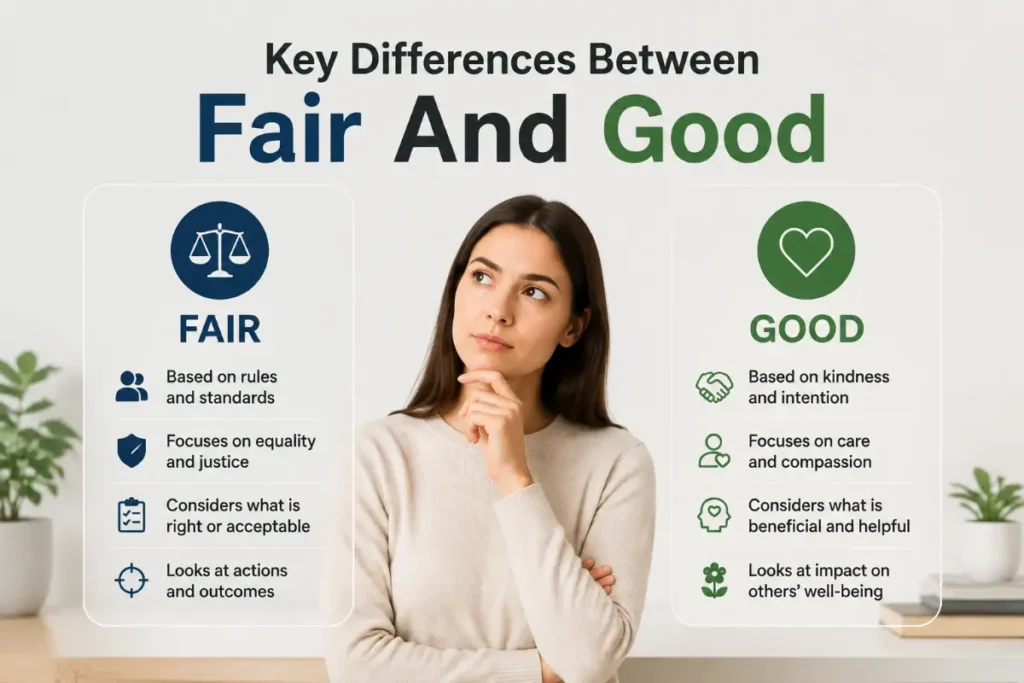
Key Differences Between Fair And Good
The easiest way to understand the difference is to look at the main idea each word carries.
Fair Focuses On Reasonableness
When fair means reasonable, the speaker asks whether something is appropriate under the circumstances.
Examples include:
That’s a fair price.
You got a fair chance.
The punishment was fair.
We reached a fair agreement.
The focus is balance and reason.
Good Focuses On Positive Value
When good describes something positively, the focus is its quality, usefulness, success, or effect.
Examples include:
That’s a good price.
You did a good job.
We reached a good agreement.
She gave me good advice.
The focus is positive value rather than balance.
Fair Can Mean Average
This is especially important when discussing performance.
His test score was fair.
The score was probably acceptable but not strong.
His test score was good.
The score was clearly positive.
The exact difference depends on the speaker’s rating system, but good generally ranks above fair when the words describe quality.
Fair Can Mean Impartial
Good doesn’t normally carry this meaning.
The referee was fair.
This means the referee treated both sides impartially.
You cannot normally replace fair with good and keep the same meaning.
The referee was good.
This could mean the referee performed well. It doesn’t specifically say the referee was impartial.
Fair And Good In Everyday Conversation
Native speakers use these words constantly, but they often rely on tone and context to add meaning.
Imagine someone asks:
How’s your new job?
You could say:
It’s fair.
This sounds cautious. You probably don’t love the job.
You could say:
It’s good.
This sounds clearly positive.
You could say:
It’s really good.
Now the praise becomes stronger.
You could say:
It’s excellent.
Now you’re expressing very strong approval.
This creates a useful informal scale:
Poor → Fair → Good → Very good → Excellent
Again, this is a practical guide rather than a strict dictionary ranking. Speakers can use fair differently depending on the situation.
Fair Vs Good In Ratings And Reviews
Reviews provide one of the clearest places to see the difference.
A reviewer might write:
The hotel was fair for the price.
This suggests the hotel was acceptable given its cost.
Another reviewer might write:
The hotel was good for the price.
This gives stronger approval.
The phrase for the price matters because it changes the standard being used.
A luxury hotel receiving a fair review might have serious problems.
A budget hotel receiving a fair review might still provide reasonable value.
So fair doesn’t always mean poor. It often means the result is acceptable relative to expectations.
Fair Vs Good In Workplace English
Workplace communication requires extra care because small differences in evaluation can affect how people understand feedback.
Suppose a manager writes:
Your performance this quarter was fair.
The employee may understand this as a signal that improvement is needed.
Now compare:
Your performance this quarter was good.
This sounds like positive feedback.
For formal workplace feedback, be specific instead of relying only on broad adjectives.
Instead of:
Your report was fair.
You could write:
Your report covered the main points and met the basic requirements.
Instead of:
Your report was good.
You could write:
Your report was clear, accurate, and easy to follow.
Specific language gives the reader something useful to act on.
Fair Vs Good In Academic Writing
Academic writing often needs more precise language than everyday conversation.
A teacher might write:
Your argument is fair but needs stronger evidence.
Here, fair suggests the argument has some merit but isn’t fully developed.
A stronger evaluation would be:
Your argument is good and supported by relevant evidence.
In academic feedback, words such as adequate, reasonable, sound, strong, and well supported can give readers more precise information than simply using fair or good.
Still, both words are grammatically correct.
Fair Vs Good In Formal Writing
Both words appear in formal English, but their meanings must remain clear.
Fair works well when discussing justice, treatment, prices, opportunities, or reasonable standards.
Good works well when discussing quality, effectiveness, character, results, or usefulness.
Examples include:
The policy provides fair access to education.
The policy has produced good results.
The company offers fair prices.
The company provides good customer service.
These sentences sound natural because each adjective matches the intended meaning.
Fair Vs Good In Different Contexts
The meaning of fair and good becomes much clearer when you see them in different situations. The same sentence pattern can produce a different meaning depending on the noun being described.
Fair And Good For Prices
Both words commonly describe prices but they don’t mean exactly the same thing.
The price is fair.
This means the price is reasonable and appropriate.
The price is good.
This usually means the price is attractive or favorable.
For example a customer might say:
$20 is a fair price for this shirt.
The customer thinks the seller is asking a reasonable amount.
Another customer might say:
$20 is a good price for this shirt.
The customer thinks the price is a bargain or offers strong value.
Fair And Good For Offers
The same distinction applies to offers.
They made me a fair offer.
The offer seems reasonable.
They made me a good offer.
The offer is favorable to the person receiving it.
This difference matters in business and negotiation. Fair focuses on balance while good focuses on benefit or value.
Fair And Good For Results
When discussing results you can use either word.
The results were fair.
The results were acceptable but probably not impressive.
The results were good.
The results were positive or satisfactory.
For stronger praise you could say:
The results were excellent.
The scale depends on the situation but fair usually carries less enthusiasm than good.
Grammar Of Fair And Good
Both fair and good can function as adjectives but good has additional grammatical uses.
Fair As An Adjective
Examples include:
We received a fair deal.
She gave everyone a fair chance.
The weather was fair.
His performance was fair.
The adjective comes before a noun or after a linking verb.
It was a fair decision.
The decision was fair.
Fair As An Adverb
Fair can also function as an adverb in certain expressions.
For example:
He hit the ball fair.
This use is especially common in sports contexts.
The phrase play fair is another familiar example.
You need to play fair.
Here fair modifies the action and means honestly or according to the rules.
Fair As A Noun
Fair can also be a noun.
We went to the county fair.
Here fair means a public event where people gather for entertainment food games or exhibitions.
This meaning has nothing to do with the adjective meaning of fair.
Fair As A Verb
The verb fair appears in phrases such as:
How did you fare on the exam?
Notice that fare is a different word from fair.
This distinction matters because fair and fare are homophones in many varieties of English.
The verb fare means to perform or get along in a particular situation.
How did you fare on your test?
This means:
How did you do on your test?
Grammar Of Good
Good is primarily an adjective but it also appears in several common expressions and grammatical structures.
Good As An Adjective
Examples include:
She is a good teacher.
We had a good time.
This is a good book.
He gave me good advice.
Good After Linking Verbs
Use good after linking verbs when describing a person or thing.
The soup smells good.
You look good.
The plan sounds good.
I feel good.
This last example deserves attention because learners sometimes replace good with well.
In modern everyday American English both I feel good and I feel well can be correct but they carry slightly different emphasis.
I feel good describes a positive state.
I feel well traditionally emphasizes health.
Fair Vs Good And Well
One of the most common English questions involves good and well.
The basic distinction is simple.
Good is usually an adjective.
Well is usually an adverb.
Compare:
She is a good singer.
She sings well.
The first sentence describes the singer.
The second describes how she sings.
This distinction doesn’t directly change the meaning of fair but it helps prevent a common chain of mistakes involving evaluation words.
You might say:
The singer was good.
The singer performed well.
You could also say:
The singer’s performance was fair.
Each sentence makes a different kind of judgment.
Fair Vs Good And Bad
The opposite of good is usually bad.
The opposite of fair depends on its meaning.
When fair means acceptable or average the opposite might be:
poor
When fair means just or impartial the opposite is:
unfair
This gives us two different scales.
Quality Scale
Poor → Fair → Good → Excellent
Justice Scale
Unfair → Fair
This is why treating fair as simply the opposite of bad doesn’t always work.
For example:
The referee was fair.
The opposite would be:
The referee was unfair.
You wouldn’t normally say:
The referee was bad.
That changes the meaning. A bad referee might make poor decisions. An unfair referee might favor one team.
Fair Vs Good And Excellent
English speakers often use fair, good, and excellent to show different levels of approval.
Consider a restaurant review.
The food was fair.
The food was acceptable.
The food was good.
These words aren’t exact numerical ratings. A person’s standards influence the meaning.
One person might call an eight out of ten meal good. Another might call it excellent.
The important point is that fair generally communicates weaker praise than good when both words are being used as quality ratings.
Fair Vs Good In Performance Reviews
Performance reviews require careful wording because employees may read subtle differences very closely.
Compare these statements.
Your work this month was fair.
This suggests the work met some basic expectations but could improve.
Your work this month was good.
This suggests the work met expectations at a positive level.
Your work this month was excellent.
This signals outstanding performance.
A skilled manager should avoid vague praise when specific feedback is possible.
Instead of:
Your presentation was good.
A stronger review might say:
Your presentation was clear and well organized. You explained the main findings without unnecessary detail.
Instead of:
Your presentation was fair.
A useful review might say:
Your presentation covered the main points but the supporting evidence needs more detail.
Specific feedback helps the reader understand exactly what worked and what needs attention.
Fair Vs Good In Customer Reviews
Customers use both words to describe experiences.
A review saying:
The service was fair.
usually sounds neutral.
A review saying:
The service was good.
sounds positive.
This distinction can influence how a business understands customer satisfaction.
For example:
The delivery time was fair.
means the customer considers the delivery time reasonable.
The delivery time was good.
could mean the package arrived quickly or faster than expected.
Again the context changes the exact meaning.
Need another quick comparison? Read Council vs Counsel: Meaning, Differences, and Examples.
Fair Vs Good In Relationships
The two words can also describe people and relationships.
He’s a fair friend.
This isn’t a common compliment. It might suggest that he treats people reasonably or doesn’t take sides.
He’s a good friend.
This is a natural and strong expression of appreciation.
Good friend often means someone who is caring loyal helpful or supportive.
You can also say:
She’s a fair person.
This usually means she treats people justly.
She’s a good person.
This usually refers to positive character and moral qualities.
The difference is subtle but important.
Fair Vs Good In School And Education
Teachers and students use both words regularly.
I got a fair grade.
This suggests the grade was acceptable or reasonable.
I got a good grade.
This suggests the grade was strong.
Compare:
The teacher gave me a fair grade.
The teacher’s evaluation seems reasonable.
The teacher gave me a good grade.
The grade itself was favorable.
These sentences focus on different things. The first focuses on fairness. The second focuses on the result.
Real Life Examples Of Fair And Good
The following examples show how native speakers might naturally use the words.
Daily Conversation
- The movie was fair but I wouldn’t watch it again.
- The movie was good and I’d recommend it.
- That’s a fair question.
- That’s a good question.
- You made a fair point.
- You made a good point.
- We got a fair deal.
- We got a good deal.
- The weather looks fair today.
- The weather looks good today.
Notice how some pairs have very different meanings even though the sentence structure looks almost identical.
Workplace Examples
- The manager gave everyone a fair opportunity.
- She did a good job on the report.
- The company offered a fair salary.
- The company offered a good benefits package.
- His performance was fair but needs improvement.
- Her performance was good and consistently met expectations.
Academic Examples
- Your argument is fair but needs stronger evidence.
- Your argument is good and supported by reliable sources.
- The professor gave me a fair grade.
- I received a good grade on the final exam.
Everyday Writing
- I think that’s a fair request.
- I think that’s a good idea.
- We reached a fair agreement.
- We reached a good agreement.
- The product received fair reviews.
- The product received good reviews.
When Fair Does Not Mean Average
This is one of the most important points for English learners.
You can’t always place fair on a quality scale.
Consider:
Everyone deserves a fair chance.
Here, fair means equal and reasonable.
It doesn’t mean an average chance.
Consider:
The judge made a fair decision.
Again, fair means just.
It doesn’t mean the decision was mediocre.
Consider:
We agreed on a fair price.
This means reasonable.
It doesn’t mean the price was average.
The surrounding noun tells you which meaning of fair is active.
When Good Does Not Mean Excellent
Learners sometimes assume good means extremely high quality.
It doesn’t.
Good simply communicates a positive judgment. The strength can vary.
Compare:
The food was good.
The food was really good.
The food was excellent.
The food was outstanding.
Adding an intensifier or choosing a stronger adjective changes the level of praise.
In casual American English good can sometimes be very positive depending on tone.
For example:
That was good.
said with enthusiasm can communicate strong approval.
So dictionaries provide the core meaning but real conversation adds nuance through tone and context.
Fair Vs Good In Idioms And Expressions
Both words appear in many established expressions.
Common Expressions With Fair
- Fair enough.
- Fair play.
- Play fair.
- Fair chance.
- Fair deal.
- Fair price.
- Fair treatment.
- Fair share.
- Fair game.
- By fair means.
Fair enough is especially common in conversation.
Fair enough. I understand your point.
It means the speaker accepts or acknowledges what someone has said.
Common Expressions With Good
- Good idea.
- Good job.
- Good luck.
- Good point.
- Good news.
- Good time.
- Good choice.
- Good reason.
- Good deal.
- Good for you.
Some expressions overlap.
For example:
fair deal
and
good deal
are both correct but can communicate different ideas.
A fair deal is reasonable and balanced.
A good deal is favorable or advantageous.
Fair Vs Good In Questions
The question itself can help you decide which word fits.
If someone asks:
Was the price fair?
They’re asking if the price was reasonable.
If someone asks:
Was the price good?
They’re usually asking if the price was attractive or favorable.
If someone asks:
Was the teacher fair?
They’re asking about impartial treatment.
If someone asks:
Was the teacher good?
They’re asking about teaching quality or ability.
This distinction is useful because English often leaves meaning to context rather than giving every concept a separate word.
Spelling And Pronunciation
Both words have simple spellings but learners sometimes confuse them with related words.
Fair
Spelling
F A I R
IPA
/fer/
Syllables
One syllable.
In American English it sounds like fare.
Good
Spelling
G O O D
IPA
/ɡʊd/
Syllables
One syllable.
The vowel sound is different from the vowel in food.
A common pronunciation mistake is saying good with the long vowel sound in food. Standard American pronunciation uses the shorter /ʊ/ sound.
Fair And Fare
Fair and fare sound alike in standard American English but have different meanings.
The price is fair.
Fare can mean the cost of transportation.
The bus fare is $2.
Fare can also function as a verb.
How did you fare at the interview?
This means how did you perform or manage.
Don’t confuse fair with fare when writing.
Good And Goods
Another useful distinction is between good and goods.
Good can describe quality.
This is a good product.
Goods is a noun meaning products or merchandise.
The store sells imported goods.
The singular good can also function as a noun in certain expressions.
We should work for the common good.
Here good means general benefit or welfare.
Word Origin Of Fair
The history of fair helps explain why it has several meanings.
The word comes from Old English and Germanic roots associated with ideas such as beauty and pleasant appearance. Over time its meanings expanded.
English eventually used fair for ideas connected with beauty pleasantness equality justice and reasonable treatment.
This explains why modern English has seemingly unrelated expressions such as:
fair weather
fair skin
fair treatment
fair price
fair decision
The meanings developed along different historical paths but remain connected to ideas of pleasantness balance or acceptability.
Word Origin Of Good
Good is also an ancient Germanic word. Its history reaches back through Old English and related Germanic languages.
Its basic idea has long involved positive value or desirable qualities.
Modern English expanded that core meaning into many areas including:
- Quality.
- Morality.
- Skill.
- Health.
- Usefulness.
- Satisfaction.
- Benefit.
That broad history helps explain why good appears in so many everyday expressions.
British And American English
The meanings of fair and good are broadly the same in American British Canadian and Australian English.
There isn’t a major regional spelling difference between the two words.
The main differences appear in usage and tone.
American speakers frequently use good for general positive evaluation.
British speakers also use fair in evaluative contexts and may use it to mean moderate or reasonable.
Canadian and Australian English follow much the same patterns.
The safest approach is to focus on meaning rather than region.
If you mean reasonable or impartial use fair.
If you mean positive quality or ability use good.
Common Mistakes With Fair And Good
Several mistakes appear repeatedly in English writing.
Treating Fair And Good As Exact Synonyms
They overlap in some evaluation contexts but don’t share every meaning.
The referee was fair.
doesn’t mean the same thing as:
The referee was good.
The first focuses on impartiality. The second focuses on performance or ability.
Assuming Fair Always Means Bad
Fair isn’t the same as poor or bad.
A fair result can be acceptable.
A fair decision can be just.
The meaning depends on context.
Assuming Good Always Means Excellent
Good is positive but doesn’t automatically mean excellent.
If you need to communicate very high quality use a stronger word such as excellent, outstanding, or exceptional.
Using Fair When You Mean Skilled
Don’t say:
She’s fair at tennis.
if you mean she has strong tennis skills.
Say:
She’s good at tennis.
If you mean her skill level is average you could say:
She’s an average tennis player.
That wording is often clearer.
Memory Tricks For Fair And Good
A simple memory trick can make the difference stick.
Think of FAIR as balanced.
A fair price is balanced.
A fair opportunity is balanced.
Think of GOOD as positive.
A good price is favorable.
A good opportunity is beneficial.
Another quick rule works well.
Fair asks if something is reasonable. Good asks if something is positive.
It isn’t perfect for every sentence but it will guide you correctly in most everyday situations.
Related Words
Understanding nearby words gives you more control over tone.
Words Related To Fair
- Reasonable.
- Just.
- Impartial.
- Balanced.
- Equitable.
- Moderate.
- Acceptable.
- Average.
Words Related To Good
- Positive.
- Useful.
- Effective.
- Strong.
- Skilled.
- Kind.
- Excellent.
- Satisfactory.
The exact synonym depends on the meaning.
For example equitable is closer to fair when discussing justice.
Effective is closer to good when discussing performance.
Fair Vs Good And Similar Words
English learners can also confuse these words with decent, okay, acceptable, reasonable, and great.
Fair And Decent
Decent often means acceptable or reasonably good.
The hotel was decent.
This sounds slightly more positive than a neutral fair in many contexts.
Fair And Okay
Okay usually means acceptable.
The movie was okay.
Depending on tone this can sound neutral or mildly negative.
Fair And Reasonable
These words overlap strongly when discussing prices requests decisions and treatment.
That’s a fair price.
That’s a reasonable price.
Both can mean the price isn’t excessive.
Good And Great
Great usually expresses stronger praise than good.
The movie was good.
The movie was great.
The second sentence shows greater enthusiasm.
Good And Excellent
Excellent is stronger than good and suggests a very high standard.
She did a good job.
She did an excellent job.
The second sentence gives more praise.
Expert Editor’s Note
From an editorial perspective the most important rule is to identify the exact meaning before choosing the adjective.
Don’t replace fair with good simply because both can describe a result. Ask what the sentence needs to communicate.
If you mean reasonable, use fair.
If you mean positive quality, use good.
If you mean skill, use good at.
If you mean moral character, good often works.
Professional editors also watch for vague evaluation words. In important writing, a sentence becomes stronger when the writer explains the specific quality instead of relying on a broad adjective.
For example:
The proposal was good.
is understandable but vague.
A stronger version is:
The proposal clearly explains the problem and offers a practical solution.
Likewise:
The proposal was fair.
leaves the reader wondering what fair means.
A more precise version might be:
The proposal gives both departments an equal share of the available funding.
Clear writing doesn’t just choose the correct word. It chooses the word that gives the reader the right picture.
Fair Vs Good Which Word Should You Use
Common Questions About Fair And Good
Is Fair Better Than Good?
Usually no. When both words rate quality or performance good normally expresses a more positive evaluation than fair. However fair can carry a completely different meaning when it describes justice or reasonableness. A fair price is not necessarily a good price. A fair price is reasonable while a good price is usually favorable to the buyer.
Does Fair Mean Average?
Fair can mean average or acceptable when you use it to rate quality or performance. For example saying a movie was fair usually suggests it was okay but not especially impressive. However fair doesn’t always mean average. In phrases such as fair treatment or fair decision it means just impartial or reasonable.
Is Good The Opposite Of Fair?
No. The usual opposite of good is bad. The opposite of fair depends on its meaning. When fair means just or impartial its opposite is unfair. When fair means an average level of quality its opposite might be poor. Context determines the best opposite.
What Is The Difference Between A Fair Price And A Good Price?
A fair price is a reasonable price that seems appropriate for the product or service. A good price usually means a favorable price that gives the buyer strong value. For example a $50 price might be fair because it matches the product’s value while $40 might be considered a good price because it’s a bargain.
Should I Say Fair Or Good For A Performance?
Use good when the performance was clearly positive or showed solid skill. Use fair when the performance was acceptable but only average or had noticeable weaknesses. If you want to give useful feedback in professional or academic writing consider explaining the specific strengths and weaknesses instead of relying on one broad adjective.
Can Fair And Good Be Used For People?
Yes but they express different ideas. A fair person usually treats people justly and doesn’t show unfair favoritism. A good person usually has positive moral qualities or behaves kindly and responsibly. Saying someone is a fair person doesn’t automatically mean they are kind while saying someone is good doesn’t specifically mean they are impartial.
Is Fair A Positive Word?
Fair is often neutral to mildly positive. Its tone depends on context. A fair decision is strongly positive because it means the decision was just. A fair movie review can sound only mildly positive because it may mean the movie was acceptable but not impressive. This flexibility makes context especially important.
Many readers also check Prescribe vs Proscribe: The Difference Explained (2026 Guide).
Final Takeaway
The difference between fair vs good becomes much easier once you stop treating them as simple synonyms.
Fair often means reasonable acceptable or impartial. When it rates quality it can suggest an average or adequate result.
Good usually means positive satisfactory useful skilled or desirable. It generally gives stronger praise when compared with fair as a quality rating.
Think about the sentence:
The price is fair.
The price is reasonable.
Now compare:
The price is good.
The price is favorable.
Another example makes the distinction even clearer.
The teacher is fair.
The teacher treats students impartially.
The teacher is good.
The teacher may be skilled helpful kind or effective.
The words can sit close together in meaning but they point the reader toward different ideas.
The Practical Rule
Use fair when the focus is on balance reasonableness justice or an acceptable middle level.
Use good when the focus is on positive quality value ability character or results.
If you’re writing something important don’t stop at choosing between the two. Give the reader a precise reason.
Instead of:
The service was good.
Try:
The service was fast friendly and reliable.
Instead of:
The price was fair.
Try:
The price was reasonable for the quality and matched similar products in the market.
Specific language gives your writing more authority and makes your meaning harder to misunderstand.
The simplest memory trick is worth keeping:
Fair means reasonable. Good means positive.
Once you remember that distinction the choice becomes much more natural.

Vocabulary & Language Research Writer
Ethan Parker researches English vocabulary, word meanings, slang, idioms, and commonly confused words. His goal is to help readers understand how English is actually used in everyday conversations and writing.