
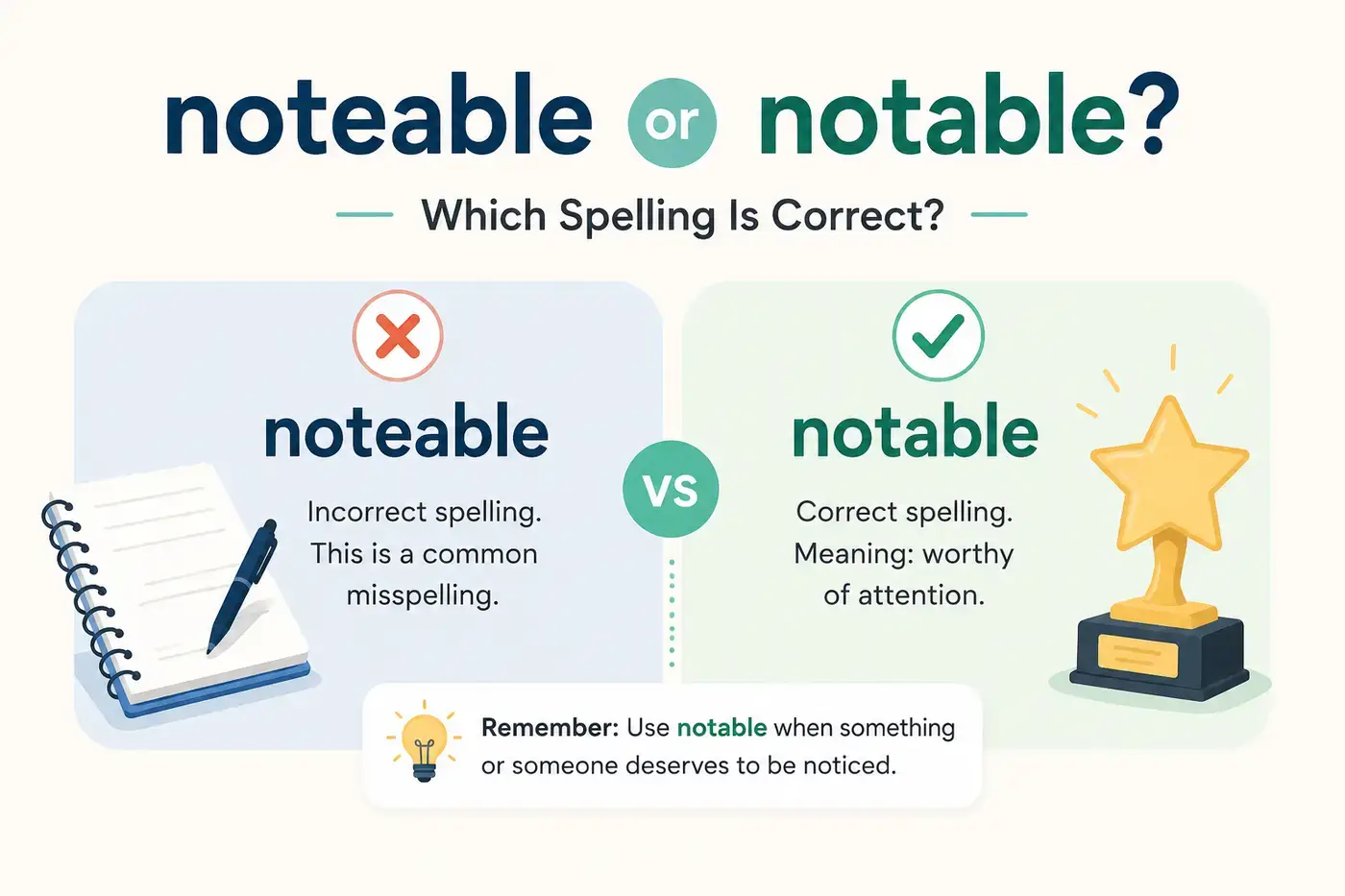
Have you ever typed noteable or notable and wondered if both spellings are acceptable? You’re not alone. This is one of the most common English spelling mistakes because the word note makes noteable seem logical. At first glance, it looks right. In reality, standard English follows a different spelling rule.
The correct spelling is notable. The spelling noteable is incorrect and does not appear as the standard form in modern English dictionaries or style guides. Many people add the extra e because they assume the base word note stays unchanged before adding the suffix. English spelling does not work that way in this case.
This guide explains the difference between noteable or notable, why the confusion happens, the spelling rule behind the correct form, and how to avoid making the same mistake. You’ll also find grammar tips, real life examples, memory tricks, and expert editing advice so you can use the correct spelling with confidence in every situation.
You may also want to read Imbed Vs Embed Which Spelling Is Correct 2026.
Quick Answer
The correct spelling is notable. The spelling noteable is a misspelling and should not be used in formal or informal writing. Notable means worthy of attention, important, impressive, or famous for a particular reason.
Noteable Or Notable Comparison Table
| Feature | Notable | Noteable |
|---|---|---|
| Correct spelling | ✔ Yes | ✘ No |
| Meaning | Worthy of attention or importance | No accepted meaning |
| Part of speech | Adjective | Not a standard English word |
| Used in dictionaries | Yes | No |
| Formal writing | Yes | No |
| Everyday English | Yes | No |
| Common mistake | No | Yes |
| Example | She made a notable contribution to science. | Incorrect spelling |

What Does Notable Mean
Notable is an adjective that describes someone or something important, remarkable, well known, or worthy of attention.
People use notable to highlight achievements, events, qualities, discoveries, or individuals that stand out from others.
Definition
Notable means deserving attention because of importance, excellence, success, or influence.
When To Use Notable
Use notable when describing someone or something that deserves recognition.
Examples.
- She made a notable contribution to medical research.
- There was a notable improvement in customer satisfaction.
- The museum displays works by several notable artists.
- His speech had a notable impact on the audience.
- This city is famous for its notable historical landmarks.
Notable In Different Contexts
Daily conversation.
Her cooking skills have shown notable improvement.
Workplace.
The company reported notable growth this quarter.
Academic writing.
The researcher made several notable discoveries during the study.
Journalism.
The article highlighted notable achievements from local businesses.
Literature.
The novel remains one of the author’s most notable works.
What Does Noteable Mean
Noteable is an incorrect spelling of notable.
Many writers assume the word comes directly from note and keep the final e before adding the ending. English spelling does not follow that pattern for this word.
You should avoid noteable in every type of writing, including emails, school assignments, business documents, blog posts, and social media.
Examples.
✘ She made a noteable discovery.
✔ She made a notable discovery.
✘ It was a noteable achievement.
✔ It was a notable achievement.
Modern dictionaries, professional editors, teachers, and style guides all recommend notable as the only correct spelling.
Which One Is Correct
The answer is simple.
Notable is correct.
Noteable is incorrect.
If you want to describe something important, remarkable, or worthy of attention, always choose notable.
Examples.
✔ She received a notable award for her research.
✔ The town has several notable landmarks.
✘ She received a noteable award.
✘ It was a noteable achievement.
Using the correct spelling makes your writing look polished and professional.
A related grammar guide is Whiny Vs Whiney Which Spelling Is Correct 2026.
Why People Confuse Noteable Or Notable
Several factors make this spelling mistake surprisingly common.
The Word Note
Many people assume notable comes directly from note. Because words like hope become hopeful, they expect the final e to stay.
Pronunciation
Both spellings sound exactly the same when spoken. That makes it difficult to notice the error without seeing it in writing.
Typing Habits
Fast typing often leads people to insert the extra e automatically because note is such a familiar word.
Spellcheck Dependence
Some writers rely on autocorrect instead of learning spelling patterns. If spellcheck is turned off, noteable can easily slip into a document.
Internet Confusion
Since the incorrect spelling appears on blogs, forums, and social media, many learners assume it must be acceptable. Repeated mistakes online do not change standard English spelling.
Key Differences Between Noteable And Notable
| Feature | Notable | Noteable |
|---|---|---|
| English word | Yes | No |
| Dictionary entry | Yes | No |
| Correct spelling | Yes | No |
| Formal writing | Accepted | Incorrect |
| Business writing | Accepted | Incorrect |
| Academic writing | Accepted | Incorrect |
| Professional editing | Recommended | Corrected as an error |
Spelling Rule Behind Notable
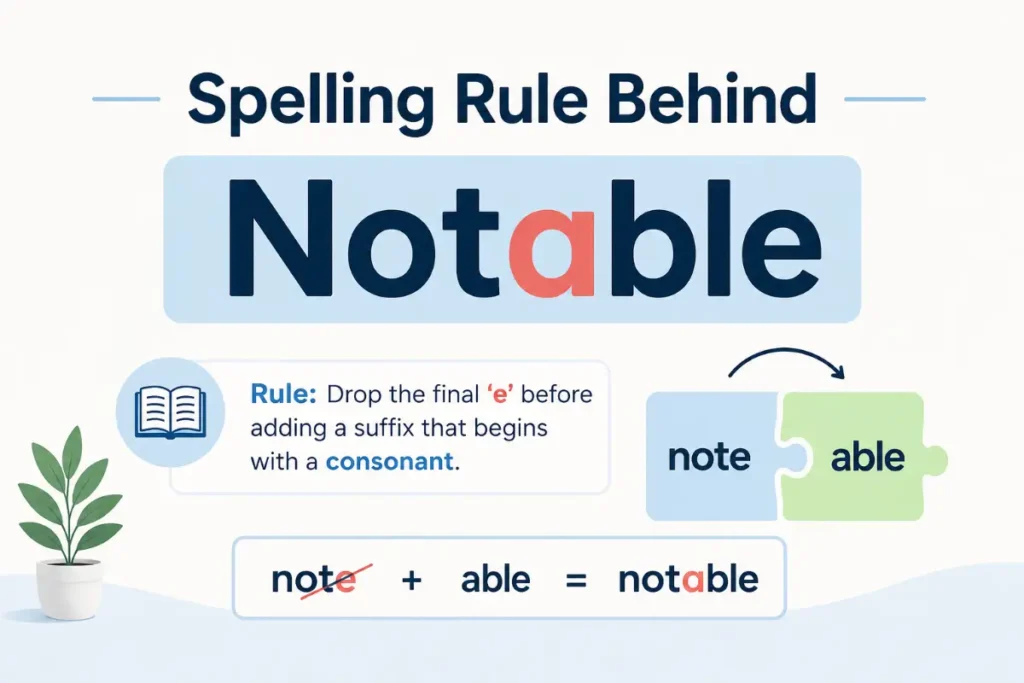
A simple spelling rule explains why notable is correct and noteable is not.
The word comes from note + able, but English drops the final e before adding a suffix that begins with a vowel.
Correct
note + able → notable
Incorrect
note + able → noteable
Similar examples
| Base word | Correct form |
|---|---|
| note | notable |
| value | valuable |
| use | usable |
| love | lovable |
The final e disappears before able. That is why notable follows the standard English pattern.
Pronunciation Guide
Notable
- IPA (American English): /ˈnoʊ.tə.bəl/
- Syllables: no ta ble.
- Stress: The first syllable receives the strongest stress.
Common pronunciation mistake
Some learners pronounce the middle syllable too strongly.
noh TAH bul
NOH tuh bul
The pronunciation is the same no matter how someone misspells the word. That is one reason the error is easy to miss.
Word Origin And Etymology
Notable has a long history.
Origin: Latin notabilis.
Meaning: worthy of note or attention.
The word entered English through Old French and Middle English. Its original idea was something important enough to be noticed and remembered. That meaning remains the same today.
Understanding the origin also helps explain the spelling. The modern English word developed from historical forms that already used the notable spelling rather than noteable.
British Vs American English
Unlike some spelling differences, there is no regional variation here.
United States
Notable
✔ notable
✘ noteable
United Kingdom
Notable
✔ notable
✘ noteable
Canada
Notable
✔ notable
✘ noteable
Australia
Notable
✔ notable
✘ noteable
Every major English speaking region uses notable as the standard spelling.
Real Life Examples Of Notable
Seeing the word in different contexts makes it easier to remember.
Daily Conversation
- Her singing showed notable improvement this year.
- We noticed a notable difference in the weather.
- The restaurant is famous for its notable desserts.
- His attitude has changed in a notable way.
Workplace
- The team achieved notable growth during the quarter.
- There was a notable increase in productivity.
- The report highlights several notable achievements.
- She made a notable contribution to the project.
Emails
- Your presentation showed notable improvement.
- We observed notable progress since last month.
Academic Writing
- The study identified a notable trend in consumer behavior.
- The researcher received recognition for notable discoveries.
Journalism
- The article covered several notable political events.
- The city is home to many notable historical sites.
Social Media
- That’s a notable achievement for such a small team.
- Her latest artwork received notable praise online.
Literature
- The novel became one of the author’s most notable works.
- Critics praised the book for its notable originality.
Public Speaking
- The speaker made a notable point about education.
- Audience engagement showed a notable increase during the presentation.
Common Mistakes With Noteable And Notable
Adding The Extra E
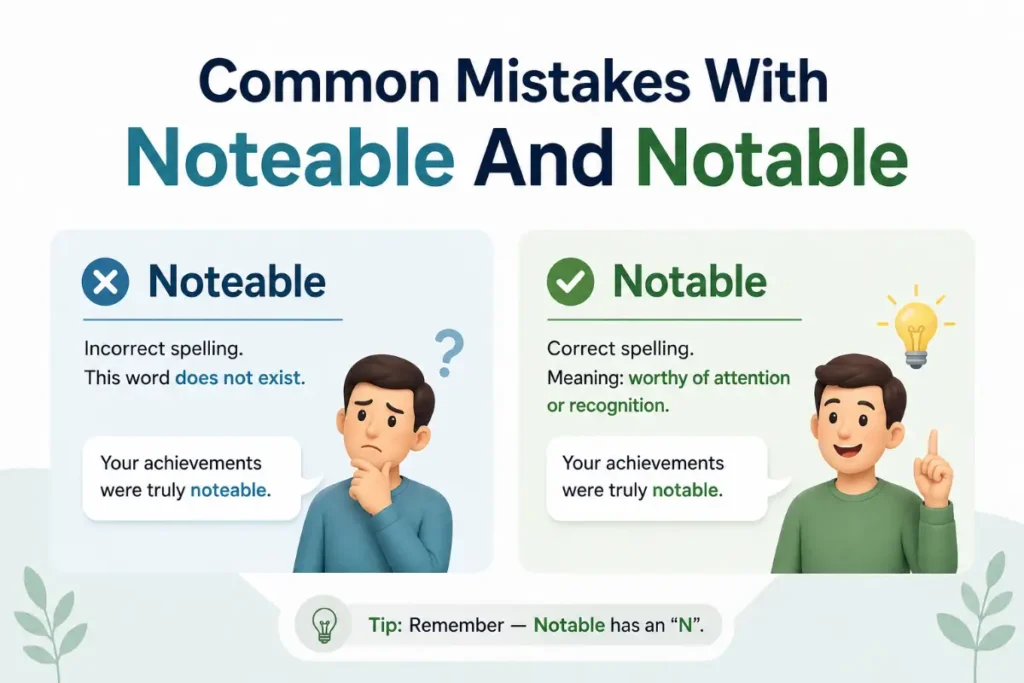
Incorrect: noteable achievement
Correct: notable achievement
Using Noteable In Formal Writing
Professional editors will almost always mark noteable as a spelling error.
Assuming Both Spellings Are Accepted
They are not. Standard dictionaries list only notable.
Confusing Notable With Noticeable
These words have related meanings but are not identical.
| Word | Meaning |
|---|---|
| Notable | Important or worthy of attention. |
| Noticeable | Easy to see or observe. |
Example.
✔ There was a noticeable change in temperature.
✔ She made a notable contribution to science.
Memory Tricks To Remember The Correct Spelling
Think Of Able
Many words ending in able drop the final e.
- love → lovable.
- use → usable.
- value → valuable.
- note → notable.
Use The Phrase Worthy Of Note
If something is worthy of note it becomes notable, not noteable.
Remember The Shortcut
Drop the E before able.
Notable is the only correct spelling.
Related Words And Synonyms
Synonyms For Notable
- Remarkable.
- Important.
- Distinguished.
- Famous.
- Significant.
- Outstanding.
- Prominent.
- Well known.
Antonyms
- Ordinary.
- Unremarkable.
- Insignificant.
- Minor.
- Unknown.
Related Expressions
- Notable achievement.
- Notable figure.
- Notable success.
- Notable contribution.
- Notable difference.
- Notable example.
These combinations appear frequently in news articles academic papers business reports and professional communication.
Expert Editor’s Note
As an editor, I see noteable appear surprisingly often in emails, blog posts, and student assignments. The mistake is understandable because the word note ends with the letter e. Still, standard English spelling drops that e before adding able.
Major dictionaries, style guides, and professional editors recognize notable as the only correct spelling. If you write noteable, readers may question your attention to detail, especially in academic, business, or professional writing.
If you want your writing to look polished and trustworthy, always choose notable.
Frequently Asked Questions
Is Noteable Or Notable Correct?
Notable is the correct spelling. Noteable is a misspelling and should not appear in standard English writing. Use notable any time you describe someone or something worthy of attention, importance, or recognition.
Why Do People Spell Notable As Noteable?
Many people assume the word comes directly from note and keep the final e when adding able. English spelling drops the e in this word, making notable the only accepted form.
Is Noteable In The Dictionary?
No. Modern English dictionaries list notable as the correct spelling. Noteable is generally identified as a spelling mistake rather than an accepted variant.
Is Notable Used In British And American English?
Yes. Notable is the standard spelling in American English, British English, Canadian English, Australian English, and other major English varieties. There is no regional difference for this word.
What Does Notable Mean?
Notable means important, remarkable, well known, or worthy of attention. It often describes achievements, people, places, discoveries, events, or qualities that stand out.
Is Notable Formal Or Informal?
It works well in both formal and informal English. You will often find notable in newspapers, research papers, business reports, books, and everyday conversations.
What Is The Difference Between Notable And Noticeable?
Notable means important or worthy of attention. Noticeable means easy to observe or see. Something can be noticeable without being notable, and something notable may not be immediately noticeable.
How Can I Remember The Correct Spelling?
Think of the spelling rule drop the e before able. Just like usable and lovable, the correct form is notable without the extra e.
Need another quick comparison? Read Different or Diffrent: Which Spelling Is Correct 2026 Guide.
Conclusion
The answer to noteable or notable is straightforward.
Notable is the correct spelling. Noteable is a common spelling mistake that should be avoided in every type of writing.
The confusion usually comes from the base word note. Even though it seems logical to keep the final e, standard English spelling removes it before adding able.
Whenever you want to describe someone or something as important, remarkable, or worthy of attention, use notable with confidence.
One simple rule can save you from this mistake every time.
Drop the e and write notable.

Editorial Reviewer & Proofreader
Grace Mitchell reviews Gramlify’s articles for clarity, consistency, and readability. She is passionate about creating accurate, approachable content that helps English learners build confidence.
1 thought on “Noteable Or Notable Which Spelling Is Correct 2026”