
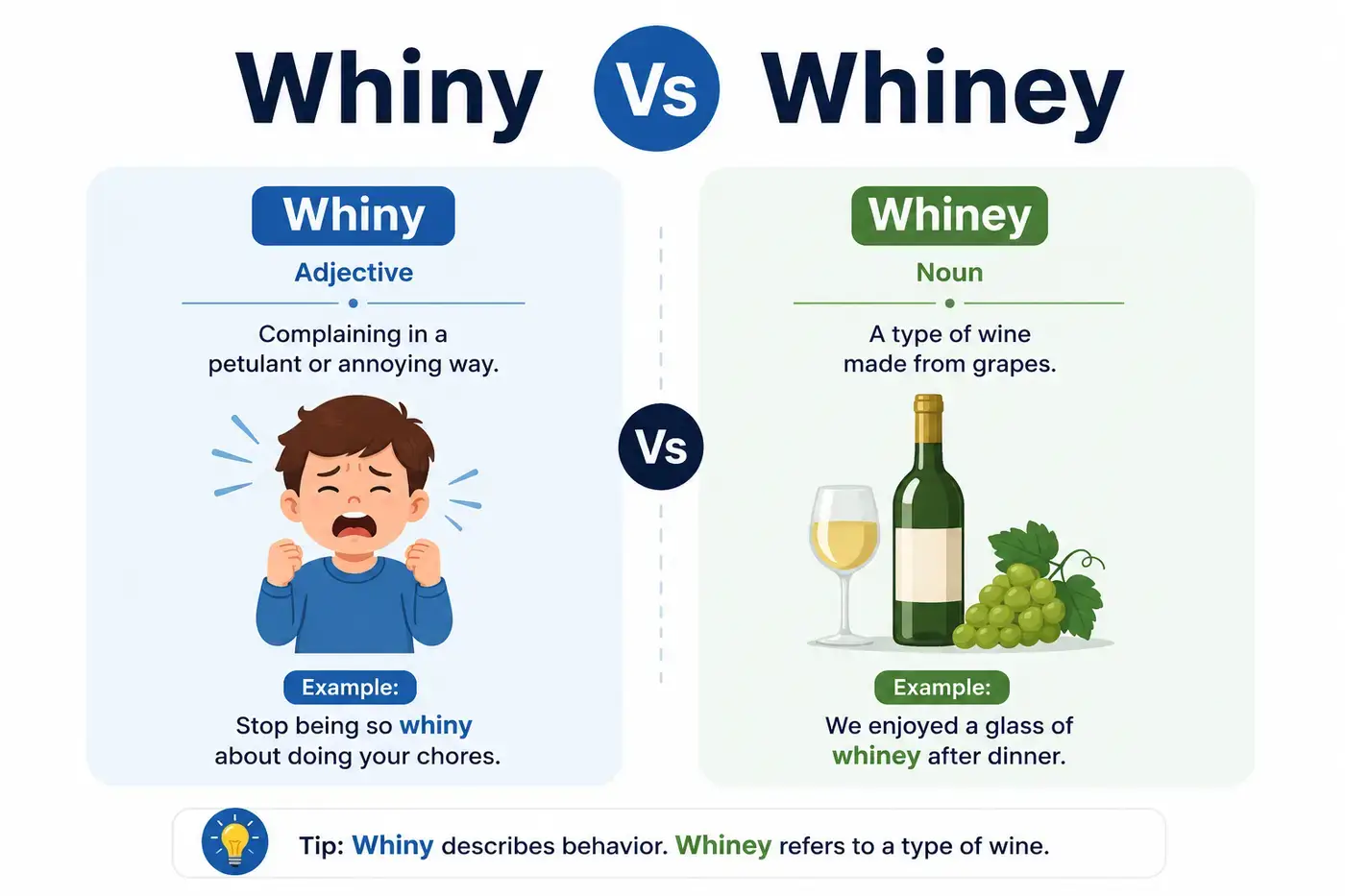
If you’ve searched for whiny vs whiney you’re probably trying to figure out which spelling belongs in your writing. The short answer is simple. Whiny is the standard and preferred spelling in modern English. Whiney appears from time to time but most dictionaries and professional editors treat it as a less common spelling or a spelling variant rather than the preferred choice.
The confusion comes from the verb whine. Since the base word ends with the letter e many people naturally assume the adjective should keep that letter. English spelling does not always work that way. When certain suffixes are added the silent e often disappears. That rule explains why whiny became the accepted spelling.
You’ll also notice both spellings across books blogs social media and online comments. Seeing two versions can make anyone stop and wonder which one is right. This guide clears up the confusion with simple grammar explanations real life examples spelling rules and expert editing advice. By the end you’ll know exactly which spelling to use and why it matters.
Many readers also check Wholey Vs Wholly Which Spelling Is Correct 2026 Guide.
Quick Answer
Whiny is the correct and preferred spelling in modern English. It describes someone who complains too much or speaks in an irritating complaining way. Whiney is an uncommon spelling variant that occasionally appears in informal writing but is rarely recommended in professional or academic English.
Whiny Vs Whiney Comparison Table
| Feature | Whiny | Whiney |
|---|---|---|
| Standard spelling | Yes | No in most style guides |
| Meaning | Complaining in an annoying way | Same meaning |
| Part of speech | Adjective | Adjective |
| Dictionary preference | Preferred | Less common variant |
| Formal writing | Recommended | Usually avoided |
| Everyday writing | Very common | Rare |
| American English | Preferred | Uncommon |
| British English | Preferred | Uncommon |
| Example | Stop being so whiny. | The spelling is uncommon. |
What Does Whiny Mean
Whiny is an adjective that describes someone who complains too much or speaks in an annoying complaining tone.
It usually refers to repeated complaints instead of expressing a genuine concern. The word often has a negative meaning because it suggests the person complains more than the situation deserves.
Simple Definition
Whiny means complaining too much in an irritating or childish way.
When To Use Whiny
Use whiny when describing a person’s voice attitude behavior or repeated complaints.
Examples.
- The child became whiny after missing his afternoon nap.
- His whiny voice made the meeting difficult to finish.
- Nobody likes a whiny teammate who blames everyone else.
- The movie review called the main character too whiny.
- She sounded whiny even though the problem was small.
Whiny In Different Contexts
Daily conversation.
Don’t be so whiny about doing the dishes.
Workplace.
The manager asked everyone to share solutions instead of sounding whiny.
School.
The teacher reminded students that asking questions is fine but constant whining is not.
Media.
Some critics felt the actor’s performance became too whiny during emotional scenes.
Social media.
People often describe negative online posts as whiny when they focus only on complaints.
What Does Whiney Mean
Whiney has the same meaning as whiny but it is not the preferred spelling in modern English.
You may still see whiney in older books personal blogs online forums or casual messages. Some dictionaries list it as a variant spelling while others only recognize whiny as the standard form.
Professional editors almost always recommend using whiny because it is clearer and matches current publishing standards.
Simple Definition
Whiney is a less common spelling of whiny that means complaining in an annoying way.
Where You May See Whiney
Although uncommon whiney still appears in a few places.
- Older publications.
- Informal online posts.
- Personal blogs.
- Social media comments.
- User generated content.
If you’re writing for school work publishing or professional communication choose whiny.
Which One Is Correct
The correct spelling for modern English is whiny.
Most dictionaries style guides publishers teachers and editors recommend this spelling because it follows current usage.
Whiney is not completely wrong. It survives as a spelling variant but appears much less often and may look like a spelling mistake to many readers.
If your goal is clear polished writing whiny is almost always the better choice.
Here are a few examples.
1.The customer sounded whiny during the phone call.
2. His whiny attitude frustrated the rest of the team.
3. The review described the character as whiny but lovable.
✘ The customer sounded whiney during the phone call.
The last sentence is understandable but most editors would change whiney to whiny before publication.
Why People Confuse Whiny And Whiney
There are several reasons these spellings continue to confuse English learners and native speakers alike.
The Base Word Ends With E
The adjective comes from the verb whine.
Many people expect the silent e to stay when the adjective is formed.
English spelling often drops the silent e before adding certain endings. That pattern creates words that look different from the original verb.
Both Spellings Exist Online
A quick internet search shows both spellings.
Seeing whiney in comments blogs or older articles can make it seem equally correct even though whiny is far more common.
Pronunciation Is The Same
Both spellings are pronounced exactly the same.
That makes it impossible to hear the spelling during conversation.
Autocorrect And Informal Writing
Some spelling tools overlook whiney because it has appeared in published writing.
Social media also spreads uncommon spellings quickly since many posts are never professionally edited.
Internet Myths
Some people believe whiny belongs to American English while whiney belongs to British English.
That is a myth.
Both American and British publishers strongly prefer whiny today.
Key Differences Between Whiny And Whiney
The biggest difference between whiny and whiney is not meaning. It is spelling.
Both words describe someone who complains too much or has an annoying complaining tone. The difference is that whiny is the accepted standard spelling while whiney is an uncommon variant that most editors replace.
| Feature | Whiny | Whiney |
|---|---|---|
| Standard English | Yes | Rare variant |
| Meaning | Complaining too much | Same meaning |
| Preferred by editors | Yes | No |
| Formal writing | Recommended | Usually avoided |
| Modern publishing | Very common | Rare |
| Reader expectation | Familiar | May look like a spelling mistake |
A simple rule will keep you out of trouble.
If you’re writing for school work business publishing or online content choose whiny every time.
Grammar Explanation
Understanding the grammar makes this spelling easier to remember.
Whiny Is An Adjective
An adjective describes a noun.
Whiny describes a person’s voice behavior attitude or personality.
Examples.
- The child became whiny after staying up too late.
- His whiny tone annoyed everyone in the meeting.
- The customer sounded whiny during the call.
Notice that whiny always describes someone or something.
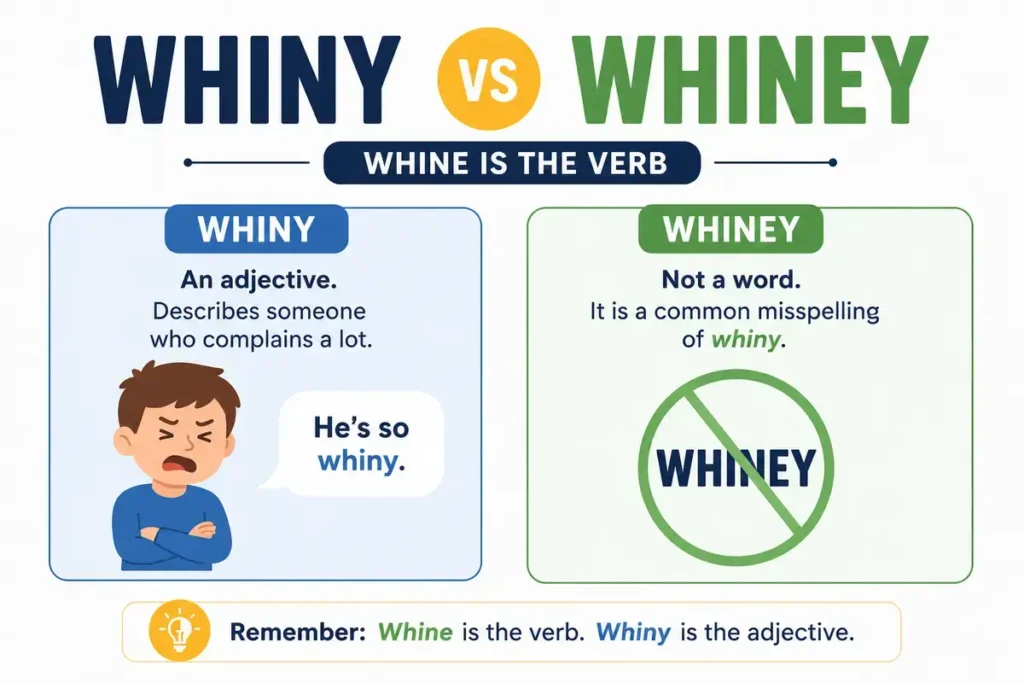
Whine Is The Verb
The adjective comes from the verb whine.
Examples.
- The dog likes to whine when it’s hungry.
- Stop whining and help me clean the garage.
- She didn’t whine even though the job was difficult.
The verb tells you what someone does.
The adjective tells you what someone is like.
Spelling Rule
Many English learners expect the adjective to be whiney because the verb ends with the letter e.
English spelling follows a different pattern.
When many adjectives and related words are formed the silent e disappears before adding another ending.
For example.
- Shine becomes shiny.
- Ice becomes icy.
- Smoke becomes smoky.
- Whine becomes whiny.
This spelling pattern explains why whiny became the standard English form.
Keeping the extra e is understandable but it no longer matches modern spelling conventions.
You may also want to read Contractor Vs Contracter Which Spelling Is Correct 2026.
Pronunciation Guide
One reason people confuse these spellings is that they sound exactly alike.
Whiny
IPA
American English
/ˈwaɪni/
Syllables
Whi ny.
Word Stress
The first syllable receives the stress.
Whiney
If someone writes whiney it is pronounced exactly the same way.
There is no pronunciation difference.
That means readers must rely on spelling rather than sound.
Word Origin And History
The history of the word also explains the spelling.
The verb whine comes from Old English and originally described making a high pitched crying or complaining sound.
Over time English speakers created the adjective whiny to describe people things or voices that constantly complain.
Although whiney appeared in older writing and informal publications whiny gradually became the preferred spelling in dictionaries newspapers magazines and style guides.
Today whiny is the version most native English speakers expect to see.
British American Canadian And Australian English
There is no meaningful regional difference.
American English prefers whiny.
British English also prefers whiny.
Canadian English uses whiny.
Australian English uses whiny as well.
Some older publications may contain whiney but it is not considered the standard spelling in any major English variety.
Real Life Examples
Seeing the word in context makes it much easier to remember.
Daily Conversation
- Stop being so whiny and enjoy the trip.
- My little brother gets whiny when he’s tired.
- She wasn’t whiny. She simply wanted an explanation.
- His whiny voice filled the entire room.
Workplace
- The manager appreciated honest feedback but ignored whiny complaints.
- Nobody wants to work with someone who sounds whiny all day.
- Try offering solutions instead of making whiny comments.
Emails
- Your message should sound professional instead of whiny.
- The email explained the issue without sounding whiny.
Academic Writing
- The reviewer described the character as whiny and immature.
- The novel avoids creating a whiny narrator despite the difficult circumstances.
Journalism
- Critics called the interview thoughtful instead of whiny.
- Readers disliked the article because its tone felt unnecessarily whiny.
Social Media
- People accused the influencer of posting another whiny video.
- That comment section became surprisingly whiny.
- The discussion stayed respectful instead of turning whiny.
Entertainment
- The actor perfectly captured the character’s whiny personality.
- The comedian joked about sounding whiny after missing one cup of coffee.
Everyday Life
- Nobody enjoys listening to constant whiny excuses.
- Even good ideas lose their impact if they are delivered in a whiny tone.
Common Mistakes
Even native English speakers occasionally use the wrong spelling. Most mistakes happen because the verb whine ends with the letter e.
These are the errors editors correct most often.
Using Whiney In Professional Writing
Incorrect.
The customer sounded whiney during the call.
Correct.
The customer sounded whiny during the call.
Professional editors almost always replace whiney with whiny.
Confusing The Verb And The Adjective
Incorrect.
He is always whine.
Correct.
He is always whiny.
Or.
He always likes to whine.
Remember that whine is the verb and whiny is the adjective.
Thinking Whiney Is British English
This is a common internet myth.
British English American English Canadian English and Australian English all prefer whiny.
Assuming Whiny Means Crying
Not always.
Someone can sound whiny without crying. The word usually describes a complaining attitude or tone rather than tears.
Easy Memory Tricks
A simple trick can save you from making this mistake.
Think Of Similar Words
Many English words drop the silent e before adding a new ending.
Examples.
- Shine becomes shiny.
- Smoke becomes smoky.
- Ice becomes icy.
- Whine becomes whiny.
The pattern stays consistent.
Remember The Letter Y
The ending y often creates adjectives that describe a quality.
Cloud becomes cloudy.
Wind becomes windy.
Whine becomes whiny.
Ask Yourself One Question
Are you describing someone who complains?
If the answer is yes use whiny.
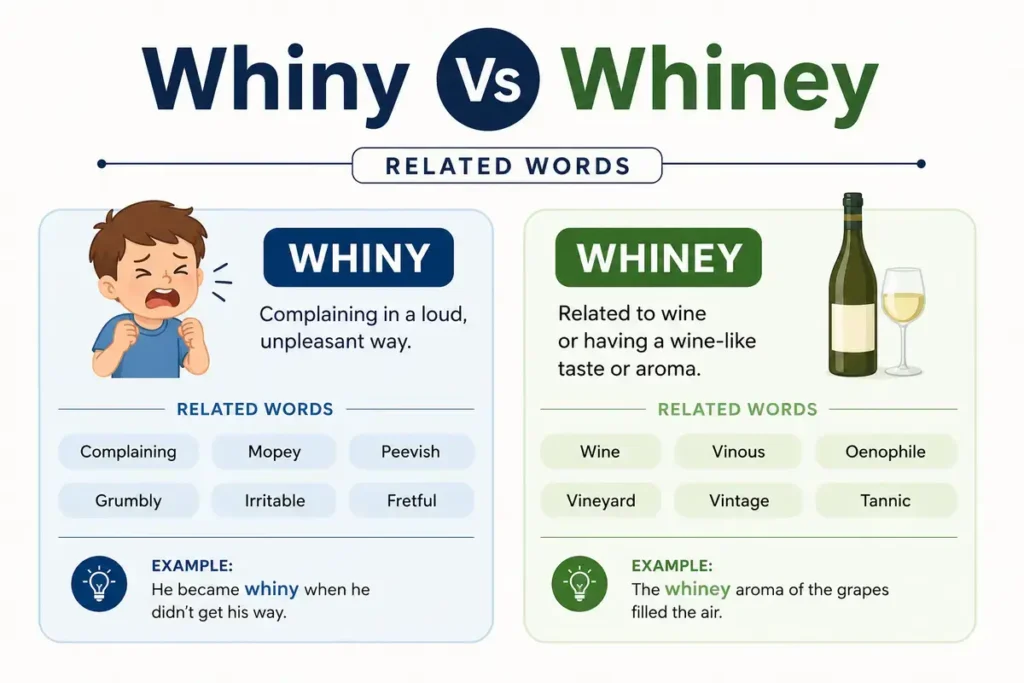
Related Words
Learning related vocabulary helps you sound more natural.
Synonyms
- Complaining.
- Grumbling.
- Fussy.
- Cranky.
- Petulant.
- Irritable.
- Moody.
- Gloomy.
Opposites
- Cheerful.
- Positive.
- Optimistic.
- Pleasant.
- Easygoing.
- Grateful.
Related Words
- Whine.
- Whining.
- Complaint.
- Complain.
- Grumble.
- Moan.
- Fuss.
- Nag.
Expert Editor’s Note
Professional editors consistently recommend whiny.
It is the spelling you’ll find in modern dictionaries newspapers magazines educational resources and style guides. Readers recognize it immediately and it looks polished in every type of writing.
Although whiney still appears online and in older publications it is no longer the preferred choice. Using whiny avoids distracting readers and keeps your writing aligned with current English standards.
If you’re unsure during proofreading choose whiny. You’ll almost always make the right decision.
Frequently Asked Questions
Is Whiny Or Whiney Correct?
Whiny is the preferred spelling in modern English. Whiney is an uncommon spelling variant that most editors and publishers avoid.
Is Whiney Wrong?
It is not completely wrong because some dictionaries recognize it as a variant spelling. Even so whiny is the spelling recommended for nearly all writing.
Why Is It Spelled Whiny Instead Of Whiney?
English often drops the silent e before adding certain endings. The same spelling pattern appears in words like shiny and smoky.
Is Whiny A Negative Word?
Yes. It usually describes someone who complains too much or speaks in an irritating complaining tone.
Can I Use Whiny In Formal Writing?
Yes. Whiny is appropriate in formal writing when it accurately describes a person’s behavior tone or attitude.
Do British And American English Spell It Differently?
No. Both varieties of English prefer whiny. The spelling whiney is uncommon in both.
What Is The Difference Between Whining And Being Whiny?
Whining describes the action of complaining. Whiny describes the person’s attitude voice or behavior. Someone can whine once without being considered whiny.
For another common grammar confusion, see Leary Or Leery Which Word Is Correct 2026 Guide.
Conclusion
The answer to whiny vs whiney is straightforward.
Whiny is the standard spelling used in modern English. It is the form preferred by dictionaries teachers editors and publishers across the English speaking world.
Whiney has the same meaning but appears far less often and may look like a spelling mistake to many readers.
If you want your writing to look polished and professional choose whiny every time. That simple choice will help your message sound clear and natural.

Senior Grammar Editor
Olivia Reynolds is a grammar editor and language writer who enjoys making complex English rules easy to understand. She specializes in grammar, punctuation, sentence structure, and everyday writing tips, helping readers write with greater confidence and clarity.
2 thoughts on “Whiny Vs Whiney Which Spelling Is Correct 2026”