
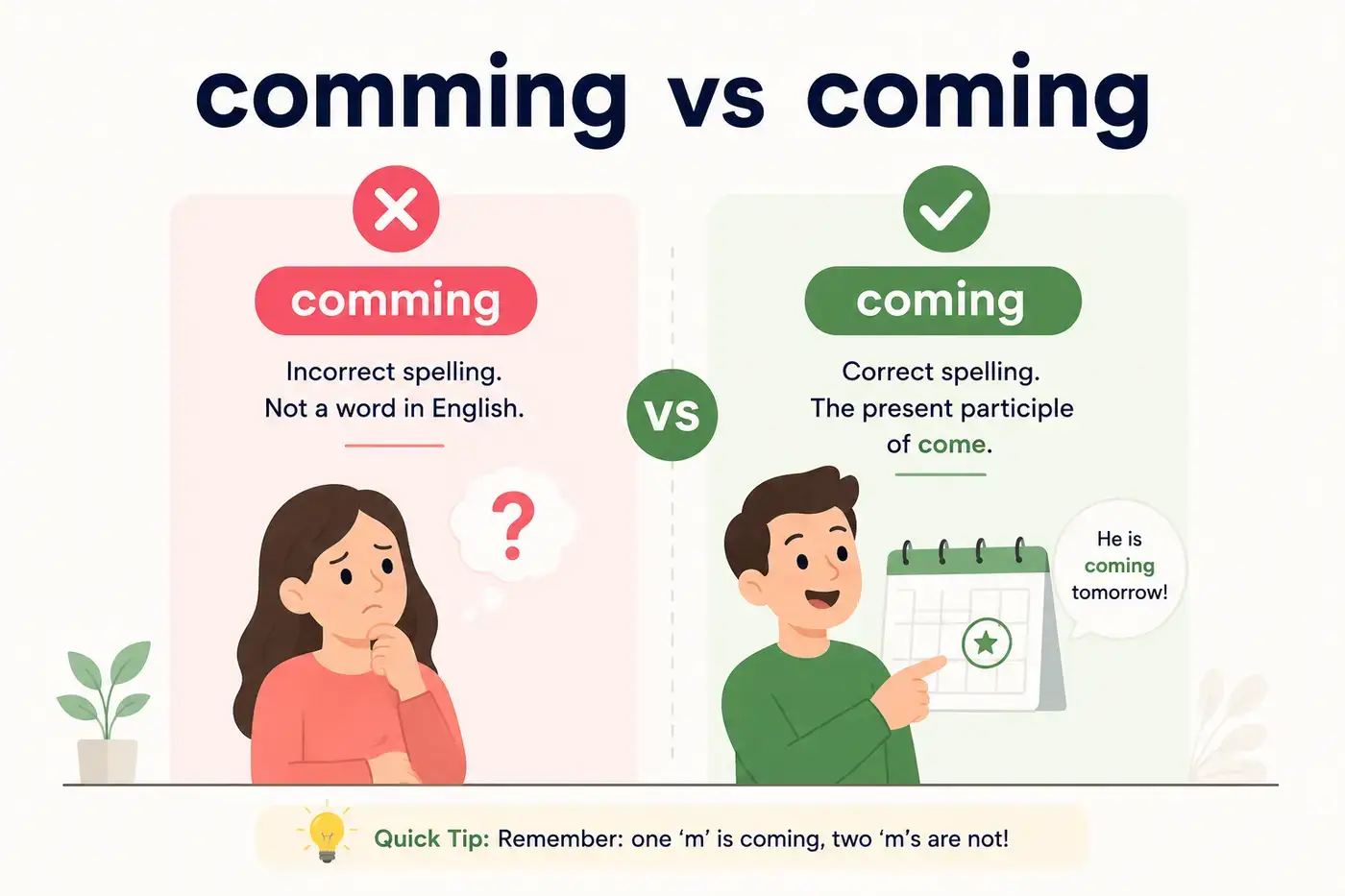
If you’ve ever typed comming and watched your spell checker flag it as an error, you’re not alone. This is one of the most common English spelling mistakes because it looks like it should follow the same pattern as words like running or stopping. At first glance, the extra m seems logical.
The correct spelling is coming. The word comming is a misspelling and is not accepted in standard English. You should avoid it in emails, school assignments, business writing, social media posts, and professional documents.
The confusion comes from English spelling rules. Some verbs double the final consonant before adding ing, while others do not. Many learners memorize examples without understanding the rule, making mistakes easy to repeat.
This guide explains the difference between comming vs coming, why the error happens, the grammar behind the correct spelling, and practical tricks that make it easy to remember. You’ll also find clear examples, expert editing advice, and simple explanations that help you use coming with confidence every time.
Still confused? Compare Placque Vs Plaque Which Spelling Is Correct 2026.
Quick Answer
Coming is the correct spelling. Comming is always incorrect in modern English. The verb come drops the silent e before adding ing, creating coming. The letter m is never doubled because come does not follow the consonant doubling rule.
Comming Vs Coming Comparison Table
| Feature | Coming | Comming |
|---|---|---|
| Correct spelling | Yes | No |
| Meaning | Present participle of come | Misspelling |
| Part of speech | Verb | Not a standard English word |
| Grammar | Correct | Incorrect |
| Used in formal writing | Yes | No |
| Used in everyday English | Yes | No |
| Dictionary entry | Yes | No |
| Example | She is coming home. | ❌ She is comming home. |
Which One Is Correct
The correct spelling is coming.
The spelling comming is incorrect and should never appear in standard English writing.
Examples.
✔ I’m coming with you.
✔ Winter is coming.
✘ I’m comming with you.
✘ Your package is comming tomorrow.
No major English dictionary accepts comming as the correct spelling of the verb come.
What Does Coming Mean
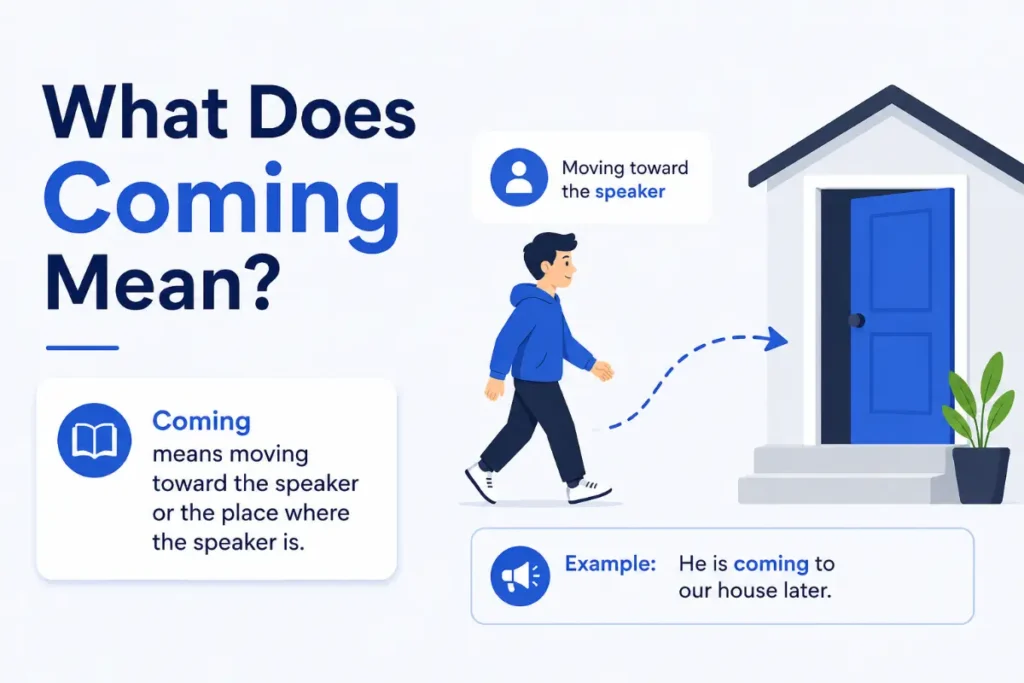
Coming is the present participle and gerund form of the verb come.
It describes movement toward a place, person, event, or situation. It can also refer to something that will happen in the future.
Simple Definition
Coming means moving toward someone or something or happening soon.
Common Uses Of Coming
People use coming in many everyday situations.
It can describe physical movement.
Example.
The bus is coming.
It can describe future events.
Example.
Summer is coming.
It can describe someone’s arrival.
Example.
Our guests are coming tonight.
It can also introduce future plans.
Example.
A new update is coming next week.
What Does Comming Mean
Comming has no accepted meaning in standard English.
It is simply a spelling mistake made when someone accidentally doubles the letter m while writing coming.
Spell checkers, grammar tools, teachers, editors, and dictionaries all treat comming as an error.
If you see comming in online comments or text messages, it is almost always an accidental typo rather than a different English word.
Why People Write Comming Instead Of Coming
This mistake happens for several reasons.
Confusing Spelling Rules
Many English verbs double their final consonant before adding ing.
Examples include.
- Run becomes running.
- Sit becomes sitting.
- Stop becomes stopping.
Because of these examples, learners sometimes assume come follows the same rule.
It doesn’t.
The Silent E Rule
Many verbs ending with a silent e simply drop the e before adding ing.
Examples include.
| Base verb | Correct form |
|---|---|
| Come | Coming |
| Make | Making |
| Write | Writing |
| Smile | Smiling |
| Dance | Dancing |
This is the rule that come follows.
Typing Quickly
Fast typing often leads to an extra m, especially on mobile keyboards.
Seeing Other Misspelled Words Online
Social media and online comments contain many spelling errors. Repeated exposure can make an incorrect spelling look familiar even though it is still wrong.
Comming Vs Coming Grammar Rule
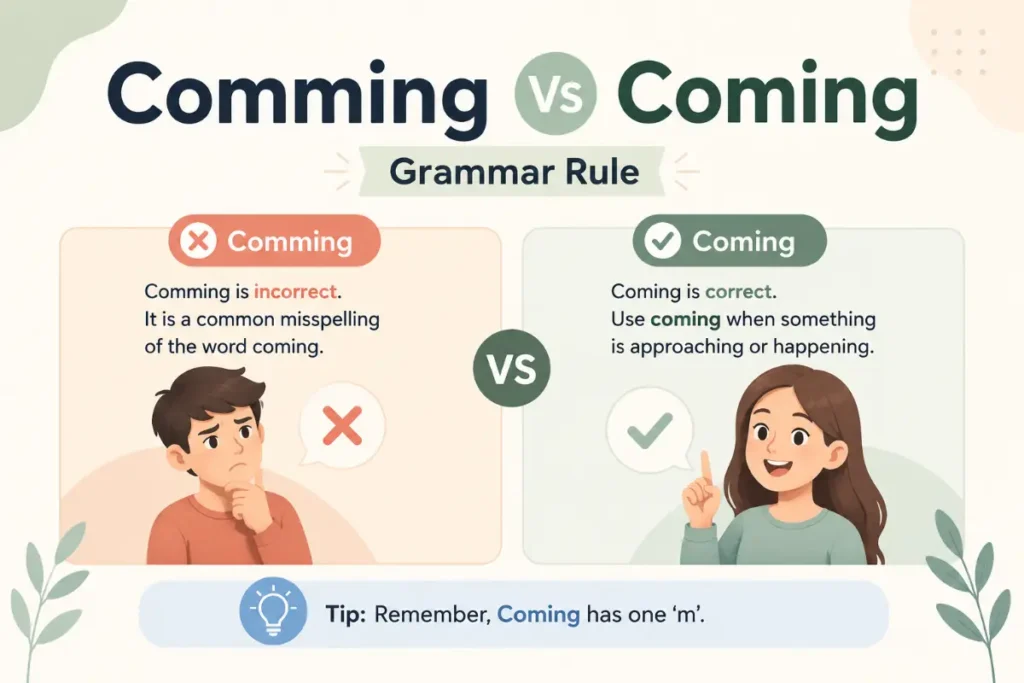
Understanding one simple grammar rule removes the confusion.
When a verb ends with a silent e, remove the e before adding ing.
Examples.
- Come becomes coming.
- Bake becomes baking.
- Drive becomes driving.
- Smile becomes smiling.
- Arrive becomes arriving.
Notice that none of these verbs double the final consonant.
When Do We Double A Consonant
English doubles the final consonant only under certain conditions.
Usually, all three of these points must be true.
- The word has one syllable or ends with a stressed syllable.
- It ends in one vowel followed by one consonant.
- The final consonant is not w, x, or y.
Examples.
- Stop becomes stopping.
- Plan becomes planning.
- Swim becomes swimming.
The verb come does not meet this pattern because it already ends with a silent e.
That is why coming is correct and comming is not.
Key Differences Between Comming And Coming
| Feature | Coming | Comming |
|---|---|---|
| English word | Yes | No |
| Found in dictionaries | Yes | No |
| Grammar | Correct | Incorrect |
| Accepted in academic writing | Yes | No |
| Used in business writing | Yes | No |
| Suitable for exams | Yes | No |
| Suitable for professional emails | Yes | No |
The difference is simple.
Coming belongs in every kind of English writing.
Comming belongs nowhere because it is a spelling mistake.
Pronunciation Guide
The pronunciation is straightforward once you know the correct spelling.
Coming
IPA
American English
/kʌmɪŋ/
Syllables
Com ing.
Stress Pattern
The first syllable receives the primary stress.
Common Pronunciation Mistakes
Most learners pronounce coming correctly. The mistake usually appears in writing rather than speech.
Some people assume the spelling should include two m letters because they hear a stronger m sound when speaking. English pronunciation does not always match spelling, so this assumption leads to the incorrect form comming.
Need another quick comparison? Read Soo Vs So Which One Is Correct 2026 Guide.
Word Origin And History
The verb come is one of the oldest words in the English language.
It comes from Old English cuman, which meant to move toward a place or arrive. Its roots can be traced even further to the ancient Germanic languages.
As English evolved, the spelling changed slightly, but the grammar rule stayed the same.
When adding ing, English drops the silent e.
Come becomes coming.
This spelling has remained unchanged for centuries.
British American Canadian And Australian English
There is no regional difference.
English speakers in the United States, the United Kingdom, Canada, Australia, and New Zealand all spell the word coming.
The spelling comming is considered incorrect everywhere.
This makes coming one of those English words with complete agreement across major English varieties.
Real Life Examples
Seeing the word in real situations makes it easier to remember.
Daily Conversation
- I’m coming over after work.
- Are you coming with us tonight?
- Your food is coming soon.
- Spring is finally coming.
Workplace
- Our new manager is coming next Monday.
- The client is coming for a meeting tomorrow.
- A software update is coming this week.
- Thank you for coming to today’s presentation.
Emails
- I’m coming to the office this afternoon.
- We appreciate everyone coming to the event.
Academic Writing
- Researchers are coming closer to finding an answer.
- New evidence is coming from several independent studies.
Journalism
- Heavy rain is coming across the eastern states.
- Experts say more changes are coming next year.
Literature
- She heard footsteps coming down the hallway.
- Winter was coming faster than anyone expected.
Social Media
- Big things are coming.
- Vacation is coming and I can’t wait.
- The best part is coming soon.
- Thanks for coming to celebrate with us.
These examples show that coming works naturally in both formal and informal English.
Common Mistakes
Most spelling errors happen because writers apply the wrong grammar rule.
Doubling The M
Incorrect.
I’m comming home now.
Correct.
I’m coming home now.
Keeping The Silent E
Incorrect.
I’m comeing tomorrow.
Correct.
I’m coming tomorrow.
The silent e disappears before adding ing.
Mixing Up Similar Words
Some learners confuse coming with words like becoming, incoming, or upcoming.
Although these words share similar endings, they have different meanings and should not be used interchangeably.
Ignoring Spell Check
Modern grammar tools almost always identify comming as a spelling error.
If your spell checker highlights it, trust the correction.
Memory Tricks
Simple tricks can help you remember the correct spelling for life.
Think About The Silent E Rule
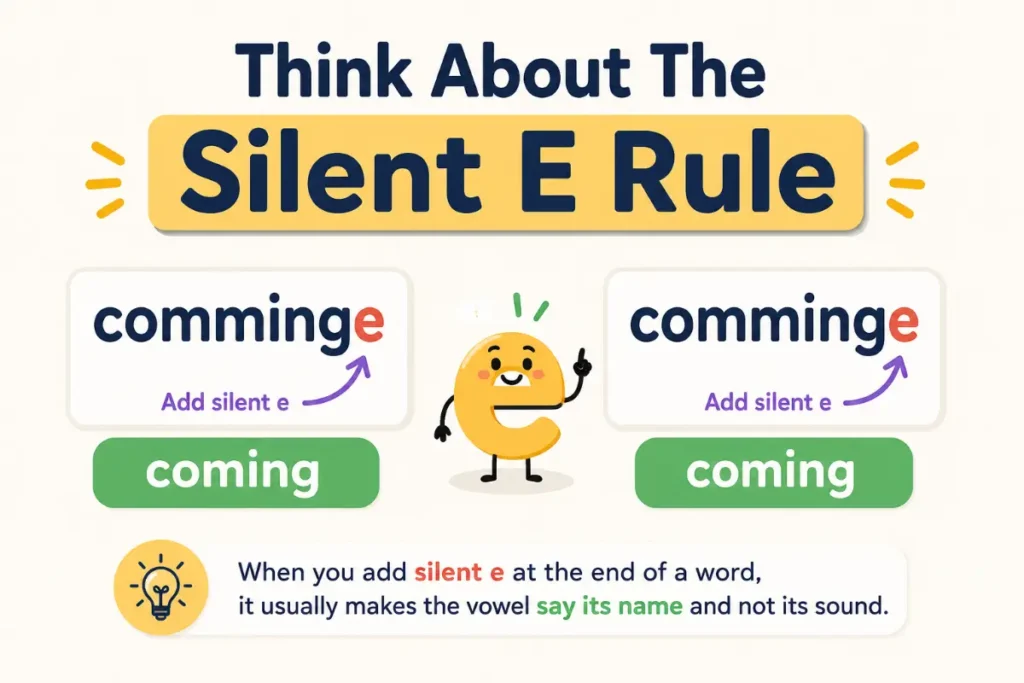
Come ends with a silent e.
Drop the e.
Add ing.
Come becomes coming.
Compare Similar Words
Notice how these words follow the same pattern.
- Make becomes making.
- Smile becomes smiling.
- Arrive becomes arriving.
- Come becomes coming.
Seeing the pattern makes the spelling easy to remember.
Remember This Sentence
Come loses its e, not its mind.
The word drops one letter.
It never gains another m.
Related Words
Learning related vocabulary helps strengthen your English.
Related Forms Of Come
- Come.
- Comes.
- Came.
- Coming.
- Comeback.
Similar Verbs
- Arrive.
- Approach.
- Enter.
- Reach.
- Return.
Opposites
- Leave.
- Go.
- Depart.
- Exit.
Frequently Confused Words
- Coming and becoming.
- Coming and incoming.
- Coming and upcoming.
- Come and came.
- Come and gone.
Each word has a different meaning even though they look similar.
Expert Editor’s Note
Professional editors agree on one point. Coming is the only correct spelling.
Every major English dictionary and style guide recognizes coming as the present participle of come. The spelling comming does not appear as a standard English word.
This mistake often slips into informal writing because people apply the wrong spelling rule. Editors look for it immediately because it is one of the easiest spelling errors to spot.
If you’re writing an email, article, report, school assignment, or business document, always use coming.
When proofreading, pay extra attention to words ending in ing. A quick spell check catches many mistakes, but understanding the grammar rule helps you avoid the error before it happens.
Frequently Asked Questions
Is Comming Ever Correct?
No. Comming is never correct in modern English. It is simply a misspelling of coming. You should replace it with coming in every type of writing.
Why Is It Coming And Not Comming?
The verb come ends with a silent e. English spelling rules say to remove the silent e before adding ing. The final m is not doubled, so the correct spelling is coming.
Is Coming A Verb Or A Noun?
Coming is usually the present participle or gerund form of the verb come. In some contexts, it can also function as a noun, such as the coming of spring, where it refers to an arrival or an event.
Why Do Spell Checkers Correct Comming?
Spell checkers compare words with standard dictionary entries. Since comming is not an accepted English word, grammar tools automatically suggest coming as the correct spelling.
Does British English Spell It Comming?
No. American English, British English, Canadian English, Australian English, and other major varieties all use coming. The spelling never changes by region.
How Can I Remember The Correct Spelling?
Remember this simple rule. If a verb ends with a silent e, remove the e before adding ing. Think of make becoming making. The same pattern gives you coming.
What Is The Difference Between Coming And Came?
Coming describes an action happening now or in the future. Came is the simple past tense of come and describes an action that already happened.
Still confused? Compare Spicey Vs Spicy Which Spelling Is Correct 2026 Guide.
Conclusion
The answer to comming vs coming is clear.
Coming is the correct spelling in every variety of English. Comming is always a spelling mistake.
The confusion happens because many English words double the final consonant before adding ing, but come follows a different rule. It drops the silent e and becomes coming.
The easiest way to remember it is to think about similar verbs like make, write, and smile. They all lose the silent e before adding ing, and come follows the same pattern.
The next time you pause over comming or coming, remember one simple rule.
Drop the e. Never add another m.
That small habit will keep your writing accurate every time.

Editorial Reviewer & Proofreader
Grace Mitchell reviews Gramlify’s articles for clarity, consistency, and readability. She is passionate about creating accurate, approachable content that helps English learners build confidence.