
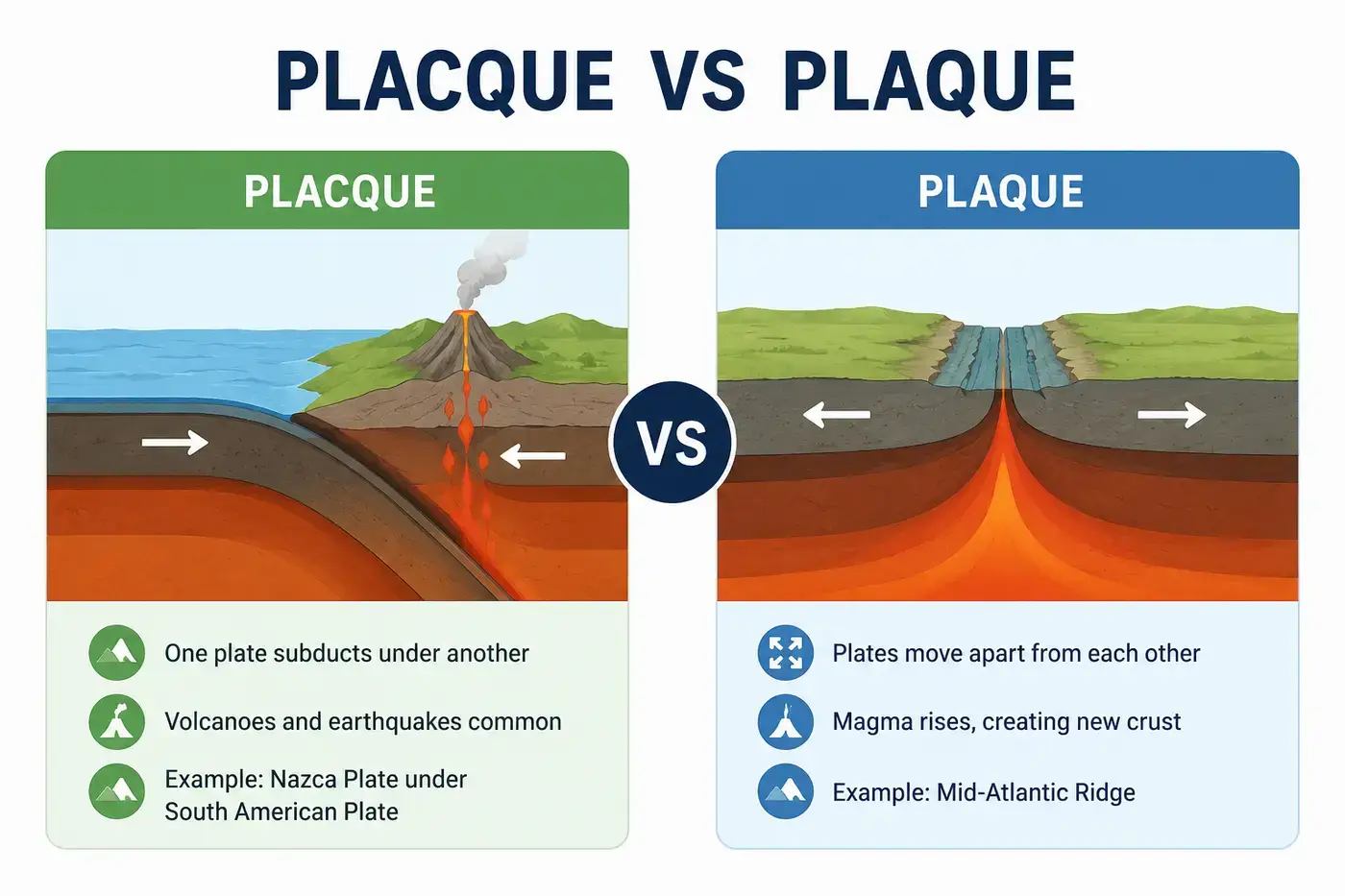
Have you ever typed placque vs plaque and wondered if it was a real English word? You’re not alone. This spelling mistake appears in search engines every day because plaque is an unusual word. Its silent letters and French origin make it easy to spell incorrectly.
The short answer is simple. Plaque is the correct spelling. Placque is a misspelling and does not appear as a standard English word in major dictionaries.
The confusion happens because English contains many words with similar letter patterns. People often assume an extra c belongs in the word, especially after seeing words like opaque or lacquer. Autocorrect does not always catch the mistake, which adds to the confusion.
This guide explains everything you need to know about placque vs plaque. You’ll learn the correct spelling, meaning, pronunciation, grammar, word origin, common mistakes, memory tricks, and plenty of real life examples. By the end, you’ll know exactly when and how to use plaque with confidence.
For another common grammar confusion, see Uncollectible Vs Uncollectable Which Word Is Correct 2026.
Quick Answer
Plaque is the correct spelling. It refers to a flat plate used as an award or memorial, or a sticky layer that forms on teeth or inside arteries. Placque is an incorrect spelling and should never be used in standard English writing.
Placque Vs Plaque Comparison Table
| Feature | Plaque | Placque |
|---|---|---|
| Correct spelling | Yes | No |
| Dictionary word | Yes | No |
| Part of speech | Noun | Not an English word |
| Meaning | A flat sign or a harmful buildup on teeth or arteries | None |
| Pronunciation | /plæk/ | Not applicable |
| Used in writing | Yes | Never |
| Formal writing | Accepted | Incorrect |
| Everyday English | Common | Misspelling |
| Example | The school unveiled a memorial plaque. | Incorrect spelling |
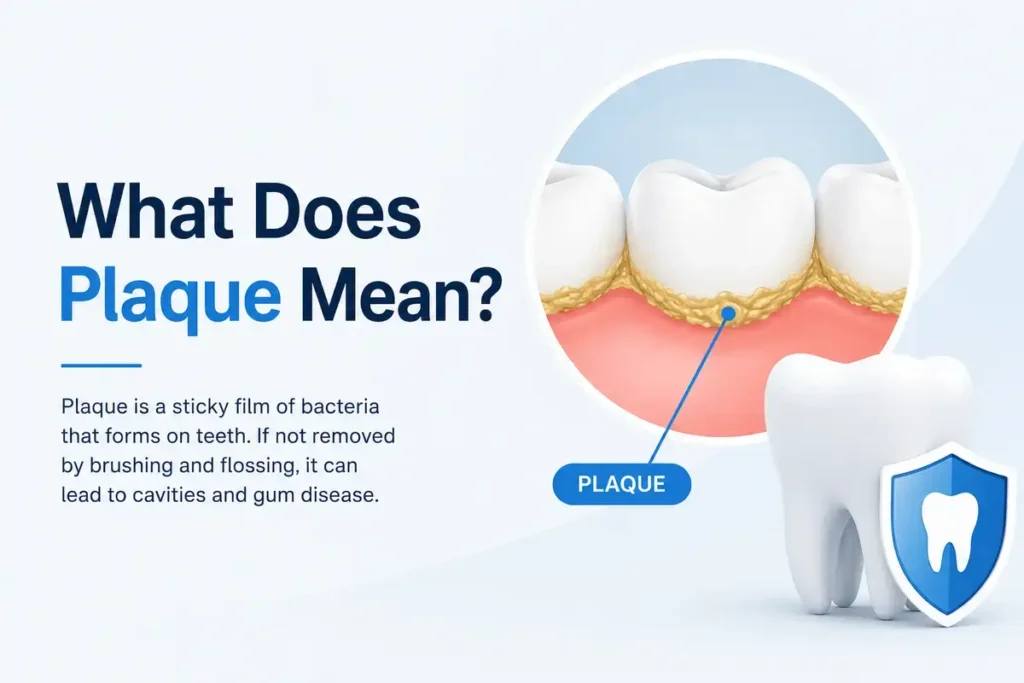
What Does Plaque Mean
A plaque is a noun with several meanings depending on the context. Although the meanings differ, they all share the idea of a flat layer or plate.
Plaque As A Memorial Or Award
One of the most common meanings is a flat piece of metal, wood, stone, or another material that displays writing. It may honor a person, celebrate an achievement, or mark a historic place.
Examples.
- The town placed a plaque outside the historic building.
- She received a plaque for twenty years of community service.
- The museum displayed a bronze plaque beside the painting.
- Every winner receives a plaque at the award ceremony.
- A marble plaque listed the names of the volunteers.
Plaque In Dentistry
In dentistry, plaque is a soft, sticky layer of bacteria that forms on teeth. If it is not removed, it can lead to cavities and gum disease.
Examples.
- Brush your teeth twice a day to remove plaque.
- The dentist explained how plaque damages tooth enamel.
- Daily flossing helps prevent plaque buildup.
- Plaque can harden into tartar if it is not cleaned away.
- Children should learn how to remove plaque properly.
Plaque In Medicine
Doctors also use plaque to describe fatty deposits that build up inside arteries. These deposits can reduce blood flow and increase the risk of heart disease.
Examples.
- The scan showed plaque inside one of his arteries.
- Healthy habits may help reduce plaque buildup over time.
- The doctor discussed treatment options for arterial plaque.
Parts Of Speech
Plaque is always used as a noun.
Examples.
- The plaque looked brand new.
- We cleaned the plaque from the monument.
- Dental plaque requires regular brushing and flossing.
What Does Placque Mean
Placque has no meaning in standard English because it is not a recognized word.
If you see placque in an email, article, textbook, or social media post, it is almost certainly a spelling mistake. The writer intended to use plaque.
Some people accidentally add an extra c because English spelling can be unpredictable. Others confuse it with words that contain similar letter combinations.
Remember this simple rule.
Placque is always incorrect.
Plaque is always correct.
Which One Is Correct
The correct spelling is plaque.
You should never use placque in formal writing, academic papers, business emails, professional documents, or everyday communication.
Here is a quick comparison.
✔ The dentist removed the plaque from my teeth.
✔ A memorial plaque honored the firefighters.
She proudly displayed the award plaque in her office.
✘ The dentist removed the placque from my teeth.
✘ A placque was placed outside the library.
He received a placque for excellent service.
If your spell checker highlights placque, it is doing its job. Replace it with plaque every time.
A simple way to remember this is to think of plaque as the only dictionary spelling. Any version with an extra c is a typo.
Why People Confuse Placque And Plaque
Many English learners and even native speakers accidentally write placque instead of plaque. The mistake is understandable because plaque does not follow the spelling patterns people expect.
Several reasons explain why this error happens.
Similar Letter Patterns
Many English words contain the letter combination cq or cc. People sometimes assume plaque follows the same pattern and insert an extra c by mistake.
For example.
- Opaque.
- Lacquer.
- Acquaint.
Although these words look similar, they have different spelling histories. Plaque does not include an extra c.
Silent Letters
The final letters ue are not pronounced separately. Since people often spell words the way they hear them, they may guess the spelling incorrectly.
Fast Typing
Typing quickly can easily turn plaque into placque. Many spelling mistakes happen because fingers move faster than the brain.
Autocorrect Is Not Perfect
Modern spell checkers catch many errors, but they do not catch every typo immediately. Some writing apps may even overlook placque, especially if the text has not been proofread carefully.
French Origin
The unusual spelling comes from French. English kept much of the original spelling, which makes the word less predictable than many native English words.
Key Differences Between Placque And Plaque
| Feature | Plaque | Placque |
|---|---|---|
| Standard English word | Yes | No |
| Found in dictionaries | Yes | No |
| Correct spelling | Yes | No |
| Used in formal writing | Yes | Never |
| Accepted in exams | Yes | No |
| Appears in professional documents | Yes | No |
| Meaning | Memorial sign or harmful buildup | None |
The difference is simple.
Plaque is a real English word.
Placque is only a spelling mistake.
Grammar Explanation
Grammar is straightforward because only one of these spellings exists.
Plaque Is A Noun
A noun names a person, place, thing, or idea.
Plaque names an object or a type of buildup.
Examples.
- The plaque hangs beside the entrance.
- The dentist removed the plaque.
- They unveiled a commemorative plaque.
In every example, plaque functions as a noun.
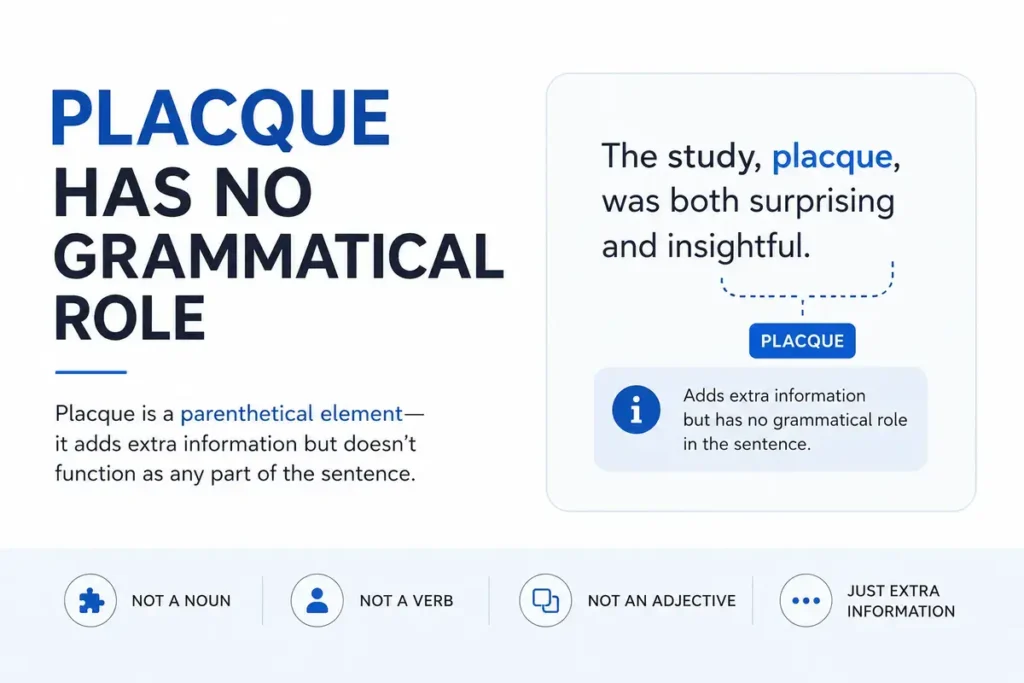
Placque Has No Grammatical Role
Since placque is not an English word, it has no accepted grammatical function.
Whenever you write placque, replace it with plaque.
Spelling Rules
There is no special spelling rule that changes plaque into placque.
Instead, remember these simple facts.
- The correct spelling always begins with pla.
- It ends with que.
- There is only one c in the entire word.
- Never add another c before que.
Think of the spelling as one complete unit instead of trying to sound it out.
Learn the difference in Instalments Or Installments Which Spelling Should You Use.
Pronunciation Guide
Correct pronunciation often helps reinforce correct spelling.
IPA
American English.
/plæk/
British English.
/plæk/
Syllables
Plaque has one syllable.
Stress Pattern
Since the word contains only one syllable, the entire word receives the stress.
Common Pronunciation Mistakes
Some learners pronounce the ending as queue or kay.
The correct pronunciation sounds exactly like plack.
The letters ue remain silent.
Word Origin
Understanding where the word came from makes its spelling easier to remember.
Plaque entered English through French.
The French word plaque originally meant a flat plate or thin sheet.
Its roots go back to Dutch and Middle Dutch words referring to a flat piece or plate.
As English adopted the word, it kept the original French spelling instead of changing it to match English pronunciation.
Today the word has expanded into several meanings.
- A commemorative sign.
- A decorative plate.
- Dental plaque.
- Arterial plaque.
Although the meanings have changed over time, the spelling has remained the same.
British American Canadian And Australian English
One helpful fact is that there is no regional spelling difference.
American English uses plaque.
British English uses plaque.
Canadian English uses plaque.
Australian English uses plaque.
Unlike words such as color and colour, this spelling never changes from one English speaking country to another.
If you write placque, it will be considered incorrect everywhere English is used.
Real Life Examples
Seeing the word in natural sentences makes it much easier to remember.
Daily Conversation
- We stopped to read the plaque outside the old church.
- The plaque tells the story of the building.
- Brush carefully to remove plaque every day.
- My dentist explained how plaque forms.
Workplace
- The company presented her with a plaque for outstanding leadership.
- His retirement plaque now hangs in the conference room.
- Every employee admired the award plaque.
Emails
- Please confirm the wording before we order the plaque.
- The memorial plaque arrived this morning.
Academic Writing
- Researchers studied plaque formation in the arteries.
- Dental plaque remains one of the leading causes of gum disease.
Journalism
- A bronze plaque now marks the historic site.
- Officials unveiled the plaque during the ceremony.
Social Media
- Finally received my award plaque today.
- Don’t forget to brush before bed because plaque never takes a day off.
- The museum’s plaque taught me something new.
Literature
- A weathered plaque stood beside the ancient gate.
- She gently touched the engraved plaque before entering.
Healthcare
- Regular cleanings help reduce plaque buildup.
- Doctors monitor arterial plaque during routine examinations.
Common Mistakes People Make
The spelling mistake placque is common because the word plaque does not sound exactly like it looks. Many writers rely on sound when spelling unfamiliar words, but English often keeps older spellings that do not match pronunciation perfectly.
Here are the mistakes to avoid.
Adding An Extra C
Incorrect.
The school installed a placque near the entrance.
Correct.
The school installed a plaque near the entrance.
The extra c has no place in the word. The correct spelling contains only one c.
Writing Placque In Professional Documents
A spelling mistake may seem small, but it can affect how readers view your writing.
Avoid placque in:
- Business emails.
- Academic papers.
- Awards and certificates.
- Medical documents.
- Published articles.
Professional writing requires accurate spelling because small errors can reduce trust.
Confusing Plaque With Plack
Some learners confuse plaque with plack because they sound similar.
A plack is an old Scottish coin.
A plaque is a sign, plate, or buildup on teeth or arteries.
They have different meanings and should not be used interchangeably.
Assuming The Extra C Makes The Word More Formal
Some people believe longer spellings look more advanced. English does not work that way.
The shorter spelling plaque is the professional and correct choice.
Memory Tricks To Remember Plaque
A simple memory trick can prevent this mistake forever.
Think Of The Plate
A plaque is often a flat plate placed on a wall.
Remember:
Plaque has one c because one plaque is one plate.
Remember The Quiet Letters
The ending que is quiet.
You do not hear the u or e, but they still belong in the spelling.
Use The Dictionary Rule
If you see placque, remove the extra c.
The correct word is always plaque.
Related Words
Understanding related vocabulary helps you use the word correctly.
Words Related To Plaque
- Memorial.
- Award.
- Engraving.
- Marker.
- Inscription.
- Plate.
- Display.
- Tribute.
- Tartar.
- Bacteria.
Similar Words
Plate
A flat object made of metal, glass, or another material.
Example.
The nameplate was attached to the door.
Marker
Something that identifies or remembers a place or event.
Example.
The stone marker showed where the battle happened.
Inscription
Words written or carved onto a surface.
Example.
The inscription on the plaque honored the founder.
Opposite Ideas
Plaque itself does not have a direct opposite, but related opposite concepts include:
- Clean teeth instead of plaque buildup.
- Removal instead of accumulation.
- Forgetting instead of memorializing.

Expert Editor’s Note
Professional editors treat placque as a spelling error, not a variation.
Major dictionaries list plaque as the accepted English spelling. Style guides and academic editors also recommend using the standard form only.
When proofreading, editors usually check words like this carefully because unusual spellings often slip through automatic tools. A writer may know the meaning perfectly but still lose credibility because of one extra letter.
The best approach is simple.
Use plaque in every situation.
If you need a medical meaning, a dental meaning, or a memorial meaning, the spelling stays the same.
Frequently Asked Questions
Is Placque A Correct Spelling?
No. Placque is not a standard English spelling. The correct word is plaque. The incorrect version usually appears because people add an extra c by mistake.
What Is The Difference Between Placque And Plaque?
There is no meaning difference because only plaque is a real English word. It can describe a memorial plate, award, dental buildup, or deposits inside arteries. Placque is simply a misspelling.
How Do You Pronounce Plaque?
Plaque is pronounced like plack. It has one syllable and sounds the same in American and British English.
Why Is Plaque Spelled With Que?
The spelling comes from French. English borrowed the word and kept much of its original spelling, including the ending que.
Is Plaque A Noun Or Verb?
Plaque is a noun. It names a physical object or a type of buildup. English does not normally use plaque as a verb.
Should I Use Plaque In Formal Writing?
Yes. Plaque is the correct spelling for formal and informal writing. It is accepted in academic work, professional documents, journalism, and everyday communication.
How Can I Remember The Spelling Of Plaque?
Remember that a plaque is like a flat plate. Both words start with pla and plaque has only one c. Avoid adding an extra letter.
You may also want to read Comprable Vs Comparable Which Spelling Is Correct 2026.
Conclusion
The answer to placque vs plaque is clear. Plaque is the correct spelling, and placque is a common mistake.
A plaque can be a memorial sign, an award, dental buildup, or a medical deposit inside arteries. The spelling never changes across these meanings.
The biggest mistake writers make is adding an extra c because the word looks unusual. Remember the simple rule: plaque has one c and one correct spelling.
When you write with accurate words, your message becomes clearer and your readers trust your work more. A small spelling choice can make a big difference.

Editorial Reviewer & Proofreader
Grace Mitchell reviews Gramlify’s articles for clarity, consistency, and readability. She is passionate about creating accurate, approachable content that helps English learners build confidence.
1 thought on “Placque Vs Plaque Which Spelling Is Correct 2026”