
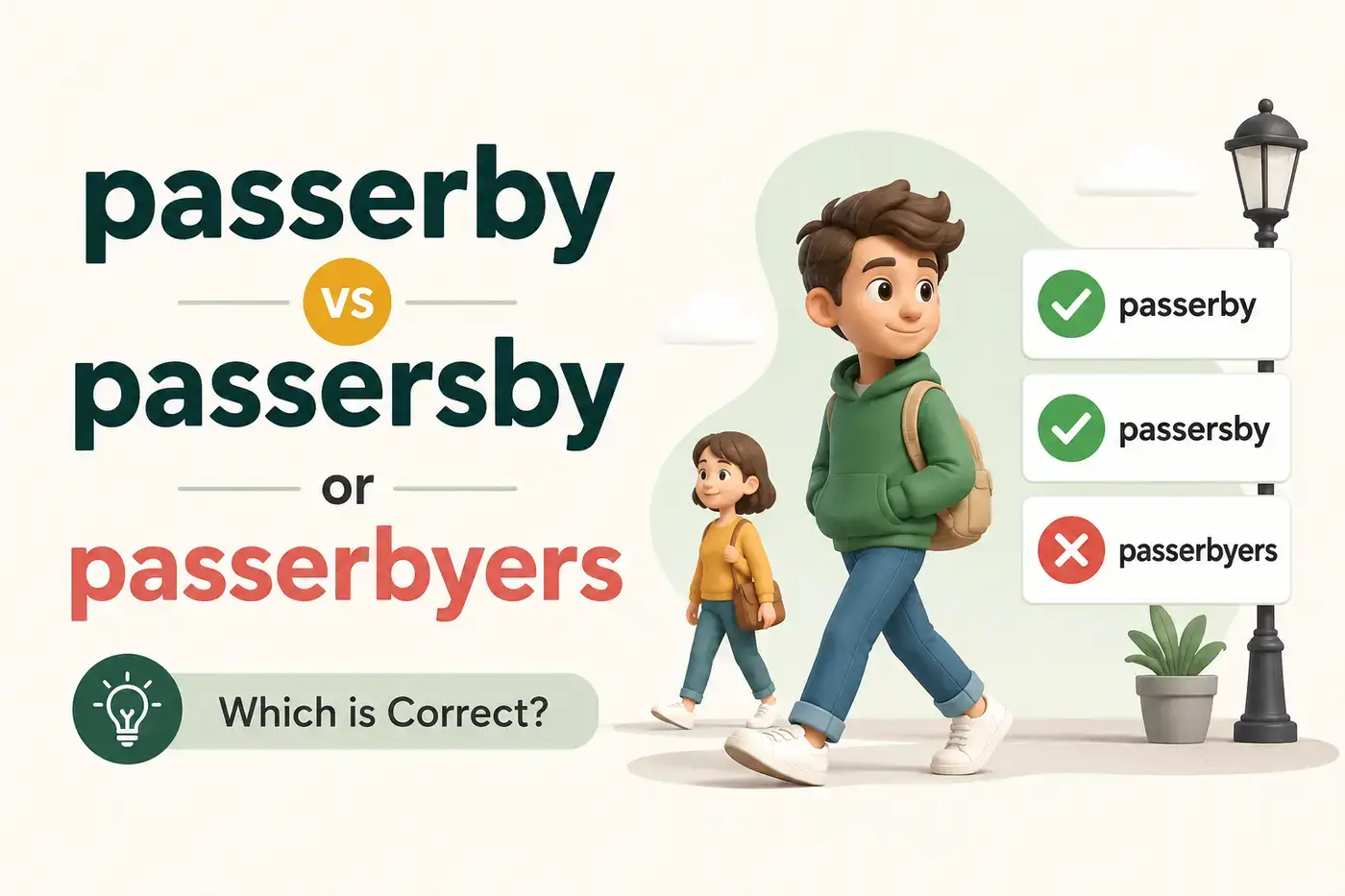
Have you ever stopped while writing and wondered if the plural of passerby is passersby or passerbyers? You’re not alone. This is one of those English words that catches even fluent speakers off guard because it doesn’t follow the usual plural rule.
Most nouns become plural by adding s or es. Passerby works differently. The word comes from two parts, and the plural changes the first part instead of the last. That unusual pattern leads many people to write passerbys or passerbyers, both of which are incorrect in standard English.
The good news is the rule is easy once you know how the word is built. After that, you’ll never second guess it again.
In this guide, you’ll learn the correct plural form, why English treats this word differently, how dictionaries and style guides explain it, and how native speakers use it in everyday conversation, news articles, and formal writing. You’ll also see plenty of real examples, common mistakes, and simple memory tricks that make the correct form stick.
Learn the difference in Realist Vs Realest Which Word Is Correct (2026 Guide).
Quick Answer
Passersby is the correct plural of passerby. Passerby refers to one person who happens to be passing. Passerbyers is not a correct English word and should never be used in formal or informal writing.
Passerby Passersby Or Passerbyers Comparison Table
| Feature | Passerby | Passersby | Passerbyers |
|---|---|---|---|
| Correct spelling | Yes | Yes | No |
| Meaning | One person passing by | More than one person passing by | Not an English word |
| Part of speech | Noun | Plural noun | Incorrect form |
| Grammar | Singular | Plural | Incorrect |
| Common usage | Very common | Very common | Not accepted |
| Formal writing | Yes | Yes | No |
| Example | A passerby called for help. | Several passersby stopped to help. | Incorrect usage |
Which Form Is Correct
The answer is straightforward.
Passerby is singular.
Passersby is plural.
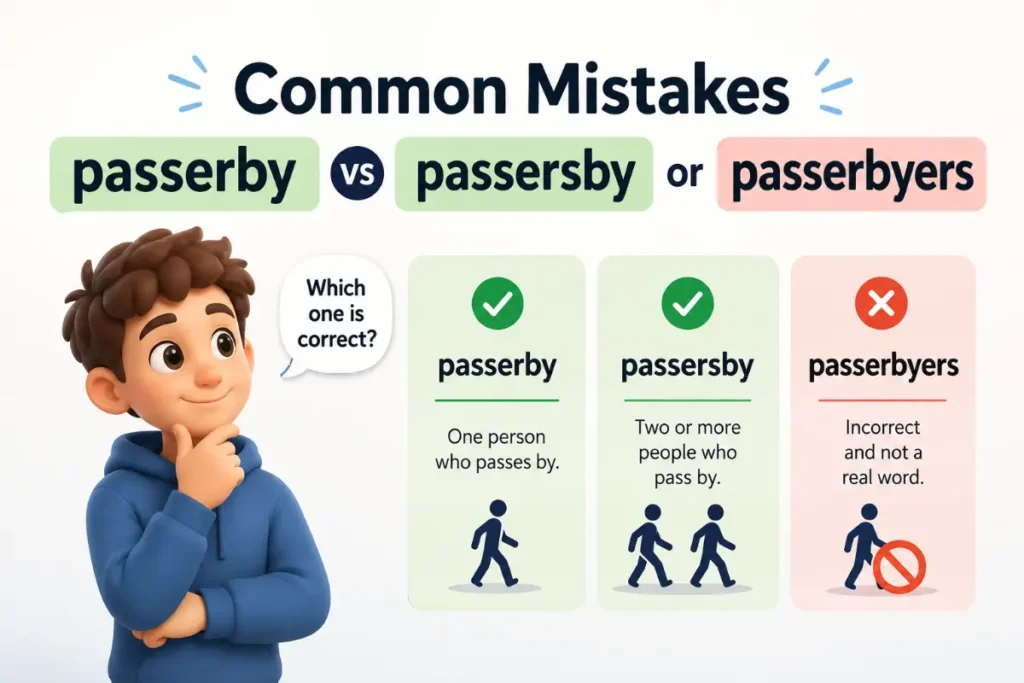
Passerbyers is always incorrect.
Examples.
✔ A passerby found the missing wallet.
✔ Two passersby reported the accident.
✘ Two passerbyers reported the accident.
If you’re writing for school, work, journalism, or everyday communication, always use passersby as the plural form.
What Does Passerby Mean
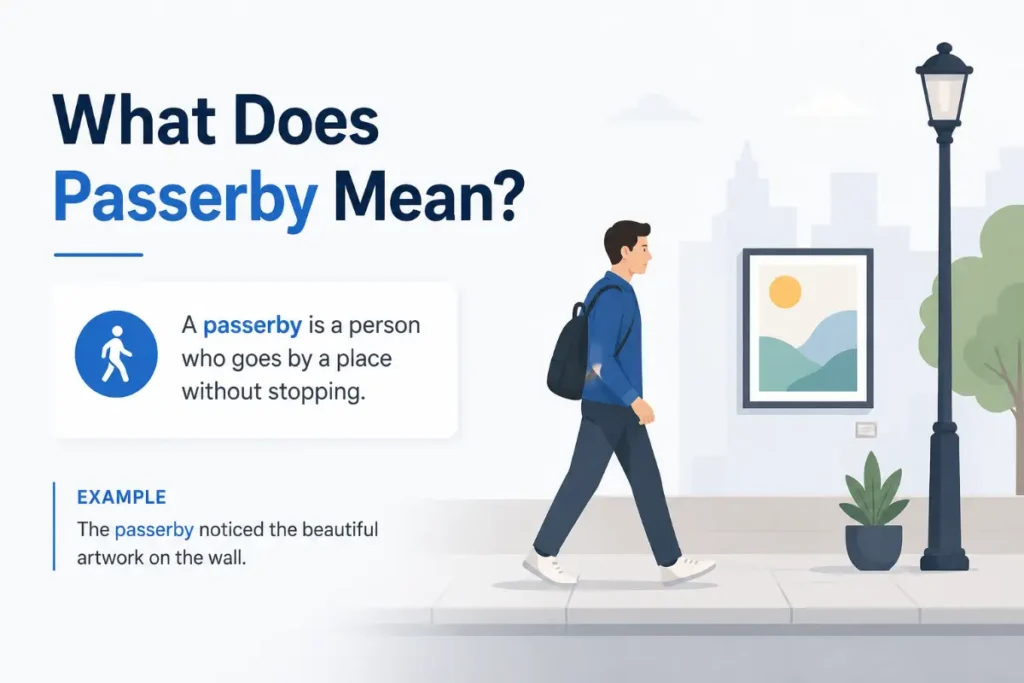
A passerby is a person who happens to be walking or moving past a place without stopping or being directly involved.
The word usually describes someone who witnesses an event simply because they were nearby.
Definition
A person who passes by a place without being part of the situation.
Common Contexts
You will often see passerby in news stories, police reports, novels, and everyday conversations.
Examples.
- A passerby noticed smoke coming from the building.
- The passerby offered directions to the tourists.
- One passerby found the lost puppy.
- A kind passerby helped carry the groceries.
- The passerby called emergency services immediately.
What Does Passersby Mean
Passersby is the plural form of passerby.
It refers to two or more people who happen to pass a place.
Definition
People who are passing a location without being directly involved.
Examples
- Several passersby stopped to watch the parade.
- Curious passersby gathered outside the museum.
- The police interviewed nearby passersby.
- Passersby applauded the street musician.
- A few passersby helped clear the fallen tree from the road.
Notice that every example refers to more than one person.
Why Is Passersby The Correct Plural
This word follows an older English pattern.
The main noun is passer, while by simply tells where the person is passing.
When English makes the word plural, it changes the noun instead of the adverb.
Think about these examples.
- Brother becomes brothers in brothers in law.
- Mother becomes mothers in mothers in law.
- Passer becomes passers in passersby.
The ending by never changes because it is not the noun.
Once you know that passer is the noun, the plural suddenly makes perfect sense.
Grammar Explanation
Understanding the grammar makes this word easy to remember forever.
Passerby Is A Compound Noun
A compound noun combines two words into one expression.
In passerby the parts are.
- Passer is the noun.
- By is an adverb that describes movement.
Since passer is the noun, English adds the plural ending there.
Singular.
A passerby.
Plural.
Several passersby.
This grammar rule also appears in other compound nouns where the main noun comes first.
Why Passerbyers Is Incorrect
Some learners assume every noun should become plural by adding ers or s to the end.
That pattern does not apply here.
English has never accepted passerbyers as a standard word.
Major dictionaries, grammar references, and style guides recognize only passersby as the correct plural.
Using passerbyers immediately stands out as a spelling mistake.
Pronunciation Guide
Passerby
IPA
American English
/ˌpæsərˈbaɪ/
Syllables
Pass er by.
Stress
The strongest stress falls on the final syllable.
Passersby
IPA
American English
/ˌpæsərzˈbaɪ/
Syllables
Pass ers by.
Stress
The final syllable still receives the primary stress.
The pronunciation changes only slightly because of the added s sound after passer.
Why People Confuse These Words
There are several reasons this question appears so often.
The Plural Looks Unusual
Most English nouns simply add s at the end.
Passersby breaks that expectation.
People Focus On The Last Word
Many writers assume by is the important part because it comes last.
In reality, passer is the noun.
Autocorrect Is Not Always Helpful
Some spell checkers fail to recognize uncommon compound nouns. That can make writers doubt the correct spelling.
Internet Myths
Some websites incorrectly suggest passerbys or passerbyers. Those forms do not appear in respected dictionaries or professional style guides.
Still confused? Compare Developed Vs Developped Which Spelling Is Correct 2026.
Passerby Vs Passersby At A Glance
Remember this simple rule.
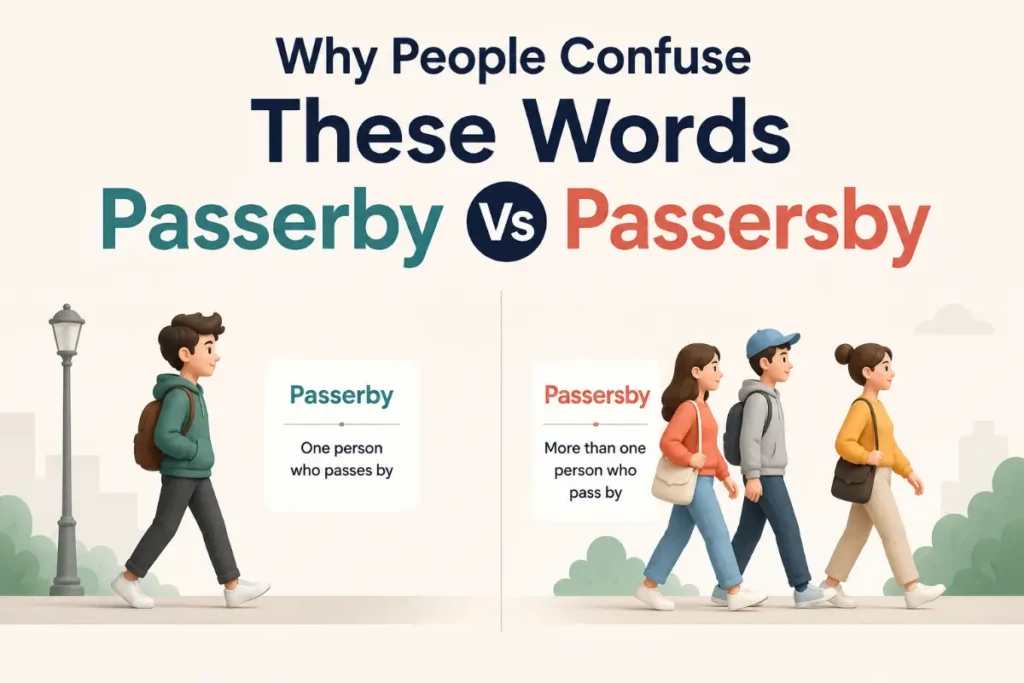
Use passerby for one person.
Use passersby for two or more people.
Never write passerbyers.
Examples.
✔ One passerby witnessed the accident.
✔ Three passersby stayed until the ambulance arrived.
✘ Three passerbyers stayed until the ambulance arrived.
Real Life Examples Of Passerby And Passersby
Seeing the words in real situations is the fastest way to remember them.
Daily Conversation
- A passerby smiled and pointed us toward the train station.
- Several passersby watched the street performer.
- The passersby applauded after the performance ended.
Workplace
- Security asked a passerby if they had seen the missing package.
- Passersby reported the broken traffic light to the city.
- A passerby informed the receptionist about the water leak.
- Several passersby gathered outside the office after hearing the alarm.
Emails
- A passerby found your wallet and turned it in at the front desk.
- According to several passersby the road was already closed before noon.
News Reports
- A passerby captured the event on a mobile phone.
- Police interviewed several passersby who witnessed the accident.
- Brave passersby rescued the driver before firefighters arrived.
- One passerby recognized the missing child from a news report.
Academic Writing
- Researchers interviewed passersby to understand pedestrian behavior.
- The survey included responses from passersby in the city center.
Literature
- A lonely passerby disappeared into the evening fog.
- Curious passersby paused to admire the old building.
Social Media
- A passerby filmed the surprise proposal.
- Passersby could not stop talking about the amazing street art.
These examples show the same pattern every time.
Use passerby for one person.
Use passersby for more than one person.
Spelling Rules
Unlike most English nouns, passerby follows the plural rule for compound nouns.
The noun inside the compound changes, not the final word.
Here are a few similar examples.
| Singular | Plural |
|---|---|
| Passerby | Passersby |
| Mother in law | Mothers in law |
| Father in law | Fathers in law |
| Attorney general | Attorneys general |
| Court martial | Courts martial |
These words may look unusual, but they all follow the same grammar pattern.
The main noun becomes plural.
The second word stays the same.
Word Origin And History
Knowing where the word came from makes the grammar much easier to understand.
The verb pass comes from Old French and originally meant to move from one place to another.
The ending er creates a noun that refers to a person performing an action.
Examples include.
- Teacher.
- Runner.
- Driver.
- Reader.
- Passer.
The word by acts as an adverb that describes movement past a place.
Over time, English combined passer and by into the compound noun passerby.
Because passer is still the main noun, the plural naturally became passersby.
The grammar has stayed the same for centuries.
British American Canadian And Australian English
There is no regional difference in the spelling of these words.
English speakers in the United States, the United Kingdom, Canada, Australia, and New Zealand all use the same forms.
Singular.
Passerby
Plural.
Passersby
No major dictionary or style guide accepts passerbyers.
This is one of those grammar rules that remains consistent across the English speaking world.
Common Mistakes
Many writers make the same errors.
Learning them now can save you from repeating them later.
Mistake One
Incorrect.
Several passerby watched the parade.
Correct.
Several passersby watched the parade.
The noun must become plural.
Mistake Two
Incorrect.
Two passerbyers reported the fire.
Correct.
Two passersby reported the fire.
Passerbyers is not an English word.
Mistake Three
Incorrect.
The passersby was interviewed.
Correct.
The passersby were interviewed.
Since passersby is plural, it needs a plural verb.
Mistake Four
Incorrect.
Every passersby received a warning.
Correct.
Every passerby received a warning.
The word every always takes a singular noun.
Easy Memory Tricks
A simple memory trick can prevent this mistake forever.
Think About The Noun
The person is the passer.
The word by only tells where the person is moving.
Since the noun is passer, make that part plural.
Passer.
Passers.
Passersby.
Compare It With Similar Words
Remember these pairs.
- Mother in law becomes mothers in law.
- Attorney general becomes attorneys general.
- Passerby becomes passersby.
The grammar pattern is exactly the same.
Ask Yourself One Question
Are you talking about one person or several people?
If the answer is one, write passerby.
If the answer is more than one, write passersby.
Never write passerbyers.
Related Words
Learning related vocabulary helps you understand the word more naturally.
Synonyms
- Pedestrian.
- Witness.
- Onlooker.
- Observer.
- Spectator.
- Bystander.
Related Expressions
- Walk past.
- Pass by.
- Happen to see.
- Chance witness.
- Casual observer.
Frequently Confused Words
- Bystander and passerby.
- Onlooker and observer.
- Pedestrian and passerby.
Although these words are similar, they are not always interchangeable.
A bystander is someone present at an event.
A passerby is someone simply passing through who may or may not stop.
Expert Editor’s Note
Professional editors, dictionary publishers, and style guides all agree on one point.
The singular form is passerby.
The plural form is passersby.
The word passerbyers does not appear in respected dictionaries because it is not part of standard English.
The confusion comes from treating passerby like an ordinary noun. It is actually a compound noun, so the plural changes the main noun instead of the last word.
If you’re writing an email, article, report, essay, or news story, always use passersby for more than one person. Native speakers immediately recognize it as the correct form.
Professional editors also recommend avoiding made up plurals such as passerbys and passerbyers. Using the correct plural makes your writing sound polished and trustworthy.
Frequently Asked Questions
Is Passersby The Correct Plural Of Passerby?
Yes. Passersby is the only correct plural of passerby. It follows the grammar rule for compound nouns, where the main noun becomes plural instead of the last word.
Is Passerbyers A Real Word?
No. Passerbyers is not recognized by standard English dictionaries or style guides. Avoid using it in both formal and informal writing.
Why Is It Passersby Instead Of Passerbys?
The noun is passer, while by is an adverb. English forms the plural by changing the noun, creating passersby instead of adding s to the end.
Can I Use Passerbys?
No. Passerbys is another common mistake. Although it looks logical, it does not follow the grammar rule for this compound noun. The correct plural is passersby.
Is Passersby Used In American And British English?
Yes. American English, British English, Canadian English, and Australian English all use passersby as the standard plural form.
What Is The Difference Between A Passerby And A Bystander?
A passerby is someone passing through an area. A bystander is someone present at an event, often watching what happens. A passerby may become a bystander after stopping to observe.
Is Passerby One Word Or Two Words?
Modern English treats passerby as one word. Most dictionaries and style guides write it as a single compound noun.
How Can I Remember The Correct Plural?
Think about the person doing the action. The passer is the noun, so it becomes passers. The word by never changes. That makes the correct plural passersby.
A related grammar guide is Feel Or Feal Which Spelling Is Correct 2026 Guide.
Conclusion
The answer is simple.
Use passerby when you mean one person.Use passersby when you mean more than one person.Never use passerbyers because it is not a correct English word.The unusual plural comes from the grammar of compound nouns. Once you know that passer is the main noun and by is only an adverb, the rule becomes easy to remember.
The next time you write about someone walking past or a group of people witnessing an event, you’ll know exactly which form belongs in your sentence. Good grammar often comes down to understanding one small rule, and this is one you’ll remember for years.

Senior Grammar Editor
Olivia Reynolds is a grammar editor and language writer who enjoys making complex English rules easy to understand. She specializes in grammar, punctuation, sentence structure, and everyday writing tips, helping readers write with greater confidence and clarity.